International Journal of Engineering
J o u r n a l H o m e p a g e : w w w . i j e . i rA Robust STATCOM Controller using Particle Swarm Optimization
S. Deepaa, S. Rajesh Babub*, M. Ranjanib
a Panimalar Institute of Technology, India
b Sathyabama University, India
P A P E R I N F O
Paper history: Received 14 May 2013
Received in revised form 09 July 2013 Accepted 07 November 2013
Keywords: Statcom PSO Fuzzy Voltage SAG Matrix Converter
A B S T R A C T
In this paper, a statcom without any energy storage devices is proposed to compensate network voltage during disturbances. This statcom utilizes a matrix converter in its topology which eliminates the DC-link capacitor of conventional statcom. The modulation method for matrix converter which is used in this paper is space vector modulation. There are some methods to improve power quality for sensitive loads. In this paper, Combination of improved multi objective Particle Swarm Optimization (PSO) algorithm with fuzzy membership function is used to determine the PI coefficients. The simulation results indicate the efficiency of proposed method.
doi:10.5829/idosi.ije.2014.27.05b.08
1. INTRODUCTION1
Power quality problems in industrial applications concern a wide range of disturbances such as voltage sags and swells, flicker, interruptions, harmonic distortion. Preventing such phenomena is particularly important because of the increasing heavy automation in almost all the industrial processes. Electronics devices hold substantial promise for making distributed energy applications more efficient and cost effective. There is a need to develop advanced power electronics interfaces for the distributed applications with increased functionality (such as improved power quality, voltage/volt-amperes reactive (VAR) support), compatibility (such as reduced distributed energy fault contributions), and flexibility (such as operation with various distributed energy sources) while reducing overall interconnection costs. The use of voltage source inverters is increasing [1]. They are used both for feeding power from distributed generators to the transmission grid and power to various types of electronic loads. In recent years, the number of different power resources connected to power systems (voltage
*Corresponding Author Email: [email protected] (S. Rajesh Babu)
grids) has increased and there has been a move toward connecting small power resources to the medium and low voltage network [2].
Power quality standards for connection of an inverter to the grid are still under development, since previously there have been a few similar high power applications. In [3], the power quality is determined by the voltage quality, when the voltage is a controlled variable. In order to deliver a good ac power the controlled pulse width modulation (PWM) inverter and L-C output filter have to convert a dc voltage source (e.g. batteries) to a sinusoidal ac voltage with low voltage THD and fast transient response under load disturbances. Another important aspect of power quality is harmonic distortion. General requirements for harmonic distortion can be found in standard [4] and particularly for connection of distributed resources to grid.
sampling rate possible for digitally-controlled inverters [6].
In the present paper, a new method based on Particle Swarm Optimization Algorithm and chaos theory is used to determine PI controller parameters efficiently. The optimization algorithm is inspired from birds swarm life. Multi-goal optimization with fuzzy membership function has also been used to improve THD and voltage sagindices. STATCOM functionality in presence of the whole range of network errors is examined to study and show the proposed algorithm efficiency. The results of proposed controller is compared with a mono goal method. STATCOM operation is introduced in section 2; multi-goal optimization with fuzzy membership function and improved PSO algorithm are discussed in sections 3 and 4, respectively. Section 5 introduces the proposed method of the paper, and the final section contains the simulation results.
2. STATCOM
The main function of a Statcom is voltage injection to compensate the voltage drop due to the voltage sagoccurrence. To do this, Statcom needs to exchange active and reactive power with the system. There are two types of Statcom in general: 1) STATCOM with no energy storage system, 2) STATCOM with energy storage system. Each type has two topologies: 1) supply-side-connected converter, and 2) load-side-connected converter.
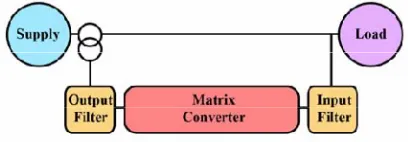
All of the mentioned topologies are compared in [4] and the no energy storage statcom topology with load-side-connected converter has been evaluated as the best one which is shown in Figure 1(a).
As there is no energy storage device in this topology, statcom needs a minimum system voltage to work properly and it may not be able to compensate very deep sags. However, the lack of energy storage device is a great economical advantage. Furthermore, most usual sags are within the range of STATCOM limits. The matrix converter based STATCOM in this paper is established on this topology which means a STATCOM with no energy storage and load-side connected converter.
According to Figure 1(a), two converters are replaced by a matrix converter and the DC-link capacitor is removed. Figure 1(b) shows the resultant STATCOM system. The input voltage of matrix converter comes from the load and the output of matrix converter is connected to an injection transformer. Matrix converter controls the required compensation voltage and injects that voltage through the transformer. To reduce harmonics, both input and output of matrix converter are supplied with filters. There is no energy storage device and the energy is taken from the grid.
Figure 1(a). General Type of statcom with no energy storage and load-side-connected converter
Figure 1(b). Matrix converter based STATCOM
3. MULTI-OBJECTIVE OPTIMIZATION WITH
FUNCTION OF FUZZY MEMBERSHIP
Several methods have proposed so far for reaching to optimal solution of multi objective optimization problems. Many multi-objective optimization problems don’t have homogeneous objectives. Therefore, we should use special methods for solving them or making them homogeneous. One of these methods is defining each objective in the form of membership function in fuzzy set environment and combining those using appropriate weighting coefficients in the form of a satisfactory fuzzy objective function [7]. In case of using this method for optimizing the objectives of THD and sagvoltage, we can use the objective function of Equation (1):
D T
F = w1m +w2m (1)
3. 1. Voltage Sag Membership Function In voltage sag, it is tried to minimize difference between base bus voltage and real bus voltage. This voltage sag is caused from system faults. The voltage errors obtain as Equation (2).
l
b v
v Max
D = - (2)
where, vb is base bus voltage of sensitive load, vl is
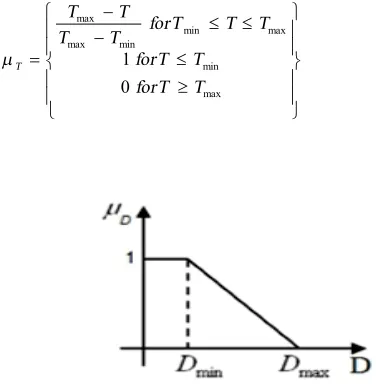
sensitive load voltage. If the maximum bus voltage sag decreases, it takes more satisfier value and vice versa. According to IEEE-519 standard, bus voltage can have any value between 0.95 and 1.05. In this paper, we considered Dmin=0 and Dmax=0.05. The membership function is specified in Equation (3) and Figure 2.
ï ï þ ï ï ý ü ï ï î ï ï í ì ³ £ £ £ -= max min max min min max max 0 1 D forD D forD D D forD D D D D D m (3)
3. 2. Voltage THD Membership Function The
THD may cause irreversible effects on the sensitive load. Thus, voltage harmonic minimization can be an attractive objective. THD index is intended to determine the harmonic distortion that the membership function is specified in Equation (4) and Figure 3.
ï ï þ ï ï ý ü ï ï î ï ï í ì ³ £ £ £ -= max min max min min max max 0 1 T forT T forT T T forT T T T T T m (4)
Figure 2. Voltage Sag Membership Function
Figure 3. Voltage THD Membership Function
4. PARTICLE SWARM OPTIMIZATION
ALGORITHM
The particle swarm optimization algorithm (PSO) has been used for the first time in 1995, by Eberhart and Kennedy [8]. This algorithm tries to access optimal solution by inspired the social behavior of animals such as flying birds or community of fish that searching for food. A community includes a number of particles (people) that can be the candidate solution for the optimization problem and the particles over time are moving toward the optimal solution. Like other population based algorithms particle, initial values are randomly generated [9]. Particles are randomly distributed in a n dimensional space and the position of each particle defined by the various components [10]. The answer is depending on the particle position and velocity. In N-dimensional space position and velocity vectors of each particle's, respectively determined by the Equations (5) and (6):
[
o]
n i o i o i o
i P P P
X = ,1, ,2, , (5)
[
o]
n i o i o i o
i V V V
V = ,1, ,2, , (6)
In Kth iteration, the best position of particles nominated as variable Xk Pbest, i and the best position in the previous iterations determined as Xk Gbest, I. The velocity and position of each particle updates over time, using Equations (7) and (8) [11].
(
)
(
k)
i k i Gbest k i k i Pbest K i K
i V R X X R X X
V + = + - +
-, 2 2 , 1 1
1 w a a (7)
1
1 +
+ = + k
i k i k
i X V
X (8)
The constants are known as (Learning coefficients) determine the effects of intelligent factors in the particle's velocity in the articles are initializing in the different ways [12-14]. The constants a1 and a2 are to determine how the ith particle’s best result and the complex intelligence of the group (the best result achieved by the group of particles) affect velocity, respectively. In this paper, we have decided to set these constant values at the beginning of the search process in a way that the values of C1 and C2 are 2 and 0, respectively. During the search process, C1 experiences a linear decrease but C2 increases linearly and at the end, they reach to the values of 0 and 2, respectively. At the beginning of the algorithm, constant A which affects the mean time velocity by the former velocity is set to 1 and with a linear decrease drops to 0 at the end of the search process.
5. ACCELERATED PSO
accelerated PSO has attracted much attention. The standard particle swarm optimization uses both the current global best (Gbest) and the individual best (Pbest). The reason of using the individual best is primarily to increase the diversity in the quality solution. However, this diversity can be simulated using the randomness [15]. Subsequently, there is no compelling reason for using the individual best. In a simplified version, which is able to accelerate the convergence of this algorithm, only using the best group experience is recommended. It is necessary for implementing this method that the velocity vector will produce according to Equation (9)
) (
) 5 . 0 (
1
i best t
i k
i V G X
V + = +a e - +b - (9)
where, “
e
” is a random variable6. CHAOTIC PSO
In order to avoid early convergence of standard PSO algorithm and converge to local minimum, use of the random and irregular properties of chaos generator is proposed. With this act, particular search area will cover all mentioned environment. In this paper, we used chaos generator to determine the inertia coefficient. To achieve this goal, chaos generator multiplied to previous inertia coefficient [16] and updated inertia coefficient can be calculated from Equations (10) and (11):
) 1 (
. k1. k
k f f
f =m - - (10)
w
wnew= f. (11)
From Equation (10), μ is control parameter that adjusts changes in chaos generator between the interval [0, 4]. It should be noted that due to the sensitivity of the chaos generator to initial value, values cannot be selected from specified number in Equation (12):
}
{
0,0.25,0.5,0.75,1Ï
o
f (12)
In this paper, we assumes μ = 4 and f = 0.1.
7. PROPOSED METHOD
By notice to standard PSO algorithm, it can be find out the effect of population number over this algorithm. On the other word, low numbers of population is caused to stick in local optimum and high numbers of population is caused to decline algorithm velocity. Therefore, standard PSO algorithm isn’t profit for solving multi objective optimization problems. In this paper, combination of chaotic theory with acceleration PSO is used. A powerful PSO based phase advancement compensation strategy is developed for optimizing the
energy storage capacity of the STATCOM in order to enhance the voltage restoration property of the device.
7. 1. Objective Function The proposed work aims
at minimizing the objective function designed to optimize energy injection from the energy storage element of the STATCOM such as a capacitor or a battery. The mathematical model is changed to the following generalized objective function which is [6] given as,
Minimize PSTATCOM = Pout - Pin
where, PSTATCOM is the real power supplied by the STATCOM, Pout and Pin, are the input power from the source and the load power, respectively.
Subject to Load voltage advance angle constraint, in which load voltage advance angle (α) during each compensation strategy should be within the permissible range : 0≤=α≤180
7. 2. A1gorithm of the Proposed Method:
1. Input the parameters of the system such as three phase voltage magnitude and angles, supply side voltage angle (δ), time duration of voltage sag, load side power factor angle (Ф) and number of iterations.
2. Specify the lower and upper boundaries of load voltage advance angle (α).
3. Initialize iteration loop, particle position and the particle velocity.
4. Calculate the input power flow of each phase (Pin1, Pin2, and Pin3). The total power flow (Tp) and the power from STATCOM (PSTATCOM) for each particle.
5. Compare each particles evaluation value. PStatcom, with its pbest. The best evaluation value among the pbest is denoted as gbest.
6. Update the inertia weight W
7. Modify the velocity V of each particle If V>Vmax then V = Vmax
If V<Vmin then V= Vmin
8. Modify the position of each particle. If a particle violates its position limits in any dimension, set its position at the proper limit.
9. Each particle is evaluated according to its updated position. If the evaluation value of each particle is better than the previous pbest, the current value is set to be pbest. If the best pbest is better than gbest, the value is set to be gbest.
10. If the stopping criteria are satisfied, then go to Step 12.
11. Otherwise, go to Step 4.
8. SIMULATION RESULTS
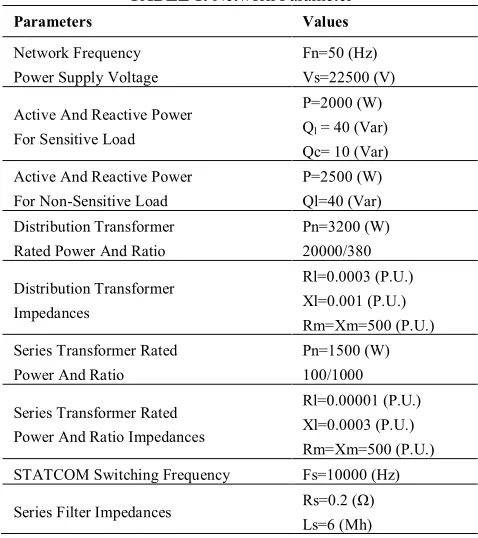
The power distribution system case study consists of two voltage buses which one of them includes sensitive load. The simple schematic of electrical network is shown in Figure 4 and its parameters introduced in Table 1.
The distractive effect of fault increases by decreasing distance between event locations to sensitive load. To simulation of more critical conditions, two faults are simulated. The first fault is occurred just after series injection transformer and the second one is occurred in near of non-sensitive load. The first short circuit fault occurs in phase B and the other short circuit fault is between phases A and B. Fault properties are shown in Table 2. At beginning, the single objective optimization problem has been solved for minimizing voltage sag by PSO. The simulation results have been obtained with 200 runs while considering 150 particles. The results indicate improvement in the voltage SAG, but in terms of harmonic index (THD) the expectations were not satisfied.
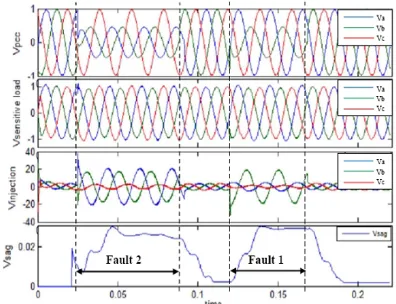
Figure 5 shows voltage signals at PCC, sensitive load voltage, injected voltage from STATCOM and sensitive load voltage deviation from the base voltage, respectively. Under fault conditions at first, each objective of problem has been turned into a fuzzy membership function to solve the problem of optimization.
In solving process, each objective has the same weight and coefficients are w1=w2=0.5. We used improved PSO with chaotic generator to assuring not to entangle the problem results in the local optimization. Firstly, this problem has been solved using standard PSO algorithm with 200 iterations and 150 particles. Next time, it has been solved using the proposed algorithm with the same number of iterations and particles. The obtained results from these two algorithms have been shown in Table 3.
Figure 4. Schematic diagram of Power distribution system
TABLE 1. Network Parameter
Parameters Values
Network Frequency Power Supply Voltage
Fn=50 (Hz) Vs=22500 (V)
Active And Reactive Power For Sensitive Load
P=2000 (W) Ql = 40 (Var) Qc= 10 (Var) Active And Reactive Power
For Non-Sensitive Load
P=2500 (W) Ql=40 (Var) Distribution Transformer
Rated Power And Ratio
Pn=3200 (W) 20000/380
Distribution Transformer Impedances
Rl=0.0003 (P.U.) Xl=0.001 (P.U.) Rm=Xm=500 (P.U.) Series Transformer Rated
Power And Ratio
Pn=1500 (W) 100/1000
Series Transformer Rated Power And Ratio Impedances
Rl=0.00001 (P.U.) Xl=0.0003 (P.U.) Rm=Xm=500 (P.U.) STATCOM Switching Frequency Fs=10000 (Hz)
Series Filter Impedances Rs=0.2 (Ω) Ls=6 (Mh)
TABLE 2. Fault parameters
Fault Point
Fault Period
Fault Resistance
Earth Resistance Fault 1 B [ 0.12,0.16] 4.6(Ω) 0.1(Ω)
Fault 2 A,B [0.025,0.085] 4.6(Ω) 0.1(Ω)
TABLE 3.The different indices in both algorithms
Methods Employed Min Max Average Standard PSO -0.5747 -0.5361 -0.5602
Proposed PSO -0.583 -0.5693 -0.5749
Table 3 shows, maximum, minimum, and average indices of fitness function for both algorithms for an equal number of iteration. It is clear that proposed algorithm has lower average and better responses in comparison with the standard PSO. It should be note that in order to maximize the fitness function mentioned in Equation (1), its negative is minimized. The convergence curve of the best response of proposed algorithm is shown in Figure 6. According to this figure, proposed algorithm reaches to an acceptable response in a few iterations. The algorithm of this problem has been solved by 200 run and 150 particles. The simulation results of PCC voltage, sensitive load voltage, injected STATCOM voltage and the sensitive load voltage deviation from its reference value are shown in the Figure 7. Improvement in THD signal and deviation signal of baseline voltage coming from network faults in algorithm are to be scrutinized. As we can see, in the whole time of simulation the requirements of IEEE-519 standard have been considered. The result has been shown in Table 4.
Figure 6. The best convergence curve of proposed algorithm
Figure 7. Voltage at PCC, the sensitive load voltage, injected voltage from STATCOM and the sensitive load voltage deviation Signal from the base voltage in multi objective case
TABLE 4. Comparison of results
Parameters Single Objective Multi Objective
THD (%) 3.27 0.66
Max Voltage SAG(%) 3.31 3.01
9. CONCLUSION
The modeling and simulation of a STATCOM using MATLAB/SIMLINK has been presented. The simulation results showed clearly the performance of the STATCOM in mitigating voltage sags. The STATCOM injected the appropriate voltage component to correct rapidly any anomaly in the supply voltage to keep the load voltage balanced and constant at the nominal value. The efficiency and the effectiveness in voltage sags compensation showed by the STATCOM makes it an interesting power quality device compared to other custom power devices. The simulation results show that the developed control technique with proposed single phase STATCOM was simple and efficient. As the results indicate, using suitable algorithm which control the STATCOM, we can make a stable voltage with low THD for electricity consumers.
10. REFERENCES
1. Milanovic, J. V. and Zhang, Y., "Global minimization of financial losses due to voltage sags with FACTS based devices",
Power Delivery, IEEE Transactions on, Vol. 25, No. 1, (2010), 298-306.
2. Quality, I. P., "IEEE recommended practice for monitoring electric power quality", IEEE Recommended Practice For Monitoring Electric Power Quality, (1995).
3. Zhou, H., Wei, T. z., Zhao, Y. l. and Z. p Qi, "Study on Dynamic Matrix Predictive Control of single-phase STATCOM", in Third International Conference on Electric Utility Deregulation and Restructuring and Power Technologies, Nanjing China., (2008), 2136-2140.
4. Kumar, G. V. N. and Chowdary, D. D., "STATCOM with Sliding Mode Control to alleviate Voltage Sags on a Distribution System for Three Phase Short Circuit Fault," in Third International Conference on Industrial and Information Systems, Kharagpur INDIA, (2008), 1-4.
5. Sensarma, P., Padiyar, K. and Ramanarayanan, V., "Analysis and performance evaluation of a distribution STATCOM for compensating voltage fluctuations", Power Delivery, IEEE Transactions on, Vol. 16, No. 2, (2001), 259-264.
6. Ramachandaramurthy, V., Arulampalam, A., Fitzer, C., Zhan, C., Barnes, M., and Jenkins ,N., "Supervisory control of dynamic voltage restorers", in Generation, Transmission and Distribution, IEE Proceedings-, IET. Vol. 151, (2004), 509-516. 7. Das, D., "Optimal placement of capacitors in radial distribution
system using a Fuzzy-GA method", International Journal of Electrical Power & Energy Systems, Vol. 30, No. 6, (2008), 361-367.
9. Dashti, M., Shojaee, K., Seyedkashi, S. and Behnam, M., "Tuning of digital PID controller using particle swarm optimization", in Control Conference (CCC), 29th Chinese, IEEE. (2010), 3383-3389.
10. Ramezani, M., Haghifam, M., Singh, C., Seifi, H. and Moghaddam, M. P., "Determination of capacity benefit margin in multiarea power systems using particle swarm optimization",
Power Systems, IEEE Transactions on, Vol. 24, No. 2, (2009), 631-641.
11. Park, J.-B., Lee, K.-S., Shin, J.-R. and Lee, K. Y., "A particle swarm optimization for economic dispatch with nonsmooth cost functions", Power Systems, IEEE Transactions on, Vol. 20, No. 1, (2005), 34-42.
12. Zhao, F.-Q., Zhang, Q.-Y. and Yang, Y.-H" A hybrid self- ,. adaptive PSO algorithm and its applications for partner selection in holonic manufacturing system (HMS)", in Machine Learning
and Cybernetics, 2006 International Conference on, IEEE., (2006), 2536-2541.
13. Franken, N. and Engelbrecht, A. P., "Particle Swarm Optimization Approaches to Coevolve Strategies for the Iterated Prisoner’s Dilemma", IEEE Transactions on Evolutionary Computation, (2005), 562-579.
14. Abdelhalim, M., Salama, A. and Habib, S.-D., "Hardware software partitioning using particle swarm optimization technique", in System-on-Chip for Real-Time Applications, The 6th International Workshop on, IEEE. (2006), 189-194. 15. Yang, X.-S., "Introduction to mathematical optimization: from
linear programming to metaheuristics, Cambridge International Science Publishing, (2008)
A Robust STATCOM Controller using Particle Swarm Optimization
S. Deepaa, S. Rajesh Babub, M. Ranjanib
a Panimalar Institute of Technology, India
b Sathyabama University, India
P A P E R I N F O
Paper history: Received 14 May 2013
Received in revised form 09 July 2013 Accepted 07 November 2013
Keywords: Statcom PSO Fuzzy Voltage Sag Matrix Converter
هﺪﯿﮑﭼ
ﮏﯾﻪﻟﺎﻘﻣﻦﯾارد
مﺎﮑﺗﺎﺘﺳا
ﺖﺳاهﺪﺷدﺎﻬﻨﺸﯿﭘﻊﯾزﻮﺗلﻮﻃردﻪﮑﺒﺷژﺎﺘﻟوناﺮﺒﺟياﺮﺑيژﺮﻧاهﺮﯿﺧذﻪﻠﯿﺳوﭻﯿﻫنوﺪﺑ،
.
ﻦﯾا
مﺎﮑﺗﺎﺘﺳا
ﯽﻃﺎﺒﺗرانزﺎﺧﻪﮐﺲﯾﺮﺗﺎﻣهﺪﻨﻨﮐﻞﯾﺪﺒﺗﮏﯾزا
DC
مﺎﮑﺗﺎﺘﺳا
شدﻮﺧﯽﯾﺎﻤﻧﺎﺟردﺪﻨﮐﯽﻣفﺬﺣارﯽﺘﻨﺳوﺞﯾار
ﺪﻨﮐﯽﻣهدﺎﻔﺘﺳا
.
ﯽﯾﺎﻀﻓرادﺮﺑيزﺎﺳلوﺪﻣ،دﻮﺷﯽﻣهدﺎﻔﺘﺳاﻪﻟﺎﻘﻣﻦﯾاردﻪﮐﺲﯾﺮﺗﺎﻣهﺪﻨﻨﮐﻞﯾﺪﺒﺗياﺮﺑيزﺎﺳلوﺪﻣشور
ﺖﺳا
.
دراددﻮﺟوسﺎﺴﺣيﺎﻫيراﺬﮔرﺎﺑياﺮﺑناﻮﺗﺖﯿﻔﯿﮐدﻮﺒﻬﺑياﺮﺑﯽﯾﺎﻫشور
.
ﻬﺑﻢﺘﯾرﻮﮕﻟازاﯽﺒﯿﮐﺮﺗ،ﻪﻟﺎﻘﻣﻦﯾارد
ﻪﻨﯿ
ياهرذمﺎﺣدزايزﺎﺳ
(PSO)
ﺐﯾاﺮﺿﻦﯿﯿﻌﺗياﺮﺑيزﺎﻓﺖﯾﻮﻀﻋﻊﺑﺎﺗﺎﺑهاﺮﻤﻫﻪﺘﻓﺎﯾدﻮﺒﻬﺑهرﻮﻈﻨﻣﺪﻨﭼ
PI
هﺪﺷهدﺎﻔﺘﺳا
ﺖﺳا
.
ﺪﻫدﯽﻣنﺎﺸﻧاريدﺎﻬﻨﺸﯿﭘشورهدزﺎﺑهﺪﺷيزﺎﺳﻪﯿﺒﺷﺞﯾﺎﺘﻧ
.
.
doi:10.5829/idosi.ije.2014.27.05b.08