unit
9
State
Your Case
argument and
persuasion
• In Nonfiction
• In Media
• In Literature
9
unit
Share What You Know
Whom can you
believe
?
As soon as you wake up in the morning, you’re surrounded by people, groups, and corporations trying to influence the way you think or act. To persuade you to buy a brand of shoes, a company runs an ad showing a great athlete wearing the same pair as he sinks a jump shot. To encourage you to sell T-shirts for a fundraiser, the class president starts the morning announcements by offering a prize to the student who sells the most. Meanwhile, a friend begs you to work with her instead of with your usual partner. How can you be sure you’re doing what’s best for you?
ACTIVITY Think about a time when an advertisement persuaded you to buy a product. What influenced your decision to believe that company’s claims? Consider the following questions:
• Were you familiar with that company’s products?
• What did the advertisement tell you that you did not hear from competing companies’ ads?
• Did the company use celebrity endorsements, statistics, or other persuasive techniques to convince you to buy its product?
86A>;DGC>6
Preview Unit Goals
Included in this unit: R1.2, R1.3, R2.2, R2.3, R2.7, R3.7, LS2.4, LC1.2, LC1.5, LS1.4, LS1.5, LS1.7, LS1.8, LS1.9, W1.2, W1.3, W2.4
c l a s s z o n e . c om
l i t e r a t u r e Literature and Reading Center Writing Center
Vocabulary and Spelling Center
reading
• Identify and analyze proposition and support patterns• Identify and analyze persuasive techniques
• Analyze the effectiveness of persuasive techniques
• Distinguish between and evaluate facts and opinions
• Identify and analyze author’s purpose
• Identify and analyze comparisons and contrasts
• Identify and analyze the historical context of a text
• Identify and analyze tone
writing and
grammar
• Write a persuasive essay
• Use parallelism to link related ideas
• Capitalize names correctly
speaking,
listening,
and viewing
• Analyze and evaluate an ad campaign
• Recognize persuasive techniques in media messages
• Deliver a persuasive speech
vocabulary
• Use knowledge of word roots, base words, and affixesto help determine word meaning
• Use antonyms as context clues to determine word meaning
academic
vocabulary
• argument • fact and opinion • historical context
• tone • author’s purpose • persuasive techniques
• proposition • strawman
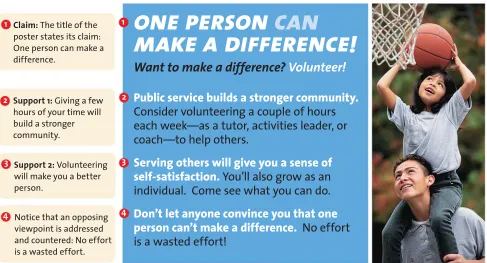
Claim: The title of the poster states its claim: One person can make a difference.
Argument and Persuasion
Persuasive messages are everywhere—on buses and billboards, on television and the Web, even on cereal boxes and candy wrappers. Using direct or subtle techniques, these messages tell you what to wear, what to buy, and what to think. How can you sift through all the pitches, claims, and pizzazz, and make sure you figure out what’s really important? In this workshop, you’ll learn how to separate the substance of these messages from what’s simply a sugar coating.
Part 1: Elements of an Argument
The word argument doesn’t always refer to two people having a disagreement. In formal speaking and writing, an argument is a claim supported by reasons and evidence. Sound arguments appeal to logic, not to emotions. A strong argument
• presents a claim, or the writer’s position on a problem or an issue. The claim might be stated directly (“Vitamins are good for you.”) or indirectly (“Take your vitamins—feel the difference.”). The claim often appears in the introduction, conclusion, or title of an argument.
• provides support, or the reasons and evidence that back up the claim. Support can include facts, statistics, examples, and quotations from experts.
• anticipates what people with the opposing viewpoint might say and counters their objections by offering further evidence to support the claim.
Look closely at the elements of an argument in this poster.
Support 1: Giving a few hours of your time will build a stronger community.
Support 2: Volunteering will make you a better person.
Notice that an opposing viewpoint is addressed and countered: No effort is a wasted effort. 4
3 2
one person
can
make a difference!
Want to make a difference?
Volunteer!
Public service builds a stronger community.
Consider volunteering a couple of hours
each week—as a tutor, activities leader, or
coach—to help others.
Serving others will give you a sense of
self-satisfaction.
You’ll also grow as an
individual. Come see what you can do.
Don’t let anyone convince you that one
person can’t make a difference.
No effort
is a wasted effort!
1
926 unit 9: argument and persuasion
4 3 2 1
Reader’s
Workshop
unit
9
86A>;DGC>6
R2.3Find similarities and differences between texts in the treatment,
model: elements of an argument
The author of this essay makes a case against junk food by focusing on one example. As you read this excerpt, try to identify the author’s claim. What reasons and evidence does he provide as support for his position?
So what’s so bad about stuffing yourself with nothing but French fries all the time, anyway? Simple: Pretty soon you’ll be missing important nutrients. Let’s start with vitamins. The body does not need much of them, but in most cases, it cannot produce them. Potatoes contain mostly vitamin C and hardly any other vitamin. No vitamin K, for example, which is needed to form a scab when you’re bleeding so that the bleeding stops. And no vitamin A, needed for the eyes to function properly. Not enough vitamin A, and you’ll see even less well at night than everyone else. Over the long run, a lack of vitamin A can even cause blindness. Many children in Africa suffer from it.
If you were to eat only French fries, your teeth would also slowly go bad and your bones would become brittle. That’s because potatoes do not contain enough calcium, and your bones need calcium throughout your life, not just while you’re growing. Besides, all those mountains of fries would overload you with sodium, because they’re often too salty, and salt contains sodium. It’s important that your body maintain a good sodium balance, because otherwise, it can’t regulate its body temperature very well, but too much sodium causes high blood pressure in some people.
French fries also contain little protein. Proteins are critical. They are the true bearers of life. The cells from which most living creatures are built consist mostly of proteins. Without proteins, for example, you would not have any muscles. . . .
We chemists and doctors still know far too little about nutrition and its effects on health. This is why every person has to find out for him- or herself what’s good for each. But one thing I can guarantee: You’ll get into trouble if you always eat nothing but French fries. By the way, I myself would love to wolf down French fries every day. But I, too, have to restrain myself and should stick to the advice that I’ve given you here.
5
10
15
20
25
Close Read
1. Reread the title and lines 1–2. What is the author’s claim?
2. In the boxed lines, the author explains that a person needs vitamins that are not found in French fries. What examples does he use to support this reason?
3. In lines 10–21, the author offers three other reasons to support his claim. Restate these reasons in your own words.
4. What does the author do in the last paragraph to strengthen his argument? Essay by Richard J. Roberts
reader’s workshop 927
from
Why Can’t I Live on
French Fries?
Part
2
: The Power of Persuasion
Who can ignore the pleading expression on the face of a starving child or a description of an injured animal whose survival depends on you? Effective writers, speakers, and advertisers know how to pull your heartstrings. They try to influence your feelings and actions using persuasive techniques, such as the ones shown here. While these techniques can enhance strong arguments, they can also mask the flaws in weak ones. That’s why it’s important for you to recognize these techniques for what they are. Use this chart as a guide.
928 unit 9: argument and persuasion
Emotional Appeals
Word Choice Appeal to Values
persuasive techni
q
ues ex amples
Appeals by Association
Bandwagon Appeal
Taps into people’s desire to belong
Snob Appeal
Taps into people’s need to feel superior to others
Testimonial
Relies on the backing of a celebrity, an expert, or a satisfied customer
Transfer
Connects a product, a candidate, or a cause with a positive image or idea
Millions of teens have made City Jeanz part their wardrobe. What are you waiting for?
Join the Brookside Club for Seasoned Skiiers —because you’re way beyond the beginner slopes.
As a supermodel, it’s important for me to have a great smile. Brite Strips whiten your teeth without the wait.
Vote for cleaner air. Vote for Tony Leonard.
Ethical Appeal
Tries to gain moral support for a claim by linking the claim to a widely accepted value
If you believe that every child deserves a good education, support the Great Minds Organization.
Appeal to Fear
Makes people feel as if their safety, security, or health is in danger
Appeal to Pity
Taps into people’s compassion for others
How clean are the hotel rooms you’re staying in? You’ll be shocked by what our documentary reveals.
For the cost of one cup of coffee a day, you could save a life.
Loaded Language
Uses words with strongly positive or negative connotations to stir people’s emotions
Reader’s Workshop
model 1: persuasion in text
This article challenges the positive concept of competition. What techniques does the author use to persuade you to adopt her position?
Newspaper article by Gayle Heaney
from
Our society uses sports metaphors for almost every aspect of life: Gear up, go for the goal, score one for the team! But studies show that the competitive spirit we admire can also have negative effects on a person—especially if the pressure to compete is instilled at a young age.
Young children often place excessive value on how they perform and can be emotionally devastated if they fail. Consider, for example, if a boy feels pressured to succeed in a particular sport. If he is unable to improve his skills, his self-esteem will disintegrate. If anyone criticizes his performance, he magnifies the criticism and views himself as a failure in everything.
In adults, competition can cause a person’s stress levels to skyrocket. High stress levels can have damaging and dangerous consequences because they often lead to high blood pressure or to uncontrollable outbursts of anger. Road rage is turning our nation’s highways into battlefields. Sports events often turn into violent fistfights, either on the field or in the crowd. Is this the kind of behavior we should be modeling for our children?
model 2: persuasion in advertising
Persuasion is a key factor in the advertisements you see on television, in magazines, and on product packaging. What techniques do you notice in this promotional poster?
Close Read
1. Notice the highlighted examples of loaded language in the boxed sentence. Find two other examples of loaded language.
2. Reread lines 10–15. Which type of emotional appeal is the author using?
Against
Competition
Close Read
1. Which type of appeal by association does this poster use?
2. Describe the intended effect of the poster on readers.
5
10
15
ANNUAL SPORTS CHALLENGE:
June 20–26
Do
you
have what it takes
to be a champion? Let us show you.
reader’s workshop 929
“i didn’t have the nerve to try out for the soccer team last year. but the sports challenge
program helped me build my skills in a fun, challenging environment. now i have the confidence i need to compete—and succeed.”
NO!
Part
3
: Analyze the Texts
Now you’ll apply what you’ve learned in this workshop as you analyze two texts—an editorial and a poster. Both texts are about the legal driving age. As you read each text, try to identify the claim, the support, and any persuasive techniques that are used.
If your neighbor robs a bank, should you go to jail? No. If your classmate gets in an accident, should your driver’s license be taken away? Of course not. Neither situation is fair. Raising the driving age will punish all young drivers for the mistakes of a few of their peers.
In this country we live by the principle of innocent until proven guilty. Those who want to raise the driving age have labeled teens guilty before they’ve gotten in an accident or before they’ve even stepped into a car. They believe that just because of your birth date, you are dangerous and must be punished by having your ability to drive taken from you.
Those who favor raising the driving age say that statistics show teenagers are more likely to get into accidents than adults. What they don’t say is that statistics also show that men of all ages are 77 percent more likely to kill someone while driving than women. If people want to save lives by raising the driving age, then how about saving lives by allowing only women to drive?
Except raising the driving age won’t save lives. Studies show that it is inexperience, not age, that causes accidents. Raising the driving age will just create inexperienced, accident-prone drivers at 18 instead of 16.
Teens need the ability to drive just as much as anyone else—to get to school, to get to work, to get to sports or band practice, or just to go out with their friends. Cars are necessary for mobility in this country. Taking that away is a large disruption to the lives of teenagers—for no good reason.
5
10
15
20
Editorial by Alex Koroknay-Palicz National Youth Rights Association
Should the Driving Age
Be Raised to 18?
Close Read
1. The title tells you which side of the issue the author falls on, but the claim of his argument is stated in the first paragraph. What is the author’s claim?
2. What reasons and evidence does the author provide as support for his claim?
3. The author presents an opposing viewpoint in the boxed lines. In your own words, restate his response to this opposition.
Reader’s Workshop
Close Read
1. Examine the text and photograph used in this ad. What emotional appeal is being used?
2. In what way does this ad use the technique of transfer?
3. Both the editorial and the public-service poster present a position on whether the legal age for driving a car should be raised, but they do so very differently. Identify two major differences in their treatment of the issue.
The creators of this public-service poster offer a different viewpoint on the same issue. What techniques are used to get you to see their side?
Support Bill 543 to raise the driving age
and cut down on needless accidents.
How many more teens need to suffer before we admit that we are putting them behind the wheel too soon? And who’s to say you
won’t be the next victim of an inexperienced teenage driver?
Zoos: Myth and Reality
Online Article by Rob LaidlawZoos Connect Us to the Natural World
Opinion Piece by Michael HutchinsShould
wildlife
stay wild?
KEY IDEA Close your eyes and picture an elephant. Are you picturing it in the zoo or in the wild? As humans inhabit more and more of the earth’s land, some species of wildlife are more likely to be found in captivity than in their natural habitat. But is this a good thing? The writers of the selections you’re about to read have different views on whether or not zoos are good for humans and animals.
LIST IT With a group, make a list of the good things and bad things about zoos. Do the pros outnumber the cons, or vice versa? Tell whether you think zoos are a good idea.
Pros Cons
1. They keep animals safe. 2.
1. 2.
932
86A>;DGC>6 R2.2Analyze text that uses
proposition and support patterns. Also included in this lesson: R1.2 (p. 942), LC1.5 (p. 943)
Michael Hutchins born 1951 Rob Laidlaw
born 1959
elements of nonfiction: proposition and support
As you just learned, effective arguments deliver a claim, support, and a counterargument. Now you will learn two ways in which writers arrange these elements to make their arguments even stronger.
• Proposition and Support The writer presents a proposition— a claim that recommends a policy—and two or three reasons for accepting the policy. For instance, “Cigarette smoking should be banned in public places because it’s bad for people’s health and smelly.” Then the writer supports each reason with evidence.
• Strawman The writer presents a proposition. Instead of supporting it, however, he or she sums up the other side’s position and disproves it. Once that “strawman” has been defeated, the writer declares his or her proposition the best or only option.
Keep these patterns in mind as you read the next selections.
reading skill: distinguish fact and opinion
To decide if an argument is convincing, you need to be able to tell the difference between a statement of fact and a writer’s opinion. A fact is a statement that can be proved by personal observation, a reliable source, or talking with an expert. An opinion is a statement of personal belief, feeling, or thought. As such, an opinion does not require proof. As you read each selection, list three facts and three opinions.
vocabulary in context
See how many of the following words you know. Match each to the word or phrase that is closest to its meaning.
word list
counterpart deprivation progressiveness
exploit devious languish propaganda sterile
1. unusual 4. uselessness 7. a lack of
2. corresponding
position
5. biased
information
8. use for selfi sh
reasons
3. stark 6. weaken
Rob Laidlaw: Wildlife Guardian
Rob Laidlaw has dedicated himself to improving the conditions of animals in captivity. He is co-founder and Executive Director of Zoocheck Canada, an animal protection charity. Laidlaw has inspected close to 1,000 zoos, circuses,
and wildlife displays throughout Canada and the United States. He has worked with Canada’s government on establishing standards for zoos. Laidlaw also worked on developing a humane stray dog program, and he investigated Canada’s role in the international pet reptile trade. Laidlaw shares his knowledge about animals through writing. He has published articles about all kinds of wildlife, from wild horses and polar bears to the red-eared slider and the black rhino.
Michael Hutchins: Animal Caretaker
As the executive director of The Wildlife Society, Michael Hutchins has traveled to more than 33 countries. His efforts have involved trapping and tagging mountain goats in the Olympic Mountains, scuba diving with manta
rays, and tracking jaguars. He has published many articles, books, and reports on the relationships between animals and their environments and on conservation.
m o r e a b o u t t h e a u t h o r
For more on Rob Laidlaw and Michael Hutchins, visit the Literature Center at ClassZone.com.
933
a PROPOSITION AN D SU PPORT
In defense of themselves, what three benefits do many zoos say they offer? If Laidlaw is using the strawman method to make his case, he will focus on disproving what zoos say they offer. As you read on, see if he does that. propaganda
(prJpQE-gBnPdE) n.
information that supports a certain cause
deprivation
(dDpQrE-vAPshEn) n. the condition of not having one’s needs met; a lack of
A N A LYZ E V I S UA L S
If you were to assign human qualities to this polar bear, what would they be?
In recent years, zoos have become the target of intense public scrutiny and criticism. In response, many have tried to repackage themselves as institutions devoted to wildlife conservation, public education, and animal welfare. But most zoos fail to live up to their own propaganda
and vast numbers of zoo animals continue to endure lives of misery and
deprivation. a
Nearly every zoo, from the smallest amateur operation to the largest professional facilities, claims to be making important contributions to conservation, usually through participation in endangered species captive propagation initiatives and public education programming. The zoo world buzzword1 of the moment is “conservation.”
Yet, with an estimated 10,000 organized zoos worldwide, representing tens of thousands of human workers and billions of dollars in operating budgets, only a tiny percentage allocate the resources necessary to
10
Rob Laidlaw
Zoos:
1. buzzword: a word or phrase connected with a specialized field or group that sounds important or technical and is usually used to impress those outside the group.
Myth
and Reality
b FACT AN D OPI N ION Reread lines 17–23. Identify the opinion and the facts. Do the facts support the author’s opinion?
c PROPOSITION AN D SU PPORT
Reread lines 26–35. What counterargument does the author present to disprove the second benefit zoos say they offer?
futility (fyL-tGlPG-tC) n.
uselessness
d FACT AN D OPI N ION Reread lines 39–44. What sources does the author cite here? Explain whether these sources sound reliable to you.
participate in captive propagation initiatives, and fewer still provide any real support for the in situ2 protection of wildlife and their natural habitat.
So far, the record on reintroductions to the wild is dismal. Only 16 species have established self-sustaining populations in the wild as a result of captive breeding efforts, and most of those programs were initiated by government wildlife agencies—not zoos. The contribution of zoos in this regard has been minimal, and often involves supplementing existing wild populations with a small number of captive-born individuals who are ill-prepared for life in the wild. b
As the futility of captive breeding as a major conservation tool becomes evident to those in the industry, many zoos are now turning to education to justify themselves. Yet, zoos claim that they teach visitors about wildlife conservation and habitat protection, and their contention that they motivate members of the public to become directly involved in wildlife conservation work doesn’t stand up to scrutiny. The truth is that scant empirical evidence exists to prove that the primary vehicle for education in most zoos—the animal in the cage—actually teaches anyone anything. In fact, viewing animals in cages may be counterproductive educationally by conveying the wrong kinds of messages to the public. Also, the legions3 of conservationists that zoos should have produced,
if their claims were true, have never materialized. c
Humane Treatment
But there is one issue about which there appears to be widespread agreement—at least in principle. So long as wild animals are kept in captivity, they ought to be treated humanely.
Studies have shown that animals can suffer physically, mentally, and emotionally. For this reason, captive environments must be complex enough to compensate for the lack of natural freedom and choice, and they must facilitate expression of natural movement and behavior patterns. This principle has been widely espoused by the modern zoo community in various articles, books, and television documentaries. d
Yet despite the best of intentions or claims, most animals in zoos in North America are still consigned to lead miserable lives in undersized,
20
30
40
2. in situ(Gn sCPtL): a Latin phrase; in zoology, it refers to studying an animal without removing it from its natural habitat.
3. legions (lCPjEnz): large numbers.
e FACT AN D OPI N ION Reread the sentence that begins at line 63. Is this statement a fact or an opinion? Tell how you know.
impoverished enclosures, both old and new, that fail to meet their biological and behavioral needs. Many in the zoo industry will bristle4
at this statement and point to numerous improvements in the zoo field. They’ll claim they’ve shifted from menagerie-style5 entertainment centers
where animals were displayed in barred, sterile, biologically irrelevant cages, to kinder, gentler, more scientifically-based kinds of institutions.
But many of the “advances” in zoo animal housing and husbandry are superficial and provide little benefit to the animals. For example, the many new, heavily promoted, Arctic “art deco” polar bear exhibits that are springing up in zoos across the continent consistently ignore the natural biology and behavior of these animals. The artificial rockwork and hard floor surfaces typically resemble a Flintstones movie set more than the natural Arctic ice and tundra habitat of polar bears. These exhibits are made for the public and dupe them into believing things are getting better. What they really achieve is more misery and deprivation.
In addition, many new exhibits are hardly larger than the sterile, barred cages of days gone by. And one look at the prison-like, off-display holding and service areas in most zoos, where many animals spend a good portion of their lives, is proof of the hypocrisy of zoo claims that things are better for the animals than they were in the past. e
Behind the Invisible Bars
If not all is well behind the invisible bars of North America’s more luxurious zoos, a more transparent problem is found in the hundreds of substandard roadside zoos that dot the continent. These amateurish operations fall far below any professional standard and do nothing but cause misery and death to thousands of animals.
My own investigations have revealed animals in visible distress lying unprotected from the full glare of the hot summer sun; primates in barren cages with no opportunity to climb; groups of black bears begging for marshmallows as they sit in stagnant moats of excrement-filled water, scarred and wounded from fighting; nocturnal6 animals kept without
shade or privacy; animals without water; and the list goes on and on.
50
60
70
sterile (stDrPEl) adj.
barren; lacking vitality
4. bristle (brGsPEl): to show annoyance or anger.
5. menagerie (mE-nBjPE-rC): a collection of live wild animals on display.
6. nocturnal (nJk-tûrPnEl): habitually active at night and asleep during the daytime.
f PROPOSITION AN D SU PPORT
Laidlaw has disproved all three benefits that he says accredited zoos offer in their defense. Now he states that these zoos make up only 10 percent of “licensed exhibitors of wild animals. ” What does this fact help him support? For help, refer to his original claim in lines 4–6.
Many zoos, including those that meet industry guidelines, also annually produce a predictable surplus in animals that often end up in the hands of private collectors, animal auctions, circuses and novelty acts, substandard zoos, and even “canned hunt” operations where they’re shot as trophies.
A look at compliance with the zoo industry’s own standards (which in the author’s view do not necessarily constitute adequate standards) demonstrates how bad the situation really is. Of the estimated 200 public display facilities in Canada, only 26—slightly more than 10 percent—have been deemed to meet the standards of the Canadian Association of Zoos and Aquariums (CAZA).
In the U.S., out of the 1,800–2,000 licensed exhibitors of wild animals (which includes biomedical research institutions, breeding facilities, small exhibitors, travelling shows, educational programs using live animals, zoos and aquariums), about 175 are accredited by the American Zoo and Aquarium Association (AZA), equivalent to less than 10 percent of all facilities. f
Times are changing, and with them, public attitudes. Increasingly, members of the public find the confinement of animals in substandard conditions offensive. Zoos across the continent are feeling the pressure. They have to accept that if wild animals are to be kept in captivity, their needs must be met.
Are there good captive environments where the biological and behavioral needs of animals are being satisfied? The answer is yes. A recent Zoocheck Canada survey of black bear and gray wolf facilities in North America revealed a number of outstanding exhibits where the animals displayed an extensive range of natural movements and behaviors. But they are few and far between.
Can zoos make a useful contribution to conservation and education? Again, the answer is yes. The Durrell Wildlife Conservation Trust (Jersey Zoo) in the U.K., for example, clearly shows that zoos can become leaders in conservation education and wildlife protection. But few actually do.
I can’t understand why the more responsible segments of the zoo industry have not come to their senses and acknowledged the obvious—the present state of zoos is untenable. Either zoos can voluntarily adopt humane policies and practices, push for the closure of substandard facilities, and participate in advocating for laws to help wildlife, or they can be dragged kicking and screaming into the new millennium. It’s their choice.
80
90
100
110
The scene of Little Joe, the curious
young gorilla out of his zoo exhibit
wandering through Franklin Park,
1certainly sold papers last month.
But less well covered was the very
real success that our nation’s best
zoos have had in nurturing the
animals who live within their walls.
At the turn of the last century,
gorillas—these strange,
human-like creatures from “darkest
Africa’’—still flourished in the
wild and thoroughly captivated
the American public. But once
relocated from their jungle habitat,
gorillas
languished.
Zoos found
it impossible to keep the animals
alive for more than a few weeks
since little was known about the
natural history of gorillas. Even as
late as the 1960s and ’70s, most
zoo gorillas were kept singly or in
pairs in small, sterile concrete and
tile cages and fed inappropriate
foods. But things began to
change as information from
field and zoo biologists brought
more understanding of both the
physiological and psychological
needs of these remarkable
creatures.
Gorillas in today’s zoos are
typically kept in large, naturalistic
exhibits, maintained in appropriate
social groupings, fed nutritionally
appropriate diets, and provided with
excellent veterinary care. The result
is that zoo gorillas exhibit behavior
similar to their wild
counterparts,
reproduce consistently, and live
longer on average than they do in
nature.
hIn fact, recent advances
in exhibit design, animal
nutrition, genetic management,
and veterinary medicine have
revolutionized animal welfare and
care in our zoos. Today, more than
90 percent of mammals housed
in accredited
2facilities were born
in zoos and not taken from the
wild. They are under the charge of
animal curators and caretakers who
are trained professionals, with both
academic and practical experience.
Furthermore, accredited zoos have
10
20
30
40
50
Zoos Connect Us
to the Natural World
gMichael Hutchins
1. Franklin Park: a Boston, Massachusetts, park that has a zoo in it.
2. accredited (E-krDdPGt-Ed): meeting certain standards that have been set by a respected authority (in this case, the American Zoo and Aquarium Association).
g PROPOSITION AN D SU PPORT
Based on the title, what do you think this opinion piece will argue?
h FACT AN D OPI N ION Reread lines 32–42. Can this information be verified? Once you decide whether this statement is a fact or opinion, add it to your chart.
languish (lBngPgwGsh)
v. to lose strength and vitality
counterpart
(kounPtEr-pärtQ) n. one that has the same functions and traits as another
become “learning organizations’’
that constantly strive to improve
the lives and health of the animals
in their care.
iSo why should we have gorillas
or any other wild animals in zoos
today? Before speculating about
the role of these institutions in
contemporary society, I must
first draw a distinction between
accredited zoos and other kinds of
facilities that keep wild animals for
public display. All of my statements
are focused exclusively on the 213
facilities accredited by the American
Zoo and Aquarium Association.
AZA members undergo a detailed
peer-review
3process, which is more
comprehensive than existing local,
state, or federal regulations.
At a time when children learn
more about the world around them
from television and computers
than from personal experience,
modern zoos—and aquariums,
for that matter—offer fun, safe
opportunities to view living wild
animals up close and personal.
In 2002, over 140 million people
visited AZA zoos and aquariums,
more than attended all professional
baseball, football, basketball,
and ice hockey games combined.
Modern zoological parks provide
us a wonderful opportunity to
build awareness and appreciation of
wildlife in an increasingly urbanized
populace—a group that is becoming
progressively disconnected from the
natural world.
jOnly a small percentage of our
nation’s citizens can afford to travel
to
exotic
locations to view wild
tigers, elephants, or giant pandas
60
70
80
90
100
3. peer-review: evaluation by equals (in this case, other zoo officials).
i PROPOSITION AN D SU PPORT
What criticisms is the author addressing in this paragraph? Paraphrase his counterargument.
j PROPOSITION AN D SU PPORT
Reread lines 77–96. Which sentence provides support for the author’s claim? Which is a restatement of his claim?
exotic (Gg-zJtPGk) adj.
foreign; unusual; exciting
A N A LYZ E V I S UA L S
What conclusions can you draw about the impact this encounter might have on the girl?
110
120
130
or to dive with sharks or moray
eels. Zoos provide exhilarating
experiences that can’t be replicated
on two-dimensional television or
computer screens. Seeing, smelling,
and in some cases even touching
real, live animals is a powerful
experience.
kThe best zoos include
conservation, education, and
science among their core missions,
4and the animals in their collections
can be viewed as ambassadors for
their counterparts in the wild.
Many species are endangered or
threatened and would have little
chance of survival without human
intervention. Increasingly, zoos
are playing an important role in
those efforts. Last year alone, AZA
member institutions supported
1,400 field conservation
5and
associated educational and
scientific projects in over 80
countries worldwide. These
ranged from restoring habitat
for endangered Karner blue
butterflies
6in Ohio to attempting
to curb the illegal, commercial
harvest of wildlife for meat in
Africa to rehabilitating injured
marine mammals and sea turtles
and returning them to the sea.
lSome critics have characterized
zoos and aquariums as “
exploiting
’’
animals for personal financial
gain, but that’s not true of the
professionals I know. As a curatorial
intern at New York’s Bronx Zoo/
Wildlife Conservation Society in
the late 1980s, I went on rounds
with the staff veterinarians as
they cared for sick and injured
animals. They worked long hours
for comparatively little pay, and
their dedication was inspiring. I also
witnessed animal keepers weeping
over the loss of their favorite animals
and spending their own money to
attend training programs to improve
their knowledge and skills.
mIn my opinion, a society
that values wildlife and nature
should support our best zoos and
aquariums. Habitat conservation
is the key to saving endangered
species, and professionally
managed zoos and aquariums and
their expert, dedicated staffs play
a vital role by supporting
on-the-ground conservation efforts and by
encouraging people to care for and
learn about wildlife and nature.
Zoos and aquariums are
reinventing themselves, but
while many are in the process
of rebuilding their aging
infrastructures, still others retain
vestiges of the past or have been hit
hard by recent state or local budget
cuts. Good zoos and aquariums
are invaluable community assets,
and they deserve our attention and
enthusiastic support.
140
150
160
170
4. core missions: central goals and beliefs.
5. field conservation: conservation of wild organisms in their natural habitats (not in zoos).
6. Karner blue butterflies: endangered butterflies of the northern U.S. and Canada.
k FACT AN D OPI N ION Reread lines 102–108. How would you verify this information?
l FACT AN D OPI N ION Find one statement of fact and one opinion in this paragraph.
m PROPOSITION AN D SU PPORT
What opposing viewpoint does the author
present? What is his counterargument? exploit (DkPsploitQ) v. to use for selfish purposes
After Reading
Comprehension
1. Recall According to “Zoos: Myth and Reality,” what often happens to surplus
animals from zoos?
2. Recall According to “Zoos Connect Us to the Natural World,” how do zoos
benefit people?
3. Clarify What kind of action does each author call for?
Critical Analysis
4. Identify Method of Argument Determine whether Laidlaw makes his case
with a proposition and support or a strawman type of argument. Support your answer with evidence from the text.
5. Infer Proposition and Support Reread lines 2–4 of Laidlaw’s article. Based on
these lines, what “proposition and support” argument do you suppose zoos offer?
6. Interpret Claim In lines 171–174, Hutchins concludes with a claim of policy:
“Good zoos and aquariums are invaluable community assets, and they deserve our attention and enthusiastic support.” Restate this claim as it might be presented in a “proposition and support” argument.
Extension and Challenge
7. Speaking and Listening Form two teams, one representing Rob Laidlaw
and one representing Michael Hutchins. Then, with your team, answer the question “Should wildlife stay wild?” from the perspective of your author. Debate the question with the other team, using support from the two selections.
8. Inquiry and Research Learn more about a zoo that you’ve visited or heard
about. Is it accredited? What kind of background do the employees have? How are they trained? How are the animals housed and cared for? Research to find answers, and discuss your findings with the class. Share your opinions on whether the zoo is keeping wildlife safe.
r e s e a r c h l i n k s
For more on zoos, visit the Research Center at ClassZone.com.
zoos: myth and reality / zoos connect us . . . 941
86A>;DGC>6
R2.2Analyze text that uses
counterpart
deprivation
exotic
exploit
futility
languish
propaganda
sterile
v o c a b u l a r y p r a c t i c e
For more practice, go to the Vocabulary Center at ClassZone.com.
exodus exoskeleton
exocarp exosphere
exo
Vocabulary in Context
vocabulary practice
For each item, choose the word that differs most in meaning from the other words.
1. (a) suffer, (b) languish, (c) enjoy, (d) endure
2. (a) exploit, (b) aid, (c) help, (d) befriend
3. (a) hope, (b) uselessness, (c) futility, (d) meaninglessness
4. (a) unadorned, (b) desolate, (c) lush, (d) sterile
5. (a) suffering, (b) deprivation, (c) lack, (d) wealth
6. (a) persuasion, (b) truth, (c) propaganda, (d) bias
7. (a) boss, (b) equal, (c) peer, (d) counterpart
8. (a) ordinary, (b) exotic, (c) foreign, (d) extraordinary
vocabulary in writing
Using at least two vocabulary words, write a surprising fact about zoos that you learned from the selections. You might start like this.
example sentence
I learned that the majority of zoo animals languish in uncomfortable, inappropriate environments.
vocabulary strategy: the greek root
exo
The vocabulary word exotic contains the Greek root exo, which means “outside” or “external.” You can use your understanding of this root along with context clues to help you to figure out the meaning of other words formed from exo.
PRACTICE Use a dictionary to look up each word that appears in the web. Then decide which word best completes each sentence. Be ready to explain how the meaning of the root is reflected in each word.
1. The earth’s _____ protects it from much of the sun’s ultraviolet radiation.
2. A peach’s fuzzy ____ holds in the juicy fruit.
3. There was a mass _____ of fans from the stadium after the concert.
4. A beetle’s _____ is like armor, protecting it from predators and weather.
942 unit 9: argument and persuasion
86A>;DGC>6
Reading-Writing Connection
Demonstrate your understanding of the arguments in “Zoos: Myth and Reality” and “Zoos Connect Us to the Natural World” by responding to these prompts. Then complete the Grammar and Writing exercise.
writing prompts
self-check
A. Short Response: Letter to the Editor
What argument would you make about wildlife
in captivity? Write a one-paragraph letter to the editor, supporting or criticizing a zoo, circus, or other place that houses wild animals.
A convincing letter to the editor will . . .
• make your position clear
• include a call to action
B. Extended Response: Compare Perspectives Look back at the authors’ biographies on page 933. How do you think each author’s experience has influenced his opinion of zoos? Write two or three paragraphs comparing the authors’ perspectives, or the ideas and values that influence their viewpoints.
A successful comparison will . . .
• clearly state each author’s opinion
• connect each author’s experience to his opinion
grammar and writing
CAPITALIZE CORRECTLY In your writing, remember to capitalize all the important words in the names of organizations, institutions, stores, and companies. Do not capitalize words such as hospital, school, company, church, and college when they are not used as parts of the official names.
Original: The university of texas is one of the many Universities offering zoology classes.
Revised: The University of Texas is one of the many universities offering zoology classes.
PRACTICE Correct the capitalization errors in the following sentences.
1. I believe the lincoln park zoo is teaching people to value wildlife.
2. The Zoo’s habitats are safer for animals than the danger of the wild.
3. The durrell wildlife conservation trust actually protects wildlife.
4. Some circuses might not have high standards, but ringling brothers and
barnum and bailey circus is trying to improve.
For more help with capitalization, see page R51 in the Grammar Handbook.
zoos: myth and reality / zoos connect us . . . 943
86A>;DGC>6
LC1.5Use correct punctuation and
Media
Study
KEY IDEA Think about the last movie you just couldn’t wait to see. How did you find out about it? Did you watch a preview that made it look exciting? Maybe you saw ads while surfing the Internet or passed billboards on the way to school. In this lesson, you’ll explore how advertisers use these marketing techniques to build a sense of anticipation for an upcoming movie release.
Background
Coming Soon . . . Movie studios know that sometimes a commercial is not enough to persuade their target audience to see an upcoming film. They use a series of different types of ads to create excitement, so that not only will you run out to see the movie; you’ll also tell your friends about it. In effect, you become part of the studio’s ad campaign. This word of mouth is powerful, as people are more likely to trust the opinion of someone they know over the razzle-dazzle of a commercial. A movie is said to have buzz around it when it gets people excited enough to spread the word.
You’ll look at advertisements for the movie Star Wars: Episode III—Revenge of the Sith to see how advertisers try to create buzz.
Movie Ad Campaign
Movie Advertisements on
Media
Smart
DVDHow do ads create
buzz
?
944
86A>;DGC>6
LS 1.9 Interpret and evaluate
the various ways in which visual image makers(e.g, graphic artists, illustrators, news photographers)
Media Literacy: Persuasion in Ads
An ad campaign is a series of advertisements for a single product or brand. The ads appear over time and in several different forms. Movie studios use carefully chosen visual and sound techniques in each ad to persuade their target audience. The image you see in a print ad should evoke the movie’s mood as much as the music that plays in a trailer. Here are some of the types of advertisements that studios use.
features of an ad campaign
Trailers are movie ads that usually appear a few months before the movie opens. They persuade viewers to see the movie by showing the most exciting, funny, or touching moments from the film.
Teaser Trailers are shorter, flashier trailers that come out long before the movie is released. They’re designed to make you curious.
Print Ads include billboards, posters, magazine ads, and newspaper ads. Graphic artists and illustrators use images in print ads to give you information and to affect how you feel about a particular subject. For instance, the image of Darth Vader shown here is large, dark, and looming. Print ads can also persuade with a tagline, a memorable phrase that sums up the movie.
Promotional Web Sites often include trailers, cast and crew information, and games.
STRATEGI ESFOR ANALYZI NGMOVI E ADS
Whether you’re looking at a print ad, a trailer, or a promotional Web site, think about how the ad creates anticipation and excitement about the film.
• Determine the target audience. Think about who is most likely to see the movie and consider how the ad is directed at that group.
• Consider the visual and sound techniques used. Think about why each image or sound was chosen and the effect that each has on the viewer.
• Notice how the different ads work together to create an overall feeling about the film. The early ads are usually designed to spark curiosity. The later ads then build on that curiosity, providing more information about the film.
media study 945
Viewing Guide for
Movie Ad Campaign
View the DVD to examine the ad campaign used for the movie Star Wars: Episode III—Revenge of the Sith. You’ll examine ateaser trailer,
a full-length trailer, and the visuals and words of print ads. As you look at each selection, consider how it attempts to persuade you to see and talk about the film. Jot down the impressions you get of the movie from each selection. Then think about the overall effect of the ad campaign. Use these questions to help you analyze it.
now view
FIRST VIEWING: Comprehension
1. Clarify What do you learn about the plot of the movie from the teaser?
2. Identify According to the full-length trailer, who are the main characters in Star Wars: Episode III?
3. Analyze Music What effect does the music in the teaser have on you?
4. Evaluate Images What information do you get from the images on the posters? Which image do you think is strongest, and why? Based on the posters, what is your impression of the movie?
5. Compare Trailers Compare and contrast the teaser and the full-length trailer. How does your response to each differ?
6. Interpret the Effect Think about the effect the ad campaign may have had on potential moviegoers when the movie was released. Based on the materials you viewed, how do you think these people would have described the movie to their friends?
.
Media
Smart
DVD• Selection 1: Star Wars: Episode III— Revenge of the Sith teasertrailer
• Selection 2: movie trailer
• Selection 3: movie posters
CLOSE VIEWING: Media Literacy
Media Study
Tech Tip
If a camera is available, take photos of classmates dressed as characters and use a computer graphics program to create your poster.
m e d i a t o o l s
For help with creating an ad campaign, visit the Media Center at ClassZone.com.
Write or Discuss
Evaluate the Ad Campaign You’ve explored how advertisers attempt to create buzz. Think about the ads you examined for Star Wars: Episode III—Revenge of the Sith. What parts of the ad campaign did you find effective? Write an opinion statement describing whether or not you think the ad campaign would create buzz among you and your friends today. Think about
• whether the teaser trailer sparks your curiosity
• the details you learn about the movie from the full-length trailer
• your overall impression of the movie from all of the selections you viewed
Produce Your Own Media
Create Your Own Ad Campaign Imagine your favorite short story or novel has just been made into a movie. You’ve been asked to plan an ad campaign that will get people buzzing about it. Working with one or two other students, draw storyboards for a teaser trailer and a full-length trailer, and draw a poster for the film.
HERE’S HOW Use these tips as you create your ad campaign:
• Remember that a storyboard is made up of drawings and brief descriptions of what happens in each shot.
• Think about the most exciting aspects of the story you choose. What will get people talking about the movie?
• For your poster, use an image that represents the overall feeling you want people to get from the film.
• Consider what music you want to play during your teaser trailer.
student model
Comparing
Persuasive
Techniques
KEY IDEA Games are supposed to be fun, right? But have you ever watched a customer at a carnival game spend 20 or 30 dollars trying to win a cheap stuffed animal? Seeing this might make you question not only how fun it is, but also whether or not all games are worth playing. You’re about to read two very different opinions on whether the game of dodgeball is fun or torture for those who play it.
LIST IT Work with a group to make two lists. On the first, list five or more games you think are worth playing. On the second, list five or more games you think are not worth the time, money, or risk. Compare your lists with others’. Were there any games that appeared on both the good and not-so-good lists?
Are all
games
worth playing?
Position on Dodgeball in Physical Education
Position Statement by the National Association for Sport and Physical EducationThe Weak Shall Inherit the Gym
Opinion Piece by Rick Reilly948
86A>;DGC>6
R2.3 Find similarities and differences
between texts in the treatment,
Funny Man with Serious Talent Many Sports Illustrated readers turn to the last page of their magazine first in order to read Rick Reilly’s weekly column “Life of Reilly.” The column, along with his novels and essay collections, has earned Reilly the reputation as “one
of the funniest humans on the planet.” Reilly has written about everything from ice-skating to the Iditarod, the Alaskan dog race. His adventures include facing fastballs from eight-time All-Star pitcher Nolan Ryan, cycling with seven-time Tour de France winner Lance Armstrong, and playing 108 holes of golf in one day. He began his sports writing career as a sophomore at the University of Colorado, taking phoned- in high-school volleyball scores for his hometown newspaper. After graduation, he moved on to stints at the Denver Post and the Los Angeles Times, eventually landing at Sports Illustrated in 1985. He has been voted National Sportswriter of the Year 10 times.
National Association for Sport and Physical Education The NASPE is made up of gym teachers, coaches, athletic directors, athletic trainers, sport management professionals, researchers, and college faculty. The association provides a way for all of these professionals to help one another to improve physical education in schools. By researching, developing standards, and spreading information, NASPE helps students learn about fitness and stay active all their lives.
m o r e a b o u t t h e au t h o r
For more on Rick Reilly and the National Association for Sport and Physical Education, visit the Literature Center at ClassZone.com.
Rick Reilly born 1958
elements of nonfiction: persuasion
A logical, well-supported argument can be very persuasive. But writers often rely on more than facts to convince readers. Sometimes they express an attitude, or tone toward their subject, in order to win your support. Writers might also use persuasive techniques such as these:
• Emotional appeals—the use of words, descriptions, or images that call forth strong feelings, such as pity, fear, or anger.
If this law doesn’t pass, innocent puppies will continue to be horribly mistreated in puppy mills.
• Ethical appeals—attempts to gain moral support for a claim by linking the claim to a widely accepted value.
We need this law because animals deserve decent treatment.
As you read, notice the ways the authors try to convince you.
reading strategy: set a purpose for reading
When you set a purpose for reading, you decide what you want to accomplish as you read. In this lesson, your purpose is to compare and contrast the persuasive techniques used in two selections. Filling in a chart like the one begun here can help. Use line numbers to tell where the appeals are.
“Position on Dodgeball in Physical Education”
“The Weak Shall Inherit the Gym”
What emotional appeals does the writer use?
Appeal to pity: lines 34–35
What ethical appeals does the writer use?
What is the writer’s tone? How does it affect you?
vocabulary in context
The boldfaced words help to convey opinions about playing dodgeball. Try to figure out each word’s meaning.
1. If you witness someone cheating, report the impropriety.
2. Students are not adequately prepared for competition.
3. We were able to eliminate the other players one by one.
4. One great player can annihilate an entire opposing team.
5. Is dodgeball a safe way to take out aggression?
6. The school is going to ban the game.
949
Position on Dodgeball
in Physical Education
National Association for Sport and Physical Education
With the recent release of both a movie and television show about
dodgeball, debate about the game’s merits and
improprieties
has escalated
in the media and on the NASPE listserv.
1Thus, the National Association
for Sport and Physical Education (NASPE) would like to reiterate its
position about including dodgeball in school physical education programs.
NASPE believes that dodgeball is
not
an appropriate activity for K–12
school physical education programs. The purpose of physical education
is to provide students with:
• The knowledge, skills, and confidence needed to be physically
active for a lifetime
• A daily dose of physical activity for health benefits
• Positive experiences so that kids want to be physically active
outside of physical education class and throughout their lifetime
The goals of physical education can be obtained through a wide variety
of appropriate physical activities.
aGetting and keeping children and adolescents active is one of the biggest
challenges facing parents and youth leaders.
• 61.5% of children aged 9–13 years do not participate in any
organized physical activity during their non-school hours
and 22.6% do not engage in any free-time physical activity.
• One-third of high school students are not
adequately
active
and over 10% do not participate in any physical activity at all.
• 16% of U.S. youth aged 6–19 are overweight—triple the
proportion of 25 years ago.
bAccording to NASPE’s
Appropriate Practices for Elementary School Physical
Education
(2000), “in a quality physical education class teachers involve
ALL children in activities that allow them to participate actively, both
physically and mentally. Activities such as relay races, dodgeball, and
10
20
1. listserv (lGst-sûrv): an e-mail list that allows a group of people to hold a discussion by writing to each other via the Internet.
impropriety (GmQprE-prFPG-tC)
n. an unsuitable or inappropriate act or quality
a PERSUASION What is the NASPE’s position on dodgeball in school physical education programs?
adequately (BdPG-kwGt-lC)
adv. enough to satisfy a requirement or meet a need
b PERSUASION Reread lines 18–24. Based on these lines, how would you describe the tone of this document?
Comparing Persuasive Techniques
elimination tag provide limited opportunities for everyone in the class,
especially the slower, less agile students who need the activity the most.”
The students who are
eliminated
first in dodgeball are typically the ones
who most need to be active and practice their skills. Many times these
students are also the ones with the least amount of confidence in their
physical abilities. Being targeted because they are the “weaker” players, and
being hit by a hard-thrown ball, does not help kids to develop confidence.
The arguments most often heard in favor of dodgeball are that it allows
for the practice of important physical skills—and kids like it.
• Dodgeball does provide a means of practicing some important
physical skills—running, dodging, throwing, and catching.
However, there are many activities that allow practice of these skills
without using human targets or eliminating students from play.
• Some kids may like it—the most skilled, the most confident.
But many do not! Certainly not the student who gets hit hard in
the stomach, head, or groin. And it is not appropriate to teach our
children that you win by hurting others.
cIn a recent article about the new GSN (games network) TV show called
“Extreme Dodgeball,” there is talk of “developing and executing
extreme strategies to
annihilate
opponents” and the use of terms such
as “throw-to-kill ratios,” and “headshots.” NASPE asks, “Is this the type
of game that you want children to be exposed to?”
30
40
50
A N A LYZ E V I S UA L S
How many people pictured on this dodgeball team appear to be getting exercise?
eliminate (G-lGmPE-nAtQ)
v. to remove from consideration by defeating
c PERSUASION Reread lines 42–45. What kind of emotional appeal is being made? What is the ethical appeal?
annihilate (E-nGPE-lAtQ)
v. to completely destroy or defeat
Rick Reilly
O P I N I O N
The
Weak
Gym
Shall
Inherit
the
952 unit 9: argument and persuasion
Text not available.
Comparing Persuasive Techniques
A N A LYZ E V I S UA L S
Is the girl in the photo wearing the appropriate amount of protective gear? Why or why not?
f
954 unit 9: argument and persuasion
Text not available.
After Reading
Comprehension
1. Recall What reason does the NASPE give for once again announcing
its position on dodgeball in school physical education programs?
2. Clarify Reread lines 15–22 of “The Weak Shall Inherit the Gym.”
What did dodgeball do for Melvin?
Critical Analysis
3. Identify Persuasive Technique Often writers use loaded language, or words
with strong positive or negative associations, to influence readers. Reread lines 46–50 of “Position on Dodgeball.” Identify the loaded language used to create an appeal to fear.
4. Examine Name-Calling Attempting to discredit a position or idea by
attacking people associated with it is name-calling. Find examples of name-calling in “The Weak Shall Inherit the Gym.” Does it make Reilly’s argument more or less convincing? Give reasons for your answer.
5. Analyze Tone What is Reilly’s tone, or attitude toward opponents
of dodgeball? Explain how this tone might persuade readers to share his opinion of the game.
6. Make Judgments A stereotype is an overgeneralization about a person
or group. In your opinion, is Reilly guilty of stereotyping? Explain.
7. Evaluate Logic Does Reilly’s piece seem logical to you? Think about whether
you found logical fallacies such as name-calling or stereotyping in it. Also look for other logical fallacies described on page R24. Support your decision.
Comparing Persuasive Techniques
Now that you’ve read “Position on Dodgeball in Physical Education” and “The Weak Shall Inherit the Gym,” finish filling in your chart. Then add and answer the final question.
“Position on Dodgeball in Physical Eduction”
“The Weak Shall Inherit the Gym”
What emotional appeals does the writer use?
Appeal to pity : lines 34–35
What ethical appeals does the writer use?
What is the writer’s tone? How does it affect you?
What does the writer rely upon most to persuade—emotional appeals, ethical appeals, or tone?
Comparing Persuasive Techniques
position on dodgeball . . . / the weak shall inherit . . . 955
86A>;DGC>6
R2.3Find similarities and differences
between texts in the treatment,
scope, or organization of ideas.
R2.7Evaluate theunity,coherence,
logic, internal consistency, and structural patterns of text.
digress
regress
aggressive
progressive transgression
gressus
adequately
aggression
annihilate
ban
eliminate
impropriety
v o c a b u l a r y p r a c t i c e
For more practice, go to the Vocabulary Center at ClassZone.com.
Vocabulary in Context
vocabulary practice
Synonyms are words that have similar meanings, and antonyms are words that have opposite meanings. Decide whether the words in each pair are synonyms or antonyms.
1. adequately—insufficiently
2. aggression—ferocity
3. annihilate—destroy
4. ban—legalize
5. eliminate—banish
6. impropriety—rudeness
vocabulary in writing
What gym class activity would you like to see either added to or banned from your school? Using at least two vocabulary words, write a short paragraph in which you explain your opinion. You might start like this.
example sentence
I would ban dodgeball from physical education classes.
vocabulary strategy: the latin word
gressus
The vocabulary word aggression comes from the Latin word gressus, which means “to go.” Many English words have the same origin. To figure out the meaning of words with this history, use context clues and your knowledge of the meaning of gressus.
PRACTICE Choose the word from the web that best completes each sentence. Then explain how the word gressus relates to the meaning of the word.
1. The trainer works with ____ dogs to make them gentler and
more obedient.
2. Many dogs will ____ if they don’t get constant social interaction.
3. Stealing a car is a serious _____, so car thieves receive harsh penalties.
4. Please stick to the topic and do not _____.
5. The Renaissance was a _____ time period in which the arts flourished
and scientists made important discoveries.
956 unit 9: argument and persuasion
86A>;DGC>6
Comparing Persuasive Techniques
Writing for Assessment
Introduction Provide the titles and authors of both selections, a brief description of each author’s position, and your thesis statement.
Body Using your outline as a guide, compare the tone and persuasive techniques used in the two selections. Include details from the selections to illustrate your statements.
Conclusion Restate your thesis statement, and leave your reader with a final thought about the persuasion used in each of these selections.
Revision Double-check to make sure your thesis statement clearly presents the ideas you develop in your body paragraphs.
3.
draft your response
To make sure you understand the persuasive techniques each writer uses, review the chart you completed. Write a thesis statement identifying the differences in their methods of persuasion. Then consider how to organize your response.
• Option A: In one paragraph, describe the tone and persuasive techniques the writer of the position paper relies upon. In the next paragraph, describe the tone and persuasive techniques the writer of the editorial relies upon.
• Option B: In one paragraph, contrast each writer’s tone. In the next paragraph, contrast their emotional appeals.
In a third, contrast their ethical appeals and any other techniques they use to persuade.
Once you have decided on your approach, create an outline to organize your details.
2.
plan your writing
1.
read the prompt
The two selections you’ve just read support opposite sides of the same issue. In writing assessments, you might be asked to compare or contrast such selections.
prompt
“Position on Dodgeball in Physical Education” and “The Weak Shall Inherit the Gym” each express a position on whether dodgeball should be played in school. In four or five paragraphs, contrast the tone