1 Benchmarking and Assessment Working Group
2015 Progress Report November 2015 Current Members:
John Christy - University of Alabama, Huntsville, USA Meaghan Flannery - Australia Bureau of Meteorology
Waldenio Gambi de Almeida - CPTEC/INPE, Brazil
Byron Gleason - NOAA NCDC, USA
Kenji Kamiguchi - Japan Meteorological Agency Albert Klein-Tank - KNMI, Netherlands
Jay Lawrimore (Chair) - NOAA NCDC, USA
David Lister - Climatic Research Unit, East Anglia, UK
Matthew Menne - NOAA NCDC, USA
Albert Mhanda - MSD, Meteorological Services of Zimbabwe Colin Morice - UK Met Office, Exeter, UK
Vyacheslav Razuvaev - Roshydromet, Russia
Jared Rennie - CICS-NC/NOAA NCDC, USA
Madeleine Renom - IFFC, Univ of the Republic, Uruguay Matilde Rusticucci - Univ of Buenos Aires, Argentina Jeremy Tandy - UK Met Office, Exeter, UK Peter Thorne (ex-officio) - NERSC, Bergen, Norway
Steve Worley - National Center for Atmospheric Research, USA Victor Venema - University of Bonn, Germany
October 2014 to October 2015 Objectives:
1) Continue collection of parallel measurements and integrate into collection 2) Integrate at least 10 new sources into the Monthly databank and release
version 1.1
3) Integrate new sources into GHCN-Daily
4) Add to collections of monthly and daily data in data sparse areas 5) Enhance metadata collections
Objectives Met:
1) Continue collection of parallel measurements and integrate into collection. Parallel measurements consist of the side-by-side collection of climate observations using different instrumentation taken over a sustained period of time. Over the past several decades a number of independent researchers, typically associated with universities or national weather services, collected parallel measurements in an effort to quantify measurement biases caused solely by differences in instrumentation. The Databank’s focus is on the creation of a central storehouse of such observations for the long-term preservation and access to such observations.
2 development of a living and accessible archive. The Parallel Observations Science Team (POST) was created under the leadership of Victor Venema at the University of Bonn and Renate Auchmann of the University of Bern, and Terms of Reference were established for this team. Two conference calls were held since its inception and encouraging progress has already been made.
PSOT now has 22 member and 27 associate members. The WMO had already
requested its members to help in building a parallel database. The new Task Team on Homogenization (TT-HOM) of the Commission on Climatology now also endorses the project. The WMO Regional Association for Europe is interested in the transition to AWS and has offered to send out a POST survey to their members. WMO CIMO has also sent a survey to its members. The Status Report of GCOS will write about POST.
Data policy is not a big problem. It helps that parallel data is seen as experimental data, not as an operational product, but this is likely also because people see the importance of this research. Sometimes it has been possible to "only" get five years of data or was "only" able to publish the indices, but not the daily data itself. The main problem is thus finding the datasets and their owners. To make it more attractive to help POST find parallel datasets, data providers are offered to co-write the first POST articles. Also quick-looks on the web will be produced with results for individual datasets so that data providers can gain insight to their own data.
At EMS2015 the first-ever POST talk was given; about the transition from
conventional observations to AWS. POST had two presentations on this transition for temperature and precipitation and a side meeting at the EUMETNET Data
Management Workshop.
The first results for temperature show that the bias in the mean is very different from country to country. Thus what is needed is a large cross-country database to make meaningful estimates of biases in the global temperature record. It is already clear now that the screen is more important than the sensor. The countries with an automatic probe in a Stevenson screen had only small inhomogeneities. The automation of the precipitation measurements seems to lead to a decrease in
precipitation, especially during winter. All conclusions are still quite tentative as they are still based on too few datasets.
2) Integrate at least 10 new sources into the Monthly databank and release version 1.1
3 merge algorithm cannot be expected to resolve such issues (and the best outcome is to withhold the data, which doesn't always occur).
The changes incorporated into the new version are considered a moderate update to the databank and as such is reflected by an increment in the second digit of the version number and the preparation of a technical report. The report is available on the surface temperatures website. It describes updates that include the changes in sources as well as changes to the merge program that ensure the most accurate data are incorporated in the merged (Stage 3) product. Changes also include updates to current sources that are made as part of monthly operational processing.
The primary change was an adjustment to the metadata threshold used during the merge process; from 0.50 to 0.75. In version 1.0.0, the metadata for two stations needed to pass a probabilistic threshold of 0.50 in order to be considered for merging. Analysis showed that too many stations were being pulled through and merges were forced between stations that should have been retained as two separate unique stations. In v1.1.0 a stricter threshold of 0.75 was applied that reduced the likelihood of this occurring. A second change was a relaxation of the requirement for the minimum length of a data gap in the target station needed to accomplish a merge of a candidate’s record. In v1.0.0 there needed to be 60 months. This was changed to 12 months, which ensured target stations with short gaps would be filled with qualifying data from candidate stations.
3) Integrate new sources into GHCN-Daily
Three enhancements were made to GHCN-Daily over the past year as part of three separate updates. The first (version 3.20) consisted of a refresh and addition of data with a new data source provided by Environment Canada. When Canadian data were first integrated historical snow depth data earlier than 2004 were not available. Incorporation of the new version resulted in the addition of snowfall and snow depth for years prior to 2004. The update also included an increase of approximately 2900 Canadian stations. With this update the GHCN-Daily source code for data provided by Environment Canada was changed from ‘G’ to ‘C’.
The second update (version 3.21) included the addition of a new element to GHCN-D (TAVG; average daily temperature) from eight GHCN-D sources TAVG is generally calculated from traditional fixed hours of the day or from the fixed synoptic hours (e.g., 00, 06, 12, 18 UTC). For TAVG data originating from NCEI’s GSOD (Global Summary of the Day; source ‘S’), daily values originate from calculations of fixed synoptic hours or up to 24-hourly values that are part of NCEI’s Integrated Surface Dataset (ISD). As part of this update to GHCN-D over 1400 stations were added that are part of the World Meteorological Organization's Regional Basic Climatology Network (RBCN). These newly added stations also are updated using NCEI's GSOD dataset.
4 (USDA/NRCS). The change to this new source of SNOTEL data also led to the
addition of 191 SNOTEL stations, including 60 from the US state of Alaska.
Partial and Unmet Objectives:
Objectives 4 and 5 remain open and will continue to receive attention from the Databank Working Group in 2016.
4) Enhance metadata collections
This continued to be an area of slow progress for the working group. Metadata primarily consists of station name, location, and elevation. Additional metadata such as current and historical information on instrumentation, station environment, and maintenance practices remain practically non-existent for the majority of databank stations. Exceptions include new station metadata provided by the US Environmental Protection Agency for a small network of stations in the state of Oregon (Oregon Crest to Coast network), and metadata for the US Climate Reference and the US Cooperative Observers Network. The USCRN and COOP network metadata are available in NCDC’s Historical Observing Metadata Repository (HOMR;
http://www.ncdc.noaa.gov/homr/).
5) Add to collections of monthly and daily data in data sparse areas
Some progress was made in data sparse areas. Most notably, the addition of TAVG data from the Global Summary of the Day source for all of the RBCN stations, as described in section 3 above, improved coverage in Antarctica. Additional hoped-for progress with the other sources was not made. Although the previous year saw strides in the collection of new data sources aimed at enhancing coverage, given that
attention of the Databank WG was focused primarily on improvements to merging methodology, there was insufficient time to incorporate additional sources into the databank v1.1.0 release.
2015 Annual Overview and 2016 Look Ahead:
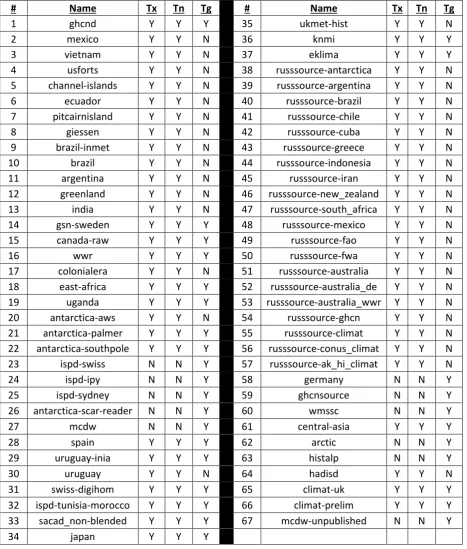
A major accomplishment of the Databank Working Group was completed in late 2015 with the release of version 1.1.0 of the Stage 3 databank. This included data from 67 sources (Table 1), an increase from the 50 sources available in the initial release in 2014. As described in section 2 above, other improvements included changes to the merge methodology to reduce forced merges so that unique stations would be retained as separate unique stations. A second change was a relaxation of the requirement for the minimum length of a data gap so that target stations with short gaps would be filled with qualifying data from candidate stations.
Another major accomplishment was the establishment of a new task team within the Databank Working Group having a principal aim of collection of parallel
5 Venema at the University of Bonn, and Terms of Reference were established for this team.
Additional details on these and other accomplishments are included in the list of 2015 objectives discussed above.
The DWG will look toward the following objectives for 2016:
1) Further improve the monthly merge algorithm
A long-term goal of the ISTI program is an expansion beyond temperature to include other elements such as precipitation, pressure, snowfall and snow depth. The international community has identified a single global data set containing as many elements as possible as a primary requirement for meeting the needs of the climate community. While the marine community began to address such a need in the 1980s, leading today to the ICOADS data set, the land near surface observing community has generally developed data sets that focused on specific needs rather than the all-encompassing marine surface and near-surface data provided by ICOADS. Given the statement of need and efforts such as ISTI, GHCN-D, and ISPD that have established a model that can be expanded to encompass the full spectrum of in situ land elements and timescales, there is now an opportunity to leverage these efforts in establishing an “ICOADS for Land”.
Although this is a complex issue requiring a lengthy development effort, an essential aspect and one starting point for such an effort will be a merge algorithm that leverages multiple elements in creating a merged data set. For instance if using a multi-element approach, precipitation and temperature measurements can be leveraged when identifying station records for merging or including as a unique station when developing the merged stage 3 data set. With this in mind attention in the coming year will be on developing a merge algorithm that leverages multi-element availability. The starting point for such an effort will be the GHCN-Daily merge algorithm. In 2016, the WG will tailor the GHCN-D algorithm for merging monthly mean data, with the starting point development of an alternate Stage 3 merged data set.
2) Additional sources will be incorporated with a particular focus on incorporating observations into GHCN-Daily with subsequent addition to the Monthly
Databank. Data previously collected, but not yet included in the current Stage 3 data, consist of the following sources.
- UK Stations from the Met Office (300+ stations) - German data released by DWD (1000+ stations)
- LCA&D: Latin American Climate Assessment and Dataset (148 stations) If the UK and German data have been incorporated into the ECA&D data set it will be possible to incorporate them into the Databank via a refresh of that source in GHCN-D. The LCA&D data can be likewise incorporated.
Homogenized sources
6 - Daily Chinese Data (380 stations)
Given the focus of the Databank is on data that have not be quality controlled or homogenized, these sources are the lowest priority and the DWG will need to decide if they should be incorporated.
Additional Sources
- NCAR Surface Libraries (unknown number of stations) - Stations from Meteomet project (240 stations)
- Libya Stations sent by their NMS (9 stations) - C3/EURO4M Stations (80 stations)
- Additional Digitized Stations from the University of Giessen (10 stations) - Long-term Swiss data (7 stations)
The above will be prioritized with those with summary of the day observations given top priority.
Other potential sources that the databank activity could obtain include the following:
- HISTALP: expected to be completed by early 2015 (Ingeborg Auer). - NORDHOM: data available from Nordic countries by the end of this year
(Erik Engstrom, SMHI)
- Monthly data for the Pyrenees from about 1950 (Marc Prohom, Servei Meteorològic de Catalunya)
7 Table 1. Summary of Stage Two sources, in prioritized form, used for the recommended version of the merge program, version 1.1.0.
# Name Tx Tn Tg # Name Tx Tn Tg
1 ghcnd Y Y Y 35 ukmet-hist Y Y N
2 mexico Y Y N 36 knmi Y Y Y
3 vietnam Y Y N 37 eklima Y Y Y
4 usforts Y Y N 38 russsource-antarctica Y Y N
5 channel-islands Y Y N 39 russsource-argentina Y Y N
6 ecuador Y Y N 40 russsource-brazil Y Y N
7 pitcairnisland Y Y N 41 russsource-chile Y Y N
8 giessen Y Y N 42 russsource-cuba Y Y N
9 brazil-inmet Y Y N 43 russsource-greece Y Y N
10 brazil Y Y N 44 russsource-indonesia Y Y N
11 argentina Y Y N 45 russsource-iran Y Y N
12 greenland Y Y N 46 russsource-new_zealand Y Y N
13 india Y Y N 47 russsource-south_africa Y Y N
14 gsn-sweden Y Y Y 48 russsource-mexico Y Y N
15 canada-raw Y Y Y 49 russsource-fao Y Y N
16 wwr Y Y Y 50 russsource-fwa Y Y N
17 colonialera Y Y N 51 russsource-australia Y Y N
18 east-africa Y Y Y 52 russsource-australia_de Y Y N
19 uganda Y Y Y 53 russsource-australia_wwr Y Y N
20 antarctica-aws Y Y N 54 russsource-ghcn Y Y N
21 antarctica-palmer Y Y Y 55 russsource-climat Y Y N
22 antarctica-southpole Y Y Y 56 russsource-conus_climat Y Y N
23 ispd-swiss N N Y 57 russsource-ak_hi_climat Y Y N
24 ispd-ipy N N Y 58 germany N N Y
25 ispd-sydney N N Y 59 ghcnsource N N Y
26 antarctica-scar-reader N N Y 60 wmssc N N Y
27 mcdw N N Y 61 central-asia Y Y Y
28 spain Y Y Y 62 arctic N N Y
29 uruguay-inia Y Y Y 63 histalp N N Y
30 uruguay Y Y N 64 hadisd Y Y N
31 swiss-digihom Y Y Y 65 climat-uk Y Y Y
32 ispd-tunisia-morocco Y Y Y 66 climat-prelim Y Y Y
33 sacad_non-blended Y Y Y 67 mcdw-unpublished N N Y
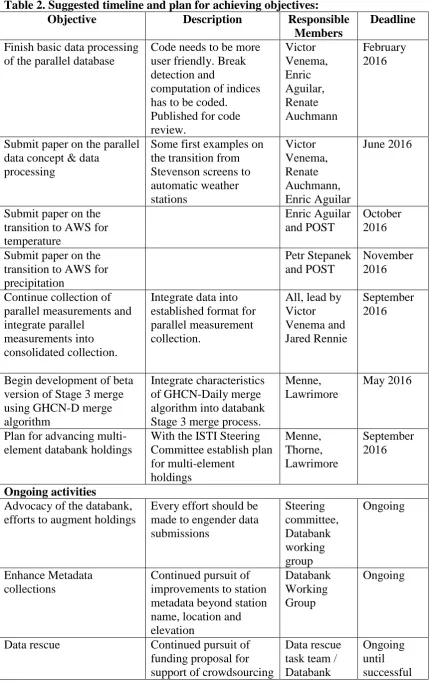
8 Table 2. Suggested timeline and plan for achieving objectives:
Objective Description Responsible
Members
Deadline
Finish basic data processing of the parallel database
Code needs to be more user friendly. Break detection and
computation of indices has to be coded. Published for code review. Victor Venema, Enric Aguilar, Renate Auchmann February 2016
Submit paper on the parallel data concept & data
processing
Some first examples on the transition from Stevenson screens to automatic weather stations Victor Venema, Renate Auchmann, Enric Aguilar June 2016
Submit paper on the transition to AWS for temperature
Enric Aguilar and POST
October 2016 Submit paper on the
transition to AWS for precipitation
Petr Stepanek and POST
November 2016 Continue collection of
parallel measurements and integrate parallel
measurements into consolidated collection.
Integrate data into established format for parallel measurement collection.
All, lead by Victor Venema and Jared Rennie
September 2016
Begin development of beta version of Stage 3 merge using GHCN-D merge algorithm
Integrate characteristics of GHCN-Daily merge algorithm into databank Stage 3 merge process.
Menne, Lawrimore
May 2016
Plan for advancing multi-element databank holdings
With the ISTI Steering Committee establish plan for multi-element holdings Menne, Thorne, Lawrimore September 2016 Ongoing activities
Advocacy of the databank, efforts to augment holdings
Every effort should be made to engender data submissions Steering committee, Databank working group Ongoing Enhance Metadata collections
Continued pursuit of improvements to station metadata beyond station name, location and elevation
Databank Working Group
Ongoing
Data rescue Continued pursuit of funding proposal for support of crowdsourcing
Data rescue task team / Databank
9 of already imaged forms
(such as NOAA foreign data library)
Working Group Parallel measurements
database data collection
Pursuit of parallel measurements data holdings
Databank Working Group / Victor Venema