CSEC Mathematics Section 6 – Algebra
Performing Operations Involving Directed Numbers
Directed numbers are negative and positive whole numbers e.g. – 7, 8, – 9 , 12, – 3.
Integers consist of zero, negative and positive
whole numbers e.g. …, – 2, – 1, 0, 1, 2, 3, …
Multiplication and Division of Directed Numbers (negative and positive whole numbers)
NOTE: i. + (+) = + + = +
ii. +(–) = + – = –
iv. – (–) = – – = +
Once there is no negative sign in front of a number, the number is positive.
Simplify the following.
a. 9 (+4)
b. 3 (– 8)
c. – 2 (– 5)
d. – 7 6
e. – 9 0 5
f. – 7 (– 2) (– 4)
g. -18 3 h. – 20 – 4 i. 14 – 7
m. n.
o.
Addition and Subtraction of Directed Numbers
Try these!
a. 4 – 0 = b. 4 – 1 = c. 4 – 2 = d. 4 – 3 = e. 4 – 4 = f. 4 – 5 = g. 4 – 6 =
What do you notice?
a. 4 + 3 = b. 4 + 2 = c. 4 + 1 = d. 4 + 0 = e. 4 + (– 1) = f. 4 + (– 2) g. 4 + (– 3) =
What do you notice?
Exercise
Answer the following.
1. Draw a number line to show the results for each of the following.
a. 1 + 5 b. 6 – 2 c. 4 – 9 d. – 2 – 7 e. 8 – 5 = f. 11 – 16 = g. – 9 – 4 =
2. Simplify the following.
NOTE: i. + (+) = + + = +
ii. +(–) = + – = –
iii. – (+) = – + = –
iv. – (–) = – – = +
a. 5 + (- 2) b. 4 + (-3) c. (- 3) + (- 3) d. 6 + (- 8) – 3 e. 7 - (- 4) - 6
f. (- 2) + (- 5) + 8 g. (– 1) + 6 – (– 14) h. – 4 + 7 – 20 i. – 3 – ( – 4)
Mixed Arithmetic Operations on Directed Numbers
Rules for Operations on directed numbers:
work out the brackets first, if they are
any
Exponential(power) operators e.g. square
or cube takes precedence over
multiplication, division, addition and subtraction
carry out multiplication or division
Simplify the following.
a. 8 4 2 b. 8 4 2
c. 62 – 24 12 + 3 Ans: 37
d. (– 8)2 – (10 – 13)2(– 2) Ans: 82
e. – 3(– 6 + 8)3 – 5(– 3 + 5)3 Ans: - 64
f. – 32 + 2[20 (7 – 11)] Ans: - 19
g. – 22 + 4[16 (3 – 5)] Ans: - 36
h. 8 – 3[– 2(2 – 5) – 4(8 – 6)] Ans: 14
i. (2 4)2 4 – (– 9 + 5 – 2) Ans: 22
Algebra (Page 229, Volume 1, Raymond Toolsie)
Algebra is the branch of mathematics in which
symbols, usually common letters of the alphabet
also called variables, are used to represent
unknown numbers.
Algebraic Expression
Variable(s) Constant Coefficient
3y – 4
9 – 5x2
2 – 8ab – 9m3 y
x2
a, b and m
– 4
9
2
3 is the
coefficient of y – 5 is the
coefficient of x2
– 8 is the
coefficient of ab – 9 is the
Using a Symbol to Represent a Number Exercise
Translate each of the following word phrases into an algebraic expression using the
symbols given.
2. Three-quarters the product of two numbers
m and w
3. Six times the product of two numbers d and
p, less 5, divided by thrice a third number c.
4. Four times a number y less twice a number
g.
5. Five times the sum of x and y.
6. The sum of two consecutive whole numbers
when the smaller is m.
7. The product of two consecutive natural
8. The sum of two consecutive whole numbers
when the larger is w.
9. The product of two consecutive natural
numbers when the larger is y
10. Five times the difference of p and q.
11. A bottle contains 500 ml of orange juice. Write an expression for each of the following. The amount of juice left in the bottle after
pouring out:
May 2015 Question 2b
a. p ml
[Practice Questions Page 230, Vol. 1, R. Toolsie - Exercise 6a]
Substitution (Page 231, Volume 1, Raymond Toolsie)
Substitution is the process whereby the
symbol(s)/variable(s) in an algebraic expression are replaced by the given number it represents, in order to simplify and find its particular
numerical value. For example, if x = 2 and
y = – 3 then,
5y – 2x = 5(– 3) – 2(2) = –15 – 4 = –19.
Exercise
1. Given that a = – 1, b = 2 and c = – 3, find the
value of:
i. 3b – 2a + c3 Ans: – 19
ii. 4c2 – 3a2 + bc Ans: 27
iii. 4cb Ans: 36
2. Find the value of where π = 3.14,
l = 0.625 and g = 10. Ans: 1.57
3. Find the value of 2x3 – 5x2 + 3x + 8
4. If x = 2, y = – 3 and z = 4, calculate the
value of each of the following algebraic
expressions.
i. 2x + y Ans: 1 ii. z – 2y Ans: 10
iii. 5x – 2y + 3z Ans: 28 iv.
Ans:
5. Given that a = 4, b= 2 and c = – 1, find the
value of: a – b + c Ans: 1 May 2015
6. Evaluate the value of each of the following
algebraic expression if m = – 2, e = – 1 and g =
3.
i. 5e2m ii. 2gm2 + eg iii. 9g2 – 4e3m
iv.
v. me – 3(e – g) + 4m vi. m2[8 – (g –
3e)2] vii. 2m3 – 3[4 – (me – 5m)]
Performing Binary Operations (Page 241, Vol. 1 – R. Toolsie)
A binary operation is an operation which
combines two numbers to produce a third
number.
Exercise
1. An operation is defined by p * q = 3q + 2p. Evaluate:
a. 4 * 5 Ans: 23
b. 5*4 Ans: 22
d. 3 * (5 * 4) Ans: 72
2. If a ^ b means , determine the
value of:
a. 5 ^ 3 Ans: 1
b. (5 ^ 3) ^ 0 Ans:
c. – 3 ^ (5 ^ 3) Ans: 0.7071
3. If m * n means 7n + m, determine the value
4. If a $ b = 3b – 2a2, evaluate:
a. 3 $ 5 Ans: – 3
b. 4 $ (3 $ 5)Ans: – 41
c. (5 $ 3) $ (– 2) Ans: – 3368
5. An operation p ! q denotes p3 – 2pq + q2,
calculate 2 ! (– 4 ! 3). Ans: 1093
6. If x * y denotes 5y2 – 3x3, evaluate (– 1 * 2)
* 3. Ans: – 36,456
7. The binary operation * is defined by
a * b = (a + b)2 – 2ab. Calculate the value of 3
* 4.
8. An operation is defined by p £ q = .
Find the value of – 5 £ 4. Ans: 6.86
Addition and Subtraction of Algebraic Terms (Page 233, Volume 1, Raymond Toolsie)
We can only add or subtract like algebraic
terms. Like algebraic terms, are those terms
which have the same variable(s). For example,
Unlike terms are those terms which do not have
the same variables. For example, 9y2, – 3x2,
0.5xy, – 0.75my2 are all unlike terms.
When simplifying an algebraic expression
involving addition and/or subtraction, we group
like terms then add or subtract the like terms,
accordingly.
Note: When grouping like terms, we keep the
sign which is front of the algebraic term.
Simplify the following algebraic expressions
1. 9x + 3y – 5z + 8y – 4x + 12z
Ans: 5x + 11y + 7z
2. 15x2 – 7y2 + 9y2 – 8x2
Ans: 7x2 + 2y2
3. 3a2b + 4ab2 – a2b – 3ab2 + a2b2
Ans: 2a2b + ab2 + a2b2
4. 1.5p2q – 0.3pq3 + 4.1p2q + 5.0pq3
Ans: 5.6p2q+4.7pq3
5. 5a2b – 7ab2 – a2b + 9ab2
Ans: 4a2b+2ab2
6. 8 – 15xy – 7x – 12 – 3xy + 9x
Ans: – 4 –18xy + 2x
7. 5r2s + 9r2 – 3s2 – 6r2 – s2
[Practice Questions Page 234, Exercise 6c]
Addition and Subtraction of Algebraic Fractions (Page 248, Volume 1, Raymond Toolsie)
Exercise
1. Simplify each of the following algebraic fractions.
a. Ans:
b. Ans:
c.
Ans:
e. Ans:
f. Ans:
g. Ans:
h. Ans:
i. Ans:
j. Ans:
2. Rewrite as a single fraction in its lowest terms.
3. Write as a single fraction, in its lowest terms:
a) Ans: May 2015 Question 2c b) Ans: January 2016 Question 2d
[Practice Questions Page 250, Exercise 6k]
Laws of Indices (Page 280, Vol. 1 – R. Toolsie)
Given that a, m and n are real numbers then the laws of indices are as follows:
2. am ÷ an = am – n
3. (am)n = amn
4. a0 = 1
5. a– 1 = and a – m =
6. = and =
Multiplication and Division of Algebraic Terms (Page 248, Volume 1, R. Toolsie) Exercise
Simplify the following expressions.
2. b13 ÷ b1 Ans: b12 3. (32)3 Ans: 36 = 729 4. k5 ÷ k9 Ans: k – 4 or 5. 94 ÷ 94 Ans: 90 = 1
6. w0 Ans: 1
7. (6– 3 )0 Ans: 1
8. (3y4b2)3 Ans: 27y12b6 9. (– 5kx3)2 Ans: 25k2x6
Multiplication and Division of Algebraic Terms (Page 248, Volume 1, R. Toolsie)
Simplify the following expressions.
1. 3x (– 5yx) Ans: –15x2y
2. – 4p2q3 (– 3p3q) Ans: 12p5q4
3. – a2b (– 2 ma) (– 3b3d) Ans: – 6a3b4dm
4. Ans: 9pq
5. 24m2y3e 72 y4m3b Ans:
7. Ans:
8. Ans: 6x3yz
9. Ans:
10. Ans:
11. Simplify Ans: 6x5
January 2016 Question 2c
The Distributive Law (Page 238, Volume 1, Raymond Toolsie)
The distributive law is applied to remove the
brackets in an algebraic expression. The
distributive law is applied when each term
inside the brackets is multiplied by the term
directly outside the brackets. For example, (a +
b)x = ax + bx or x(a + b) = ax + bx, where a
and b are real numbers and x is a variable.
1. Remove the brackets in each of the
following expressions and simplify.
a. 5(x + 2y) – 7x Ans: – 2x + 10y
b. 3(5m – 2k) + k Ans: 15m – 5k
c. – 8( – 2b + 3a) – 5a Ans: 16b – 29a
d. – 7(4y – 6w) + 9y Ans: – 19y + 42w
e. Ans:3x – 3
f. Ans: – d + 5b
h. Ans: 6x – 1
i. 3(2m – y) – 4(5y – 3m) Ans: 18m – 23y
j. 2(4e + h) – (6e – 5h) Ans: 2e + 7h
2. Expand and simplify 2x(x + 5) – 3(x – 4)
Ans: 2x2 + 7x + 12 [January 2016
Question 2b]
[Practice Questions Page 236, Exercise 6e] The Product of Two Binomial Expressions
A binomial expression consists of two terms.
follows: (x + p)(x + q) = x(x + q) + p(x + q) =
x2 + qx + px + pq
Exercise
1. Expand and simplify each of the following
algebraic expressions.
a. (p + 3)(p – 4) Ans: p2 – p – 12
b. (m + 2)(m – 5) Ans: m2 – 3m – 10
c. (3y – 2)(2y +1) Ans: 6y2 – y – 2
d. (2p – 1)(2p + 1) Ans: 4p2 – 1
g. (6x – 5y)(2x – 3)
Ans: 12x2 – 18x – 10xy + 15y
h. (3y – 4)2 Ans: 9y2 – 24y + 16
i. (2 – m)2 Ans: 4 – 4m + m2
j. (3w – 2k)2 Ans: 9w2 – 12kw + 4k2
Factorization (Page 242, Volume 1, Raymond Toolsie)
Factorization is the reverse of removing the
brackets. It involves using the distributive law
Note: We find the H.C.F. for the terms in the
algebraic expression, then divide each term by
the H.C.F. Then express the result as a product
of the H.C.F. and the sum of the quotients.
Exercise
1. Factorize each of the following algebraic
expression completely.
a. 5x + 10y Ans: 5(x + 2y)
b. 15m – 6k Ans: 3(5m – 2k)
e. 6x – 4 Ans: 2(3x – 2)
f. 4y – 2k Ans: 2(2y – k)
g. 5wx + 10yw – 15wz Ans: 5w(x + 2y – 3z)
h. 18ap – 36pb – 72cp Ans: 18p(a – 2b – 4c)
i. – 8xk – 16ty – 24ht Ans: 8( - xk – 2ty – 3ht)
j. – 9ab + 36ca – 45ad Ans: 9a(- b + 4c – 5d)
k. – 9a3b + 36ca2 – 45a5d
Ans: 9a2(-ab + 4c – 5a3d)
l. 18ap4 – 36p8ab – 72cp3a7
[Practice Questions Page 243, Exercise 6g]
Exercise
Simplify the following.
1. Ans:
2. Ans:
3. Ans:
5. Ans:
6. Ans:
7. Ans:
Factorizing by Grouping (Page 236, Volume 1, Raymond Toolsie)
In this method, we are normally given four
algebraic terms to factorize. We first group the
algebraic terms in pairs, so that each pair has a
factorize each pair of terms. Then a common
factor is then factored out of the pair of
factorized terms until the process is finished.
Exercise
1. Factorize each of the following algebraic
expressions completely.
a. px + yp + qx + yq Ans: (x + y)(p + q)
b. 3am – 6ay + bm – 2by
Ans: (m – 2y)(3a + b)
d. bm(5d – 1) + 3pq(– 1 + 5d)
Ans: (5d – 1)(bm + 3pq)
e. 8pa – 16aq + 2bp – 4bq
Ans: 2(8a + 2b)(p – 2q)
f. 4pr – 8ps + qr – 2qs
Ans: (4p + q)(r – 2s)
g. 10y – 2ym + 4m – 20
Ans: 2(y – 2)(5 – m)
h. xp + yp – xq – yq
i. 3ab(4y – 3m) – 2pq(– 3m + 4y)
Ans: (4y – 3m)(mab – 2pq)
j. 5ax + 3bx – 5ay – 3by
Ans: (5a – y)(x + 3b)
[Practice Questions Page 247, Exercise 6j]
Factorizing a Difference of Two Squares (Page 774, Volume 2, Raymond Toolsie)
The product (a + b)(a – b) = a2 – b2 according to
an algebraic expression is a difference of two
squares, then we can factorize it directly in the
form (a + b)(a – b).
Exercise
1. Factorize each of the following algebraic
expressions completely.
a. 3y2 – 48 Ans: 3(y – 4)(y + 4)
b. 36b2 – 1 Ans: (6b – 1)(6b + 1)
c. 27x2 – 12m2 Ans: 3(3x – 2m)(3x + 2m)
d. 25 – 49p2 Ans: (5 – 7p)(5 + 7p)
f. 500 – 5x2 Ans: 5(10 – x)(10 + x)
g. 64m2 – 49k2 Ans: (8m – 7k)(8m + 7k)
h. 75p2 – 12q2 Ans: 3(5p – 2q)(5p + 2q)
i. 360x2 – 1000 Ans: 40(3x – 5)(3x + 5)
j. 490 – 1210h2 Ans: 10(7 – 11h)(7 + 11h)
2. Factorize completely:
a. i) a3 – 12a Ans: a(a2 – 12)
May 2015 Question 2e (i)
ii) 3a3 – 12a Ans: 3a(a – 2)(a + 2)
January 2016 Question 2e
c. m2 – 9n2
[Practice Questions Page 774,Vol. 1 – R. Toolsie, Exercise 13i]
Factorizing Quadratic Expressions (ax2 + bx + c) (Page 775, Volume 2, Raymond
Toolsie)
The general form of a quadratic expression is
ax2 + bx + c, where ‘a’ is the coefficient of x2,
b is the coefficient of x and c is the constant
expression, we obtain the product of two
binomial expressions.
Given the quadratic expression ax2 + bx + c we
can write it as
ax2 + (p + q)x + c = ax2 + px + qx + c, where b =
p + q and ac = pq.
That is, we find two integers p and q whose sum
is equal to b and whose product is equal to ac.
Then we write the quadratic expression in the
form ax2 + px + qx + c and factorize by
A quadratic expression can also be factorized
using , where m and n are two
numbers such that the sum m + n = b and the
product mn = ac.
Exercise
Factorize each of the following quadratic expressions completely.
1 a. x2 + 7x + 12 Ans: (x + 3)(x + 4)
c. x2 – 4x – 21 Ans: (x + 3)(x – 7)
d. x2 – 7x + 6 Ans: (x – 1)(x – 6)
e. 6x2 + 7x + 2 Ans: (3x + 2)(2x + 1)
f. 4x2 – 11x – 3 Ans: (4x + 1)(x – 3)
g. 3x2 + 5x – 2 Ans: (x + 2)(3x – 1)
h. 2x2 – 7x + 6 Ans: (x – 2)(2x – 3)
i. 3x2 + x – 2 Ans: (x + 1)(3x – 2)
j. 12x2 – 11x + 2 Ans:(3x – 2)(4x – 1)
See May 2015 Question 2e
b. 6x2 – 6 Ans: 6(x – 1)(x + 1)
[Practice Questions Page 778, Exercise 13j]
The Subject of Formula
In the form A = πr2, which is the formula for the
area of a circle, we say that A is the subject of the formula. Usually the subject of a formula is on its own on the left-hand side.
Changing the Subject of a Formula
of the formula you must do to the other side’. To rearrange a formula you may:
• add or subtract the same quantity to or from both sides
• multiply or divide both sides by the same quantity
Exercise
1. JANUARY 2013 QUESTION 4A
a) Make r the subject of each of the following
formulae:
i. r – h = rh 2 marks
2. JANUARY 2011 QUESTION 2C
Express p as the subject of the formula
.
Make x the subject of each equation below.
1. 3 + x = 5y – p
2. 2x – 5 = m + 2k
3. 6 – 4m = 2 – 5x
5.
6. y = mx + c
7. 5p =
Make p the subject of the formula in each of the
following.
1. 2p +mp = 7
2. 1 – 3k = 5p + yp
3. 3 – 4p = wp – 1
Make y the subject of the formula in each of the following.
1.
2.
3.
4.
5. y2 = 2x – 3
6. 3y2 = w – 5
7. 4 – 2m = 1 – 5y2
Algebraic Equation
equal sign to show equality between two quantities or expressions.
We can maintain the equality of an equation by adding, subtracting, dividing or multiplying
both sides of the equation by the same quantity.
Solving a Linear Equation (ax + b = c) [Page 252, Volume 1, Raymond Toolsie]
numbers on the other side. This can be done by applying reverse operation.
Exercise
Solve the following equations.
1 a. y + 5 = 10 Ans: y = 5
b. p – 8 = 13 Ans: p = 21
c. 4m = 28
d.
e. 3w – 7 = 2
f. 4k + 9 = 1 Ans: k = - 2
g. 9x – 1 = – 10 Ans: x = - 1
i. 2(3m – 5) – 4m = 8 Ans: m = 9
j. 4(2y – 3) = Ans: y =
k. Ans: p =
l. Ans: x =
m. Ans: x =
n. x =
o. Ans: x =
p. Ans: x =
2. Venesha, Tameca and Racquel were playing a card game.
Venesha scored x points
Tameca scored 3 points fewer than Venesha
Racquel scored twice as many points as Tameca
Together they all scored 39 points.
a. Write down in terms of x, an expression for
the number of points scored by
i. Tameca ii. Racquel.
b. Write an equation which may be used to find
c. Solve for x. Ans: x = 12 points
3. MAY 2013 QUESTION 2c
[Practice Questions, Page 255, Exercise 6m]
An inequation is a statement involving an
inequality sign. It is a statement showing that
one quantity is not equal to another quantity in general. The inequality signs < (less than), > (greater than), (less than or equal to) and (greater than or equal to) are used to represent inequations.
An inequation can be solved using the same method of solving equations. However, if an inequality is multiplied or divided by a negative number, the inequality sign is reversed. For
example: Given that – 4 < 2 is true.
Multiplying both sides by – 2 gives
8 < – 4 which is incorrect. However, 8 > – 4 is correct.
Similarly, is 4 < – 2 which is
incorrect. However, 4 > – 2 is correct.
Exercise
i. Solve the following linear inequations.
ii. Draw a number line to represent your solution.
iii. State the solution set for the inequation.
1 a. x + 2 > 7 b. 2x – 3 5
f. 5x – 9 7x + 1 g. 3(4x – 1) > 5(3x – 2)
h. – 3x < 21 i. 6x – 12 8x + 2
j. 7x – 3 < 13x + 33
k. 2(x – 3) – 1 3(x + 2) – 14
2. a) Solve for x, where x is a real number.
8 – x 5x + 2 See January 2016
Question 2a
b) Show your solution to (a) (i) on the
number line below.
3. a) Solve the inequality: 5 – 2x < 9
b) If x is an integer, determine the SMALLEST
in (a) above. MAY 2011 – QUESTION 4a
4. a) Solve for x the in-equation 2x – 7 ≤ 3.
b) If x is a positive integer, list the possible
values of x. JANUARY 2015 – QUESTION
2d
[Practice Questions, Page 261, Exercise 6n]
Solving Quadratic Equations [Page 784, Volume 2, Raymond Toolsie]
We can solve a quadratic equation by first
factorizing the equation then solve for x. If the
quadratic equation cannot be factorized we use the quadratic formula to solve the equation. The
quadratic formula is .
Exercise
Solve the following quadratic equations.
Show the use of the quadratic formula.
a. (2x + 5)(x – 3) = 0 Ans: x = -5/2 or 3
b. (4 – 3x)(x – 7) = 0 Ans: x = 4/3 or 7
e. x2 – 6x = 0 Ans: x = 0 or 6
f. x2 + 3x – 10 = 0 Ans: x = - 5 or 2
g. 3x2 + 5x – 2 = 0 Ans:x = - 2 or 1/3
h. 5x2 + 9x = 2 Ans: x = - 2 or 1/5
i. 2x2 + 4x – 1 = 5 Ans: x = - 3 or 1
j. 4x2 – 11x = 3 Ans: x = -1/4 or 3
k. 2x2 – 6x = –1 Ans: x = 2.82 or 0.1775
l. 4x2 + 11x = 3 Ans: x = - 3 or 1/5
[Practice Questions, Page 790, Exercise 13L]
When we solve two equations with two
unknown values simultaneously, the solutions obtained must satisfy both equations at the same time.
Simultaneous equations can be solved
graphically or algebraically - using the method of elimination or substitution.
The Method of Elimination (used for linear equations only e.g. ax + by = c)
The Method of Substitution (used for any pair of equations)
In this method we use one of the linear equation to substitute in the other equation for one of the unknown values. Then we substitute the
determined value in one of the equations and solve for the second unknown value.
Exercise
1. Solve the following simultaneous equations using both methods.
c. Ans: x = 3 & y = 7
d. Ans: x = 4 & y = 1
e. Ans: x = 2 & y = – 1
f. Ans: x = 2 & y = 3
g. Ans: x = 2 & y = – 4
h. Ans: x = 1 & y = 0
i. Ans: x = 2 & y = 0
x = 1 & y = – 2
j. x2 + 2xy = – 5 Ans: x = – 0.59, y = 4.59
x + y = 4 x = 8.59, y = - 4.59
k. x2 + 2xy = – 5 Ans: x = – 1, y = 3
x + y = 2 x = 5, y = – 3
2. Four mangoes and two pears cost $24.00, while two mangoes and three pears cost $16.00.
a. Write a pair of simultaneous equations in x
and y to represent the information given above.
b. State clearly what x and y represents and
See May 2015 Question 2d
3. JANUARY 2013 QUESTION 2C
One toffee(y) is 3 grams
4. JANUARY 2011 QUESTION 2D
5. The cost of four chairs and a small table is $684. The cost of six chairs and a large table is
$1,196. The cost of a large table is twice the
dollars, of a chair and y is the cost, in dollars, of a table:
a. Write a pair of simultaneous equations to represent the information given;
b. calculate the cost of large table.
6. Carlene buys buns and bullas for 10 persons. For 7 bullas and 3 buns she paid $1,923. If she had bought 3 bullas and 7 buns instead she
would have paid $2055. Using x to represent the
price of a bulla and y to represent the price of a bun:
b. By solving the equation determine the price of a bulla and that of a bun (3marks)
7. At the Sandals Hotel, a supervisor and seven (7) chefs together earn $1 560 per week whilst
two (2) supervisors and seventeen (17) chefs earn $3 660 per week. Find the weekly wages of a:
i. supervisor ii. Chef
8. The cost of five textbooks and a dictionary is $473, the cost for seven textbooks and an
encyclopedia is $691. The cost of an
Given that x is the cost of a textbook and d is the cost of a dictionary:
a. Write a pair of simultaneous equations to represent the information given.
b. Calculate the cost of an encyclopedia.
Ans: $96
9. A bill for $123 was paid with $5 and $1
notes. A total of 59 notes were used. Find how many $5 notes were used?
Direct Variation (Page 315, Vol. 1 – R. Toolsie)
If y is directly proportional to x , then
we can write y = kx where k is the constant of
proportion.
Exercise
1. If m is directly proportional to p and m = 10
when p = 2.5, determine the value of:
a. the constant of proportion Ans: k = 4
2. Given that A varies directly to r2, and
A = 392 when r = 7 find:
a. the constant of proportion Ans: k = 8
b. A when r = 3 Ans: A = 72
c. r when A = 510.5 Ans: r = 7.99
3. Given that y varies directly with x, find the value of p and q in the table below.
x 5 p 1.25
y q 10 5
Ans: p = 2.5 Ans: q = 20
Inverse Variation
If y is inversely proportional to x , then
we can write y = .
Exercise
a. the constant of proportion Ans: k = 25
b. m when p = 20 Ans: m = 1.25
c. p when m = 1.25 Ans: p = 20
2. Given that A varies inversely to r2, and
A = 392 when r = 7 find:
a. the constant of proportion Ans: k = 19,208
b. A when r = 3 Ans: A = 2,134.22
c. r when A = 510.5 Ans: r = 6.13
3. Given that y varies inversely with x, find the value of p
and q in the table below.
x 5 p 1.25
Ans: q = 1.25 p = 0.625
4. The table below shows corresponding values
of the variables x and y, where y varies
directly as x. MAY 2011 – Question 2(d)
x 2 5 b
y 12 a 48
Calculate the values of a and b.
Ans: a = 30 b = 8
Answer at least five years of ‘Paper Two - Question 8.
Patterns and Sequences
Consider using graph paper in the exam to draw the required diagram, if no answer sheet is provided.
1. January 2016 – Question 8
The diagram below shows the first three figures in a sequence of figures.
Figure 1 Figure 2 Figure 3
a. Draw the fourth figure in the sequence.
b. The table below shows the number of dots and lines in each figure. Study the pattern in the table and complete the table by inserting the missing values in the rows numbered (i), (ii), (iii) and (iv).
Figure Number of Dots Number of Lines
3 10 16
4 ………. ……….
Entries omitted for Figures 5 – 9
10 ……… ………..
Entries omitted for some Figures
……… 49 ……….
Entries omitted for some Figures
n ……… ………..
2. May 2015 – Question 8
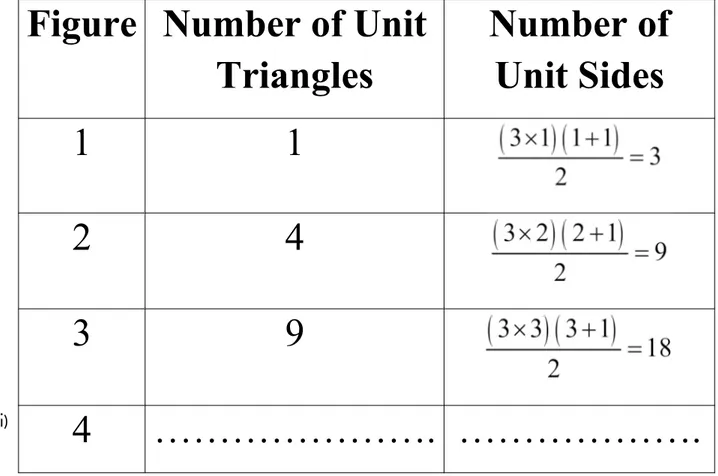
A sequence of figures is made up of equilateral triangles, called unit triangles with sides. The first three figures in the sequence are shown below.
Figure 1 Figure 2 Figure 3
(i) (ii) (iii)
a. Draw figure 4 of the sequence.
b. Study the patterns of numbers in each row of the table below. Each row relates to one
of the figures in the sequence of figures. Some rows have been included in the table.
Complete the rows numbered (i), (ii), (iii) and (iv).
Figure Number of Unit Triangles
Number of Unit Sides
1 1
2 4
3 9
……. 144 ………
25 ……… ………..
n ……… ………..
3. May 2014 – Question 8
A number sequence may be formed by counting the number of dots used to draw each of a set of geometric figures. The first three figures are shown below.
a. Draw Figure 4, the next figure in the
sequence above.
b. Complete the table below by inserting the missing information at the rows numbered (i) and (ii).
Figure (f)
Total Number of Dots
Formula Number (n)
1 5 2 – 5 5
2 5 3 – 5 10
3 5 4 – 5 15
4 Not Required Not Required
5 ……….. ………
6 ……… ………..
c. Write an expression in f for the number (n)
of dots used in drawing the f th figure.
d. Which figure in the sequence contains 145
4. May 2013 – Question 8
The drawings below show the first three
diagrams in a sequence. Each diagram is made up of wires of equal length which are joined at the ends by balls of plasticine. Diagram 1 is made up of 12 wires and 8 balls. Each new diagram in the sequence is formed by adding the frame below, which has 8 wires and 4 balls.
Diagram 1 Diagram 2 Diagram 3
● ● ●
● ● ● ● ● ●
a. Draw a sketch of Diagram 4, the fourth diagram in the sequence.
b. Complete the table by inserting the missing values at the rows marked (i) and (ii).
Name of Diagram
(N)
Number of Wires (W)
Number of Balls (B)
1 12 8
2 20 12
3 28 16
4 ______________ ______________
20 ______________ ______________
c. Write the rules which may be used to find
i. W = _____________ ii. B = _____________
5. May 2012 – Question 8
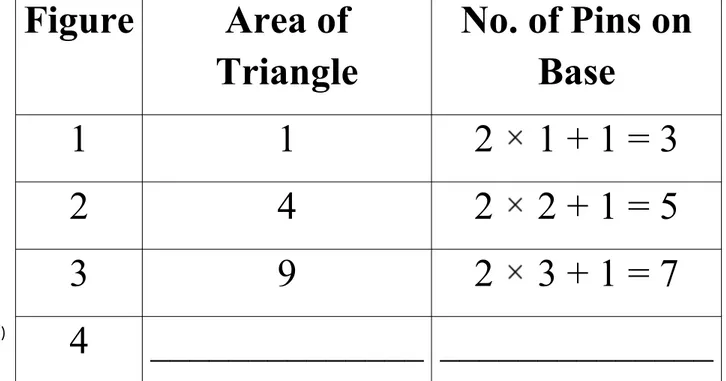
The diagram below shows the first three figures in a sequence of figures. Each figure is an
isosceles triangles triangle made of a rubber
band stretched around pins on a geo-board. The pins are arranged in rows and columns, one unit apart.
Figure 1 Figure 2 Figure 3
a. Draw the fourth figure (Figure 4) in the sequence.
b. Study the patterns in the table below.
Complete the rows numbered (i), (ii), (iii) and (iv). The breaks in the column are to indicate that the rows do not follow one after the other.
Figure Area of Triangle
No. of Pins on Base
1 1 2 1 + 1 = 3
2 4 2 2 + 1 = 5
3 9 2 3 + 1 = 7
4 ______________ ______________
____ 100 ______________
20 ____________ ____________
n
6. May 2011 – Question 8
The figure below shows the first three diagrams in a sequence. Each diagram is made up of
sticks joined at the ends by thumb tacks. The sticks are represented by lines and the thumb
(ii)
(iii)
tacks by dots. In each diagram, there are t
thumb tacks and s sticks.
a. Draw the FOURTH diagram in the sequence. b. i) How many sticks are in the SIXTH
diagram?
ii) How many thumb tacks are in the SEVENTH diagram?
c. Complete the table by inserting the missing values at the rows marked (i) and (ii).
No. of Sticks (s)
Rule
Connecting t
4 4 8 7 12 10 52 _____________ _ _____________ _ __________ _ _____________ _ 55
d. Write the rule, in terms of s and t, to show
how t is related to s.
7. January 2015 – Question 8
The diagram below shows the first three figures in a sequence of figures.
(i)
a. Draw the fourth figure in the sequence.
b. The table below shows the number of squares in each figure. Study the pattern in the table and complete the table by inserting the missing values in the rows numbered (i), (ii), (iii) and (iv).
Figure (n)
No. of Squares
1 5
2 8
3 11
4 ……….
10 ………
n ………
……… 50
n ……….
(iv) (ii)