
• Atoms are the smallest unit
which display all of the
properties of the material.
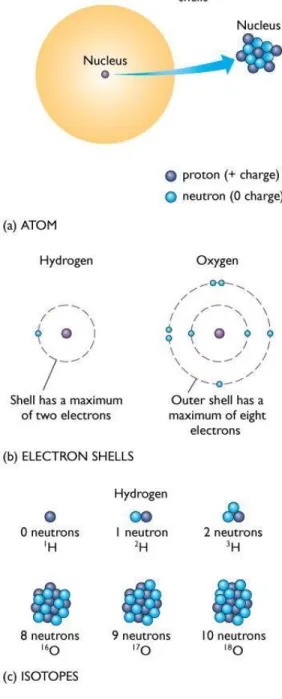
• Atoms are composed of:
– Nucleus - the center of the atom consisting of:
• positively charged particles (protons) • neutrally charged particles
(neutrons)
–
Electrons - negatively chargedparticles that orbit the nucleus in discrete electron shells
.
• Electrically stable atoms have the same
number of electrons as protons.
• Ions are atoms with either more or fewer
electrons than protons.
• Isotopes are atoms containing the same number of
protons, but different numbers of neutrons.
– Therefore, they have different atomic weights.
– For example, O-16 and O-18. Both have 8 protons, but differ in neutrons, one has 8 the other 10. (This can be used to determine climate temperature…sediments have greater amounts of O-18 during colder periods since O-16 that was locked up in ice because it evaporated more easily has returned to the ocean)
•
Heat
results from the vibrations of
atoms (
kinetic energy
). Heat is
the
total
energy present
•
Temperature
is the
average
Kinetic Energy
of molecules.
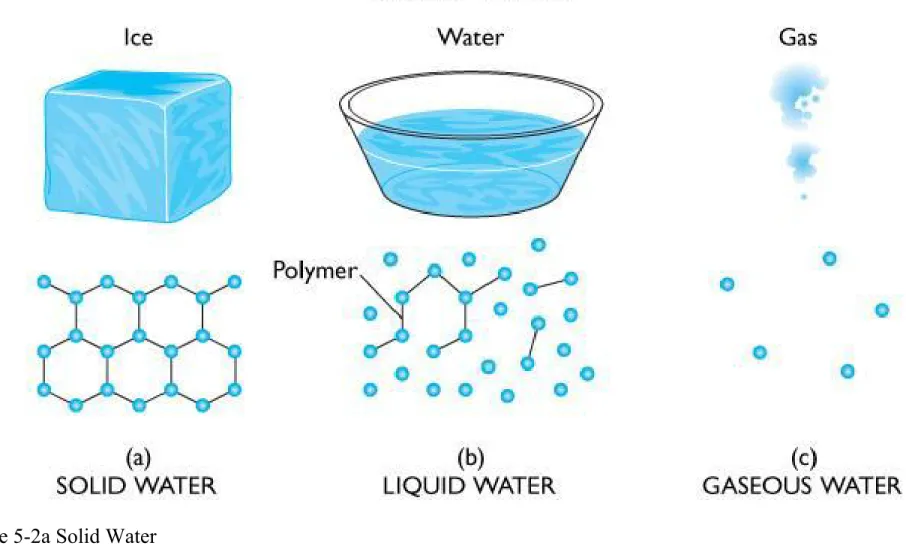
• In
solids,
the atoms or molecules:
– vibrate weakly
– are rigidly held in place
• In liquids, the atoms or molecules:
– vibrate more rapidly – move farther apart
– are free to move relative to each other
• In gases, the atoms or molecules:
– are highly energetic – move far apart
•
Melting
is the transition from solid to liquid;
freezing
is the reverse.
•
Evaporation
(vaporization) is the transition from
liquid to gas;
condensation
is the reverse.
– Evaporation requires heat input – Condensation releases heat
•
Temperature
controls density.
– As temperature increases:
• atoms or molecules move farther apart
The water molecule is unique in structure and
properties.
• H2O is the chemical formula for water.
• Unique properties of water include:
– Higher melting and boiling point than other hydrogen compounds.
– High heat capacity (amount of heat needed to raise the temperature of one gram of water 1oC).
– Greater solvent power than any other substance.
• Water molecules are asymmetrical is shape:
• Asymmetry of a water molecule and distribution of electrons result in a dipole structure.
• The oxygen end of the molecule is negatively charged.
• The hydrogen end of the molecule positively charged.
• Dipole structure of water molecule produces an
• The dipole structure of water makes it an exceptional solvent.
• Na+ and Cl- ions are removed from the halite crystal by the
negative and positive ends of the water dipole.
• Ice floats in water because all of the
molecules in ice are held in hexagons.
– The center of the hexagon is open space,
making ice 8% less dense than water.
•
Fresh water
reaches its maximum density
at 3.98
oC.
– Below this temperature increasing numbers of
water molecules form hexagonal polymers and
decrease the density of the water.
Hydrogen bonding is responsible for many of the unique properties of water.
This is because energy is required to break the hydrogen bonds and separate the water molecules.
High Heat of Fusion (energy needed to melt/form ice 80 cal/g)
High Heat of Vaporization (energy needed to vaporize water; 540 cal/g)
• Water dissolves salts by:
– surrounding the atoms in the salt molecule
– neutralizing the
ionic bond
holding the
molecule together.
• Dissolved salts form
cations
(positively
charged ions) and
anions
(negatively
charged ions).
Seawater consists predominantly of water with
various materials dissolved within it.
• The
solvent
is the material doing the dissolving.
– In seawater it is the water.
• The
solute
is the substance being dissolved.
•
Salinity
is the total amount of salts dissolved in
the water.
– It is measured in parts of salt per thousand parts of
salt water and is expressed as ppt (parts per thousand) or abbreviated as o/oo.
• Salt sources include:
– weathering of rocks on land
– the reaction of lava with seawater OR outgassing, primarily at vents/rifts
• Weathering mainly involves the chemical reaction between rock and acidic
rainwater.
– Acid rain is produced by the interaction of carbon dioxide and rainwater, which forms carbonic acid, or between Pollutants like SO
3, NO,
Figure 5-6 Sedimentary Cycle - Weathering
• 99.9% of all the salt ions in the sea are:
– chloride (Cl-) (18.98 ppt)
– sodium (Na+) (10.556 ppt)
– sulfate (SO4-2) (2.649 ppt)
– magnesium (Mg+2) (1.272 ppt)
– calcium (Ca+2) (0.400 ppt)
– potassium (K+) (0.380 ppt)
– Bicarbonate (HCO3-) (0.140 ppt)
• Sodium and chloride alone comprise about 86% of
the salt in the sea.
• The major chemical constituents of seawater
display little variation over time and are a
• Trace elements occur
in minute quantities.
– They are usually
measured in parts per
million (ppm) or parts
per billion (ppb).
• Even in small
Addition of salt modifies the properties of water.
• Pure water freezes at 0oC.
• Adding salt increasingly lowers the freezing point.
– This is because salt ions interfere with the formation of the hexagonal structure of ice.
• Density of water increases as salinity increases.
• Vapor pressure is the pressure exerted by the gaseous
phase on the liquid phase of a material.
– It is proportional to the amount of material in the gaseous phase. (In other words, the saltier the water, the slower the evaporation.)
Effects of Salinity on the Maximum-Density and
Freezing-Point Temperatures of Seawater
Figure 5-8
Because the solute lowers the freezing point, it turns out that seawater
• Salinity is the total mass (in grams) of all
substances dissolved in one kilogram of sea
water when:
– all carbonate has been converted to oxide
– all bromine and iodine has been replaced by
chlorine
• The
Principle of constant proportion
states that:
(Forchhammer’s Principle)
The absolute amount of salt in sea water varies, but
the relative proportions of the ions is constant.
• Because of this principle, it is necessary to test for only one salt ion, usually chloride, to determine the total amount of salt
•
Chlorinity
is the amount of halogens in seawater
and is expressed as grams/kilogram or o/oo
(ppt).
• Halogens are determined by titration
• chlorine • bromine • iodine • Fluorine
• Salinity is equal to 1.8065 times chlorinity.
•
Salinometers
determine salinity from the
electrical conductivity produced by the dissolved
salts.
•
Refractometers
use refraction of light in different
• Salinity in the ocean is in a steady-state
condition.
• This is because the amount of salt added to
the ocean (input from source) equals the
•
Salt sinks
(
remove salts
) include the following:
– Wind-blown spray carries minute droplets of saltwater inland.
– Adsorption of ions onto clays and some hydrogenous minerals. (Adsorption is the binding of molecules or particles to a surface, must be distinguished from absorption, the filling of pores in a solid)
– Shell formation by organisms. (These become uplifted or subducted…)
•
Evaporation removes only water
molecules.
– Remaining water becomes increasingly saline, eventually producing a salty brine.
– If enough water evaporates, the brine becomes
• Lack of similarity between relative composition of river
water and the ocean is explained by residence time.
– Residence time is average length of time that an ion remains in solution in the ocean.
• Ions with long residence times tend to accumulate in the
sea. (Chloride has the longest RT)
• Ions with short residence times are removed. (Iron has the
least RT)
• Rapid mixing (as compared to residence time) and long
Gases are also dissolved in the Ocean
• In order of decreasing abundance the major gases
in the sea are:
– nitrogen (N2) - Greatest quantity
– oxygen (O2)
– carbon dioxide (CO2) - quickly reacts with water
– the noble gases:
• argon (Ar) • neon (Ne) • helium (He)
Sources and Sinks of Gases
5-6 Gases in Seawater
• The surface layer is usually saturated in
atmospheric gases because of direct gas
exchange with the atmosphere.
• Below the surface layer, gas content reflects
the relative importance of:
– Respiration
– Photosynthesis
– Decay
– Infusion from volcanic vents
• The solubility and saturation value of gases in sea water increase as: – temperature decreases
– salinity decreases – pressure increases
• Solubility is a measure of a substance's tendency to dissolve and go into solution.
5-6 Gases in Seawater
•
Saturation value
is the equilibrium amount of gas
dissolved in water at an existing temperature,
salinity and pressure.
– Water is undersaturated when it has the capacity to
dissolve more gas.
• This means that its gas content is below the saturation value.
– Water is saturated when it contains as much dissolved
gas as it can hold in equilibrium.
• Gas content is at its saturation value.
– Water is supersaturated when it contains more
dissolved gas than it can hold in equilibrium.
• Gas content is then above its saturation value and excess gas will come out of solution.
Nutrients are chemicals essential for life.
• Major nutrients in the sea are compounds of:
– phosphorus 0.07 ppm
– nitrogen 0.5 ppm
– Silicon 3 ppm
• Because of usage,
nutrients
are scarce at the
surface and their
concentrations are
measured
in parts per million (
ppm
).
• Concentration of nutrients vary greatly over
time and because of this they are considered a
• Marine organic compounds occur in low
concentrations and consist of large complex
molecules, such as:
– Fat
– Proteins
– Carbohydrates
– Hormones
– Vitamins
Carbon dioxide is of major importance in
controlling the
acidity
of seawater
• Major sources of carbon dioxide are respiration and decay.
• Major sinks are photosynthesis and construction of carbonate shells.
5-6 Gases in Seawater
Acidity of sea water
•
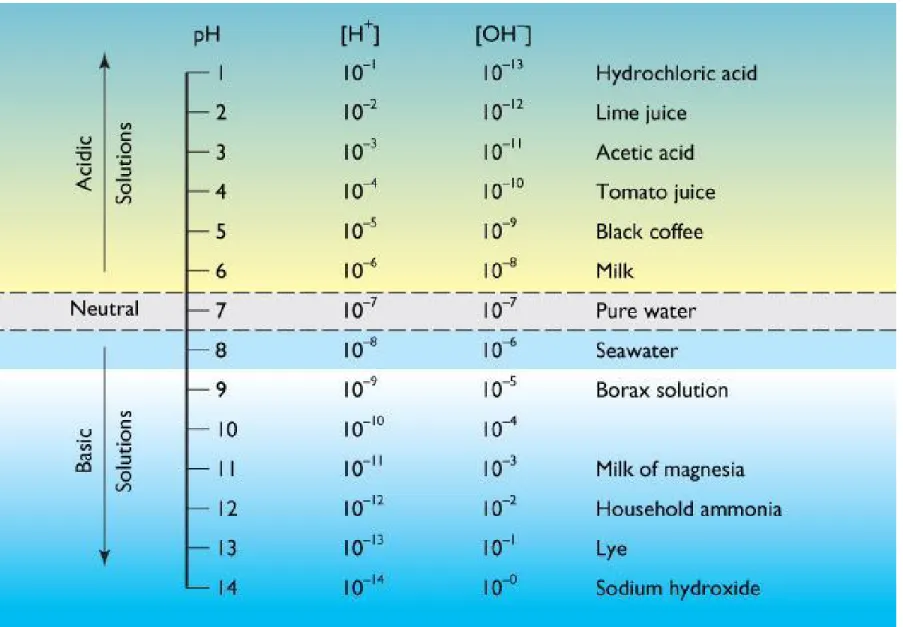
A solution is acidic if it has excess H+ (hydrogen) ions• A solution is basic if it has excess OH- (hydroxyl) ions.
• pH measures how acid or base water is.
– - pH of 0 to 7 is acidic. – - pH of 7 is neutral.
– - pH of 7 to 14 is basic.
The pH Scale
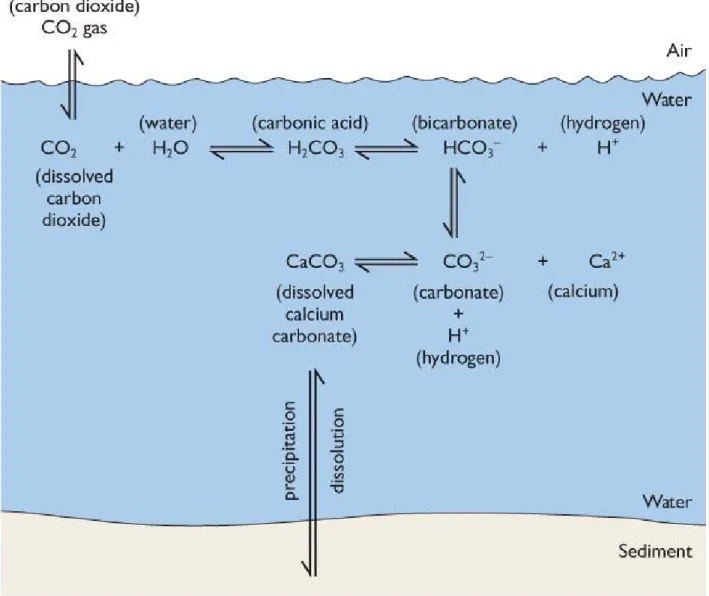
Carbon Species and the CO
2system in the oceans
• Dissolved carbon appears in water in 3 forms:
–
Carbon dioxide (CO2) reacts to form carbonic acid–
Bicarbonate (HCO3
-)
– Carbonate (CO32-)
• Basic solutions are dominated by carbonate.
• Acidic solutions are dominated by carbon dioxide.
Distribution of Carbon Species in Water
Figure 5-19a Distribution of Carbon Species in Water
The CO
2System
Figure 5-19c The CO2 System
• pH is related to the amount of CO
2dissolved in
water.
• CO
2combines with the water to produce carbonic
acid, which releases H
+ions.
CO2 + H2O ←→ H2CO3 ←→ H+ + HCO3-←→ H+ + CO3-2
– H2CO3 is carbonic acid
– HCO3- is the bicarbonate ion
– CO3-2 is the carbonate ion
CO
2+ H
2O ←→ H
2CO
3←→ H
++ HCO
3-←→ 2H
++ CO
3-2
• Changing the amount of CO
2shifts the reaction to
either the right or left of the equation.
– Adding CO2 shifts the reaction to the right and produces more H+ ions.
• This makes the water more acidic.
– Removing CO2 shifts the reaction to the left,
combining H+ ions with carbonate and bicarbonate ions.
• This makes the water less acidic.
• Dissolved CO2 in water acts as a buffer
– A buffer is a substance that prevents large shifts in pH.
5-6 Gases in Seawater
• Dissolution of carbonate shells in deep water occurs because:
– cold water under great pressure has a high saturation
value for CO2
– the additional CO2 releases more H+ ions making the
water acidic
• Carbonate sediments are stable and do not dissolve in warm, shallow water because the water:
– is under low pressure
– contains less dissolved CO2
– is less acidic than the deep water.
Water is recycled continually between the
ocean and the land
• The reservoirs of free water include:
– Oceans:
• cover 60% of the northern hemisphere • cover 80% of the southern hemisphere • contain 97% of Earth’s water
– Rivers, lakes and glaciers
– Groundwater
• contains a larger volume of water than all of the combined water in lakes and rivers
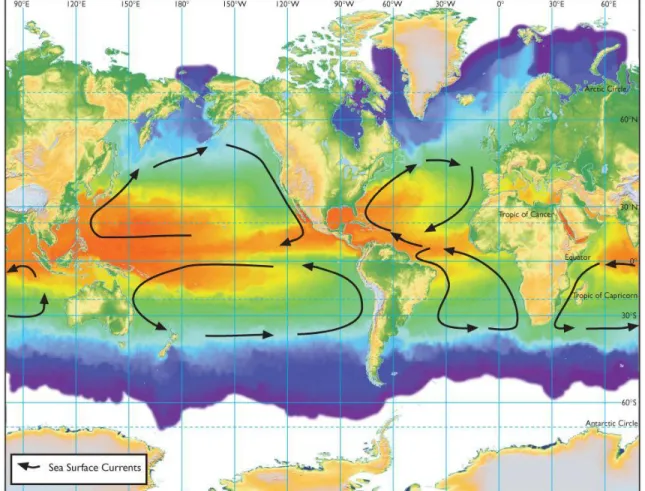
• Ocean surface temperature strongly correlates with
latitude.
– This is because insolation – the amount of sunlight
striking Earth’s surface – is directly related to latitude.
• Ocean
isotherms
– lines of equal temperature –
generally trend east-west except where deflected
by currents.
• Ocean currents carry warm water poleward on the western side of ocean basins.
Sea Surface Temperatures
• Insolation and ocean-surface water temperature vary with the season.
• Ocean surface temperature is highest in the tropics (25oC) and decreases poleward.
• Tropical and subtropical oceans are permanently
layered with warm, less dense surface water
separated from cold, dense deep water by a
thermocline
.
– The thermocline is a layer in which water temperature and therefore density change rapidly.
Salinity changes with latitude due to variations in
precipitation and evaporation
• Highest ocean salinity is between 20-30o north and south of the
equator, because evaporation exceeds precipitation.
• Salinity at the equator and poleward of 30o is low because
evaporation is less than precipitation.
Figure 5-12b Latitudinal Variations in Salinity and “Dryness”
• In some places surface water and deep water are
separated by a
halocline
.
– The halocline is a zone of rapid change of
salinity, and therefore density, with water
depth.
Density of sea water is a function of
temperature, salinity and pressure
• Density increases as
– temperature decreases
– salinity and pressure increase.
• Pressure increases regularly with depth, but
temperature and salinity are more variable.
• Higher salinity water can rest above lower salinity water if:
– the higher salinity water is sufficiently warm – the lower salinity water is sufficiently cold
• Pycnocline is a layer within the water column where water density changes rapidly with depth.
Figure 5-14a Seawater Density
Note that the
isopycnals (equal density lines) are curved - this is
because salinity must increase (which
increases density) as temperature increases (which lowers density) to maintain a given
Thermocline, Halocline, and Pycnocline
Figure 5-14b
Decreased Temp = Increased Salinity = Two Pycnoclines here increased Density increased density where density changes with
• The water column in the ocean can be divided into the:
– surface layer – pycnocline – deep layer
The
Surface Layer
• About 100m thick
• Comprises about 2% of the ocean volume
• Is the most variable part of the ocean because it is
in contact with the atmosphere.
• Is
less dense
than the layers below because of its
The Pycnocline
• Is transitional between the surface and deep layers.
• Comprises 18% of the ocean basin.
• In the low latitudes, the pycnocline coincides with
the thermocline.
The Deep Layer
• Represents 80% of the ocean volume.
• Water in the deep layer originates at the surface
in high latitudes, where it:
– cools
– becomes dense
– sinks to the sea floor
Helium-3
Figure 5-16 Helium-3
• Oxygen tends to be abundant in the water of the surface layer and deep layer, and lowest in the pycnocline.
• Surface layer is rich in oxygen because of photosynthesis and diffusion from the atmosphere layer.
• Oxygen minimum layer occurs at about 150 to 1500m below the surface and coincides with the pycnocline.
5-6 Gases in Seawater
The Oxygen Minimum Layer
• Sinking food particles settle into this layer and are
slowed down by the sharp density gradient.
• The food draws large numbers of organisms which
respire, consuming oxygen.
• Decay of uneaten material consumes additional
oxygen.
• Density difference prevents mixing downward of
oxygen-rich water from the surface or upwards
from the deep layer.
• The deep layer is rich in oxygen because its
water is derived from cold surface waters
that sank to the bottom.
• Oxygen consumption by respiration is low
because there are fewer organisms in the
deep layer.
• Anoxic waters contain no oxygen and are
inhabited by anaerobic organisms (bacteria).
• The hydrologic cycle
describes the exchange of
water between ocean, land and atmosphere.
– On land precipitation exceeds evaporation.
– In the ocean evaporation exceeds precipitation.
Figure 5-20 Hydrologic Cycle
The ocean is part of a vast biogeochemical system
• Rocks on land undergo weathering.
• The products are transported to the sea.
• They may be deposited directly or used by organisms and later deposited as organic remains or organic wastes.
• These sedimentary deposits are buried, lithified and recycled by plate tectonics into new land
• The new land then undergoes weathering repeating the cycle.
Biochemical Recycling of Matter
Figure 5-22 Biogeochemical Recycling of Matter
• Water samples must be collected in inert
containers and isolated as they are
recovered so as to prevent contamination.
• The Niskin bottle has valves at each end.
– They automatically close when a weight (called
a
messenger
), is sent down the cable and
causes the bottle to flip over and seal itself.
• Sample depth can be determined from cable
inclination and length or with a pulsating
sound source.
Desalinization
is the process of producing
potable (drinkable) water from seawater using
one of the following methods
•
Distillation
is the evaporation of seawater and the
condensation of the vapor.
•
Freezing
produces salt-free ice which can be melted for
water.
The Ocean Sciences: Desalinization
•
Reverse osmosis
is placing seawater under
pressure and forcing water molecules
through a semi-permeable membrane,
leaving a brine behind.
•
Electrodialysis
is using electrically charged
surfaces to attract cations and anions,
leaving behind freshwater.
•
Salt absorption
is using resins and charcoal
to absorb ions from seawater.
• Sea ice is ice that forms by the freezing of sea
water.
– Icebergs are detached parts of glaciers.
• As ice forms, the salt remains in solution: – increasing salinity
– further lowering the freezing point of the water
• Depending upon how quickly the ice freezes, some salt may be trapped within the ice mass, but is gradually released.
As sea water
freezes, needles of ice form
The needles grow into platelets
The platelets
• Pancake ice
are rounded
sheets of flexible sea ice
that become abraded as
they collide.
• Sea ice thickens with time as snow freezes to its
surface and water to its bottom.
• The amount of light entering the ocean depends upon: – the height of the sun above the horizon
– the smoothness of the sea surface
• 65% of light entering the ocean is absorbed within the first meter and converted into heat.
• Only 1% of light entering the ocean reaches 100m.
• Water displays the selective absorption of light: – long wavelengths are absorbed first
– short wavelengths are absorbed last
• In turbid coastal waters
light rarely penetrates
deeper than 20m.
– The water appears
yellow to green because
particles reflect these
wavelengths.
• The
photic zone
is the part of the water
column penetrated by sunlight.
• The
aphotic
zone is the part of the water
column below light penetration and
permanently dark.
• The speed of sound in water increases as:
– Salinity increases
– Temperature increases
– Pressure increases
• In the ocean, the speed of sound is mainly a
function of temperature and pressure.
• Above the pycnocline, increasing pressure with
depth
increases the speed of sound
, despite the
gradual decrease in temperature.
• Within the pycnocline, the
speed of sound
decreases
rapidly because of the rapid decrease in
temperature and only slight increase in pressure.
• Below the pycnocline the speed of sound
•
SOFAR Channel
is located where sound speed is at a
minimum.
• Refraction of sound waves within the channel prevents
dispersion of the sound energy.
• Sound waves travel for 1000s of kilometers within the
channel.
Sound Speed Increases
• The
sea surface microlayer
is the water surface
to a depth of a few hundred micrometers.
• It is critical for the exchange of gases, liquids, and
solids between the atmosphere and the ocean.
• The
neuston layer
is the habitat of the sea surface
microlayer and is inhabited by
neuston.
• Processes that transport matter to the
surface layer from below are:
–
Diffusion
- random movement of molecules.
–
Convection
- vertical circulation resulting in
the transfer of heat and matter.
–
Bubbles
- the most important process because
bubbles absorb material and inject it into the air
as they bursts.
• Processes within the microlayer can be
divided into the:
–
Biological
- bacteria and plankton are more
densely concentrated in the neuston layer than
below.
–
Photochemical effect
- the interaction of
ultraviolet light and organic compounds.
Recycling of Water
Figure 5-21 Recycling of Water
Light Absorption



![Jeopardytemplate[1].ppt](data:image/gif;base64,R0lGODlhAQABAIAAAP///wAAACH5BAEAAAAALAAAAAABAAEAAAICRAEAOw==)