Units and Dimensions
Lec -1
Topics to be Covered
List of Topics No of
Weeks Contact hours
1
-Definitions fundamental and
derivatives units and measurement system
1 3
Dimensional analysis 1 3
2
-Vectors 2 6
3
-mechanics(motion along straight
line) 1 3
4
-force and Newton law of motion 1 3
5
-kinetic energy and work 1 3
6
-fluid(fluid density and pressure-
equation) 2 6
pascal Archimedes
principal-equation of continuity- Bernoulli 2 6
7
-electric field-current 1 3
8
-resistance
- 1 3
3
9
-electromagnetic wave 1 3
10
-nuclear 1 3
What is Physics and Why is it Important
?
Physics: The science in which matter and energy are studied both separately and in combination with one
another
.
And a more detailed working definition of physics may be: The science of nature, or that which pertains to natural objects, which deals with the laws and properties of matter and the forces which act upon them. Quite often, physics concentrates upon the forces having an impact upon matter, that is,
gravitation, heat, light, magnetism, electricity, and others
.
Physics. Range of Fields
- Nuclear Physics. Study of the physical properties of the atomic nucleus.
- Astrophysics. Study of the physical properties of objects in space.
- Biophysics. Study of physics in living systems.
- Electromagnetism. Study of electrical and magnetic fields, which are two aspects of the same phenomenon.
- Electronics. Study of the flow of electrons, generally in a circuit.
- Fluid Dynamics and Fluid Mechanics. Study of the physical properties of "fluids," specifically defined in this case to be liquids and gases.
-High Energy Physics. Study of physics in extremely high energy systems, generally within particle physics
.
-Laser Physics. Study of the physical properties of lasers
.
-Mathematical Physics. Discipline in which rigorous mathematical methods are applied to solving problems related to physics
.
-Mechanics. Study of the motion of bodies in a frame of reference
.
-Molecular Physics. Study of physical properties of molecules
.
-Nanotechnology. Science of building circuits and machines from single molecules and atoms
.
-Optics and Light Physics. Study of the physical properties of light
.
-Particle Physics. Study of fundamental particles and the forces of their interaction
.
-Quantum Mechanics and -Quantum Physics. Study of science where the smallest discrete values, or quanta, of matter and energy become
relevant
.
-Thermodynamics. Physics of heat
PHYSICAL QUANTITIES
•
A quantity that can be measured.
•
A physical quantities have numerical
value and unit of measurement.
•
For example temperature 30 degrees
celcius, 30 is numerical value & ‘degree
celcius’ is the unit. Written as 30
oC
.Temperature = 30 degree Celcius = 30o c
are physical quantities that cannot be derived from other physical
quantities . 1 -length 2-mass 3-time 4-current 5- temperature,
6-amount of substance
7
-and luminous intensity
Base quantities
are physical
quantities derived from combination of base quantities
through multiplication or division or both
Area –volume- acceleration-velocity-force-density- work-power-energy- pressure . derived quantities
Physics quantities can be classified into
SI units (International System Units).
Base quantities
1- Mass: The amount of matter in a body.
• SI Units: kilogram (kg) • Common Units:
pounds (lbs) and ounces (oz) 1 kg is approx. 2.2 lbs
1 kg = 1000 g 1 oz = 28.35 g
Kilogram is defined in terms of platinume-iridume standard mass kept near Paris. For
measurements on an atomic scale ,
the atomic mass unit (U),defined in terms of an atomcarbon-12,is usually used
.
The relation between the units is
2- Length:
A measure of distance.
•
SI Unit:
meter (m)
•
Common Units:
inches (in); miles (mi)
1 in = 2.54 cm = 0.0254 m
1 mi = 1.609 km = 1609 m
The meter is
: the length of the
path traveled by light in a vacuum
during a time interval of
of a
3
-Time
Time in physics is defined by its measurement: time is what a
clock reads. Time can be combined mathematically with
other physical quantities to derive other concepts such as
motion
.
The second is the time taken by 9,192,631,770 oscillations of the light (of specified wave length)
Example of derived quantity 1- area
2
-Volume:
Amount of space occupied by a body
.
volume = m × m × m = m3
SI Unit: cubic meter (m3)
• Common Units: Liter (L) or milliliter (mL) or cubic centimeter (cm3)
3
-Density: Amount of mass per unit volume of a substance .
SI Units of density = kg / m3 = kg m−3
• Common Units: g/cm3 or g/mL
23
-A 2.00x3.00 m plate of aluminum has a mass of 324 kg What is the thickness of the plate? (The density of aluminum is 2.70x10³kg/m3)
Solution: =m/v
V=m/
h=324/2.70x103x2.00x3.00=0.02m
L.W.h= m/
4- Velocity = displacement/ time
Units of speed = m/s
5
-acceleration = velocity/time
Units of acceleration = m/
6- Force = mass × acceleration
Units of force = Kg m/s2
7- Work = Force x Displacement
Units of Work = J = Kg m2/s2
8-Energy = Mass x gravity x high
Units of Energy = J = Kg m2/s2
9- Power = Force x displacement / time
Units of Power = W = Kg m2/s3
10-Pressure = Force / area
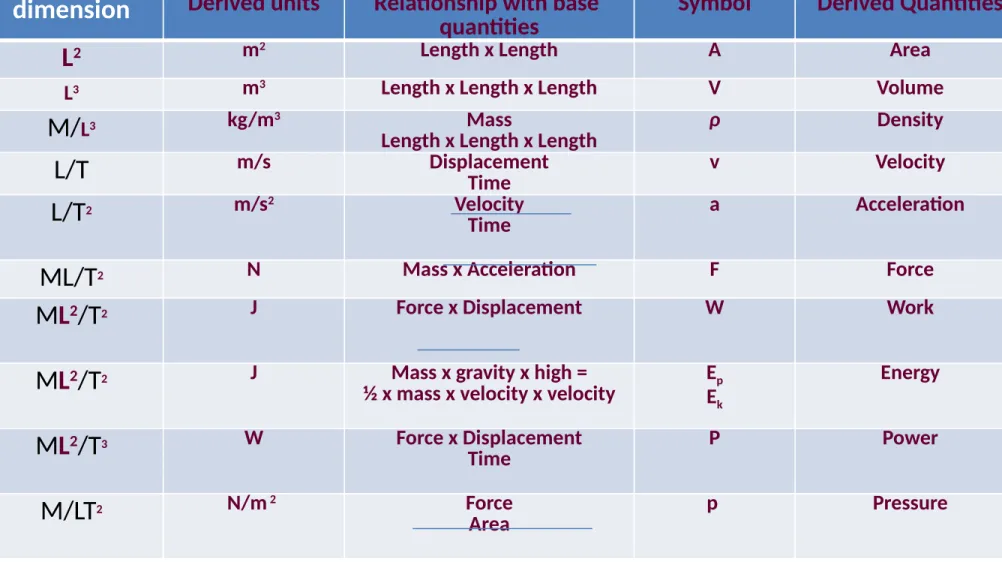
Table 1.2 shows some of the derived quantities and their respective derived units
dimension Derived units Relationship with base
quantities Symbol Derived Quantities
L2 m2 Length x Length A Area L3 m3 Length x Length x Length V Volume
M/L3 kg/m3 Mass
Length x Length x Length ρ Density
L/T m/s DisplacementTime v Velocity L/T2 m/s2 Velocity
Time a Acceleration
ML/T2 N Mass x Acceleration F Force
ML2/T2 J Force x Displacement W Work
ML2/T2 J Mass x gravity x high =
½ x mass x velocity x velocity EEpk Energy
ML2/T3 W Force x Displacement
Time P Power
M/LT2 N/m 2 Force
PREFIXES
Value Symbol Prefix
1015 P Peta
1012 T tera
109 G giga
106 M mega
103 k kilo
102 h hekto
10 da deka
10-1 d deci
10-2 c centi
10-3 m milli
10-6
m micro
10-9 n nano
10-12 P pico
10-15 F Femto
PREFIXES :
For each of the following, express the magnitude using a scientific notation.
1-20000000 2-345000 3-0.0000023 4-0.00000006 5-123402123100
Solution:
1- 2x 10⁷
2- 3.45x 10⁵
3- 2.3x 10⁻⁶
4- 6x 10⁻⁸
5- 1.2 x 10¹¹
1
-2million meters (2,000,000m) written in
scientific notation form= or
written using prefix=
2Mm
. (2 mega meter)
.
2
-Fill the table
Example
number
Scientific
form
Prefixes form
2900
2
K
2.9
Dimensional Analysis
The word dimension in physics indicates
the physical nature of the quantity. For
example the distance has a dimension of
length
, and the speed has a dimension of
length
/
time
.
The dimensional analysis is used to
Example
Using the dimensional analysis check that this equation x = ½ at2 is correct, where x is the distance, a is the acceleration
and t is the time.
Solution
x
= ½
at
2Example
Show that the expression v = vo + at is dimensionally correct, where v and vo are the velocities and a is the acceleration, and t is the time
Solution
The right hand side [
v
] = L/T
The left hand side L/T+L/T =
2 L/T=L/T
Example
Suppose that the acceleration of a particle moving in circle of radius r with uniform velocity v is proportional to the rn and vm. Use the dimensional analysis to determine
the power n and m.
Solution
Let us assume a is represented in this expression
a
=
k r
nv
mWhere k is the proportionality constant of dimensionless unit.
The right hand side
n
+
m
=1 and
m
=2
Therefore.
n
=-1 and the acceleration
a
is
Exercise
Part A:
See if you can determine the dimensions of the following quantities:
volume
acceleration (velocity/time) density (mass/volume)
force (mass × acceleration
Check your answers
You are correct if you wrote down:
1.Volume L3
2.acceleration (velocity/time) L/T2
3.density (mass/volume) M/L3
Now find the dimensions of these:
1-pressure (force/area)
2-(volume)2
3-work (in 1-D, force × distance)
4-energy (e.g., gravitational potential energy = mgh
5.square root of area
answers
1.
pressure (force/area)
M·L-1·T-22.
(volume)
2 L63.
work (in 1-D, force × distance)
M·L2/T24.
energy (e.g., gravitational potential energy = mgh
= mass × gravitational acceleration × height)
M·L2/T2Which one of the following quantities are dimensionless?
1-68
2-sin (68 ) 3-e
4-force 5-6
6-frequency 7-log (0.0034)
What are the dimensions of the following?
1.[3]
2.[force] 3.[height]