
Ecology
Look at the Word “Ecology.”
•
Eco =
House
•
-ology =
Study of
•
Study of
Ecology
•
Interaction of
organisms
with each
other, and
Ecology and Human History
• Humans --- especially those in western cultures --- didn’t really understand the concept of Ecology.
• Some ancients Greeks recognized there was a connection between organisms in nature.
• Herodontus
• Noticed crocodiles didn’t eat the sandpipers
(birds) cleaning out of its.
• They must rely on each other to survive.
Animals we killed
because we thought they
were evil.
• Honshu Wolf
Animals we killed because we thought
they were controlled by witches.
Animals we killed off because we
thought they were a witch…
• Great Auk
• Technically only one was killed
because some people thought it was a witch.
• The rest were hunted for it
However…
• Interconnectedness between…
• Animals • Plants • Bacteria • Mushrooms • Air • Water
• Wouldn’t be fully appreciated for a long time.
• Even now we don’t know
So in this unit we will learn about the
basics of Ecology which is…
•
Interaction of
organisms
with each
other, and
First: What is the environment?
•
Environment
-•
All conditions
surrounding
an organism.
•
Can be broken
1
stPart: Biotic
•
Biotic: all living parts of the
environment.
• Trees2
ndPart:
•
Abiotic:
Nonliving parts of the
environment.
Examples of the Interactions of Abiotic and
Biotic
• Tadpoles eat algae, frog eats insects, herons eat
frogs
• Frog is affected by how much water is available,
temperature and humidity.
• Organisms influence abiotic factors; tree canopy
Ecology
•
Interaction of
organisms with each
other and their
physical environment.
•
Scientists have
classified different
levels of organization.
•
Levels reflect
different types
1
1
ststLevel of Organization
Level of Organization
•
Organism
Organism
:
:
An individual living
An individual living
thing that is made of
thing that is made of
cells, uses energy,
cells, uses energy,
reproduces,
reproduces,
responds, grows, and
responds, grows, and
develops
develops
2
2
ndndLevel of Organization
Level of Organization
•
Population
Population
:
:
A group of
A group of
organisms, all of
organisms, all of
the same species,
the same species,
which interbreed
which interbreed
and live in the
and live in the
same place at the
same place at the
same time.
same time.
3
3
rdrdLevel of Organization
Level of Organization
•
Biological
Biological
Community
Community
:
:
All the populations
All the populations
of different species
of different species
that live in the
that live in the
same place at the
same place at the
same time.
same time.
4
4
ththLevel of Organization
Level of Organization
•
Ecosystem
Ecosystem
:
:
Populations of Populations of plants and animals that interactplants and animals that interact
with each other in a given area
with each other in a given area
with the abiotic components of
with the abiotic components of
that area.
that area.
(terrestrial or
(terrestrial or
aquatic)
aquatic)
5
thLevel of Organization
•
Biome
6
6
ththLevel of Organization
Level of Organization
•
Biosphere
Biosphere
:
:
The portion
The portion
of Earth that
of Earth that
supports life
supports life
.
.
The Biosphere
The Biosphere
•
Life is found in air, on land, and in
Life is found in air, on land, and in
fresh and salt water.
fresh and salt water.
•
The
The
BIOSPHERE
BIOSPHERE
is the portion of
is the portion of
Earth that supports living things.
Earth that supports living things.
Energy, Producers, Consumers
•
Every organism
needs energy to
fuel life’s
processes.
•
Growth
•
Reproduction
•
Other metabolic
processes
•
No organism can
create energy.
Only animal that makes its own
energy…
Cyborg Bear with built in fusion
Ultimate Source of Energy on the
Planet
•
Organisms use energy from
other sources.
•
Sunlight is the ultimate
To be alive is to be part of a struggle for
energy.
•
Energy = Life
•
Many
strategies to
get this
energy.
•
Two basic
Strategy 1:
Be an Autotroph
•
Harness
Strategy 2: Be a
Heterotroph
•
Obtain energy
by eating other
organisms.
Primary Producers
•
Autotrophs
•
First producers of
energy-rich
compounds
Autotroph: Process I
•
Photosynthesis-using sunlight;
making oxygen,
removing carbon
dioxide
• Plants-land
• Algae-freshwater and
surface ocean
• Cyanobacteria-tidal flats
Autotroph Process II
• Chemosynthesis-chemical
energy is used to produce carbohydrates
• Deep ocean floor, harsh
environments (volcano vents), hot springs.
Note
• Photosynthesis = ~99% of
autotrophs
• Chemosynthesis = ~1% of
autotrophs
• Organisms use one, not
Consumers
•
Organisms that rely on other
organisms for energy, nutrients.
•
Animals, many bacteria
•
Usually involves ingesting an organism.
Type of Consumers
• Different types of consumers. • Depends on where the food
chain the organism is.
• Primary • Secondary • Tertiary • Quatinary
Primary consumer - Animals
that eat plants or other
producers
Herbivores – are able to digest
•
Secondary or tertiary
consumers
•
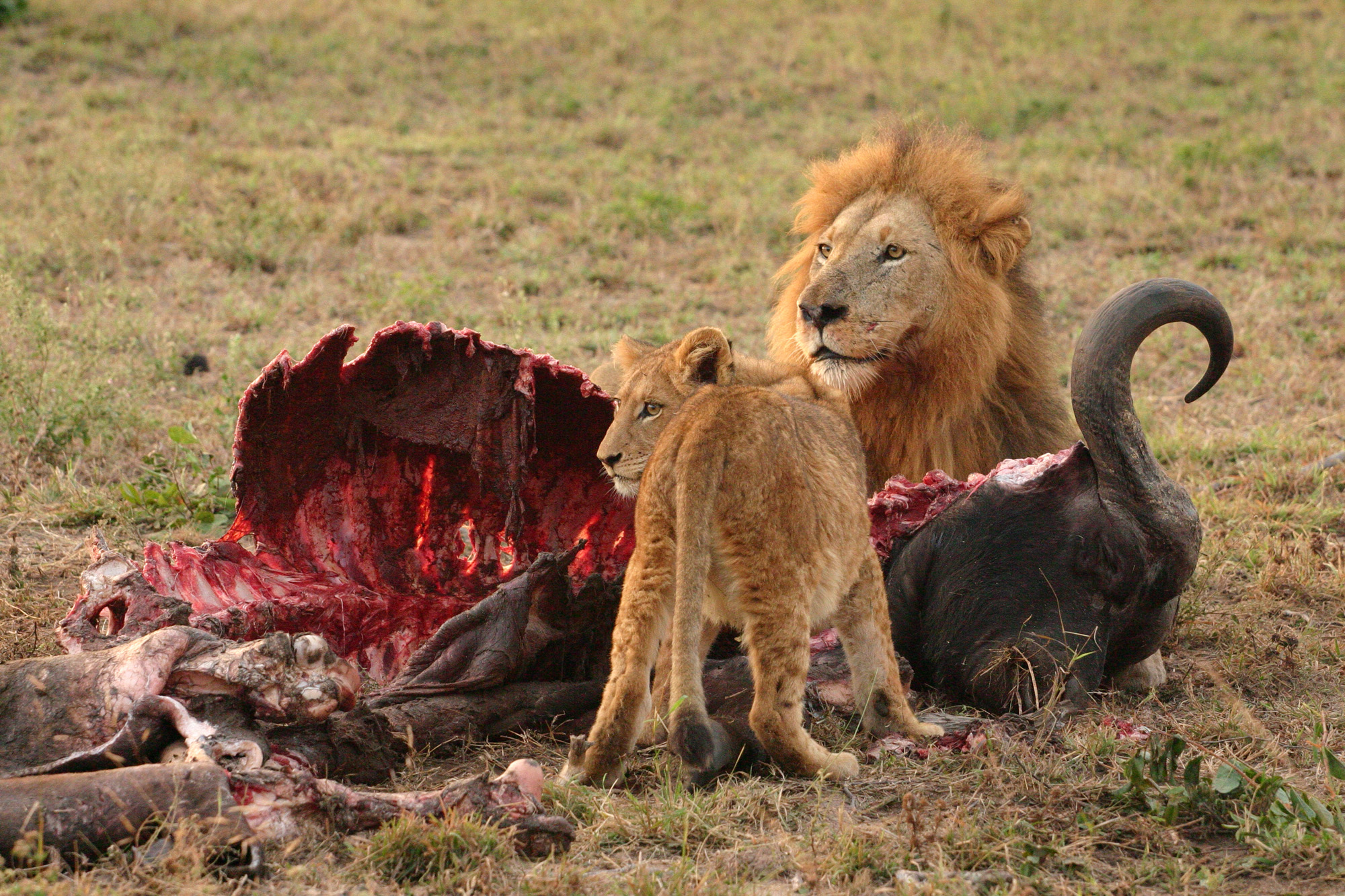
Carnivores
•
Organisms that get their
•
Omnivores
•
Animals that get their
energy from both
producers and consumers
are omnivores.
•
Eat plants but CANNOT
digest cellulose.
•
Can still eat and get some
nutrients from it.
Scavenger
• Heterotroph
•
An animal that
feeds on carrion,
dead plant
material, or
refuse.
•
Food source must
Decomposers and Detritivores
• Decomposer – No Mouth • Breaks down dead materials
• Plant or Meats
• releases nutrients that are used
by primary producers
• Decomposers are recyclers
• Without them the circle of life
ends.
• No nutrients = no plants = no
animals = no ANYTHING!!.
• Detrivore - Mouth • organism that feeds
on plant and animal
Food Chain
•
Energy flow through an ecosystem.
•
One way stream-primary
•
Energy flows from producer to consumers.
•
Organisms transfer energy:
•
Eating
•
Being eaten
•
Absorbing
KEY PIECES
•
One direction
•
Arrow Points to
where the
energy to
moving towards!
•
Multiple levels
•
Note:
•
The different
levels have
Arrow always points to the eater. (To
the organism obtaining the energy)
Food Webs
• Many animals eat more than one kind of food. • A food web is:
• many food chains linked together
• shows a model of the feeding relationships of
NOTE
• More Complex than a food chain
• Many food chains linked.
Trophic Levels
• Each step in a food
chain or a food web.
• Bottom level is always
the first level.
• Plants
• Primary Consumers
• Things that eat plants.
• Secondary Consumers
• Eat primary consumers.
• Tertiary Consumers
Ecological (Trophic) Pyramids
• Show the relative amount of energy and matter
contained within each trophic level
• Pyramids of energy • Pyramids of biomass
Pyramid of Energy
• Only a small amount of energy passes between trophic
each levels.
• Organisms expend energy in • Respiration
• growth
• reproduction
• A lot is also wasted and released as heat energy.
• About 10% of the energy in one trophic level is passed
to the next trophic level.
• Passed = Stored in the fat and muscles of
Pyramids of Biomass and Numbers
•
Biomass-the total amount of living tissue in
a trophic level.
•
Took all the organisms.
•
Put them in a ball
•
Dried that ball
•
That is total biomass
•
Population-relative number of organisms in
•
Organisms have relationships
•
With other organisms
•
With the environment
What is a niche?
•
Niche –
1.
the biotic and abiotic needs of a
organism
2.
How the organism gets those
needs.
•
Resources: food, water, space
•
Abiotic factors: weather, moisture
•
Biotic factors: reproduction, specific food
Amazonian Horned Frogs
• Niche
• Amazon Rain Forest • Freshwater
• Stalks prey by hiding in
leaves
• Then it “Chomps” them. • This is how it survives
•
One Animal = One Niche
•
Rarely do two organisms share
the same niche.
•
The better one would just win
•
Similar
organism can
coexist as long
as they have
Competition
•
Two organisms compete for the same
resource.
•
Relationship: /
-• Both suffer as a result.
How do organism interactions shape ecological
communities?
•
Predation
•
One organism
captures and
feeds on another
•
Relationship : + /
-
•
Large impact on prey
Predator-Prey
•
Predator - capturing, subduing
prey
•
Prey - avoiding, escaping, fighting
off predator
How do organism interactions shape ecological
communities?
•
Symbiosis
•
Any relationship where species live
closely together
•
Mutualism – both benefit
•
+/+
•
Commensalism – one benefits, no
effect on the other
•
+ / …
•
Parasitism – one benefits, other is
harmed


.jpg)