Statistical Physics (PH-524) Section V
Phase Transitions and Critical Phenomenon Lecture 5.1
• Statistical mechanics by R K Pathria & Paul D. Beale, 3rd Edition, Elsevier
• Concepts in Thermal Physics by S. J Blundell • Thermal Physics by Daniel V. Schroeder
Phase transformations
A discontinuous change in the properties of a substance as environment is changed infinitesimal.
Ice, water and steam are different phases of H2O.
Phase diagram of H2O
• Stable Phases: Ice, water and steam
• Metastable phases can also Exists, e.g., water can be
“Supercooled”
• On phase diagram, lines represent the conditions under which two different phases can coexist in equilibrium.
• Pressure at which gas can coexist with solid or liquid phase is called vapour pressure.
• At T = 0.01oC and P = .006 bar, three phases coexist. This point is called Triple point.
• Triple point of CO2 lies above atm press. It is 5.2 bar.
• Note the difference in solid-liquid phase boundary for CO2 and H2O.
• Most substances are like CO2. If we increase pressure,
melting temperature also increase (Positive slope). However, for ice it is not so. Applying pressure, lower
• Liquid-gas phase boundary always has a positive slope.
• If liquid and gas are in equilibrium, and if temp is raised, press also need to increase to keep liquid from vaporizing.
• However, as pressure is increased gas become more
dense. A point known as Critical point is reached where is not possible to distinguish between liquid and water. (we call it just fluid)
Critical point:
For H2O: 374oC and 221 bar; For CO
• Boiling point of 4He at atm press is 4.2K and critical point (5.2K,2.3 bar)
• Only element which remain liquid at absolute temperature.
• 4He has two phases: He I (Normal phase) & He II
Few important points
• For a thermally isolated system, the stable equilibrium situation is characterized by
Entropy S = Maximum
• For a system which is in contact with a heat reservoir such
that temperature is held constant
equilibrium corresponds to the situation when
Helmholtz free energy F = U-TS is minimum
• For a system which is in contact with a reservoir such that temperature and pressure is held constant
equilibrium corresponds to the situation when
• Stability conditions for a homogeneous substance
Consider a one-component system in single phase
Consider a small part A of this system having some fixed no of particles. Rest part can be considered as reservoir at temp T0 and pressure P0
Stability equilibrium applied to A
• If we allow temperature variations
• If we allow variations in volume
Density fluctuations
Condition for equilibrium of phases
We consider single component system with two phases say phase 1 and 2.
For example ice and water as two phases of H2O
Suppose system is in contact with reservoir at temp T and press P. At equilibrium
We consider N1 and N2 as no of particles in phase 1 and 2, such that
---(1) Equilibrium implied that
=0
---(2) And therefore
Conservation of matter implied that
---(4) And therefore
---(5)
Thus from eq.(3)
=0 ---(6)
The Clausius–Clapeyron equation
Here we want to find an equation which describe the phase boundary between two phases
We start from the equilibrium condition
We move along the phase boundary such that and
From eq.(7) note that, left side represent the slope of
phase equilibrium at point (T,p) and is related to change in the entropy and volume of substance on “crossing the line” at this point.
As entropy change occur on moving from one phase to
other heat is also absorbed.
We define the “Latent heat of transformation” as the heat
Latent heat per particle
Eq.(9) helps to understand the nature of slope of line
separating solid-liquid phases in substances e.g. H2O and CO2.
As solid melts into liquid, entropy increase. Latent heat is absorbed and heat gets absorbed.
• In most cases, solid expands upon melting i.e.,
If i.e., substances contract on melting, for example in case of water.
Exercise: Derive the equation for the phase boundary
between liquid and gas, considering vapours as ideal gas.
Exercise: Derive the equation for the phase boundary
Classification of Phase transitions
• Order of the phase transition is determined from the
order of lowest differential of Gibbs free energy G which shows discontinuity at Tc.
• First order phase transition: If the first derivative
given by eq.(1) are discontinuous and hence, S and V, then phase transition will be of 1st order.
Heat capacity, which is a 2nd derivative of G, will show a
If the 2nd differential of G (i.e. heat capacity,
compressibility) is discontinuous, then transition is called 2nd order phase transition.
Examples: Superconducting transitions
Transitions other than 1st order are also known as
Liquid-gas phase transition is a 1st order phase transition except at critical point where it is continuous or 2nd order.
In relation to phase transitions one usually use the parameter known as “order parameter” ( ).
For example, for liquid gas phase transition we can define density difference as order parameter
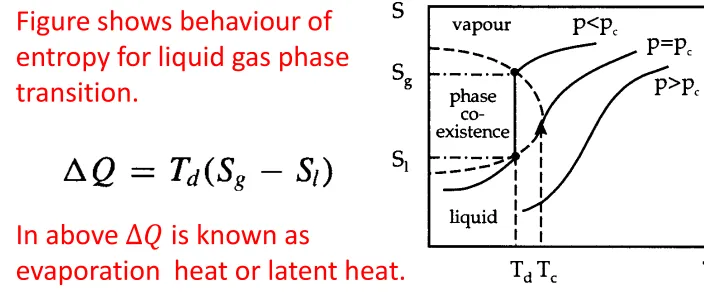
Figure shows behaviour of entropy for liquid gas phase transition.
In above is known as
evaporation heat or latent heat.
• 1st order transitions involve latent
For 1st order phase
In general