https://doi.org/10.3926/jiem.3099
Key Performance Indicators (KPIs) to Promote Building Developers
Safety Performance in the Construction Industry
Abubakar Sadiq Mahmoud1 , Mohd Hamdan Ahmad1 , Yahya Mohd Yatim1 , Yakubu Aminu Dodo2 1Universiti Teknologi Malaysia UTM (Malaysia)
2Istanbul Gelisim University (Turkey)
[email protected], [email protected], [email protected], [email protected]
Received: January 2020
Accepted: May 2020
Abstract:
Purpose:The aim of this study is to establish key performance indicators (KPIs) that can be deployed in the evaluation and promotion of safety performance of building developer’s in Nigeria.
Design/methodology/approach: A thorough review of the literature was performed to generally identify sets of KPIs used to evaluate the safety performances of building developer’s during construction. Interviews and focus group discussions were conducted with eleven (11) subject matter experts and professionals to ensure inclusion, validation and clarity of the indicators and to further provide agreement/disagreement, and importance ratings for the identified KPIs. The KPIs was grouped into appropriate categories, keeping out redundant KPIs, and ensuring KPIs are clear and measurable. The Relative Importance Index (RII) and Mean values were computed.
Findings: Results from the study consist of 137 KPIs, grouped into 9 categories including: Planning, design and procurement, communication on & maintenance of effective safety behaviour, construction safety policy, construction safety personnel, management effort and support, safety training and enlightenment, administration of safety processes, investigation and reporting of accidents, and rewards and sanctions for project stakeholders. These KPIs were observed to be at different levels of importance from the respondents. The following KPIs were considered based on their extreme importance judging from the respective RII values: communicating safety requirements to designer (98.18%), safety performance set as part of contractor selection criterion (96.36%), availability and accessibility of the relevant insurance policies (98.18%) and appropriate issuance of motivational directives by the top management (100%).
Originality/value: Many studies have been done in the past where KPIs as it relates to construction safety were identified. However, the specificity of these KPIs to countries other than Nigeria requires similar research be conducted to identify building developer safety performance KPIs for the Nigerian construction industry
Keywords: construction safety, key performance indicators KPIs, building developers, assessment, construction safety performance
To cite this article:
1. Introduction
Nations all over the world consider the construction industry as a major stimulant to their economic growth and development (Okoye, Mbakwe & Igbo 2018). According to Alarcón, Acuña, Diethelm and Pellicer (2016) the construction industry is project-based with many stakeholders consisting of professionals such as designers, building developers, contractors, subcontractors and workers among others working as a team to achieve a common goal. In achieving such goal, however, the life of workers is always threatened by occupational hazards. The complex nature of the activities carried out in building construction as noted by Muiruri & Mulinge (2014); Suárez-Sánchez, Carvajal-Peláez and Catala-Alis (2017) lead to various impacts on the health and safety of workers with occupational risks during building production. Gambatese and Behm (2008) opine that despite the numerous ongoing research, accident still occurs.
Diugwu and Baba (2014) suggested that, successful delivery of the project depends on the level of compliance with safety regulations. This has led to the establishment of Occupational Safety and Health Administration (OSHA) to enforce safety laws and regulations (Jaselskis, Anderson & Russel 1996). Occupational safety forms part of operations on construction site as various skills and activities are required to be done in an environment that is safe (Wachter & Yorio, 2014). In addition, a number of research have been conducted globally in order to improve the safety performance of the construction industry (Alarcón et al., 2016; Choudhry, Fang & Mohamed, 2007; Jannadi & Almishari, 2003; Misiurek & Misiurek, 2017; Okoye, Ezeokonkwo & Ezeokoli, 2016). Many research efforts have been considered at several levels, such as design for safety”, “safety culture”, “safety climate”, and “behaviour base safety BBS” (Choudhry, 2014; Choudhry, Fang & Mohammed, 2007; Fang & Wu, 2013; Toole & Gambatese, 2008). In spite of the wide recognition of the importance of safety in the construction industry, it appears there is rare research conducted to identify building developer’s safety performance indicators. Thus, it becomes pertinent to have developed some KPIs which will guide the building developer’s commitment to safety performance before and throughout the construction stages. Besides, these elements will give an enabling environment for the industry.
project stakeholders. Thus, the objective of this paper is to establish a set of KPIs as a causal factor for each of the 9 elements for building developer to assess their safety performance.
2. Research Methodology
To achieve the objective of this research, the following activities were undertaken:
• An extensive literature review was conducted to source for the broad and different KPIs appropriate to evaluate the building developers’ safety performance.
• KPIs is grouped into appropriate categories, leaving out redundant KPIs, and ensuring the KPIs are unambiguous and measurable.
• Interviews and focus group discussions with eleven (11) member panel of experts and professionals were conducted to ensure inclusion, validation and clarity of the indicators and to further provide agreement/disagreement, and adequate ratings for the identified KPIs.
• Statistical analysis was performed on the results to derive the rate of agreement/disagreement with the identified KPIs, as well as the computed Relative Importance Index (RII) and the Mean Value and finally the level of importance.
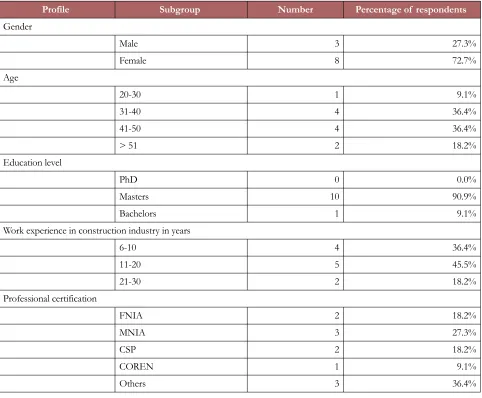
• Panel member’s main business includes: design, construction supervision and property development, and they all acknowledge the significance of safety on site. Details of panel members are presented in Table 1.
Profile Subgroup Number Percentage of respondents
Gender
Male 3 27.3%
Female 8 72.7%
Age
20-30 1 9.1%
31-40 4 36.4%
41-50 4 36.4%
> 51 2 18.2%
Education level
PhD 0 0.0%
Masters 10 90.9%
Bachelors 1 9.1%
Work experience in construction industry in years
6-10 4 36.4%
11-20 5 45.5%
21-30 2 18.2%
Professional certification
FNIA 2 18.2%
MNIA 3 27.3%
CSP 2 18.2%
COREN 1 9.1%
Profile Subgroup Number Percentage of respondents
Current engagement /designation
Representative ministry of
labour 1 9.1%
Former president NIA 1 9.1%
Building development control
(Public sector) 2 18.2%
University lecturers 2 18.2%
Others (private sector) 5 45.5%
Note: FNIA-Fellow Nigerian Institute of Architect, MNIA- Member, Nigerian Institute of Architect, CSP- Certified Safety Professional, COREN- Council for the Regulation of Engineering in Nigeria.
Table 1. Panel member’s profile
3. Key Performance Indicators for Building Developer
Øien, Utne, Tinmannsvik and Massaiu (2011) maintain that performance indicator is considered to measure both qualitative and quantitative data, which seeks to generate information on a matter of concern with safety. They are used as indicators to assess the level of construction safety on site and it determines the quality of performance (Kim, Yanq, Yeo & Kim, 2005). Herrera (2012) also upholds that, performance indicators play a vital part in providing information on organizational performance, increasing organizational potential for safety and motivating people to work in safety. Performance indicators, however, are not universal, and may vary according to the evaluation purpose and the case study at hand (Kim, Yanq, Yeo & Kim, 2005). Thus, Hale (2009) state that the main function of the performance indicators is to direct the sociotechnical activity in the organization by motivating certain safety-related activities such as the practices, abilities, skills and motivation of the personnel, the organizational potential for safety. Hale also acknowledges that organizations will improve significantly if performance indicators are used for operations. However Okoro, Musonda and Agumba (2017) posit that understanding and managing organizational processes and practices is becoming a primary concern of safety management system. Herrera (2012) concludes that in order to be in controls of a site, it becomes necessary to have the required information such as safety performance indicators so as to avoid what may occur in the future like accidents. Though, many studies, like Reiman and Pietikäinen (2012), Shea, De Cieri, Donohue, Cooper and Sheehan (2016); Sinelnikov, Inouye and Kerper (2015) have been carried out to identify indicators such as “leading” and “lagging” indicators to evaluate the safety performance on site. However, lagging indicator is based on the premise of an accident occurring and taking action that is reactive. Thus, Hale (2009) argues that performance indicators are geared toward being proactive.
3.1. Construction Safety Policy
The American Society of Civil Engineers - ASCE (2012) established that policy statement outline developer’s responsibility as the pillar for improving safety performance. The policy suggested that developer’s should take an active role and consider safety based on the specific project. The policy should have provision for contractor’s selection based on safety records (Construction Industry Institute - CII, 2015). Xinyu and Hinze (2006) also suggest that the contractor selection should be centered on the contractor that have established safety program. In addition, Gambatese (2000) also mentioned that building developer should be proactively engaged in all phases of project management in all issues relating to safety. The study by Xinyu and Hinze (2006) concluded that a building developer can positively impact project performance by active participation at the conceptual phase. Agwu (2012) identified that total safety management, when integrated in the policy of the organizations, has the potentials of enhancing safety practices on construction sites, it is recommended that for enhanced development of individuals and organizations, improved occupational safety policy is a paramount investment in terms of precautions and safety intelligence. Inuwa, Githae & Diang (2014) reported that comprehensive safety policy requires that safety be reflected at all project phases. It is obvious that the safety performance of workers has a strong link with safety policies of the building developer.
3.2. Planning, Design and Procurement
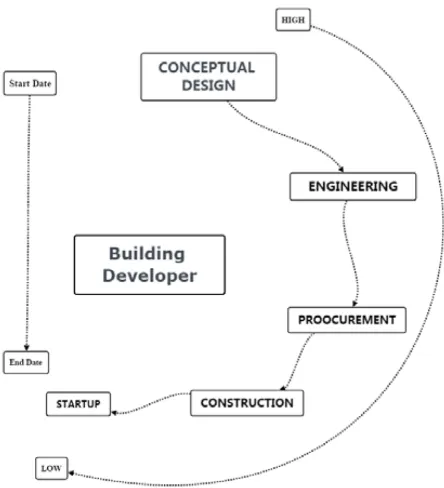
Figure 1. Time/safety influence curve (Szymberski, 1997)
3.3. Construction Safety Personnel and Safety Culture
Safety personnel relate to the safety and health officer who supervise the worker activities on a construction site (Gunduz, Birgonul & Ozdemir, 2017). These activities point to the safety performance and approaches of the workers and the management in the construction industry (Biggs & Biggs, 2013). Dingsdag, Biggs and Sheahan (2008) reported that there is a need for the engagement of safety personnel to handle the impediments to worker operations. In addition, Gunduz et al. (2017) revealed that, safety performance have proved to be positively impacted by the existence improvement in safety personnel on the project site. Zwetsloot, Kines, Ruotsala, Drupsteen, Merivirta and Bezemer (2017) recommended that safety culture covering specific factors like commitment of the management, involvement of safety personnel and adoption of safety regulations with enforcement without compromise impact significantly on the overall safety performance of a company. In a research aimed at reviewing accidents and violation of safety regulations on Nigerian construction sites, (Mahmoud, Sanni-Anibire Hassanain & Ahmed, 2019; Aniekwu, 2007) found professionals and workers on site responsible for most accidents occurring on a site which requires a zealous effort of safety managers for the coordination of personnel and materials on site. However, this view contradicts the view of Mudi, Bioku, & Kolawole (2015) that linked the occurrence of accidents on construction sites to indiscipline among workers, poor strategies of communication and conditions of the site.
3.4. Communication & Maintenance of Effective Safety Behaviour
3.5. Management Commitment and Support
According to Zwetsloot et al. (2017) safety commitment is the extent to which organizational leadership is represented by the willingness to prevent and promote safety as part of organizational goals, values and morale. Safety performance is a concept of commitment approach based on establishing safety program. Thus far, due to increased interest toward safety commitment, several studies have been undertaken to examine how commitment can improve safety performance globally (Huang, Verma, Chang, Courtney, Lombardi, Brennan et al., 2012; Zwetsloot, et al., 2017). While the significance of safety commitment in improving safety performance is widely accepted. Many literature demonstrate how commitment served as an effective tool in improving safety performance (Abudayyeh, Fredericks, Butt & Shaar, 2006; Barling & Hutchinson, 2009; Michael, Evans, Jansen & Haight, 2005; Zwetsloot et al., 2017) this has necessitated the construction industry to embrace the concept of commitment. Suraji, Duff and Peckitt (2001) shows a research conducted by the Health and Safety Executive (HSE) indicates that 75% of serious accident in the construction industry are mostly initiated by lack of management’s commitment and effective support. De Silva and Walimalaratne (2012) established that the construction company with good safety performance is due to management support and commitment toward safety on the project site. Farooqui (2011) indicate that zero accident is achievable when management are committed to safety improvement and upholding to established industry standards.
3.6. Administration of Safety Processes
Safety administration and processes denote management of work activities on the construction site that is detrimental to the well-being of workers (Tappura, Nenonen, & Kivistö-Rahnasto, 2017). The process of production in construction projects is evidently hampered by failure to comply with safety practice. Umoh and Torbira (2013) suggested that attitude of workers and how they behave towards the delivery of their works while minimizing accidents and increasing output is the major driver of safety practice. In his view, however, Smallwood (2002) opines that accidents cannot be avoided in the building industry and is more of a component in building production process due to the danger inherent in it; which negatively affects adherence to safety regulations. Mahmoud, Sanni-Anibire Hassanain and Ahmed (2019) found that professionals and workers on site are responsible for most accidents occurring on a site. However, this view contradicts the view of Mudi et al. (2015) that linked the occurrence of accidents on construction sites to indiscipline among workers, poor strategies of communication and conditions of the site. The main issues in managing construction site processes is the efficiency of control of many subcontractors, operating on the construction site due different specialization in trades, as such the chances of high accident occurrence will increase (Ali, Kamaruzzaman & Sing, 2010). Moreover, sometimes contractors transfer safety responsibility to the subcontractors, thus, workers operate with unsafe practice in an unsafe environment (Shen, Ju, Koh, Rowlinson & Bridge, 2017). Various method of construction on project site must meet different construction safety standards, policy, procedure and program. Accidents occur due to unsafe actions or unsafe conditions of work (Kadiri, Nden, Avre, Oladipo, Edom, Samuel & Ananso, 2014). Accidents occur when unskilled workers are tasked to undertake a work they are not skilled enough to handle like loading unsafely, arranging and placing, non-use of safety/protective equipments, and exposure to hazardous materials and stressed (Wu, Li & Fang, 2017).
3.7. Rewards and Sanctions for Project Stakeholders
social incentive is an influential index for worker safety performance. Accordingly, workers should be actively engaged in the policy formulation and review process that will empower them to consider the risk at all levels of project execution. Though Fass et al. (2017) research findings support the system of financial reward which they argued reduced construction accident. Other researchers illustrates that despite the introduction of safety incentive, the accident situations did not change much (El-Nagar, Hosny & Askar, 2015). Also, Alarcón et al. (2016) and Jaraiedi, Plummer and Aber (1995) debated that incentive do not significantly impact on the safety performance. Molenaar et al. (2009) indicated that incentive effectiveness depends on how they are being allocated. On the other hand, Aksorn and Hadikusumo (2008) opined that incentive and sanction on safety performance do not necessarily resulted in the anticipated output of improving safety, but rather depend on the relationship of the different stakeholders in a project. Therefore, evaluating the workers attitude and behaviour toward safety operation before engaging a contract will be able to produce a desired outcome. Building developer should identify policies, approached and strategies inculcate safety culture before and during the project implementation, though, the project completed within a time frame should be considered. (Choi & Kwak, 2012).
3.8. Investigation and Reporting of Accident
Accidents happen in all kinds of construction project, the majority of accidents on construction site are as a result of unsafe environment and unsafe act (Khosravi, Asilian-Mahabadi, Hajizadeh, Hassanzadeh-Rangi, Bastani & Behzadan, 2014; Alarcón et al., 2016). Identifying and eliminating construction accident on the project site is not always possible without identifying the causal factor through accident investigation. A number of preventive methods are acknowledged to protect workers from project site hazards or to reduce the severity of the accident. These methods involve the use of guardrail systems, safety harnessing systems, safety signs and housekeeping (Chi, Chang & Ting, 2005). The accident investigation is aimed at the determining of all root causes of accidents and suggesting that measure should be taken to prevent future recurrence. Wu, Gibb and Li (2010) establish that company that tract incident and near misses have improved safety performance, the research also discovered that companies having a sufficient record of near misses have lower accident and injury rates. Thus, addressing the causal factor would prevent the incident from happening again, hence it will strengthen the safety performance of the company.
3.9. Safety Training and Enlightenment
Choudhry and Fang (2008) established that construction workers that received formal safety training and orientation record lower injury rates compared to workers that received informal orientation. OSHA (2015), indicates that part of the features of a safer firm are providing workers on the project site with training and orientation before commencing work. The International Labour Organization - ILO (1995) also promoted safety and health on construction with emphasis on training by adopting the 1988 Safety and Health in Construction Convention (No. 167), and Recommendation (No. 175). Tackett, Goodrum and Maloney (2006) shows that significant safety enhancement can be achieved by application of construction site safety training on all projects, formalized supervisor training, hiring a full-time corporate training director, computerized tracking of worker training and increased evaluation of workers’ skills and knowledge upon hiring. Nevertheless, the majority of the study indicate safety orientation and training have to be considered as a prerequisite before engaging constructors on a project. Safety passport training’s modules should be introduced at every construction site.
4. Results and Findings
4.1. Assessment of the KPI Questionnaire Survey
The respondents’ assessments of the questionnaire survey were analysed based on the Relative Importance Index (RII) calculated according to the following equation (Dominowski, 1980; Hassanain, Sanni-Anibire, Mahmoud & Hamida, 2019):
Where ai is the constant representing the weight assigned to i; and xi is the variable representing the frequency assigned to i. The response for i is 1, 2, 3, 4, 5, and is illustrated as follows:
• x0 = frequency of “Extremely Important” response corresponding to a0 = 5.
• x1 = frequency of “Very Important” response corresponding to a1 = 4.
• x2 = frequency of “Important” response corresponding to a2 = 3.
• x3= frequency of “Somewhat Important” response corresponding to a3 = 2.
• x4 = frequency of “Not Important” response corresponding to a4 = 1.
For the quantification of the level of importance for each of the KPIs, the following range was adopted: • An RII value within (0 ≥ 12.5%) implies that, the respondents categorized the KPI as “not important”.
• An RII value within (12.5 ≥ 37.5%) implies that, the respondents categorized the KPI as “somewhat important”.
• An RII value within (37.5 ≥ 62.5%) implies that, the respondents categorized the KPI as “important”.
• An RII value within (62.5 ≥ 87.5%) implies that, the respondents categorized the KPI as “very important”.
• An RII value within (87.5 ≥ 100%) implies that, the respondents categorized the KPI as “extremely important”.
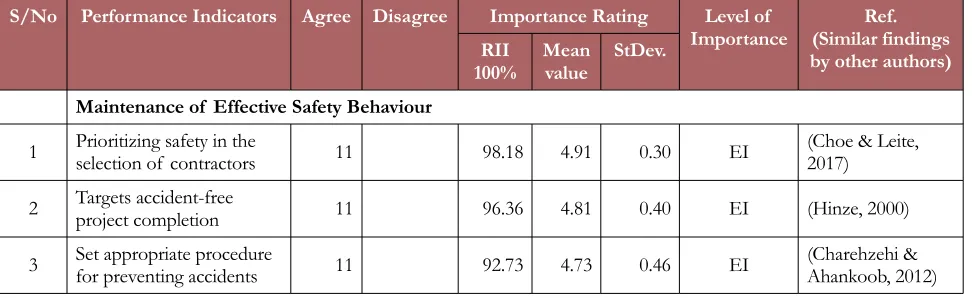
Tables 1-9 is an illustration of the various KPIs in 9 categories, with their corresponding agreement levels, as well as their RII values, mean value and levels of importance. Also referred findings from similar authors that were reviewed.
4.2. Planning, Design and Procurement
Results in Table 2, which shares similar findings with other researchers, indicate that respondents unanimously agreed on the inclusion of 24 KPIs in the Planning, design phase and procurement. except in 7 places where about 22 respondents differed in opinion. Also, 16 KPIs in this group (preconstruction) were ranked “extremely important” with RII values above 87.5%. These include: Safety related issues considered in the feasibility study (RII of 96%), communicating a safety requirement to the designer (RII of 98%), and Safety performance set as part of contractor selection criterion (RII of 96%). Contractor accident and injury rates (RII of 100%), availability of insurance policy (RII of 100%), safety requirements are outlined in the contract document for preselected contractors (RII of 100%), available plan for report of injury and incidents on site by the contractor (RII of 100%) were among the KPIs ranked with RII values at 100%. Availability of plan on accidents mitigation to be submitted by the contractor (RII of 98%), meeting up the benchmark for “extremely important” KPIs. Although 3 KPIs were rated “important” in this category.
S/No Performance Indicators Agree Disagree Importance Rating Level of
Importance (Similar findingsRef. by other authors) RII
100% Meanvalue StDev. Design Firm Engagement
1
Safety related issues considered in the feasibility study during the design conceptualization phase
11 96.36 4.72 0.47 EI
(Bello, 2012; Luo & Van Den Brand, 2016; van der Molen et al., 2018)
2
Responsiveness of design firms towards safety to forms the bases for their selection
3 8 80.00 3.91 0.70 VI
S/No Performance Indicators Agree Disagree Importance Rating Level of
Importance (Similar findingsRef. by other authors) RII
100% Meanvalue StDev.
3 Construction safety constructability considered
by designers 11 94.55 4.64 0.67 EI
(Gambatese et al., 2008)
4 Engaging safety professionals to review the
design. 11 92.73 4.55 0.69 EI
(Weinstein, Gambatese, Asce & Hecker, 2005)
5 Design decisions that impact safety on
construction worker 11 81.82 4.45 0.52 VI
(Gambatese et al., 2005)
6 Communicating safety requirement to designer. 11 98.18 4.82 0.40 EI (Saifullah & Ismail,2012)
7
Building developers safety professionals are engaged in reviewing the design along with the designers to ensure safety during the construction phase.
11 92.73 4.64 0.50 EI
(Gambatese, Asce, Toole, Asce, Abowitz, Asce et al., 2017)
Contractor Selection
8 Safety performance sets as part of contractor selection
criterion 11 96.36 4.72 0.47 EI
(Construction Industry Institute -CII, 2015)
9 Safety forms a criterion forprequalifying contractors 9 2 89.09 4.18 0.75 EI (Construction Industry Institute
CII, 2015)
10 Contractor accident and injury rates. 11 94.55 4,73 0.46 EI (Xinyu & Hinze, 2006)
11 Considering safety awards received by the contractor. 8 3 56.36 2.82 1.08 I
(Hinze 2002; Dodo, 2012) 12 Safety programs applicable to the services to be
performed 10 1 72.73 3.55 0.52 VI
13 Contractor designated safety supervisor 8 4 60.00 3.00 0.45 I
14 Availability of contractor safety
management/program 9 2 60.00 3.00 0.77 I
15 Established accident reporting and mitigating
program 11 96.36 4.82 0.40 EI
(Umeokafor, et al., 2014 )
16 Availability of insurance policy 11 100 5.00 0.00 EI (Odeyinka, 2000)
Contractual Arrangement
17 Contractor to comply with all applicable safety rules &
regulation 9 2 70.00 3.50 0.82 VI
S/No Performance Indicators Agree Disagree Importance Rating Level of
Importance (Similar findingsRef. by other authors) RII
100% Meanvalue StDev.
18
Safety requirements are outlined in the contract document for preselected contractors
11 100 4.73 0.46 EI (Wu, Wang, Zou &Fang, 2016)
19 Written safety program to be submitted before work
commences 11 98.18 4.55 0.52 EI
(Mustapha, Aigbavboa & Thwala, 2017)
20
Availability of plan on accidents mitigation to be submitted by the contractor
11 98.18 4.55 0.69 EI
(Asanka & Ranasinghe, 2016; Hallowell & Gambatese, 2009) 21 Available plan for report ofinjury and incidents on site
by the contractor 11 96.36 4.64 0.50 EI
22 Contractor to establish the applicable site safety plan 11 83.64 4.18 0.60 VI
23
Preconstruction meeting with the contractors on safety matters prior to the commencement of construction
11 90.91 3.91 0.70 EI (Hare, Cameron & Duff, 2006)
24
Involvement of the building developer at all project phases with regard to safety.
11 93.33 4.64 0.50 EI (Fang & Wu, 2013)
Table 2. Key Performance Indicators for Planning, design and procurement
4.3. Communication on & Maintenance of Effective Safety Behaviour
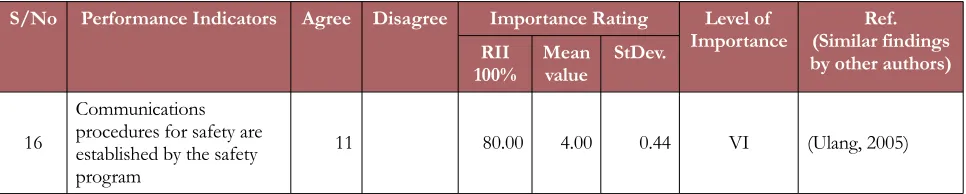
As shown in Table 3 respondents unanimously agreed with the inclusion of the KPIs in this group except in two KPIs where one or two respondents differed. Meanwhile, respondents ranked all the KPIs “extremely important” except in 6 places, these include: contractor is provided with support for safety on site, defined responsibilities of site safety personnel, all project participant/stakeholders are made to understand safety plan of the project clearly, safety, commitment are communicated to contractors, health and safety implementation plan effectively communicated to all are ranked with RII of 72%, 85%, 78%, 81%, 87% and 80% respectively which were perceived by respondents to be “very important”. Table 3 also shares similar findings with other researchers.
S/No Performance Indicators Agree Disagree Importance Rating Level of
Importance (Similar findingsRef. by other authors) RII
100% Meanvalue StDev. Maintenance of Effective Safety Behaviour
1 Prioritizing safety in the selection of contractors 11 98.18 4.91 0.30 EI (Choe & Leite, 2017)
2 Targets accident-free project completion 11 96.36 4.81 0.40 EI (Hinze, 2000)
S/No Performance Indicators Agree Disagree Importance Rating Level of
Importance (Similar findingsRef. by other authors) RII
100% Meanvalue StDev.
4
Promotion of safety performance forms the basis for the engagement of construction personnel
11 100.00 5.00 0.00 EI (Fang & Wu, 2013)
5 The contractor is providedwith support for safety on
site 10 1 72.00 3.45 0.82 VI
(International Labour Organization - ILO, 1995)
6 The contractor bears responsibility for the safety
of his workers 11 100.00 5.00 0.00 EI
(Manu, Ankrah, Proverbs & Suresh, 2013)
7 The contractor is providedwith a safety manual which
must be complied with 11 98.18 4.91 0.30 EI
(Dodo, 2012) 8 A minimum of one safety personnel is appointed to a
project 11 92.73 4.64 0.67 EI
9 Established unit to check the safety performance of
contractors 11 89.09 4.45 0.52 EI
10 Defined responsibilities ofsite safety personnel 11 85.45 4.27 0.64 VI
Communication of Effective Safety Behaviour
11
All project
participant/stakeholders are made to understand the safety plan of the project clearly
11 78.18 3.91 0.53 VI
(Choudhry, Fang, & Rowlinson, 2008; Ulang, 2005). 12 Safety commitment is communicated to
contractors 9 2 81.82 4.09 0.53 VI
13
Communicate practically anticipated hazards associated with the nature of the work
11 98.18 4.90 0.30 EI
14
Health and safety implementation plan effectively communicated to all contractor and subcontractor workers within their respective companies.
11 87.27 4.36 0.50 VI
15
Lessons learned from accidents are
communicated to workers with a view to enhancing positive safety
performance
S/No Performance Indicators Agree Disagree Importance Rating Level of
Importance (Similar findingsRef. by other authors) RII
100% Meanvalue StDev.
16
Communications procedures for safety are established by the safety program
11 80.00 4.00 0.44 VI (Ulang, 2005)
Table 3. Key Performance Indicators for the communication & maintenance of effective safety behaviour
4.4. Construction Safety Policy
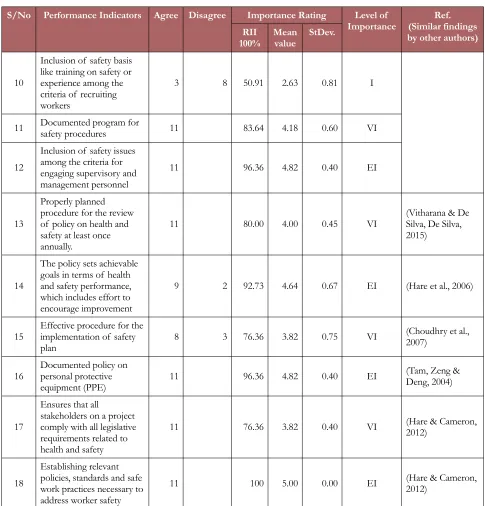
As indicated in Table 4, respondents agreed to all KPIs in this category except for 5 KPIs of which 2 KPIs has 16 respondents disagreed with the inclusion of these KPIs. Meanwhile, all the respondents ranked all the KPIs between “very important” and “extremely important” excluding 2 KPIs which were perceived as “important”, including: “SMS implementation” (RII of 58%), “Inclusion of safety basis like training on safety or experience among the criteria of recruiting workers” (RII of 51%). This might be connected to the lack of formal safety regulation in the industry that stakeholders consider the KPIs less important. Table 4 also shows similar findings from other researchers.
S/No Performance Indicators Agree Disagree Importance Rating Level of
Importance (Similar findingsRef. by other authors) RII
100% Meanvalue StDev. Construction Safety Policy
1 Implementation of available safety rules and
regulations 7 4 69.09 3.45 0.82 VI (Mustapha,
Aigbavboa & Thwala, 2017) 2 Understanding of company sets down rules
and regulations 11 92.73 4.64 0.50 EI
3 SMS implementation 3 8 58.18 2.91 0.83 I
4 Understanding of FactoriesAct and other applicable
regulations 11 81.82 4.09 0.30 VI (Ezenwa, 2001)
5 Understanding of permit-to-work system 11 96.36 4.82 0.40 EI
(Helix ESG, 2003)
6 Application of the permit-to-work system 11 80.00 4.00 0.44 VI
7 Availability and accessibilityof relevant insurance
policies 11 98.18 4.91 0.30 EI (Odeyinka, 2000)
8 Inclusion of subcontractors in the safety
program 11 100 5.00 0.00 EI
(Diugwu & Baba, 2014)
9 Specified the roles and
responsibility of the management team in the improvement of health and safety
11 96.36 4.82 0.40 EI (Boyd, 2014;
S/No Performance Indicators Agree Disagree Importance Rating Level of
Importance (Similar findingsRef. by other authors) RII
100% Meanvalue StDev.
10
Inclusion of safety basis like training on safety or experience among the criteria of recruiting workers
3 8 50.91 2.63 0.81 I
11 Documented program for safety procedures 11 83.64 4.18 0.60 VI
12
Inclusion of safety issues among the criteria for engaging supervisory and management personnel
11 96.36 4.82 0.40 EI
13
Properly planned procedure for the review of policy on health and safety at least once annually.
11 80.00 4.00 0.45 VI (Vitharana & De Silva, De Silva,
2015)
14
The policy sets achievable goals in terms of health and safety performance, which includes effort to encourage improvement
9 2 92.73 4.64 0.67 EI (Hare et al., 2006)
15 Effective procedure for theimplementation of safety
plan 8 3 76.36 3.82 0.75 VI
(Choudhry et al., 2007)
16 Documented policy on personal protective
equipment (PPE) 11 96.36 4.82 0.40 EI
(Tam, Zeng & Deng, 2004)
17
Ensures that all
stakeholders on a project comply with all legislative requirements related to health and safety
11 76.36 3.82 0.40 VI (Hare & Cameron, 2012)
18
Establishing relevant policies, standards and safe work practices necessary to address worker safety
11 100 5.00 0.00 EI (Hare & Cameron, 2012)
Table 4. Key Performance Indicators for construction safety policy
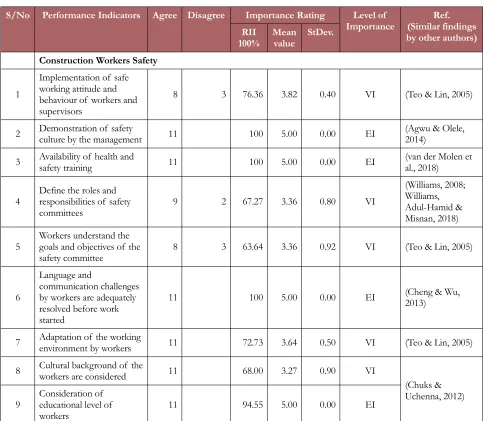
4.5. Construction Safety Workers
S/No Performance Indicators Agree Disagree Importance Rating Level of
Importance (Similar findingsRef. by other authors) RII
100% Meanvalue StDev. Construction Workers Safety
1
Implementation of safe working attitude and behaviour of workers and supervisors
8 3 76.36 3.82 0.40 VI (Teo & Lin, 2005)
2 Demonstration of safety culture by the management 11 100 5.00 0.00 EI (Agwu & Olele, 2014)
3 Availability of health and safety training 11 100 5.00 0.00 EI (van der Molen et al., 2018)
4 Define the roles and responsibilities of safety
committees 9 2 67.27 3.36 0.80 VI
(Williams, 2008; Williams, Adul-Hamid & Misnan, 2018)
5 Workers understand the goals and objectives of the
safety committee 8 3 63.64 3.36 0.92 VI (Teo & Lin, 2005)
6
Language and
communication challenges by workers are adequately resolved before work started
11 100 5.00 0.00 EI (Cheng & Wu, 2013)
7 Adaptation of the working environment by workers 11 72.73 3.64 0.50 VI (Teo & Lin, 2005)
8 Cultural background of theworkers are considered 11 68.00 3.27 0.90 VI
(Chuks & Uchenna, 2012) 9 Consideration of educational level of
workers 11 94.55 5.00 0.00 EI
Table 5. Key Performance Indicators for Construction Safety Workers
4.6. Management Effort and Support
S/No Performance Indicators Agree Disagree Importance Rating Level of
Importance (Similar findingsRef. by other authors) RII
100% Meanvalue StDev Management Effort and Support
1 Management emphasis on the establishment of safety
committees for all projects 8 3 63.64 3.18 0.406 VI
(Choudhry & Fang, 2008)
2
Monitoring of contractor’s performance in terms of safety on the construction projects
11 98.18 4.90 0.302 EI (Idoro, 2012)
3
Safety makes a major criterion for evaluating the performance of a supervisor
9 2 76.36 3.81 0.603 VI (Choudhry & Fang, 2008)
4
Availability of proper procedure for receiving and reviewing feedback of workers on health and safety related issues
10 1 76.36 3.81 0.404 VI (Hinze, Asce, Hallowell, Asce &
Baud, 2013)
5 Provision for review of injury reports by top
management 5 6 58.18 2.90 0.700 I
(Haslam et al., 2005)
6
Appropriate issuance of motivational directives by the top management to enhance safety
11 100 5.00 0.00 EI (Delegach, Kark, Katz-Navon & van
Dijk, 2017)
7
Involvement of top management in the establishment of reward system to enhance adherence to safety plan by all personnel
9 2 83.64 4.18 0.751 VI (Hu, Chan, Le, Jiang, Xie & Hon,
2012)
8 Direct involvement of top management in the activities
of safety committees 2 9 56.36 2.63 0.809 I
(Choudhry & Fang, 2008)
9 Obvious emphasis on the management on safe work
above output 10 1 72.73 3.81 0.603 VI
(Alarcón et al., 2016)
10
Accident cases reported on a site influence the number of safety personnel deployed to the site
8 3 50.91 2.54 0.934 I (Fonseca, Lima & Duarte, 2014)
11 Top management directly takes part in the enforcement
of safety on sites. 3 8 36.36 2.09 1.04 SI
(Alarcón et al., 2016)
12 Corporate safety targets areset by the management 8 3 56.36 2.81 0.404 I
13
Availability of personnel specifically responsible for handling and implementation of safety policy
S/No Performance Indicators Agree Disagree Importance Rating Level of
Importance (Similar findingsRef. by other authors) RII
100% Meanvalue StDev
14
Emphasis on open discussion between workers and supervisors on safety related matters
11 83.64 4.81 0.404 VI (Choudhry & Fang, 2008)
15 Encourages involvement of workers on decisions
that affect safety on site 11 98.18 4.90 0.301 EI
(Park & Kim, 2013; Choudhry & Fang, 2008) 16 Involvement of workers in preparation of safety
programs for the site 11 100 5.00 0.00 EI
17 Subcontractors are involved in all aspects of
site safety issues 11 94.55 4.72 0.467 EI
Table 6. Key Performance Indicators for Management Effort and Support
4.7. Safety Training and Orientation
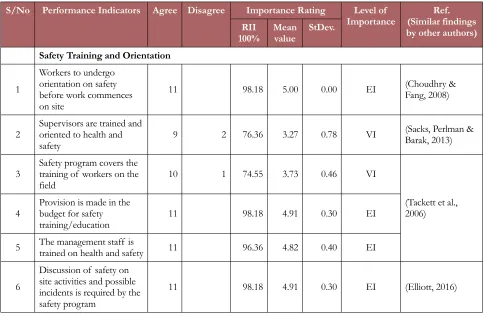
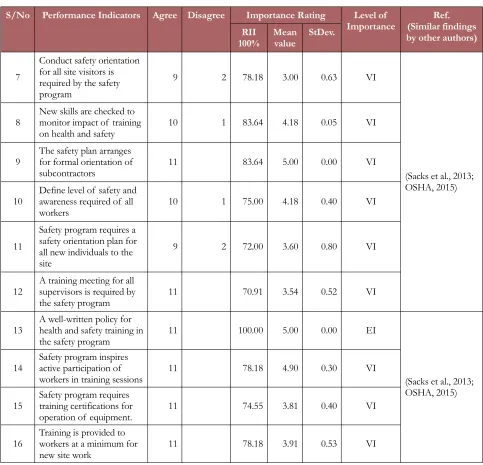
Respondents unanimously agreed with the inclusion of the KPIs in this group except in six KPIs where one or two respondents differed or disagreed. Perceived levels of importance are “very important”, as shown in Table 7 that shares similar findings with other researchers. 5 KPIs is rated as “extremely important” with RII values between 96%-100%, indicating appreciation for inclusion of the KPIs. However, the KPI that is rated the lowest in this category is “a training meeting for all supervisors is required by the safety program” with RII of 70.91% which shows disagreement with the KPIs.
S/No Performance Indicators Agree Disagree Importance Rating Level of
Importance (Similar findingsRef. by other authors) RII
100% Meanvalue StDev. Safety Training and Orientation
1
Workers to undergo orientation on safety before work commences on site
11 98.18 5.00 0.00 EI (Choudhry & Fang, 2008)
2 Supervisors are trained andoriented to health and
safety 9 2 76.36 3.27 0.78 VI
(Sacks, Perlman & Barak, 2013)
3 Safety program covers the training of workers on the
field 10 1 74.55 3.73 0.46 VI
(Tackett et al., 2006)
4 Provision is made in the budget for safety
training/education 11 98.18 4.91 0.30 EI
5 The management staff is trained on health and safety 11 96.36 4.82 0.40 EI
6
Discussion of safety on site activities and possible incidents is required by the safety program
S/No Performance Indicators Agree Disagree Importance Rating Level of
Importance (Similar findingsRef. by other authors) RII
100% Meanvalue StDev.
7
Conduct safety orientation for all site visitors is required by the safety program
9 2 78.18 3.00 0.63 VI
(Sacks et al., 2013; OSHA, 2015) 8 New skills are checked to monitor impact of training
on health and safety 10 1 83.64 4.18 0.05 VI
9 The safety plan arranges for formal orientation of
subcontractors 11 83.64 5.00 0.00 VI
10 Define level of safety and awareness required of all
workers 10 1 75.00 4.18 0.40 VI
11
Safety program requires a safety orientation plan for all new individuals to the site
9 2 72.00 3.60 0.80 VI
12 A training meeting for all supervisors is required by
the safety program 11 70.91 3.54 0.52 VI
13 A well-written policy for health and safety training in
the safety program 11 100.00 5.00 0.00 EI
(Sacks et al., 2013; OSHA, 2015) 14 Safety program inspires active participation of
workers in training sessions 11 78.18 4.90 0.30 VI
15 Safety program requires training certifications for
operation of equipment. 11 74.55 3.81 0.40 VI
16 Training is provided to workers at a minimum for
new site work 11 78.18 3.91 0.53 VI
Table 7. Key Performance Indicators for Safety Training and Orientation
4.8. Administration of Safety and Processes
S/No Performance Indicators Agree Disagree Importance Rating Level of
Importance (Similar findingsRef. by other authors) RII
100% Meanvalue StDev. Administration of Safety and Processes
1 Established procedure to measure safety achievements 11 76.36 4.90 0.30 VI (Arezes & Sérgio-Miguel, 2003)
2 Investigate non-compliance for proper use of personal
protective equipment (PPE) 11 82.27 4.36 0.67 VI (Chi, et al., 2005)
3 Workers commitment to safe work practice are
rewarded 11 100 5.00 0.00 EI
(Zahoor, Chan, Utama, Gao & Zafar, 2017)
4 Rules of work are routinelyreviewed 11 81.82 4.09 0.53 VI (Hale & Borys, 2013)
5
Provision for the monitoring of safety inspection to understand its impact and coverage
11 83.64 4.18 0.60 VI
(Saurin, 2016) 6 Proper planning towards retrieval and analysis of
safety inspection reports 11 81.82 4.00 0.89 VI
7
Proper planning to ensure actions are taken based on the analysed reports of inspection
9 2 74.55 3.72 0.78 VI
8 Safety site layout is made before the commencement
of the project 11 78.18 3,81 0.60 VI (Huang & Wong,
2015) 9 Safety issues are discussed at preconstruction and
progress meetings 11 85.45 4.27 0.46 VI
10
Procedures for identifying safety risk and its
management are established in the safety program
11 80.00 4.00 0.63 VI (Arezes & Sérgio-Miguel,
2003)
11 Safety program requires emergency response drills 2 9 45.45 2.27 0.90 I
(Hallowell & Gambatese, 2009) 12
Provision is made for safety bulletin boards accessible to workers during working hours
11 78.18 3.91 0.30 VI
13
Maintenance of a site accident record book to document accidents, impact and preventive safety measures.
11 94.55 5.00 0.00 VI
(Hallowell & Gambatese, 2009)
14 Posters and signs for site
safety are obviously displayed on the project site
S/No Performance Indicators Agree Disagree Importance Rating Level of
Importance (Similar findingsRef. by other authors) RII
100% Meanvalue StDev.
15
Safe operational procedures for all contractors and subcontractor are documented.
11 81.82 4.09 0.30 VI
16
Procedures for checking the appropriate utilization of PPE as well as
inspection and training are established.
11 83.64 4.18 0.40 VI
(Haslam et al., 2005)
17 Available/appropriate PPEs on project sites. 11 83.64 4.18 0.40 VI
18 Adequate provision of First Aid and CPR facilities
on project sites 11 80.00 4.00 0.63 VI
(Findley, Smith, Kress, Petty & Enoch, 2004) Table 8. Key Performance Indicators for Administration of Safety and Processes
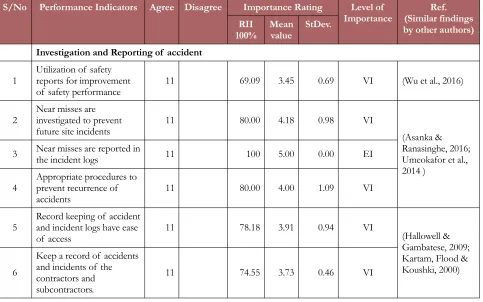
4.9. Investigation and Reporting of Accident
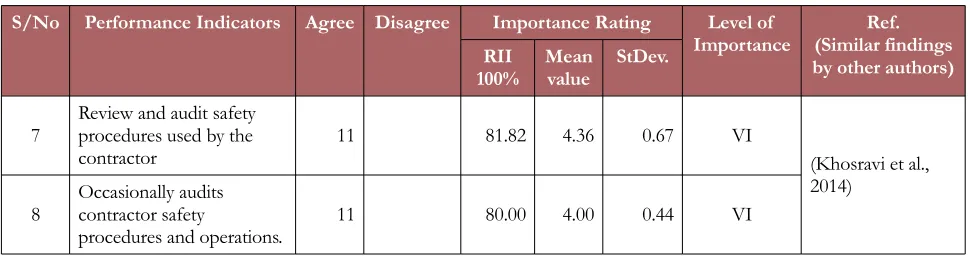
All participants unanimously agreed the inclusions to all KPIs in this group and the perceived level of importance to be “very important”, as shown in Table 9, except one KPI “near misses are reported in the incident logs” which is perceived to be “extremely important”. The KPI with the lowest RII was “utilization of safety reports for the improvement of safety performance” (RII of 69.09%) which shows respondents perceived level of importance in reducing accidents on sites. Also, Table 9 shows similar research outcome by other authors.
S/No Performance Indicators Agree Disagree Importance Rating Level of
Importance (Similar findingsRef. by other authors) RII
100% Meanvalue StDev. Investigation and Reporting of accident
1 Utilization of safety reports for improvement
of safety performance 11 69.09 3.45 0.69 VI (Wu et al., 2016)
2 Near misses are investigated to prevent
future site incidents 11 80.00 4.18 0.98 VI (Asanka &
Ranasinghe, 2016; Umeokafor et al., 2014 )
3 Near misses are reported inthe incident logs 11 100 5.00 0.00 EI
4 Appropriate procedures to prevent recurrence of
accidents 11 80.00 4.00 1.09 VI
5 Record keeping of accidentand incident logs have ease
of access 11 78.18 3.91 0.94 VI (Hallowell &
Gambatese, 2009; Kartam, Flood & Koushki, 2000) 6
Keep a record of accidents and incidents of the contractors and subcontractors.
S/No Performance Indicators Agree Disagree Importance Rating Level of
Importance (Similar findingsRef. by other authors) RII
100% Meanvalue StDev.
7 Review and audit safety procedures used by the
contractor 11 81.82 4.36 0.67 VI (Khosravi et al.,
2014) 8 Occasionally audits contractor safety
procedures and operations. 11 80.00 4.00 0.44 VI
Table 9. Key Performance Indicators for Investigation and Reporting of accident
4.10. Rewards and Sanctions for Project Stakeholders
Results in Table 10 indicate that respondents agree to the inclusion of all the KPIs except two or three respondents that disagreed. However, the KPI “appropriate penalty in the form of reporting to relevant law enforcement authorities” and “provision of penalty in the form of rank demotion” had almost all the respondents disagreed, which were perceived as “somewhat important” (with RII values 53.33% and 32.73% respectively) this clearly indicate the non-inclusion of the KPIs in reducing construction accidents. Furthermore, two of the KPIs were perceived as “extremely important’ “provision of rewards for good safety performance” with RII of 96.36% and “availability of reward in the form of certificate of corporate recognition” with RII of 98.18%. Table 10 also shows similar findings by other researchers.
S/No Performance Indicators Agree Disagree Importance Rating Level of
Importance (Similar findingsRef. by other authors) RII
100% Meanvalue StDev. Rewards and Sanctions for Project Stakeholders
1 Penalties are spelt out for dissatisfactory safety
performance 8 3 70.91 3.64 0.92 VI
(Teo, Ling & Ong, 2005)
2 Provision of rewards for good safety performance 11 96.36 4.81 0.40 EI (Alarcón et al., 2016; Arditi,
Yasamis & Member, 1998; Ashworth, 2013; Choi & Kwak, 2012; Hu et al., 2012; Rose & Manley, 2011)
3 Provision of sanctions and penalties 8 3 74.55 3.73 1.10 VI
4 Provision of penalty in form of work stoppage 10 1 76.36 3.62 0.92 VI
5 Provision of reward in form monetary bonus 8 3 70.91 3.55 0.82 VI
6 Availability of reward in form of certificate of
corporate recognition 11 98.18 4.91 0.30 EI
7 Provision of reward in the form of rank elevation 11 80.00 4.00 0.44 VI
8
The appropriate penalty in the form of reporting to relevant law enforcement authorities
2 9 53.33 3.00 0.89 SI
9 Provision of penalty in
S/No Performance Indicators Agree Disagree Importance Rating Level of
Importance (Similar findingsRef. by other authors) RII
100% Meanvalue StDev.
10 Established penalty in form of disengagement
from work 9 2 69.09 3.45 0.68 VI
11 Availability of monetary fines and penalty 11 81.82 4.09 0.70 VI
Table 10. Key Performance Indicators for Rewards and Sanctions for project stakeholders
5. Discussions and Conclusions
Key performance indicators refer to a tool used to assess the efficiency of construction facilities. Such KPIs differ in relation to the reason of the assessment and typology of facility being examined. Kylili, Fokaides and López-Jiménez (2016) among other researchers also identified their effectiveness in the assessment of building construction performance. Despite existing research in the area of construction safety, there is no established KPIs that could be used to reliably assess or promote building developer safety performance.
This study, established 137 KPIs that can be deployed for promoting or assessing building developer’s safety performance in the construction industry in Nigeria. In-depth review of the literature supported by evaluation from 11 subject matter experts and professionals that validated and ensure clarity and inclusion. The KPIs were further categorized into 9 categories that include: Planning, design and procurement. Construction safety policy, construction safety personnel, communication & maintenance of effective safety behavior, management effort and support, safety training and orientation, administration of safety processes, accident reporting and investigation, rewards and sanctions for project stakeholders. The categorization was used as a basis of presenting the KPIs to show the response of survey conducted on 11 respondents. The survey required the respondents to either agree/disagree with statements and rank the KPIs by their perceived relevance.
Results from the focus group discussion revealed that the respondents consider all the KPIs important, even as some of the KPIs are rated less important, compared to the ones perceived to be “extremely important”. Thus, factors such as “Near misses are reported in the incident logs”, “Availability of reward in form of certificate of corporate recognition” “Involvement of the building developer at all project phases” with RII value of 100%, 98%, and 93% respectively to be extremely important. Also, “language and communication challenges by workers are adequately resolved before work start” with an RII value of 100%, “establishing relevant policies, standards and safe work practices necessary to address worker safety” with an RII value of 100% are among the KPIs considered extremely important. Some KPIs is perceived to be “important” by the respondents include: “SMS implementation”, “accident cases reported on a site influence the number of safety personnel deployed to the site” (RII of 51%), “conduct safety orientation for all site visitors is required by the safety program”, (RII of 51%). Moreover, “safety program requires emergency response drills” (RII of 45%), is among the KPIs considered “important”. Also, other KPIs perceived to be as “somewhat not important” such as “top management directly takes part in the enforcement of safety on sites” RII of 35%, “appropriate penalty in the form of reporting to relevant law enforcement authorities” RII of 53%.
Declaration of Conflicting Interests
The authors have declared no potential conflicts of interest with respect to the research, authorship, and/or publication of this article.
Funding
The authors received no financial support for the research, authorship, and/or publication of this article.
References
Abudayyeh, O., Fredericks, T.K., Butt, S.E., & Shaar, A. (2006). An investigation of management’s commitment to construction safety. International Journal of Project Management, 24(2), 167-174.
https://doi.org/10.1016/j.ijproman.2005.07.005
Agwu, M. (2012). Total Safety Management: A Strategy for Improving Organisational Performance in Chosen Construction Companies in Nigeria. International Journal of Business and Social Science.
https://doi.org/10.9734/BJEMT/2012/1317
Agwu, M.O., & Olele, H.E. (2014). Fatalities in the Nigerian Construction Industry : A case of poor safety culture. British Journal of Economics, Management & Trade, 4(3), 431-452. https://doi.org/10.9734/BJEMT/2014/6439
Ajayi, R. (2016). Evaluation of Health and Safety Planning Process on Construction Sites in Kaduna Metropolis, Nigeria. 399-408.
Aksorn, T., & Hadikusumo, B.H.W. (2008). Critical success factors influencing safety program performance in Thai construction projects. Safety Science, 46(4), 709-727. https://doi.org/10.1016/j.ssci.2007.06.006
Alarcón, L.F., Acuña, D., Diethelm, S., & Pellicer, E. (2016). Strategies for improving safety performance in construction firms. Accident Analysis & Prevention, 94, 107-118. https://doi.org/10.1016/j.aap.2016.05.021
Ali, A.S., Kamaruzzaman, S.N., & Sing, G.C. (2010). A Study On Causes Of Accident And Prevention In Malaysian Construction Industry. Journal of Design + Build.
Alzahrani, J.I., & Emsley, M.W. (2013). The impact of contractors’ attributes on construction project success: A post construction evaluation. International Journal of Project Management.
https://doi.org/10.1016/j.ijproman.2012.06.006
American Society of Civil Engineers-ASCE (2012). Quality in the Constructed Project: a Guide for Owners, Designers and Constructors. https://doi.org/10.1061/9780784411896
Aniekwu, N. (2007). Accidents and safety Violations in the Nigerian construction industry. Journal of science and technology, 27, 81). https://doi.org/10.4314/just.v27i1.33027
Anumba, C. (1999). Concurrent Engineering in Construction - An Opportunity to Improve Construction Safety; Implementation of Safety and Health on Construction Sites. Proceedings of the 2nd International Conference of the CIB Working Commission; Honolulu, HA; March 24- 27; pp. 157-164
Arditi, D., Yasamis, F., & Member, S. (1998). of Owners and Contractors. Engineering, 124, 361-373. https://doi.org/10.1061/(ASCE)0733-9364(1998)124:5(361)
Arezes, P.M., & Sérgio-Miguel, A. (2003). The role of safety culture in safety performance measurement. Measuring Business Excellence. https://doi.org/10.1108/13683040310509287
Asanka, W.A., & Ranasinghe, M. (2016). Distribution of Responsibilities and Applicability of Risk Assessments in Construction Safety. Annual Sessions of IESL, 455-463.
Ayob, A., Shaari, A.A., Zaki, M.F.M., & Munaaim, M.A.C. (2018). Fatal Occupational Injuries in the Malaysian Construction Sector – Causes and Accidental Agents. Earth and Environmental Science PAPER.
https://doi.org/10.1088/1755-1315/140/1/012095
Barling, J., & Hutchinson, I. (2009). Commitment vs. Control-based Safety Practices, Safety Réputation, and Perceived Safety Climate. Canadian Journal of Administrative Sciences / Revue Canadienne Des Sciences de l’Administration. https://doi.org/10.1111/j.1936-4490.2000.tb00208.x
Bello, M.A. (2012). Minimizing Impediments to Design for Construction Safety (DFCS) Implementation on Capital Projects. Dissertation.
Biggs, H.C., & Biggs, S.E. (2013). Interlocked projects in safety competency and safety effectiveness indicators in the construction sector. Safety Science, 52, 37-42. https://doi.org/10.1016/j.ssci.2012.03.014
Biswas, G., Bhattacharya, A., & Bhattacharya, R. (2017). Occupational health status of construction workers: A review. International Journal of Medical Science and Public Health, 6(4), 1.
https://doi.org/10.5455/ijmsph.2017.0745302112016
Boyd, M. (2014). Recruiting high skill labour in north america: Policies, outcomes and futures. International Migration. https://doi.org/10.1111/imig.12139
Chan, A.P.C., & Chan, A.P.L. (2004). Key performance indicators for measuring construction success. In Benchmarking. https://doi.org/10.1108/14635770410532624
Charehzehi, A., & Ahankoob, A. (2012). Enhancement of safety performance at construction site. International Journal of Advances in Engineering & Technology. https://doi.org/10.4038/engineer.v48i3.6840
Cheng, C.W., & Wu, T.C. (2013). An investigation and analysis of major accidents involving foreign workers in Taiwan’s manufacture and construction industries. Safety Science, 57, 223-235.
https://doi.org/10.1016/j.ssci.2013.02.008
Chi, C.F., Chang, T.C., & Ting, H.I. (2005). Accident patterns and prevention measures for fatal occupational falls in the construction industry. Applied Ergonomics, 36(4 spec.), 391-400. https://doi.org/10.1016/j.apergo.2004.09.011 Choe, S., & Leite, F. (2017). Construction safety planning: Site-specific temporal and spatial information integration.
Automation in Construction. https://doi.org/10.1016/j.autcon.2017.09.007
Choi, K., & Kwak, Y.H. (2012). Decision support model for incentives/disincentives time-cost tradeoff. Automation in Construction. https://doi.org/10.1016/j.autcon.2011.06.006
Choudhry, R.M. (2014). Behavior-based safety on construction sites: A case study. Accident Analysis and Prevention, 70, 14-23. https://doi.org/10.1016/j.aap.2014.03.007
Choudhry, R.M., & Fang, D. (2008). Why operatives engage in unsafe work behavior: Investigating factors on construction sites. Safety Science. https://doi.org/10.1016/j.ssci.2007.06.027
Choudhry, R.M., Fang, D., & Mohamed, S. (2007). Developing a Model of Construction Safety Culture. Journal of Management in Engineering. https://doi.org/10.1061/(ASCE)0742-597X(2007)23:4(207)
Choudhry, R.M., Fang, D., & Rowlinson, S. (2008). Challenging and Enforcing Safety Management in Developing Countries: A Strategy. International Journal of Construction Management.
https://doi.org/10.1080/15623599.2008.10773110
Chuks, O.K., & Uchenna, P. (2012). Appraising the Influence of Cultural Determinants of Contruction Workers Safety Perceptionand Behaviour in Nigeria. March 2013, 11-24.
Construction Industry Institute - CII (2003). Value of best practices report. Rep. No. BMM 2003-4, Construction Industry Institute, The Univ. of Texas at Austin, Austin, Tex.
CPWR (2008). The construction chart book: the U.S. construction industry and its workers (Issue April). Available at: www.cpwr.com
De Silva, N., & Wimalaratne, P.L.I. (2012). OSH management framework for workers at construction sites in Sri Lanka. Engineering, Construction and Architectural Management, 19(4), 369-392.
https://doi.org/10.1108/09699981211237094
Delegach, M., Kark, R., Katz-Navon, T., & van Dijk, D. (2017). A focus on commitment: the roles of transformational and transactional leadership and self-regulatory focus in fostering organizational and safety commitment. European Journal of Work and Organizational Psychology. https://doi.org/10.1080/1359432X.2017.1345884 Dingsdag, D.P., Biggs, H.C., & Sheahan, V.L. (2008). Understanding and defining OH&S competency for
construction site positions: Worker perceptions. Safety Science, 46(4), 619-633. https://doi.org/10.1016/j.ssci.2007.06.008
Diugwu, I.A., & Baba, D.L. (2014). A Health and Safety Improvement Roadmap for the Construction Industry. https://doi.org/10.6106/JCEPM.2014.4.1.037
Dodo, M. (2012). Best practices for optimizing DOD contractor safety and occupational health program performance. December. Dominowski, R.L. (1980). Research methods. Prentice-Hall.
El-Nagar, R., Hosny, H., & Askar, H.S. (2015). Development of a safety performance index for construction projects in Egypt. American Journal of Civil Engineering and Architecture, 3(5), 182-192.
Elliott, J. (2016). Safety I and safety II: the past and future of safety management. Ergonomics. https://doi.org/10.1080/00140139.2015.1093290
European Foundation for the Improvement of Living and Working Conditions (1991). From Drawing Board to Building Site (EF/88/17/FR): Dublin, Ireland.
Ezenwa, A.O. (2001). A study of fatal injuries in Nigerian factories. Occupational Medicine. https://doi.org/10.1093/occmed/51.8.485
Fang, D., & Wu, H. (2013). Development of a Safety Culture Interaction (SCI) model for construction projects. Safety Science, 57, 138-149. https://doi.org/10.1016/j.ssci.2013.02.003
Farooqui, R.U. (2011). Achieving Zero Accidents – A Strategic Framework for Continuous Safety Improvement in the Construction Industry. https://doi.org/10.25148/etd.FI11050608
Fass, S., Yousef, R., Liginlal, D., & Vyas, P. (2017). Understanding causes of fall and struck-by incidents: What differentiates construction safety in the Arabian Gulf region? Applied Ergonomics, 58, 515-526.
https://doi.org/10.1016/j.apergo.2016.05.002
Filstad, C. (2011). Organizational commitment through organizational socialization tactics. Journal of Workplace Learning. https://doi.org/10.1108/13665621111154395
Findley, M., Smith, S., Kress, T., Petty, G., & Enoch, K. (2004). Safety Program Elements in Construction. Professional Safety, 49(2), 14-21. http://libproxy.unm.edu/login?url=http://search.ebscohost.com/login.aspx? direct=true&db=a9h&AN=12136203&loginpage=Login.asp&scope=site
Fonseca, E.D., Lima, F.P.A., & Duarte, F. (2014). From construction site to design: The different accident prevention levels in the building industry. Safety Science, 70, 406-418. https://doi.org/10.1016/j.ssci.2014.07.006 Funso, A., Sammy, L., & Gerryshom, M. (2016). Impact of Motivation on Productivity of Craftsmen in
Construction Firms in Lagos, Nigeria. International Journal of Economics and Finance, 8(4), 271. https://doi.org/10.5539/ijef.v8n4p271
Gambatese, J.A., Asce, M., Toole, T.M., Asce, F., Abowitz, D.A., Asce, M. et al. (2017). Owner Perceptions of Barriers to Prevention through Design Diffusion. Journal of Construction Engineering and Management.
https://doi.org/10.1061/(ASCE)CO.1943-7862.0001296
Gambatese, J.A., Behm, M., & Rajendran, S. (2008). Design’s role in construction accident causality and prevention: Perspectives from an expert panel. Safety Science. https://doi.org/10.1016/j.ssci.2007.06.010
Gambatese, J., & Hinze, J. (1999). Addressing construction worker safety in the design phase designing for construction worker safety. Automation in Construction. https://doi.org/10.1016/S0926-5805(98)00109-5 Gambatese, J.A. (2000). Owner involvement in construction site safety. Construction Congress.
https://doi.org/10.1061/40475(278)71
Ghasemi, F., Mohammadfam, I., Soltanian, A.R., Mahmoudi, S., & Zarei, E. (2015). Surprising incentive: An instrument for promoting safety performance of construction employees. Safety and Health at Work. https://doi.org/10.1016/j.shaw.2015.02.006
Gu, C., & Yang, Y. (2015). Incentive mechanism for customer collaboration in product development: An exploratory study. Journal of Industrial Engineering and Management. https://doi.org/10.3926/jiem.1603
Gunduz, M., Birgonul, M.T., & Ozdemir, M. (2017). Fuzzy Structural Equation Model to Assess Construction Site Safety Performance. Journal of Construction Engineering & Management. https://doi.org/10.1061/(ASCE)CO.1943-7862.0001259
Hale, A. (2009). Why safety performance indicators? Safety Science, 47(4), 479-480. https://doi.org/10.1016/j.ssci.2008.07.018
Hale, A., & Borys, D. (2013). Working to rule or working safely? Part 2: The management of safety rules and procedures. In Safety Science. https://doi.org/10.1016/j.ssci.2012.05.013
Hallowell, M.R., & Gambatese, J.A. (2009). Construction Safety Risk Mitigation. Journal of Construction Engineering & Management, 135(December), 1316-1323. https://doi.org/10.1061/(ASCE)CO.1943-7862.0000107
Hallowell, M.R., & Hansen, D. (2016). Measuring and improving designer hazard recognition skill: Critical competency to enable prevention through design. Safety Science, 82, 254-263.
https://doi.org/10.1016/j.ssci.2015.09.005
Hare, B., & Cameron, I. (2012). Health and safety gateways for construction project planning. Engineering, Construction and Architectural Management. https://doi.org/10.1108/09699981211206115
Hare, B., Cameron, I., & Duff, A.R. (2006). Exploring the integration of health and safety with pre-construction planning. Engineering, Construction and Architectural Management. https://doi.org/10.1108/09699980610690729 Haslam, R.A., Hide, S.A., Gibb, A.G.F., Gyi, D.E., Pavitt, T., Atkinson, S. et al. (2005). Contributing factors in
construction accidents. Applied Ergonomics, 36(4 spec.), 401-415. https://doi.org/10.1016/j.apergo.2004.12.002 Hassanain, M.A., Sanni-Anibire, M.O., Mahmoud, A.S., & Hamida, M.B. (2019). Design guidelines for the
functional efficiency of laboratory facilities. Architectural Engineering and Design Management. https://doi.org/10.1080/17452007.2019.1675580
Helix ESG (2003). Permit to work. In Permit to Work System. https://doi.org/10.1205/026095703770045474
Herrera, I. (2012). Proactive safety performance indicators, resilience engineering perspective on safety management. Doctoral Thesis. Norwegian University of Science and Technology, Norway. PhD Thesis, 12, 123-9.
Hinze, J. (2002). Safety Incentives: Do They Reduce Injuries? Practice Periodical on Structural Design and Construction. https://doi.org/10.1061/(ASCE)1084-0680(2002)7:2(81)
Hinze, J., & Gambatese, J. (2003). Factors That Influence Safety Performance of Specialty Contractors. Journal of Construction Engineering and Management, 129(2), 159-164. https://doi.org/10.1061/(ASCE)0733-9364(2003)129:2(159) Hinze, J., Hallowell, M., & Baud, K. (2013). Construction-Safety Best Practices and Relationships to Safety
Performance. Journal of Construction Engineering and Management. https://doi.org/10.1061/(ASCE)CO.1943-7862.0000751
Hinze, J.W. (2000). Moving toward a Zero Injury Objective. Journal Construction and Engineering Management. ttps://doi.org/10.1061/(ASCE)0733-9364(2000)126:5(399)
Hu, Y., Chan, A.P.C., Le, Y., Jiang, W.P., Xie, L.L., & Hon, C.H.K. (2012). Improving Megasite Management Performance through Incentives: Lessons Learned from the Shanghai Expo Construction. Journal of Management in Engineering. https://doi.org/10.1061/(ASCE)ME.1943-5479.0000102
Huang, C., & Wong, C.K. (2015). Optimisation of site layout planning for multiple construction stages with safety considerations and requirements. Automation in Construction. https://doi.org/10.1016/j.autcon.2015.03.005
Huang, X., & Hinze, J. (2006). Owner ’s Role in Construction Safety. Journal of Construction Engineering and Management, February, 164-173. https://doi.org/10.1061/(ASCE)0733-9364(2006)132:2(164)
Huang, Y., Verma, S.K., Chang, W., Courtney, T.K., Lombardi, D.A., Brennan, M.J. et al. (2012). Management commitment to safety vs . employee perceived safety training and association with future injury. Accident Analysis and Prevention, 47(2012), 94-101. https://doi.org/10.1016/j.aap.2011.12.001
Idoro, G.I. (2008). Health and safety management efforts as correlates of performance in the Nigerian construction industry. Journal of Civil Engineering and Management, 14(4), 277-285. https://doi.org/10.3846/1392-3730.2008.14.27 Idoro, G.I. (2012). Influence of the monitoring and control strategies of indigenous and expatriate nigerian
contractors on project outcome. Journal of Construction in Developing Countries.
International Labour Organization - ILO (1995). Safety, health and welfare on construction sites: A training manual. International Labour Organization.
Inuwa, I.I., Githae, W., & Diang, S. (2014). Indigenous Contractors Involvement and Performance in Construction Procurement Systems in Nigeria. Global Journal of Researches in Engineering: General Engineering, 14(1), 13.
Jannadi, O.A., & Almishari, S. (2003). Risk Assessment in Construction. Journal of Construction Engineering and Management, 129(5), 492-500. https://doi.org/10.1061/(ASCE)0733-9364(2003)129:5(492)
Jaraiedi, M., Plummer, R.W., & Aber, M.S. (1995). Incentive/disincentive guidelines for highway construction contracts. Journal of Construction Engineering and Management, 121(1), 112-120. https://doi.org/10.1061/(ASCE)0733-9364(1995)121:1(112)
Jaselskis, E.J., Anderson, S.D., & Russell, J.S. (1996). Strategies for achieving excellence in construction safety performance. Journal of Construction Engineering and Management.
https://doi.org/10.1061/(ASCE)0733-9364(1996)122:1(61)
Jazayeri, E., Liu, H., & Dadi, G.B. (2017). Perception Differences between Contractors and Owners Regarding Drivers of Construction Safety, 6(2), 29-39. https://doi.org/10.5923/j.safety.20170602.02
Jensen, P.L., Laustsen, S., & Jensen, E. (2016). Development of the Relationship Between Small Building Contractors and Developers in Order to Meet OSH Requirements. Policy and Practice in Health and Safety, 8(2), 37-55. https://doi.org/10.1080/14774003.2010.11667747
Kadiri, Z.O., Nden, T., Avre, G.K., Oladipo, T.O., Edom, A., Samuel, P.O., & Ananso, G.N. (2014). Causes and Effects of Accidents on Construction Sites (A Case Study of Some Selected Construction Firms in Abuja FCT Nigeria). IOSR Journal of Mechanical and Civil Engineering (IOSR-JMCE).