Rahmat Ade, Asmawi Moch, Tangkudung James, Dlis Firmansyah, Saputra Surya Adi. Development of exercise smash, lob and backhand models in Bulutangkis based on training variation for beginner. Journal of Education, Health and Sport.
2019;9(7):681-690. eISSN 2391-8306. DOI http://dx.doi.org/10.5281/zenodo.3354614
http://ojs.ukw.edu.pl/index.php/johs/article/view/7187
The journal has had 7 points in Ministry of Science and Higher Education parametric evaluation. Part B item 1223 (26/01/2017). 1223 Journal of Education, Health and Sport eISSN 2391-8306 7
© The Authors 2019;
This article is published with open access at Licensee Open Journal Systems of Kazimierz Wielki University in Bydgoszcz, Poland
Open Access. This article is distributed under the terms of the Creative Commons Attribution Noncommercial License which permits any noncommercial use, distribution, and reproduction in any medium, provided the original author (s) and source are credited. This is an open access article licensed under the terms of the Creative Commons Attribution Non commercial license Share alike.
(http://creativecommons.org/licenses/by-nc-sa/4.0/) which permits unrestricted, non commercial use, distribution and reproduction in any medium, provided the work is properly cited. The authors declare that there is no conflict of interests regarding the publication of this paper.
Received: 01.07.2019. Revised: 05.07.2019. Accepted: 30.07.2019.
Development of exercise smash, lob and backhand models in Bulutangkis
based on training variation for beginner
Name : Ade Rahmat
Affiliation : IKIP PGRI Pontianak
Country : Indonesia
Name : Moch. Asmawi
Affiliation : Universitas Negeri Jakarta
Country : Indonesia
Name : James Tangkudung
Affiliation : Universitas Negeri Jakarta
Country : Indonesia
Name : Firmansyah Dlis
Affiliation : Universitas Negeri Jakarta
Country : Indonesia
Name : Surya Adi Saputra
ORCID iD : http://orcid.org/0000-0002-7241-4072 Affiliation : STKIP Kusumanegara Jakarta
Country : Indonesia
ABSTRACT
The purpose of this research and development is to produce a model practice badminton smash and lob-based variation of tools for novice players and determine the effectiveness, efficiency and appeal of players to the model created. This study uses research methods development Research & Development (R & D) from Borg and Gall. The subjects in this research and development is a club of players consisting of 40 players.
The instruments are used in research and development are the instrument test the suitability and the results of the motion that is used to collect motion data smash and lob, while the stages in the research and development are, in stages: (1) analysis of needs, (2) the expert evaluation (evaluation the initial product); (3) the trial is limited (small group trial); and (4) the main test (field testing).
Key words: Development, Model, Training, Badminton, Tools
Background
Training materials designed in the training process, will greatly assist coaches in training process that will take place. Training materials, design or workout plan on the environment exercises a right course in accordance with the conditions of training required in the arrangement will facilitate also the source of exercise that will be used and expected to be developed in an effort to achieve the objectives of the exercise were achieved and appropriate.
Implementation activity badminton game has been done by many companies from several manufacturers, government agencies, community members, and even educational environment ranging from elementary, junior high school to the university. Various advantages obtained from badminton activity, the researcher interested in making this event as The observations. From experience and observation that exist in the field, especially in Pontianak, researchers looked at many clubs or coaches in preparing and adjusting programs and training activities in the field, there are still shortcomings and needs to be repaired. Badminton exercise carried out in the club, in addition to the practice of the close relationship between activity in the game of badminton is also a very regular community activities we do, but on the other hand there are still many players who just play for more pleasure without playing well this is shown by his many novice players, interest in this case in terms by the old age. Badminton game exercises conducted during the time felt less than the maximum, it can be seen from the interaction and training process that centered on the coach as the only source of information, while the athletes or players tend to be passive and just received the knowledge of the coach concerned.
Actually a lot can be gained by athletes and coaches in practice, though in fact one of the objectives is done in this activity for fun but is expected to have additional training and other values to be gained by athletes after the training process is complete badminton game. This situation prompted researchers to develop recreational sports training model application especially badminton game that could accommodate training purposes as well as to create conditions walking exercise to be fun, not centered on the coach,
Badminton training programs in technical and tactical coach formulated in accordance with experience and personal feelings of athletes, who do not have the scientific data to be referred for brevity, main factors limiting increased performance athlete competition are as follows: 1. Data collection badminton players training and competition is incomplete and inaccurate, difficult to integrate this data effectively; 2. Analysis of this data is not systematically and fail to benefit rules for practical use; 3. From the standpoint of optimization of training mode, a training program in view of the athlete's individual technical and tactical aspects of the training are less, and the lack of scientific data support. Based on observations at various clubs Pontianak city known to many novice players who visits of his old age still practice very many mistakes in a punch smash and lob a game of badminton. The fact is that in 5 people true novice players hit a smash or lob least 1-2 people who can achieve success in the motion of matter smash and lob badminton less than the maximum.
Based on the above reasoning, the authors are interested in the innovation of applying the model of exercise in an effort to improve results and Lob in Game Smash Badminton. Selection of this type of training is based on the analysis of research by a team of coaches in clubs badminton in the city of Pontianak, namely that the application of this type of training smash and lob-based variation of tools is the concept of exercise that can help facilitate a coach link between training material in accordance with the state of the world real beginner novice players or athletes, stimulating the novice player / athlete acting as a group and were able to socialize well, and encourage athletes / players to make the application of knowledge in their daily lives.
Based on the description in the above background, this study focused on Model Development Exercise Smash And Lob bebasis Variation Tool To Improve Ability and Lob Smash In Badminton Games in Pontianak Kalimantan Barat.
4. For higher education institutions, can be used as input in improving the training and learning process in an effort to advance the quality of education in the future.
5. For agencies or clubs, can be used as a guide in order to add new knowledge to develop training programs and learning.
6. The results of this study will result in a product in the form of a model exercise in the form of modules and CD recording at the time of execution of this type of training is done and is expected to contribute on thinking scientifically for scientists and other researchers to develop models of practice more specifically, exciting and innovative course.
Method.
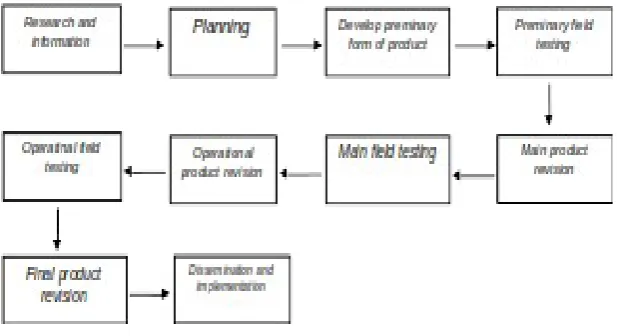
[image:3.595.144.453.232.400.2]This is research and development (R & D) Method, the next step is to do the stages in the development of the model. Research and development of this model using the steps of developing a model developed by Borg and Gall Theory. Or it can be described in terms of stages of development schemes as shown below:
Figure Instructional Design R and D
Source: Walter R. Borg and Meredith D. Gall, Educational Research: An Introduction, 4th Edition. (New York: Longman Inc., 1983)
In this model of development research is a process used to develop and validate learning products. Research by Nana Syaodih Sukmadinata development is a process or steps to develop a new product or improve existing products, which already can be accounted. Research and development in this study using a model of development Research & Development (R & D) with a flow chart that consists of seven steps, among others:
1. First time specified is an ideas that will be developed, to gather information as a rationale for making the concept.
2. Making the learning model (product design), the shape of the design is a model form of exercise. 3. A product revision, the revision carried out by the expert concerned.
4. Production of prototype, being done with badminton practice models.
5. The test prototype, testing of the subject field in both the trial phase I and phase II trials.
Research development of this model consists of three phases, with steps description design explanation has been modified and aligned with the purpose and conditions of the actual research, as illustrated clearly in the following table:
Tables and Steps Stage Development Research
Stage Step Activity
pre-Development 1 a. Initial data collection
b. Preparation of research proposals c. analysis of needs
2 a. learning plan
Development 3 a. learning
4 Formative evaluation:
a. Early trials (1)
Expert evaluation of Phase I (Expert juggement) with badminton experts and learning experts of physical education. Initial repair (1)
5 a. Early trials (2)
Expert evaluation stage II (Expert juggement) with badminton experts and learning experts of physical education.
b. Initial repair (2)
Application 6 a. Field trials
Evaluation by the limited scale of 30 respondents
7 Revised Product
Implementation / dissemination
production Porduksi Model
Effectiveness test with SPSS
Results of Paired samples statistics (pre-test) and after being given treatment (post-test)
Paired Samples Statistics
mean N Std. deviation Std. error Mean
pair 1 Pre_test 75.12 40 4,816 .761
Post_test 76.35 40 3,984 .630
In the table, the average value is 75.12 and the athletes before the value after is 76.35, which means that there are differences in the amount of scores that result from pre-test and post-test so that the skills of athletes increases.
Results Paired Samples Statistics (Pre-Test) and (Post-Test) Paired Samples Test
paired Differences t df
Sig. (2-tailed)
mean deviationStd. Std. errorMean
95% Confidence Interval of the
Difference
Lower Upper
pair 1 Pre_test -
Post_test -1225 1,847 .292 -1816 -.634 -4196 39 .000
In the significant difference test with SPSS 22 obtained mean = 1.225 indicates the difference from the pre-test and post-test results, results of t-test = 4. 196 df = 39 and p-value = 0.000 <0.05 which means there are significant differences between before and after exercise. Based on these results it can be concluded that the exercise carried out by the control group backhand lob to improve skills and has been developed and has a significant effectiveness. As an illustration of how the difference between before and after treatment in development that has been conducted by researchers can be seen as the following diagram:
Smash Lob Forehand Lob Backhand
64 66 68 70 72 74 76 78 80 82
Chart Title
pre_test post_test Analysis Data
a. The formula for process data per subject test.
Information:
P = The percentage of subjects evaluation test results. X = Total answers scores by test subjects.
Xi = Maximum number of answers in the aspect of the assessment by the test subjects try. 100% = Constants.
b. The formula for the overall data processing test subjects.
Information:
P = The percentage of the overall results of the evaluation of the test subjects. X = The total number of test subjects answer in the overall aspects of evaluation.
Xi = The total number of the maximum score in the test subjects all aspects of the assessment. 100% = Constants.
[image:6.595.70.452.419.487.2]To determine the conclusions that have been reached then set the criteria as in the following table:
Table of Percentage Analysis Evaluation By Subject Test.
percentage Information Mean
80% - 100% valid be used
60% - 79% enough Valid be used
50% - 59% Less Valid be replaced
<50% Invalid be replaced
Results
Products made in the book the author has a specification such as: model developed due respect to the needs of novice players in the field. In addition there is a detailed explanation and details about the different variations of exercises smash and lob. In the explanation of the items the model, the authors outline a complete and clear from the title of the item models, purpose, method, tool or medium used is simple, easy to get and are very economical, implementation of the game as well as explanations pour through the illustrations are unique and attractive, thus providing ease of understanding, and applying for a workout.
Skills smash and lob is one component of the techniques that must be mastered by badminton players, especially in this book discuss how to improve through practice models variation. Hopefully, with the development of the ability of this technique will greatly help the player to achieve reach point during the game, like a troublesome opponent and is able to kill the opponent with the proper smash attack. And will certainly help to win the game.
P = X x 100 %
Xi
P =
X
x 100%
smash and lob bulutangkis game variations based tools can be used by coaches as references to broaden as well as other perspective that is able to provide color and other variations in exercise smash and lob. In addition, the use of tools will have a positive effect both the use of second-hand goods and the simple will reduce operational trainers in their duties.
Given so interesting variation of tools to exercise the player, of course, the coach must consider several factors that fit the needs of players and item models in this book can be used but must be revisited and adapted to the needs of the players, for trying.
Model exercises developed as follows: A. Item Model Punch Smash
1. Item Model Blows Exercise Smash (AR.1) Aim :
Coaching grip on the whip hand
To familiarize the athletes obtain proper timming hit
Increase the sense of motion to the handle of the racquet during play
Information : implementation:
Athletes stand with the ready / ready position by holding the plastic ball
Athletes stand up straight position and preparing to swing hand movement by directing a plastic ball on pre-determined targets.
Pull Swing the arms up the front of the rear and throwing plastic balls at predetermined target
Back to the original attitude.
Point Exercise:
Smash
Semi Smash full Smash Jump Smash
Smash made by cutting punch half
Smash be done in the full force
Doing Smash by leaps and blow full
Coaching process Int. 30-70%Rest.1 m Int. 50-80%Rest.1m Int. 70-100Rest.1m Coaching Point Power arms, legs power, coordination accomplice, smashtechnique Variation Smash cut, full smash, smash jump.
B. Item Model Punch Exercises Forehand Lob
1. Item Model Punch Exercises Forehand Lob (AR.21) Aim :
Train lash grip on the racket
To familiarize the athletes obtain proper timming hit
Information : implementation:
Athletes stand with the ready / ready position by holding a tennis racket
Athletes stand up straight left side of the field position, squadjump place in mid field line and preparing to make a move lob forhand
Pull Swing arm over the front of the head with a tennis racket
Back to the original attitude.
Point Exercise:
C. Item Model Training backhand lob Punch
1. Item Model Exercise Backhand Blow Lob (AR. 36) Aim :
Train lash grip on the racket
To familiarize the athletes obtain proper timming hit
Improving a sense of motion to the handle of the racket during play
Lob Forehand
Semi Lob
forehand Full lob forehand
Attack Lob forehand
forehand lob
carried out with a punch half field
forehand lob was done on the full force
Doing forehand lob by leaps and blow full
Information :
implementation:
Standing at the ready / ready position by holding a Aqua bottle.
Athletes stand up straight left position in the line of attack the middle of the field
Position quiet place, then do the movement stepped into positions 1 and 2
Hit with the former media aqua bottle filled with sand / water towards the top front of the field.
Point Exercise:
backhand
Semi backhand lob Full Lob backhand Attack backhan backhand Lob
carried out with a punch half field
Bachand lob be done in the full force
Doing backhand attack with plain good
Coaching process Int. 30-70%Rest.1 m Int. 50-80%Rest.1 m Int. 70-100%Rest.1 m
Coaching Point Powertechnique arms, legs kekutan, Coordination accomplice, backhand
Variation backhand lobgood punch. half, full backhand lob, backhand with a plain or a
Discussion / Conclusions.
Based on the data that researchers gain from the results of field testing and discussion of the results of this study concluded that study product is a model exercise smash, lob and backhand badminton game based variation of tools for athletes in Pontianak in West Kalimantan which consists of 50 items models which consists of 20 models item smash, forehand lob models 15 items, and 15 items backhand lob models can be applied to athletes. The use of this type of training smash, lob and backhand badminton game variations based tools for athletes in Pontianak in West Kalimantan effectively improve the skills of athletes. Then able to create an atmosphere of fun and prevent boring time.
Research by Joanna Harasimowicz and friend in the Journal of Education, Health and Sport.Physical has results about efficiency is one of the most important health parameters, and its high level in the early years Obtained guarantees correct adaptation in later periods of life. In children and adolescents, the right amount of
Research and
information Planning preminary form Develop of product
Preminary field testing
Operatinal
field testing Operational product revision Main field testing Main product revision Final product revision Dissemination and implementation Coach Ball thrower Direction Of Movements Plastic Ball Target
Direction of Ball Movements Coach Ball thrower Direction Of Movements Plastic Ball Target
Direction of Ball Movements Coach
Ball thrower
Direction Of Movements
Plastic Ball
Target
traffic plays a huge role. Other research by Wawryków, A., Stecko has Showed The human motoriness is the whole of behaviors, possibilities and needs movement manifested differently at every stage of life.
In this section the researcher suggests some advice in connection with the products developed. Meanwhile, the suggestions put forward include advice utilization, dissemination and further development advice. Suggestions utilization of product development is a model exercise smash, lob and backhand badminton game variations based tools for athletes in Pontianak in West Kalimantan which can be used as references or references by the coach. Utilization of this model should be able to consider the needs, circumstances, conditions that occur, and infrastructure owned. Dissemination and development of these products to a wider target, for the researchers will provide advice, among others, prior to the dissemination of the products should smash practice models,
In a further development of research that is useful to expand persefektif and rejuvenation science. Then, in further developing this study, researchers have some suggestions, for research subjects should be used more broadly, the resulting model should be more varied and more so that the goal can be achieved with the maximum exercise. This generated model of practice should be disseminated broader level to facilitate coaches get references a variety of exercises smash, lob and backhand. Similarly to the researcher to use, Dissemination, to product models practice models smash, lob and backhand badminton game variations based tools developed for athletes.
REFERENCES
Borg. W. R & Gall, M. D, Educational Research: An Introduction. New York: Longman, 1983. Cheryl A. Coker, Moter Learning and Control Practitioners Mexico: McGraw Hill, 2004.
Education, H., Authors, T., Open, L., & Systems, J. (2019). Motor fitness of young children undergoing general development exercises. 9 (6), 452-455.
Fitt and Richard A. Posner in Magill, Motor Learning and Control: Concepts and Aplications. New York: McGraw-Hill, 2011.
Kulikowski, B., Zdziarski, K., & Antczak, K. (2019). Impact of physical activity on the quality of life of residents of a social welfare home Introduction: 9 (5), 241-250.
Sapta Kunta, Coaching Badminton, Surakarta: Yama Library 2010