www.biogeosciences.net/11/2691/2014/ doi:10.5194/bg-11-2691-2014
© Author(s) 2014. CC Attribution 3.0 License.
Comparison of different methods to determine the degree of peat
decomposition in peat bogs
H. Biester1, K.-H. Knorr2, J. Schellekens3, A. Basler4, and Y.-M. Hermanns1
1Institut für Geoökölogie, AG Umweltgeochemie, Technische Universität Braunschweig, Germany 2Institute of Landscape Ecology, Hydrology Group, University of Muenster, Germany
3Departamento de Edafoloxía e QuímicaAgrícola, University of Santiago de Compostela, Fac. de Bioloxía, Campus
Universitario Sur 15782 Santiago de Compostela, Spain
4Centre for Stable Isotopes and Analysis, Büsgen Institute, University of Göttingen, Germany
Correspondence to: H. Biester ([email protected])
Received: 8 September 2013 – Published in Biogeosciences Discuss.: 5 November 2013 Revised: 29 March 2014 – Accepted: 7 April 2014 – Published: 21 May 2014
Abstract. Peat humification or decomposition is a frequently used proxy to extract past time changes in hydrology and cli-mate from peat bogs. During the past century several meth-ods to determine changes in peat decomposition have been introduced. Most of these methods are operationally defined only and the chemical changes underlying the decomposi-tion process are often poorly understood and lack validadecomposi-tion. Owing to the chemically undefined nature of many humifi-cation analyses the comparison of results obtained by differ-ent methods is difficult. In this study we compared changes in peat decomposition proxies in cores of two peat bogs (Königsmoor, KK; Kleines Rotes Bruch, KRB) from the Harz Mountains (Germany) using C / N ratios, Fourier trans-form infrared spectra absorption (FTIR) intensities, Rock Eval® oxygen and hydrogen indices, δ13C and δ15N iso-topic signatures and UV-absorption (UV-ABS) of NaOH peat extracts. In order to explain parallels and discrepancies be-tween these methods, one of the cores was additionally anal-ysed by pyrolysis gas chromatography mass spectrometry (pyrolysis-GC-MS). Pyrolysis-GC-MS data provide detailed information on a molecular level, which allows differentia-tion of both changes attributed to decomposidifferentia-tion processes and changes in vegetation. Principal component analysis was used to identify and separate the effects of changes in veg-etation pattern and decomposition processes because both may occur simultaneously upon changes in bog hydrology. Records of decomposition proxies show similar historical de-velopment at both sites, indicating external forcing such as climate as controlling the process. All decomposition prox-ies except UV-ABS andδ15N isotopes show similar patterns
1 Introduction
Many studies have used ombrotrophic bogs as archives to reconstruct climate or environmental conditions of the past (Barber, 2006; Barber and Langdon, 2007). Changes of the physical–chemical conditions through time or changes in vegetation offer different proxies for past environmental con-ditions (Chambers et al., 2012; Charman et al., 2009, and ref-erences therein). Some of these proxies, such as pollen, dust, volcanic ash or trace elements and pollutants from anthro-pogenic sources, are related solely to atmospheric deposition and may therefore be considered as “external” proxies, re-flecting changes on a local or regional scale. Such proxies are thought to be mostly unaffected by internal processes of peat formation, although an influence of decomposition on trace element records has been reported (Biester et al., 2012, 2004, 2003; Martínez Cortizas et al., 2007). In addition to these ex-ternal proxies, a number of inex-ternal proxies exist which de-scribe changes of the bog vegetation (Booth, 2010; Charman et al., 2006; McMullen et al., 2004) or of the water table posi-tion over time, such as non-pollen palynomorphs (Mighall et al., 2006) or testate amoebae (Hendon et al., 2001; Woodland et al., 1998). The strongest factor controlling peat accumula-tion is the ratio between peat formaaccumula-tion and decay of organic matter (OM). This is mainly dependent on the climatic or hydrological conditions, resulting redox conditions and the availability of nutrients. Since in ombrotrophic bogs, nutri-ent supply is limited to atmospheric deposition and therefore generally low, the most important factor for peat decompo-sition is the oxygen availability controlled by podecompo-sition of the water table. Because of the critical role of the water table (Ise et al., 2008), a bog’s profile is generally separated into two sections: (i) the permanently water logged catotelm, charac-terized by anoxic conditions and slow peat decay, and (ii) the temporally aerated acrotelm, where decomposition is gen-erally fast and most of the initial plant mass is mineralized (Kuhry and Vitt, 1996; Malmer and Holm, 1984; Malmer and Wallén, 2004). It is therefore generally recognized that peat decomposition is low during times of high water table lev-els or wet climatic conditions, but high during times of low water table levels or dry climatic conditions (Clymo, 1984). Accordingly, the degree of peat decomposition in the historic profile reflects the hydrological conditions during the time of peat formation, or more exactly at the time of peat burial in the catotelm. It has to be noted, though, that repeated dry-falling and re-wetting cycles might also affect deeper and older peat layers and modify and superimpose the historic record of peat decomposition. This latter process, named sec-ondary decomposition, can therefore result in a decoupling of the age versus depth relationship between peat formation and peat decomposition (Biester et al., 2007; Steinmann et al., 2006).
A problem in the discussion and comparison of changes in peat decomposition addressed in different studies is that the chemical changes during decomposition are often not clearly
defined. In many studies the term humification is used, which solely addresses the formation of humic acids containing UV absorbing aromatic components (Blackford and Cham-bers, 1993; Klavins et al., 2008). The term decomposition as used here encompasses mass loss during mineralization caus-ing selective preservation of more resistant compounds, and transformations of the remaining OM.
Since early investigations of peat bogs as climate archives in the 1920s, several chemical and physical methods have been developed to determine the degree of peat decomposi-tion. The von Post scale (von Post, 1922) divides the degree of peat decomposition into 10 grades, based on the colour of the manually squeezed peat pore water and the remaining solid material. Later, a number of mostly alkaline extraction procedures have been developed which all aim to extract and quantify humic or fulvic acids from the peat as a measure of peat decomposition. Aaby and Tauber (1975) used Bahnson’s (1968) alkaline extraction (NaOH) procedure combined with UV absorption (UV-ABS) measurements to determine dif-ferences in the degree of peat humification based on the leachate’s colour intensity, and related this to bog surface wetness at the time of peat formation. Blackford and Cham-bers (1993) compared this colorimetric “determination of peat humification” for reconstructing past bog surface wet-ness with various other simple methods (such as fibre con-tent; von Post visual humification scale), and considered fibre content and the colorimetric technique to be superior. How-ever, because “percentage of peat humification” is a dubi-ous concept, they recommended that results from colorimetry should instead be reported using percentage light transmis-sion values. A revised protocol for this colorimetric method was published recently by Chambers et al. (2011). How-ever, other factors can also influence the abundance of humic acids, such as botanical changes (Yeloff and Mauquoy, 2006; Chambers et al., 1997).
Peat decomposition has also been intensively investigated by coal petrologists (Outridge and Sanei, 2010) often us-ing Rock Eval© pyrolysis to determine H / C and O / C ra-tios (Carrie et al., 2012; Lafargue et al., 1998; Langford and Blanc-Valleron, 1990). This approach relies on the assump-tion that during decomposiassump-tion of OM, labile compounds such as polysaccharides are preferentially decomposed while refractory aromatic or aliphatic compounds become residu-ally enriched, causing a decrease of O / C and H / C ratios (Klavins et al., 2008).
Another common proxy of peat decomposition is the use of C / N ratios (Kuhry and Vitt, 1996; Malmer and Holm, 1984). This approach is based on the observed residual en-richment of N relative to C during mineralization of OM, i.e. lower C / N ratios of more decomposed peat material. Thus, changes in C / N ratios are postulated to indicate mainly changes in bog surface wetness and concomitant changes in peat decomposition. However, C / N ratios differ widely between peatland plants (Hornibrook et al., 2000), and thus shifts in vegetation upon changes in surface wetness affect
C / N ratios in peat and may obscure the signal of decompo-sition.
Owing to the turnover of OM and associated C losses in mires, a relation between peat decomposition and stable iso-tope inventories of hydrogen (H), C, N, sulfur (S) and oxygen (O) would also be expected. However, the fate of H, C, N, S, O stable isotopes during peat decomposition and their use as indicators is discussed controversially. Some studies used C, N, S, O stable isotopes to reconstruct past temperature or hu-midity (Skrzypek et al., 2009; Jones et al., 2010) and found support that the isotopic signature of the peat reflects that of the former living plant and is not affected by decomposition, at least if specific parts of plants are investigated (Skrzypek et al., 2007). Other studies found a rapid decrease in δ13C in the upper peat layers attributed to the preferential decay of cellulose over lignins, the latter being isotopically lighter (Benner et al., 1987). Methane formation causes a strong in-crease in 13C content of the residual peat (Charman et al., 1999; Quay et al., 1999; Jones et al., 2010). Therefore, the use of stable isotopes to elucidate decomposition processes is so far not fully constrained.
Klavins et al. (2008) compared a number of indicators for peat humification based on changes in some quality indices. They distinguished between a humification index, pyrophos-phate index, humus quality, peat humification index, humi-fication degree and several element ratios such as the H / C, O / C and the N / C ratio. Most of these indices are, however, operationally defined and it remains unresolved by which biogeochemical processes these indices are controlled.
A spectroscopic approach to overcome the limitations of operationally defined parameters of peat decomposition is the use of Fourier transform infrared spectra absorption (FTIR) spectroscopy. This technique is used in peat and soil OM studies to distinguish the principal chemical classes such as carbohydrates, lignin, aliphatics, lipids and pro-teins through the vibrational characteristics of their chemical bonds (Artz et al., 2008; Cocozza et al., 2003; Senesi et al., 1991). Several studies used the relative intensities of FTIR absorption bands to evaluate the degree of peat decomposi-tion (e.g. Artz et al., 2008; Broder et al., 2012; Kalbitz et al., 1999). An overview of FTIR absorption bands of peat humic acids and their assignment to defined chemical groups in peat can be found in Niemeyer et al. (1992).
Several approaches have been made to compare decom-position proxies in peat (Borgmark and Schoning, 2006; Klavins et al., 2008). However, most studies compare a small number of humification proxies or indices, only, and neglect changes in the botanical setting. Moreover, comparisons of these methods with methods that provide detailed structural information in peat have only been applied in a few cases (Disnar et al., 2008; Halma et al., 1984; Bourdon et al., 2000).
Pyrolysis-GC-MS is a powerful method to characterize complex mixtures of OM such as peat (Buurman et al., 2006; Kracht and Gleixner, 2000; van der Heijden and Boon,
1994; van der Heijden et al., 1990; van Smeerdijk and Boon, 1987) and has been successfully applied to deter-mine past environmental conditions from peat records (Boon et al., 1986; Kuder and Kruge, 1998; McClymont et al., 2011; Schellekens et al., 2012; Schellekens et al., 2011). Pyrolysis-GC-MS provides on the one hand molecular vege-tation markers, which allow deciphering past changes in the bog’s surface vegetation and, on the other hand, changes in the relative abundance of easily degradable and more resis-tant compounds that can be related to historical changes in peat decomposition linked to water table controlled redox conditions. Despite the fact that pyrolysis-GC-MS data are semi-quantitative, good agreement of peat pyrolysis data had been observed with C / N ratios (Schellekens and Buurman, 2011), spectroscopic methods such as FTIR (González et al., 2003) and13C NMR (Buurman et al., 2006; Kaal et al., 2007; Pontevedra-Pombal et al., 2001).
The main aim of this study is to evaluate the extent to which common peat decomposition proxies compare with peat structural components and to discuss their value as in-dicators of historical changes in peat decomposition. We analysed bulk samples of peat cores and plants from two ombrotrophic mires of the Harz Mountains for C / N ratios, HI and OI indices obtained by Rock Eval analyses, FTIR-spectra band intensities,δ13C andδ15N isotope fractionation and UV-absorption of NaOH humic acid extracts. Most of these peat decomposition proxies are potentially influenced by both vegetation changes and decomposition processes, which are both mainly controlled by the bog’s surface wet-ness. To disentangle these processes we analysed one of the cores with pyrolysis-GC-MS. The detailed structural infor-mation obtained with analytical pyrolysis was used as the basis for the interpretation of the peat decomposition indi-cators. The relationship between decomposition proxies and molecular composition of the peat was evaluated by means of principal component analysis (PCA) to decipher underlying biogeochemical processes (factors) related either to decom-position and/or to changes in vegetation pattern.
2 Materials and methods 2.1 Sampling and sampling sites
Peat cores were sampled from two bogs located in the central Harz Mountains (Germany) (Supplement Fig. S1). Both mires, Königsmoor (KK, 83 cm; 51◦45058.8900N, 10◦34050.3100E) and Kleines Rotes Bruch (KRB, 97 cm; 51◦4501.8300N, 10◦3504.5900E) are situated at 730– 850 m a.s.l., respectively. The ombrothrophic parts of the bogs cover an area of 0.66 ha (KK) and 2.65 ha (KRB), respectively. Peat growth started about 11 000– 11 500 years BP. Present-day vegetation is dominated by
Sphagnetum magellanici (Baumann, 2009). Peat cores were
Pürckhauer soil corer and were cut into 2 cm sections, deep frozen, freeze dried and milled in an agate ball mill.
Plants were sampled at the KK and the KRB bog, washed, freeze dried and milled in an agate ball mill before analysis. For all analyses bulk plant samples were used.
2.2 Determination of peat decomposition indicators 2.2.1 Pyrolysis-GC-MS
Platinum filament coil probe pyrolysis (temperature 650◦C) was performed with a Pyroprobe 5000 pyrolyser (CDS, Ox-ford, USA) coupled to a 6890N GC and 5975B MSD GC/MS system from Agilent Technologies (Palo Alto, USA). Sam-ples were embedded in quartz tubes using glass wool. The pyrolysis interface and GC inlet (split ratio 1:20) were set at 325◦C. The GC instrument was equipped with a (non-polar) HP-5MS 5 % phenyl, 95 % dimethyl-polysiloxane col-umn (length 30 m; internal diameter 0.25 mm; film thickness 0.25 µm). Helium was used as the carrier gas (constant gas flow of 1 mL min−1). The oven temperature program was 50 to 325◦C (held 10 min) at 15◦C min−1. The GC/MS trans-fer line was held at 270◦C, the ion source (electron impact mode, 70 eV) at 230◦C, the quadrupole ion filter and the de-tector at 150◦C, scanning a range betweenm/z50 and 500. Compounds were identified using the NIST’05 library.
For the eight analysed plant species all visible peaks were identified, of which six pyrolysis products appeared to be valuable as markers for one species or for a group of species. A marker is here defined as a pyrolysis product which is (i) exclusively found in one of the investigated species and (ii) well preserved in the peat. The term “marker” is used here for pyrolysis products that were specific within the analysed data set and in previous studies (Schellekens et al., 2011; Schellekens et al., 2009; Schellekens et al., 2013). Such markers may only be valid within the current study, as their presence in other species cannot be excluded, and thus the use of the term “marker” is provisional.
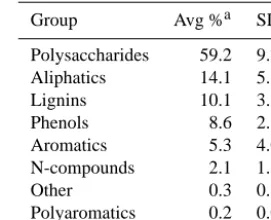
Based on frequency, abundance and potential as vegeta-tion marker, a selecvegeta-tion of 84 pyrolysis products was quan-tified for all 42 peat samples of the KK core. Quantification was based on the peak area of characteristic ions (m/z)from each pyrolysis product (Supplement Table S1). For each sam-ple the sum of the quantified peak areas was set at 100 % and amounts were calculated relative to this. According to probable origin and similarity, the pyrolysis products were grouped as follows: polysaccharides, aliphatics (n-alkanes, n-alkenes, methyl ketones, fatty acids, other aliphatic com-pounds), lignins, phenols, aromatics, polyaromatics and ni-trogen compounds.
2.2.2 C / N ratios and C and N stable isotope analyses Concentrations of C and N were determined in the carbon-ate free, acid peat by gas chromatography and thermal
con-ductivity detection after thermal combustion in an elemental analyser (Euro EA3000, Eurovector). Reproducibility of du-plicates was always better than∼8 % RSD.
Ratios of 13C /12C and 15N /14N and total C and N were quantified in dried bulk plant material and peat on mass basis using an elemental analyser (CE instruments NA 1108, Milan, Italy), connected via ConFlo III inter-face to a delta S IR-MS (Thermo Finnigan MAT, Bremen, Germany). Isotope signatures are given in the δ-notation δ‰ = ((Rsample/Rstandard)−1)×103, relative to the V-PDB
standard or N2in ambient air.
2.2.3 FTIR spectra
FTIR spectra of the ground peat samples were obtained us-ing a Vector 22 FTIR spectrometer (Bruker Optik, Ettlin-gen, Germany; absorption mode, subsequent baseline sub-traction) on KBr pellets (200 mg dried KBr and 2 mg sam-ple). Measurements were recorded from 4500 to 300 cm−1 using a resolution of 2 cm−1. A number of 32 scans per sample were averaged. Absorption peaks indicative of struc-tural units in OM were identified according to Senesi et al. (1989) and Niemeyer et al. (1992) and used as indi-cators of peat OM quality. Absorption at 1420 cm−1 is ascribed to OH deformations and CO stretch of phenols or CH deformation of CH2 or CH3 groups (phenolic and
aliphatic structures), at ∼1510 cm−1 to aromatic C = C or to CO of amide groups. The∼1630 cm−1region is indica-tive of aromatic C = C and asymmetric COO− group vibra-tions (lignin and other aromatics and aromatic or aliphatic carboxylates) and ∼1720 cm−1 of CO stretch of carbonyl
and carboxyl groups (carboxylic acids and aromatic esters). The 2920 cm−1 and 2850 cm−1 bands reflect C–H
stretch-ing vibrations, and 460 cm−1can be assigned to substituted aromatics and unsaturated aliphatic chains, which agrees with aromatic and aliphatic pyrolysis products. However, this band may be influenced by minerals such as clays and is thus not further considered here. Multiple signals at 1707 cm−1 (C = O), 1620 cm−1 (C = O, C = C), 1510 cm−1 (C = C), 1420 cm−1 (CH2, heterocyclics), 1370 cm−1 (C–
H, phenolics) and 1265 cm−1 (C–O, C–O–C) agree with lignin or alike compounds; strong bands at 3370 cm−1 (O– H), 1151 cm−1 (C–O, cellulose, carbohydrates), 1032 cm−1 (C–O, cellulose, carbohydrates) and 891 cm−1(O–H, carbo-hydrates) bands agree with polysaccharides.
To determine relative abundances of functional groups as a humification index, the ratio between peak intensity at 1630 cm−1with respect to polysaccharides (1053 cm−1)was
calculated (Holmgren and Norden, 1988; Niemeyer et al., 1992).
2.2.4 Oxygen and hydrogen indices using the Rock Eval©method
Rock Eval analyses were performed at the Alfred Wegener Institut für Polar- und Meeresforschung in Bremerhaven, Germany, using a Rock-Eval II (plus S3 unit). The method determines several operational defined groups of organic compounds based on pyrolysis at different temperatures and different H / C and O / C ratios. The obtained results al-low distinguishing between labile and increasingly refrac-tory OM fractions (Tissot and Welte, 1978). Pyrolysis is conducted on bulk peat samples (20 mg) to determine the amount of (i) hydrocarbons present in the sample (S1 peak in milligrams of hydrocarbons per gram of peat, data not shown), (ii) the amount of hydrocarbons generated by py-rolytic degradation of the peat during heating up to 550 ◦C (S2 peak in mg hydrocarbon per gram sediment) defined as the Hydrogen Index (HI) when normalized to the total or-ganic C content, and (iii) the amount of carbon dioxide gen-erated during heating up to 390◦C (S3 peak in milligrams carbon dioxide per gram sediment), which gives the Oxygen Index (OI), when normalized to the total OM content (Lafar-gue et al., 1998).
2.2.5 Humic acids extraction and UV-absorption The colorimetric method for characterizing the degree of decomposition was adopted by Blackford and Chambers (1993). For this study 0.1 g pulverized and freeze-dried peat samples were dissolved in 50 mL NaOH (8 %) and placed on a hot plate for 1 h to simmer. After cooling the extract was filled up to 100 mL with deionized water and filtered through a Whatman No. 1 filter paper. Then 25 mL of the extract were diluted to 50 mL prior to the colorimetric measurement. The absorbance of light (in %) was measured with a Perkin-Elmer UV-Vis spectrometer at a wavelength of 540 nm (UV-ABS).
2.2.6 Statistical analyses
Statistical analyses were performed using PASW Statistics 18.0 (IBM Corporation). All data were tested for correlation with a level of significance p <0.05 (Pearson, two-tailed). PCA was applied to extract the chemical signatures of the OM composition to derive the underlying factors accounting for them. The analysis was performed in theZ-score trans-formation (Zscore = (Xi−Xavg)/Xstd; whereXi is a given
value of a variable in a sample,Xavg is the average of that
variable andXstd is its standard deviation).Z scores allow
keeping the relative variation of the original data while re-ducing all variables to a similar range of variation avoiding scaling effects (Eriksson et al., 1999). For the pyrolysis prod-ucts, factor analysis was performed using Statistica 6 (Stat-Soft, Tulsa). PCA was applied for the complete data set of the KK core including pyrolysis-GC-MS and decomposition
data. In addition data on decomposition proxies of both cores (KK and KRB) was evaluated by PCA, separately.
3 Results
3.1 Carbon nitrogen ratios and isotopic composition of peat-forming plants
Results of C and N analyses of plants show highest C / N ratios for Sphagnum as compared to Calluna vulgaris (Eri-caceae) and Eriophorum vaginatum (Cyperaceae), which are considered as the most important peat-forming plants in the Harz bogs (Table 1).δ13C values range between−27.09 ‰ and−29.21 ‰ and are therefore similar in the three investi-gated species, but significantly lighter in C. vulgaris. In con-trast toδ13C,δ15N vary in a broad range between−0.87 ‰ and−8.13 ‰, with C. vulgaris being lightest.
3.2 Molecular composition of KK peat determined by pyrolysis-GC-MS
Molecular components were only determined in the KK core, assuming a similar relationship between the molecular com-ponents and the traditional decomposition proxies in both bogs (KK and KRB).
3.2.1 Vegetation markers
Based on analysis of plant species (Eriophorum vaginatum,
Sphagnum and Calluna vulgaris) and on previous plant
anal-yses several markers were identified. 4-Isopropenylphenol is specific for Sphagnum moss (Ph5) (van der Heijden et al., 1997). Additionally two biphenyl compounds were solely detected in Sphagnum (Ph7, Ph9; Supplement Table S1). 3-Methoxy-5-methylphenol (Ph6,m/z107, 109, 138) is char-acteristic for several lichen species (Schellekens et al., 2011; Schellekens et al., 2009). Ferulic acid methyl ester (Ph8,m/z 145, 177, 208) was only detected in E. vaginatum and has been proposed as a marker of graminoids (Schellekens et al., 2011; Schellekens et al., 2013). A sesquiterpene (St1) was solely detected in the pyrolysate of Pinus. Three unidenti-fied compounds with m/z 86 and 114 were present in the peat OM, but were not detected in any of the analysed plant species. All three probably originate from the same macro-molecule as the difference between their molecular masses (M+182, 210 and 238) point towards two CH
2groups. Only
the compound with molecular mass 210 (unkn3) was quanti-fied, as it showed the highest abundance.
3.2.2 Peat record
Table 1. Average carbon and nitrogen isotope ratios and C / N ra-tios in plants from two Harz Mountain bogs (KK, KRB). Standard deviation of repeated measurements of isotopic composition were
<0.5 ‰ and<0.25 ‰ forδ15N andδ13C, respectively.
Plant C / N δ13C δ15N
species ratios (‰) (‰)
Sphagnum magellanicum (n=3) 41.55 −27.67 −3.58
Calluna vulgaris (n=3) 37.73 −29.21 −8.13
[image:6.612.47.287.118.186.2]Eriophorum (n=3) 28.58 −27.09 −0.87
Table 2, polysaccharides are by far the most abundant organic compound in the peat followed by much smaller amounts of aliphatics, lignins, phenols and aromatics. We selected five molecular proxies including plant-specific markers for
Sphagnum and pine, and groups of pyrolysis products. Based
on their distribution these proxies can roughly be divided into two groups, where polysaccharides and the marker of
Sphag-num (4-isopropenylphenol) on one hand and aliphatics and
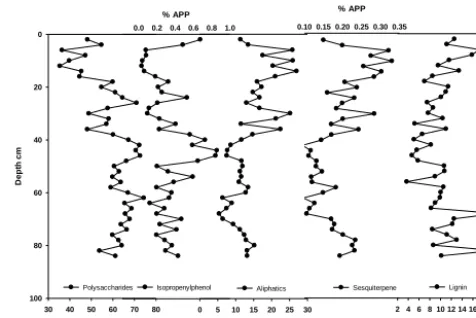
the marker of pine (sesquiterpene) on the other, showed sim-ilar changes (Fig. 1), whereas the distribution of lignin py-rolysis products shows smaller variations and less similarity to the distribution of aliphatics. All five groups of compo-nents except lignin show the highest variability in the upper 50 cm of the core. Polysaccharides and 4-isopropenylphenol show a trend of declining values towards the surface with pronounced minima between about 8 and 15 and 25 and 38 cm depth and a clear maximum between 38 and 50 cm depth (Fig. 1). Aliphatics and sesquiterpene show the oppo-site trend, also increasing below∼70 cm.
3.3 Records of decomposition proxies 3.3.1 Königsmoor (KK)
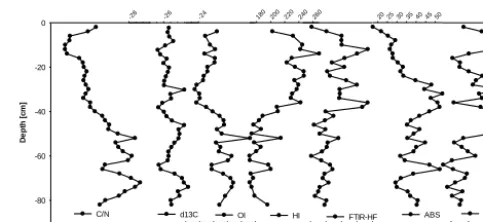
C / N ratios in the KK core show lowest values in the surface layer and increase down to a depth of 50 cm where they reach their maximum (Fig. 2). A pronounced peak of high C / N ra-tios indicating relatively low decomposition is observed be-tween∼43 and 50 cm. Below 50 cm they show some varia-tion but no more trends towards the end of the core. A sim-ilar trend of increasing values with depth is also observed forδ13C values as well as for UV-ABS andδ15N (Fig. 2 and Supplement Table S3). Neither HI and OI values show a trend despite intense changes throughout the core. The records of both values seem to show an inverse relationship, with high-est OI and lowhigh-est HI values in the surface layer, but are not significantly correlated (Supplement Table S3). Most intense variability is observed in the section between∼38 and 50 cm depth corresponding to similar intense changes of the other proxies in the same section (Fig. 2). UV-ABS is lowest in the surface layer and increases down to 40 cm by a factor of 2.5 after a pronounced low between 38 and 50 cm values again slightly increase towards the bottom of the core
with-34
% APP
30 40 50 60 70 80
D e p th c m 0 20 40 60 80 100 Polysaccharides
% APP
2 4 6 8 10 12 14 16 18 20 22 Lignin % APP
0.00.20.4 0.60.81.0
Isopropenylphenol
% APP
0.10 0.15 0.20 0.25 0.30 0.35
Sesquiterpene
% APP
0 5 10 15 20 25 30 Aliphatics
1
Figure 1: Distribution of selected (groups of) pyrolysis products in the KK peat record 2
indicative for polysaccharides, aliphatics and lignin, the markers of Sphagnum (4-3
Isopropenylphenol) and Pinus (sesquiterpene). Values show percentages of bulk samples 4
relative to the sum of all quantified pyrolysis products (APP). 5
[image:6.612.309.550.306.415.2]6
Figure 1. Distribution of selected (groups of) pyrolysis products in the KK peat record indicative for polysaccharides, aliphatics and lignin, the markers of Sphagnum (4-Isopropenylphenol) and Pinus (sesquiterpene). Values show percentages of bulk samples relative to the sum of all quantified pyrolysis products (APPs).
35
20 30 40 50 60 70 80
D e p th [ c m ] 0 20 40 60 80 100 C/N -28. 0 -27. 5 -27. 0 -26. 5 -26. 0 -25. 5 -25. 0 d13C
100 110 120 130 140 150
OI
180200220240260
HI
0.550.600.650.700.750.800.85
FTIR-HF
-2.5-2.0-1.5-1.0-0.5 0.0
d15N
25 30 35 40 45 50 55
ABS
1
Figure 2: Records of decomposition proxies: C/N ratios, δ13C (‰), oxygen and hydrogen
2
indices (OI, HI (mg CO2 g-1TOC)) determined by Rock Eval® analyses, FTIR decomposition
3
index 1630/1053 cm-1, UV-ABS of NaOH peat extracts and δ15N (‰) in bulk peat of the KK
4 core. 5 6
Figure 2. Records of decomposition proxies: C / N ra-tios, δ13C (‰), oxygen and hydrogen indices (OI, HI (mg CO2g−1TOC)) determined by Rock Eval® analyses, FTIR
decomposition index 1630/1053 cm−1, UV-ABS of NaOH peat extracts andδ15N (‰) in bulk peat of the KK core.
out larger changes. There are, however, almost no common features with any other indicator (Fig. 2). Alsoδ15N values vary in a broad range throughout the profile with a weak trend of decreasing values towards the bottom of the core, but also do not seem to be related to the other indices under study (Supplement Table S3).
The depth distribution of the FTIR spectra of the KK peat core is given in Supplement Fig. S1. The distribution of FTIR band intensities can be roughly divided into two groups. Group I mainly reflects polysaccharides (bands 1053 cm−1) and show a slight decrease of values in the uppermost 38 cm, whereas Group II includes aromatics (bands 1420, 1510, 1630 cm−1) and aliphatics (bands 2850, 2920 cm−1) and shows generally higher intensities in the upper 38 cm. The humification index (1630/1053 cm−1) based on FTIR also
greatly varies throughout the core (Fig. 2). Values are com-paratively high in the upper 40 cm and show a distinct low between 38 and 50 cm depth.
3.3.2 Kleines Rotes Bruch (KRB)
C / N ratios in the KRB core exhibit a similar course as those found in the KK core. Values are higher in the top layer but decrease to minimum values between 5 and 10 cm (Fig. 3). From 10 to about 50 cm C / N ratios steadily increase with-out larger changes and reach maximum values between 50 and 70 cm. A remarkable sharp decrease of the C / N ratios occurs between 65 and 70 cm, also indicated by changes in the other decomposition proxies. Different from the KK pro-file,δ13C values in the KRB core do not exhibit a trend, but show intense changes throughout the core (Fig. 3). OI and HI indices show a distribution comparable to that observed in the KK profile. Again, lowest OI and highest HI values are observed in the upper 40 cm and the inverse course in the low part of the core interrupted by several short-term changes (Fig. 3). UV-ABS values do not show a trend as observed in KK. They are lowest in the surface layer and steadily increase down to about 30 cm. Two pronounced maxima are observed between 30 and 45 cm and 65 to 70 cm where highest val-ues occur (Fig. 3). No trend inδ15N could be observed but there are intense changes especially in the upper 60 cm of the core. As for the KK site, in most sections, changes inδ15N do not correspond to those of any other decomposition proxy (Fig. 3, see also Supplement Table S3).
FTIR band intensities of KRB peat (Supplement Fig. S2) show a similar distribution to those of KK peat. In the upper 45 cm, with the exception of the uppermost 6 cm which re-flects the living plants, bands indicative for aliphatics (2920, 2860 cm−1) and aromatics (1630, 1510, 1420 cm−1) show higher intensities than in deeper peat sections. The upper-most 50 cm are characterized by a minimum between 18 and 25 cm followed by a pronounced peak of the aliphatic and especially the aromatic bands (25–35 cm). Another peak of aliphatic and aromatic band intensities is found at 65 cm. In contrast, bands indicating polysaccharides (1053 cm−1) show generally slightly higher values in the lower 50 cm and a trend of increasing values with depth. In some sections of the core, especially between 30 and 50 cm, polysaccharide band intensities appear to develop inversely to the aliphatic and aromatic bands. High intensities of these bands are also found in the uppermost∼10 cm where the high intensities of the polysaccharide band are attributed to the high cellu-lose and hemicellucellu-lose content in the living or only slightly decomposed plants. The development of the FTIR-based hu-mification index with depth (Fig. 3) is also comparable to what is found in the KK core. Highest values are found in the upper 40 cm followed by a section of low values between 40 and 65 cm and a strong sharp increase up to maximum values between 65 and 70 cm.
36
10203040 5060708090
D
e
p
th
[
c
m
]
-80 -60 -40 -20 0
C/N
-28 -26 -24
d13C
20 25 30 35 40 45 50
ABS
-2 -1 0 1
d15N
80100120140160180
OI
180200220240260
HI
0,6 0,8 1,0 1,2 1,4
FTIR-HF
1
Figure 3: Records of decomposition proxies C/N ratios, δ13C(‰) in bulk peat, oxygen and
2
hydrogen indices (OI, HI (mg CO2 g-1TOC)) determined by Rock Eval® analyses, FTIR
3
decomposition index 1630/1053 cm-1, UV-absorption of NaOH peat-extracts and δ15N(‰) in 4
bulk peat of the KRB core. 5
[image:7.612.307.549.64.175.2]6
Figure 3. Records of decomposition proxies C / N ratios,
δ13C (‰) in bulk peat, oxygen and hydrogen indices (OI, HI (mg CO2g−1TOC)) determined by Rock Eval®analyses, FTIR
de-composition index 1630/1053 cm−1, UV-absorption of NaOH peat-extracts andδ15N (‰) in bulk peat of the KRB core.
4 Discussion
4.1 Interpretation of pyrolysis-GC-MS data and PCA (KK)
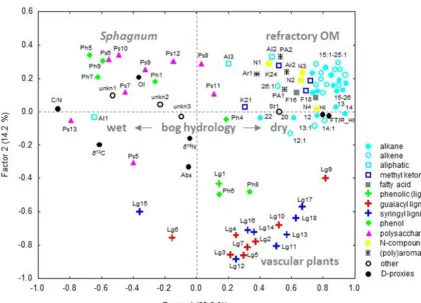
The main difficulty with the interpretation of decomposition proxies in peat is the fact that changes in bog hydrology si-multaneously affect the botanical composition, both causing changes in the relative abundance of polysaccharides, lignin and aliphatics. For example, in Sphagnum-dominated bogs a relatively high abundance of lignin indicates an increase of vascular plant species to the peat OM, as Sphagnum does not contain lignin. It also points to increased decomposi-tion, as in peat polysaccharides are preferentially degraded (Bracewell et al., 1980; Benner et al., 1984; van der Heij-den et al., 1990) causing a relative increase of lignin and/or aliphatics. Accordingly, drier conditions simultaneously re-sult in an increase of vascular plant species and an increase of aerobic decomposition. A relatively high abundance of lignin may thus be used as a proxy for hydrological reconstructions. However, if the relative abundance of lignin and polysaccha-rides are used as either vegetation or decomposition proxy it is problematic to separate the two factors. To disentangle the relationship between changes in plant species distribu-tion on one side and decomposidistribu-tion changes on the other we applied a factor analysis to all 82 quantified pyrolysis prod-ucts of the KK core. To enable comparison with the decom-position proxies discussed below, they were included in the factor analysis. The first four factors explained 67.7 % of the variance, of which the major part is explained by F1 and F2 (51.7 %).
37
1
Figure 4: Factor loadings of the F1-F2 projection extracted from PCA of pyrolysis products
2
from peat samples of the KK core. Note the opposite loadings of polysaccharides versus
3
alkanes, alkenes and aliphatics on F1, while lignins have high loadings on F1 and F2 resulting
4
in “fields” separating Sphagnum moss from vascular plants and refractory OM. Thus, the
5
projection of F1-F2 factor loadings could help to separate decomposition and vegetation
6
effects.
7
8
Figure 4. Factor loadings of the F1–F2 projection extracted from PCA of pyrolysis products from peat samples of the KK core. Note the opposite loadings of polysaccharides versus alkanes, alkenes and aliphatics on F1, while lignins have high loadings on F1 and F2 resulting in “fields” separating Sphagnum moss from vascular plants and refractory OM. Thus, the projection of F1–F2 factor loadings could help to separate decomposition and vegetation effects.
show negative loadings on F2 and positive loadings on F1 (Fig. 4); in Sphagnum-dominated peat this points towards an increased input of vascular plant species as mosses do not contain lignin. This possibility to differentiate between the contribution of Sphagnum and vascular plant residuals to the bulk peat is the particular value of the pyrolysis-GC-MS method. Aliphatics (except Al1), (poly)aromatics and nitro-gen compounds show positive loadings on both F1 and F2 and indicate selective preservation and addition of microbial OM in peat (e.g. Schellekens et al., 2009).
The separation of polysaccharides, lignin and aliphatic py-rolysis products in F1–F2 projection suggests the following interpretation. F1 reflects the water table height at the time of plant death, with relatively dry conditions (positive on F1) causing an increase of vascular plants and aerobic decompo-sition. A lowering of the water table results in (i) a higher input of vascular plant material (negative on F2) and (ii) increased aerobic decomposition of Sphagnum moss (from negative on F1 to positive). F2 thus reflects the occurrence and degradation of vascular plants (lignin, negative on F2), which increases under relative dry conditions (positive load-ings on F1). A more detailed look confirms this interpreta-tion. The marker of lichens (Ph6) is located with the lignin
pyrolysis products (Fig. 4), which confirms its preference for drier habitats (Kleinebecker et al., 2007). Both lignin moi-eties with an acetyl side chain (Lg9, Lg17) show lowest load-ing on F2 and highest positive loadload-ing on F1 compared with other lignin pyrolysis products, which is in agreement with the oxygenation of lignin alkyl side chains upon degrada-tion (Kögel-Knabner, 2002; Schellekens et al., 2012). The main pyrolysis product of cellulose is levoglucosan (Ps13) (Pouwels et al., 1987); its neutral loadings on F2 (Fig. 4) agree with the high abundance of cellulose in both mosses and vascular plants. Xylose, which has a high abundance in hemicelluloses of grasses (Smith and Harris, 1999; Wende and Fry, 1997) and sedges (Bourdon et al., 2000), results in 4-hydroxy-5,6-dihydro-(2H)-pyran-2-one (Ps5) upon pyrol-ysis (Pouwels et al., 1987); Ps5 is the only polysaccharide pyrolysis product that shows negative loadings on F2, which is in agreement with a graminoid origin and the high negative loadings of vascular plant derived lignins on F2. However, the overall contribution of this compound to the statistical interpretation is only low.
[image:8.612.89.510.63.365.2]4.2 Comparison of decomposition proxies (KK, KRB) PCA of decomposition proxies reveals only minor differ-ences if applied to the cores KK and KRB separately (Sup-plement Table S2). For both cores most of the variance (49 and 53.5 %) is explained by the first component. All used decomposition proxies show high loadings on the first com-ponent in both cores exceptδ15N and UV-ABS, which both load significantly on a second component in the KRB core, and OI, which loads higher on the second component of the KK PCA. KK peat shows three components with higher load-ings of OI andδ15N on the second and high loadings of UV-ABS on the third component. PCA gives two components if the data of both cores are analysed together, with C / N ratios, HI, OI, FTIR andδ13C loading high on the first and UV-ABS andδ15N on the second component.
From this it is likely that variations in all proxies, except of δ15N, are predominately attributed to changes in the degree of peat decomposition and in vegetation. The occurrence of the C and N isotope data in a second component can be ex-plained by additional fractionation processes, which are in-dependent of or only indirectly linked to decomposition such as changes in temperature, humidity, plant species or N re-cycling. This seems to be especially true forδ15N, which we assume is mostly influenced by N-recycling, whereas δ13C appears to be mainly influenced by decomposition at least in the KRB core. This influence becomes more pronounced when the data of both cores are analysed together and signifi-cant loadings ofδ13C disappear from the second component. The appearance of UV-ABS in a second or third component independent of the other proxies was unexpected as UV-ABS of NaOH extracts has been frequently used to determine the degree of peat humification. The missing correlation between UV-ABS and the other decomposition proxies indicates that changes in mass loss affecting C / N ratios, FTIR band in-tensities, HI, OI andδ13C is not necessarily coincident with the formation of humic acids, the main process underly-ing changes in UV-ABS of NaOH peat extracts. However, changes in vegetation controlled by hydrology, i.e. shifts in vascular plant species (containing lignin) in peat which is dominated by Sphagnum (not containing lignin) during drier periods, may also lead to changes in the abundance of humic acids (Yeloff and Mauquoy, 2006; Chambers et al., 1997). Changes in humic acids may thus reflect more a signal of vegetation changes than of changes in humification or de-composition alone.
C / N ratios and the FTIR humification index have been used in a number of studies as indicator of peat decomposi-tion or, more exactly, as a measure of mass loss caused by increased mineralization during water table lows, although most studies do not consider changes in the botanical setting. The influence of plants on one hand and decomposition on the other is a key issue of this study. However, results from previous studies on trace element distribution in the same samples (Biester et al., 2012) show significant negative
cor-relation between C / N ratios and trace element (e.g. Br, Ti, Zr) enrichment, confirming the major influence of mass loss on C / N in peat dominated by Sphagnum. Thus, C / N ratios in these Sphagnum-dominated cores predominantly indicate mass loss attributed to peat decomposition and to a lesser ex-tent shifts in vegetation. While a number of studies address this shortcoming by analysing specific plant residues (e.g. re-mainders of Sphagnum only; Loisel et al., 2009; Skrzypek et al., 2007), this has not always been done and is not always possible in more decomposed peat or if Sphagnum provides only a small proportion of predominant vegetation.
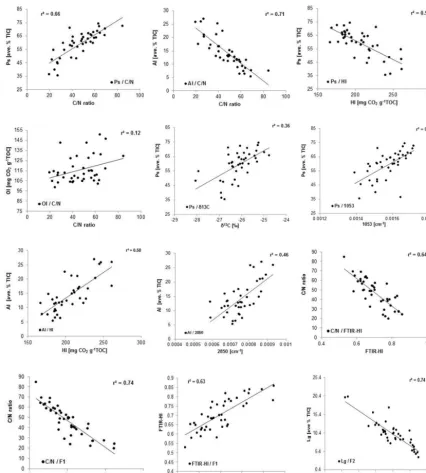
C / N ratios correlated well and negative with hydrogen in-dices in both cores (r2=0.74 (KK),r2=0.74 (KRB)), but only weakly with OI. The good correlation between C / N and HI is explained by a concurrent loss of mass (decreas-ing C / N) dur(decreas-ing decomposition of labile compounds and a relative enrichment of aliphatics (increasing HI indices). The concept of peat humification/coalification suggests in-creasing decarboxylation under anoxic conditions. C / N ra-tios, however, remain relatively stable under anoxic condi-tions and correlation between C / N ratios and OI indices could therefore not be expected. The weak correlation be-tween C / N ratios and OI in our cores could be explained by oxidation of OM during low water tables, which does not generally lead to complete mineralization, but to an in-crease in carboxyl groups. Thus, dry falling may promote two processes: an increase in OM associated oxygen groups and losses of (oxygenated) OM through mineralization; thus mass loss and losses of oxygen from OM do not necessarily have to be correlated, suggesting that the HI may be a better indicator for decomposition than the OI.
Correlations of C / N with intensities on FTIR band 1510 cm−1 (r2=0.69; lignins, phenols) and band
1630 cm−1 (r2=0.52; lignins, other aromatics, aliphatic carboxylates) were always negative and significant, suggest-ing that lignins, aromatics and aliphatic carboxylates are enriched during peat mineralization (Fig. 5 and Supplement Table S3). However, correlations between C / N ratios and pyrolysis products assigned to lignins or aromatics were significantly lower or absent, but, as will be discussed below, the intensities of the FTIR bands 1510 cm−1and 1630 cm−1 are significantly correlated (r2=0.7 andr2=0.48, respec-tively) with the first component (F1) obtained from the PCA of pyrolysis-GC-MS data (Fig. 5 and Supplement Table S3). As F1 is mostly determined by variations in concentrations of polysaccharides and aliphatics it is most likely that both bands mainly reflect changes in the content of aliphatics and to a lesser extent variations in aromatics or lignins. This may be due to an overlap of functional groups in the IR spectra (Coates, 2000), making an exact assignment of peaks difficult.
38
1
2
3
4
Figure 5: Selected correlations between decomposition proxies in the KK core and factors
5
(F1, F2) obtained by PCA of pyrolysis-GC-MS data. C/N ratios, FTIR bands 1053 cm
-1and
6
2850 cm
-1, FTIR-Humification index (FTIR-HI, 1630/1053), HI and
δ
13C and molecular
7
components determined by pyrolysis-GC-MS (polysaccharides (Ps), aliphatics (Al), lignin
8
(Lg).
9
Figure 5. Selected correlations between decomposition proxies in the KK core and factors (F1, F2) obtained by PCA of pyrolysis-GC-MS data. C / N ratios, FTIR bands 1053 cm−1and 2850 cm−1, FTIR humification index (FTIR-HI, 1630/1053), HI andδ13C and molecular components determined by pyrolysis-GC-MS – polysaccharides (Ps), aliphatics (Al), lignin (Lg).
(r2=0.74 and 0.62, respectively) which represent the group of lignins and other aromatics, as well as the FTIR hu-mification index (1630/1053) (r2=0.65) (Supplement Ta-ble S3). This probably indicates that the bands 2920 cm−1
and 2850 cm−1 do not solely absorb on fats and waxes as
suggested previously (Cocozza et al., 2003; Niemeyer et al., 1992) but overlap with signals from polysaccharides and cellulose (Coates, 2000). HI solely correlate significantly with aromatics and lignin (band 1510 cm−1not shown) and
F1 (r2=0.6) and the FTIR humification index (r2=0.48), which indicates that both aliphatics and aromatics increase during decomposition owing to the loss of polysaccharides and both increase HI values. Such ambiguous information from FTIR data suggests that interpretation needs to be done with caution.
[image:10.612.85.511.65.538.2]4.3 Comparison of decomposition proxies and molecular components (KK)
PCA of the pyrolysis-GC-MS data shows that the hydrologi-cal controlled distribution of polysaccharides on one side and aliphatics and lignins on the other determine the variability in the molecular peat components through peat decomposition. Comparison of the decomposition proxies derived from KK peat with the molecular compounds obtained by pyrolysis-GC-MS (Fig. 4 and Supplement Fig. S3) indicates that factor F1 and the group of aliphatics yield similar records as the hy-drogen index and the FTIR-humification index. C / N ratios, δ13C and the oxygen index show similarity to the record of polysaccharides, which runs inversely to the PCA factor F1 (Supplement Fig. S3). Under drier conditions, decomposition through mineralization of predominately polysaccharides is thus higher, but so also is the abundance of vascular plants, which causes an increase in lignins, HI values and a decrease of polysaccharides, C / N ratios,δ13C and OI values. Accord-ingly, wet conditions are indicated by the reverse trend in the distribution of the proxies attributed to higher abundance of Sphagnum in relation to lignin-containing graminoids and less intense decomposition of polysaccharides (Fig. 4).
4.3.1 C / N ratios
In detail, F1 is negatively correlated with the C / N ratio (r2= 0.74; Fig. 5, Supplement Table S2) and positively correlated with polysaccharides (r2=0.66; Table 2), which means that – not surprisingly – a higher content of polysaccharides cor-relates with a lower degree of peat decomposition. However, the C / N ratio is similarly affected by the effects of both botanical changes and aerobic decomposition upon changes in hydrology. The C / N ratio decreases with decomposition but also highly differs between Sphagnum spp. and vascular plants (e.g. Hornibrook et al., 2000). Table 1 shows slightly higher C / N ratios for the analysed Sphagnum species com-pared to graminoids and ericoids. However, C / N ratios in
Sphagnum from the Harz sites (Table 1) are much lower than
[image:11.612.360.496.87.197.2]those in Sphagnum from remote sites (Schmidt et al., 2010), which is most likely a result of the high atmospheric N de-position in the Harz Mountains in the past decades. As large parts of atmospheric N are captured by Sphagnum moss (Hei-jmans et al., 2002). Sphagnum from before the 20th century is likely to show similar C / N ratios to those from present-day remote sites (see e.g. C / N of 89–134 reported in Broder et al., 2012). Independently of the initial C / N ratio in the upper part, the highest negative loading of C / N on F1 and the loading of almost zero on F2 (Fig. 4) indicate that despite light shifts in vegetation, C / N ratios here provide a reason-able estimate of the degree of decomposition. In a peat record from Tierra del Fuego major shifts in C / N ratio perfectly agreed with the main botanical transitions, from Sphagnum-dominated to Sphagnum–Juncus to Juncus-Sphagnum-dominated peat (Schellekens and Buurman, 2011). In another peat record
Table 2. Groups of pyrolysis products in peat samples of KK.
Group Avg %a SDb
Polysaccharides 59.2 9.76 Aliphatics 14.1 5.61
Lignins 10.1 3.63
Phenols 8.6 2.68
Aromatics 5.3 4.01
N-compounds 2.1 1.55
Other 0.3 0.34
Polyaromatics 0.2 0.06
aMean value for bulk sample relative to the sum
of all quantified pyrolysis products (n=42).
bStandard deviation.
dominated by graminoids, an increase in lignin and aliphat-ics was related to decomposition (Schellekens et al., 2011; Schellekens et al., 2012), but no correlation with C / N ratio was found. However, within the KK peat, which is dominated by Sphagnum, shifts in C / N ratio mainly reflect decompo-sition. The fact that not lignin (indicating vascular plants) but aliphatics showed the better correlation with C / N ratios (r2=0.60; Fig. 5, Supplement Table S2) further confirms this. Because vascular plants increase under relatively dry conditions in Sphagnum-dominated peat, this automatically indicates a higher degree of aerobic decomposition (positive loadings of lignin on F1, Fig. 4). A combination of vege-tation and decomposition proxies is expected to best reflect changes in bog hydrology, as vegetation shifts are probably slower than decomposition (which is a continuous process). On the other hand secondary decomposition may disturb the hydrological interpretation when only decomposition proxies are used.
4.3.2 FTIR
could be related to the fact that also Sphagnum contains high amounts of lignin-like phenolic compounds. Compa-rable to what has been found by pyrolysis-GC/MS, inten-sity changes of the FTIR bands mainly reflect the changes in the peat’s concentrations of aliphatic and aromatic struc-tural components and polysaccharides (Supplement Fig. S4), while signals for lignin may be influenced by too much over-lapping with other functional groups. Nevertheless, ratios of intensities on band 1630 (aromatic structures in lignins or aliphatic carboxylates) and those of band 1053 (0.36) (polysaccharides), which has been suggested as a FTIR hu-mification index, are significantly correlated to F1 (r2= 0.67) (Fig. 5), aliphatics (r2=0.58), polysaccharides (r2= 0.55), 4-isopropenylphenol (r2=0.48) (Sphagnum) and a sesquiterpene (Pinus) (r2=0.43) (Supplement Table S3). A unique interpretation of the FTIR bands is obviously con-strained by their overlap in complex OM such as peat, a shortcoming which may only partly be resolved by relat-ing FTIR-based indices to molecular markers. FTIR data, however, confirm the interpretation that decomposition on a molecular level in the KK peat record is mainly indicated by an increase in aliphatics and aromatic structures and a de-crease in polysaccharides.
4.3.3 Oxygen and hydrogen indices (OI, HI)
The oxygen/carbon ratio in peat as expressed by the OI is expected to be high in sections where decomposition is low and higher amounts of oxygen containing compounds oc-cur (e.g. polysaccharides). According to the van Krevelen concept of coal petrology the oxygen index is expected to decrease during proceeding OM decomposition and coali-fication (Tissot and Welte, 1978). Although the OI index showed high values during the Sphagnum-dominated period (38–48 cm, Figs. 1 and 3 (4-isopropenylphenol)) and also in the uppermost sample, correlations with other pyrolysis-GC-MS proxies were rather low (Supplement Table S3). Signif-icant correlation (r2=0.41) was only found for an uniden-tified polysaccharide (Ps10, Supplement Table S1) and for 4-isopropenylphenol, the latter which is specific for
Sphag-num. Higher values of HI (equivalent to high H / C) in peat
deposits have been interpreted as hydrogen-rich labile C compounds in unprocessed OM (Outridge and Sanei, 2010). However, the HI index is thought to reflect aliphatic struc-tures in general and the HI record of KK peat was posi-tively correlated (r2=0.49) with aliphatics determined by Py-GC-MS and with FTIR band 460 (aliphatics) (r2=0.58) (not shown), but only weak (r2=0.32 and 0.26) if corre-lated to the bands 2850 cm−1 and 2920 cm−1, respectively (lipids, waxes, CH2stretching (2850 cm−1)(Supplement
Ta-ble S3). Negative, but higher correlation (r2=0.58) was found with band 891 cm−1 indicative of polysaccharides. Thus, the HI record in KK peat also reflects the relative en-richment of aliphatics compared to more labile polysaccha-rides such as cellulose as we have already concluded from
the results of pyrolysis-GC-MS measurements. The H / C ra-tio is often found to decrease with burial depth and regarded to reflect a maturity-enhanced conversion of aliphatic C to fixed aromatic C under Rock Eval conditions (Schenk et al., 1986). However, such assumptions seem not to hold true for peats with a low diagenetic grade, in which decomposition of polysaccharides results in a relative increase of aliphatics. A transformation to aromatic compounds seems hardly rel-evant, which would explain the absence of a correlation be-tween HI and aromatics and only a weak correlation bebe-tween HI and polyaromatics in KK peat.
4.3.4 C and N isotope ratios (δ13C,δ15N)
In the literature information derived from δ13C values in peat are interpreted in different ways. C isotopes in peat have been assigned to several processes, among which are the inherent isotopic signals of the plants owing to e.g. the photosynthesis pathway, the temperature during plant forma-tion at the bog’s surface, bog surface wetness and by de-composition processes. Jedrysek and Skrzypek (2005) stated that peat diagenesis has generally no influence on δ13C in
Sphagnum or extracted cellulose. Kaislahti et al. (2010)
re-ported a dependency ofδ13C in young peat on temperature and could also not find a relationship with peat decompo-sition patterns. Several studies have stated that Sphagnum δ13C reflects surface moisture conditions (Rice and Giles, 1996; Price et al., 1997; Ménot and Burns, 2001; Loisel et al., 2009). While some studies found thatδ13C values were lower during drier conditions (Loisel et al., 2009) or in more decomposed peat (Broder et al., 2012), the opposite effect was also reported (Hong et al., 2001). Nevertheless, this in-dicates that C isotope ratios may indeed be influenced by decomposition processes. Several publications indicate a de-crease inδ13C due to preferential preservation of refractory C compounds depleted in13C (Akagi et al., 2004; Melillo et al., 1989), but uniform depth trends with no significant C isotope fraction or fractionation effects during CH4
forma-tion were also observed (Clymo and Bryant, 2008; Kracht and Gleixner, 2000). However, only very few studies have included analyses of peat decomposition or molecular prox-ies, so that the role of peat decomposition on C isotopes of-ten remains speculative. Values ofδ13C in peat from the KK bog range between−24.76 and−28.06 ‰ with a median of −26.1 ‰, which is typical for C3 plants (Hong et al., 2001), but slightly heavier than the peat-forming plants of the Harz mires (−27.42 to−29.06 ‰) (Table 1). Correlations of the δ13C record with pyrolysis-GC/MS molecular components are comparatively weak (Supplement Table S3). Levoclu-cosan, a pyrolysis product of cellulose, as well as the group of polysaccharides show a positive correlation ofr2=0.41 andr2=0.37, respectively. Best correlation was found with aliphatics (r2=0.59, negative), which means thatδ13C be-comes lighter with the enrichment of aliphatics. Moreover, an increase in lignin content during water table lows as a
result of an absolute increase in vascular plants and a rela-tive decrease of polysaccharides might also lowerδ13C val-ues, although no correlation between lignin and δ13C has been found. The unusually lowδ13C in the surface layer is probably attributed to the present-day increase in grasses on the bog’s surface or the “Suess” effect, which has caused a decrease in the global atmospheric δ13C value from −6.5 to −8.0 ‰ since the Industrial Revolution (Francey et al., 1995).
Values ofδ15N are not correlated with any of the pyrolysis-GC-MS components or FTIR band intensities (Supplement Table S3). As an essential nutrient, nitrogen undergoes in-tense recycling, which most likely is accompanied by inin-tense isotope fractionation processes (Robinson, 2001). Moreover, N isotope variability in different peat-forming plants will fur-ther add to the overall high variability, so that fractionation attributed to peat decomposition seems to have a minor ef-fect, and thus is mostly overwritten by other fractionation processes, especially N recycling. δ15N values in the Harz mire’s plants (Table 1) were in agreement with other stud-ies on peatland plants (Asada et al., 2005) and were signifi-cantly lower than those found in peat (mean−1.23 ‰, KK; and 0.75 ‰, KRB) indicating that microbial processes, espe-cially denitrification, have removed isotopic light N compo-nents from the peat (Jones et al., 2010). Ericoids (C. vulgaris) were typically low in15N (−8.13 ‰) due to their association with mycorrhiza (Gebauer and Dietrich, 1993), but this sig-nal is not reflected in the peat owing to inverse enrichment of
13C in the remaining fungal tissues. The reverse behaviour
of 15N with the other proxies in the part where Sphagnum dominated and lowest decomposition took place (38–45 cm) suggests that when Sphagnum is dominant the effect of veg-etation is larger than that of decomposition, which was also found for C / N ratio.
4.3.5 UV-ABS
Despite some similarities in the records of UV-ABS values and F1 and aliphatics especially below 25 cm, absorption data showed no significant correlations with other molecu-lar components or decomposition indices (Supplement Ta-ble S3). However, low absorption values in the upper three samples and in the Sphagnum-dominated period between 38 and 48 cm agreed with a low degree of decomposition of re-cent samples and during Sphagnum dominance (Figs. 2 and 3 and Supplement Fig. S3). The absence of good correlations with other proxies can be attributed to the fact that the peat, although dominated by Sphagnum, had a relatively high con-tribution and high variability of vascular plant species that differ in chemical composition and chemical changes dur-ing decay (e.g. graminoids, ericoids, pine, etc.) (Baumann, 2009). UV-ABS of alkaline peat extracts is based on the as-sumption that more extractable humic acids indicate a higher degree of peat decomposition, but the conditions under which increased “humification” occurs are poorly defined.
More-over, the molecular compounds extracted by alkaline leach-ing are loosely specified, although it is believed that mostly aromatic moieties such as lignin or phenols are preferentially extracted. However, lignins and aromatics in KK peat have been found not to be correlated to any of the decomposition proxies including the UV-ABS values and the reasons for this lack of significant correlation remains largely unresolved.
5 Conclusions
The two investigated peat cores show similar progression and relationship of decomposition proxies indicating that the ob-served changes are attributed to external and at least regional forcing. Results from PCA reveal high correlation between C / N, HI and the FTIR-humification index and moderate correlation withδ13C and OI. Accordingly, all investigated proxies show changes upon peat decomposition reflecting changes in mass loss and related relative enrichment of more persistent components. Pyrolysis-GC-MS analyses of the KK core have shown that preferential decomposition of polysac-charides and relative enrichment of aliphatics, as indicated by the decomposition proxies, is predominantly caused by de-composition instead of vegetation changes. Although lignins are also enriched during peat decay their influence on decom-position patterns are of less importance, here. Going hand in hand during water table changes, peat decomposition appears to overwrite most of the influence of changes in the contribu-tion of vascular plants in the Harz mires and thus allows the use of C / N ratio, FTIR index and the HI as bulk decomposi-tion proxies. But in order to understand the processes and to ensure consistency of decomposition proxies, comparison of proxies that provide detailed molecular information (i.e. an-alytical pyrolysis) is recommended.
by N recycling and plant uptake in the acrotelm, and to a low extent by peat decomposition. Although UV-ABS is fre-quently used as a measure of humification, its correlation with other decomposition proxies in the KK peat record was generally low. One reason might be that the impact of de-composition on the formation of humic acids is poorly con-strained and the results obtained are chemically poorly de-fined.
C / N ratios, pyrolysis-GC-MS, and FTIR spectroscopy yielded a comprehensive picture of mass loss and the relative abundance of different OM components (e.g. carbohydrates versus aliphatics), respectively, during peat decomposition at the investigated sites. Future studies need to show to what ex-tent these results can be generalized for other sites and how decomposition proxies compare at sites with different botan-ical, hydrological or climatic background.
The Supplement related to this article is available online at doi:10.5194/bg-11-2691-2014-supplement.
Acknowledgements. The authors like to thank Adelina Calean and
Petra Schmidt at Technische Universität Braunschweig for their help with geochemical analyses. Stable isotope measurements were done in the Isotope Biogeochemistry Lab at BayCEER, headed by G. Gebauer. The help of Heidi Zier with FTIR analysis and the lab-oratory staff at the Department of Hydrology (headed by S. Peiffer), University of Bayreuth, is greatly acknowledged. This research was also supported by the collaboration framework of projects CGL2010-20672 and 10PXIB200182PR (Spanish Ministry of Sci-ence and Innovation, General Directorate of I+D-Xunta de Galicia).
Edited by: D. Obrist
References
Aaby, B. and Tauber, H.: Rates of peat formation in relation to de-gree of humification and local environment, as shown by studies of a raised bog in denmark, Boreas, 4, 1–17, 1975.
Akagi, T., Minomo, K., Kasuya, N., and Nakamura, T.: Variation in carbon isotopes of bog peat in the ozegahara peatland, japan, Geochem. J. Japan, 38, 299–306, 2004.
Artz, R. R. E., Chapman, S. J., Jean Robertson, A. H., Potts, J. M., Laggoun-Défarge, F., Gogo, S., Comont, L., Disnar, J.-R., and Francez, A.-J.: Ftir spectroscopy can be used as a screening tool for organic matter quality in regenerating cutover peatlands, Soil Biol. Biochem., 40, 515–527, 2008.
Asada, T., Warner, B. G., and Aravena, R.: Nitrogen isotope signa-ture variability in plant species from open peatland, Aquat. Bot., 82, 297–307, doi:10.1016/j.aquabot.2005.05.005, 2005. Bahnson, H.: Kolorimetriske bestemmelse af humificenngstal i
ho-jmosetorv fra fuglso mose på djursland, Meddelande Dansk Ge-ologisk Forening, 18, 55–63, 1968.
Barber, K. E.: Peatland records of holocene climate change, Ency-clopedia of Quaternary Science, 1883–1894, 2006.
Barber, K. E. and Langdon, P. G.: What drives the peat-based palaeoclimate record? A critical test using multi-proxy climate records from northern britain, Quaternary Sci. Rev., 26, 3318– 3327, 2007.
Baumann, K.: Entwicklung der moorvegetation im nationalpark harz, in: Schriftenreihe aus dem nationalpark harz, National-parkverwaltung Harz, Wernigerode, 2009.
Benner, R., Maccubbin, A. E., and Hodson, R. E.: Anaerobic biodegradation of the lignin and polysaccharide components of lignocellulose and synthetic lignin by sediment microflora, Appl. Environ. Microbiol., 47, 998–1004, 1984.
Benner, R., Fogel, M. L., Sprague, E. K., and Hodson, R. E.: Deple-tion of c in lignin and its implicaDeple-tions for stable carbon isotope studies, Nature, 329, 708–710, 1987.
Biester, H., Martinez-Cortizas, A., Birkenstock, S., and Kilian, R.: Effect of peat decomposition and mass loss on historic mercury records in peat bogs from patagonia, Environ. Sci. Technol., 37, 32–39, 2003.
Biester, H., Keppler, F., Putschew, A., Martinez-Cortizas, A., and Petri, M.: Halogen retention, organohalogens, and the role of organic matter decomposition on halogen enrichment in two chilean peat bogs, Environ. Sci. Technol., 38, 1984–1991, 2004. Biester, H., Bindler, R., Martinez-Cortizas, A., and Engstrom, D. R.: Modeling the past atmospheric deposition of mercury using natural archives, Environ. Sci. Technol., 41, 4851–4860, 2007. Biester, H., Hermanns, Y.-M., and Martinez Cortizas, A.: The
in-fluence of organic matter decay on the distribution of major and trace elements in ombrotrophic mires – a case study from the harz mountains, Geochim. Cosmochim. Ac., 84, 126–136, 2012. Blackford, J. J. and Chambers, F. M.: Determining the degree of peat decomposition for peat-based palaeoclimatic studies, Int. Peat J., 5, 7–24, 1993.
Boon, J. J., Dupont, L., and De Leeuw, J. W.: Characterization of a peat bog profile by curie-point pyrolysis-mass spectrometry combined with multivariant analysis and by pyrolysis-mass spec-trometry, Peat Water, 215–239, 1986.
Booth, R. K.: Testing the climate sensitivity of peat-based paleocli-mate reconstructions in mid-continental north america, Quater-nary Sci. Rev., 29, 720–731, 2010.
Borgmark, A. and Schoning, K.: A comparative study of peat prox-ies from two eastern central swedish bogs and their relation to meteorological data, J. Quaternary Sci., 21, 109–114, 2006. Bourdon, S., Laggoun-Défarge, F., Disnar, J.-R., Maman, O.,
Guil-let, B., Derenne, S., and Largeau, C.: Organic matter sources and early diagenetic degradation in a tropical peaty marsh (tritrivakely, madagascar). Implications for environmental recon-struction during the sub-atlantic, Org. Geochem., 31, 421–438, 2000.
Bracewell, J. M., Robertson, G. W., and Williams, B. L.: Pyrolysis-mass spectrometry studies of humification in a peat and a peaty podzol, J. Anal. Appl. Pyrol., 2, 53–62, 1980.
Broder, T., Blodau, C., Biester, H., and Knorr, K. H.: Peat decom-position records in three pristine ombrotrophic bogs in south-ern Patagonia, Biogeosciences, 9, 1479–1491, doi:10.5194/bg-9-1479-2012, 2012.
Buurman, P., Nierop, K. G. J., Pontevedra Pombal, X., and Martínez Cortizas, A.: Molecular chemistry by pyrolysis-gc/ms of selected