Extending, Changing, and Explaining the Brain
Abstract
This paper address concerns raised recently by Edouardo Datteri (2009) and Carl Craver (2010) about the use of prosthetic implants in experimental neuroscience. Since the operation of the implant induces plastic changes in neural circuits, it is reasonable to worry that operational knowledge of the hybrid system will not be an accurate basis for generalisation when modelling the un-tampered brain. I argue, however, that Datteri’s no-plasticity constraint unwittingly rules out numerous experimental paradigms in systems neuroscience which also bring about changes in the brain. Furthermore, the relevance of prosthetic experiments to basic neuroscience is apparent when one considers the kind of theoretical questions that can be explored precisely by methods which alter neural circuits.
1. Introduction – Extending the Brain
The science-technology relationship is of particular interest in brain research. Basic neuroscience yields hundreds of thousands of publications annually, exploiting an impressive range of techniques from genetic engineering to functional neuroimaging. Yet the discipline lacks an overarching theory of brain function to unify the vast quantity of data collected, and neuroscientists focussing on single levels of investigation (e.g. cellular, molecular, or systems), share little common ground. At the same time, certain findings in basic neuroscience have fostered practical applications, including neural
technologies with significant therapeutic and commercial potential. For example, optogenetics uses genetic insertion of photosensitivity in brain cells to enable fine control of neural circuits with impulses of light (e.g. Zhang et al. 2010). Much neural technology aims simply to control the operation of neurons, especially in cases of psychiatric and neurological disease where function is pathological. Other technologies aim to extend neural function, for example by engaging parts of the cortex in the control of robotic limbs. These are the focus of this paper. The techniques are made possible because of the brain’s lifelong capacity for plasticity, the alteration of brain anatomy and connectivity in response to trauma, demands of learning, or interaction with new objects in the environment. I ask how such technologies can contribute to basic neuroscience. In other words, does changing the brain rule out
Let us begin with a few words from Daniel Moran, professor of biomedical engineering at Washington University in St. Louis:
“We’ll drill a small hole in the skull, pop the bone out, drop the device in, replace the bone, sew up the scalp and you’ll have what amounts to Bluetooth in your head that translates your thoughts into actions.” (quoted in Lutz 2011)
What is the “device” in question?, you may be wondering. It is an epidural electrocorticography (EECog) implant, a recording device similar to an array of EEG electrodes but designed to rest on the cortex, inside the surface of the skull. It is one of a number of brain computer interfaces (BCI) 1 in
development for eventual clinical application in populations suffering from the most severe forms of paralysis due to malfunction of the motor nervous system. Users learn to adjust their patterns of brain activity so that the BCI provides real-time, voluntary control of a robotic limb, or moves a cursor on a computer screen. No residual motor skills are required, potentially restoring locomotive and
communicative abilities to quadriplegic and “locked in” patients. To take just one example from the Andrew Schwartz laboratory at the University of Pittsburgh, monkeys trained with the BCI can use a robotic arm to reach to a marshmallow, grasp it in a pincer movement and carry the food to the mouth (Velliste et al. 20082)
While BCI technology has received much attention for its great promise in rehabilitative medicine, it also has stood out as being of theoretical importance. Now it is tempting to assume that demonstrations of precise, engineered control over biological systems indicate that the system has been explained and understood. Perhaps this assumption tacitly fuels interest in neuroengineering. Dretske (1994) wrote, “if you can’t make one, you don’t know how it works”. That is not to say that if you can make one, then you do know how it works. In other words, practical mastery may be a necessary, but certainly not sufficient, corollary of theoretical insight.
This is a point pressed by Carl Craver (2010). He makes a compelling case that the prosthetic or bionic
1 AKA brain machine interfaces (BMI). Craver (2010) discusses these as a kind of prosthesis (i.e. “a device designed to
replace or restore the function of some biological component” [my emphasis]). The BCI involved in neural control of the robotic arm is not a prosthesis in the sense of replacing a function. Rather, it is there to add a new function to the brain (control of a robotic arm). Note that in quadriplegic patients the motor cortex is still functioning, but its signals to peripheral nervous system and muscles are cut off at the cervical spine. So the prosthesis (in sense of replacement) is the robotic arm with its electronic nervous system. To avoid this ambiguity I use Datteri’s (2009) preferred term, bionic. However, for the purposes of this article, the terms prosthetic, bionic, or hybrid (another term used by various authors) should be
interchangeable in reference to models and experiments.
models implemented by BCI’s do not have advantages over standard ways of building models in neuroscience. The bionic system does things differently from the natural system, so cannot constrain models of processing in the natural system. Engineers and basic biologists find themselves in pursuit of different goals, Craver observes. Engineers’ models aim at practical utility by any means, whereas biologists’ models aim to mirror the workings of nature.
Edoardo Datteri (2009) recommends even greater scepticism about the theoretical importance of experiments involving hybrid components, and asks what methodological constraints need to be imposed on such experiments in order that their findings can rightly contribute to basic neuroscience. Though curiously one of his constraints – that “one has to exclude that bionic implantations produce plastic changes in the biological components of the system” (p.305) – patently cannot be met by BCI technology (at least when applied to humans). As we saw at the outset, these systems depend on the capacity of neural tissue to be changed by experimental intervention. This issue of the epistemic significance of neuroplasticity is really the crux of this paper, and I will be asking how the goals of BCI experiments can be reinterpreted so that plasticity need not be said to compromise the theoretical significance of the research.
Before considering Datteri’s and Craver’s critical arguments in turn, it is necessary to say something about how exactly artificial interfaces extend and change the brain. Here I do not consider the extended
mind in Andy Clark’s sense, i.e. extending the mind beyond the bounds of the skull (Clark and Chalmers 1998, Clark 2004, 2008). Bionic devices may arguably do that, and one could think of the brain-prosthesis hybrid system as constituting an extended mind. However, the concern of this paper is with what happens to the brain following its interface with the artificial component. The brain is extended in the sense that its repertoire of functions is expanded beyond the limits that are set by the facts of the brain’s embodiment3. Crudely put, the brain’s situation within the body, and its typical
pattern of connections with sensory organs, the central nervous system and muscular architecture define a range of brain functions in relation to these relatively fixed “inputs” and “outputs”4. Adding a
new kind of interface on the motor or sensory side allows for a new range of brain functions not
3 This clarification is needed because there is a sense in which any skill learning extends the brain beyond its previous
repertoire of functions – e.g. learning to type, play the violin. I do not assume that there is a difference in kind between the kinds of brain plasticity and extension of function required for skill learning, and those observed following BCI use. It is just that the latter will not be observed in the absence of specific technological interventions because they rely on new kinds of brain-implant-body connections offered by the technology.
4 Scare quotes because I do not aim to reinforce the simplistic picture of the brain as sandwiched between sensory inputs
possible within the un-tampered bodily framework.
Sensory substitution technologies interface with the “input end” of the brain, and rely on the brain’s ability to adapt to a different format of sensory information. For example, the cochlear implant which stimulates the auditory nerve is a very widely used BCI. For the congenitally deaf, cochlear
implantation is most successful if introduced before two years of age, when the brain is most plastic, meaning that entire regions of the cortex can be co-opted for new purposes (Harrison et al. 2005). Tactile-visual sensory substitution (TVSS) has been much discussed as a potential means of restoring sight to the blind by the re-routing of optical information through the touch receptors of the skin (Bach-y-Rita 1972, Lenay et al. 2003). Extensive training is required for the use of TVSS, and neuroplasticity is recognised to underlie this process as the brain reorganises itself in order to utilize the new artificial inputs (Ptito et al. 2005). In this sense TVSS extends the brain – it prompts the brain to reinforce and forge new pathways from peripheral somatosensory nerves to the visual cortex, therefore expanding its repertoire of functions. (Pascual-Leone and Hamilton 2001).
At the “output end”, devices which are designed to control artificial limbs may interface with the motor cortex. Since activation in this brain area usually brings about movement in the person’s actual body (or no movement at all, for the paralysed patient), the co-opting of the neural tissue for a new task is an addition to its functional range. What is more, it need not be movement in an artificial body part that is generated, since many BCI experiments just require subjects to control the movement of a cursor on a computer monitor; and also, it has been shown that parts of the brain other than motor cortex can be co-opted for this purpose (Leudthardt et al. 2011). These operations are an even further extension of the pre-existing functions of the nervous system.
The effects of these functional extensions are not instantaneous. A certain period of training is required before performance in the BCI motor control task is satisfactory in terms both of speed and accuracy (see Taylor et al., 2002; Carmena et al., 2003; Musallam et al., 2004; Schwartz, 2007; Ganguly and Carmena, 2009). This is related to the time needed for neuroplastic changes to occur within the brain. As Legenstein and colleagues (2010:8400) write,
“Monkeys using BCIs to control cursors or robotic arms improve with practice, […] indicating that learning-related changes are funneling through the set of neurons being recorded.”
of individual neurons and populations and related these to behavioural findings (e.g. Carmena et al. 2003; Jarosiewicz et al. 2008). An important point is that the BCI induced plasticity is not qualitatively different from learning related plasticity occurring in the absence of technological intervention. It is well known that strength of synaptic connections, number of long range connections, and response properties of individual neurons are all rapidly modified with perceptual and behavioural experience (see Shaw and MacEachern 2001 and Pinaud et al. 2006 for overviews). Indeed, it is the brain’s inherent potential for plasticity which makes bionic devices technologically feasible.
One purpose of this paper is to explain in greater detail the role of neuroplasticity in neurotechnology, thus fleshing out an objection to Datteri’s no-plasticity constraint. Another is to examine scientists’ own claims for the theoretical significance of progress in neuroengineering and ask whether the methodological norms suggested by the scientists are reasonable, and how the picture that emerges from the science may or may not conflict with the mechanistic proposals of Craver and Datteri. Section 2 examines Datteri’s no-plasticity constraint, arguing in section 2.2 that it overgeneralises to many experimental protocols in systems neuroscience. Section 3 considers Craver’s account of the
differences between the goals of basic neuroscience and neuro-engineering. In section 3.2 I argue that a more pluralist conception of the aims of research can encompass the uses of brain computer interfaces in basic neuroscience.
2. Changingthe Brainin Experimental Neuroscience
In this section I examine Datteri’s cautionary observations regarding bionic preparations which induce plastic changes. Datteri’s assertion of the need for a “regulative methodological framework” (p.301) for the use of BCI’s and related technologies when modelling biological systems is stronger than Craver’s central point, that prosthetic models are not epistemically privileged. Both philosophers can be understood as a reacting against certain expectations raised by scientists engaged in BCI research. In fact, Datteri quotes two papers from Miguel Nicolelis’ laboratory, one of the most active research groups in the field, heralding the arrival of the BCI as a core technique in computational and behavioural neurophysiology:
al., 1999, p. 669).
‘‘[Brain-computer interfaces] can become the core of a new experimental approach with which to investigate the operation of neural systems in behaving animals’’ (Nicolelis, 2003, p. 417).
Nicolelis (2003) argues that the BCI preparation involving high resolution recordings of motor cortex in the brain which are decoded by a computer and used for immediate control of a robot arm constitutes a new kind of experimental technique which he calls “real-time neurophysiology”. In standard
neurophysiology experiments, neurons’ electrical activity is only fully analysed on completion of recording. The BCI system requires continual analysis of the neural signals while recording continues, potentially yielding new insights into the precise function of neural activity in controlling the body, especially with respect to temporal firing patterns.
2.1 Datteri’s Plasticity Worry
The technique is obviously promising, but Datteri’s concern, simply put, is that the results one obtains through real-time neurophysiology will contain artefacts due to the presence of the implant and will not reflect the workings of the original mechanisms for motor control. If plasticity is taken to be one such artefact, then there is certainly a problem with this experimental method. Yet, as we have seen, plastic changes are a pervasive feature of BCI research and are actually required for the correct functioning of the technology. Also, they are not qualitatively different from forms of plasticity occurring in other contexts not involving BCI’s. Given these considerations, Datteri’s no plasticity caveat – that before drawing conclusions from BCI research for basic neuroscience, “one has to exclude that bionic implantations produce plastic changes” (2009 p.305) – appears oddly out of joint with the actual business of neuroscience. But in order to see why this constraint should have been proposed it is necessary to say more about the theoretical framework employed by Datteri, and the conception of the goals of BCI research, both for the scientist and the philosopher.
Firstly, Datteri outlines three aims of his philosophical analysis, focusing on:
methodological regulative framework for setting up and performing bionic experiments.” (303) The first two points may be read as simply descriptive, outlining current usage of BCI’s in
neuroscience, whereas the third point is explicitly normative. Regardless of actual practice, Datteri’s aim is to specify how BCI experiments ought to be executed. I will concentrate this part of Datteri’s analysis because it is here the possibility arises that the proposed methodological constraints will diverge from actual practice.
The part of Datteri’s paper that I will focus on is his discussion of experiments which involve the replacement of a piece of neuronal circuitry with an artificial component. Here, the resulting hybrid system (called an “ArB” – “Artificial replaces Biological” system) can be used to test a hypothesis about the properties of the substituted biological part. Drawing on Craver’s (2007) framework for mechanistic explanation in neuroscience, Datteri envisages one goal of BCI research as getting from “how-plausibly” simulations of the biological system to “how-actually” models (305).
Figure 1 (Datteri 2009 Fig 4. Permission required)
MB is the mechanism description of a biological system and bn are the biological components linked
together at nodal points. MH is the mechanism description of a hybrid system and a1 is artificial
component replacing b1, linked to the other biological components by the interface.
Figure 1 is a schematic which Datteri uses to describe the relationship between a model of the
Datteri writes, “one may reasonably doubt that the analysis of hybrid system performances can play a significant role in the scientific modelling of the target biological system, thus suggesting the need for adding crucial qualifications to Chapin’s and Nicolelis’s claims” (315). The caveats are:
(ArB1) the brain-machine interface included in the system does not introduce uncontrolled perturbations which interferes [sic] unpredictably with normal mechanism working. (310)
(ArB2) H and B are identical except for the replaced component. (311)
(ArB3) artificial component a1 is governed by the regularity which, according to MB, governs the
behaviour of the corresponding (replaced) biological component b1. (311)
I shall say little about the first and third of these until section 3.2 below. I focus on ArB2 because it strictly and explicitly rules out the epistemic significance (for basic neuroscience) of any BCI experiments that involve neuroplasticity. Now as we saw above, all of the applications of BCI’s reported so far at the “input” stage (sensory substitution) and at the “output” stage (motor control), in humans and other mammals, have relied on some degree of neuroplasticity and reorganisation of the neural circuits interfacing with the device. So this constraint actually rules out a vast swathe of BCI research as not informative in the modelling of actual biological systems for sight, hearing or reaching.
Now it might be pointed out that the above examples of BCI’s for motor control and sensory
substitution do not conform to Datteri’s formal description of an ArB (Artificial replaces Biological) system. Except for the cochlear implant, perhaps, those BCI’s do not have a target biological
due to the lack of adequate theoretical models” (315). This implies that it is the task of the
experimenter to weed out preparations in which plasticity occurs and eliminate resulting data, as if the only useful data are those derived from non-plastic preparations. Datteri therefore neglects the
importance of plasticity to the working of the motor control devices. To reiterate, functioning prosthetic implants are possible because the brain adapts to them5.
So as it stands, the no-plasticity constraint appears implausibly restrictive and uncharitable to the actual activities of neuroscientists. In the next subsection I will argue that ArB2 overgeneralises in a way that makes its application unacceptable in systems neuroscience at least, and in section 3.2 below I will discuss how important results for basic neuroscience come out of BCI experiments in spite of (and sometimes because of) plastic effects. Yet there is much philosophical interest in understanding why
this constraint fits naturally into the version of the mechanistic framework employed by Datteri. To understand the motivation behind this constraint we must look more carefully at the mechanistic perspective, as expressed in Carl Craver’s work on prosthetics, and see how the account should be expanded in the light of neuroplasticity findings. This will be the task of section 3.
2.2 Neuroplasticity in Non-bionic Experiments
To summarise the issue at hand, experiments involving BCI’s for motor control have been presented by some of the scientists involved as an exciting new way to understand neural processing for motor control, whereas Datteri urges caution over such claims because the neuroplasticity occurring in these systems means they cannot meet a condition specifying conformity between the biological and the hybrid preparations. This raises the question of whether more credence should be given to the
neuroscientist’s enthusiasm or the philosopher’s caution. As philosophers of science should we operate a principle of charity when examining scientific methodology? If our analysis rules out an entire
5 One might wonder, if the artificial component in Fig 1 is exactly like the biological one (at least in its input and output
programme of research (i.e. the use of motor control BCI’s in basic neuroscience), is that reason enough to reject the constraints imposed by our analysis? I do in fact think this is sufficient grounds for challenging the strength of Datteri’s no plasticity constraint. Yet we can see that the problem for Datteri is even more widespread since his negative conclusions generalise to a substantial proportion of research done in mainstream systems neuroscience, not involving BCI’s but inducing plasticity
nevertheless. As I will now explain.
Systems neuroscience is the field which tries to understand how the interrelations of large numbers of neurons bring about perceptions, motor responses, emotions, cognition, etc.. This research involves a combination of methods borrowed from psychology (e.g. visual psychophysics, working memory probes) which precisely measure behavioural effects of brain activity, and physiological methods (e.g. fMRI, electrophysiology) which record neural activity more directly. The crucial point is that plastic effects are not rare occurrences only observed in BCI laboratories, but they pervade systems
neuroscience. Plasticity is the neural accompaniment to any kind of experiment involving a
behavioural task which is subject to increased performance with training during laboratory sessions. Memory and skill learning need not be the explicit targets of investigation, but almost any task can elicit improvement in a sensory, cognitive, or motor capacity with a small number of practice trials. To the extent that any experiment in systems neuroscience involves the subject learning a specific task in the lab, there will be subtle, but real, changes happening in the brain.
On the strength of the fact that both bionic and non-bionic preparations can change during experimental procedures, then if the no-plasticity constraint applies to one it should also apply to the other. This argument needs fleshing out a little more, for of course there are differences between the hybrid experimental setup and the non-bionic one. The comparison requires a recognition of the motivation behind the no-plasticity constraint. The key assumption is that the aim of the BCI experiment is to provide either negative or supporting evidence for a particular mechanistic model of the biological system. The model aims to picture the relevant features of the biological mechanism (e.g. in the number, arrangement and activities of its parts) so if the experimental preparation used to test the model diverges from biological system in more ways than just an obvious replaced part or implant, then it can no longer aid in the model’s reconstruction of that system. This mirroring of model and neural mechanism is what Craver (2010) calls “mechanism validity” (see section 3 below). Just as in the BCI case, a standard neuroscience experiment which causes plastic modifications to the target system will not be a reliable means to construct a model of the mechanism as it existed before the changes. So if this mirroring process is really a central goal of research, plasticity is as much of a problem for non-bionic as it is for bionic methods.
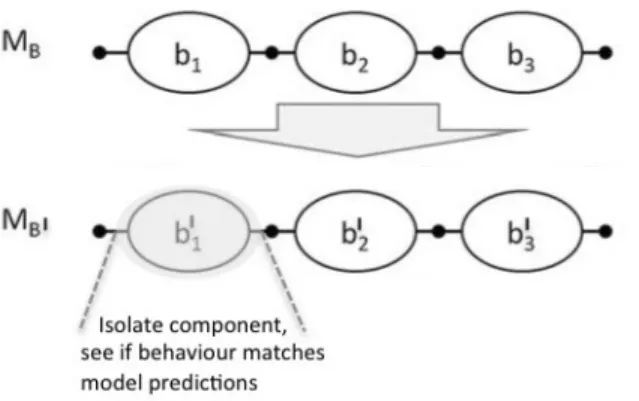
Here is an example that spells out why the no-plasticity constraint would apply to both. Consider the schematic of figure 1 (Datteri 2009 fig 4). The researcher begins with a model of a biological system (MB) and tests one aspect of it by measuring the behaviour of a hybrid system (H) in which an artificial
component (a1) performs the function predicted of a biological one (b1).
Figure 2 –Model of biological system and its experimental preparation
MB is the mechanism description of a biological system. It cannot be tested directly. MBIis the
mechanism description of the experimental preparation of the biological system. Components bnI can
The use of a bionic implant is just one way of getting round the problem that one cannot directly examine a neurobiological mechanism, in toto, as it operates in the natural setting. Instead, components of the model have to be localised and isolated (following the heuristics of decomposition and
localisation described by Bechtel and Richardson 1993) and prepared in the laboratory for testing. One approach to testing the model’s predictions regarding a component is to replace it with an artificial device which behaves according to the model’s specifications, and seeing if the overall behaviour of the system acts as predicted. If so, it can be inferred that the components function in the system is as the model describes. A more straightforward way is to collect data from the isolated component itself, e.g. through electrophysiological recording or neuroimaging, and compare these with the model prediction. This is what happens in most of systems neuroscience.
The model or mechanism description of the original biological system (MB) should be labelled
differently from the model of the laboratory preparation (MBI). Figure 2 shows the relation between the
two models in a way comparable to the relation between MB and the hybrid model depicted in figure 1. The fact that the biological system must be prepared in some way before it can be tested opens up a space between the original system and the one that is experimented on, such that it cannot be
guaranteed that the two are identical. In this context, one obtains the following no-plasticity constraint which is equivalent to ArB2:
(BIrB) BI and B are identical with respect to the component undergoing testing.
Yet many standard experimental preparations cannot satisfy this condition. For example, if component b1I is physically isolated from the rest of the brain (in vitro slice preparation) for the purposes of
intracellular recording, it cannot be guaranteed that its behaviour will not be different from the original b1. Similarly, the function of contrast discrimination is effectively isolated in vision experiments, by
Schematised in this way, the instances of non-bionic and bionic induced change are truly comparable. The only difference is that in the bionic case the concern is with plasticity in the other components of the system that have not been replaced (b2 and b3), whereas in the non-bionic cases described, plasticity
is induced in the target component (b1). So if Datteri is correct about the need for a stringent
no-plasticity constraint in BCI research, he has inadvertently hit upon a major flaw in systems
neuroscience. That is a big if. In fact, plasticity is only a problem on the assumption that the aim of the experiment is to get a detailed, quasi-anatomical, account of the neural mechanism6. My argument in
the next section is that the aims of experiment must be construed much more broadly than this. By examining in more detail what the neuroscientists claim to have learnt from BCI research about the workings of the motor cortex, we will see that plasticity is not an obstacle to these alternative goals.
3. Explaining?
This section concentrates on alternative ways of conceptualising the aims of neuroscientific research. These impact on how the research will be evaluated, what kinds of explanation are derived from the findings, and they ultimately decide whether plasticity is to be considered an epistemic problem. Carl Craver (2010) in fact lists five evaluative dimensions for models, simulations and prosthetics in neuroscience: completeness, verification, phenomenal validity, mechanistic validity and affordance validity. I will argue that even though this list covers much ground, it lacks the conceptual resources to accommodate the ways that BCI research can contribute to basic neuroscience. Section 3.2 begins with scientists’ claims for their contribution to basic neuroscience. These do not amount to the specification of an actual circuit or mechanisms e.g. for motor control. Instead, they arrive at more abstract
principles, that can be applied across mechanisms that are changing plastically.
3.1 Varieties of Validity
Craver’s “Prosthetic Models” paper (2010) focuses on the epistemic value of models involving BCI’s asking, “What if anything does the effort to build a prosthesis contribute to the search for neural
6 A further assumption is that experimenters are unaware of the occurrence of plasticity. If experimenters are aware, they
can weed out preparations where plasticity occurs and exclude the data, so that the results are not affected by this “artefact”. Since in some cases plasticity is clearly well recognised, but neuroscientists cannot be said to have a complete
mechanisms over and above the more familiar effort to build models and simulations?” (840).
Importantly, he conceives evidence to be any finding that constrains the space of possible mechanisms for a phenomenon (843), so that the ultimate aim of research is to narrow the space of possibilities to one. The contrast in methods is between BCI experiments involving electronic circuitry designed to functionally augment or replace samples of neural tissue, and those which use (physically fairly similar) electrodes to passively record the activity of neural ensembles.7 Craver is particularly
concerned with the three types of validity, thought of as “fit […] between a model and the world” (843). These are phenomenal, mechanistic and affordance validity8.
Phenomenal validity is the extent to which the model’s “input-output function is relevantly similar to the input-output function of the target” (842), while a model is mechanistically valid if “the parts, activities, and organizational features represented in the model are relevantly similar to the parts, activities, and organizational features in the target”9 (842). So both phenomenal and mechanistic
validity require a mirroring between the relevant features of the model and the target biological mechanism. Affordance validity, on the other hand, does not require this kind of verisimilitude. It is simply “the extent that the behavior of the simulation could replace the target in the context of a higher-level mechanism” (842). In other words, it must function in a satisfactory way.
The nub of Craver’s discussion is that while prosthetic models excel with respect to affordance validity, this is no guarantee of phenomenal or mechanistic validity:
“Consider mechanistic validity first. Prosthetic models at their most biologically realistic are engineered simulations. As such, they inherit the epistemic problem of multiple realizability10. A 7 For simplicity of exposition, and consistency with the rest of the paper, I focus on Craver’s example of the BCI for
movement control, rather than the alternative case study of Berger’s prosthetic hippocampus. The conclusions he draws are not different for the two examples.
8 The dimensions of completeness and verification describe how exhaustively and faithfully the model or simulation
reproduces features of the biological mechanism. As Craver writes “All models and simulations of mechanisms omit details
to emphasize certain key features of a target mechanism over others. Models are useful in part because they commit such sins of omission” (842). I will return to this point in section 3.2 below, and in this section concentrate on the three kinds of validity.
9 Given that the topic is systems neuroscience, rather than cellular or molecular neuroscience which study sub-neuronal
mechanisms, I understand the key “parts” here to be neurons, so that for a model of a brain circuit to be mechanistically valid it must be quite anatomically accurate, featuring the same number and type of neurons as in the actual mechanism.
10 One wonders if Craver is saying that if multiple realizability were to occur in a non-bionic experiment, this would cause
prosthetic model might be affordance valid and phenomenally valid yet mechanistically invalid. Prosthetic runners legs do not work like typical biological legs. Heart and lung machines do not work like hearts and lungs. If so, then building a functional prosthesis that simulates a mechanistic model is insufficient to demonstrate that the model is mechanistically valid.” (845)
Concerning phenomenal validity, Craver explains that the key difference between the biological mechanism and the prosthetic model is in the pattern of inputs and outputs used. He notes that no existing BCI for motor control uses just those neurons that the brain uses to move the right arm, say. Furthermore, neuroplasticity means that the space of possible inputs and outputs is not tightly bounded (846, cf. 848). In both instances, the fact that the function which the prosthesis replicates is multiply realizable (due to plasticity) suggests to Craver that the epistemic value of prosthetic modelling is limited. Given that a vast range of internal mechanisms and input-output patterns can realize the same function, building the hybrid system cannot tighten the net around the actual mechanisms used in nature.
Craver makes a number further of points, centring on the contrast between basic neuroscience (i.e. “explanatory knowledge of how the brain works” p.849) and neural engineering (i.e. “maker’s knowledge of how to prevent disease, repair damage, and recover function.” p.849). Basic
neuroscience, in its quest for explanatory knowledge is associated with obtaining models that are both phenomenally and mechanistically valid, while neural engineering settles for affordance validity and the maker’s knowledge of “how the brain might be made to work for us” (p. 840). In effect, BCI research does not help neuroscientists explain the brain. So even if Craver’s explicit conclusion (as stated in the abstract), is quite weak – that prosthetic models provide a sufficient test for affordance validity and are, “[i]n other respects […] epistemically on par with non-prosthetic models” (p.840), another conclusion that he arrives at by the end of the paper is actually quite strong, as expressed here:
“I argue that affordance valid models need not be mechanistically or phenomenally valid. This is a blessing for engineers, and a mild epistemic curse for basic researchers.” (850)
As with Datteri, Craver’s strong conclusion, which is rather sceptical about the explanatory
possibilities of BCI research, rests on a clear assumption about the goal of basic neuroscience, i.e. that
the research should reveal actual mechanisms or circuits, rather than organisational principles. In section 3.2 below I argue that despite multiple realizability, BCI research can in fact contribute to the explanatory projects of neuroscience. The curse only overshadows a subset of the problems facing basic neuroscience. To see how this is so we must acknowledge a greater plurality of scientific
questions and goals than Craver and Datteri suggest.
3.2 Principles, Mechanisms and Explanatory Knowledge
In order to see with clarity how BCI research can contribute to basic neuroscience it is necessary to look in detail at some examples which support my claim. In each case the explanatory knowledge that arises from the experiment involving bionics or prosthetics is not answering a question concerning the layout of an actual neural circuit or mechanism. For this reason it does not matter if plasticity in the circuits has occurred during the experiment, and that the function performed by the mechanism is multiply realizable. Instead, BCI research can answer questions about the operational principles that allow a range of neuronal mechanisms to do what they do.
The first example is from a paper by Carmena and colleagues (2003). They discuss the significance of one of their findings with regards to “the ongoing debate of two opposing views of what the motor cortex encodes” (205). Having observed that tuning depth (roughly, the strength of a neuron’s selectivity towards its preferred direction of movement) decreases during the operation of the BCI controlling a robotic arm, they note that this could be taken as evidence for the hypothesis that the tuning of motor cortex neurons is governed by proprioceptive feedback and movement dynamics. However, the observation that tuning depth is still significantly reduced when the monkey uses the BCI while still being allowed to move its real arm lead Carmena and colleagues to the conclusion that the alternative hypothesis, that tuning is governed by abstract motor goals, is also partially true. They argue that this conclusion is supported by the finding that improvement in performance using the BCI is correlated with increases in the tuning depth, suggesting that the motor cortex adapts to the BCI in reformulating motor goals and incorporating visual feedback concerning the operation of the robotic limb or computer cursor, as an alternative to proprioceptive feedback.
question that these researchers seek to answer. This debate about what the motor cortex encodes does not concern any precise specification of a neuronal circuit, the number of neurons it contains, their directional preferences, and patterns of connection. Instead, it asks what general explanation accounts for the tuning properties of these neurons, whether it is movement dynamics or abstract motor goals. Crucially, the answer to this question can be the same even though, as is observed, tuning strengths and preferences change due to the insertion of the BCI. In fact, it is the very observation of the extent and direction of those plastic alterations in neuronal preference that is used to formulate the answer. We have an example of an issue in basic neuroscience that can be addressed with BCI research not only in spite of, but because of neuroplasticity. Moreover, this supports the claim, rejected by Craver, that BCI’s are a privileged method in certain contexts in basic neuroscience. It is their effectiveness in inducing plastic changes which makes them uniquely useful in this case.
We see now that changing the brain can be a way of explaining the brain, if the explanation that is sought is of a general feature of neuronal circuits that remains invariant with plastic modifications induced by the BCI. A recent review by Nicolelis and Lebedev (2009) supplies us with many more examples of this kind. Table 1 lists their “principles of neural ensemble physiology”. These are operational principles that determine how neurons work together in the cortex to bring about motor control with or without the bionic implant. It is important to note that most of these have been validated by findings from non-bionic research, while others remain controversial. I will discuss a few of these in detail. Note that Nicolelis and Lebedev do not present their principles as mere “maker’s knowledge”. They write that:
“Extending, Changing, Explaining” - M. Chirimuuta - Uploaded PhilSci Archive 19 Sept 2011
that information about single motor param-eters is processed within multiple cortical areas. BMI studies1,42 have also revealed that
real-time predictions of motor parameters can be obtained from multiple frontal and parietal cortical areas. This widespread rep-resentation of motor parameters defines the distributed-coding principle73,84–86.
The analysis of neuron-dropping curves (NDCs) illustrates this principle well. NDCs depict a BMI’s prediction accuracy as a func-tion of the number of neurons recorded simultaneously during a given experimental session. NDCs are computed by first meas-uring the entire neuronal population’s per-formance and then repeating the calculation after randomly chosen individual neurons are removed (dropped) from the original sample. In essence, NDCs measure the size of neuronal ensembles needed for a given BMI algorithm to achieve a certain level of performance. FIGURE 1b,c shows a series of
NDCs that describe the contribution made by populations of neurons, located in dif-ferent cortical areas, to the simultaneous prediction of multiple time-varying motor parameters during operation of a BMI by a rhesus monkey. This figure shows how the predictions of two such parameters — hand position (FIG. 1b) and gripping force123 (FIG. 1c) — vary as a function of the size of
the recorded neuronal population1.
A widely distributed representation of each motor parameter does not necessarily mean that equally sized neuronal samples obtained from each of these cortical areas should yield similar levels of predictions1
(FIG. 1b,c). For instance, in the example shown
in FIG. 1, the prediction of hand position was,
on average, better when randomly sampled populations of M1 neurons were used than
when similar samples of posterior parietal cortex (PP) neurons were used. Moreover, the difference in prediction performance was much smaller between these two corti-cal areas when gripping force was used as the predicted parameter. However, NDC extrap-olation to larger samples13 indicates that, if a
sufficiently large sample of PP neurons could be obtained, neural ensembles from the PP could eventually accurately predict both hand position and gripping force. Although the representation of motor parameters is distributed in the cortex, cortical areas none-theless show a clear degree of specializa-tion (but not in an absolute or strict sense). Additionally, modulations in neuronal activity in different cortical areas that seem to be similar (for example, increases in activity during rightward movements) may underlie different functions in the corti-cal motor programme transmitted to the spinal cord.
The observation of distributed repre-sentations of motor parameters obtained in BMI studies corresponds well with the proposition from previous neurophysiologi-cal research that brain areas represent infor-mation in a holographic manner, and that searching for explicit coding (of force, limb displacement or behavioural context) may be futile124.
The single-neuron insufficiency principle. BMI studies have also revealed that, no mat-ter how well tuned a cell is to the behavioural task in question, the firing rate of individual neurons usually carries only a limited amount of information about a given motor parameter1,13,42. Moreover, the
contribution of individual neurons to the encoding of a given motor parameter
tends to vary significantly from minute to minute125. Reliably predicting a motor
vari-able, and achieving accurate and consistent operation of a BMI for long periods of time, therefore requires simultaneous recording from many neurons, and combining their collective ensemble firing118. Incidentally, the
same single-neuron limitations have been observed in the rat somatosensory126–128 and
gustatory systems86,129,130, and in the
cortico-striatal system of wild-type and transgenic mice121. We have called this principle the
single-neuron insufficiency principle. The insufficiency of single-neuron firing to precisely reproduce a given behavioural output has long been appreciated in studies in which averaging of neuronal activity over many trials was required to quantify a given neuron’s behavioural function131,132. This
analytical strategy is typically used when animals have attained a highly stereotyped behavioural performance, after being over-trained in a given task. Despite this caveat, single neurons have often been attributed very specific functions, and their inherent noisiness — clearly verified when single tri-als are analysed independently — has been disregarded132. In such studies, peri-event
time histograms and directional tuning curves have emphasized a consistent rela-tionship between the modulations of the firing rate of a single cell and behavioural parameters. As the attention of neurophysio-logical investigations started to shift towards ensemble recordings, neuronal variability, as opposed to consistency, came into focus, and neurophysiologists started to realize that modulations in neuronal firing are usually highly transient and plastic86,133–137. This led
researchers to question the classic assertion that behavioural parameters are encoded only by the modulation of the firing rate of individual cells, and to the realization that the precise timing and correlations of neu-ral ensemble firing should be taken more seriously65–67,138. Usually, in BMIs based on
recordings from large neuronal popula-tions, single-neuron noisiness is removed by ensemble averaging. In other words, as the population recorded becomes larger, vari-ability in single-neuron firing declines in importance.
A recent study139 documented significant
single-neuron tuning stability over recording sessions that lasted several hours while mon-keys performed a reaching task. Although this result initially seemed to contradict the earlier claim that there is single-neuron discharge variability125, these two points
of view proved to be consistent. The study demonstrating tuning stability focused on Table 1 | Principles of neural ensemble physiology
Principle Explanation
Distributed coding The representation of any behavioural parameter is distributed
across many brain areas
Single-neuron insufficiency Single neurons are limited in encoding a given parameter
Multitasking A single neuron is informative of several behavioural parameters
Mass effect principle A certain number of neurons in a population is needed for their
information capacity to stabilize at a sufficiently high value
Degeneracy principle The same behaviour can be produced by different neuronal
assemblies
Plasticity Neural ensemble function is crucially dependent on the capacity
to plastically adapt to new behavioural tasks
Conservation of firing The overall firing rates of an ensemble stay constant during the
learning of a task
Context principle The sensory responses of neural ensembles change according to
the context of the stimulus
532 | J ULY 2009 | VOLUM E 10 www.nature.com/reviews/neuro
Table 1 (from Nicolelis and Lebedev 2009, permission needed)
Firstly, a central question in theoretical neuroscience has been over whether the brain uses a population code (“distributed coding”) to represent perceptual features or to control actions, or a single neuron code featuring the infamous “Grandmother cells” (see Barlow 1972, Kenet et al. 2006). Nicolelis and Lebedev weigh in in favour of the population code, arguing that BCI research has found relatively large populations of around 50 neurons are required to accurately drive a robotic limb11. The “Single-neuron
insufficiency” and “Mass effect” principles make similar claims regarding the importance of neuronal populations. In all cases, these principles are indifferent to the exact number and nature of the neurons in the populations, so that it is irrelevant if a population is multiply realized.
In effect, these “principles” are at a higher or more abstract level than the circuit-level descriptions that Datteri and Craver take to be the aim of the research which they discuss. In other words, they do not give you a “how actually” model, though the principles would have to apply to any such model if it were to be built. [And be true of any mechanism if they are right]. For that reason it does not matter if the neural realizations change – these principles are applicable to neural behaviour in unmodified and modified systems. It is interesting that three of the principles – “Degeneracy”, “Plasticity” and “Conservation of firing” – explicitly refer to what happens as changes occur to the neural systems.
However, in order for these principles to apply across all experimental preparations, even when
11 This finding is somewhat controversial as other research groups have reported BCI’s operating with fewer neurons being
plasticity occurs, it has to be assumed that even if neural circuits undergo plastic modification, the brain does not begin to do things in radically different ways just because of the introduction of the BCI. This actually amounts to endorsing Datteri’s other caveats: ArB1, that there are no uncontrolled
perturbations arising due to the implant, and ArB3, that the hybrid system is governed by the same regularity that governs the biological system. So in the end it is fitting to give positive endorsement to two out of Datteri’s three assumptions.
As it happens, Datteri does also talk favourably about a different kind of hybrid experiment (Reger et al. 2000 and Karniel et al. 2005) which, as he puts it, sheds light on the “mechanisms of synaptic plasticity” (322). That is, he apparently does share the insight that plasticity itself is an appropriate target of investigation in neuroscience. Unfortunately, this does not lead him to modify his conception of experimental aims to arrive at a more charitable reading of other bionic experiments that induce plasticity. One option would have been to supplement the idea that the goal of research is a “how actually” model of the target mechanism with the addition that “actually” can be in terms of “what neuron goes where”, but also “what rules lie behind the organisation of the neurons”. Or to turn again to Craver’s schema, in addition to mechanistic, phenomenal and affordance validity, we may add
organisational validity12. This is the test of whether the model is organised in the same way that the
biological system is, applying the same rules of neural coding. As we have seen in this section of the paper, bionic models contribute to basic neuroscience to the extent that they have both affordance and organisational validity.
The question now arises as to whether these additions to Datteri’s and Craver’s schemas still fall with in the scope of mechanistic explanation. Are “principles of plasticity” and “mechanisms of plasticity” the same thing? On the one hand, the accounts of plasticity invoked here are not tied to a realisation in a particular neuronal circuit and are not, therefore, typical cases of mechanism description. Still, low level molecular mechanisms of synaptic plasticity might actually be conserved across multiple
realizations of the circuit. It is also worth noting that neuroscientists describe their findings as revealing mechanisms even when situated at this fairly high level of abstraction, not being tied to any particular neural realisation. To take an example of BCI research from the Schwartz laboratory, Legenstein and colleagues (2010) set out to uncover the learning rule behind the modification of motor neurons’ tuning
12 Note that in Craver’s definition of mechanistic validity, the model’s representations of parts, activities, and organizational
preferences in the prosthetic reaching task of Jarosiewicz (et al. 2008). The mathematical model that they use to account for the data (a variation on Hebbian learning) is repeatedly referred to as simulating the “learning mechanism”. It can only be that this “mechanism” is multiply realised by different groups of neurons with a variety of tuning preferences, as they adapt plastically to the BCI task. So it remains to be seen if Craver’s account of mechanistic explanation can, in the end, incorporate such usages.13
4. Conclusions
Both Datteri and Craver have challenged claims from researchers that neuroengineering of brain computer interfaces can provide important insights into basic neuroscience. Their criticisms centre around the fact that hybrid systems diverge from natural systems that basic neuroscientists aim to model, because of plasticity induced by bionic implants and the very fact that a prosthetic system is not constrained to function in the same way as the natural one. In my analysis of Datteri’s argument, I showed that plasticity is only problematic on the assumption that the aim of research is to uncover the circuit mechanism at play in the natural systems. Similarly, Craver’s concern over the multiple
realizability of functions carried out by natural and prosthetic systems also rests on the assumption that basic neuroscience must focus on mechanistic and phenomenal validity, narrowly construed as the mapping of components, activities, inputs and outputs in the brain.
Section 3.2 showed that a more pluralist approach is needed in conceptualising the aims of basic research. Certain questions in systems neuroscience need not (and cannot) be answered with models that aim at anatomical specification in their representation of neuronal circuits (i.e. conventional “how actually” models). Instead, they concern what organisational principles hold across different circuits and are not tied to a particular realisation. When designing experiments to address these kinds of questions, plasticity in the experimental preparation is not a problem, and may even be a help, so long as the preparation is not so grossly perturbed as to be performing a function in a fundamentally different way. It is worth clarifying that the resulting “principles” (Lebedev and Nicolelis 2009) or “learning mechanisms” (Legenstein et al. 2010) are not “mechanism sketches” or “how possibly” models, i.e. models whose details are left unspecified, to be filled in with later research. The potential
13 Here is another example from (non-bionic) visual neuroscience: Freeman et al. (2011) present new fMRI data on
finding of the coding rule for motor cortex neurons (Carmena et al. 2003) is an end point of research in itself.
This paper has asked whether techniques for extending and changing the brain are inimical to the project of explaining the brain, and concluded that they are not. One point to add is that certain
experimental procedures necessarily involve an alteration occurring in the subject matter, yet that does not rule out the validity of the procedure (cf. the measurement problem in physics). It does, however, suggest that there are limits to what can be measured directly, which is a truism, but something often overlooked outside studies in philosophy of science which focus directly on the problem of
intervention. I have described the complementary nature of neuroscientific methods, given that
discovery of one property of a neural systems may come at the cost of knowledge of a related property. One experiment, using BCI’s might be ideal for telling you certain things about the motor cortex, e.g. what temporal information in neuronal firing patterns is critical for movement control (i.e. the “real-time neurophysiology” of Nicolelis 2003), yet be ill equipped for resolving a different question, such as the anatomy of motor control circuits in natural systems. Fortunately, experimental neuroscience employs an impressive variety of research strategies, each addressing issues that others cannot. It is important that philosophers of neuroscience should recognise the strengths and weaknesses of all of these methods. This is part and parcel of the “mosaic unity” that Craver (2007) aptly describes.
References
Bach-y-Rita, P. (1972). Brain mechanisms in sensory substitution, Academic Press.
Barlow, H.B. (1972). Single units and sensation: A neuron doctrine for perceptual psychology? Perception. 1:371-394.
Bechtel, W. and R. C. Richardson (1993). Discovering Complexity. Princeton, NJ, Princeton University Press.
Carmena, J., M. Lebedev, et al. (2003). "Learningtocontrola brain-machine interface for reaching and grasping by primates." PLoS Biol 1.
neurons in the motor cortex. ." Nat Neurosci 2(7): 664–670.
Chirimuuta, M. and I. J. Gold (2009). The embedded neuron, the enactive field?. Handbook of Philosophy and Neuroscience. J. Bickle. Oxford, Oxford University Press.
Clark, A. (2004). Natural-Born Cyborgs: Minds, Technologies, and the Future of Human Intelligence, Oxford University Press.
Clark, A. (2008). Supersizing the mind: embodiment, action, and cognitive extension, Oxford University Press.
Clark, A. and D. J. Chalmers (1998). "The Extended Mind." Analysis 58(1): 7-19.
Craver, C. F. (2007). Explaining the Brain. Oxford, Oxford University Press.
Craver, C. F. (2010). "Prosthetic Models." Philosophy of Science. 77(5): 840-851.
Datteri, E. (2009). "Simulation experiments in bionics: A regulative methodological perspective." Biology and Philosophy 24: 301–324.
David, S. V., W. E. Vinje, et al. (2004). "Natural stimulus statistics alter the receptive field structure of V1 neurons." J. Neuroscience 24: 6991-7006.
de Weerd, P., R. Pinaud, et al. (2006). Plasticity in V1 induced by percpetual learning. Plasticity in the visual system: From genes to circuits. R. Pinaud, L. A. Tremere and P. de Weerd. Berlin, Springer
Dretske, F. (1994). "If You Can't Make One, You Don't Know How It Works. ." Midwest Studies in Philosophy 19(1): 468-482.
Ganguly, K. and J. Carmena (2009). "Emergence of a stable cortical map for neu- roprosthetic control." PLoS Biol 7.
Harrison, R. V., K. A. Gordon, et al. (2005). "Is there a critical period for cochlear implantation in congenitally deaf children? Analyses of hearing and speech perception performance after
implantation." Developmental Psychobiology 46(3): 252–261.
Hochberg, L., M. Serruya, et al. (2006). "Neuronal ensemble control of prosthetic devices by a human with tetraplegia." Nature 442: 164–171.
Holmes, D.J. and Meese, T.S. (2004) “Grating and plaid masks indicate linear summation in a contrast gain pool.” J Vis 4(12): 7; doi:10.1167/4.12.7
Hurley, S. (1998). Consciousness in Action. Cambridge, MA, Harvard University Press.
Jarosiewicz, B., S. Chase, et al. (2008). "Functional network reorganization during learning in a brain-computer interface paradigm." Proc Natl Acad Sci U S A 105: 19486 –19491.
Karniel, A., M. Kositsky, et al. (2005). "Computational analysis in vitro: dynamics and plasticity of a neuro-robotic system." J Neural Eng 2: S250–S265.
Kenet, T., A. Arleli, et al. (2006). Are single neurons soloists or are they obedient members of a huge orchestra? 23 Problems in Systems Neuroscience. J. L. v. Hemmen and T. J. Sejnowski. Oxford, Oxford University Press.
Kourtzi Z (2010). "Visual learning for perceptual and categorical decisions in the human brain. ." Vision Res. 50(4): 433-440.
Legge, G. E. F. and J. M. Foley (1980). "Contrast masking in human vision." Journal of the Optical Society of America 70: 1458-1470.
Lenay, C., O. Gapenne, et al. (2003). Sensory substitution: Limits and perspectives. Touching for Knowing. Y. Hatwell, A. Streri and E. Gentaz. Amsterdam/Philadelphia, John Benjamins Publishing Group.
Leuthardt, E. C., C. Gaona, et al. (2011). "Using the electrocorticographic speech network to control a brain–computer interface in humans." J. Neural Eng 8: 1-11.
Lutz, D. (2011) "Epidural electrocorticography may finally allow enduring control of a prosthetic or paralyzed arm by thought alone." Washington University in St. Louis Newsroom Volume, DOI:
Musallam, S., B. Corneil, et al. (2004). "Cognitive control signals for neural prosthetics." Science 305: 258 –262.
Nicolelis, M. (2003). "Brain-machine interfaces to restore motor function and probe neural circuits." Nat Rev Neurosci 4: 417–422.
Nicolelis, M. and M. Lebedev (2009). "Principles of neural ensemble physiology underlying the operation of brain–machine interfaces." Nature reviews neuroscience 10: 530-540.
Pascual-Leone, A. and R. Hamilton (2001). "The Metamodal organization of the brain." Progress in Brain Research 134: 427-445.
Pinaud, R., L. A. Tremere, et al., Eds. (2006). Plasticity in the Visual System from Genes to Circuits. Berlin, Springer.
Ptito, M., S. M. Moesgaard, et al. (2005). "Cross-modal plasticity revealed by electrotactile stimulation of the tongue in the congenitally blind." Brain 128: 606–614.
computational properties of neural tissues." Artif Life 6(4): 307–324.
Sagi, D. (2011). Perceptual Learning in Vision Research. Vision Research 51: 1552–1566.
Schwartz, A. (2007). "Useful signals from motor cortex." J Physiology 579: 581– 601.
Serruya, M., N. Hatsopoulos, et al. (2002). " Instant neural control of a movement signal." Nature 416: 141–142.
Shaw, C. A. and J. McEachern, Eds. (2001). Toward a Theory of Neuroplasticity. Philadelphia, Psychology Press.
Taylor, D., S. Tillery, et al. (2002). "Direct cortical control of 3D neuroprosthetic devices." Science 296: 1829 –1832.
Velliste, M., S. Perel, et al. (2008). "Cortical control of a prosthetic arm for self-feeding." Nature 453: 1098-1101.
Zelenin, P., T. Deliagina, et al. (2000). "Postural control in the lamprey: a study with a neuro- mechanical model." J Neurophysiol 84: 2880–2887.