The Thirty-Third AAAI Conference on Artificial Intelligence (AAAI-19)
Exploiting Background Knowledge in Compact Answer Generation for
Why-Questions
Ryu Iida, Canasai Kruengkrai, Ryo Ishida,
Kentaro Torisawa, Jong-Hoon Oh,
and
Julien Kloetzer
National Institute of Information and Communications Technology, Kyoto, 619-0289, Japan {ryu.iida, torisawa, rovellia, julien}@nict.go.jp, [email protected], [email protected]
Abstract
This paper proposes a novel method for generating compact answers to open-domain why-questions, such as the follow-ing answer, “Because deep learnfollow-ing technologies were intro-duced,” to the question, “Why did Google’s machine transla-tion service improve so drastically?” Although many works have dealt with why-question answering, most have focused on retrieving as answers relatively long text passages that consist of several sentences. Because of their length, such passages are not appropriate to be read aloud by spoken di-alog systems and smart speakers; hence, we need to create a method that generates compact answers. We developed a novel neural summarizer for this compact answer generation task. It combines a recurrent neural network-based encoder-decoder model with stacked convolutional neural networks and was designed to effectively exploit background knowl-edge, in this case a set of causal relations (e.g., “[Microsoft’s machine translation has made great progress over the last few years]effect since[it started to use deep learning.]cause”) that was extracted from a large web data archive (4 billion web pages). Our experimental results show that our method achieved significantly better ROUGE F-scores than existing encoder-decoder models and their variations that were aug-mented with query-attention and memory networks, which are used to exploit the background knowledge.
1
Introduction
The recent popularity of smart speakers suggests that spo-ken dialog systems may become a core component of future user interfaces and be used in a wide range of environments for many types of tasks. However, in the current state of lan-guage technologies, many such tasks are beyond the reach of dialog systems. One such task is non-factoid Question An-swering (QA), such as why-question answering (why-QA) and how to-question answering. Although many attempts have been made to develop highly accurate non-factoid QA methods (Girju 2003; Higashinaka and Isozaki 2008; Verberne et al. 2011; Oh et al. 2013; Oh et al. 2016; Sharp et al. 2016; Tan et al. 2016; dos Santos et al. 2016; Oh et al. 2017), most developed methods retrieve from a text archivelong text passages that contain real answersthat are not suitable for dialog systems due to their lengths. Table 1 exemplifies a why-question and its answer passage retrieved
Copyright c⃝2019, Association for the Advancement of Artificial Intelligence (www.aaai.org). All rights reserved.
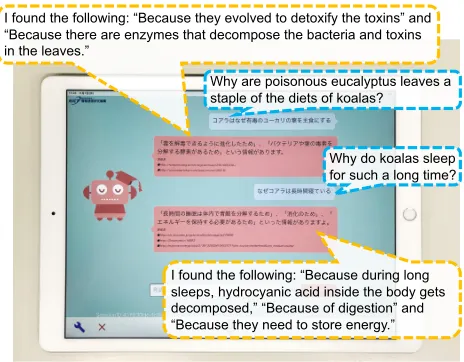
Why are poisonous eucalyptus leaves a staple of the diets of koalas?
Why do koalas sleep for such a long time? I found the following: “Because they evolved to detoxify the toxins” and “Because there are enzymes that decompose the bacteria and toxins in the leaves.”
I found the following: “Because during long sleeps, hydrocyanic acid inside the body gets decomposed,” “Because of digestion” and “Because they need to store energy.”
Figure 1: Screenshot of our spoken dialog system prototype WEKDA: why-questions and their compact answers were manually translated.
with an existing why-QA method. Much of the retrieved pas-sages is unnecessary and/or has little to do with the question. Since such redundant and long passages are inappropriate to be read aloud by spoken dialog systems and smart speak-ers, we need a method that condenses the essence of these answer passages into much shorter, compact answers using only a handful of words.
The aim of this work is to develop a novel method that generates non-redundant compact answers to Japanese open-domain why-questions. Actually, the method pre-sented in this paper is already being used in our spo-ken dialog system prototype called WEb-based Knowledge Disseminating dialog Agent (WEKDA). The system can smoothly provide compact answers to such why-questions as “Why are poisonous eucalyptus leaves a staple of diets of koalas?” and “Why do koalas sleep for such a long time?” (Figure 1).
Question:“Why did Google’s machine translation service im-prove so drastically?”
Answer Passage: Deep learning relatedtechnologies have recently received much attention, and many high-tech com-panies are eager to integrate the results of the latest deep learningadvancements. The Google Brain team, for exam-ple, developed suchtechnologiesthatwerelaterintroduced into Google’s translation engine. The quality of this machine translation service dramatically improved for languages such as French and Chinese, and the same can be expected in the fu-ture for many other languages. Although it remains unclear ex-actly how much,deep learning technologiesmay drastically change our future.
Compact Answer:Because deep learning technologies were introduced.
In the answer passage, the words in bold should be included in compact answers. The underlined words are the question’s content words.
Table 1: Example of a why-question, an answer passage and a compact answer
aloud by spoken dialog systems. We follow the basic set-up of compact why-QA answer generation proposed by Ishida et al. (2018): asingle sentencecompact answer (e.g., “Be-cause deep learning technologies were introduced.”) to a given why-question (e.g., “Why did Google’s machine trans-lation service improve so drastically?”) is generated from a five- or seven-sentence long passage retrieved by an exist-ing web-based why-QA method (Oh et al. 2016). As seen in the example above, this task is complicated because the words that constitute compact answers (those in bold in Table 1) may be scattered throughout a passage and need to be organized into a well-formed sentence. Ishida et al. (2018) treated this as a summarization task and based their method on a state-of-the-art seq2seq model called a pointer-generator network(See, Liu, and Manning 2017), in which a long answer passage is given to an encoder and a decoder exploits the passage encoding to generate a compact answer. The content words in the passage that also appear in the question arelabeledso that the encoder can identify which part of the passage corresponds to the question’s content.
In this work, we introduce background knowledge to Ishida et al.’s method in the form of texts representing causal relations (e.g., “[Tsunami was occured]effect because
[an earthquate suddenly displaced sea water.]cause”). When we ask a why-question, we basically expect the answer to be the cause of the events expressed in the question. If we can find the causal relations where the effect part resembles a target why-question, the cause parts may include valuable clues for generating appropriate compact answers, such as important keywords to be included in the compact answers. We thus automatically extract the causal relations relevant to a target why-question from the web, such as “[Microsoft’s machine translation has made great progress over the last few years]effect since[it started to use deep learning.]cause”: although this text does not express a direct answer to “Why did Google’s machine translation service improve so drasti-cally?”, it helps to generate a proper answer since it includes
such critical keywords as “deep learning” in its cause part. In the answer passage in Table 1, there are no explicit clue expressions such as “because” and “since” that indicate the causal relations between the part corresponding to the ques-tion (“The quality of this machine translaques-tion service was dramatically improved.”) and the part containing the com-pact answer (“Deep learning technologies· · · introduced
into Google’s translation engine.”). In general, proper an-swer passages often lack such clue expressions, and to gen-erate proper compact answers, such words as “deep learn-ing” that are causally associated with a given question in causal relations should be helpful.
We propose a novel neural summarizer that utilizes the causal relations extracted from the web as background knowledge. In this summarizer, we assign labels, which are distinguishable from the labels given to the words in a why-question, to the words that appear both in a passage and the cause part of causal relations, such as “deep learning” in the above example, when the passage is given to the encoder. In addition, we extend the summarizer to exploit such causality-related labels more effectively in an encoder-decoder model. We introduce a stacked version of convolu-tional neural networks (CNNs) (van den Oord et al. 2016; Dauphin et al. 2017; Gehring et al. 2017) that considers the surrounding context of the labeled words in the encoder and aggregate such informative encoding results as the ini-tial decoder state for generating better compact answers. Our experimental results show that our summarizer achieved significantly better ROUGE F-scores than several baseline methods including the existing compact answer generation method (Ishida et al. 2018) and variations augmented with query-attention (Nema et al. 2017) and key-value memory networks (Miller et al. 2016), which are more sophisticated than our method that explicitly assigns labels to words.
The rest of this paper is organized as follows. We provide an overview of related works in Section 2, we present our proposed method in Section 3, and we describe our dataset and experimental results in Section 4.
2
Related Work
We follow the approach proposed in Ishida et al. (2018), in which compact answer generation is regarded as a spe-cial case of text summarization. The recent progress of neu-ral network-based techniques, especially the seq2seq frame-work (Luong, Pham, and Manning 2015; Bahdanau, Cho, and Bengio 2015), has led to a significant improvement in summarization quality (Rush, Chopra, and Weston 2015; Chopra, Auli, and Rush 2016; Nallapati et al. 2016; Chen et al. 2016; Miao and Blunsom 2016; See, Liu, and Manning 2017; Zhou et al. 2017).
Another research direction uses more than one input text. Nema et al. (2017) proposed a new attention mechanism calledquery attention, which was first computed for words in an additional input calledquery, and utilized it when com-puting the attention distribution of words in the source text. In our evaluation in Section 4, we regard background knowl-edge (i.e., a set of texts representing causal relations) as queries and introduce a variant of this method as a baseline method.
For why-QA, several neural methods (Sharp et al. 2016; Tan et al. 2016; dos Santos et al. 2016; Oh et al. 2017) showed significant performance improvement over methods using conventional machine learning methods such as sup-port vector machines (Girju 2003; Higashinaka and Isozaki 2008; Verberne et al. 2011; Oh et al. 2013; Oh et al. 2016). Oh et al. (2017) used causality expressions that were au-tomatically extracted from the Web for why-QA, like our approach. However, these methods are basically binary clas-sifiers that predict whether a given long passage is a proper answer to a given question and cannot generate compact an-swers like ours.
Another work that resembles ours is a causality recog-nition method proposed in Kruengkrai et al. (2017). This neural method exploits web texts and why-QA answers as background knowledge for event causality recognition. But again, it is a binary classifier that judges whether a given sentence expresses event causality.
Finally, in the SQuAD machine comprehension task (Ra-jpurkar et al. 2016), participating systems identified short consecutive word sequences in passages as answers to ques-tions. In compact answer generation, however, words that comprise the answer may be scattered throughout the answer passage. In this respect, our task differs from the SQuAD task and Ishida et al. (2018) actually showed that a neural network developed for the SQuAD task performed poorly on compact answer generation task. (See Ishida et al. (2018) for more details.)
3
Proposed Method
In this section, we first describe Ishida et al. (2018)’s model and then present our proposed model. We use uppercase to denote sequences (e.g.,X,Y), lowercase to denote symbols in a sequence (e.g.,x,y), bold uppercase to denote matri-ces (e.g.,X,H) and bold lowercase to denote vectors (e.g.,
x,w). We respectively denote an answer passage, a target compact answer and a why-question byX = (x1, . . . , xS),
Y = (y1, . . . , yT)andQ= (q1, . . . , qU).
3.1
Background: Ishida et al.’s model
Ishida et al. (2018) first represented each wordxsin the an-swer passageX as a feature vectorxs ∈ Rd. The answer
passage becomesX= [x1, . . . ,xS]∈Rd×S. Then The
fea-ture vectorsxs(s∈ {1,· · ·, S})are computed as:
xs= tanh(Wq[ws;qs]). (1)
HereWq∈Rd×(d+e)is a trainable matrix,ws∈Rdis ad
-dimensional word embedding vector andqs∈Reis a train-ablee-dimensional vector. Note thatqs∈ {qq,qnq}where
qqandqnqare randomly initialized vectors.qsfunctions as a label that is given to each content word that appears in a given questionQ, as mentioned in the Introduction.qs=qq if a wordxsappears in the questionQandqs=qnq other-wise.
The encoder (a multi-layer bi-directional recurrent neural network(RNN)) then encodesX into hidden statesHR =
[hR1, . . . ,hRS] ∈ Rd×S. Each hR
s = [ − →
hs; ←−
hs] is a con-catenation of a forward−→hs and a backward
←−
hs. Accord-ing to the standard scheme, the decoder (a sAccord-ingle-layer uni-directional RNN) initializes its initial hidden state with:
s0= ReLU(Wr[ −→
hS; ←−
h1] +br), (2) whereWr∈Rd×dandbr∈Rdare a trainable matrix and
a vector.
The decoder is also set up with state-of-the-art techniques, including Bahdanau, Cho, and Bengio (2015)’s attention, copy-attention in See, Liu, and Manning (2017)’s pointer-generator network and Luong, Pham, and Manning (2015)’s input-feeding, all of which greatly strengthen Ishida et al. (2018)’s model. They used long short-term memory (LSTM) (Hochreiter and Schmidhuber 1997) but we also examine gated recurrent unit (GRU) (Cho et al. 2014) in our experi-ments.
The network then learns to minimize the negative condi-tional log-likelihood of the target compact answer:
LR=− T
∑
t=1
logp(yt|y<t, X, Q). (3)
3.2
Proposed network model
As explained in the introduction, our method first retrieves a set of texts that represents the causal relations in which the effect part resembles a target why-question and labels the words that appear both in an answer passage and the cause parts of the causal relations. We hypothesized that these la-bels can be exploited more effectively by taking into account their context. For example, a text region that is densely la-beled in an answer passage is more likely to be included in a proper compact answer than less densely labeled re-gions. Also, the combination of some labeled words and the specific syntactic patterns surrounding them may signal that the text regions should be included in a proper compact answer. We expect that such tendencies will be automati-cally learned by the encoder RNN, but simply adding these labels to Ishida et al.’s method only marginally improved performance in our preliminary experiments. We thus intro-duced a stacked version of CNNs (van den Oord et al. 2016; Dauphin et al. 2017; Gehring et al. 2017) to our encoder-decoder model to consider the contexts of the labeled words in a manner different to that in the encoder RNN. In the fol-lowing, we first present how to label the words in an answer passage and then explain our stacked CNNs.
Stacked CNN
Encoder Decoder
... dilation = 2
... y1 y2y3... yT-1
y2y3y4... yT Attention
Element-wise sum
Compact answer
Question
4-billion web page archive
Causal relations Causal relation
recognizer
dilation = 1
Question word / cause word labeled passage Words
Labels for question Labels for causal relations
w1w2w3w4 w5 w6... wS q q
c c c
Answer passage
x!"x#" x$" x%"
x!"x#" x$" x%"
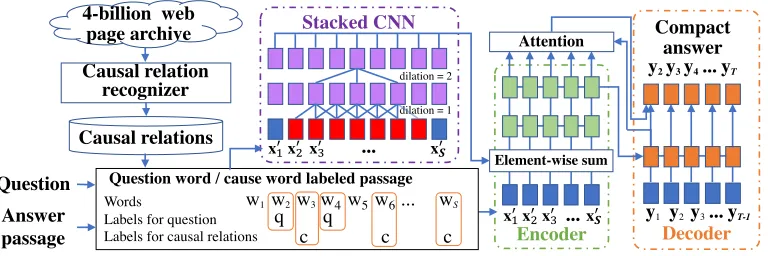
Figure 2: Proposed method
learning.]cause.” Next we label the content words in an an-swer passage that match words in the cause parts of the CEs. We newly introduce two trainabled-dimensional randomly initialized vectorsccandcnc. To each wordx
s, we associate a vectorcs ∈ {cc,cnc}:cs =ccif the wordxsappears in the cause parts andcs = cnc otherwise. Given the vector
cs, we compute the feature vectorx′s, which represents each wordxsin the answer passage, as:
x′s= drop(ws+qs+cs), (4)
where drop denotes the dropout operation (Hinton et al. 2012) and ws and qs are the embedding vectors for ws and the question label. We use the identical dimensiondfor the vectorsws,qsandcs, unlike in Ishida et al.’s original model. By replacing equation (1) with equation (4), we can avoid introducing an additional parameter,Wq.
We extracted CEs from a 4-billion-page Japanese web text archive. To recognize them in the archive, we applied the conditional random fields (CRF)-based causal recognizer developed by Oh et al. (2013) and obtained about 100 mil-lion CEs. This method first looks up one or two consecutive sentences using Japanese clue terms that can be translated as “because” and “reason.” Then the CRF judges whether the sentences represent a causal relation; if they do, we identify the regions describing the cause and effect. Following Oh et al. (2017), we indexed the effect parts of the archive CEs us-ing a Lucene search engine1. We then extracted the content words (e.g., noun, verb and adjectives) in questionQand re-trieved the relevant CEs by matching the content words with the effect parts of all the CEs. We ranked the retrieved CEs by thetf-idfscore model in the Lucene search engine and used CEs with highertf-idfscores than a predefined thresh-oldθ.
As mentioned above, to consider the contexts of labeled words, we introduce a stacked version of CNNs (van den Oord et al. 2016; Dauphin et al. 2017; Gehring et al. 2017) that combines dilated convolutions (Yu and Koltun 2015) and multi-layer CNNs with residual connections (Gehring et al. 2017). As shown in Figure 2, a stacked CNN is given as inputs the labeled word embeddings of the answer passage
1
http://lucene.apache.org
and assigns probabilities to the words in the answer passage
X that measure how likely they are to appear in the target compact answerY using both thelabeledfeature vectorx′s (defined in equation (4)) and the surrounding contexts of the input wordwsand hands these probabilities to Ishida et al.’s encoder as input to the RNNs.
Let us describe the stacked CNNs more precisely. Assume that our stacked CNN has L layers. Then, a feature map
vℓ
s∈Rd(ℓ∈ {1,· · ·, L}), which corresponds tos-th word in an answer passageX and is computed at thel-th layer, is defined using the feature maps in the(ℓ−1)-th layer as follows:
vℓs=(
Wℓ∗[vℓs−−12ℓ−1;v
ℓ−1 s ;v
ℓ−1
s+2ℓ−1] +b
ℓ)
+vℓs−1, (5)
whereWℓ∈Rd×3d,bℓ∈Rdare trainable parameters and
∗denotes the convolution operator. Thei-th element of the convolutional operator is given by:
vℓs[i] =⟨Wℓ[i],[vℓs−−12ℓ−1;v
ℓ−1 s ;v
ℓ−1
s+2ℓ−1]⟩+b
ℓ[i], (6)
where⟨·,·⟩is the Frobenius inner product.v0
s =x′s, which is computed by equation (4). Since vℓs−−12ℓ−1 and v
ℓ−1 s+2ℓ−1 may point to words outside the answer passage, we apply zero-padding by havingvℓs−−12ℓ−1 =0whens−2
ℓ−1 < 1
andvℓs−+21ℓ−1 =0whens+ 2
ℓ−1> S.
Note that each vℓ
s is computed from just three feature maps:vℓs−−12ℓ−1,v
ℓ−1
s andv
ℓ−1
s+2ℓ−1. In the first layer,v 1 s is computed fromv0s−1,v0sandv0s+1, which is actually a tri-gram of the feature vectors of the(s−1)-th,s-th and(s+1) -th words. Asℓincreases, the gap betweens±2ℓ−1ands exponentially increases and, at theℓ-th layer,vℓ
saggregates the information related to the (up to)2ℓ+1−1 words sur-rounding thes-th word.
Finally, the probability vectorps ∈ R2, which indicates
whether a wordxsshould appear in the compact answerY is computed as follows:
ps= softmax(WpvLs +bp), (7)
whereWp ∈R2×dandbp∈R2are trainable parameters.
decoder of the baseline model. At the pretraining step, the stacked CNN learns to minimize the negative log-likelihood of the probability ps,1 indicating whether the words in the answer passage should appear in the compact answer:
LC=−[∑ xs̸∈Y
(1−α) log(ps,0) + ∑
xs∈Y
αlog(ps,1)], (8)
whereps = [ps,0;ps,1] andps,1 is the probability of how likelyxs would appear inY andps,0 = 1−ps,1. αis a weight in the range of[0,1]that represents a trade-off be-tween precision and recall.
Second, we conduct joint training of the stacked CNN and the baseline model. At the second step, we integrate the pre-trained stacked CNNs to our entire architecture (Figure 2) and jointly train the stacked CNNs and the encoder-decoder model as follows. Letp1:S = [p1,1,· · ·, pS,1]∈RS denote
the probability vector of how likelyxswould appear inY. The input embeddingsXto the baseline model encoder are updated as:
˜
X= drop(X+uxp1:S⊤), (9)
whereux ∈ Rdis a trainable vector. Given a datasetD =
{(Xi, Yi)}Ni=1, we jointly train the stacked CNN and Ishida et al.’s model by minimizing the following:
LM= 1
N
N
∑
i=1
[(1−β)LC+βLR]. (10)
In our experiments, we setαin equation (8) to a relatively large value during the pretraining step, favoring recall, and then change it to a smaller value in the joint training step, favoring precision. The idea is to first train a model that tries to focus on potential candidate words as much as possible and do fine-tuning in the next step, the joint training.
3.3
Decoder initialization with averaging
Thus, we described our proposed method but observed that another trick can boost the performance even further. In Ishida et al.’s method, the decoder input was the final en-coder output, which is likely to focus more on the first and last words. On the other hand, we hypothesized that the de-coder initial state should contain more information concern-ing words in the middle of answer passages because our compact answers are short sentences that often start with words located in the middle of a passage. According to this hypothesis, we used the following initial decoder hidden state, which is actually the average of all the encoder hid-den states:
s0=
1
S ∑
s
hRs . (11)
We refer to this modification asdecoder initialization with averagingand use it in our experiments. Note that this mod-ification helps reduce the number of parameters to be tuned (i.e., a trainable matrixWris excluded from equation (2)). We expect that this will positively affect performance.
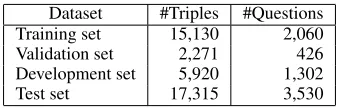
Dataset #Triples #Questions Training set 15,130 2,060 Validation set 2,271 426 Development set 5,920 1,302 Test set 17,315 3,530
Table 2: Number of (question, answer passage, compact an-swer) triples and questions covered by them in each data set
4
Experiments
4.1
Data
Each of our four datasets (training, validation, development, and test) consists of triples of a why-question, an answer passage and a compact answer. Table 2 provides the num-ber of triples in each. We confirmed that no question was found in multiple datasets. The average length of all the questions, passages and compact answers in all the datasets is 8.0, 184.4, and 9.5 words, respectively. The compact an-swers are much shorter than the answer passages, suggesting the difficulty of our task.
Basically, we used the datasets used in Ishida et al. (2018), which were built in the following manner. First, human an-notators manually wrote open-domain why-questions and entered them into a publicly available web-based QA sys-tem called WISDOM X (Mizuno et al. 2016), which has an open-domain why-QA module (Oh et al. 2016). The system retrieves answer passages from a 4-billion-page-scale web archive and provides a ranked list of answer passages for each question. Each answer passage consists of five or seven consecutive sentences. For each question, the top 20 answer passages in the ranked list were chosen, and for each pas-sage, three annotators were asked to create a compact and non-redundant answer. Restrictions given to the annotators include (1) no compact answers should exceed 25 Japanese characters in length, and (2) the compact answers’ content words have to be included in the passage (see (Ishida et al. 2018) for more details). Annotators did not have to create compact answers for which the passage did not answer the question, resulting in triples without compact answers. They were removed from the training, validation and development sets, but not from the test set.
This discrepancy led to inconsistencies in the results mea-sured for the development and test sets reported in Ishida et al.’s paper. For this reason, we removed from the test set any triple without a compact answer. Then, for more reli-able experimental results, we created new triples following the same creation scheme (only using the top three answer passages for each question instead of 20) and added them to the test and development sets. The numbers given in Table 2 include these adjustments to the development and test sets.
4.2
Baseline methods
We compared our method with the following baseline meth-ods.
were not used in the original paper, to improve its perfor-mance. We also implemented a version of Ishida’s method that uses GRUs instead of LSTMs. As shown later, GRUs gave better results than LSTMs in our settings. Although Ishida et al.’s original method used automatically gen-erated training data (AGTD), we did not use them in this comparison. (We compare our method with Ishida’s method using AGTD in the end of this section.)
QryAttn: Nema et al. (2017) proposed a query-attention method that gives attention to words based on an addi-tional text input calledquery. We implemented a variant of this query-attention scheme, which can take multiple queries as inputs, on top of the same seq2seq model as
Ishida-GRUand used the cause part of a causal relation as a query. In this way, since the words in an answer pas-sage that appear in the causal relation receive more atten-tion, they are more likely to be generated in a compact answer.
Let us describe our modified version of the query atten-tion scheme. We first encodedM cause parts of causal relations CP = {CP1, . . . ,CPM} (same as those we used for the labeling in Section 3.2) into hidden states
HCPi = [hCP1,i, . . . ,hNCPi,i] ∈ Rd×Ni with a multi-layer
bi-directional GRU, where Ni denotes the word length of the i-th cause part CPi. Each hCPj,i = [
− →
hCP j,i;
←−
hCP j,i] is a concatenation of a forward −→hCP
j,i and a backward ←−
hCPj,i. Second, we computed the representation of CPias
rCPi = [−→hCPN
i,i;
←−
hCP1,i]. Then, we compute the represen-tationqt of the M cause parts at the time step tin the decoding process as:
aqt,k =z⊤tanh(Wqst+UqrCPk ) (12)
αqt,k=
exp(aqt,k)
∑
mexp
(
aqt,m), (13)
qt= M
∑
k=1
αt,kq rCPk (14)
wherestis the decoder state at time steptandz∈Rd×1,
Wq ∈ Rd×d andUq ∈ Rd×d are trainable parameters.
Finally, we replaced Nema et al.’s query representation by the representationqt. Note that this method uses causal relations on the decoder side, unlike our proposed method that uses the relations on the encoder side.
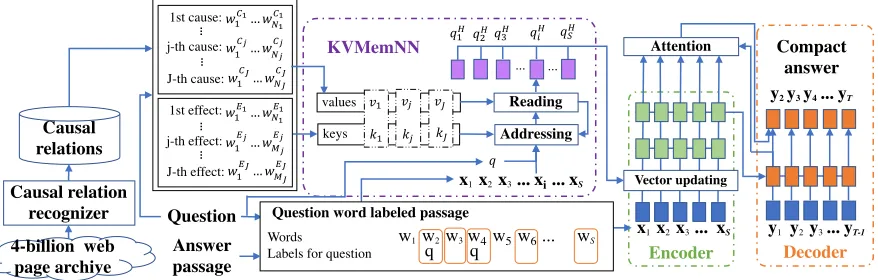
KVMemNN: In this baseline, we integrated a key-value memory network (Miller et al. 2016) into the Ishida-GRU. We stored causal relations in the memory network, regarding the effect parts as keysand the cause parts as
values. Our expectation here is that the information about the causal relations stored in the memory ispropagatedto the encoder input (i.e., word embeddings) and the propa-gated information signals the importance of the words that appear in causal relations so that those words are more likely to be generated in a compact answer.
The details are given in the Appendix. Here we only de-scribe how the output of the memory network modifies the
word embeddings. Given a why-question, we first com-puted the initial query representationq0
s, which is an input to the memory network, as:
q0s=A(∑ i
qi+xs), (15)
where A ∈ Rd×d is a trainable matrix and qi is the word embedding vector of thei-th word in the question andxsis the original input vector to the encoder. Then, the memory network iteratively updates the query repre-sentation using the reprerepre-sentations of the causal relations stored in the key-value memory. AfterHiterations, which are calledHhops, the updated query representationqHs is added to the encoder’s inputxsas:
ms = σ
(
W1qHs +b
)
, (16)
˜
xs = drop (xs+msu1), (17)
whereσdenotes the sigmoid activation function,drop de-notes the dropout operation, andW1 ∈R1×d,u1 ∈Rd
andb ∈ Rare trainable parameters. The new vector ˜xs is used as the input to the encoder RNN in Ishida et al.’s method instead of the original input vectorxs. We em-ployed this method as a baseline because using causal relations in a more sophisticated method might improve performance more than our simple word labeling on the encoder side.
4.3
Experimental settings
For all the methods, we used the following settings deter-mined through preliminary experiments using the develop-ment data. Both the sizes of the word embeddings and the RNN (i.e., GRU and LSTM) hidden states2were set to 500. The source and target vocabulary sizes were both set to 50,000. We used Adam (Kingma and Ba 2015) with learn-ing rate of 0.001 and mini-batches of 32 for optimization. If the validation error did not decrease after each epoch, the learning rate was divided by two. We used 1-layer RNNs as a decoder. We independently tried{1,2,3,4}-layer RNNs as encoders and chose the one that led to the optimal ROUGE-1 F-score on the development data. We ran a maximum of 20 epochs and selected the best model of each method based on the perplexity of the validation data. We pretrained the word embedding vectors on Japanese Wikipedia articles3 using word2vec (Mikolov et al. 2013) and fixed their weight vec-tors during the training of each method. In the testing step, we used a beam search with a beam size of 3 and unknown word replacement (Jean et al. 2015).
ForIshida-{LSTM,GRU},QryAttn andKVMemNN, we set the size of vectors for the word labels to 32 as done in Ishida et al. (2018). For the stacked CNNs, we used 4-layer CNNs. We set the weightαin equation (8) to 0.9 for the first (pretraining) step and changed it to 0.5 for the second train-ing step. We set the scaltrain-ing factorβin equation (10) to 0.5.
2
The hidden state size of each RNN in the bidirectional RNNs was set to 250 and the outputs were simply concatenated.
3
Method #Layers Development Test
R-1 R-2 R-L R-1 R-2 R-L
Baseline Ishida-LSTM 1 54.75 40.50 54.16 52.33 37.62 51.68
Ishida-GRU 2 56.20 42.25 55.60 52.82 38.27 52.17
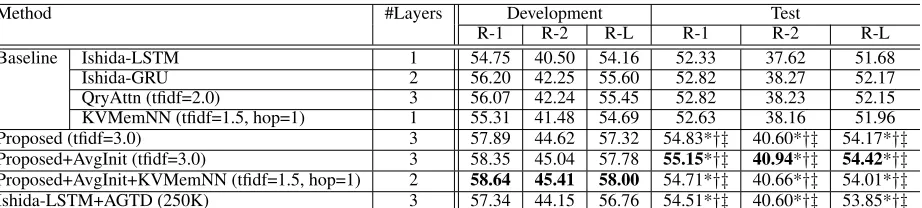
QryAttn (tfidf=2.0) 3 56.07 42.24 55.45 52.82 38.23 52.15 KVMemNN (tfidf=1.5, hop=1) 1 55.31 41.48 54.69 52.63 38.16 51.96 Proposed (tfidf=3.0) 3 57.89 44.62 57.32 54.83*†‡ 40.60*†‡ 54.17*†‡ Proposed+AvgInit (tfidf=3.0) 3 58.35 45.04 57.78 55.15*†‡ 40.94*†‡ 54.42*†‡ Proposed+AvgInit+KVMemNN (tfidf=1.5, hop=1) 2 58.64 45.41 58.00 54.71*†‡ 40.66*†‡ 54.01*†‡ Ishida-LSTM+AGTD (250K) 3 57.34 44.15 56.76 54.51*†‡ 40.60*†‡ 53.85*†‡ Proposed: our proposed network model. AvgInit: decoder initialization with averaging. #Layers: number of encoder layers. R-1, R-2 and R-L respectively denote ROUGE-1, ROUGE-2 and ROUGE-L F-scores. AGTD: automatically generated training data. Statistically significant improvements over Ishida-GRU, QryAttn and KVMemNN are respectively denoted by ‘*’, ‘†’ and ‘‡’ (Significance was estimated by a 95% confidence interval computed by the ROUGE script).
Table 3: Results of compact answer generation
InQryAttn,KVMemNN, and our proposed method, we in-dependently evaluated 1.5, 2.0 and 3.0 of thetf-idf thresh-old for causal relation retrieval and selected a threshthresh-old to achieve the best ROUGE-1 F-score of the development data. Furthermore, inKVMemNN, we independently evaluated {1,2,3,4} of the hop size in the key-value memory net-work and selected the one that best optimizes the ROUGE-1 F-score of the development data. For word segmentation, we used the morphological analyzer MeCab4 (Kudo, Ya-mamoto, and Matsumoto 2004).
4.4
Evaluation results
We evaluated the quality of each method by measuring the averaged ROUGE-1, ROUGE-2, and ROUGE-L F-scores (Lin 2004) and conducted significance test using a 95% confidence interval computed by a ROUGE script5. The re-sults of each method obtained for both the development and test data are presented in Table 3. Our proposed method (Proposedin Table 3) achieved significantly better ROUGE F-scores than all the baseline methods on the test data. In addition, our method with decoder initialization with aver-aging (Proposed+AvgInit) achieved slightly better ROUGE F-scores than Proposed. The improvement over Ishida et al.’s original method (Ishida-LSTM) is around 3% in all the ROUGE scores. The improvement overIshida-GRU, which shows slightly better results thanIshida-LSTM, exceeded 2%.
In contrast, QryAttnand KVMemNN gave almost the
same or slightly worse results thanIshida-GRUfrom which these methods were modified. This means that, contrary to our method, the more complex query-based summarization technique and key-value memory networks do not effec-tively exploit background knowledge, at least in our current settings. A possible explanation of these results is that the current encoding schemes for the cause parts in both Qry-AttnandKVMemNN were inadequate.QryAttnencodes the entire word sequences in the N cause parts using RNNs and generates a single representation vector for each cause part.KVMemNNalso generates a single representation
vec-4
http://taku910.github.io/mecab/ 5
http://www.berouge.com/
tor of the cause part through key addressing and value read-ing processes. In other words, the information in each cause part word sequence in both baselines is “condensed” into a single vector. On the other hand, the word labels are gener-ated from cause parts without such condensation processes. If the condensation process is good enough, the two base-lines may outperform the proposed method. However, this was not the case in our experiments.
Actually, a similar observation was obtained in the pre-vious work of Ishida et al. (2018). They tried to give in-formation concerning a given why-question using Nema et al. (2017)’s query-attention mechanism by encoding the en-tire word sequence in the question into a single representa-tion. However, their experiments revealed that this method does not improve performance. On the other hand, the same previous work showed that the word labels obtained from the question words improved the performance, just like our word labels for causal relations in our work. That is, at least in our compact answer generation task settings, word labels generated from external inputs (i.e., questions and causal re-lations) consistently improved performance, but QryAttn
and KVMemNN did not. This suggests that the encod-ing/condensation processes of the cause parts in those base-lines were inadequate for our task settings.
Another possible explanation may be that information from the cause parts must somehow be used in the answer passage encoding processes, probably because the answer passage encoder must focus on (possibly fragmented) the text regions of the passages from which a compact answer is generated. InQryAttn, the cause part information does not affect the encoding process for the answer passages (i.e., it is used only for attention computation in the decoder), but word labels do affect the encoding process because they are given to the encoder for answer passages alongside the word embeddings of the answer passages. This may be another reason why the improvement byQryAttnwas not signifi-cant.
We also tried a combination of the key-value
mem-ory networks and Proposed+AvgInit, both of which
Method #layers Development Test R-1 R-2 R-L R-1 R-2 R-L Proposed+AvgInit 3 58.35 45.04 57.78 55.15 40.94 54.42 w/o word labels for causal relations 2 57.95 44.76 57.35 54.75 40.66 54.04 w/o stacked CNNs 3 57.40 43.72 56.86 54.62 40.38 53.95 w/o AvgInit (=Proposed) 3 57.89 44.62 57.32 54.83 40.60 54.17
Table 4: Results of ablation test
on the development set were slightly better than it.
We compared our method with Ishida et al. (2018)’s en-tire method. We obtained from them their auto-generated training data (AGTD), which was automatically gener-ated using the same type of causal relations that we used for labeling words in Section 3.2. We re-trained
Ishida-LSTM after adding 250K, 500K, 750K, and 1M
in-stances of AGTD to the manually generated training data, and selected the hyper-parameters and AGTD whose size achieved the best ROUGE-1 F-score against the develop-ment data. The resulting model’s performance is shown as
Ishida-LSTM+AGTDin the bottom line of Table 3. Pro-posed+AvgInit outperformed Ishida-LSTM+AGTD even
without AGTD. Note thatIshida+LSTM+AGTDachieved
the best performance when AGTD was rather small (250K). This implies that using even more AGTD (more than 1M) is unlikely to improve performance. Our results suggest that using background knowledge may be more effective than us-ing AGTD.
Table 4 shows the ablation test results to assess the effec-tiveness of each component inProposed+AvgInit. All the components introduced in this work improved performance. Table 5 shows some examples of compact answers that were automatically generated by each method.
5
Conclusion
We proposed a novel neural method for generating compact answers (e.g., “Because deep learning was introduced.”) to why-questions (e.g., “Why did Google’s machine translation improve so drastically?”) from long multi-sentence text pas-sages that were retrieved by existing why-QA methods. The method exploits such causal relations as “[Microsoft’s ma-chine translation has made great progress over the last few years]effect since [it started to use deep learning.]cause”, re-trieved from a large web archive of 4 billion web pages. In this method, we first labeled the words that appear in the cause parts in the causal relations (e.g., deep learning) to focus on such words in generating compact answers by an encoder-decoder model. Also, we introduced stacked CNNs to consider the contexts of the labeled words in a man-ner different to that in the encoder RNN. Our experimental results show that our method achieved significantly better ROUGE F-scores than existing encoder-decoder models and their variations augmented with query-attention and mem-ory networks, which exploit background knowledge.
Appendix: Details of KVMemNN baseline
This appendix details the baseline method (KVMemNN) that uses key-value memory networks (Miller et al. 2016),
Example 1
Question: Why are Japan’s trains so crowded?
Answer passage:I’m visiting Japan on a sightseeing trip, but it’s really irritating that so many trains are too crowded in Tokyo. It is quite obvious that they are too crowded because many company employees work in central Tokyo while living in the suburbs. I cannot fathom why no political action has al-leviated this situation.
Ishida-GRU:Because I’m visiting Japan on a sightseeing trip. QryAttn:Because sightseers live in the suburbs.
KVMemNN:Because many company employees live in the suburbs.
Proposed+AvgInit:Because many company employees live in the suburbs.
Example 2
Question: Why does bamboo charcoal deodorize smells? Answer passage:Thank you for buying our “bamboo charcoal pillow.” Bamboo charcoal’s microscopic pores having absorp-tion capabilities, it provides air purificaabsorp-tion and deodorizaabsorp-tion effects and alleviates any discomfort while sleeping. Our pil-low will provide you with comfortable sleep.
Ishida-GRU:Because it alleviates discomfort while sleeping. QryAttn:Because it alleviates discomfort while sleeping. KVMemNN:Because it has air purification and deodorization effects.
Proposed+AvgInit: Because the microscopic pores has ab-sorption capabilities.
Table 5: Examples of compact answers generated by each method (manually translated in English for readability)
which were also used in our experiments. This method chose key-value memory networks as an alternative way to exploit causal relations as background knowledge. Instead of label-ing the words, we modified the original input vector for each word that was given to an encoder using the key-value mem-ory network in which the causal relations are encoded and stored.
The modified input vector is computed in the following four steps: causal relation encoding, memory addressing,
memory readingandvector updating. An overview of the whole method is illustrated in Figure 3.
Causal relation encoding: In our KVMemNN, given
J causal relations that are relevant to a target why-question, we stored the effect parts of the relations as keysand the cause parts asvalues. We first computed the representations of the keys and values following Miller et al. (2016)6. As a value stored in the network, we computed the cause part
6
KVMemNN
Encoder Decoder x1x2x3... xi... xS
x1x2x3... xS y1 y2y3... yT-1
y2y3y4... yT
Attention
Vector updating
Compact answer
Question 4-billion web
page archive Causal relations
Causal relation recognizer
Words
Labels for question
w1w2w3w4 w5 w6... wS
q q Answer
passage
j-th cause:!"#$
… !&#$$
1st cause:
J-th cause:
'"(
Addressing Reading
keys values )"
*"
... ...
'
'+(
',('-( '.(
!"#/… !&/ #/
!"#0… ! &0 #0
)1 )2
*1 *2
j-th effect:!"3$… ! 4$ 3$
1st effect:
J-th effect:
!"3/… !&/ 3/
!"30
… !4300
Question word labeled passage
Figure 3: Baseline model augmented with KVMemNNs
representationvjfrom thej-th cause part as the sum of the word embeddings of all the words in the cause part. As key representations, we computed the effect part representation
kj from thej-th effect part as the sum of the word embed-dings of all the words in the effect part. These two types of representation are iteratively used for the processes of mem-ory addressingandreading, both of which are described be-low. The number of iterations is referred to ashop, which is denoted byhin the following.
Memory addressing: At the first step of memory ad-dressing, we compute the representationqof a target why-questionQas the sum of the word embedding of every word inQ. Then the initial query vectorq0
s for thes-th word’s feature vectorxs, which is the original input vector given to the encoder, is computed as:
q0s=A(q+xs), (18)
whereA∈Rd×dis a trainable matrix. Then at theh-th hop,
the j-th causal relation is assigned a relevance probability by comparing the query vectorqh
s and the effect part repre-sentation:
phs,j=softmax(qhs⊤Akj
)
. (19)
Memory reading: In the memory reading step, we com-puted the weighted sum of the values in the memory using the above relevance probability:
ohs=∑ j
phs,jAvj. (20)
Then we updated the query vector by combining the current query vectorqh
sand the aboveohs as:
qhs+1=Rh
(
qhs +o h s
)
, (21)
whereRh ∈ Rd×d is a trainable matrix. We updated the
query vector qh
s H times using equations (19), (20), and (21), whereHis the fixed number of hops.
Vector updating: Finally, we obtained a modified input vectorx˜sto be given to the encoder by combining the orig-inal input vectorxsand the final query vectorqHs as:
ms = σ
(
W1qHs +b
)
, (22)
˜
xs = drop (xs+msu1), (23)
whereσdenotes the sigmoid activation function,drop de-notes the dropout operation (Hinton et al. 2012), andW1∈
R1×d,u1∈Rdandb∈Rare trainable parameters.
Note that computing the modified input vectors using equations (22) and (23) is intended to function in a simi-lar way to our stacked CNNs (especially as in equation (9) of Section 3.2). In stacked CNNs, the predicted valuepiis added after expanding it with the trainable vectorux. Anal-ogously, in the above vector updating, we first computed the value ms in equation (22) and then expanded it using the trainable vectoru1in equation (23). We also tried a simpler version of vector updating in which the modified input vec-tor˜xsis computed as:
˜
xs= drop(xs+qHs
)
. (24)
However, it drastically decreased the ROUGE scores and we used equations (22) and (23) for computingx˜sin the base-line method using the KVMemNN.
References
Bahdanau, D.; Cho, K.; and Bengio, Y. 2015. Neural ma-chine translation by jointly learning to align and translate. In
ICLR 2015.
Chen, Q.; Zhu, X.; Ling, Z.; Wei, S.; and Jiang, H. 2016. Distraction-based neural networks for modeling documents. InIJCAI-16, 2754–2760.
Dauphin, Y. N.; Fan, A.; Auli, M.; and Grangier, D. 2017. Language modeling with gated convolutional networks. In
ICML, 933–941.
dos Santos, C. N.; Tan, M.; Xiang, B.; and Zhou, B. 2016. Attentive pooling networks.CoRRabs/1602.03609. Gehring, J.; Auli, M.; Grangier, D.; Yarats, D.; and Dauphin, Y. N. 2017. Convolutional sequence to sequence learning.
CoRRabs/1705.03122.
Girju, R. 2003. Automatic detection of causal relations for question answering. Inthe ACL 2003 Workshop on Multi-lingual Summarization and Question Answering, 76–83. Higashinaka, R., and Isozaki, H. 2008. Corpus-based ques-tion answering for why-quesques-tions. InIJCNLP 2008, 418– 425.
Hinton, G. E.; Srivastava, N.; Krizhevsky, A.; Sutskever, I.; and Salakhutdinov, R. 2012. Improving neural networks by preventing co-adaptation of feature detectors. CoRRabs /1207.0580.
Hochreiter, S., and Schmidhuber, J. 1997. Long short-term memory.Neural Computation9(8):1735–1780.
Ishida, R.; Torisawa, K.; Oh, J.-H.; Iida, R.; Kruengkrai, C.; and Kloetzer, J. 2018. Semi-distantly supervised neural model for generating compact answers to open-domain why questions. InAAAI 2018.
Jean, S.; Cho, K.; Memisevic, R.; and Bengio, Y. 2015. On using very large target vocabulary for neural machine trans-lation. InACL-IJCNLP 2015, 1–10.
Kingma, D. P., and Ba, J. 2015. Adam: A method for
stochastic optimization. InICLR 2015.
Kruengkrai, C.; Torisawa, K.; Hashimoto, C.; Kloetzer, J.; Oh, J.; and Tanaka, M. 2017. Improving event causality recognition with multiple background knowledge sources using multi-column convolutional neural networks. InAAAI 2017, 3466–3473.
Kudo, T.; Yamamoto, K.; and Matsumoto, Y. 2004. Ap-plying conditional random fields to Japanese morphological analysis. InEMNLP 2004, 230–237.
Lin, C.-Y. 2004. ROUGE: A package for automatic evalu-ation of summaries. Inthe ACL-04 Workshop on Text Sum-marization Branches Out, 74–81.
Luong, M.-T.; Pham, H.; and Manning, C. D. 2015. Effec-tive approaches to attention-based neural machine transla-tion. InEMNLP 2015, 1412–1421.
Miao, Y., and Blunsom, P. 2016. Language as a latent vari-able: Discrete generative models for sentence compression. InEMNLP 2016, 319–328.
Mikolov, T.; Sutskever, I.; Chen, K.; Corrado, G. S.; and Dean, J. 2013. Distributed representations of words and phrases and their compositionality. In NIPS 2013, 3111– 3119.
Miller, A.; Fisch, A.; Dodge, J.; Karimi, A.-H.; Bordes, A.; and Weston, J. 2016. Key-value memory networks for di-rectly reading documents. InEMNLP 2016, 1400–1409. Mizuno, J.; Tanaka, M.; Ohtake, K.; Oh, J.-H.; Kloetzer, J.; Hashimoto, C.; and Torisawa, K. 2016. WISDOM X,
DIS-AANA and D-SUMM: Large-scale NLP systems for analyz-ing textual big data. InCOLING 2016, 263–267.
Nallapati, R.; Zhou, B.; dos Santos, C.; Gulcehre, C.; and Xiang, B. 2016. Abstractive text summarization using sequence-to-sequence RNNs and beyond. InCoNLL 2016, 280–290.
Nema, P.; Khapra, M. M.; Laha, A.; and Ravindran, B. 2017. Diversity driven attention model for query-based abstractive summarization. InACL 2017, 1063–1072.
Oh, J.-H.; Torisawa, K.; Hashimoto, C.; Sano, M.; Saeger, S. D.; and Ohtake, K. 2013. Why-question answering us-ing intra- and inter-sentential causal relations. InACL 2013, 1733–1743.
Oh, J.-H.; Torisawa, K.; Hashimoto, C.; Iida, R.; Tanaka, M.; and Kloetzer, J. 2016. A semi-supervised learning approach to why-question answering. InAAAI-16, 3022–3029. Oh, J.-H.; Torisawa, K.; Kruengkrai, C.; Iida, R.; and Kloet-zer, J. 2017. Multi-column convolutional neural networks with causality-attention for why-question answering. In
WSDM 2017, 415–424.
Rajpurkar, P.; Zhang, J.; Lopyrev, K.; and Liang, P. 2016. Squad: 100, 000+ questions for machine comprehension of text. InEMNLP 2016, 2383–2392.
Rush, A. M.; Chopra, S.; and Weston, J. 2015. A neural attention model for abstractive sentence summarization. In
EMNLP 2015, 379–389.
See, A.; Liu, P. J.; and Manning, C. D. 2017. Get to the point: Summarization with pointer-generator networks. In
ACL 2017, 1073–1083.
Sharp, R.; Surdeanu, M.; Jansen, P.; Clark, P.; and Ham-mond, M. 2016. Creating causal embeddings for question answering with minimal supervision. InEMNLP 2016, 138– 148.
Tan, M.; dos Santos, C. N.; Xiang, B.; and Zhou, B. 2016. Improved representation learning for question answer matching. InACL 2016, 464–473.
van den Oord, A.; Dieleman, S.; Zen, H.; Simonyan, K.; Vinyals, O.; Graves, A.; Kalchbrenner, N.; Senior, A. W.; and Kavukcuoglu, K. 2016. WaveNet: A generative model for raw audio. CoRRabs/1609.03499.
Verberne, S.; Halteren, H.; Theijssen, D.; Raaijmakers, S.; and Boves, L. 2011. Learning to rank for why-question answering. Information Retrieval14(2):107–132.
Yu, F., and Koltun, V. 2015. Multi-scale context aggregation by dilated convolutions. CoRRabs/1511.07122.