The Thirty-Third AAAI Conference on Artificial Intelligence (AAAI-19)
Multi-Level Deep Cascade Trees for Conversion Rate Prediction in
Recommendation System
Hong Wen,
1∗Jing Zhang,
2,3 ∗Quan Lin,
1Keping Yang,
1†Pipei Huang
1 1Alibaba Group2Hangzhou Dianzi University 3University of Technology Sydney
{qinggan.wh, pipei.hpp}@alibaba-inc.com
{tieyi.lq, shaoyao}@taobao.com, [email protected]
Abstract
Developing effective and efficient recommendation meth-ods is very challenging for modern e-commerce platforms. Generally speaking, two essential modules named “Click-Through Rate Prediction” (CTR) and “Conversion Rate Pre-diction” (CVR) are included, whereCVRmodule is a crucial factor that affects the final purchasing volume directly. How-ever, it is indeed very challenging due to its sparseness na-ture. In this paper, we tackle this problem by proposing multi-Level Deep Cascade Trees (ldcTree), which is a novel deci-sion tree ensemble approach. It leverages deep cascade struc-tures by stacking Gradient Boosting Decision Trees (GBDT) to effectively learn feature representation. In addition, we propose to utilize the cross-entropy in each tree of the preced-ingGBDTas the input feature representation for next level GBDT, which has a clear explanation, i.e., a traversal from root to leaf nodes in the next level GBDT corresponds to the combination of certain traversals in the precedingGBDT. The deep cascade structure and the combination rule enable the proposedldcTreeto have a stronger distributed feature representation ability. Moreover, inspired by ensemble learn-ing, we propose an EnsembleldcTree(E-ldcTree) to encour-age the model’s diversity and enhance the representation abil-ity further. Finally, we propose an improved Feature learning method based onEldcTree(F-EldcTree) for taking adequate use of weak and strong correlation features identified by pre-trainedGBDT models. Experimental results on off-line data set and online deployment demonstrate the effectiveness of the proposed methods.
Introduction
With the explosive growth of information available online, Recommender System (RS), as a useful information filter-ing tool, is used for estimatfilter-ing users’ preferences on items they have not seen and guides them to discover products or services they might be interested in from massive possi-ble options. In general, recommender systems are classified into the following three categories based on the forms of recommendations (Balabanovi´c and Shoham 1997): Collab-orative recommendations, Content-based recommendations
∗
The co-first authors contributed equally.
†
Corresponding author.
Copyright c2019, Association for the Advancement of Artificial Intelligence (www.aaai.org). All rights reserved.
Trigger
Selection Candidate Selection User behavior
Matching Stage
CTR Model CVR Model Ranking Stage Features
Features
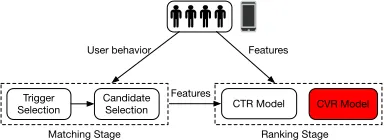
Figure 1: The framework for online recommendation in our E-commerce platform.
and Hybrid recommendations. Collaborative recommenda-tions make users recommended items that people with sim-ilar tastes preferred in the past. Content-based recommen-dations make users recommended items similar to the ones the user preferred in the past. Hybrid recommendations in-tegrates two or more types of recommendation strategies, which helps to avoid certain limitations of single strategy (Adomavicius and Tuzhilin 2005).
Recommender System increasingly plays an essential role in industry area, which promotes services for many applica-tions (Gomez-Uribe and Hunt 2016; Davidson and Liebald 2010). In addition, in order to help customers find exactly what they need, recommendation techniques have been stud-ied and deployed extensively on E-commerce platforms, which provides good user experience and promotes incredi-ble increment in revenue. Usually, the deployed framework for our online E-commerce platforms is illustrated in Fig. 1. Specifically, when a user visits it through a terminal, such as smart phones, the system firstly analyzes his/her long and short term behaviors and then his/her interested items, calledTriggers, are selected. Then, massive items closely re-lated withTriggersare generated. Further, top K(e.g., 500) of them (based on the “matching score”), along with ex-tra information (e.g., user, item, user-item cross features), are delivered to the nextRankingstage where it mainly con-tains two core modules, namelyCTRandCVR. Finally, the recommendation results are generated and displayed to the user. In this paper, we mainly focused on theCVRmodule.
Simonyan and Zisserman 2014) , speech recognition (Deng et al. 2010; 2013) and object detection (Girshick 2015; Ren et al. 2015). Meanwhile, recent studies also demon-strate its efficiency and effectiveness in coping with rec-ommendation tasks(Elkahky, Song, and He 2015; Wang, Wang, and Yeung 2015; Chen et al. 2017; He et al. 2017; Huang et al. 2015; Yang et al. 2017; Guo et al. 2017). Though deep learning has been partially overcoming ob-stacles of conventional models and gaining momentum due to its state-of-the-art performances, it has apparent deficien-cies, such as a huge amount of data and powerful computa-tional facilities required for training, more importantly many hyper-parameters to be tuned. Recently,gcForest(Zhou and Feng 2017), an alternative toDNN, is proposed, which gen-erates a deep forest ensemble, with a cascade structure to do representation learning. In addition, it achieves highly com-petitive performance compared with DNN for various do-mains’ tasks while having fewer hyper-parameters.
In this paper, partially inspired by gcForest (Zhou and Feng 2017), we firstly propose a multi-Level Deep Cascade Trees model (short as ldcTree) to cope with the essential
taskCVR predictionin the “also view” module.ldcTree is
another alternative toDNNand encourages to do represen-tation learning by a level-by-level cascade structure. Specif-ically, it takes a multi-dimensional representational feature vector from preceding level and outputs its processing re-sults to the next level by employing Gradient Boosting De-cision Trees (GBDT) models (Friedman 2001), where a new tree is created to model the residual of previous trees during each iteration, and a traversal from root node to a leaf node represents a combination rule of certain input features. One step further, we propose to utilize the cross-entropy value of each leaf node on the trees in the preceding levelGBDTto construct the feature representation for the next levelGBDT, which results a clear explanation of the spliting node in the next level GBDT, i.e., a traversal from root to a leaf node in next levelGBDT indicates a combination rule of certain paths on the trees from preceding level GBDT. Then, in-spired by the idea of ensemble learning, we proposed En-sembleldcTree (short asE-ldcTree), which encourages the model’s diversity and enhances the representation ability.
Furthermore, it is noteworthy that a small number of raw features contributes the majority of explanatory power while the remaining features have only a marginal contribution in GBDT models (He et al. 2014), which results in the importance of certain raw features can’t be demonstrated. Therefore, we further proposed an improved Feature learn-ing method based on the aboveEldcTree, namedF-EldcTree, which takes more adequately use of weak and strong corre-lation features identified by pre-trainedGBDTmodel at cor-responding levels. The key contributions of this paper are:
• We propose a novel model ldcTree and its extension
EldcT ree, which are decision tree ensemble methods by
exploiting the deep cascade structures and using a cross-entropy based feature representation. It exhibits a strong feature representation ability and has a clear explanation.
• To the extent of our knowledge, our proposedF-EldcTree
is the first recommendation work which adequately takes
into account weak and strong correlation features identi-fied by pre-trainedGBDTmodel at corresponding levels, and contributes more excellent ability for representation learning.
• We have successfully deployed the proposed methods to the recommendation module in our E-commerce plat-form, and carry out online experiments with more than 100M users and items, furthermore achieves 12 percent
CVRimprovement compared with the baseline model.
The rest of this paper is organized as follows. Section 2 briefly reviews existing related work. Section 3 describes the proposed approach in detail, followed by presenting exper-imental results on both off-line evaluation and online appli-cations in Section 4. We conclude the paper in Section 5.
Related work
Conversion Rate Prediction
Conversions are very rare events and only a very small por-tion of the users will eventually convert after clicking or being shown, resulting in extremely challenging for build-ing thus models (Mahdian and Tomak 2007; Chapelle, Man-avoglu, and Rosales 2015; Rosales, Cheng, and Manavoglu 2012; Oentaryo et al. 2014). In addition, it can be broadly di-vided to two categories of Post View Conversion (PVC) and Post Click Conversion (PCC), which means conversion after viewing an item without having clicked it itself and conver-sion after having clicked, respectively. In the context of this paper, conversion refers to the purchase event that occurs af-ter a user clicking an item, i.e. post click conversions (PCC) (Rosales, Cheng, and Manavoglu 2012).
Tree based Feature Representation
GBDT follows the Gradient Boosting Machine (GBM) (Friedman 2001), which produces competitive, highly ro-bust, interpretable procedures for both regression and clas-sification, especially appropriate for mining less than clean data. In literature (He et al. 2014), a hybrid model, combin-ing GBDT with Logistic Regression (LR), outperforms ei-ther of these methods on their own. It treats each individual tree as a bin feature and takes the index of the leaf node an instance ends up falling in as value. Therefore, it converts a real-valued vector into a compact binary-valued vector, further included into the next linear model, i.e. LR. Com-pared with (He et al. 2014), our proposed method employs the cross-entropy based feature representation in a deep cas-caded structure, which results in strong and explainable rep-resentation ability, i.e., a traversal from root to a leaf node in next levelGBDTindicates a combination rule of certain paths on the trees from preceding levelGBDT.
gcForest, an alternative to deep neural networks for many
• In gcForest, the class-specific prediction probabilities form a feature vector, further included into the next level forest after concatenating it with the original features. However, We employGBDT as the base unit in the pro-posed deep cascade structure. In addition, we use the cross-entropy in each tree of the precedingGBDT as the feature representation for next level GBDT. The afore-mentioned two points lead to a more explainable fea-ture representation ability of the proposed method, e.g., a traversal from root to a leaf node in next levelGBDT
indicates a combination rule of certain paths on the trees from preceding levelGBDT.
• Compared withgcForest, Our method takes into account mutual complementarity between strong correlation fea-tures and weak correlation feafea-tures for better representa-tion learning.
The Proposed Approach
In this section, we firstly proposed a novel multi-Level Deep Cascade Trees (ldcTree) to tackle theCVRprediction prob-lem in recommendation. Specifically, the base structure of
the ldcTree is constructed by stacking several GBDTs
se-quentially, and the cross-entropy of each leaf node in the pre-cedingGBDT is calculated and used to form the input fea-ture representation for the nextGBDT. Moreover, inspired by the idea of ensemble learning, an improved structure of
the ldcTree is proposed, named Ensemble ldcTree (
Eldc-Tree), which further encourages the model’s diversity and enhances the representation ability. Finally, we notice that a small number of features contributes the majority of ex-planatory power while the remaining features have only a marginal contribution in GBDT models (He et al. 2014), which leads to the importance of weak correlation features, especially the combination of weak correlation features, can’t be revealed. Therefore, based onEldcTree, We propose an improved Feature learning method, namedF-EldcTree. We will present the details in the following parts.
Representation Learning based on Cascade Trees
Inspired by representation learning in deep neural network which mostly relies on the level-by-level abstraction of fea-tures, we propose a novel method named ldcTree by em-ploying the deep cascade tree structure. InldcTree, level-by-level greedily learning towards the final target is carried out. Specifically, each level with a certain number of trees included inGBDT, receives the outputted features from its proceding level. Referring to Fig. 2, it is an illustration of
ldcTree, where it contains two levels, with each level three trees and two trees respectively. To facilitate the narration, some mathematical notations are defined as follows:
• Sijk: the cross-entropy of thek-th leaf node of thej-th
tree at leveli.
• Iijk: the number of instances falling in thek-th leaf node
of thej-th tree at leveli.
• δijk: the split threshold for the k-th node of the j-th tree at
the leveli.
• Lij: the number of leaf nodes of thej-th tree at leveli.
Tree 1
F11 F12 F13
Tree 1 (a) F12 <= 0.13 Level 1
Level 2 S111
Tree 2 Tree 3
0.13 0.18 0.19 0.15 0.11 0.14 0.13 0.16 0.13 0.04 0.18 0.16
F11 > 0.15
Tree 2 F13 > 0.13
F12 <= 0.13
A B
(b)
S112S113S114 S121S122S123S124 S131S132S133S134
S121 U S123 S112 U S113
S133 U S134 S121 U S123
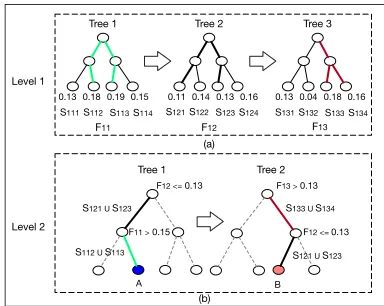
Figure 2: Illustration of feature representation in theldcTree. (a) an exemplarGBDTof three trees at level 1. (b) an exem-plarGBDTat the next level of two trees. Each splitting node at the level 2 corresponds a split of paths in a certain tree at level 1. Please note the corresponding colors of paths at the two levels.
• Fij: the feature value at the j-th dimension of the feature
at leveli.
• Ni: the number of trees for theGBDTmodel at leveli.
• hij(xn): the predicted probability of the n-th instancexn
on the j-th tree at the leveli.
• yn: the ground truth label of the n-th instancexn: 0 or 1
in our two classCVRproblem.
Given an instance, according to the principle of GBDT
model, each individual tree will produce a path from the root node to a leaf node. Instances are split into different paths and each leaf node will gather a certain part of them. Then, we define the cross-entropySijkat each leaf node as:
Sijk = −
1
Iijk Iijk
X
m=1
[ymlog(hij(xm))
+(1−ym)log(1−hij(xm))] (1)
Therefore, there are Lij cross-entropy values on the j-th
tree on thei-th level, i.e.,Sij1, Sij2, ..., SijLij and each of them is a possible instantiation ofFij. For all the trees in a
GBDTat the leveli, we denote the feature representation as [Fi1, Fi2, ..., FiNi], and use it as the inputs of theGBDTat the leveli+ 1.
Without loss of generality, assuming the featureFijwith
the bestgini value is chosen for splitting instances on the
q-th node of thep-th tree at the leveli+ 1. The split thresh-oldδ(i+1)pqdivides the set ofSij1, Sij2, ..., SijLij, into two subsetsSij+, Sij−:
Sij+= Lij
[
p=1
I(Sijp> δ(i+1)pq)Sijp (2)
Sij−= Lij
[
p=1
whereI(z)is an indicator faction that outputs 1 ifzis true and zero otherwise.
Remark 1. By using cross-entropy as the basic feature
rep-resentation for leaf nodes, the proposedldcT reehas a clear
explanation: i.e., a traversal from root to leaf nodes in the next level GBDT corresponds to the combination of certain traversals in the preceding GBDT, which also leads to a dis-tributed feature representation ability.
Explanation:Usually,δ(i+1)pqin Eq.(2) and Eq.(3) takes
a value from the set ofSij1, Sij2, ..., SijLij. The splitting process is carried out repeatedly until the stop rule for leaf nodes holds (We show an example in Fig. 2). It can be seen that, each element inS+ij or Sij− corresponds a path on the
j-th tree of level i. Therefore, each splitting node at the level i+ 1 corresponds a split of paths in a certain tree at the preceding leveli. Consequently, a path at the level
i+ 1 corresponds a union of several paths at the preced-ing leveli. It indicates the nature of the proposedldcT ree:
a clear explanation and a distributed feature representation
ability. As shown in Fig. 2, an instance is represented as a
three-dimensional feature vector [F11, F12, F13] after level 1 with three trees, whereF11takes a value from the set of 0.13, 0.18, 0.19, 0.15, analogously forF12 andF13. Given [F11, F12, F13]as the inputs at level2,F12is chosen as the split feature with the split threshold0.13on Tree 1, which leads toS121, S123⊂S12− andS122, S124⊂S12+. And anal-ogously,S112, S113 ⊂ S11+ andS111, S114 ⊂ S11−. Conse-quently, the union of paths at leaf node A can be represented asS12−∩S11+, i.e.(S121SS123)T(S112SS113), and analo-gously for Tree 2.
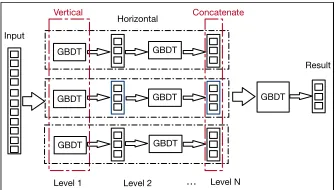
Moreover, inspired by the ensemble learning idea, we pro-pose an EnsembleldcTreenamedEldcTreeby constructing several parallelldcTrees to enhance the representation abil-ity further. As shown in Fig. 3, each horizontal part of the ensemble structure is a singleldcTree, and each vertical part of the ensemble structure are parallelGBDTs. Their initial input features for the first level of eachldcTreeare different and chosen randomly from a raw feature pool which encour-ages the model’sdiversity. The last level’s outputted features from eachldcTreeare concatenated together and used as the input features of the last GBDT for final prediction. Here,
thediversityin our model not only represents the nature of
diverse abstracted high-level features, but also the value of inherent ensemble learning. For example, each individual
Horizontalstructure randomly choose a subset of features
from the feature pool as input, which are then abstracted to different high-level features through the cascaded structure. It inherits the idea in feature engineering by learning high-level features from different combinations of low-high-level raw features. Then, the finalGBDTmodel, concatenating all the high-level features from precedingldcTreeas inputs, indeed follows the ensemble learning idea for further enhancing the performance of the entire model. It is noteworthy that such an ensemble structure is naturally apt to parallel implemen-tation and have the potential for incremental learning, e.g., the idea used in broad learning system (Chen and Liu 2018). We leave it as a future work.
GBDT
GBDT GBDT
GBDT
GBDT
GBDT
GBDT Input
Result
Level 1 Level 2 … Level N Horizontal
Vertical Concatenate
Figure 3: Illustration of the structure of EldcTree, where each horizontal part of the ensemble structure is a single
ldcTree, and each vertical part of the ensemble structure
are parallel GBDTs. The input features of the first level
GBDTs are different and randomly chosen from a feature pool, which encourages the model’s diversity. The outputted features from each ldcTree are concatenated together and used as the input features of the last GBDT for final pre-diction.
Cascade Trees Associated With Weak Correlation
Features
Though features can be chosen randomly from a given fea-ture pool and used as the input feafea-tures of eachldcTree, fea-tures indeed have different importance for prediction. In this paper, we use thestatistic Boosting Feature Importance(He et al. 2014), which aims to capture the cumulative loss re-duction attributable to a feature, to measure feature’s impor-tance. More specifically, a best feature is selected and split to maximize the squared error reduction during each tree node construction. Therefore, the importance of each fea-ture is determined by summing the total reduction for itself across all the trees. Typically, a small number of features contributes the majority of explanatory power while the re-maining features have only a marginal contribution inGBDT
models. Here, we regard the features contributing the major-ity of explanatory power as SCF, i.e. “Strong Correlation Features”, while features having only a marginal contribu-tion asWCF, i.e. “Weak Correlation Features”.
To take adequate use of WCF, we proposed an im-proved Feature learning method based on the above Eldc-Tree, namedF-EldcTree, whose structure is showed in Fig. 4. In Fig. 4(a), a separatedGBDT is pre-trained to identify the importance of all the initial raw features, and these fea-tures are further split into two subsets, namely WCF and
SCF. Due to our practical lessons, single feature fromWCF
contributes little to final prediction results, while the combi-nations of these features fromWCFnot. Moreover, inGBDT
models, a traversal from root to a leaf node in each tree indi-cates a combination rule of certain raw features. Therefore, we can resort toGBDT models for uniting certain features from WCFto take full advantage of them and collaborate withSCFs to further improve the prediction accuracy.
The strategies of randomly selecting features ingcForest
(Zhou and Feng 2017) convinces us its effectiveness in en-semble learning. Therefore, in Fig. 4(b), features are also randomly chosen from WCFs during the first levelGBDT
the combination of certainWCFs, but also encourages the model’s diversity and enhances the representation ability further. For GBDTs at the remaining levels of each ldc-Tree, their input features consists of two parts: one is the representational features from the preceding level, the other is randomly chosen from the SCFs. In this way, the
F-EldcTreestarts learning features fromWCFs and combines
the learned features (i.e., the combinations ofWCFs) with
SCFs little by little. Lastly, an additionalGBDTmodel con-catenates all the representational features fromldcTrees as the inputs for final results.
Experimental results
To evaluate the effectiveness of the proposed method, we conducted extensive experiments including off-line and on-line evaluations. First, we present the evaluation settings including data set preparation, evaluation metrics, a brief description of related comparison methods, and the hyper-parameters settings of the proposed method. Then, we present the experimental results of different methods on the off-line data set along with the analysis. Finally, we present experimental results of different methods for online deploy-ment through A/B test.
Evaluation settings
Data set preparation The off-line benchmark data set was constructed from the real click and purchase logs of our recommendation module in several consecutive days of De-cember, 2017. And it consists of more than 100M instances, each of which contains user/item features and label (here, an individual id for each instance, while label is positive if purchase after clicking, or negative if no purchase af-ter clicking). When preparing off-line benchmark data set, we divided the whole benchmark data into three disjoint parts according to the id, i.e., 40, 20 and 40 percent of the whole benchmark data for training data, validation data and test data respectively. Additionally, we extract hundreds of raw features including user features, item features and user-item cross features for each instance. For example, user fea-tures include users’ ages, genders and purchasing powers, etc. Item features include items’ prices, historicalCVRs and Click-through Rate (CTRs), etc. User-item cross features in-clude uses’ historicalCVRs, preference scores, etc, on items.
Evaluation metrics In order to comprehensively compare the performance of the propose method with other related methods, we adopt two commonly used metrics namely
AUC(Area Under Curve) andF1score based on precision and recall. Specifically, denoting all ground truth positive in-stances asT and all predicted positive instances asP, then precision and recall are defined as follows:
precision= |P
TT|
|P| (4)
recall= |T
TP|
|T| (5)
Then, theF1score is defined as:
F1=
2∗precision∗recall
precision+recall (6)
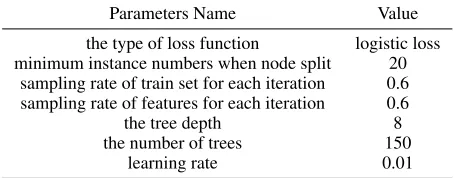
Table 1: Hyper-parameters inldcTreeandEldcTree
Parameters Name Value
the type of loss function logistic loss minimum instance numbers when node split 20
sampling rate of train set for each iteration 0.6 sampling rate of features for each iteration 0.6
the tree depth 8
the number of trees 150
learning rate 0.01
Related comparison methods In the following experi-ments, we compare the proposed method with other related methods including:
• Naive GBDT: We refer to a singleGBDT model without
level-by-level learning asNaive GBDT.
• GBDT + LR: First, feature representation is trained from
aGBDT model. Then, it is used for CVRprediction by a Logistic Regression (LR). For feature representation, it calculated a bin feature for each individual tree by tak-ing the index of the leaf node which an instance ends up falling in as the corresponding feature value. Therefore, it converts a real-valued raw feature vector into a compact binary-valued feature vector (He et al. 2014).
• DNN: Referring to (He et al. 2017), we design aDNN
structure including three hidden layers and a prediction layer, where ReLU is used as the activation function for each hidden layer. We choose the hyper-parameters on the validation set. For instance, the number of units for each hidden layer is set as 128. Dropout rate is set as 0.5. We use the cross-entropy loss andSGDalgorithm to train this
DNNmodel.
• gcForest: Following our practical experience, we replace
the Forests in the originalgcForest(Zhou and Feng 2017) withGBDTs. Since theCVRprediction is a binary clas-sification problem, a two-dimensional class-specific fea-ture vector is obtained from eachGBDT. Then, it is used along with the raw feature vector as the inputs of next levelGBDT for learning deep feature representation fur-ther.
.
Moreover, we also evaluate the performance among our proposed ldcTree, EldcTree and F-EldcTree methods for demonstrating the effectiveness of ensemble learning and the adequate use ofWCFandSCFat corresponding levels. It should also be noted that all methods use the same raw features as inputs if not specified (e.g., here, user, item and user-item cross features are included.)
Hyper-parameters settings We choose the
hyper-parameters of the proposed methods according to theAUC
GBDT Input
Result
Level 1 WCF SCF
Tree 1 Tree N
…
GBDT
(a)
GBDT GBDT
GBDT GBDT GBDT
GBDT GBDT GBDT
Level i Level N
GBDT Concatenate
WCF
WCF
WCF
SCF
SCF
SCF
SCF
SCF
SCF
(b)
Figure 4: Illustration of the proposedF-EldcTreemethod, which utilizes weak correlation features and strong correlation fea-tures in a coordinated manner.
Table 2: The metric on Time Cost and the AUC inldcTree
Metric Name Depth 4 Depth 6 Depth 8 Depth 10
Time Cost(s) 5 7 15 26
AUC 0.783 0.789 0.794 0.797
differentldcTree models by changing the tree depth while fixing other settings. Results are shown in Tab. 2. It can be seen that the time cost for each iteration increases consistently with the growth of the tree depth, and the corresponding AUC on the validation set also increases. In addition, the time cost increases significantly when the depth increases from 8 to 10, while for theAUC value, it grows at a snail’s pace. For example, marginal gains of 0.003 are achieved by increasing the depth from 8 to 10. Therefore, to achieve a trade-off between model capacity and complexity, we set the hyper-parameter “the tree depth” as 8. Moreover,EldcTree and F-EldcTreecan refer to the same hyper-parameters asldcTree. Finally, aforementioned naive experiments also taught us that the performance of models can’t be boosted further while increasing the tree depth blindly.
Comparison results on off-line dataset
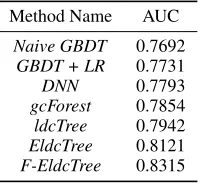
We report theAUCvalues andF1scores of different meth-ods on the off-line test set. The results are shown in Tab. 3 and Tab. 4, respectively. Referring to Tab. 3, it can be seen that theGBDT + LRmethod achieves a gain of 0.0039 compared toNaive GBDT due to the additionalLR classi-fier.DNNandgcForestachieve better results thanGBDT + LR. It convinces us that strong representation features are learned due to their deep structures. Our proposed method
ldcTree achieves higher AUC values than certain related
methods(such as Naive GBDT, GBDT+LR, DNN). More-over, the proposedEldcTreeachieves betterAUCresult than
ldcTree due to the idea of ensemble learning. Finally, the
further proposedF-EldcTreeachieves the best result than all the other competitive methods by taking full use ofWCF
andSCFlittle by little, together with the idea of ensemble learning. And the gain is nearly 0.063 compared to the initial
Table 3: Comparison AUC results for all competitors.
Method Name AUC
Naive GBDT 0.7692 GBDT + LR 0.7731
DNN 0.7793
gcForest 0.7854 ldcTree 0.7942 EldcTree 0.8121 F-EldcTree 0.8315
baselineNaive GBDT. According to our practical lessons, it should be noted that a gain of 0.01 in off-lineAUCcan lead to big increment in revenue in our online recommendation system. In conclusion, the significant gain over initialNaive GBDTconvinces the effectiveness of the proposed deep cas-cade structure for stronger feature representation, and the gain overgcForestconvinces the effectiveness of level-by-level learning, for example, taking the outputs of preceding level as the inputs of the next level. Moreover, compared
withEldcTree, results ofF-EldcTreeconvince the idea by
taking full use of weak and strong correlation features. As for the F1 score, we report several values by set-ting different thresholds. First, we sort all the instances in a descending order according to the predicted score. Then, we choose 3 thresholds namely top@10%, top@20% and top@50% to split the predictions into positive and negative groups accordingly. Finally, we calculate the Precision, Re-call and F1 scores of these predictions at different thresh-olds. Results are showed in Tab. 4. As can be seen, the pro-posed method achieves the best performance which is con-sistent with Tab. 3.
Online evaluation results
Table 4: The Precision, Recall andF1score for all the competitors.
Method Type Method Name top@10 percent top@20 percent top@50 percent
Precision Recall F1-Score Precision Recall F1-Score Precision Recall F1-Score
Compare Methods
Naive GBDT 5.75% 36.39% 9.93% 4.16% 51.69% 7.70% 2.42% 76.57% 4.68%
GBDT + LR 6.39% 37.40% 10.92% 4.63% 54.16% 8.52% 2.68% 78.71% 5.19%
DNN 6.79% 38.32% 11.54% 4.92% 55.51% 9.03% 2.85% 80.96% 5.51%
gcForest 6.82% 39.03% 11.61% 4.94% 56.52% 9.08% 2.87% 82.14% 5.54%
Our Methods
ldcTree 6.85% 39.86% 11.69% 4.96% 57.72% 9.13% 2.88% 82.92% 5.56%
EldcTree 7.44% 41.49% 12.62% 5.39% 61.81% 9.91% 3.13% 87.31% 6.04%
F-EldcTree 8.16% 43.91% 13.76% 5.91% 63.58% 10.81% 3.43% 92.40% 6.61%
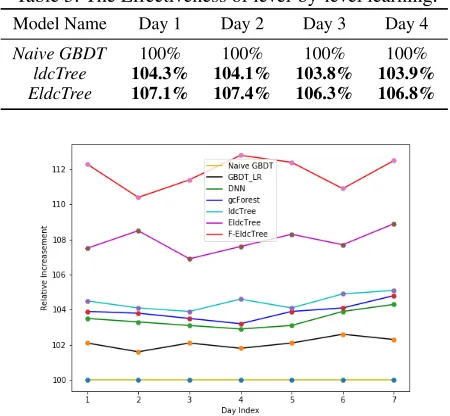
Table 5: The Effectiveness of level-by-level learning.
Model Name Day 1 Day 2 Day 3 Day 4
Naive GBDT 100% 100% 100% 100%
ldcTree 104.3% 104.1% 103.8% 103.9%
EldcTree 107.1% 107.4% 106.3% 106.8%
Figure 5: The online A/B test results onCVR. The initial baseline model marked in yellow is based onNaive GBDT. Here, all the comparison methods resort to the same features including user, item, and user-item cross features.
here, user, item and user-item cross features are included.). In addition, we fix all the other online recommendation mod-ules unchanged except theCVRmodule.
The Effectiveness of level-by-level Learning For demon-strating the effectiveness of the proposed level-by-level learning, we implementldcTreeandEldcTreemethods with the same features fromNaive GBDT. After deploying them in the online recommendation system, we record four days’ purchase logs and calculate the relative increasement in
CVR. The A/B test results are showed in Tab. 5. It can be seen the proposedldcTree method achieves more than 4% gain ofCVRaveragely, whileEldcTreemore than 7%. In ad-dition, after analyzing the difference between the structures of the two methods, we find that the gain mainly comes from the stronger feature representation ability of the proposed deep cascade structure inEldcTree. It is consistent with the experimental results on the aforementioned off-line data set.
The Effectiveness of F-EldcTree. After demonstrating the effectiveness of utilizing level-by-level learning through
online A/B experiments, we employedF-EldcTreefor on-line environment. In addition, the features for other competi-tive methods are exactly the same withF-EldcTree. The A/B test results are showed in Fig. 5, wheregcForestandDNN
achieve better results thanNaive GBDT due to their deep feature representation abilities. As for the proposed method, it achieves the best result, i.e. 12 percent increment inCVR
among all the methods.
In a nutshell, considering the experimental results from both off-line and online tests, we conclude that the proposed method has a stronger feature representation ability due to its deep cascade structure and the adequate use ofWCFs and
SCFs at corresponding levels. Moreover, these two distinct characteristics enables the learned features to have a clear explanation as depicted in Section 3.1.
Conclusions and future work
In this paper, we introduce effective and efficient distributed feature learning methodsldcTreeand its extensionEldcTree, which have a deep cascade structure by stacking several
GBDT units sequentially. By using a cross-entropy based feature representation, it leads to a clear explanation and a distributed feature representation ability. Moreover, af-ter taking into account mutual complementarity between strong correlation features and weak correlation features un-der the ensemble learning framework, the proposed method
F-EldcTreeachieves the best performance in both off-line
and on-line experiments. Specifically, we successfully de-ploy the proposed method online in our E-commerce plat-form, it achieves a significant improvement compared with the previously baseline, i.e. 12 percent increment in CVR. Our methods have small training cost and are naturally apt to parallel implementation. In addition, it is promising to be applicable for other online advertising scenarios.
Future work may include the following two directions: 1) Incorporating more features, such as information from the parent nodes and sibling nodes for learning stronger feature representation. 2) Studying the end-to-end training method for jointly feature learning and classifying based on the pro-posed deep cascade tree structure.
Acknowledgment
References
Adomavicius, G., and Tuzhilin, A. 2005. Toward the next generation of recommender systems: A survey of the state-of-the-art and possible extensions. IEEE Transactions on
Knowledge & Data Engineering(6):734–749.
Balabanovi´c, M., and Shoham, Y. 1997. Fab: content-based, collaborative recommendation. Communications of
the ACM40(3):66–72.
Chapelle, O.; Manavoglu, E.; and Rosales, R. 2015. Sim-ple and scalable response prediction for display advertising.
ACM Transactions on Intelligent Systems and Technology (TIST)5(4):61.
Chen, C. P., and Liu, Z. 2018. Broad learning system: an effective and efficient incremental learning system without the need for deep architecture. IEEE transactions on neural
networks and learning systems29(1):10–24.
Chen, J.; Zhang, H.; He, X.; Nie, L.; Liu, W.; and Chua, T.-S. 2017. Attentive collaborative filtering: Multimedia recommendation with item-and component-level attention.
In Proceedings of the 40th International ACM SIGIR
con-ference on Research and Development in Information
Re-trieval, 335–344. ACM.
Davidson, J., and Liebald, B. 2010. The youtube video recommendation system. InProceedings of the fourth ACM
conference on Recommender systems, 293–296. ACM.
Deng, L.; Seltzer, M. L.; Yu, D.; Acero, A.; Mohamed, A.-r.; and Hinton, G. 2010. Binary coding of speech spectrograms using a deep auto-encoder. InEleventh Annual Conference
of the International Speech Communication Association.
Deng, L.; Li, J.; Huang, J.-T.; Yao, K.; Yu, D.; Seide, F.; Seltzer, M.; Zweig, G.; He, X.; Williams, J.; et al. 2013. Recent advances in deep learning for speech research at microsoft. In Acoustics, Speech and Signal Processing
(ICASSP), 2013 IEEE International Conference on, 8604–
8608. IEEE.
Elkahky, A. M.; Song, Y.; and He, X. 2015. A multi-view deep learning approach for cross domain user modeling in recommendation systems. InProceedings of the 24th
Inter-national Conference on World Wide Web, 278–288.
Interna-tional World Wide Web Conferences Steering Committee. Friedman, J. H. 2001. Greedy function approximation: a gradient boosting machine. Annals of statistics1189–1232. Girshick, R. 2015. Fast r-cnn. InProceedings of the IEEE
international conference on computer vision, 1440–1448.
Gomez-Uribe, C. A., and Hunt, N. 2016. The netflix rec-ommender system: Algorithms, business value, and innova-tion. ACM Transactions on Management Information
Sys-tems (TMIS)6(4):13.
Guo, H.; Tang, R.; Ye, Y.; Li, Z.; and He, X. 2017. Deepfm: A factorization-machine based neural network for ctr pre-diction. arXiv preprint arXiv:1703.04247.
He, X.; Pan, J.; Jin, O.; Xu, T.; Liu, B.; Xu, T.; Shi, Y.; Atallah, A.; Herbrich, R.; Bowers, S.; et al. 2014. Prac-tical lessons from predicting clicks on ads at facebook. In
Proceedings of the Eighth International Workshop on Data
Mining for Online Advertising, 1–9. ACM.
He, X.; Liao, L.; Zhang, H.; Nie, L.; Hu, X.; and Chua, T.-S. 2017. Neural collaborative filtering. InProceedings of
the 26th International Conference on World Wide Web, 173–
182. International World Wide Web Conferences Steering Committee.
Huang, W.; Wu, Z.; Chen, L.; Mitra, P.; and Giles, C. L. 2015. A neural probabilistic model for context based citation recommendation. InAAAI, 2404–2410.
Krizhevsky, A.; Sutskever, I.; and Hinton, G. E. 2012. Imagenet classification with deep convolutional neural net-works. InAdvances in neural information processing sys-tems, 1097–1105.
Liu, W.; Wang, Z.; Liu, X.; Zeng, N.; Liu, Y.; and Alsaadi, F. E. 2017. A survey of deep neural network architectures and their applications. Neurocomputing234:11–26. Mahdian, M., and Tomak, K. 2007. Pay-per-action model for online advertising. In Proceedings of the 1st interna-tional workshop on Data mining and audience intelligence
for advertising, 1–6. ACM.
Oentaryo, R. J.; Lim, E.-P.; Low, J.-W.; Lo, D.; and Fine-gold, M. 2014. Predicting response in mobile advertising with hierarchical importance-aware factorization machine.
InProceedings of the 7th ACM international conference on
Web search and data mining, 123–132. ACM.
Ren, S.; He, K.; Girshick, R.; and Sun, J. 2015. Faster r-cnn: Towards real-time object detection with region proposal net-works. InAdvances in neural information processing sys-tems, 91–99.
Rosales, R.; Cheng, H.; and Manavoglu, E. 2012. Post-click conversion modeling and analysis for non-guaranteed delivery display advertising. InProceedings of the fifth ACM
international conference on Web search and data mining,
293–302. ACM.
Simonyan, K., and Zisserman, A. 2014. Very deep convo-lutional networks for large-scale image recognition. arXiv
preprint arXiv:1409.1556.
Wang, H.; Wang, N.; and Yeung, D.-Y. 2015. Collaborative deep learning for recommender systems. InProceedings of the 21th ACM SIGKDD International Conference on
Knowl-edge Discovery and Data Mining, 1235–1244. ACM.
Yang, C.; Bai, L.; Zhang, C.; Yuan, Q.; and Han, J. 2017. Bridging collaborative filtering and semi-supervised learn-ing: a neural approach for poi recommendation. In Proceed-ings of the 23rd ACM SIGKDD International Conference on
Knowledge Discovery and Data Mining, 1245–1254. ACM.
Zhang, S.; Yao, L.; and Sun, A. 2017. Deep learning based recommender system: A survey and new perspectives.arXiv
preprint arXiv:1707.07435.
Zhou, Z.-H., and Feng, J. 2017. Deep forest: towards an alternative to deep neural networks. In Proceedings of the 26th International Joint Conference on Artificial