DRTC Annual Seminar on Electronic Sources of Information 1-3 March 2000
Paper: AM
USE
OF
INTERNET
BY
THE
ACADEMIC
COMMUNITY
:
A
CASE
STUDY
N.B.Pangannaya,
Professor, Department of LIS, University of Mysore,
Manasagangotri, Mysore - 570 006 &
Shijith Kumar.C
, Research Fellow,
Department of LIS, University of Mysore, Mysore - 570 006.
The emergence of INTERNET has revolutionized the academic world. The NET is paving way for a great leap in the field of higher education and research. This paper is an attempt to investigate the use of INTERNET resources by the academic community of Mysore University, using survey as the research tool. The paper has investigated the faculty - wise, frequency and length of use of INTERNET. The knowledge of search engines and prior skills in the use of INTERNET are also examined. Factors such as search results, usefulness and difficulties in browsing the net and the physical facilities providing satisfactory environment for using the INTERNET service are also examined.
1. INTRODUCTION
The INTERNET has made tremendous impact on the academic activities of the faculty, researchers and the students. With the advent of INTERNET a significant transition can be seen in their approach and the way they seek information and the methods they employ for research and learning activities. This has become possible as INTERNET provides a wealth of new course materials and acts as a powerful supplement to the transitional ways of studying and learning. INTERNET is now facilitating electronic communication and exchange of ideas and collaboration in research globally. INTERNET can be accessed for the latest developments in one's area of research at an amazing speed. It also plays a significant role in distance education and conferencing and thus transforming the academicians as facilitators providing guidence, drawing students and steering observations. The NET therefore creates an excellent academic environment where the academic community can perform their activities in a reguvanated manner.
1.1 BackGroundofthe Study
The INTERNET centre at MUL was opened on 5th February, 1999 with 14 nodes and two terminals. Connectivity is provided by the VSNL, through a 64 kbps leased line. 14 nodes with windows 95 operating system are provided to the users. Out of the 14 nodes 2 are reserved for the faculty and 2 nodes for research scholars. The remaining nodes are made available for the post-graduate students. The working hours of the centre is from 8AM to 8PM.
Eversince the INTERNET services were introduced at the MUL, in February 1999, the need to examine the use of the facility by the academic community has been strongly felt. This need became particularly pressing by the end of November, 99, when a dramatic increase in INTERNET usage was witnessed.
It was against this background of introduction of the INTERNET service and it's heavy usage that, it was decided to conduct this study. The results of the study are expected to be useful in planning the future development and enhancement of the facility in MUL.
1.2 Objectives
The specific objectives of the study include:
1. To understand the purposes for which the INTERNET is being used by the students,
faculty and researchers.
2. To know if there is a relationship between prior computer experience and the use of
INTERNET.
3. To identify the different search engines used by the academic community.
4. To identify the extent of awareness of the important sites in their subject fields.
5. To understand the difficulties faced in using the INTERNET.
6. To make suggestions for improving the services of the MUL INTERNET centre
1.3 Methodology
Keeping in view the objective of the study, a structured questionnaire was distributed among 100 INTERNET users of MUL. Of the total 100 questionnaires, 50 were distributed among the students, 25 questionnaires each were distributed among the faculty members and research scholars respectively. In each group, randam sampling method was used to select the sample population.
2. DATAANALYSISANDDISCUSSIONS
The distribution of responses from the various groups of academic community is indicated in Table 1.
Table 1.CategoriesofRespondentsandRate ofresponse
Category No. of
questionnaires distributed
No. Questionnaires returned
Students 50 30(60%)
Research Scholars 25 14(56%)
Faculty 25 12(48%)
Total 100 56(56%)
Data indicates that (Table 2), the members of academic community belonging to science disciplines are the primary users (79%) of the INTERNET facility. Only a small percentage of members from the Humanities (14%) and social science (7%) disciplines are appear to be making use of the NET. The factors contributing to this need to be explored.
Table 2.Departmentuseresponse
Department User Category Total
Students Research
Scholar
Faculty
Science 25(83%) 11(79%) 8(66%) 44(79%)
Humanities 4(13%) 2(14%) 2(17%) 8(14%)
Social Science 1(4%) 1(7%) 2(17%) 4(7%)
Total respondents 30 14 12 56(100%)
2.2. Experience of the Internet Use
As indicated in Table 3, most of the INTERNET users (78%) have started using the facility only recently i.e. after the introduction of service by MUL. This clearly indicates INTERNET usage among a majority of the members of academic community of MUL has been a direct outcome of the introduction of the service by the MUL. Also it's noted that, the flow of new users to the INTERNET centre has came down recently.
Table 3. Use of Internet
Period Total N=56 Students N=30
Researchers N=14
Faculty N=12
More than 6 months 32% 37% 43% 8.5%
Between 3-6 months 21.5% 23% 21.5% 16.5%
Between 1-3 months 12.5% 20% 7% -
Less than 1 month 3.5% 3% - -
2.3. Frequency of use
The data (Table 4) indicates that, faculty members and research scholars appear to make greater use of INTERNET than the P.G. students community.
Most of the users are making use of the facility atleast once in a week.
Table 4.FrequencyofuseofINTERNET
Frequency Students Researchers Faculty Total
Every day 23% 50% 42% 34%
2-3 times/week 70% 43% 58% 61%
Once in a week 7% 7% - 5%
2-3 times/month - - - -
Once in a month - - - -
2.4 Prior computerexperienceofINTERNETUsers
Of the total respondents, 75% had prior experience in computer operations. Among them 74% had undergone formal training.
2.5 MethodsofLearningINTERNETSkills
A significant proportion of the users appear to have acquired the requisite skills to use the ITNERNET through self-learning or from colleagues. However, what is important is that only 7% of the respondents appear to have participated in the INTERNET orientation programmes conducted by the MUL.
Table 5.MethodsofLearningINTERNETSkills
Method Students Researchers Faculty Total
Formal training 6% 7% 17% 11%
programe by the library staff
Assistance from colleagues 67% 71% 33% 61%
Using Manuals/hand books 10% 7% 8% 9%
Self instruction through trial and error
43% 36% 42% 42%
Demo packages - - - -
2.6 Purposes
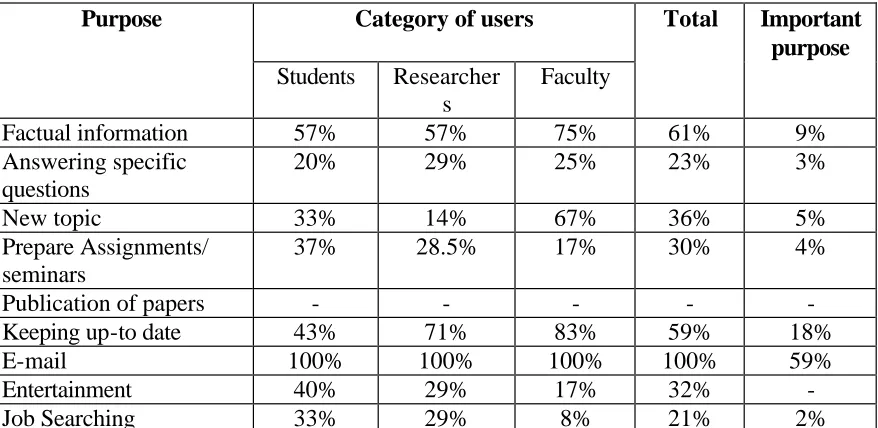
The various purposes for which academic community is making use of the NET is given in Table 6.
Table6:PurposesofINTERNETuse
Purpose Category of users Total Important
purpose
Students Researcher
s
Faculty
Factual information 57% 57% 75% 61% 9%
Answering specific questions
20% 29% 25% 23% 3%
New topic 33% 14% 67% 36% 5%
Prepare Assignments/ seminars
37% 28.5% 17% 30% 4%
Publication of papers - - - - -
Keeping up-to date 43% 71% 83% 59% 18%
E-mail 100% 100% 100% 100% 59%
Entertainment 40% 29% 17% 32% -
Job Searching 33% 29% 8% 21% 2%
2.7 InternetServices
Discussion Lists: 16% of the total users are making use of discussion list / news group service. They are 13% of students, 14% of researchers and 25% of faculty.
Bibliographicdata bases: Totally 36% of respondents (20% of students, 57% of researchers and 5% of faculty respondents) are using this service.
Document delivery service: 39% of respondents including 26% of students, 50% of researchers and 58% of the faculty members are using this service.
36% of respondents make use of this service, including 26% of students, 36% of researchers and 58% of faculty.
E-journals:
23% of students, 17% of researchers and 50% of faculty use this service.
2.8 SearchEngines
The most widely used search engine is Yahoo (92%). The next favorite search engine after Yahoo is Altavista, which is being used by 41% of respondents, followed by Infoseek (16%) and Hotbot (14%). The other search engines used include, Webcrawler, hycus etc.
2.8.1 Acquaintance with the search engines
Of the total 39 users, who reported using different search engines, 70% became acquainted with them through their colleagues. 23% learned about search engines from professional literature and 7% of the respondents became acquainted with search engines through a formal training.
2.9.1 Search results and time justification
One question was asked whether the search results justify the time spent in searching. 14% of respondents reported strong justification of time.
66% (includes 57% of students, 79% of researchers and 75% of faculty) respondents search results some what justify the time spent in searching.
20% of the respondents are of the opinion that the search results do not justify the time spent in searching.
2.9.2 Useful sites
39 users (70%) indicated their useful sites in INTERNET. They are 60% students, 78% researchers and 83% faculty members. The number of sites indicated by the respondents vary. 14% of respondents indicated only 1 site., 36% indicated 2 sites and 11%, indicated 3 sites. More than 3 sites were indicated by a mere 8% of users.
2.9.3 Difficulties faced in browsing the NET
82% of the survey respondents are facing some kind of difficulties in using the NET.
45% of respondents (53% of students, 50% of researchers and 17% of faculty) are unaware of the important sites in their subject.
41% of respondents feel that it's taking a long time to get connected to a particular site.
11% of respondents (17% of students and 7% of researchers) don't know how to formulate queries.
7% of respondents reported retrieval of irrelevant materials.
2.9.4 User satisfaction with physical facilities
70% of respondents are not satisfied with the number of terminals.
68% of respondents need down loading facility in the form of printing. 7% are not satisfied with the furniture.
3. CONCLUSIONANDSUGGESTIONS
1. The members of the academic community belonging to the social science and humanities
disciplines are making a low use of the INTERNET, whereas academic community hailing from scientific disciplines are making high use.
2. When compared the overall strength of the academic community of the University only a small
fraction is making use of the facility.
3. The flow of new users to the Internet centre has come down considerably during the last two
months, when compared to the early months of introduction of the facility.
4. Almost all the registered members are making use of the NET atleast once in a week. Among
them majority are using the facility daily or 2-3 times a week.
5. Majority of the ITNERENT users were computer literate, before they started using the NET.
6. The Internet orientation programe conducted by MUL does not appear to be very popular
among the INTERNET user community.
7. The potential of INTERNET as an up-dated source of information of any kind on varied
disciplines, is yet to be fully exploited by the academic community as majority of them are using it mainly for E-mail.
8. Though majority indicated useful sites in their subject field, only a few indicated more than
three sites.
The following suggestions can be made for the improvement of service of INTERNET centre of MUL.
1. More number of terminals should be installed in the centre and the number of terminals should
be shared equally among the students, researchers and faculty according to their strength.
2. Some computers with floppy disk drives can be installed at some other locations in the library
so that, the INTERNET users can download relevant information from the NET to floppy and can read it leisurely using these P.C.'s. Thus they can spare more time in searching information on the NET.
3. Few dot matrix printers can be installed in the centre so that the users can take print-out of
important documents. This facility can be restricted to faculty members and research scholars. The centre can charge for printing facility.
4. The present time slot of 45 minutes should be extended to atleast 1 1/2 hrs for all the
categories of users. Also the centre should be kept open 24 hrs.
5. The present 64 kbps leased line should be replaced by 2 MB line or the bandwidth must be
enhanced.
6. The E-mail server of the centre should be configured and a local E-mail address should be
provided to every user.
7. The centre should create a web page with links to important sites in different subject fields in a
classified order.
8. There is a need for extensive training programme. This is required for all the categories of
academic community.
ACKNOWLEDGMENT
The authors acknowledge the help rendered by Prof. K.S.Ragavan, the Visiting Faculty, Dr. Achutha Rao, University Librarian and his staff and Dr.Harinarayan, in the faculty.
4. REFERENCES
1. Hann, Harley. The Internet: A complete inform. Ind. ed. Tata McGraw Hill. New Delhi, 1996.