University of New Orleans University of New Orleans
ScholarWorks@UNO
ScholarWorks@UNO
University of New Orleans Theses and
Dissertations Dissertations and Theses
12-17-2004
Towards a Regression Test Selection Technique for
Towards a Regression Test Selection Technique for
Message-Based Software Integration
Based Software Integration
Sriram Kuchimanchi
University of New Orleans
Follow this and additional works at: https://scholarworks.uno.edu/td
Recommended Citation Recommended Citation
Kuchimanchi, Sriram, "Towards a Regression Test Selection Technique for Message-Based Software Integration" (2004). University of New Orleans Theses and Dissertations. 189.
https://scholarworks.uno.edu/td/189
This Thesis is protected by copyright and/or related rights. It has been brought to you by ScholarWorks@UNO with permission from the rights-holder(s). You are free to use this Thesis in any way that is permitted by the copyright and related rights legislation that applies to your use. For other uses you need to obtain permission from the rights-holder(s) directly, unless additional rights are indicated by a Creative Commons license in the record and/or on the work itself.
TOWARDS A REGRESSION TEST SELECTION TECHNIQUE FOR
MESSAGE-BASED SOFTWARE INTEGRATION
A THESIS
Submitted to the Graduate Faculty of the University of New Orleans
in partial fulfillment of the requirements for the degree of
by
Sriram Kuchimanchi
B.E Bangalore University, 1999 M.S University of New Orleans 2004
Acknowledgements
When I was given an opportunity to work on Regression Testing and test case
selection, I was initially excited about entering an unknown area. Over the past one year,
I went through ups and downs. This area being one of those grey areas, research in this
has been more academic and theoretical rather than practical. To make things further
difficult, hardly any assistance was available for object oriented languages especially
Java. PeopleSoft posed another angle of difficulties.
Through out this whole exercise, though, Dr.Shengru Tu has been extremely
helpful and supportive. If I had hit a road block and needed some relief, he would always
have the supportive smile. Not just this, but, towards the end, when I had to type in this
entire document and get ready for the defense, he helped out with many late nights and
night-outs. I can’t thank him enough for all this. His strong fundamental knowledge about
distributed programming and theories like RPC was very helpful, not to mention his
experience in writing technical papers.
I would also like to thank Eric Normand for being a very able team partner
through the difficult time with PeopleSoft and Web Services. We forged a very good
partnership throughout this thesis. Together we worked on 2 technical papers under Dr.
Tu’s guidance and one of them making it to the IEEE symposium was one of the
highlights of this effort.
I would like to thank the committee members; Dr.Chiu and Dr.DePano for
allocating time for me and supporting me through this research.
Then, I would like to thank all my friends who have been very supportive and
helpful when I had technical queries to bug them. Some provided with the required
shoulder to rest when needed.
I would like to thank my parents and family for their support and blessings,
Table of Contents
Chapter 1 – INTRODUCTION... 1
Chapter 2 - BACKGROUND ... 3
2.1 Introduction... 3
2.2 Goals of Testing... 4
2.3 Selecting the Test Cases... 4
2.4 Run the Test Cases... 5
2.5 Analyze the Test Results... 5
2.6 Regression Testing... 5
2.6.1 Definition ... 7
2.6.2 Unit Level ... 8
2.6.3 System Level... 9
2.7 Messaging Based Systems... 9
2.7.1 Web Services ... 10
2.8 Problem Specification... 17
Chapter 3 - A SURVEY ON REGRESSION TEST SELECTION... 19
3.1 Safe RTS Techniques... 19
3.1.1 Test Tube Methodology ... 19
3.1.2 DejaVu Methodology ... 20
3.2 Selective RTS Techniques... 23
3.3 InterProcedural Data Flow RTS Techniques... 24
Chapter 4 - RTS FOR APPLICATIONS ... 30
4.1 RTS for Database Systems ... 30
4.1.1 Phase I – Change Identification & Impact Analysis ... 32
4.1.2 Phase II – Test Case Reduction ... 33
4.2 RTS for Java based applications ... 34
4.2.1 Assumptions - Regression Bias ... 35
4.2.2 RETEST ... 37
4.2.3 Implementation Issues ... 41
Chapter 5 - A CASE STUDY OF INTEGRATION WITH MESSAGING ... 45
5.1 Introduction... 45
5.2 PeopleSoft Integration Broker (PIB)... 46
5.2.1 System Integration ... 48
5.2.2 Application Messaging ... 49
5.3 Case Study... 51
5.3.1 Information Capture from PeopleSoft ... 52
5.3.2 Fetch Image from TerraServer... 55
Chapter 6 - RTS TECHNIQUE PROPOSAL... 58
6.1 Introduction... 58
6.2 Architecture Diagram... 58
6.3 Assumptions of the systems and the definition of being impacted... 59
6.4 Modification based Selection... 60
6.5 Message-Comparision based Selection... 61
6.5.1 Phase I – Recognize impacted units... 61
6.5.2 Phase II – Select test cases... 62
6.6 Prioritization based Selection... 63
6.7 Web Services Specific... 63
Chapter 7 - CONCLUSION AND FUTURE WORK ... 65
Appendix A - References... 67
List of Figures
Figure 2-2: Web Services Technology Stack (IBM & Microsoft)………16
Figure 2-3: SOAP sections in an XML document……….20
Figure 2-4: Thesis Scope Diagram………22
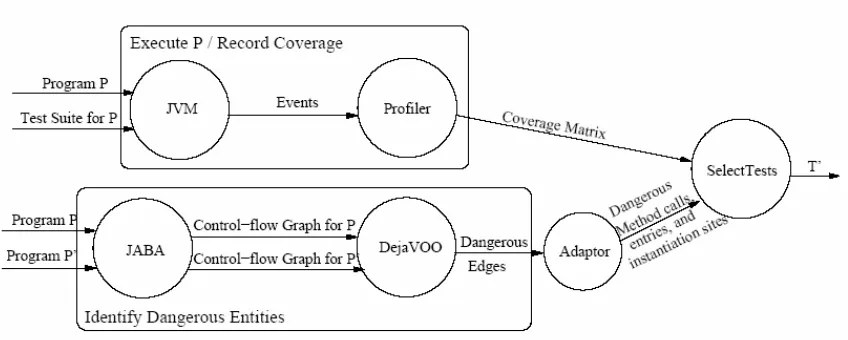
Figure 4-1: RETEST Architecture……….41
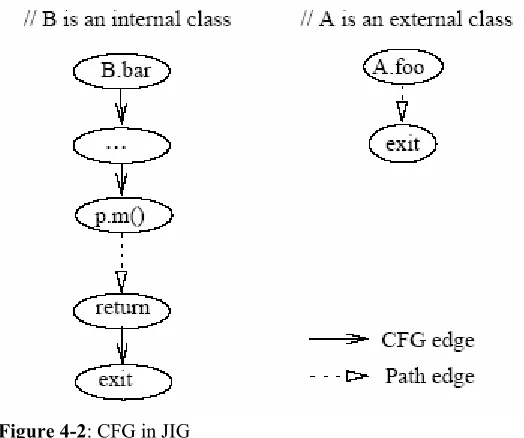
Figure 4-2: CFG in JIG………..43
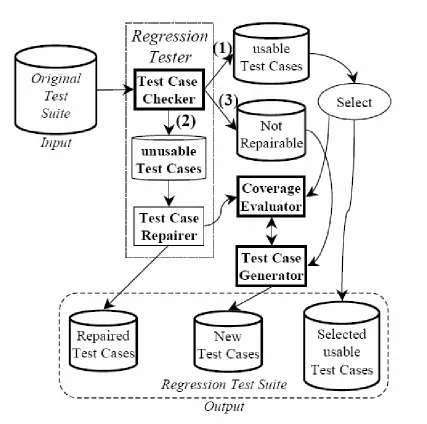
Figure 4-3: GUI Regression Tester’s Architecture………48
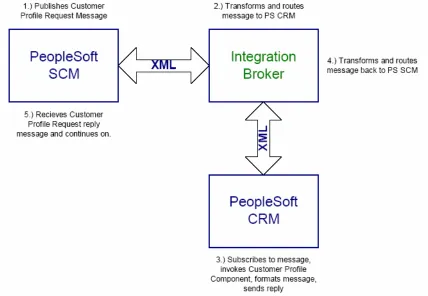
Figure 5-1: Synchronous PIB interactions……….50
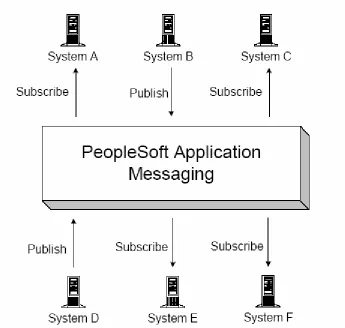
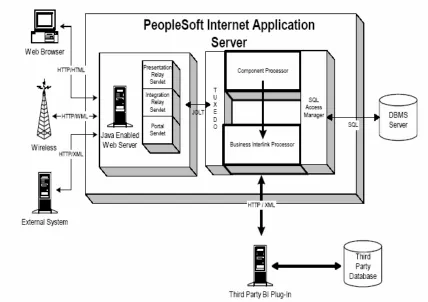
Figure 5-2: PS Application Messaging Publish and Subscribe Bus Architecture….54 Figure 5-3: PIA integration with a third party plug-in………..59
Figure 5-4: A sample image retrieved from TerraServer………..60
Figure 5-5: High-level Architecture………..61
Abstract
Regression testing is essential to ensure software quality. Regression Test-case
selection is another process wherein, the testers would like to ensure that test-cases which
are obsolete due to the changes in the system should not be considered for further testing.
This is the Regression Test-case Selection problem. Although existing research has
addressed many related problems, most of the existing regression test-case selection
techniques cater to procedural systems. Being academic, they lack the scalability and
detail to cater to multi-tier applications. Such techniques can be employed for procedural
systems, usually mathematical applications.
Enterprise applications have become complex and distributed leading to
component-based architectures. Thus, inter-process communication has become a very
important activity of any such system. Messaging is the most widely employed
inter-module interaction mechanism. Today’s systems, being heavily internet dependent, are
Web-Services based which utilize XML for messaging.
We propose an RTS technique which is specifically targeted at enterprise
Chapter 1 – INTRODUCTION
As a software system ages, the cost of maintaining the software dominates the
overall cost of developing the software. The cost of maintenance is increasing. In the
1990s, the estimated expenditure exceeds 70% of total software costs [2, 3]. As software
reuse has been more and more emphasized in practice, the life cycle of software
components has been constantly prolonged. While reuse helps reduce overall
development costs, it tends to increase the percentage of software maintenance costs.
A large percentage of maintenance expense is devoted to testing especially
regression testing. Testing is widely used to build confidence in the correctness of
software and to increase software reliability. Testing is a validation process that
determines the conformance of the software’s implementation to its specification. It is an
important phase in software development life cycle. On one hand, the modern business
processes have become more and more dynamic and adaptive, which requires more and
more changes to their software. On the other hand, software systems and software
components’ life cycles are prolonged for economically reasons. Both phenomena
contribute more change requests to existing software systems. Upon each set of changes,
a thorough test must be carried out for the modified software system again. Thorough
tests for large systems are very expensive.
Regression testing is a testing process that is used to determine if a modified
program still meets its specifications or if new errors have been introduced. By
regression, we mean to use the test cases for the original system again. Regression
testing saves the cost for test case generation by reusing the existing test cases. Even so,
the cost to rerun the existing test cases for large systems is still very high.
The most important improvement in the regression testing process is regression
testing selection (RTS) approach, which helps reduce the cost of testing by
algorithmically select a subset of test cases from the original test case set. The smaller the
chosen subset is, the lower the cost of the testing will be. At the same time, the chosen
subset must establish the equal correctness confidence as the original test case set.
Regression testing is an important type of testing. Onoma et al. reported that the secret in
Although a number of well-known methods for RTS have been extensively
studied (discussed with details in Chapters 3 and 4), the RTS techniques are inadequate
for the software development in the Internet era. Gone are the days when software was
written on the fly. Reusing software, especially, integrating existing systems (including
legacy systems) using new components and bridges has been an industry norm. The most
important feature of this is communication. Inter-process communication has thus, gained
significance and has risen from mere academic research topic to an industry mandate
when it comes to software development. To my knowledge, very few attempts were made
at implementing an RTS technique for enterprise software integrations.
Our goal is to develop a regression test selection technique and implement
corresponding tools for systems composed of enterprise software integrations. Our focus
is on the integration components rather than the enterprise software products themselves.
This ambitious goal requires extensive studies, research, preparation, experiments and
development. The very first challenge is that experiments of this kind would require
comprehensive environments including multiple enterprise software product installations.
Secondly, the enterprise integrations are usually involved companies’ proprietary
intelligence or trade secretes; it is difficult to get the underlying systems. Thirdly,
obtaining or establishing the integration only provides the possibility of experiments.
RTS requires nontrivial test cases. Realizing the mounting tasks for our goal, I laid out a
feasible work scope for this thesis which includes the following three objectives. More
research efforts will be continued by other graduate students.
• To carry out a thorough survey on RTS;
• To establish an experiment underlying system, an integration of multiple
enterprise software systems;
Chapter 2 - BACKGROUND
2.1 Introduction
This chapter would explain the concepts based on which this thesis work has been
built. In particular, this effort is directed towards the area of regression testing and the
difficulties in test case selection for message based integration in enterprise applications.
In this regard, the following terms have to be explained before we delve further into
subsequent chapters.
1. Regression testing
2. Regression test case selection
3. Messaging-based systems and integration
Before we get into the details of each, I would like to talk on some of the basics
on software testing.
Reliability is defined as the probability that a system functions according to its specification for a specified time and in a specified environment. It gives a
measure of confidence in the system for the user.
A failure occurs when the run-time system behavior does not match the
specifications. Reliability is a statistical study of the failures.
A fault is a static component of the software that causes the failure. A fault
causes failure only when that part of the code is executed. So, not all faults
result in failures.
An error is a programmer action or omission and results in a fault.
A domain space for the variable is defined as the set of all possible legal values that the variable can assume during system operation.
A Test Case is defined as a single value mapping for each input of the program that enables a single execution of the software system.
Test Script is a set of conditions specified on each input variable for guiding the automatic generation of test cases.
2.2 Goals of Testing
There are two main goals of testing software. On one hand, testing can be viewed
as a means of achieving required quality of the system. The main aim here is to probe the
software for defects and fix them. This is also called debug testing and is assumed to be
very effective in uncovering potential faults. On the other hand, testing can also be
viewed as a means of assessing the existing quality of the system and provide fault
coverage measurement, which consists of studying the potential faults generated by a
given test suite. This method is called operational testing and is proved to be effective in
predicting the future reliability of the system. In debug testing, a systematic approach is
followed for selecting test cases based on situations likely to produce the most number of
errors. The drawback of this approach is that it may uncover failures with negligible rates
of occurrence and risk, and the test effort may not worth the reliability improvement
achieved. Another drawback is that it does not provide complete mathematical and
technical validity of the reliability assessments.
In operational testing, a test case is selected based on the probability of its
occurrence in the real operating environment. Hence, this method is likely to uncover
failures with highest probability of occurrence first and provide accurate assessment of
current reliability. This is done after the debugging phase, and the objective is to assert
that the system is reliable and gain confidence for the final release of the system. The
method is not very effective in improving the reliability of the system, and at the same
time it is very difficult to generate an accurate operational profile.
2.3 Selecting the Test Cases
The input and output domain space for a complex system is typically very large
and completely impractical for manual testing of each combination of the input values
within the domain space. An automated test tool for generating test cases based on user
specified criteria is needed to cover as much of the test domain as possible. Automated
testing also allows much more tests to be run than manually testing and permits tests to
be easily run over and over again. This repeating of previous tests is an important step in
testing and is referred to as regression testing. Regression testing attempts to assure that
2.4 Run the Test Cases
Once the test suite is selected, it must be run in the simulated environment
sequentially and the results must be captured. Any failures generated also have to be
captured and reported to the user. This involves integrating the automated test tool with
the simulated environment.
2.5 Analyze the Test Results
This is the most important part of testing and should be done very carefully. The
test results are used as a mechanism for identifying the defects in the software or the
model and should be used as a mechanism to quantify the software reliability. The test
results have to be analyzed to assess the quality of the software and to determine potential
problem areas that require more testing and to identify portions of the input domains that
have not been tested. An important consideration here is to leverage measurements
against multiple independent test runs. A decision regarding the end of the test phase is to
be made based on all the test runs.
With this behind us, let me now get into the details of afore mentioned topics. I
shall attempt at defining and explaining these topics so that the subsequent chapters
become easier to understand.
2.6 Regression Testing
Regression testing is one of the necessary maintenance tasks. It is defined as the
process of validating modified software to provide confidence that the changed parts of
the software behave as intended and that the unchanged parts of the software have not
been adversely affected by the modification [Harrold]. The adverse impact of a change is
often called the “ripple effect”, and is known to be a serious cause of software defects as
the result of a change [Probert]. It is widely accepted that efficient and effective
regression testing can reduce the frequency and cost of software maintenance.
As a software application gets updated regularly, each iteration would change the
test applications or the testing system. Changes in the System Under Test (SUT), is a
normal process. An obvious after effect is that some of the existing test cases would
become redundant. Other functionality of the latest version of the SUT could potentially
go untested or unattended. Regression Testing deals with the aspect of testing a
periodically changing software system.
With widespread usage of object-oriented programming techniques, more and
more projects follow an evolutionary process model, also called an incremental model
[McGregor]. An increment is a deliverable that provides some of the functionality
required for the system, including models, documentation and code. Under this process
model, a system is developed as a sequence of increments. For each increment, the
development process feeds new and/or revised designs and implementations into the
testing process. The testing process feeds identified failures back into the development
process. The development process and the testing process form a continual feedback
loop.
In the incremental model, successive increments add and sometimes revise system
functionality while keeping most of the functionality of previous increments. Regression
testing is typically done between increments to ensure that changes do not adversely
affect correctly working code of the previous versions.
Reuse has been proposed as a general solution to chronic software development
problems: namely, lengthy development time and high cost, unacceptably frequent
failures, low maintainability, and low adaptability [Binder]. A major precondition of
reuse is to ensure that the reused components match the new requirement and do not
conflict with old components. An example of disasters caused by incorrect reusing of
components was the explosion of Ariane 5 on June 4, 1996. The rocket was on its first
voyage, after a decade of development costing $7 billion. Estimates of the total cost of
the destroyed rocket and its cargo vary from a low of $350 million in a European Space
The main reason of the explosion was that a time sequence based on the requirement of
Ariane 4 was reused, but this did not match the requirement of Ariane 5 [SIAM].
Effective regression testing should have caught this problem before the disastrous launch.
2.6.1 Definition
The most widely used representation of the concept of regression testing in
relation with software development is given below -
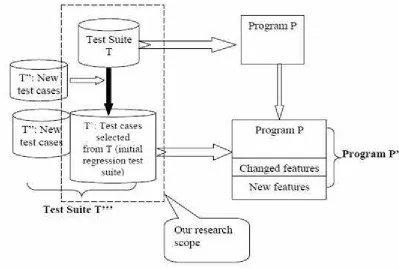
Let P be a procedure or program, let P’ be a modified version of P, and let T be a
test suite for P. A typical regression test proceeds as follows:
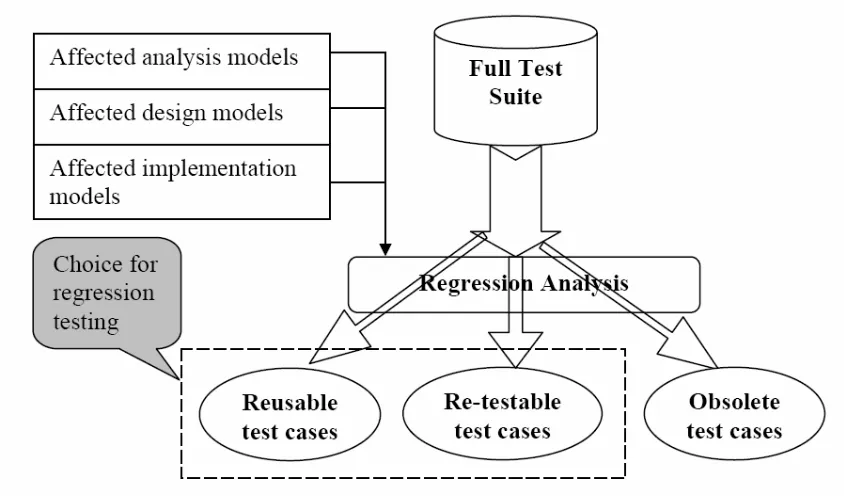
1. Select T’ ⊆ T, a set of test cases to execute on P’.
2. Test P’ with T’, establishing P’'s correctness with respect to T’.
3. If necessary, create T’’, a set of new functional or structural test cases for P’.
4. Test P’ with T’’, establishing P’'s correctness with respect to T’’.
5. Create T’’’, a new test suite and test execution profile for P’, from T, T’, and T’’.
Figure 2-1: Regression Testing and Test Case Selection
Further, I would now briefly discuss various levels of regression testing. Three
types of software testing are applied during the software development life cycle: unit
testing, integration testing, and system testing. Testing at the unit, integration and system
levels reveals different types of failures.
2.6.2 Unit Level
Unit testing is the process of testing each software module to ensure that its
performance meets its specification. Most existing regression testing techniques focus on
unit testing. Yau and Kishimoto [5] developed a method based on the input partition
strategy. This approach divides the input domain of a module into a set of input partitions
(classes) using the information from the program specification and code. The input
partition P is derived by intersecting the two input partitions Ps and Pc which are
generated respectively from the program specification and code [5]. The retest criterion
of the testing method is to ensure that each new or changed input partition is executed by
at least one test case. A cause-effect graph of the specifications is constructed and a test
information table is created to help in selecting test cases. The specification partitions are
The code partitions are the paths in the code that correspond to the specification
partitions [5]. A test case is chosen if it exercises one of these paths. If the selected test
cases do not satisfy the testing criterion, new test cases are generated. The authors
demonstrated the feasibility of their method on FORTRAN programs that perform
mathematical computations.
2.6.3 System Level
System testing is testing of the entire software system against the system
specifications. System testing must verify that all system elements have been properly
integrated and perform allocated functions. System testing can be performed without the
knowledge of the software implementation at all. TestTube is a system developed at
AT&T Bell Laboratories to perform system-level regression testing [8]. TestTube is an
example of a selective retesting technique. It can be used with unit-level regression
testing as well.
In TestTube, test selection is based on analysis of the coverage relationship
between test cases and the system under test. It partitions a software system into basic
code entities, then monitors the execution of a test case, analyzes its relationship with the
system under test, and determines which subset of the code entities the test covers. For a
C program, each test case is associated with function definitions, global variables, type
definitions and preprocessor macro definitions that it covers or possibly covers. If a
change is made to one of the entities associated with a test case, then the test case is
selected. TestTube is an example of how automatic regression testing can be applied. If a
program and its revision each have a database, then a program is run to determine
differences in the databases and thus what has been changed.
2.7 Messaging Based Systems
Messaging is one very important communication mechanism. Messaging can be
implemented in many ways using different kinds of technologies, but, here, I would like
exchanging XML messages. My work employs Web services technology which have
XML messages exchanged using underlying SOAP protocol.
In the following paragraphs, I will explain the Web services technologies. Java
has been used throughout this work as the development language. Platforms for
implementing and deploying the web services were many, ranging from Apache AXIS
and TOMCAT to IBM Websphere.
2.7.1 Web Services
Despite the fact that the term Web Services has rapidly gained a lot of
momentum, there is no single, universally adopted definition of Web Services. Several
major Web services infrastructure providers have published their definitions for a Web
Service. The World Wide Web Consortium (W3C) defines Web Services as below [13] –
A Web service is a software system designed to support interoperable
to-machine interaction over a network. It has an interface described in a to-
machine-processable format (specifically WSDL). Other systems interact with the Web service in a
manner prescribed by its description using SOAP-messages, typically conveyed using
HTTP with an XML serialization in conjunction with other Web-related standards.
We, thus derive a reasonable understanding as follows –
A Web Service is a programmable application, accessible as a component via standard Web protocols like HTTP, XML and SOAP;
Web Services are a combination of the powerful Remote Method Invocation clubbed with the ease of HTTP based communication.
A Web Service is published, located, and invoked across the Web;
A Web Service is XML-based with standards which enables simplicity, extensibility, and interoperability, programming language
and platform independency;
Before we get into explaining some of the technologies which form the
infrastructure, let us get a closer look at why are web services becoming so popular? The
reason can be attributed to chief characteristics of Web Services, namely;
1. Loose Coupling - Web services are loosely coupled. They have well defined,
published interfaces and can be easily accessed from remote systems over the
internet. They require a simple level of coordination between systems and the
underlying technology behind the web service can be changed and replaced without
impacting the systems that invoke it.
Previous attempts at distributed computing such as CORBA, DCOM, and
Distributed Smalltalk are not appropriate for low overhead, ubiquitous B2B Internet
processing because they require tight coupling between systems. These tightly
coupled integration technologies require that the developer thoroughly understands
and has control over both ends of the connection. The problems with tightly coupled
integration are not unique to internet-based integration but also apply in many
instances to intranet-based integration.
This loose coupling nature of web services simplifies the integration process,
lowering the cost of integration and making it easier to integrate applications than
techniques used in the past.
2. Internet Accessible - Another issue with past integration technologies is that they
were not designed to work securely over the internet. Web services make use of the
existing, ubiquitous transport protocol of the internet: HTTP. This is the same
transport protocol that is used to deliver content over the web. Piggybacking on
HTTP, web services leverage existing infrastructure and can comply with corporate
firewall policies.
The principle behind the potential of web services is its architecture. Devoid of
any particular standard, it provides flexibility to the implementation. Even then,
interoperability is still a key requirement for large-scale adoption of the architecture.
Microsystems have been pushing an architecture which would have a technology stack as
shown below –
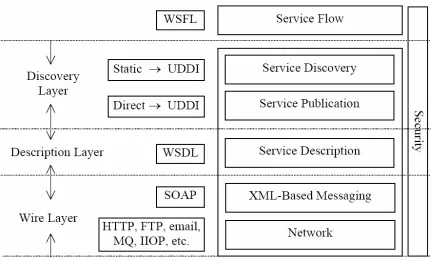
Figure 2-2: Web Services Technology Stack (IBM & Microsoft)
Before we get into the technical details, let me explain this figure.
(a) Wire Layer - The wire layer defines the messaging format and components
between the service requestor and the service provider. The base of the
wire layer is the network, which makes Web services accessible to a
service requestor. Internet-available Web Services use commonly
deployed network protocols. HTTP is the de facto standard network
protocol for Internet-available Web Services. Other Internet protocols,
such as SMTP and FTP, are also supported. Reliable messaging and call
infrastructures, such as MQSeries, IIOP, and so on, are supported for
Intranet Web Services. SOAP is chosen as the de facto XML messaging
protocol for general IT Web services.
(b) Description Layer - The Description layer consists of Web Services
description documents. XML is not only the basis of the Wire layer, it is
(WSDL) is the de facto standard for Web Services description in the IT
Industry. WSDL defines the interface of a Web service and mechanisms of
service interaction, which specifically include the operations supported by
the Web service, the input and output of the service, the bindings to
concrete network, and data encoding schemes. It is the minimum standard
service description necessary to support interoperable Web Services.
Additional description is needed to specify other properties of Web
services, such as quality of service, service-to-service relationships, and so
on. Web Services Flow Language (WSFL) is used to describe Service
composition and flow.
(c) Discovery Layer - A Web service needs to be discovered in the first place
before it can be invoked. Service discovery closely depends on service
publication since a service cannot be discovered if it has not been
published.
The simplest way of service invocation is a static & direct way in which the
service provider sending a service description, i.e., the WSDL file(s), directly to the
service requestor. Many a times this is the case when the parties know each other and it is
strictly a private affair. On the other hand, in a complex scenario, a service provider
publishes the service description to a local service registry or UDDI service registry
which would then be the source of the WSDL file for the requestor.
In the remaining part of this chapter, I am going to summarize WSDL and SOAP.
1. WSDL - WSDL is an XML-based description of how to connect to a web
service. It references a schema which describes the inputs and outputs of a web service
and the URL to post requests to in order to invoke the web service. Simply put, it
describes the technical invocation syntax of a Web service.
A complete WSDL service description provides two pieces of information: an
application-level service description, or abstract interface, and the specific
protocol-dependent details that users must follow to access the service at concrete service end
functionality is often deployed at different end points with slightly different access
protocol details. Separating the description of these two aspects helps WSDL represent
common functionality between seemingly different end points.
The W3C has a well defined schema for WSDL introducing several high level or
major elements in the language. They are briefly explained below:
a) PortType – A Web Service’s abstract interface definition where each child operation element defines an abstract method signature.
b) Message – Defines a set of parameters referred to by the method signatures or operations. A message can be further decomposed into parts.
c) Types – Defines the collection of all the data types used in the Web service as referenced by various message part elements.
d) Binding – Contains details of how the elements in an abstract interface (portType) are converted into a concrete representation in a particular
combination of data formats and protocols.
e) Port – Expresses how a binding is deployed at a particular network endpoint.
f) Service – A collection of ports.
To summarize, the portType (with details from the message and type elements)
describes the what of the Web Service. The binding element describes the how, and the
port and service elements describe the where of the Web Service.
Many developers split their WSDL designs into two parts, each placed in a
separate document. The service interface definition, containing the types, message,
portType, and binding elements, appears in one file. You can then place this file, for
example, on a well-known Web site (on an e-marketplace, for example) for everyone to
view. Each organization that wants to implement a Web service conformant to that
well-known service interface definition would describe a service implementation definition,
containing the port and service elements, describing how that common, reusable, service
interface definition was, in fact, implemented at the network endpoint hosted by that
organization. Finally, WSDL is not a requirement for a web service. It simply makes it
2. SOAP - SOAP is the primary web services protocol. It uses XML over HTTP
for messaging and RPC-style communications. It is a simple, flexible, and highly
extensible XML-based messaging protocol [22]. It is implementation language or
platform neutral. His includes the Web Service implementation details. Rather than
defining a new transport protocol, SOAP works on existing network protocols, such as
HTTP, SMTP, FTP, and so on. No surprise hence, that, since its introduction in late 1999,
SOAP has become the de facto standard for Web services messaging and remote
procedure calls.
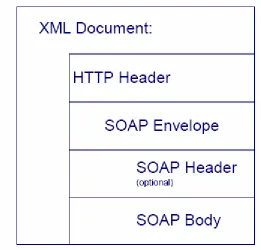
A SOAP Message is an ordinary XML document that consists of three sections:
1. Envelope – The top element of the XML document representing the message and defines the content of the message. It defines the framework of what is in a
message, how to process it, who should deal with it and whether it is optional or
mandatory.
2. Header – This section is optional. It contains header information and attributes that can be set to encode and further identify the type of processing and additional
features of the message.
3. Body – This section contains the call and response information intended for the recipient of the message. This is the message “payload”.
Figure 2-3: SOAP sections in an XML document
There are two types of messaging pattern using SOAP: the Remote Procedure
Calls and the Conversational Message Exchanges.
Remote Procedure Calls (RPCs) with SOAP is used when there is a need to model
a certain programmatic behavior, with the exchanged messages conforming to a
pre-defined description of the remote call and its return. To use SOAP for RPCs, you must
define an RPC protocol, including [16]:
how typed values can be transported back and forth between the SOAP representation (XML) and the application’s representation (such as a Java
class for a ticket), and
where the various RPC parts are carried (object identity, operation name, and parameters).
The Conversational Message Exchange is a request-response pattern, in which
XML-based content conforming to some application-defined schema are exchanged via
SOAP messages. In the simplest case, the user can only send the SOAP request to the
SOAP is not a requirement for exposing a web service, but should be used when
appropriate when implementing a web service. Many web services today expose
functionality over XML/HTTP without using SOAP. SOAP implementations exist for
several programming languages, including C, Java, and Perl, which automatically
generate and process the SOAP messages. Assuming the messages conform to SOAP
specifications, they can thus be exchanged by services implemented in different
languages.
2.8 Problem Specification
In layman terms, the problem of regression test case selection can be described as
follows – For a constantly changing system making corresponding changes to the test
cases and subsequently running them is not easy. Some test cases which could have been
originally written for a specific functionality might just become redundant and hence
would have to be removed from the test suite. The problem however becomes
compounded when this task would have to be performed automatically. Most types of
testing jobs are/have been automated for easy and human intervention free execution.
Based on the understanding from the definition of regression testing, I stated in
this chapter in section 2.6, I would like to explain the problem we would be taking up as
part of this thesis.
In trying to perform the steps described in the definition of section 2.6, we identify the following problems –
Step (1) involves the regression test selection problem: the problem of selecting a subset T’ of T with which to test P’. This problem includes the sub-problem of
identifying tests in T that are obsolete for P’. Test t is obsolete for program P’ if
and only if t specifies an input to P’ that is invalid for P’, or t specifies an invalid
input-output relation for P’.
Step (3) addresses the coverage identification problem: the problem of identifying
portions of P’ that require additional testing.
Step (5) addresses the test suite maintenance problem: the problem of updating and storing test information.
Although each of these problems is significant, we restrict our attention to the
regression test selection problem. We further confine ourselves to messaging based
systems. Messaging based enterprise systems would in many ways manifest the changes
in their components through changes in the messages exchanged. This would in turn
require test cases to change and subsequent re-execution of the test cases. The challenge
lies in trying to isolate and identify the modified components and identifying the test
cases which actually interact with multiple components. This scenario is more commonly
understood as the inter-module communication.
So, RTS technique on such systems has not been attempted much and the industry
surely requires one such architecture which would cut down on the costs as well as, time
required by the Software Quality Assurance team of an organization to certify an
application before it can be used.
The objective of the thesis can be depicted in the diagram below –
Chapter 3 - A SURVEY ON REGRESSION TEST SELECTION
In this chapter, I discuss various theories and methodologies for Regression Test
Case Selection. Some of these are empirical studies with implementation used as case
studies. Each of these has its own advantages and disadvantages. While this is not an
attempt at rating any of them, it would throw light on the research done on RTS.
3.1 Safe RTS Techniques
Rothermel and Harrold [1996] presented a framework that is widely accepted and
employed for use in comparative analyses of safe RTS techniques. Test Tube and Dejavu
are two such techniques which were built keeping this framework in mind. It consists of
four criteria:
Inclusiveness measures the extent to which an RTS technique selects test cases from T (test suite) that are modification-revealing for the SUT (system under
test). And, for the safe techniques 100% inclusiveness is required.
Precision measures the extent to which a technique omits test cases from T that are not modification-revealing for the SUT and are thus unnecessary.
Efficiency measures the time and space requirements of a technique.
Generality measures the ability of a technique to function in a practical and sufficiently wide range of situations: in particular, a general safe technique does
not require strong or difficult-to-satisfy preconditions for safety.
3.1.1 Test Tube Methodology [2]
It is a system for selective retesting that identifies which subset of a test suite
must be rerun to test a new version of a system. Test Tube combines static and dynamic
analysis to perform selective retesting of software systems. It first identifies which
functions, types, variables and macros are covered by each test unit in a test suite. Each
time the system under test is modified, Test Tube identifies which entities were changed
to create the new version. Using the coverage and change information, Test Tube selects
program can be inferred from static source code analysis of the relationships among the
functional and non-functional entities. This premise is valid for languages without pointer
arithmetic and type coercion.
The method underlying Test Tube is simple. First the system under test is
partitioned into basic code entities. These entities are defined in such a way that they can
be easily computed from the source code and monitored during execution. The execution
of each test unit is then monitored; its relationship with the system under test is analyzed,
and in this way determines which subset of the code entities it covers. When the system is
changed, the set of changed entities are identified and then the previously computed set
of covered entities for each test unit are examined and check to see if any has changed. If
none has changed, the test unit need not be rerun. If a test unit is rerun, its set of covered
entities must be recomputed. Note that the notion of what constitutes a change in the
system is programming language-dependent. Especially, when it comes to testing
enterprise applications, the underlying architecture followed, for instance, J2EE or .NET,
would make a difference when defining a change, before regression can be performed.
Test Tube differs from these previous approaches in a number of ways and has
some noteworthy advantages which make it the first choice to describe here. First, Test
Tube can be used with any chosen test generation and test suite maintenance strategy.
Second, the analysis employed in Test Tube is performed at a granularity that makes it
suitable for both unit-level and system-level testing, Third, the analysis algorithms
employed in Test Tube are computationally inexpensive and thus scale up for retesting
large systems with large numbers of test units. Fourth, the analysis that is performed in
Test Tube produces byproducts that can be used for purposes other than selective
retesting.
3.1.2 DejaVu Methodology [3]
Rothermel and Harrold developed another safe Regression Test case Selection
technique, a tool named, DejaVu. DejaVu constructs control-flow graph (CFG)
representations of the procedures in two versions a P (program), in which individual
available that records, for each test case t in T and each edge e in the CFG for P, whether
t traversed e. This test history is gathered by instrumentation code inserted into the source
code of the SUT. Construction and storage of the CFGs for P and the test history are
preliminary phase costs. Construction of the CFGs for the other version of P, however, is
a critical-phase cost.
DejaVu performs a simultaneous depth-first graph walk on a pair of CFGs for
each procedure and its modified version in P and its modified version, keeping pointers
^N and ^N’ to the current node in each graph.
The tool begins with the entry nodes of both the graphs; it then executes a
recursive depth-first search on both CFGs. Upon visiting a pair of nodes N and N’,
DejaVu examines each edge e leaving N to determine whether there is an equivalently
labeled edge in the other CFG. If not, then the tool places e into a set of dangerous edges.
If there is a corresponding edge in the second CFG, and that edge enters an already
traversed portion of the graph at the same node in both CFGs, then the current recursion
is terminated. Otherwise, ^N and ^N’ are moved forward to point to a new pair of nodes.
The tool then checks to see if the labels on the nodes pointed to by ^N and ^N’ are
lexically equivalent (textually equivalent after non-semantically meaningful characters
such as white space and comments have been removed). If they are not, DejaVu places
the edge it just followed into the set of dangerous edges and returns to the source of that
edge, ending that trail of recursion. After DejaVu has determined all the dangerous edges
that it can reach by crossing non-dangerous edges, it terminates. At this point, any test
case t in T is selected for retesting the modified SUT if the execution trace for t contains a
dangerous edge. DejaVu guarantees safety as long as equivalent execution traces for
identical inputs imply equivalent behaviors.
However, in certain situations DejaVu is not as precise, as it seems. Especially
with programs in environments that cannot be controlled, DejaVu can provide only a
guideline for safety. For instance, in a system in which the state of the operating system
system cannot be controlled or simulated, DejaVu could omit a potentially fault-revealing
test case. This aberration not withstanding, DejaVu is a very precise RTS technique.
Test Tube and DejaVu have been two very popular safe RTS techniques which
prompted a lot of researchers and industry experts alike to attempt implementations. A
comparative study of these two techniques would reveal that they have very little to
chose. In summary, TestTube and DejaVu were often comparable in their costs, although
for some programs, one tool or the other could prove superior. For example, when
considering applications/programs which were not too big, TestTube proved the more
efficient choice. On the other hand, when considering programs with more than 50,000
lines of code, DejaVu consistently reduced re-verification time by a significant amount,
whereas TestTube varied in its behavior.
Study reveals that there are two main factors that can contribute to the success or
failure of the two safe RTS tools.
First, the program’s size (or more probably the complexity of the program’s control structure) seems to be an important factor. Presumably, larger programs may
decompose more easily into different control paths, which, in turn, will allow DejaVu
and TestTube to more readily separate out test cases with potentially changed
behaviors.
Second, the costs of executing and validating test cases can have a significant effect on the cost-effectiveness of both methods. Where test execution is inexpensive,
analysis will generally assume a larger percentage of the re-verification cost. For a
tool such as DejaVu, for which the bulk of the cost is in analysis of the code itself,
large test suites can amortize the cost of analysis, in which case the tool might be
cost-effective even for test suites with test cases that require only seconds to execute
and validate. Most of TestTube’s cost, on the other hand, is derived from the time
required to select test cases using the difference file; thus it is likely that TestTube
will suffer if test cases are inexpensive to execute and validate. On the other hand,
when test cases are sufficiently expensive to execute and validate, experiments
Further research is necessary to determine if these are the only factors contributing to the success or failure of these tools, or even the most important ones.
The study on these two techniques was conducted mostly using large componentized
programs written in C. While this is not exactly the interest of this thesis, studying these
techniques gave a good understanding of safe regression techniques. A pretty obvious
conclusion drawn from this is that, a tool built with both Test Tube and DejaVu as basis, a
hybrid one, would give significantly improved results and might be an apt technique for
such applications to perform Regression Testing and automating the test case selection.
3.2 Selective RTS Techniques
Several selective regression testing techniques have been proposed. Selective
regression testing techniques have been extensively studied because researchers believe
that selective techniques can reduce the cost of regression testing. Selective regression
techniques allow the testers to reuse a subset of the original test cases. However, if we
consider the time and resources required for test selection, we find that the selective
techniques do not always reduce the total cost of regression testing. If the cost in analysis
for test case selection is too high, or the number of selected test cases is not significantly
smaller than the number of original test cases, the selection is not cost effective. Leung
and White [4] analyzed the various factors that can affect the cost of regression testing,
and proposed a simple model to compare the cost between the selective regression testing
strategy and the retest-all strategy. They claimed that a benefit is accrued only if the
effort spent in test selection is less than the costs for executing the extra test cases and for
checking the results of the extra test cases used by the retest-all strategy [4]. This model
established a basis for cost comparison between the two regression testing strategies.
However, because this model makes some simplifying assumptions that may be
inappropriate for some systems, it has limitations. Rosenbhim and Weyuker [5] extended
Leung and White's model [4] by developing cost-effective predictors to determine the
cost effectiveness of a selective regression testing strategy. Their design of the predictors
is based on some fundamental assumptions about the nature of test coverage and the
The selection in selective regression testing is driven by two kinds of analysis:
coverage analysis and change analysis. Rosenbhim and Weyuker's experiences lead them
to find that, in practice the relationship between the test suite and the entities the test suite
covers (i.e., the coverage of tests) in a software system changes very little during
maintenance, except when new features are added to the system [5]. This means that the
coverage of a test case in different versions of a system changes very little. They also
observed that the ability of a method to find a subset of test cases from a test suite is
governed by the nature of the coverage relationship [5]. For example, if there is a great
deal of overlay in the sets of entities of the system that each test case covers, they do not
expect a safe strategy to be able to exclude very many test cases [5]. Based on those
considerations, Rosenblum and Weyuker presented their algorithm for predicting the
cost-effectiveness of a selective regression testing technique for a given software system
[5]. The algorithm is the following: given a system under test, a candidate selective
regression testing method, and a stable coverage relation, it suffices to evaluate the
cost-effectiveness of the testing method on one version of the system in order to predict its
cost-effectiveness for all future versions of the system [5]. For a safe strategy, their
predictor first predicts the cost-effectiveness of the strategy when a change is made to a
single entity. If it shows the strategy is cost-effective, then further computation will be
performed when changes are made to multiple entities. During the two steps, if there are
any data indicating that the testing strategy is not cost-effective, the candidate strategy
will be discarded [5]. Rosenblum and Weyaker's work is significant since it provides a
method for determining whether or not a selective regression testing technique is cost
effective.
3.3 Inter-Procedural Data Flow RTS Techniques
Data flow techniques can be broadly divided into two kinds. One for intra
-procedural situations and the other is for inter-procedural situations. Although a lot of
research went into data flow methodologies, [7,8] they were addressing data dependency
dependencies that exist among different processes or procedures i.e., inter-procedural
requires information about the flow of data across procedure boundaries, including both
calls and returns. The data dependencies that exist between procedures both directly over
single calls and returns and indirectly over multiple calls and returns are needed. The
current data flow testing tools either use intra-procedural data flow analysis typically
employed in compiler optimization to determine the data dependencies or determine the
definition-use pairs from the source code by building and then searching the program’s
def-use graph. Although inter-procedural data flow analysis algorithms do exist, [9,10]
they do not provide the detailed information (i.e., the locations of definitions and uses
that reach across both procedure calls and returns) needed for the inter-procedural data
flow testing. Also, the methods for guiding the actual data flow testing do not currently
handle the renaming of variables that is required when performing inter-procedural
testing.
The underlying premise of all of the data flow testing criteria is that confidence in
the correctness of a variable assignment at a point in a program is dependent on whether
some test data has caused execution of a path from the assignment (i.e., definition) to
points where the variable’s value is used (i.e., use). Test data adequacy criteria are used
to select particular definition-use pairs or sub-paths that are identified as the test case
requirements for a program. Then, test cases are generated that satisfy the requirements
when used in a program’s execution. Thus, inter-procedural data flow testing consists of -
(1) Determining the definition-use information for definitions that reach across
procedure boundaries (both calls and returns) to meet the adequacy criteria and
(2) Guiding the selection and execution of test cases that meet the requirements.
The problems of determining inter-procedural definition-use information include
the development of an efficient technique. The technique should be procedure-call-site
specific and handles reference parameters, global variables and recursion for direct and
indirect data dependencies. Direct dependencies exist when either:
(1) a definition of an actual parameter in one procedure reaches a use of the
(2) a definition of a formal parameter in a called procedure reaches a use of the
corresponding actual parameter in the calling procedure.
Conditions for indirect dependencies are similar to direct dependencies except that
multiple levels of procedure calls and returns are considered. When a formal parameter is
passed as an actual parameter at a call site, an indirect data flow dependency may exist.
In this case, a definition of an actual parameter in one procedure may have uses in
procedures more than one level away in the calling sequence, considering both calls and
returns. For the selection and execution of the test cases, the presence of reference
parameters requires incorporating the renaming of variables as procedures are called and
returned, which complicates the design of a testing tool.
Most of the techniques concentrate on providing sets of variables that are used or
modified by procedure calls using either flow sensitive or flow insensitive information.
Although this information is useful in optimizations and parallelization, it does not
provide the locations of the definitions and uses of variables that reach across procedure
boundaries. A new method for computing the inter-procedural definition-use information
would involve the development of an efficient representation of the procedures within a
module and an algorithm to propagate data flow information throughout a module, taking
into account reference parameters. One possible way to represent the program is by
in-line substitution of procedures at call sites. In addition to the obvious problem of the
memory requirements, inline substitution has other inherent problems. Both scoping of
local variables in procedures and binding of formal and actual parameters are difficult
because the entire module is viewed as one procedure. Additionally, recursive procedures
cannot be represented. Another possible representation is the traditional call graph of a
module where nodes in the graph represent procedures and edges represent call sites.
However, the call graph is not sufficient for computing the definition-use information
across procedure boundaries because it has no return information and provides no
information about the control flow in individual procedures.
Module representation design would then lead one to the next problem which is
-the data propagation throughout -the module. Here, -the requirements are that -the algorithm
inter-procedural definition-use computation for both recursive and non-recursive procedures.
Definitions that reach across procedure boundaries include definitions of global variables
that reach a call or return site, definitions of actual parameters that reach a call site and
definitions of formal parameters that reach a return site. A similar situation exists for
uses. Most of the existing inter-procedural data flow analysis techniques make worst case
assumptions at the call sites that involve recursion due to the fact that incomplete
information is known about the called procedure. And, when it comes to enterprise
applications, it can be a much bigger problem as we have seen in Chapter 3.
Other problems deal with guiding the testing of a module to meet the test case
requirements that were computed using the results of the inter-procedural data flow
analysis. A procedure is instrumented to record the execution path that occurs when the
procedure is executed with particular test data as input. The testing application then
searches the execution path for the desired definition and use, making sure that the
variable is not redefined on the sub-path between them. Thus, an important component of
such an application is the information about the locations of all definitions of a variable
being considered. With global variables, the names of the variables remain the same
throughout the module and thus, the locations of the definitions can be easily computed
during inter-procedural analysis and used in the testing.
However, for reference parameters, this is not the case. While searching for a
definition and use pair, the execution path moves from procedure to procedure, causing
the name of a definition to change. In order to ensure that the sub-path from the definition
to the use has no redefinition of the associated variable, the pairings of the actual and
formal parameters must be handled when the execution path reaches a call or return site.
A problem occurs when a definition and use are separated by a number of procedure
calls. The actual parameter associated with a use in a procedure must be bound to the
appropriate formal parameter on the returns along the call chain.
This brings one to the next issue when considering data flow techniques of
inter-procedural situations i.e., the actual testing. The inter-inter-procedural data flow testing is
(1) static analysis of the module to compute the inter-procedural definition-use
information for the test case requirements and
(2) dynamic testing that guides the testing of the module to meet the requirements.
Some assumptions are necessary for such an implementation. They are,
(a) the user has chosen the ‘all-uses’ criterion for the testing and
(b) only the definitions of reference parameters that have inter-procedural uses are
considered. Global variables can be handled similarly.
Computation of data in such a technique by Harrold [12] represents the module by
a graph, the inter-procedural graph (IFG) that is based on the program summary graph.
[6] The algorithm, by Callaghan, computes the inter-procedural definition-use
information using the IFG for modules with both recursive and non-recursive procedures.
The technique has four steps which are summarized below -
Step I - Construction of IFG sub-graphs to abstract control flow information for
each procedure in the program. A sub-graph is constructed for each procedure where
nodes represent regions of code associated with points that are of interest
inter-procedurally, and edges represent the control flow in the procedure. Local information is
computed for non-local variables and is attached to appropriate nodes in the graph.
Step 2 - Construction of an IFG to represent the inter-procedural control flow in
the program. The sub-graphs of the procedures, obtained in step 1, are combined to create
the IFG which is constructed by creating edges that represent the bindings of formal and
actual parameters in both called and calling procedures. Preserved information is
computed for each procedure, using the IFG, and edges that represent this information are
added to the graph.
Step 3 - Propagation throughout the graph to obtain global information. The local
information at each node is propagated in two phases throughout the graph resulting in
the inter-procedural definitions that reach, and the inter-procedural uses that can be
Step 4 - Computation of the inter-procedural def-use and use-def chains.
Inter-procedural def-use and use-def chains are computed using both the local information and
the propagated global information.
This work would have been complete with cost analysis especially with some
experimentation to determine the cost of applying inter-procedural data flow testing,
especially when changes are made within a module. In addition, the same principle of
summarizing information can be further applied to determine the problems of developing
Chapter 4 - RTS FOR APPLICATIONS
Regression testing is an important activity of software maintenance, which
ensures that the modified software still satisfies its intended requirements. It is an
expensive testing process that attempts to revalidate modified software and ensure that
new errors are not introduced into previously tested code. At application level, RTS
implementation has been attempted at various levels in an enterprise application. This
chapter considers the implementations of RTS for specific types of software systems.
4.1 RTS for Database Systems [18]
Software revalidation involves essentially four issues: change impact
identification, test suite maintenance, test strategy, and test case selection [17]. Database
systems have been accepted as a vital part of the information system infrastructure. In
addition to traditional software testing difficulties, database application features such as
SQL, exception programming, integrity constraints, and table triggers pose some
difficulties for maintenance activities; especially for regression testing that follows
modifications to database applications. DBM Systems are of various kinds. Relational,
Distributed and Network are just a popular few to name. But, this study limits its scope to
the relational database systems.
The following procedure is a 2-phase approach. Phase 1 involves detecting
modifications and performing change impact analysis. The impact analysis technique
localizes the effects of change, identifies all the affected components and selects a
preliminary set of test cases that traverse modified components. Phase 2 involves running
a test case reduction algorithm to further reduce the regression test cases selected in phase
1. The algorithm employed here is an adaptation of the firewall regression testing
technique on the inter-procedural level that utilizes data flow dependencies.