DEMOGRAPHIC RESEARCH
VOLUME 35, ARTICLE 3, PAGES 47
−
80
PUBLISHED 13 JULY 2016
http://www.demographic-research.org/Volumes/Vol35/3/ DOI: 10.4054/DemRes.2016.35.3
Research Article
Pragmatic tradition or romantic aspiration?
The causes of impulsive marriage and early
divorce among women in rural Malawi
Anaïs Bertrand-Dansereau
Shelley Clark
©2016 Anaïs Bertrand-Dansereau & Shelley Clark.
This open-access work is published under the terms of the Creative Commons Attribution NonCommercial License 2.0 Germany, which permits use, reproduction & distribution in any medium for non-commercial purposes, provided the original author(s) and source are given credit.
1 Introduction 48
2 Background 49
2.1 Defining ‘modern’ and ‘traditional’ 49 2.2 Cultural repertoires of love 50
3 Data and methods 52
3.1 Quantitative study 52
3.2 Dependent variable 53
3.3 Respondent characteristics 53
3.4 Family involvement 55
3.5 Relationship-level variables 56
3.6 Analysis 57
3.7 Qualitative study 57
4 Results 59
4.1 Divorce in first unions: Early and often 59 4.2 The devil you don’t know: Relationship characteristics and early
divorce 60
4.3 Making sense of impulsive marriage 62
4.3.1 Courtship 63
4.3.2 Family 67
5 Discussion and conclusion 71
5.1 Limitations 73
5.2 Conclusion 74
6 Acknowledgements 74
References 75
Pragmatic tradition or romantic aspiration? The causes of impulsive
marriage and early divorce among women in rural Malawi
Anaïs Bertrand-Dansereau1 Shelley Clark2
Abstract
BACKGROUND
Despite increased attention to shifting union-formation processes, there is little consensus as to which is more stable, modern unions or traditional marriages. This is especially relevant in Malawi, where divorce is common.
OBJECTIVES
We investigate what individual, family, and relationship characteristics are associated with early divorce, and how unions with these characteristics make sense in the lives of young women.
METHODS
We draw on the 2006 wave of the Malawi Longitudinal Study of Families and Health (MLSFH) and on qualitative peer interviews by young people. We first investigate the prevalence of divorce by time since first union and then estimate a logistic discrete-time hazard model to test the association between individual, family, and relationship characteristics and early divorce. Finally, we use a thematic analysis of qualitative data to understand the social context of fragile relationships.
RESULTS
The first three years of marriage exhibit the highest rates of divorce. Women who marry someone they have known for a short time and whose relationship is not embedded in family ties are more likely to divorce early. These impulsive marriages reflect characteristics that are borrowed from both modern and traditional cultural repertoires. Their fragility stems from the absence of both family involvement and a strong emotional bond between spouses.
CONTRIBUTION
This research bridges the demographic literature on divorce in sub-Saharan Africa with anthropological inquiry into the globalization of romantic courtship and companionate
marriage. We show that hybrid impulsive unions are more fragile than either modern or traditional unions.
1. Introduction
The last decades of the 20th century have seen important shifts in the way young people meet, marry, and interact with their spouses in sub-Saharan Africa. Recently, social scientists have taken an interest in the rise of romantic courtship and companionate marriage (Cole and Thomas 2009; Hirsch and Wardlow 2006; Padilla et al. 2007). This spike in interest, however, should not obscure the fact that the defiant appropriation of romantic love by young generations has been happening for nearly a century and might have become an African tradition in itself (Thomas 2009). First through literature, then through photography (Behrend 1998), films from India (Fair 2009), and more recently through mobile phones (Archambault 2011), social media, and Nigerian blockbusters (Abah 2009), young Africans avidly consume narratives of romantic love and create their own.
While unions based on love and companionship are highly desired in most young adult relationships in sub-Saharan Africa (Clark, Kabiru, and Mathur 2010), there is little consensus as to whether modern unions or traditional marriages are more stable. Goode (1993) and Takyi (2001) contend that unions with low involvement from kin are inherently less stable, while Jones (1997) believes that such unions are more stable as the couple is likely to be more mature and compatible. Changes in the nature of unions and their implications for divorce are of special concern in countries like Malawi, where divorce rates are high and where divorce and remarriage are linked to poorer health outcomes for both women and children (Boileau et al. 2009; Clark and Brauner-Otto 2015; Reniers 2003).
Although we set out to determine whether early divorce was driven by traditional or modern marriage practices, we instead find that early divorce most often results from impulsive marriages that correspond to neither fully traditional nor modern unions. Impulsive unions are not embedded in family and community ties, but neither are they rooted in deep affective ties between individuals. This kind of marriage, between people who are not particularly invested in each other and whose families have little or no stake in making the relationship work, are particularly fragile and tend to dissolve rapidly. They reflect hybrid patterns of courtship and spouse selection in which traditional ideas about what makes a good spouse collide with contemporary ways of knowing a person’s character.
2. Background
In this section we provide information about marriage in Malawi, including definitions of what we mean by ‘traditional’ and ‘modern’ forms of marriage.
2.1 Defining ‘modern’ and ‘traditional’
– and combined this with Christian teachings (see Banda’s preface to Kambalame, Chidzalo, and Chadangalara 1946). In general, when ordinary Malawians talk about Malawian traditions, they refer to those practices that were recognized as the official tradition under Banda in the second half of the 20th century.
2.2 Cultural repertoires of love
We started this research with a binary typology of marriage in Malawi that defines two sets of cultural love repertoire (Swidler 1986, 2003), based on the answers to two key questions: what makes a good spouse and how can one know if a specific person has these qualities?
In traditional union formation, young people start a relationship when a young man formally “proposes love” to a young woman. She is free to accept immediately, to ask for time to make a decision, or to refuse (Pattman 2005). Youth relationships generally involve the exchange of sex and gifts, especially in the southern and central regions of Malawi (Poulin 2007). Relationships are kept secret until young people are ready to marry, either by choice or due to a pregnancy, at which point families get involved in marriage negotiations via ankhoswe. An important part of the marriage process, ankhoswe are senior relatives who are in charge of negotiating and formalizing the marriage and who will later act as mediators in case of marital conflict (Chimango 1977). In the patrilineal northern region of the country and in parts of the central region they also negotiate the payment of lobola, a gift of cattle or its equivalent in cash, which is paid by the groom to the bride’s family (Wanda 1988). Once this payment has been made, children born in the marriage are affiliated with the father’s family (Mwambene 2012). Young couples can also elope without the consent of their families, in which case cohabitation suffices for the couple to be considered a family. They may later involve relatives to formalize the union.
neighbors and relatives know whether a man is hardworking, abstains from drinking, and shares his wealth with poorer relatives – all important signs of a good husband. This information circulates in the form of gossip, a key source of information in all Malawian social life, including the evaluation of marital prospects (Watkins and Swidler 2009; Watkins 2004). Elder family members are especially apt to learn of a prospective spouse’s material wealth and to take this into account when encouraging (or discouraging) certain unions. Social mobility through marriage (which sociologists call hypergamy) is thus possible, and it happens through family alliances.
Modern or companionate unions differ from traditional unions in several key aspects. The first is timeframe. While the process of union formation follows similar steps in both modern and traditional unions, it is spread over a much longer period in modern marriage. This is, in part, because in the Malawian context companionate unions are more prevalent among the educated, urban elites who pursue secondary and sometimes tertiary education and whose entry into marriage occurs at a later age. The longer timeframe is also relevant to a second important difference: the importance of emotional closeness prior to marriage. The fulfillment of gender roles is important in modern unions, but it is not sufficient for a successful marriage. Romantic books and films, as well as evangelical pastors in Malawian towns and cities who champion a Christian form of companionate union all put a heavy emphasis on marriage as the union of two individuals as opposed to two families. Finally, in modern unions, knowledge of another person’s character is achieved through one-on-one verbal communication. This can occur in person, on the phone, or in a written form via text messages or letters. Modern unions also create the possibility of upward social mobility through love between individuals, thereby removing the need for family alliances.
3. Data and methods
This paper seeks to determine whether divorce happens most often early in unions, what relationship characteristics are associated with early divorce, and why women enter into these fragile relationships. In order to do so, we draw on two sources of data: a quantitative survey of rural Malawians and a qualitative project on young Malawians’ narratives of love.
3.1 Quantitative study
The quantitative data comes from the Malawi Longitudinal Study of Families and Health (MLSFH), a longitudinal cohort study of individuals and families living in three rural sites in Malawi. The MLSFH started in 1998 and has since collected seven rounds of data (Kohler et al. 2015). It provides a record of more than a decade of demographic, socioeconomic, and health data, including detailed marital and birth histories. Respondents were initially selected from 145 villages using a clustered sampling strategy. In each village a random sample of women was selected and interviewed. Throughout the years and with various sampling additions (e.g., adolescents, elderly parents, new spouses), the MLSFH has reached 7,647 respondents, with each wave comprising 2,500 to 4,000 respondents. The MLSFH does not have a nationally representative sample design, but overall it reflects the considerable heterogeneity of social and demographic contexts across rural Malawi (Kohler et al. 2015).
3.2 Dependent variable
Our outcome variable measures whether the respondent’s first union ended within the first three years of marriage (i.e., zero to three years since the union was formed).3 This variable was created based on reported years of first marriage and of separation or divorce. Given that many unions in Malawi are informal marriages, we follow the standard practice for this region and combine divorced and separated women. We found that 16.5% of respondents had divorced within the first three years of their union, 16.7% had divorced after 3 years, and 66.8% had not divorced at the time of the survey.
To focus on early divorce and properly accommodate unions that are censored at the time of the survey, we created a person-year for each year the first marriage was ongoing for the first three years of marriage. This includes the year the couple got married and the subsequent three years. For example, if a woman was married in the year 2000 and was still married at the time of the survey, we created an observation for year zero (2000), year one (2001), year two (2002), and year three (2003). However, if a woman married in 2000 and divorced in 2001, then she would only be observed for two years. We then created a binary variable that indicates whether or not divorce or separation occurred in a particular year. Women whose first union began less than four years before the survey are censored at the time of the survey.
3.3 Respondent characteristics
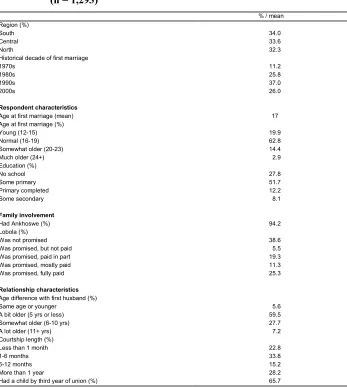
Since divorce rates vary considerably by region in Malawi, we include the respondent’s region of residence (north, central, or south). We also include the historical decade in which they first got married to account for historical differences in marital patterns and cohort effects. Some respondents first married in the 1970s (9.4%), but larger proportions married in the 1980s (25.8%), 1990s (37%), and most recently between 2000 and 2006, the year of the survey (26%). As shown in Table 1, respondents in our sample were, on average, 31 years old.4
3 We chose to work on those first three years due to their high risk of divorce and to the particular social
meaning of early divorce. Alternative lengths of time were also explored, but they did not substantively change the results.
4 In our models we include decade of first marriage and age at first marriage. Consequently, we have to
Table 1: Descriptive statistics of respondent and relationship characteristics
(n = 1,293)
% / mean Region (%)
South 34.0
Central 33.6
North 32.3
Historical decade of first marriage
1970s 11.2
1980s 25.8
1990s 37.0
2000s 26.0
Respondent characteristics
Age at first marriage (mean)
Age at first marriage (%) 17
Young (12-15) 19.9
Normal (16-19) 62.8
Somewhat older (20-23) 14.4
Much older (24+) 2.9
Education (%)
No school 27.8
Some primary 51.7
Primary completed 12.2
Some secondary 8.1
Family involvement
Had Ankhoswe (%) 94.2
Lobola (%)
Was not promised 38.6
Was promised, but not paid 5.5
Was promised, paid in part 19.3
Was promised, mostly paid 11.3
Was promised, fully paid 25.3
Relationship characteristics
Age difference with first husband (%)
Same age or younger 5.6
A bit older (5 yrs or less) 59.5
Somewhat older (6-10 yrs) 27.7
A lot older (11+ yrs) 7.2
Courtship length (%)
Less than 1 month 22.8
1-6 months 33.8
6-12 months 15.2
More than 1 year 28.2
Had a child by third year of union (%) 65.7
age (age 16‒19, 62.8% of sample); at a somewhat older age (age 20‒23, 14.4% of sample); and at a much older age (age 24 and older, 2.9% of sample).
To measure the respondent’s socioeconomic status, we include indicators of their education level. For the purpose of this study we coded education into four categories, according to the highest level completed. The majority of respondents did not complete primary education, either because they never went to school (27.8%) or because they attended some primary school but did not finish (51.7%). Only a small proportion of respondents completed primary school (12.2%) or attended or completed secondary school (8.2%).
The MLSFH also includes a measure of wealth quintiles based on a list of common household assets (e.g., radio, bicycle). Unfortunately, this measure is based on respondents’ wealth at the time of the survey and not at the time of their first marriage. Since divorce is likely to lead to changes in women’s wealth, we do not include it in the final model. However, when included in preliminary models, wealth was not a significant predictor of early divorce and did not alter the effects of the other variables in the models.
3.4 Family involvement
To better understand whether the involvement of family helps or hinders union stability, we assess whether the couple involved extended kin in their union formation process. To measure family involvement, we first look at whether ankhoswe were involved in the transaction. Marriages in our sample were overwhelmingly (94%) negotiated with the help of anskhoswe. Lobola, which also reflects family involvement, was promised to 61.4% of respondents in the sample. It was nearly universal in the north (92%), very common in the central region (86%), and rare in the south (8%). Respondents who were promised lobola were also asked what proportion of it was paid by their husband’s family. For a quarter (25.3%) of the women in our sample, lobola was fully paid, while for others it was mostly paid (11.3%), or paid in part (19.3%). In only 5.5% of cases was lobola promised but not paid.
economic incentive for encouraging, and possibly even coercing, couples to stay together.
3.5 Relationship-level variables
We use several relationship-level variables as indicators of relationship dynamics, starting with a measure of age difference with husband. We classify age differences into four categories: younger or the same age; a bit older (5 years or less); somewhat older (6‒10 years); and much older (11 years and more). Respondents married men who were, for the most part (59.3%), a little bit older than them. Only 5.6% married men who were of the same age or younger.
The second couple-level variable is the length of pre-marital courtship, which reflects how long a couple knew each other before they got married or started living together. Respondents could choose from five categories: less than 1 month, 1‒6 months, 6‒12 months, 1‒2 years, and more than 2 years.5 For the purpose of this analysis, the last two categories were grouped under “More than one year” as there were very few respondents who knew each other for more than two years, and there was no statistical difference between these categories. The first marriage of respondents took place after a period of acquaintance that varied from less than a month (22.8%) to more than a year (28.5%). We find important differences in length of courtship, with fairly large proportions of both short and long courtships. Nearly a quarter of respondents report marrying a man they have known for four weeks or less, which constitutes the first hint of the possibility of an impulsive model of marriage.
Lastly, infertility is believed to be an important driver of divorce and couples with children may have a greater incentive to stay together (Tilson and Larsen 2000). We therefore created a binary time-varying variable that indicates whether or not the respondent had children in each year of marriage by examining the respondent’s birth history. Unfortunately, respondents did not provide the year of birth of their children if the child had died by the time of the survey. Thus, we are undercounting the number of children in each year. To minimize this problem, we code the number of children into category 0 for those who had no child and 1 for those who had one or more children. A third (34%) of respondents had not had a child by the third year of their marriage. Half of the respondents had one child and 15% had two children.
We created several interaction terms in order to test whether the effect of a short courtship on early divorce changed according to different circumstances. Specifically, we tested for interactions between courtship length and involvement of ankhoswe,
5 These categories are listed as they appeared in the questionnaire. Since they are not mutually exclusive, it is
payment of lobola, age difference, and age at first marriage. None of these interaction terms were significant and hence are not included in our final models.
3.6 Analysis
In our first analyses, we estimate the hazard of divorce by year since first union. After establishing that the risk of divorce is considerably higher in the first three years of marriage, we then focus on the factors that elevate the risk of early divorce. In order to answer our question about the factors that are associated with reporting divorce within the first three years of marriage, we used a logistic discrete-time hazard model. This type of model is particularly well suited to study outcomes such as divorce, which are dependent on duration, and which may be censored because some unions may have been formed very recently and their ultimate outcomes are unknown. This approach also allows for the inclusion of time-varying variables, in this case whether or not the woman has a child.
After transforming our data into person-years of marriage, we find that the 1,293 respondents in our sample contribute 4,656 person-years of marriage. Our full model is:
𝑙𝑜𝑔 �1− ℎℎ𝑖𝑡
𝑖𝑡�=𝐼𝑛𝑑𝑖𝛽𝟏
′ +𝐹𝑎𝑚
𝑖𝛽2′+𝑅𝑒𝑙𝑖𝛽3′ +𝛽4𝐶ℎ𝑖𝑙𝑑𝑖𝑡+∝𝑡+𝑢𝑖𝑡
where hit indicates whether respondent (i) in year (t) experiences a divorce and αt represents time since first union. Time-constant individual, family, and relationship characteristics are indicated by the vectors Ind, Fam, and Rel, respectively, while the time-varying indicator for number of children is signified by Child in the equation above.
3.7 Qualitative study
research interaction is informal, which favors the expression of non-normative ideas and narratives (Angotti and Kaler 2013).
In collaboration with local youth organizations, two groups of young Malawian men and women were selected and trained in the research process, research ethics, and interviewing skills. The ethics training focused on risks for both respondents and interviewers, on ways to avoid those risks, and on how to respond to ethical problems. The data collection process took place in two separate stages. First, the interviewer would meet a respondent, obtain their consent, conduct an interview in a conversational style in a private place, and take notes on the exchange immediately after the interview. Then, once a week, one of the authors would meet the interviewers in small groups, where they told each other about the stories they had heard and commented on others’ interviews. These conversations were recorded and transcribed.
In total, 181 ‘narratives of love’ were collected in this manner in the city of Lilongwe and in various rural areas of Dedza district. To more closely align the narratives with the rural survey data, we use only the 106 narratives from respondents in rural Dedza. The interviewers were instructed to be faithful to the words used by respondents, and the data reflects the ways in which young Malawians talk about other people’s love, sex, and intimate relationships, rather than the way a young Malawian would answer a research question in a formal interview. This is a strength of the data, as this type of peer exchange is an important source of information on the sexuality and relationships of adolescents in Malawi (Bankole et al. 2007). Working with peer interviewers over six months also provided the authors with ethnographic insights, which influenced our interpretation of both the qualitative and quantitative data.
4. Results
4.1 Divorce in first unions: Early and often
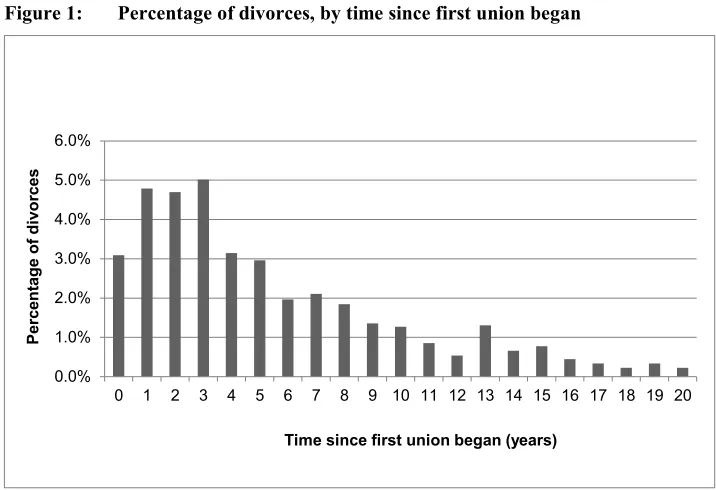
To better understand the timing of union dissolution, we first examined the proportion of unions that end in divorce by time since first union (Figure 1). We find that divorce is highest from years zero to three, rising from 3.1% in year zero to around 5.0% in years one, two, and three. While the percentage in year zero is lower, it is worth noting that this ‘year’ consists of the months between the marriage and the end of the calendar year. After year three, the probability of divorce falls to around 3% in years four and five, and remains below 3% in all subsequent years.
This confirms that it is in the initial years of a union that respondents face the highest risk of divorce. Indeed, half of all the divorces observed in our sample occurred within the first three years. This proportion varies regionally from 42% of divorces in the central region to 57% in the south. Overall, 16.5% of all respondents are divorced by the end of the third year of their first union. In the south, where divorce rates are highest and where divorce occurs fastest, this proportion rises to a full quarter of all respondents.
Figure 1: Percentage of divorces, by time since first union began
0.0% 1.0% 2.0% 3.0% 4.0% 5.0% 6.0%
0 1 2 3 4 5 6 7 8 9 10 11 12 13 14 15 16 17 18 19 20
Per
cen
tag
e o
f d
ivo
rces
4.2 The devil you don’t know: Relationship characteristics and early divorce
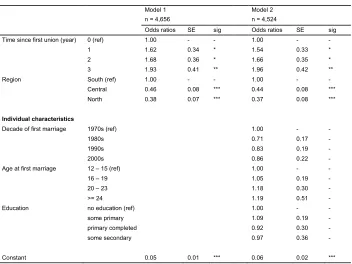
Because early divorce is common and the factors associated with early divorce are likely to differ from those associated with later divorce, in the remainder of our analyses we focus on characteristics associated with early divorce. In Model 1 of Table 2 we include measures of the time since the first union began (our time measure), the decade the union began, and individual characteristics of respondents. Consistent with Figure 1, we find that the hazard of divorce is lowest in the first year and much higher in the subsequent three years. As expected, we also find that respondents from the south are more than twice as likely to experience early divorce in their first union than respondents from other regions. However, none of the individual characteristics of respondents (historical decade of first marriage, age at first marriage, and education) are significantly associated with early union dissolution (Model 2).
Table 2: Associations between individual characteristics and early divorce (discrete-time logistic regression)
Model 1 Model 2 n = 4,656 n = 4,524
Odds ratios SE sig Odds ratios SE sig Time since first union (year) 0 (ref) 1.00 - - 1.00 - -
1 1.62 0.34 * 1.54 0.33 *
2 1.68 0.36 * 1.66 0.35 *
3 1.93 0.41 ** 1.96 0.42 ** Region South (ref) 1.00 - - 1.00 - -
Central 0.46 0.08 *** 0.44 0.08 *** North 0.38 0.07 *** 0.37 0.08 ***
Individual characteristics
Decade of first marriage 1970s (ref) 1.00 - -
1980s 0.71 0.17 -
1990s 0.83 0.19 -
2000s 0.86 0.22 -
Age at first marriage 12 – 15 (ref) 1.00 - -
16 – 19 1.05 0.19 -
20 – 23 1.18 0.30 -
>= 24 1.19 0.51 -
Education no education (ref) 1.00 - -
some primary 1.09 0.19 -
primary completed 0.92 0.30 -
some secondary 0.97 0.36 -
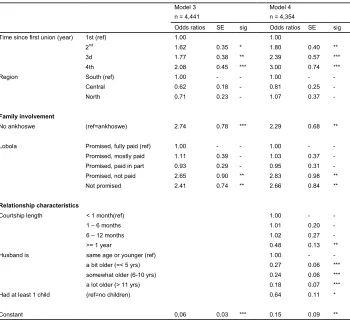
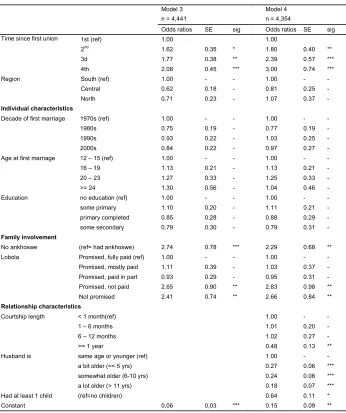
In Table 3 we examine family involvement in Model 1 and we add relationship characteristics in Model 2. In both models we control for the individual characteristics found in Table 2. Contrary to individual characteristics, family involvement and relationship characteristics reveal a number of statistically significant correlates of early divorce.
Table 3: Association between family involvement and relationship
characteristics and early divorce (discrete-time logistic regression)
Model 3 Model 4 n = 4,441 n = 4,354
Odds ratios SE sig Odds ratios SE sig Time since first union (year) 1st (ref) 1.00 1.00
2nd 1.62 0.35 * 1.80 0.40 **
3d 1.77 0.38 ** 2.39 0.57 *** 4th 2.08 0.45 *** 3.00 0.74 ***
Region South (ref) 1.00 - - 1.00 - -
Central 0.62 0.18 - 0.81 0.25 - North 0.71 0.23 - 1.07 0.37 -
Family involvement
No ankhoswe (ref=ankhoswe) 2.74 0.78 *** 2.29 0.68 **
Lobola Promised, fully paid (ref) 1.00 - - 1.00 - - Promised, mostly paid 1.11 0.39 - 1.03 0.37 - Promised, paid in part 0.93 0.29 - 0.95 0.31 - Promised, not paid 2.65 0.90 ** 2.83 0.98 ** Not promised 2.41 0.74 ** 2.66 0.84 **
Relationship characteristics
Courtship length < 1 month(ref) 1.00 - -
1 – 6 months 1.01 0.20 -
6 – 12 months 1.02 0.27 -
>= 1 year 0.48 0.13 **
Husband is same age or younger (ref) 1.00 - - a bit older (=< 5 yrs) 0.27 0.06 *** somewhat older (6-10 yrs) 0.24 0.06 *** a lot older (> 11 yrs) 0.18 0.07 *** Had at least 1 child (ref=no children) 0.64 0.11 *
Constant 0,06 0,03 *** 0.15 0.09 **
Models 1 and 2: Include controls for all variables found in Model 2 of Table 2.
stable early unions. Thus, even though only a small minority (6%) of women did not have ankhoswe involved in negotiating their first union, it appears that the absence of ankhoswe is associated with early divorce. Lobola also plays an important role: compared to women whose lobola was fully paid, women who were not promised lobola or whose lobola was not paid are more likely to experience early divorce. There is no significant difference between women whose lobola was paid in full and those who were paid in part. Thus, it appears that any payment of lobola, rather than the promise of lobola, is a key determinant of divorce.
Taking lobola into account also changes the effect of a respondent’s region. It decreases the magnitude of effect and makes the association statistically insignificant. This indicates that the strong regional effect observed Table 2 reflects the regional variation in the practice of lobola, which is much more common in the central and northern regions of Malawi.
The effects of lobola become slightly more pronounced in Model 2 of Table 3 after other relationship variables are added. Several relationship characteristics are also found to be significantly associated with early divorce. Compared to respondents who knew their partner for less than a year before marrying, respondents who knew their partner for a year or more are half as likely to report an early divorce. While with longer courtship a monotonic decrease in the likelihood of divorce might be expected, our model shows a cut-off point at one year and no difference in courtship lengths shorter than one year. This suggests that truly impulsive marriages, where respondents knew each other for less than a month, are not at greater risk of divorce than those relationships where the couple knew each other for at least six months.
Age difference between wife and husband is also linked to the likelihood of divorce. The small minority of female respondents who married someone of the same age or younger (6%) are four to five times more likely to divorce than those who married an older husband. This association that holds true regardless of the specific age difference with an older husband.
Finally, respondents who had a child during the early years of their first union are less likely to divorce, compared with those who did not. Taken together, these results give us a clearer picture of who is most at risk of early divorce: couples of the same age, whose relationship is not embedded in family ties, who do not have children, and who have known each other for less than a year before marrying.
4.3 Making sense of impulsive marriage
qualitative data to make sense of these findings. In this section, we present qualitative insights into the most salient variables: the length of courtship and the role of family support and coercion. The qualitative data both confirms and adds to the analytic results of the quantitative component.
4.3.1 Courtship
The effect of a longer courtship is salient in our quantitative analyses, with a cut-off point of one year. While this finding is intuitive, since marriage to someone you know well is more likely to last, it is surprising that such a large proportion of the sample (nearly a quarter) married someone they had known for less than a month. Our qualitative data confirms the importance of courtship length. Further, it shows how short courtships can make sense in the lives of young Malawian women, and it illustrates the perils of short courtships and the rewards of waiting longer.
In rural Dedza we heard stories of courtships of various length, ranging from a spontaneous elopement on the day of meeting to relationships that lasted a number of years before marriage. Because the original research project focused on youth relationships and not on divorce, there were many stories of respondents who were in long-term relationships and were planning to marry, but fewer stories of respondents who had married after many years of being in a relationship.
Why marry so quickly?
A prime reason for young women to get married quickly is the social pressure that women face as they reach their late teens. In rural Dedza in 2011, a woman needed a good reason to be unmarried and childless past the age of 20. If she was not pursuing her education or waiting for a boyfriend to complete his, people would look for an explanation in character flaws, infertility, or family issues. Those women who pursued an education could wait a little longer, but they were expected to marry within a few months of graduating and certainly should not wait past the age of 25. Respondent Lydia, for example, was 18 years old and just finishing primary school when she met Herbert, a clothes vendor.
of her age. She was eighteen and maybe they thought she was too old to be in Standard 8 (Lydia, age 19).
Given Lydia’s age, any additional years spent on schooling were unlikely to lead to concrete rewards in the form of employment opportunities or marriage to an educated schoolmate. Starting secondary school at age 18 would mean that Lydia would be at least 22 when she graduated, by which point she would be considered old for a first-time bride in rural Dedza.
As a result of these age constraints, some women end relationships because they are unable or unwilling to wait a long time for their boyfriends to be ready to marry. This may be the case even when a boyfriend has the potential to be a good provider. Respondent Bright, for example, told the story of his relationship with Tawina, whom he had met at church.
They were going to marry after he finished his college studies in Blantyre. Six months into the relationship, Tawina decided to find another boy because Bright was taking a long time to complete his studies. One day, another man proposed love to her. They made a secret marriage and ran away to another village. Bright heard this from his friend (Bright, age 24).
For Tawina, who is not in school, waiting for Bright to complete his studies before marrying proves too long, and she prefers eloping with another man on the same day he proposes love to her. This story shows that, in the absence of a strong emotional bond between Bright and Tawina, the relationship could not sustain his long delay in schooling nor motivate Tawina to resist social pressure and marry at a later age. It also shows that this pressure to marry is highly gendered: for men, the pressure to marry increases when they start to make a living rather than with chronological age.
On her way to the market, she met a 27-year-old man who was a mechanic and lived in her sister’s neighborhood. They agreed to get married after two months. In the second month, she packed her few belongings and went to the man’s house. She didn’t tell her guardians about it, but she just left a letter on the table explaining what she was doing. In 2009, she got pregnant and delivered a male baby who soon died. In 2010, she came to see her parents here in Dedza and stayed for three and a half weeks. When she returned to Lilongwe, she found another woman in the house. She did not say a word but simply went back to Dedza (Lily, age 23).
Lily’s story illustrates the ease of marriage when it is done without formalities, but also its fragility. While the couple waits two months before eloping, they make the decision to do so on the very day they meet in a public space. Lily does not know much about her husband. Moreover, as a visitor to the neighborhood who is keeping her relationship secret from her sister, she does not have the social networks to discover more about her potential husband.
So why would Lily decide to marry a near stranger? The second important factor that is common in scenarios of short courtship is the apparent relative wealth of the young man. The men are not necessarily from the elite economic strata, but they have either a regular job or outward signs of wealth and status, e.g., fashionable clothes, a bicycle, some furniture. Lily, in the story above, does not know much about her fiancé but she knows that he is working as a mechanic, and, thus, that he can earn a regular income. His offer of marriage, however, will not last forever. If Lily goes back to Dedza at the end of her holidays, she will lose contact with him. This element of transience was present in many stories of impulsive marriage. A man who appears wealthy makes an offer of marriage, but his proposal comes with an expiration date precluding the option of a months-long relationship before accepting it. Faced with a ‘now or never’ proposal, young women do not have time to investigate the prospective husband and to find out if appearances can be trusted. Instead, they either forego the opportunity to marry the man or they take a marital gamble and hope that the man is who he seems to be. Often, he is not.
The perils of impulsive unions
tales, in which a union ended following the death of an only child or simply following a woman’s absence of a few weeks.
In other cases, an impulsive marriage proved to be fragile not because of a weak bond between spouses, but because of things they did not know going into the marriage. Such factors were often related to a man’s ability to provide for his family: alcohol abuse, relationships with sex workers, or, in more than one instance, another family to support. In a number of cases a young respondent divorces a man with whom she has eloped because he turns out to have a wife and children in another town. When she was 18, respondent Leslie eloped with a truck driver on the same day that she had met him on the road when coming home from church. They went to live in Zomba, in the southern region, where she had a child and where she was happy because “she had everything in the house”. One day, when her husband was away working in Mozambique, she heard a knock on the door.
When she opened the door, she saw a short woman with two children asking for her husband. Leslie just said “Who is your husband?” The other woman replied “The one who lives in this house”. “Ah! He didn’t tell me that he has a wife,” said Leslie. The wife answered “I am the one, and these are his children so I command you to pack and leave this home.” Leslie just left to go back to her home village. This occurred in the year 2004, February. It was very hard with a little baby to stay in the village without the support of his dad. So she found another man to marry. (Leslie, age 26).
Leslie’s story is about broken trust, but also about realizing that her aspirations for a comfortable life will not happen with this man. Her hopes of upward social mobility and comfort (“having everything in the house”) are dashed and she must return to her parents’ home as a divorced single mother. She might have avoided this outcome if she had had more time to get to know her husband ‒ and his wife ‒ before marriage.
The benefits of longer courtships
Leslie was not the only respondent to be surprised by her male partner’s first wife. Julia was lonely and poor following her widowed father’s re-marriage. One day she met Jones on her way to fetch firewood:
that he had a wife in town. One day, his wife came to Julia’s house and beat her without giving her a chance to explain herself. Julia ran away and came back at night. She wrote a letter to Jones telling him that she was terminating the relationship. He suggested polygamy but Julia said no (Julia, age 21).
Julia’s story of finding out her wonderful partner is already married is very similar to Leslie’s. However, as a result of a longer period of acquaintance, she finds out before marrying and having children. Her subsequent first marriage is to a man who is less wealthy, but who is single.
The benefits of a longer courtship are the logical opposite of the perils of a very short courtship: the creation of a strong affective bond between spouses, a more realistic knowledge of who one is marrying, and the ability to involve family and community. Many respondents told us about how they enjoyed spending time together, “encouraging each other” and making plans for a future together. This not only allowed them to develop a bond, but it also made their relationship known first to their peers, who never hesitated in letting a poor opinion about a boyfriend be known, and eventually to relatives. Rumor and gossip were central to the way respondents found out about a cheating partner, which was the most common reason for break-ups in our sample.
These stories show that the first year is a crucial time for getting to know someone’s character and that many respondents discovered less savory aspects of a partner during that time, either directly or indirectly through friends. For those who married within a few days or weeks, this leads to a rapid divorce from their first union, while for those whose courtship was longer it leads to a premarital break-up. Those who know each other for a full year or more before marrying may discover that married life brings new irritants, but it is less likely to reveal irreconcilable differences. What counts as irreconcilable, however, depends on whether it is a young woman or her family who gets the final say.
4.3.2 Family
when a family has no stake in the continuation of their daughter’s union, their support for her may make divorce easier by allowing her to leave a bad union.
When families support a marriage
A family’s financial stake in a union can come from having received lobola and not wanting to pay it back upon divorce. As the quantitative results show, the payment itself has an effect on divorce. Even in families where lobola is not practiced, parents can still benefit from a son-in-law’s largesse with money, food, a piece of land to farm, or school fees for younger siblings. This is not to say that parents disregard their daughters’ well-being. Rather, they often prioritize some degree of material security over feelings when making decisions about daughters’ marital options.
Family involvement can also take the form of support for a marriage through ankhoswe when a couple experiences difficulties. These conflict resolution mechanisms work by providing a senior ‘spokesperson’ for a young woman. According to traditional gender norms, a wife must obey her husband, but he must obey his older relatives. This family dynamic appeared in a few stories like that of Violet, a married woman in Dedza town. After a long courtship that involved rumors, cheating, and a number of fights, Violet married her boyfriend in 2008 in a traditional ceremony involving both of their families. When asked whether they had ever spoken about his infidelities again, interviewer Esther added this:
At the end of the story, she said that even when they were married her husband also cheated on her. She caught him once with another girl here in Dedza. And when she reported this matter to his uncle, his uncle went to talk to him, and Violet said that he has changed (Violet, age 25).
Communication through ankhoswe thus creates a channel of communication that imparts a message with authority, without compromising the wife’s apparent obedience and good manners. It lets the faulty spouse know that he or she is accountable not only to his spouse, but also to his own family.
Coercion, the other side of family support
story of his first love, Melinda, who lived in his village. They had promised to marry each other after Owen finished his studies, but Melinda’s family had other plans:
The parents of Melinda were not interested in her marrying Owen because he was poor. When their relationship was a year old, Melinda’s parents forced her to get married with a certain rich man in the village. Despite all this, she was still sending messages to Owen and she was unhappy to see him with other girls. Owen still loved her. Later, the parents told her they want Owen to stop chatting with her. After he heard this, he ended the relationship (Owen, age 23).
The story of Owen shows an example of parents who decide on their daughter’s marriage partner and who also remain involved to ensure the union is not threatened by love messages to her former boyfriend.
Another respondent, Angela, eloped following a pregnancy when she was 15 but later returned to arrange for a lobola. After the marriage was finalized her husband became physically abusive and she often had to seek refuge at her parents’ home. Despite the violence she did not divorce, but instead her family intervened to stop the beatings. Had Angela’s family not paid lobola, this physical violence might have been enough to justify a divorce. Instead, when Angela sought refuge with them, they let her stay for a while and later went to the marital home and entered into a discussion with her husband to make his behavior stop. This example shows the double-edged effect of lobola and family involvement. Angela is tied to her husband through lobola, which leads her to initially stay with an abusive husband, but which later provides mechanisms to make the violence stop.
Family support after a divorce
Her parents were suspicious of him. They thought that Davison might have a wife somewhere. They called their daughter outside of their house and told her about their suspicions. But the girl refused. She said, “Why are you saying this? Just leave me. Let me choose what I want. Because I know what I’m doing.” She was saying this because she remembered the gifts that his parents gave her. So she thought that Davison would be like his parents. As a result, her parents did what she said.
Harriet’s parents tell her what they think, but once her decision is made they accept it. Parents’ lack of involvement in their daughter’s marital choice does not mean that they disappear from her life. On the contrary, that same family was ready to welcome back Harriet when it turned out that they were right and she found out that married life with Davison was far from perfect.
After their engagement, Davison took his wife to another town in the district, where he wanted to start a business. There he was coming late, sometimes at midnight, but Harriet didn’t know where he was coming from. After some months, she heard a rumor from her friends, that the man was a womanizer. One day she found her husband at a certain rest house in Dedza town with a prostitute. So the lady came back, packed her properties and went back to her home village. Now she wants to finish her school [and] go to a certain college (Harriet, age 20).
Harriet was hoping for rapid upward mobility through marriage to a man whose family was wealthier than her own. However, her hopes for a Cinderella story were quickly dashed when marriage revealed Davison’s character. Rather than remaining married to a man she knew was unfaithful, she leaves him as quickly as she married him. Unlike Angela’s parents who had received lobola, Harriet’s parents welcome her back without putting any pressure on her to remain married to a man they did not like in the first place. While the support from her parents allows Harriet to divorce, thus supporting marital instability, in this case divorce might also mean a better life if Harriet completes her college education.
5. Discussion and conclusion
The aim of this research is to gain a better understanding of the phenomenon of early divorce, of the relationships that lead up to it, and of the way these relationships make sense in young people’s lives. We find that early divorce is common in our sample of women under the age of 50, particularly in the southern region of Malawi. Overall, one in six respondents experienced an early divorce in Malawi, rising to one in four in the south. Couples who will eventually divorce tend to do so quickly. Half of all divorces in our sample take place in the first three years of a first union. Other studies that have followed young women in Malawi closely during the first years of their first union found even higher proportions, particularly in the south (Grant and Soler-Hampejsek 2014). The difference between these findings and our own are likely to reflect an under-reporting by older women of early, very short marriages that are deemed unsuccessful (Chae 2016).
The quantitative findings indicate that traditional unions, in which families are involved through the presence of ankhoswe and the payment (in full or in part) of lobola, are more stable than modern, companionate unions. However, they also highlight the importance of a longer courtship, a hallmark of modern unions. The qualitative data helps to make sense of these findings by showing the nuances of young women’s decision-making concerning their first marriage. These findings highlight the limits of a traditional/modern dichotomy in the classification of marriages. Instead, we find that a form of union that we call impulsive, which combines destabilizing characteristics of both modern and traditional unions, often results in a dysfunctional hybrid that rapidly deteriorates into divorce.
Women who enter into impulsive unions borrow from traditional forms of marriage by valuing a man’s ability to provide a comfortable life, as opposed to a more modern emphasis on a strong emotional bond. They also follow traditional practice in believing that a man’s character and his potential to be a good husband can be assessed quickly and that a young woman must marry at a very young age, which leads to short or very short courtships.6 Contrary to traditional practice, in which families and friends help evaluate a potential spouse, they rely on their own assessment of a man’s character, achieved primarily through individual verbal exchanges. Such unions often do not involve friends and family because the potential spouses do not share a community and cannot access public information about potential character flaws. The
6 Short courtships were sometimes described by interviewers as “love at first sight”, a distinctly romantic
result is a remarkably fragile form of union in which two people who do not share a community start living together as a married couple a few days or weeks after their first meeting. In many cases, the newlyweds find out about each other’s minor and major faults over the course of the first year of acquaintance. Without a strong emotional bond and with little family support, divorce is swift when a young woman discovers that her husband is violent, abuses alcohol, is sexually unfaithful, or has another wife.
However, divorce is not so easy when family members are involved in the marriage. Our findings show that the involvement of family members matters when they have a financial stake in the union, whether through lobola or other transfers. In that case, parents and relatives will discourage divorce if it means they lose an important source of income or have to repay lobola. These findings confirm what observers have noted since colonial times, that lobola is good for marriage stability but not necessarily for women (Kaler 2006 p. 344) . The qualitative data also show another side of family involvement which is more common in the absence of lobola, where parents take a daughter back after her divorce from an abusive or otherwise inadequate husband.
The idea that traditional and modern marriage practices are not mutually exclusive is not new. Researchers have shown that in various African countries the relationship practices of urban young women and university students are influenced by both traditional and modern notions of love and marriage (Jonason 2013; Okonkwo 2010; Sadgrove 2007; van Pelt and Ryen 2015). Other studies have focused on transactional ‘sugar daddy’ and ‘sugar mummy’ relationships in which young people use established gender norms in the context of more transactional relationships (Mojola 2014; Selikow and Mbulaheni 2013). We enrich this literature by drawing on data about women in rural Malawi, where the majority of young people live and where their exposure to the various forms of mainstream media is different from that of their urban counterparts. We also bring nuance to discussion of the desire for a wealthier partner by showing that it is, to a degree, anchored in a traditional model of marriage.
5.1 Limitations
There are several important limitations to this work. First, we use datasets from separate projects, with different years of data collection (2006 and 2011, respectively) and different geographical foci (three villages in the three regions of Malawi for the MLSFH and rural areas of Dedza district in central Malawi for the peer interviewing project). These differences pose some challenges when using the two datasets to answer our questions; however, it is also a strength of our results that some findings are confirmed in both datasets, despite differences in time and space.
Another limitation is that we exclude men from our quantitative sample, and thus we only account for women’s responses, in a setting where marital patterns and choices are highly gendered. Given our focus on the first years of a respondent’s union and the fact that women tend to report on unions more reliably than men (Chae 2016), we chose to treat men and women separately. As the qualitative data targeted young people it also contains more accounts of divorce from a woman’s perspective, as men typically get married at a later age. Further research is needed to investigate early divorce from the perspective of men.
An important control variable missing from our data is the respondent’s religion, which we were not able to include due to the absence of a detailed religious history for Muslim respondents. Religion has been shown to be a crucial part of life for most rural Malawians, as religious leaders and congregations provide people with advice, material resources, social networks, and monitoring of spousal behavior (Manglos 2011; Trinitapoli 2009, 2011; Trinitapoli and Weinreb 2012; Yeatman and Trinitapoli 2008). Future research into the phenomenon of early divorce should examine the role of spouses’ religious affiliation at the time of marriage, and also of previous and subsequent changes in religious community and affiliation.
5.2 Conclusion
We set out to determine whether traditional or modern unions were driving the phenomenon of early divorce in Malawi, and we found that neither was. Rather, a hybrid form of union that we call ‘impulsive marriage’ seems to be both common and exceptionally fragile. While impulsive marriages follow the traditional logic of selecting a husband who shows the potential to be a good provider, they are also driven by the aspirations of modern love (chiefly, intimacy between individuals and a life free of the hard toil of poverty) in an economic environment where these dreams are unlikely to become reality. With an otherwise drab horizon, a wealthy-looking suitor seems to open a window on a bright future and offers an appealing prospect to young women who are pressed to marry at a young age.
Impulsive marriages are thus not easily categorized as either traditional or modern marriages. Grounded in pragmatic traditions and fuelled by modern aspirations, they do away with the safeguards that solidify both traditional and modern unions. As a result, they are more fragile than either. As digital media and mobile technologies become more widespread in Malawi, globalized romantic ideals are likely to continue taking root and marriage practices are likely to grow ever more complex. Our results suggest that, as long as young women face social pressure to marry early and as long as men with a good livelihood are few and far between, this is likely to lead to fragile first unions.
6. Acknowledgements
The Malawi Longitudinal Study of Families and Health (MLSFH) has been supported by the National Institute of Child Health and Development (grant numbers R03 HD058976, R21 HD050652, R01 HD044228, R01 HD053781), the National Institute on Aging (grant number P30 AG12836), the Boettner Center for Pensions and Retirement Security at the University of Pennsylvania, and the National Institute of Child Health and Development Population Research Infrastructure Program (grant number R24 HD-044964), all at the University of Pennsylvania. The MLSFH has also been supported by for pilot funding received through the Penn Center for AIDS Research (CFAR), supported by NIAID AI 045008, and the Penn Institute on Aging.
References
Abah, A.L. (2009). Popular culture and social change in Africa: The case of the Nigerian video industry. Media, Culture & Society 31(5): 731‒748. doi:10.1177/ 0163443709339456.
Angotti, N. and Kaler, A. (2013). The more you learn the less you know? Interpretive ambiguity across three modes of qualitative data. Demographic Research
28(33): 951‒980. doi:10.4054/DemRes.2013.28.33.
Archambault, J.S. (2011). Breaking up ‘because of the phone’ and the transformative potential of information in southern Mozambique. New Media & Society 13(3): 444‒456. doi:10.1177/1461444810393906.
Bankole, A., Biddlecom, A., Guiella, G., Singh, S., and Zulu, E. (2007). Sexual behavior, knowledge and information sources of very young adolescents in four sub-Saharan African countries. African Journal of Reproductive Health 11(3): 28‒43. doi:10.2307/25549730.
Behrend, H. (1998). Love à la Hollywood and Bombay in Kenyan studio photography.
Paideuma 44: 139‒153.
Boileau, C., Clark, S., Bignami-Van Assche, S., Poulin, M., Reniers, G., and Watkins, S.C. (2009). Sexual and marital trajectories and HIV infection among ever-married women in rural Malawi. Sexually Transmitted Infections 85(Suppl 1): i27‒i33. doi:10.1136/sti.2008.033969.
Brown, L. and Strega, S. (2005). Introduction: transgressive possibilities. In Brown, L. and Strega, S. (eds.). Research as resistance: Critical, indigenous, and anti-oppressive approaches. Toronto: Canadian Scholar’s Press/Women’s Press: 1‒ 17. doi:10.1016/j.amjcard.2005.06.022.
Chae, S. (2016). Forgotten marriages? Measuring the reliability of marriage histories.
Demographic Research 34(19): 525‒562. doi:10.4054/DemRes.2016.34.19.
Chimango, L. (1977). Woman without ankhoswe in Malawi. African Legal Studies 15: 54‒61. doi:10.1080/07329113.1977.10756240.
Clark, S. and Brauner-Otto, S. (2015). Divorce in sub-Saharan Africa: Are unions becoming less stable? Population and Development Review 41(4): 583‒605.
Clark, S., Kabiru, C., and Mathur, R. (2010). Relationship transitions among youth in urban Kenya. Journal of Marriage and Family 72(1): 73‒88. doi:10.1111/j.1741 -3737.2009.00684.x.
Cole, J. and Thomas, L.M. (eds.) (2009). Love in Africa. Chicago: University of Chicago Press. doi:10.7208/chicago/9780226113555.001.0001.
Fair, L. (2009). Making love in the Indian Ocean: Hindi films, Zanzibari audiences, and the construction of romance in the 1950s and 1960s. In Cole, J. and Thomas, L.M. (eds.). Love in Africa. Chicago: University of Chicago Press: 58‒82.
doi:10.7208/chicago/9780226113555.003.0003.
Forster, P.G. (1994). Culture, nationalism, and the invention of tradition in Malawi. The Journal of Modern African Studies 32(3): 477‒497. doi:10.1017/S0022278X00 015196.
Freeman, E.K. and Coast, E. (2014). Sex in older age in rural Malawi. Ageing and Society 34(7): 1118‒1141. doi:10.1017/S0144686X12001481.
Goode, W.J. (1993). World changes in divorce patterns. New Haven and London: Yale University Press.
Grant, M.J. and Soler-Hampejsek, E. (2014). HIV risk perceptions, the transition to marriage, and divorce in Southern Malawi. Studies in Family Planning 45(3): 315‒337. doi:10.1111/j.1728-4465.2014.00394.x.
Hirsch, J.S., and Wardlow, H. (2006). Modern loves: The anthropology of romantic courtship and companionate marriage. Ann Arbor: University of Michigan Press. doi:10.3998/mpub.170440.
Jonason, P.K. (2013). Four functions for four relationships: Consensus definitions of university students. Archives of Sexual Behavior 42(8): 1407‒1414. doi:10.1007/ s10508-013-0189-7.
Jones, G.W. (1997). Modernization and divorce: Contrasting trends in Islamic Southeast Asia and the West. Population and Development Review 23(1): 95‒ 114. doi:10.2307/2137462.
Kaler, A. (2006). “When they see money, they think it’s life”: Money, modernity and morality in two sites in rural Malawi. Journal of Southern African Studies 32(2): 335‒349. doi:10.1080/03057070600656333.
Klocker, N. (2012). Conducting sensitive research in the present and past tense: Recounting the stories of current and former child domestic workers. Geoforum
43(5): 894‒904. doi:10.1016/j.geoforum.2012.05.012.
Kohler, H.-P., Watkins, S.C., Behrman, J.R., Anglewicz, P., Kohler, I.V., and Thornton, R.L. (2015). Cohort profile: The Malawi longitudinal study of families and health (MLSFH). International Journal of Epidemiology 44(2): 394‒404.
doi:10.1093/ije/dyu049.
Mair, L.P. (1951). Marriage and family in the Dedza district of Nyasaland. The Journal of the Royal Anthropological Institute of Great Britain and Ireland 81(1/2): 103‒119. doi:10.2307/2844018.
Manglos, N. (2011). Brokerage in the sacred sphere: Religious leaders as community problem solvers in rural Malawi. Sociological Forum 26(2): 334‒355.
doi:10.1111/j.1573-7861.2011.01243.x.
Mhone, C. (1994). Draconian dress act repealed. Southern Africa Political & Economic Monthly 7(3‒4): 20.
Mojola, S.A. (2014). Providing women, kept men: Doing masculinity in the wake of the African HIV/AIDS epidemic. Signs 39(2): 341‒363. doi:10.1086/673086. Mwambene, L. (2012). Custody disputes under African customary family law in
Malawi: Adaptability to change? International Journal of Law, Policy and the Family 26(2): 127‒142. doi:10.1093/lawfam/ebs004.
Okonkwo, A.D. (2010). Gender and sexual risk-taking among selected Nigerian university students. Sexuality & Culture 14(4) 270‒305. doi:10.1007/s12119-010-9074-x.
Padilla, M., Hirsch, J.S., Munoz-Laboy, M., Sember, R.E., and Parker, R.G. (2007).
Love and globalization. Nashville: Vanderbilt University Press.
Pattman, R. (2005). “Boys and girls should not be too close”: Sexuality, the identities of African boys and girls and HIV/AIDS education. Sexualities 8(4): 497‒516.
doi:10.1177/1363460705056623.
Poulin, M. (2007). Sex, money, and premarital partnerships in southern Malawi. Social Science & Medicine 65(11): 2383‒2393. doi:10.1016/j.socscimed.2007.05.030. Ranger, T. (1997 [1983]). The invention of tradition in colonial Africa. In Grinker,
Reniers, G. (2003). Divorce and remarriage in rural Malawi. Demographic Research
Special Collection 1(6): 175‒206. doi:10.4054/DemRes.2003.S1.6.
Ryan, L., Kofman, E., and Aaron, P. (2011). Insiders and outsiders: Working with peer researchers in researching Muslim communities. International Journal of Social Research Methodology 14(1): 49‒60. doi:10.1080/13645579.2010.481835. Sadgrove, J. (2007). “Keeping up appearances”: Sex and religion amongst university
students in Uganda. Journal of Religion in Africa 37(1): 116‒144.
doi:10.1163/157006607X166618.
Schatz, E. (2005). “Take your mat and go!”: Rural Malawian women’s strategies in the HIV/AIDS era. Culture, Health & Sexuality 7(5): 479‒492. doi:10.1080/1369 1050500151255.
Selikow, T.-A. and Mbulaheni, T. (2013). “I do love him but at the same time I can’t eat love”: Sugar daddy relationships for conspicuous consumption amongst urban university students in South Africa. Agenda 27(2): 86‒98.
Smith, D.J. (2001). Romance, parenthood, and gender in a modern African society.
Ethnology 40(2): 129‒151. doi:10.2307/3773927.
Smith, D.J. (2009). Managing men, marriage and modern love: Women’s perspectives on intimacy and male infidelity in southeastern Nigeria. In Cole, J. and Thomas, L.M. (eds.). Love in Africa: University of Chicago Press: 157‒180. doi:10.7208/ chicago/9780226113555.003.0007.
Smith, D.J. (2010). Promiscuous girls, good wives, and cheating husbands: Gender inequality, transitions to marriage, and infidelity in southeastern Nigeria.
Anthropological Quarterly 83(1): 123‒152. doi:10.1353/anq.0.0118.
Swidler, A. (1986). Culture in action: Symbols and strategies. American Sociological Review 51(2): 273‒286. doi:10.2307/2095521.
Swidler, A. (2003). Talk of love: How culture matters. Chicago: University of Chicago Press.
Swidler, A., and Watkins, S.A. (2007). Ties of dependence: AIDS and transactional sex in rural Malawi. Studies in Family Planning 38(3): 147‒162. doi:10.1111/j.172 8-4465.2007.00127.x.
Takyi, B.K. (2001). Marital instability in an African society: Exploring the factors that influence divorce processes in Ghana. Sociological Focus 34(1): 77‒96.
Thomas, L. (2009). Love, sex, and the modern girl in 1930s southern Africa. In Cole, J. and Thomas, L. (eds.). Love in Africa. Chicago: University of Chicago Press: 31‒57. doi:10.7208/chicago/9780226113555.003.0002.
Tilson, D. and Larsen, U. (2000). Divorce in Ethiopia: The impact of early marriage and childlessness. Journal of Biosocial Science 32(3): 355‒372. doi:10.1017/ S0021932000003552.
Trinitapoli, J. (2009). Religious teachings and influences on the ABCs of HIV prevention in Malawi. Social Science & Medicine 69(2): 199‒209. doi:10.1016/ j.socscimed.2009.04.018.
Trinitapoli, J. (2011). The AIDS-related activities of religious leaders in Malawi.
Global Public Health 6(1): 41‒55. doi:10.1080/17441692.2010.486764.
Trinitapoli, J. and Weinreb, A. (2012). Religion and AIDS in Africa. Oxford: Oxford University Press. doi:10.1093/acprof:oso/9780195335941.001.0001.
van Pelt, I.S. and Ryen, A. (2015). Self-efficacy in protecting oneself against HIV transmission: A qualitative study of female university students in Malawi.
Journal of Comparative Social Work 10(2).
Wanda, B.P. (1988). Customary family law in Malawi: Adherence to tradition and adaptability to change. The Journal of Legal Pluralism and Unofficial Law
20(27): 117‒134. doi:10.1080/07329113.1988.10756407.
Wardlow, H. and Hirsch, J.S. (2006). Introduction. In Hirsch, J.S. and Wardlow, H. (eds.). Modern loves: The anthropology of romantic courtship & companionate marriage. Ann Arbor: University of Michigan Press.
Watkins, S. and Swidler, A. (2009). Hearsay ethnography: Conversational journals as a method for studying culture in action. Poetics 37(2): 162‒184. doi:10.1016/ j.poetic.2009.03.002.
Watkins, S.C. (2004). Navigating the AIDS epidemic in rural Malawi. Population and Development Review 30(4): 673‒705. doi:10.1111/j.1728-4457.2004.00037.x. Yeatman, S.E. and Trinitapoli, J. (2008). Beyond denomination: The relationship
between religion and family planning in rural Malawi. Demographic Research
Appendix
Table A-1: Association between individual and relationship characteristics and early divorce (discrete-time logistic regression)
Model 3 Model 4 n = 4,441 n = 4,354
Odds ratios SE sig Odds ratios SE sig Time since first union 1st (ref) 1.00 1.00
2nd 1.62 0.35 * 1.80 0.40 **
3d 1.77 0.38 ** 2.39 0.57 *** 4th 2.08 0.45 *** 3.00 0.74 *** Region South (ref) 1.00 - - 1.00 - -
Central 0.62 0.18 - 0.81 0.25 - North 0.71 0.23 - 1.07 0.37 -
Individual characteristics
Decade of first marriage 1970s (ref) 1.00 - - 1.00 - - 1980s 0.75 0.19 - 0.77 0.19 - 1990s 0.93 0.22 - 1.03 0.25 - 2000s 0.84 0.22 - 0.97 0.27 - Age at first marriage 12 – 15 (ref) 1.00 - - 1.00 - - 16 – 19 1.13 0.21 - 1.13 0.21 - 20 – 23 1.27 0.33 - 1.25 0.33 - >= 24 1.30 0.56 - 1.04 0.46 - Education no education (ref) 1.00 - - 1.00 - - some primary 1.10 0.20 - 1.11 0.21 - primary completed 0.85 0.28 - 0.88 0.29 - some secondary 0.79 0.30 - 0.79 0.31 -
Family involvement
No ankhoswe (ref= had ankhoswe) 2.74 0.78 *** 2.29 0.68 ** Lobola Promised, fully paid (ref) 1.00 - - 1.00 - -
Promised, mostly paid 1.11 0.39 - 1.03 0.37 - Promised, paid in part 0.93 0.29 - 0.95 0.31 - Promised, not paid 2.65 0.90 ** 2.83 0.98 ** Not promised 2.41 0.74 ** 2.66 0.84 **
Relationship characteristics
Courtship length < 1 month(ref) 1.00 - -
1 – 6 months 1.01 0.20 -
6 – 12 months 1.02 0.27 -
>= 1 year 0.48 0.13 **
Husband is same age or younger (ref) 1.00 - - a bit older (=< 5 yrs) 0.27 0.06 *** somewhat older (6-10 yrs) 0.24 0.06 *** a lot older (> 11 yrs) 0.18 0.07 *** Had at least 1 child (ref=no children) 0.64 0.11 *