DEMOGRAPHIC RESEARCH
VOLUME 35, ARTICLE 51, PAGES 1523
−
1536
PUBLISHED 7 DECEMBER 2016
http://www.demographic-research.org/Volumes/Vol35/51/ DOI: 10.4054/DemRes.2016.35.51
Descriptive Finding
Age at migration and disability-free life
expectancy among the elder Mexican-origin
population
Marc A. Garcia
Chi-Tsun Chiu
©2016 Marc A. Garcia & Chi-Tsun Chiu.
This open-access work is published under the terms of the Creative Commons Attribution NonCommercial License 2.0 Germany, which permits use, reproduction & distribution in any medium for non-commercial purposes, provided the original author(s) and source are given credit.
2 Conceptual framework 1524
3 Data and methods 1525
3.1 Statistical analysis 1526
4 Results 1527
4.1 ADL disability 1527
4.2 IADL disability 1529
5 Discussion and conclusion 1530
6 Acknowledgments 1531
References 1532
Age at migration and disability-free life expectancy among the elder
Mexican-origin population
Marc A. Garcia1
Chi-Tsun Chiu2
Abstract
BACKGROUND
Migration selectivity is thought to shape the health profiles of Mexican immigrants.
OBJECTIVE
This study examines how the experience of Mexican migration to the United States affects the health process and the quality of life in old age by age at migration, specific to sex.
METHODS
We use 20 years of data from the Hispanic Established Populations for the Epidemiologic Study of the Elderly to estimate the proportion of life spent disability-free prior to death across eight subgroups by sex, nativity, and age at migration among Mexican-origin elderly in the United States.
RESULTS
Female migrants are at a significant disadvantage in terms of IADL disability-free life expectancy relative to US-born women, particularly late-life migrants. Conversely, mid- and late-life male migrants exhibit an advantage in ADL disability-free life expectancy compared to their US-born counterparts.
CONCLUSIONS
Foreign-born Mexican elders are not a homogeneous group. This issue merits special attention in the development of community-based long-term care programs in order to appropriately target the specific needs of different subgroups of older Mexican individuals entering their last decades of life.
1 Sealy Center on Aging, University of Texas Medical Branch at Galveston, USA. E-Mail: [email protected].
CONTRIBUTION
This study contributes to immigrant health literature by providing a more comprehensive documentation of nativity differentials, by distinguishing subgroups of Mexican elderly by sex, nativity, and age at migration.
1. Introduction
A growing body of research indicates declines among the older population in functional limitations and disability (Crimmins and Saito 2001). Although disability may be decreasing in general, recent evidence suggests that functional disability may be more common among Latinos – or at least among certain subgroups of Latinos. (Hayward et al. 2014; Melvin et al. 2014). Previous research reveals that although the Mexican-origin population has a relatively long life span, this rapidly aging population is disproportionately beset by chronic disease (Caskie, Sutton, and Margrett 2010). This high rate of chronic illness suggests that a large proportion of the years past 65 may be characterized by serious functional disability (Al Snih et al. 2009).
Given the potential of higher rates of disability and an earlier onset among Mexican-origin elderly, this research examines nativity and age at migration differences in disability-free life expectancy, by sex, based on Activities of Daily Living (ADL) and Instrumental Activities of Daily Living (IADL). Nativity status has been found to be strongly related to health (Hummer and Hayward 2015). Indeed, research has identified a ‘healthy immigrant effect’ in which foreign-born individuals residing in the United States tend to show favorable health and mortality profiles relative to their US-born counterparts (Bostean 2013; Singh and Hiatt 2006). We assess whether the healthy immigrant effect in mortality documented among immigrants extends to disability by examining the number of years past age 65 that elderly Mexicans live disability-free.
2. Conceptual framework
examine how the experience of Mexican migration to the United States affects the health process and the quality of life in old age.
Health selection likely operates differently for different age groups and by sex. For example, migration selectivity may be strongest at young and middle ages, when immigrants decide to cross the border to pursue occupational opportunities in physically demanding fields such as agriculture, construction, and the service sector (Gubernskaya, Bean, and Van Hook 2013). Labor migrants are healthy enough to migrate, work when they arrive, and deal with the potential challenges they face in the process of migration, and thus are self-selected on the basis of good health (Angel et al. 2010).
By contrast, Mexicans who migrated as children or adolescents are more likely to have been brought to the United States by their parents or to have migrated in order to join family members. These early-life migrants have little or no positive selection, since their migration depends on their parents’ characteristics and they do not necessarily have to deal with the demands of migration (Gubernskaya 2014). Positive health selectivity may also be weaker among those who migrate in late life because older migrants are more likely to migrate for reasons of family reunification rather than job opportunities (Treas 2015). Furthermore, if late-life immigrants come to the United States to seek care from family members they may exhibit negative health selection.
3. Data and methods
Data from the Hispanic Established Populations for the Epidemiologic Study of the Elderly (H-EPESE) was used to estimate the proportion of life spent disability-free prior to death for US-born and foreign-born Mexican-origin elderly. The H-EPESE is a longitudinal study of Hispanics, aged 65 years and older, residing in the southwestern United States (Markides et al. 1997). We used aggregated data from 1993‒2013 to obtain prevalence estimates across survey years, with mortality linkages through the National Death Index (NDI) up to December 31, 2015. Respondents range in age from 65 to 107 years. The final analytic sample comprises 3,860 unique individuals and 37,203 person-years of data.
language, which are associated with traditional gender and family roles such as managing household finances, using transportation, preparing meals, and shopping (Lawton and Brody 1969). We dichotomized disability as ‘no help needed’ versus ‘unable to perform one or more of the tasks.’ The disability questions are presented in Appendix A.
Mexicans involved in the migration process are not a monolithic group but are heterogeneous in various aspects. Although the factors that contribute to this heterogeneity are less studied, some scholars suggest that age at migration can be useful for understanding health disparities in later life, by approximating the type of migration (i.e., labor versus family) and the degree of selectivity among immigrants (Markides and Rote 2014; Gubernskaya 2014). We included two measures of immigration status: nativity and age at migration. To classify nativity we used birthplace information and categorized respondents as born in the United States versus born in Mexico. To measure life course stage at migration we included three age-at-migration groups: those who arrive in childhood (0‒19 years), in middle age (20‒49 years), and in later life (after age 50).
3.1 Statistical analysis
We combined age-specific mortality rates with age-specific prevalence of ADL and IADL disabilities to calculate Sullivan-based multistate life table models of disabled life expectancy (DLE) and disability-free life expectancy (DFLE) for each group (Sullivan 1971). This method divides total life expectancy (TLE) into different health states based on the age-specific prevalence of disabled and disability-free states.
To estimate mortality rates, we employed Gompertz models of the following form stratified by sex, nativity, and age at migration:
ln 𝑚(𝑥) = 𝛽0+ 𝛽1∙ 𝐴𝐴𝐴 (1)
where x is age, 𝑚(𝑥) is age-specific mortality rate, 𝛽0 the constant term, and 𝛽1 is the coefficient for age (Teachman and Hayward 1993).
To estimate prevalence, we fitted the logistic regressions of the following form stratified by sex, nativity, and age at migration:
ln1−𝜋𝜋 = 𝛽0+ 𝛽1∙ 𝐴𝐴𝐴 (2)
Using equation (1), we estimate age-specific mortality rates and obtain TLE. From equation (2) we obtain the age-specific prevalence of ADL and IADL. We use the estimated prevalence to divide TLE into the different health states based on the age-specific prevalence of disabled and disability-free states. DLE and DFLE calculated by this method is the number of remaining years (at age 65) a population can expect to live in a disabled/disability-free state (Jagger et al. 2006).
We used a bootstrapping technique to obtain standard errors (Efron and Tibshirani 1986). Bootstrapping generates repeated estimates of DFLE by randomly drawing a series of bootstrap samples from the analytic samples. Repeating this approach 300 times, the distributions we obtain allow us to estimate sampling variability for TLE, DLE, and DFLE. Based on the 300 life tables for a given group, we obtain simulated 95% confidence intervals for the distributions of TLE, DLE, and DFLE, or the ratio of disability-free to TLE of that group. The 95% interval is from the 2.5th to the 97.5th percentile of the simulated distribution.
4. Results
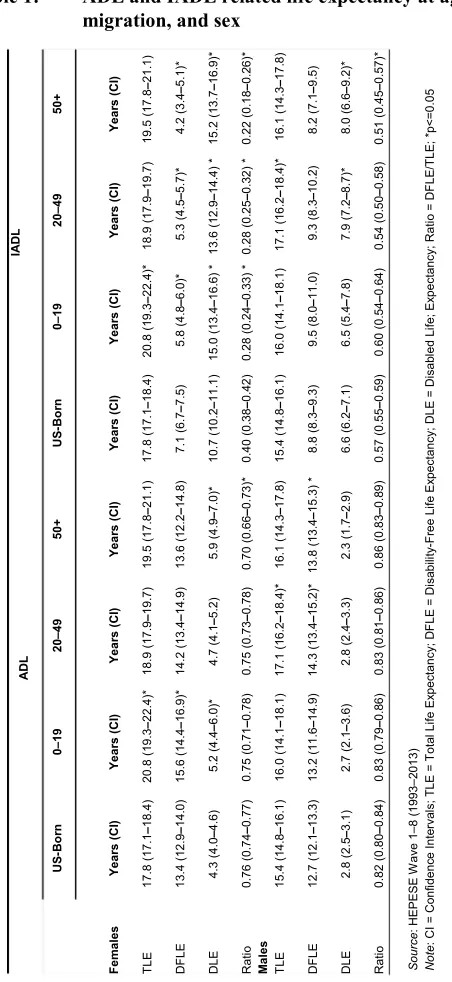
Table 1 presents ADL and IADL related life expectancy data (see also Figure 1). We stratified the analysis by nativity, age at migration, and sex to determine whether an immigrant advantage emerges. Overall, foreign-born immigrants have a higher TLE at age 65 relative to their US-born counterparts, regardless of sex.
4.1 ADL disability
Table 1: ADL and IADL related life expectancy at age 65 by nativity, age at migration, and sex
4.2 IADL disability
Overall, foreign-born women are at a significant disadvantage in terms of DFLE and the ratio of years spent IADL disability-free, relative to their US-born counterparts. Foreign-born females can expect to spend between 22% and 28% of their remaining years after age 65 disability-free compared with 40% for US-born women. However, there are important differences by age at migration. Early-life and mid-life migrant women generally exhibited positive health selectivity relative to late-life migrant women. In terms of DFLE and the ratio of disability-free years, early-life immigrant women displayed the healthiest outcome (5.8 years), followed by mid-life (5.3 years) and late-life (4.2 years) women.
In general, foreign-born men exhibit no health advantage in DFLE with IADL disability. In fact, the results point in the opposite direction. Mid-life and late-life migrant males spend fewer years after age 65 IADL disability-free than US-born men. Indeed, the ratio of number of elderly years lived disability-free to total number of years lived is significantly lower for mid-life (54%) and late-life (51%) immigrant men than for US-born men (57%).
Figure 1: ADL and IADL related life expectancy at age 65 by nativity, age at
migration, and sex
Source: HEPESE Wave 1‒8 (1993-2013)
5. Discussion and conclusion
This analysis examined differences in Activities of Daily Living and Instrumental Activities of Daily Living life expectancy among Mexican-origin elderly residing in the southwestern United States. Our aim was to assess whether the ‘healthy immigrant effect’ documented among immigrants for mortality extends to disability by examining the number of years past 65 lived disability-free. Although previous research has focused on comparing life expectancy across racial and ethnic groups, few studies have focused specifically on disability-free life expectancy among Mexican-origin elders as a function of nativity, and for immigrants as a function of age at migration. Utilizing a life course perspective allows us to advance current knowledge by examining the role of age at migration. This perspective argues that experiences that happen early in the life course impact health outcomes in later stages of life (Dannefer 2003). Differences in immigration motivation and selection mechanisms might be found between younger and older immigrants and within the older immigrant population. Thus, comparing disability outcomes among the foreign-born can highlight positive health selectivity.
Our results are consistent with previous findings that foreign-born individuals residing in the United States have lower mortality than their US-born counterparts (Cantu et al. 2013; Singh and Hiatt 2006). As other studies increasingly show, the healthy immigrant effect does not appear to apply to disability, with the exception of ADL disability among males (Garcia et al. 2015; Hayward et al. 2014). Furthermore, these results add to emerging literature on age at migration as an important factor for understanding health outcomes among older immigrants (Angel, Angel, and Markides 2003; Gubernskaya 2014). Importantly, our results build on previous studies by documenting that immigrant health selectivity varies by both age at migration and sex, depending on the health outcome.
support the idea that IADL disability among the foreign-born is largely attributable to low levels of acculturation, associated with both traditional gender roles and the structural factors encountered when driving a vehicle or obtaining the transportation necessary for shopping, banking, and managing household business; areas in which they are clearly disadvantaged (Garcia et al. 2015; Angel et al. 1996).
These findings have important research and policy implications. The disability results demonstrate the importance of considering multiple factors, including nativity, age at migration, and gender, when planning for long-term care in the rapidly aging Mexican-origin population. Because disability is a major driver of acute and chronic healthcare costs, prevention and treatment of medical conditions should be given high priority in this population to reduce disability as much as possible. The possibility of a longer life characterized by compromised health and material hardship raises serious questions about the potential burden on government and family. Our findings clearly illustrate that as they grow older, Mexican immigrant families will need to mobilize their informal support systems since they will be heavily burdened with physical and cognitive impairments. Future research should investigate specific ADL and IADL domains in order to develop community-based programs aimed at meeting the specific needs of older Mexican-origin subgroups.
6. Acknowledgments
References
Al Snih, S., Graham, J.E., Ray, L.A., Samper-Ternent, R., Markides, K.S., and Ottenbacher, K.J. (2009). Frailty and incidence of activities of daily living disability among older Mexican Americans. Journal of Rehabilitation Medicine
41(11): 892‒897.doi:10.2340/16501977-0424.
Angel, J.L. and Angel, R.J. (1992). Age at migration, social connections, and well-being among elderly Hispanics. Journal of Aging and Health 4(4): 480‒499. doi:10.1177/089826439200400402.
Angel, J.L., Angel, R.J., McClellan, J.L., and Markides, K.S. (1996). Nativity, declining health, and preferences in living arrangements among elderly Mexican Americans: Implications for long-term care. Gerontologist 36(4): 464‒473. doi:10.1093/geront/36.4.464.
Angel, R.J., Angel, J.L., Díaz Venegas, C., and Bonazzo, C. (2010). Shorter stay, longer life: Age at migration and mortality among the older Mexican-origin population. Journal of Aging and Health 22(7): 914‒931. doi:10.1177/08982 64310376540.
Angel, R.J., Angel, J.L., and Markides, K.S. (2003). Salud física de los Mexicanos migrantes mayores en los Estados Unidos. Envejeciendo en la pobreza. México: Instituto Nacional de Salud Pública: 153‒172.
Bostean, G. (2013). Does selective migration explain the Hispanic paradox? A comparative analysis of Mexicans in the U.S. and Mexico. Journal of Immigrant and Minority Health 15(3): 624‒635.doi:10.1007/s10903-012-9646-y.
Cantu, P.A., Hayward, M.D., Hummer, R.A., and Chiu, C.T. (2013). New estimates of racial/ethnic differences in life expectancy with chronic morbidity and functional loss: evidence from the National Health Interview Survey. Journal of Cross-Cultural Gerontology 28(3): 283‒297. doi:10.1007/s10823-013-9206-5.
Caskie, G.I.L., Sutton, M.C., and Margrett, J.A. (2010). The relation of hypertension to changes in ADL/IADL limitations of Mexican American older adults. Journals of Gerontology Series B-Psychological Sciences and Social Sciences 65(3): 296‒ 305. doi:10.1093/geronb/gbq001.
Dannefer, D. (2003). Cumulative advantage/disadvantage and the life course: cross-fertilizing age and social science theory. The Journals of Gerontology. Series B, Psychological Sciences and Social Sciences 58(6): S327‒337. doi:10.1093/ geronb/58.6.S327.
Efron, B. and Tibshirani, R. (1986). Bootstrap methods for standard errors, confidence intervals, and other measures of statistical accuracy. Statistical Science 1(1): 54‒ 75. doi:10.1214/ss/1177013815.
Garcia, M.A., Angel, J.L., Angel, R.J., Chiu, C.T., and Melvin, J. (2015). Acculturation, gender, and active life expectancy in the Mexican-origin population. Journal of Aging and Health 27(7): 1247‒1265. doi:10.1177/ 0898264315577880.
Gubernskaya, Z. (2014). Age at migration and self-rated health trajectories after age 50: Understanding the older immigrant health paradox. The Journals of Gerontology Series B: Psychological Sciences and Social Sciences 70(2): 279‒290. doi:10.10 93/geronb/gbu049.
Gubernskaya, Z., Bean, F.D., and Van Hook, J. (2013). (Un)healthy immigrant citizens: Naturalization and activity limitations in older age. Journal of Health and Social Behavior 54(4): 427‒443. doi:10.1177/0022146513504760.
Hayward, M.D., Hummer, R.A., Chiu, C., Gonzales, C., and Wong, R. (2014). Does the Hispanic paradox in mortality extend to disability? Population Research and Policy Review 33(1): 81‒96. doi:10.1007/s11113-013-9312-7.
Hummer, R.A. and Hayward M.D. (2015). Hispanic older adult health and longevity in the United States: Current patterns and concerns for the future. Daedalus 144(2): 20‒30. doi:10.1162/DAED_a_00327.
Jagger, C., Cox, B., Le Roy, S., and EHEMU (2006). Health expectancy calculation by the Sullivan method. in EHEMU Technical Report September 2006.
Katz, S., Ford, A.B., Moskowitz, R.W., Jackson, B.A., and Jaffe, M.W. (1963). Studies of illness in the aged ‒ The index of Adl: A standardized measure of biological and psychosocial function. Jama ‒ Journal of the American Medical Association
185(12): 914‒919. doi:10.1001/jama.1963.03060120024016.
Lawton, M.P. and Brody, E.M. (1969). Assessment of older people: Self-maintaining and instrumental activities of daily living. Gerontologist 9(3p1): 179‒186. Markides, K.S. and Rote, S. (2014). Aging, minority status, and disability. Generations
Markides, K.S., Rudkin, L., Angel, R.J., and Espino, D.V. (1997). Health status of Hispanic elderly. In Martin, L.G. and Soldo, B.J. (eds.). Racial and ethnic differences in the health of older Americans. Washington, D.C.: National Academies Press: 285‒300.
Melvin, J., Hummer, R.A., Elo, I., and Mehta, N. (2014). Age patterns of racial/ethnic/nativity differences in disability and physical functioning in the United States. Demographic Research 31(17): 497‒509. doi:10.4054/DemRes. 2014.31.17.
Singh, G.K. and Hiatt, R.A. (2006). Trends and disparities in socioeconomic and behavioural characteristics, life expectancy, and cause-specific mortality of native-born and foreign-born populations in the United States, 1979‒2003.
International Journal of Epidemiology 35(4): 903‒919.doi:10.1093/ije/dyl089. Sullivan, D.F. (1971). A single index of mortality and morbidity. HSMHA Health
Reports 86(4): 347‒354. doi:10.2307/4594169.
Teachman, J.D. and Hayward, M.D. (1993). Interpreting hazard rate models.
Sociological Methods and Research 21(3): 340‒371. doi:10.1177/00491241 93021003003.
Treas, J. (2015). Incorporating immigrants: Integrating theoretical frameworks of adaptation. The Journals of Gerontology. Series B, Psychological Sciences and Social Sciences 70(2): 269‒278.doi:10.1093/geronb/gbu067.
Appendix A: Activities of Daily Living and Instrumental Activities of
Daily Living scales
ADL Items: Do you need help from another person or special equipment or a device?
Walking across a small room
Bathing (either a sponge bath, tub bath, or shower)
Personal grooming like brushing hair, brushing teeth, or washing face
Dressing (like putting on a shirt, buttoning and zipping, or putting on shoes)
Eating (like holding a fork, cutting food, or drinking from a glass)
Getting from a bed to a chair
Using the toilet
IADL Items: Can you do these activities by yourself or without any help from anyone else?
Can you use the telephone without help (including looking up numbers and dialling)
Can you drive your own car or travel alone on buses or taxis
Can you go shopping for groceries or clothes without help (taking care of all shopping needs yourself, assuming you had transportation)
Can you prepare your own meals without help (plan and cook full meals yourself)
Can you do light housework without help (dish washing and bed making, etc.)
Can you take your own medicine without help (in the right doses at the right time)
Can you handle your money without help (write checks, pay bills, etc.)
Can you do heavy work around the house like washing windows, walls and floors without help
Can you walk up and down stairs to the second floor without help
Can you walk half a mile without help