Open Access
Research
Computer-tailored physical activity behavior change interventions
targeting adults: a systematic review
Leonie Michelle Neville*, Blythe O'Hara and Andrew Milat
Address: Centre for Health Advancement, New South Wales Department of Health, Locked Mail Bag 961, North Sydney NSW 2059, Australia
Email: Leonie Michelle Neville* - [email protected]; Blythe O'Hara - [email protected]; Andrew Milat - [email protected]
* Corresponding author
Abstract
Background: Increasing physical activity is important in the promotion of better health. Computer-tailored behavior change programs have shown promise in changing lifestyle risk factors.
Purpose: To provide a narrative systematic review describing the range of evidence on 'second' and 'third' generation computer-tailored primary prevention interventions for physical activity, to determine their effectiveness and key characteristics of success. Unlike previous reviews, this review used specific criteria to measure the external validity of studies, was exclusive to primary prevention interventions in which tailoring was generated through an expert system, and excluded first generation computer-tailored interventions.
Methods: Computer-tailored intervention studies published from January 1996–2008 were identified through a search of five databases: Medline; Embase; PsycINFO; CINAHL; and All EBM Reviews and by examining reference lists of relevant articles.
Results: Seventeen articles were included, describing the evaluation of 16 interventions, ten of which found significant positive effects of the computer-tailored interventions on physical activity or weight reduction outcomes.
Conclusion: The evidence of effectiveness for computer-tailored physical activity interventions is inconclusive. They have potential to reach large groups of people however there is uncertainty whether reported effects are generalizable and sustained.
Introduction
At least 60% of the world's population does not meet the recommended levels of physical activity required to induce health benefits [1]. Levels of inactivity are high in nearly all developed and developing countries, with more than half the adults in developed countries insufficiently active [2]. This is certainly the case in Australia, where in 2004 about 50% of the adult population were insuffi-ciently physically active [3]. This is a significant problem
as physical inactivity is estimated to cause 1.9 million deaths with a burden of 19 million disability-adjusted life years globally, significantly contributing to many cancers, diabetes and heart disease [4].
There is growing evidence that behavior change programs using computer-tailoring can be effective in changing life-style risk factors [5]. Computer-tailoring refers to the doc-umentation of participant information using a
Published: 3 June 2009
International Journal of Behavioral Nutrition and Physical Activity 2009, 6:30 doi:10.1186/1479-5868-6-30
Received: 6 November 2008 Accepted: 3 June 2009
This article is available from: http://www.ijbnpa.org/content/6/1/30
© 2009 Neville et al; licensee BioMed Central Ltd.
Page 2 of 12
computerized expert system, which then generates feed-back and advice based on such information. Computer-tailored interventions have been classified into three gen-erations, according to their mode of delivery. First genera-tion intervengenera-tions are delivered through printed materials such as letters, reports and pamphlets. Second generation interventions are delivered through interactive technology or desktop applications such as websites, email and CD-ROM programs [6,7]. Third generation interventions are relatively new and include mobile and remote devices such as mobile phones and handheld computers which may enhance the potential for timely feedback and assess-ment [6].
Computer-tailoring is promising as a strategy for health education [5]. Firstly, like personal counseling, partici-pants' behaviors are assessed and the results then used to generate individualized feedback and advice [7], making the health information received personalized and pro-vided at a relatively lower cost than interpersonal coun-seling [5]. Participant's behaviors can be compared with current recommendations, the behaviors of peers and pre-vious assessments [8]. Feedback can then be provided that is relevant to performance levels, awareness, motivation, self-efficacy, expectations and goals [5]. Secondly, compu-ter tailoring has potential for wide distribution due to its application to electronic non-print media such as the Internet, providing an opportunity for remote access to the intervention [5].
The limitations of computer-tailored interventions are that the participant must answer many questions to be assessed accurately, allowing for the provision of reliable and individualized advice [9]. Feedback is based on the participant's self-reported behavior, which may result in incorrect estimates of behavior and mismatched feedback and advice [10]. These limitations may be minimized through the use of a combination of validated self-reports with more objective measures of physical activity behav-ior [5].
Previous well-conducted systematic reviews on computer-tailored interventions [5], web-based interventions [11,12] and interventions using interactive technology [6] targeting physical activity and dietary behaviors indicated that further research was required to form any conclusions on the effectiveness of such interventions in the promo-tion of physical activity or healthy weight, but the evi-dence was promising. We investigated the potential of developing computer-tailored physical activity behavior change interventions targeting Australian adults. The abovementioned reviews had significant relevance and application to the development of such strategies, how-ever had a different purpose, focus and inclusion criteria
and considerable time has lapsed since their publication in this rapidly developing field [5,6,11,12].
These reviews noted the significant heterogeneity of such studies. When there is significant heterogeneity of studies it is considered more appropriate to undertake a narrative systematic review than a meta-analysis and to describe the variation in findings rather than attempt to combine find-ings into one overall estimate of effect [13].
The aim of this study was to conduct a narrative systematic review which would describe the range and quality of available evidence on second and third generation com-puter-tailored primary prevention interventions for phys-ical activity behavior change and to determine their effectiveness and key success factors.
Methods
Data Sources and Search Strategy
Literature searches were conducted to retrieve articles from January 1996 to January 2008 that were written in English using five databases in February 2008: Medline, Embase, PsycINFO, CINAHL and All EBM Reviews. Previ-ous systematic reviews on computer-tailored physical activity interventions did not identify any studies prior to 1996 [5,6]. The search consisted of a combination of each of the following terms to represent computer-tailored or expert systems: expert system; or web based; or computer tailor*; or computer based; or Internet based; with each of the target domains: physical activity; overweight; obesity; and weight loss. Additional articles of relevance were sought by reviewing the reference lists of included articles and previous systematic reviews [5,6,11,12,14-16].
Selection criteria
Articles identified through the literature search were restricted to those written in English and published in a scientific journal between January 1996 to January 2008, inclusive. Only randomized controlled trials (RCTs) or quasi-experimental designs with pretest and post test behavioral outcome data were included.
of lifestyle or behavioral changes to prevent the onset of chronic diseases in apparently healthy participants." Phys-ical activity behavior or fitness levels had to be described as the primary outcome measure.
Studies were excluded that had an intervention with sig-nificant face-to-face contact involving counseling in the main treatment arm. Interventions with limited interper-sonal contact such as: provision of computer-tailored feedback through telephone or email; initial one-off face-to-face sessions for the purpose of instructing participants in the use of the technology or data collection (not for the purposes of behavioral counseling) were included. Stud-ies that had additional treatment arms such as face-to-face sessions were included, however the effects reported in this review are only that of the treatment arm with none or limited interpersonal contact as described above.
Articles were also excluded if they met the following crite-ria:
• Conference abstracts, dissertations, commentaries, descriptions of the technology or information architec-ture, description of intervention development only
• The target group for the intervention was caregivers, health professionals or those with a manifested chronic disease state and/or recruitment occurred using chronic disease registries
• Intervention described was a maintenance strategy for a previous intervention that had not been generated through such a system.
Where studies addressed multiple behaviors, only physi-cal activity and change in body mass or weight outcomes were considered. Although not the main purpose of this review, when physical activity behavioral effects were absent or conflicting, physical activity mediator outcome measures were considered.
Data synthesis
The Australian National Public Health Partnership (NPHP) guidelines for evaluating evidence on public health interventions [17] and previously published reviews [5,6,11] were used as a guide to reviewing and summarizing the studies included. Each article was reviewed by two of the authors with the following infor-mation extracted and tabulated: Intervention context: set-ting, target population, recruitment methods, eligibility/ inclusion criteria, exclusion criteria, sample characteris-tics, incentives offered; Intervention: description of treat-ment groups & control, delivery process, intensity, duration, use of a behavior change theory, the communi-cation channel/delivery mode; Study design and
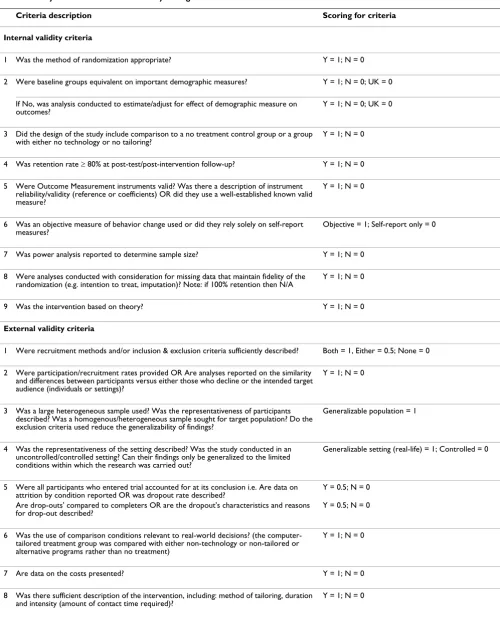
evalua-tion: study design, randomization, methods, analysis, length of follow-up; Outcome measures: primary & sec-ondary, instruments used, validation; Findings: generaliz-ability, sustaingeneraliz-ability, retention; Strengths & limitations of the study. These two authors independently performed a quality coding assessment of all studies, which consisted of eighteen criteria symbolizing the quality of the inter-vention and the study internal and external validity (Table 1). These characteristics were adapted from those used in previous reviews [6,12], the Australian NPHP guidelines for evaluating evidence on public health interventions [17] and external validity criteria outlined by Glasgow & Emmons [18]. Each criteria had the same value or weight-ing, the sum of which was used as a validity score, calcu-lated as a percent of the maximum obtainable score. Ranking disagreements were discussed by all authors until consensus was reached. All authors reviewed both the summarized review of studies and the quality assessment then convened to reach consensus on the strength of evi-dence.
Results
Study selection
The initial cross-database literature search yielded 769 publications. After removing duplicates and reviewing the title and abstract of these publications against the inclu-sion criteria the number of eligible published articles was 26. After reviewing the full articles, 14 were excluded for meeting one of the exclusion criteria, leaving 12 articles. The search of reference lists of relevant publications yielded three articles. Two additional articles were included: one was identified in the same journal issue of an included study and one was in press, which was iden-tified by a colleague.
A total of sixteen interventions, evaluated in seventeen separate studies aimed to increase physical activity (Addi-tional file 1) [19-35]. Two articles described the post-test [27] and long-term follow-up [26] of the one intervention program. Another two articles were related, but described an adapted version of the intervention and its trial in dif-ferent settings [23,24]. One article described the physical activity component only [35] of a two armed RCT of par-allel nutrition [36] and physical activity interventions.
Six articles described the evaluation of five computer-tai-lored multi-component health interventions that targeted both physical activity and dietary behaviors [19,20,26-28,30]. Four studies also measured weight reduction out-comes [19,20,28,33].
Outcome effects
post-Page 4 of 12
Table 1: Study internal and external validity coding criteria
Criteria description Scoring for criteria
Internal validity criteria
1 Was the method of randomization appropriate? Y = 1; N = 0
2 Were baseline groups equivalent on important demographic measures? Y = 1; N = 0; UK = 0
If No, was analysis conducted to estimate/adjust for effect of demographic measure on outcomes?
Y = 1; N = 0; UK = 0
3 Did the design of the study include comparison to a no treatment control group or a group with either no technology or no tailoring?
Y = 1; N = 0
4 Was retention rate ≥ 80% at post-test/post-intervention follow-up? Y = 1; N = 0
5 Were Outcome Measurement instruments valid? Was there a description of instrument reliability/validity (reference or coefficients) OR did they use a well-established known valid measure?
Y = 1; N = 0
6 Was an objective measure of behavior change used or did they rely solely on self-report measures?
Objective = 1; Self-report only = 0
7 Was power analysis reported to determine sample size? Y = 1; N = 0
8 Were analyses conducted with consideration for missing data that maintain fidelity of the randomization (e.g. intention to treat, imputation)? Note: if 100% retention then N/A
Y = 1; N = 0
9 Was the intervention based on theory? Y = 1; N = 0
External validity criteria
1 Were recruitment methods and/or inclusion & exclusion criteria sufficiently described? Both = 1, Either = 0.5; None = 0
2 Were participation/recruitment rates provided OR Are analyses reported on the similarity and differences between participants versus either those who decline or the intended target audience (individuals or settings)?
Y = 1; N = 0
3 Was a large heterogeneous sample used? Was the representativeness of participants described? Was a homogenous/heterogeneous sample sought for target population? Do the exclusion criteria used reduce the generalizability of findings?
Generalizable population = 1
4 Was the representativeness of the setting described? Was the study conducted in an uncontrolled/controlled setting? Can their findings only be generalized to the limited conditions within which the research was carried out?
Generalizable setting (real-life) = 1; Controlled = 0
5 Were all participants who entered trial accounted for at its conclusion i.e. Are data on attrition by condition reported OR was dropout rate described?
Y = 0.5; N = 0
Are drop-outs' compared to completers OR are the dropout's characteristics and reasons for drop-out described?
Y = 0.5; N = 0
6 Was the use of comparison conditions relevant to real-world decisions? (the computer-tailored treatment group was compared with either non-technology or non-computer-tailored or alternative programs rather than no treatment)
Y = 1; N = 0
7 Are data on the costs presented? Y = 1; N = 0
8 Was there sufficient description of the intervention, including: method of tailoring, duration and intensity (amount of contact time required)?
Y = 1; N = 0
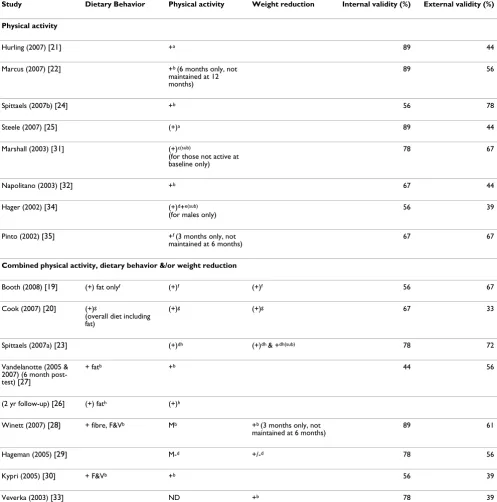
intervention [19-25,27,30-32,34,35] and one reported positive effects at long-term post-intervention follow-up (Table 2) [26]. Of these 14 studies: seven reported a signif-icant short to medium-term effect in favor of the compu-ter-tailored intervention over a control group; [21,22,24,27,30,32,35]; and seven reported a significant positive effect on physical activity over time for both the computer-tailored intervention and a comparison treat-ment group but no significant between group effects, for one of which the effect was only found for those inactive at baseline [31]. The comparison treatment groups for these studies are outlined in Table 2. Of the three studies which did not find positive effects on physical activity behavior outcomes, two reported positive effects on phys-ical activity mediators such as self-efficacy and physphys-ical activity self-regulation strategies [28,29] and two reported significant positive effects on weight reduction outcomes [28,33].
Two of the studies mentioned above with short to medium-term positive effects on physical activity were not able to report positive effects at longer-term post-test fol-low-up [22,35]. It is worth noting the positive medium-term effects on physical activity found for one interven-tion at test [27] were confirmed at long-term post-intervention follow-up, however there was no control group and a potential drop-out bias at the long-term fol-low-up [26]. The authors of this study noted the limita-tions of these findings in terms of real-life effectiveness, generalization and application to practice due to the con-trolled setting and motivated sample [26,27]. However medium-term post-test positive effects on physical activity were also found for an adapted version of this same inter-vention program implemented in a real-life setting using the Internet [24].
Study quality: Internal & external validity characteristics
Internal validity scores
The internal validity scores ranged from 44–89%, with an average of 71% for all studies and 67% for those studies reporting significant positive between group effects on physical activity outcomes (Table 2). Of the eight studies which had an above average internal validity quality rat-ing (> 71%) five found positive between-group effects: two for physical activity outcomes and three for weight reduction outcomes. Most quality criteria reflecting the internal validity of studies were met by a majority of stud-ies, with the exception of three quality criteria: reporting a rationale for sample size; the use of objective measures of behavior change; and conducting analyses with consider-ation for missing data that maintained the fidelity of the randomization. Low internal validity scores reported by studies reporting significant positive between group effects on physical activity outcomes were mainly due to reliance on self-report measures of behavior, poor
reten-tion rates and no descripreten-tion of the following: whether baseline groups were demographically equivalent; and sample size determination.
External validity scores
The external validity scores ranged from 33–78%, with an average of 54% for all studies and 52% for those studies reporting significant positive between group effects on physical activity outcomes (Table 2). Of the nine studies which had an above average external validity quality rat-ing (> 54%) six reported positive between-group effects: four for physical activity outcomes and two for weight reduction outcomes. Only a minority of studies met the following external validity criteria: reporting the mainte-nance of long-term post-intervention effects; reporting on intervention costs; using representative samples; and reporting on participation or recruitment rates or the sim-ilarity and differences between participants to either those who declined participation or the intended target audi-ence.
Intervention and study characteristics
Mode of delivery
All interventions were classified as 'second' generation computerized interventions with only one including addi-tional mobile phone technology, considered as 'third' generation technology [21]. The majority of interventions were delivered using the Internet and/or email [19-21,23-25,28,29,31-34], followed by desktop computer pro-grams [27,30] and telephone [22,35].
Of 11 studies that isolated the effect of the technology by comparing the computer-tailored intervention group to either a no-treatment or waiting list control, or a compar-ison treatment group receiving print materials or personal counseling, nine found significant between group effects: 6 for physical activity [21,22,24,27,30,32] and three for weight reduction outcomes [23,28,32]. Of these nine studies, six were delivered using the Internet and/or email [21,23,24,28,32,33], two were delivered using desktop computer programs [27,30] and one was delivered by tel-ephone [22]. One Internet-based study also used mobile telephone technology [21].
Study sample
Baseline sample size ranged from 31 to 1071. Nine studies either described dropouts compared to study completers and/or described reasons for dropout [19,22-24,26,28,30,32,35], five studies reported a rationale for sample size [25,28-31], and only four studies reported on the characteristics of participants compared to the target population [23,24,28,31].
Page 6 of 12
Table 2: Outcome effects* and validity scores of reviewed studies
Study Dietary Behavior Physical activity Weight reduction Internal validity (%) External validity (%) Physical activity
Hurling (2007) [21] +a 89 44
Marcus (2007) [22] +b (6 months only, not maintained at 12 months)
89 56
Spittaels (2007b) [24] +b 56 78
Steele (2007) [25] (+)a 89 44
Marshall (2003) [31] (+)c(sub)
(for those not active at baseline only)
78 67
Napolitano (2003) [32] +b 67 44
Hager (2002) [34] (+)d+e(sub) (for males only)
56 39
Pinto (2002) [35] +f (3 months only, not maintained at 6 months)
67 67
Combined physical activity, dietary behavior &/or weight reduction
Booth (2008) [19] (+) fat onlyf (+)f (+)f 56 67
Cook (2007) [20] (+)g
(overall diet including fat)
(+)g (+)g 67 33
Spittaels (2007a) [23] (+)dh (+)dh & +dh(sub) 78 72
Vandelanotte (2005 & 2007) (6 month post-test) [27]
+ fatb +b 44 56
(2 yr follow-up) [26] (+) fath (+)h
Winett (2007) [28] + fibre, F&Vb Mb +b (3 months only, not maintained at 6 months)
89 61
Hageman (2005) [29] M-d +/-d 78 56
Kypri (2005) [30] + F&Vb +b 56 39
Veverka (2003) [33] ND +b 78 39
Key:
+ significant difference over time between treatment & control group OR significant difference between groups at post-test (+) significant difference within groups over time but no significant difference between groups
+/- conflicting results
M positive effects on behavior mediators but not on actual behavior M – negative effects on behavior mediators
(sub) outcome effect only for sub sample (1 worksite, n = 57) ND no difference
*Outcome effects are reported for the effect of the computer-tailored intervention group as compared to the following control groups:
a Tailored (personal) verbal b No treatment control group c Tailored print comparison group d Generic computerized comparison group
e Computerized comparison group with different method of tailoring f Comparison treatment group on different/additional targeted behavior g Generic print comparison group
small or unrepresentative sample; an unrepresentative tar-get population, or the controlled setting within which the study was conducted. The majority of study samples usu-ally consisted of healthy adults recruited through commu-nity settings, [19,21,22,24-29] followed by the workplace, [20,23,31,32,34] primary care [30,35] and one in the mil-itary [33]. The majority of interventions recruited self-select volunteer individuals [19-25,27-30,32-35]. Many studies used additional eligibility or exclusion criteria related to medical conditions [22-24,27,28,32,33,35] age, [21,23,24,27,29,33,35] health behavior status [21,22,25,29,32,35], medication [19,21,22,33] body mass index (BMI) [19,21,22] and gender [29].
The majority of samples were predominately female, well educated and Caucasian. Of the 17 studies, 14 reported a predominately female baseline or follow-up sample [19-22,24-29,31,32,34,35] with a median proportion of 67% for all studies. Eleven of the 13 studies reporting on edu-cation level of their baseline or follow-up sample had a predominately well-educated sample, as determined by level of educational attainment or years of education, [19,20,22-24,26,27,29-32,34] with a median proportion of 71% for all 13 studies. All seven studies reporting on the ethnic-racial background of their baseline or follow-up sample had a predominately Caucasian/White sample, with a median proportion of 90% [19,20,22,29,32, 34,35].
Of the seven computer-tailored interventions reporting significant positive between group effects on physical activity outcomes [21,22,24,27,30,32,35] all but one study [30] had a predominately female baseline or follow-up sample and five reported a predominately well-edu-cated sample [22,24,27,30,32].
Duration and exposure
Of the seven computer-tailored interventions reporting significant positive between group effects on physical activity outcomes [21,22,24,27,30,32,35] five were multi-ple exposure interventions, ranging from nine weeks to 12 months duration [21,22,24,32,35] three of which ensured weekly exposure at minimum [21,32,35] and the remain-ing two approximately monthly [22,24]. Two of the inter-ventions involved a single exposure for the participant to a computer-tailored program [27,30] one of which was followed up at two years [26].
Napolitano et al [32] questioned whether participants received adequate exposure to their three month interven-tion after the first month as most of the physical activity outcome changes that occurred did so in the first month and they received anecdotal feedback from participants suggesting that changing the static website over time would be worthwhile. Steele et al [25] reported sustained
physical activity outcomes at five months and noted their content was delivered on a weekly basis to enhance user engagement over time.
Intensity
Four interventions compared computer-tailored interven-tion groups which differed in intensity [19,23,24,27] only one of which found significant differences between the groups, reporting the higher intensity intervention group had greater improvements than the lower intensity group, but only for a sub sample of participants [23].
Two web-based studies compared computer-tailored intervention groups with the same intervention in addi-tion to personal support [25,28]. One study found that the intervention group receiving the additional social sup-ports had better outcomes, however both groups had sig-nificantly better outcomes than a waitlist control group [28]. The other study found no enhanced physical activity outcomes for additional personal contact, concluding that the Internet intervention was as effective as the face-to-face intervention [25].
Use of theory
Of the seven computer-tailored interventions reporting significant positive between group effects on physical activity outcomes [21,22,24,27,30,32,35] a wide range of theories were used, most commonly the transtheoretical model [22,24,27,32,35], social cognitive theory [22,32,35], and the theory of planned behavior [24,27]. These were also the most commonly used theories overall. Other theories of successful interventions included deci-sion making theory [35] and social psychological theories (social comparison, decisional balance, elaboration likeli-hood, Goal [21].
Tailoring
Only two studies isolated the effect of the tailoring by comparing the computer-tailored intervention group to a comparison treatment group receiving generic informa-tion via the same technology. Neither of these studies reported significant between-group differences in physical activity outcomes [23,29].
Page 8 of 12
and feedback tailored to participant's self-efficacy [23,24,27,29] their intentions and attitudes, [23,24,27] and their perceived benefits and/or barriers to behavior [21,29].
Outcomes and instrument validity
Only one physical activity study did not indicate the use of valid instruments to measure behavioral outcomes [30]. The most commonly used instrument for measuring physical activity outcomes was the long or short version of the International Physical Activity Questionnaire [21,23,24,26,27,31]. Other questionnaires included the Seven-day Physical Activity Recall [22,34,35], the Physical Activity Readiness Questionnaire [28,32], the Active Aus-tralia questionnaire [19,25], the Modified Seven-day Activity Recall [29], the Behavioral Risk Factor Surveil-lance System [32] and the Veterans Specific Activity Ques-tionnaire [28].
Objective physical activity outcome measurement instru-ments included the pedometer [19,28], accelerometer [21], functional capacity (estimated VO2) test [22], tread-mill duration test [22], exercise stress test [22], a modified sit-and-reach test [29], the Rockport Fitness Walking Test [29] and a submaximal cycle ergometry test [33]. In one study a sub-sample also wore an Actigraph to validate self-reported behavioral outcome findings [22].
Six studies included weight reduction as an outcome measure, reported as change in BMI, percentage body fat, body composition, waist circumference and waist-to-hip ratio. Four of the studies used objective ways of measuring weight changes, three by taking anthropometric measure-ments in a clinic (height, weight and/or body fatness and/ or waist circumference) [19,23,33] and one using bio-medical impedance analysis [29]. Two of the six studies used self-reported measures of weight and/or height [20,28].
All nine studies only using self-report measures of physi-cal activity reported positive effects on physiphysi-cal activity outcomes, either between group effects [24,27,32,35] or within group effects over time [23,25,26,31,34]. Only half of the studies using more objective measures of physical activity found positive effects between groups [21,22] or within groups [19].
Retention rates
Studies reported retention rates for different timeframes making comparisons difficult. Retention rates were com-pared by considering post-test retention rates when reported, [19-22,24,27,28,32-35] and when not available the earliest post-intervention follow-up retention rate was used as the best approximation, the majority of which were short-term (< 3 months) [29-31], and a couple medium-term (3 ≤ months ≤ 6) [23,25].
Estimated retention rates ranged from 66–97%, ten of which were above 80% [20-22,25,28-30,32,33,35]. It must be noted the majority of these relatively higher retention rates were actual post-test measurements [20-22,25,28,32,33,35]. For the seven studies reporting reten-tion rates lower than 80%, most were measured at post-test [19,24,27,34] with two based on approximations from reported post-intervention follow-up retention measurements: short-term [31], and medium-term [23], which may account for the relatively lower rates.
There were some commonalities between the studies with relatively high retention. All used highly motivated and/ or self-select samples, eight of which had predominately female samples (range 66–100%) and five of the six stud-ies reporting on education levels of participants, had pre-dominately well-educated samples (range 71–95%). All but one study [30] were intended as multiple exposure interventions; the majority of which either used control-led program delivery, which provides new information at each exposure [21,22,25,28,29,33,35] and/or offered incentives to participants [20-22,25,28,30]. However these characteristics were not necessarily predictors of good retention. Due to the small number of heterogene-ous studies reviewed we could not find any consistent relationship between retention rates and mode of deliv-ery, intervention duration, intervention intensity and length of follow-up.
Three studies reported both retention rates at post-test and post-intervention follow-up retention rates, two of which were able to report rates above 80% at both times: one short-term post-intervention follow-up [29] and one at medium-term post-intervention follow-up [28]; and another study was able to report a post-test retention rate above 80%, for which the medium-term post-interven-tion follow-up retenpost-interven-tion rate was only slightly below at 77% [25]. All three interventions involved multiple expo-sures and used controlled program delivery.
Study design: isolating the effect of the technology
Four studies isolated the effect of the computer-tailored intervention in terms of the technology by comparing to a tailored non-technology control group. Only one of these reported between-group differences in favor of the com-puter-tailored intervention on physical activity outcomes, however the intensity differed significantly between the groups [21].
Intervention costs
Internet-based intervention with nutrition counseling [19]. They reported that although the original set-up costs for a website are costly (minimum $20 000 AUD) ongo-ing costs are minimal and additional cost savongo-ings may be had by participants due to no travel time or costs. One US study indicated operating costs of a computer-tailored tel-ephone communications system was low, that is, between $1 to $2 US per call, including all personnel and non-per-sonnel costs [35].
Discussion
This narrative systematic review has described the range of evidence on 'second' and 'third' generation computer-tai-lored primary prevention interventions targeting physical activity behavior change in adults. Common characteris-tics of interventions that produced significant between-group effects and interventions with good retention rates were considered, as were internal and external validity of studies as measures of quality and generalizability.
This review differs from previous systematic reviews on computer-tailored interventions [5,6] in the following ways: our review was exclusive to primary prevention interventions; first generation computer-tailored interven-tions and studies in which tailoring was not generated through an expert system were excluded; the review was not limited to RCTs, but also included quasi-experimental studies and studies with limited interpersonal contact that did not involve counseling. To our knowledge, previous reviews have not attempted to gauge the external validity of such intervention studies, although they have included varying measures of external validity in their quality crite-ria. Doing so is important in determining their generaliz-ability and relevance to health promotion practice [37].
The volume of evidence has grown since the publication of previous reviews which had indicated that the evidence of effectiveness of computer-tailored interventions in the promotion of physical activity was limited [5,6]. Several more recent studies reported significant positive effects either in comparison to a control group or over time, which boosts the overall evidence of efficacy. Overall, just over half of the studies reported positive short-to-medium term effects in comparison to a control group for physical activity behaviors or weight reduction, the majority of others reporting positive effects within the treatment group over time or positive effects on behavior mediators.
The efficacy of computer-tailored interventions is depend-ent on many factors such as the intervdepend-ention quality, dura-tion, exposure, intensity, use of theory, method of tailoring, source credibility and mode of delivery. Due to the small number of studies that isolated the effect of tai-loring or the technology in their study design no conclu-sions can be drawn on their relative importance for
success. Comparing participant's behavior to current rec-ommendations, tailoring according to the participant's stage of change and tailoring feedback in more than one way were common in studies reporting significant posi-tive between-group outcomes but using these tailoring methods was not necessarily predictive of success. More research is required to determine why and when tailoring is effective [5]. In agreement with the findings of a previ-ous review [5] it seems that whilst the intervention should be based on theory, no one theory has proven to be more applicable or effective. Ensuring multiple intervention exposures may also be important but was neither neces-sary nor predictive of success.
The quality, intervention intensity, duration and mode of delivery differed widely for the seven computer-tailored interventions reporting significant positive between group effects on physical activity outcomes. Success of the inter-vention does not appear dependent on the technology used in its delivery or in its intensity, with little evidence that interventions of greater intensity had better out-comes. This was the case whether additional support was delivered through the technology or interpersonal com-munication. However very few studies compared inter-vention groups of differing intensity, a similar finding to that reported by a previous review [5]. Therefore there is insufficient evidence to determine the optimal intensity for computer-tailored interventions and to determine the best way of delivering interventions targeting more than one behavior change. More research is needed in this area [24,26].
It has been recommended that studies use a combination of validated self-reports with more objective measures of behavior change [5], however less than half the studies included objective measures of physical activity. It appears that the use of objective measures of physical activity may be important in determining whether self-reported changes found are actual, with only one third of studies using objective measures of physical activity find-ing positive between group effects on behavior.
Page 10 of 12
on effectiveness and dissemination may assist in the development of programs in population-based effective-ness settings. Future RCTs should attempt to increase their external validity by including representative participants and answering real-world questions [37]. However this review found such characteristics of design lacking, with the common use of either small, homogenous or unrepre-sentative samples, restrictive exclusion criteria and for some a lack of comparison conditions relevant to real-world decisions, that is, comparison to no treatment con-trols only. Such characteristics significantly limit the dis-semination of such interventions into practice [18].
Although determining cost-effectiveness was not the pur-pose of this review we recommend future studies at the very least report on basic economic measures such as costs, which are relevant to decision-makers and can assist in intervention uptake, dissemination and inform more advanced cost-effectiveness studies [18,37]. Cost-effec-tiveness analyses are recommended as they will be impor-tant in determining the additional value of such intervention delivery modes over the more traditional delivery modes such as face-to-face counseling. The pre-sumed cost savings for participants due to no travel time or costs may be particularly important for those living in rural or isolated areas.
There was a fundamental lack of long-term post-interven-tion follow-up, with only one study demonstrating inter-vention effects were maintained at two years post-baseline[26]. However the generalizability of this study's findings and application to practice may be limited. More studies with long term follow-up of 12 months post-inter-vention are needed [25].
Previously noted poor retention rates of computer-tai-lored interventions, in particular web-based interventions [5-7,11] prompted consideration of characteristics of interventions that might maintain engagement and reten-tion such as the intervenreten-tion's interactivity, durareten-tion, intensity, setting and study sample characteristics. How-ever with the small number of studies comparing reten-tion rates became problematic due to their varied follow-up length and therefore we could not form any definite conclusions. However based on our findings and other published reviews it seems the following intervention characteristics may be important in enhancing participant retention: ensuring multiple exposures to the intervention material, preferably evolving intervention materials or using controlled program delivery; the use of incentives; prompts through another medium; interactive and dynamic web components; and individualized tailoring [6,11,31]. Each of these characteristics may be insufficient on its own to result in good retention and therefore all will need to be considered in intervention design, sample
size calculations and probable retention rates in the future.
Engaging and retaining interest using the Internet and email mediums, which are increasingly busy and through which many other information sources compete for atten-tion will be a challenge. Attracting people to return to a website is challenging in particular for websites that do not offer new information at each visit [7]. Telephone support in Internet-based interventions as an intervention strategy and a maintenance strategy has been shown to be as effective as face-to-face contact and to result in greater adherence and maintenance to the intervention and thus future research in this area is warranted as a way of increasing Internet engagement [25].
The limitations of this review must also be acknowledged. Firstly, this review did not actively seek unpublished stud-ies, although one such study was included. Therefore when considering the findings of this review, the possibil-ity of publication bias must be noted, resulting in a bias of studies with positive findings. However given the fairly high proportion of published studies reviewed that did not have significant findings, it is believed that the likeli-hood of publication bias is minimal.
Secondly, this review did not include articles in which physical activity behavior was not a primary outcome. This meant that articles were excluded in which psycho-logical indicators, behavior mediators or process meas-ures were the only outcome measmeas-ures reported. Although behavior mediator effects, where available, were exam-ined when behavioral change outcome effects were absent or conflicting, process measures were not described. This limits our discussion on retention, engagement and acceptability of computer-tailored interventions and their components in different population subgroups and set-tings. Although this was not the purpose of the review, reviewing research in this area would be worthwhile as it may indicate different levels of acceptance and the relative effectiveness in different population subgroups. This may be particularly important given the majority of reviewed studies had predominantly female, Caucasian, well edu-cated samples.
sizes [5,6]. We agree with these and other authors that despite the small effect sizes found, such interventions can have substantial impact at a population health level, with their potential for wide distribution at low cost [5,6]. However it will be critical to determine whether such find-ings are generalizable, can be replicated and to ensure ade-quate reach and engagement within varied population groups for such interventions.
In addition, our findings on common characteristics of successful interventions and those with good retention are limited due to the small number of heterogeneous studies included and our reliance on varying levels of detail pro-vided in each article. Only a small proportion of the retrieved articles were included in this review. The main reasons for this include: many studies were duplicated in the databases that were searched, broad search terms were used and the exclusion criteria were specific and detailed. For example, the search terms did not distinguish between first, second and third generation interventions and first generation interventions which make up a substantial proportion of the literature were not considered in this review.
Lastly, due to the small number of studies reporting posi-tive weight reduction outcomes, the relaposi-tive contribution of nutrition and physical activity behaviors to such out-comes were not examined in this review.
Future research should endeavor to replicate studies in different populations to indicate effectiveness and gener-alizability. Following the example of Vandelanotte and colleagues where the same theory-based intervention was trialed and adapted in different population groups & set-tings and followed up long term [23,24,26,27,39] in addi-tion to their reports on the acceptability and feasibility of these interventions in individuals of different age, sex, education level and computer literacy [9,10] is important in building the evidence base.
Conclusion
The evidence base regarding the effectiveness of compu-ter-tailored physical activity interventions is growing. However, no conclusions on their effectiveness can be drawn, given inconsistent results of the studies. These interventions have the potential to reach large groups of people, albeit self-selected groups. The uncertainty lies in whether the reported behavior changes found can be sus-tained long-term, and whether they are generalizable. Also, the relative success of different components of effi-cacious interventions is unclear in addition to the optimal intervention intensity. Interventions should be based on theory and ensure multiple exposures, preferably with evolving intervention materials. These factors may also be important in enhancing retention, in addition to
tailor-ing, the use of incentives, interactive and dynamic compo-nents and prompts through another medium.
Further research will be needed on computer-tailored physical activity primary prevention interventions includ-ing: the replication of successful efficacy trials in different settings and population groups; more effectiveness stud-ies in representative heterogeneous populations that com-pare to current practice; a review of the research on engagement and acceptability of such interventions; and most importantly long-term post-intervention follow-up and cost-effectiveness studies. More research is also needed to determine the optimal intensity for population-level interventions.
Competing interests
The authors declare that they have no competing interests.
Authors' contributions
LN participated in the design of the study, reviewed the lit-erature and drafted the manuscript. BOH participated in the design of the study, reviewed the literature and revised and edited the manuscript. AM conceived of the study, participated in its design and coordination, and revised and edited the manuscript.
Additional material
Acknowledgements
The Authors would like to thank both the library staff of the New South Wales Department of Health and Liz Develin, Director, Centre for Health Advancement, New South Wales Department of Health.
References
1. World Health Organization: Physical Inactivity: A Global Public Health Problem. 2008 [http://www.who.int/dietphysicalactivity/ factsheet_inactivity/en/print.html]. Accessibility verified June 5, 2008. 2. World Health Organization: Preventing Chronic Diseases: A Vital Investment. Switzerland 2005 [http://www.who.int/chp/ chronic_disease_report/contents/en/index.html].
3. Australian Institute of Health and Welfare: Australia's Health 2006. AIHW cat. no. AUS 73. Canberra 2006.
4. World Health Organization: Reducing Risks, Promoting Healthy Life. World Health Report: Switzerland; 2002.
5. Kroeze W, Werkman A, Brug J: A systematic review of rand-omized trials on the effectiveness of computer-tailored edu-cation on physical activity and dietary behaviors. Ann Behav Med 2006, 31(3):205-223.
Additional file 1
Table S1: Summary of physical activity behavior change interventions. The data provides a summary of each study regarding the following areas: Context/setting and sample characteristics; Intervention characteristics & control condition; Study design & evaluation Method; Outcome measures; and Key Findings.
Click here for file
Publish with BioMed Central and every scientist can read your work free of charge "BioMed Central will be the most significant development for disseminating the results of biomedical researc h in our lifetime."
Sir Paul Nurse, Cancer Research UK
Your research papers will be:
available free of charge to the entire biomedical community
peer reviewed and published immediately upon acceptance
cited in PubMed and archived on PubMed Central
yours — you keep the copyright
Submit your manuscript here:
http://www.biomedcentral.com/info/publishing_adv.asp
BioMedcentral
Page 12 of 12 6. Norman GJ, Zabinksi MF, Adams MA, Rosenberg DE, Yaroch AL,
Atienza AA: A Review of eHealth Interventions for Physical Activity and Dietary Behavior Change. Am J Prev Med 2007,
33(4):336-345.
7. Brug J, Oenema A, Kroeze W, Raat H: The internet and nutrition education: challenges and opportunities. Eur J Clin Nutr. 2005,
59(Suppl 1):S130-S139.
8. Oenema A, Brug J, Lechner L: Web-based tailored nutrition edu-cation: Results of a randomized controlled trial. Health Educ Res 2001, 16(6):647-660.
9. Vandelanotte C, De Bourdeaudhuij I, Brug J: Acceptability and fea-sibility of an interactive computer-tailored fat intake inter-vention in Belgium. Health Promot Int 2004, 19(3):463-470. 10. Vandelanotte C, De Bourdeaudhuij I: Acceptability and feasibility
of a computer-tailored physical activity intervention using stages of change: project FAITH. Health Educ Res 2003,
18(3):304-317.
11. Vandelanotte C, Spathonis KM, Eakin EG, Owen N: Website-Deliv-ered Physical Activity Interventions: A Review of the Litera-ture. Am J Prev Med 2007, 33(1):54-64.
12. Berg MH Van den, Schoones JW, Vliet Vlieland TPM: Internet-Based Physical Activity Interventions: A Systematic Review of the Literature. J Med Internet Res [serial online] 2007, 9(3):e26. 13. Rychetnik L, Hawe P, Waters E, Barratt A, Frommer M: A glossary
for evidence based public health. J Epidemiol Community Health
2004, 58:538-545.
14. Weinstein PK: A Review of Weight Loss Programs Delivered Via the Internet. J Cardiovasc Nurs 2006, 21(4):251-258. 15. Kirsch SED, Lewis FM: Using the World-Wide Web in
Health-related Intervention Research: A Review of Controlled Tri-als. Comput Inform Nurs. 2004, 22(1):8-18.
16. Wantland DJ, Portillo CJ, Holzemer WL, Slaughter R, McGhee EM:
The Effectiveness of Web-Based vs. Non-Web-Based Inter-ventions: A Meta-Analysis of Behavioral Change Outcomes.
J Med Internet Res [serial online] 2004, 6(4e40 [http://www.jmir.org/ 2004/4/e40/].
17. Rychetnik L, Frommer M: A Schema for Evaluating Evidence on Public Health Interventions: Version 4. National Public Health Partnership: Melbourne; 2002.
18. Glasgow RE, Emmons KM: How can we increase translation of research into practice? Types of evidence needed. Annu Rev Public Health. 2007, 28:413-433.
19. Booth AO, Nowson CA, Matters H: Evaluation of an interactive, tailored. Internet-based weight loss program: A pilot study.
Health Educ Res 2008, 23(3):371-381.
20. Cook RF, Billings DW, Hersch RK, Back AS, Hendrickson A: A Field Test of a Web-Based Workplace Health Promotion Pro-gram to Improve Dietary Practices, Reduce Stress, and Increase Physical Activity: Randomized Controlled Trial. J Med Internet Res. 2007, 9(2):e17.
21. Hurling R, Catt M, De Boni M, Fairley BW, Hurst T, Murray P, Rich-ardson A, Sodhi JS: Using Internet and Mobile Phone Technol-ogy to Deliver an Automated Physical Activity Program: Randomized Controlled Trial. J Med Internet Res. 2007, 9(2):e7. 22. Marcus BH, Napolitano MA, King AC, Lewis BA, Whiteley JA, Albre-cht A, Parisi A, Bock B, Pinto B, Sciamanna C, Jakicic J: Telephone Versus Print Delivery of an Individualized Motivationally Tai-lored Physical Activity Intervention: Project STRIDE. Health Psychol 2007, 26(4):401-409.
23. Spittaels H, De Bourdeaudhuij I, Brug J, Vandelanotte C: Effective-ness of an online computer-tailored physical activity inter-vention in a real-life setting. Health Educ Res 2007,
22(3):385-396.
24. Spittaels H, De Bourdeaudhuij I, Vandelanotte C: Evaluation of a website-delivered computer-tailored intervention for increasing physical activity in the general population. Prev Med 2007, 44:209-217.
25. Steele R, Mummery WK, Dwyer T: Using the Internet to Pro-mote Physical Activity: A Randomized Trial of Intervention Delivery Modes. J Phys Act Health 2007, 4(3):245-260.
26. Vandelanotte C, De Bourdeaudhuij I, Brug J: Two-Year Follow-Up of Sequential and Simultaneous Interactive Computer-Tai-lored Interventions for Increasing Physical Activity and Decreasing Fat Intake. Ann Behav Med 2007, 33(2):213-219. 27. Vandelanotte C, De Bourdeaudhuij I, Sallis JF, Spittaels H, Brug J:
Effi-cacy of Sequential or Simultaneous Interactive
Computer-Tailored Interventions for Increasing Physical Activity and Decreasing Fat Intake. Ann Behav Med 2005, 29(2):138-146. 28. Winett RA, Anderson ES, Wojcik R, Winett SG, Bowden T: Guide
to Health: Nutrition and Physical Activity Outcomes of a Group-Randomized Trial of an Internet-Based Intervention in Churches. Ann Behav Med 2007, 33(3):251-261.
29. Hageman PA, Noble Walker S, Pullen CH: Tailored Versus Stand-ard Internet-delivered Interventions to Promote Physical Activity in Older Women. J Geriatr Phys Ther 2005, 28(1):28-33. 30. Kypri K, McAnally HM: Randomized controlled trial of a web-based primary care intervention for multiple health risk behaviors. Prev Med 2005, 41:761-766.
31. Marshall AL, Leslie ER, Bauman AE, Marcus BH, Owen N: Print Ver-sus Website Physical Activity Programs: A Randomized Trial. Am J Prev Med 2003, 25(2):88-94.
32. Napolitano MA, Fotheringham M, Tate D, Sciamanna CA, Leslie E, Owen N, Bauman A, Marcus B: Evaluation of An Internet-Based Physical Activity Intervention: A Preliminary Investigation.
Ann Behav Med 2003, 25(2):92-99.
33. Veverka DV, Anderson J, Auld GW, Coulter GR, Kennedy C, Chap-man PL: Use of the Stage of Change Model in Improving Nutrition and Exercise Habits in Enlisted Air Force Men. Mil Med 2003, 168(5):373-379.
34. Hager RH, Hardy A, Aldana SG, George JD: Evaluation of an Inter-net, Stage-Based Physical Activity Intervention. Am J Health Educ 2002, 33(6):329-337.
35. Pinto BM, Marcus RFH, Kelley H, Tennstedt S, Gillman MW: Effects of a Computer-Based, Telephone-Counseling System on Physical Activity. Am J Prev Med 2002, 23(2):113-120.
36. Delichatsios HK, Friedman RH, Glanz K, Tennstedt S, Smigelski C, Pinto BM, Kelley H, Gillman MW: Randomized Trial of a "Talking Computer" to Improve Adults' Eating Habits. Am J Health Pro-mot 2001, 15(4):215-224.
37. Rabin BA, Brownson RC, Kerner JF, Glasgow RE: Methodologic challenges in disseminating evidence-based interventions to promote physical activity. Am J Prev Med 2006, 31(Suppl 4):24-34.
38. Block G, Wakimoto P, Metz D, Fujii ML, Feldman N, Mandel R, Suth-erland B: A Randomized Trial of the Little by Little CD-ROM: Demonstrated Effectiveness in Increasing Fruit and Vegeta-ble Intake in a Low-income Population. Prev Chronic Dis 2004,
1(3):A08.