Study the effect of partially replacement
sand by waste pistachio shells in cement mortar
Zainab Hashim Abbas Alsalami
*Introduction
The high cost of construction materials is a major problem in the construction industry. Therefore, researchers tend to study more economic materials such as agricultural and industrial waste Materials. However, these waste materials if not charged safely it may be dangerous. The manufacture of traditional masonry materials consume a lot of thermal and electrical power and in return it turn contaminates the air, water and land.
Other benefits of using agricultural waste materials in the construction industry instead of naturalistic materials are protection of natural resources, elimination of waste materials and release of precious ground for different purposes.
Pistacia vera is an individual from the Anacardiaceae or cashew family. Pistachio trees are separate sex, implying that there are isolated male and female trees. The criterion male class is “Peters”, the essential vaccinator for “Kerman”, the principle female class [1].
Abstract
The most economic and environmental problems result from burial agricultural waste materials. The main objective of the present investigation is to assess the usefulness of agricultural waste in mortar admixture. These materials are expected to reduce the density of the admixture, and thus producing lightweight mortar.This study aims to study the effect of using pistachio shells as partial replacement of sand on the proper-ties of cement mortar. Furthermore, the effect of density, absorption, and compressive strength of cement mortar were also obtained.Ordinary Portland cement from Kufa Cement Plant was used with a water cement ratio of 0.48 and a mix proportion of 1:3, also six percentages of pistachio shells were used (10, 20, 30, 40, 50 and 60% by weight of fine aggregate).A total number of 84 mortar cubes were casted with 12 cubes for each mixture ratio. From 84 mortar cubes 21 cubes were utilized to calculate the aver-age water absorption and 63 cubes were utilized to calculate the averaver-age density and compressive strength.Compressive strength values of the mortar cubes were evaluated at 7, 14, 28 days at different percentage replacement levels obtaining a range of values of 6.78, 8.92 and 14.1 MPa, respectively at 20% replacement.The density values were reduced with the increment in replacement levels until it reached (1.21 and 1) gm/cm3 at 28 days with replacement percentages of (50 and 60%) respectively.Water absorp-tion was increased with the increment in replacement levels and reaching (6.04%) at (60%) replacement level.
Keywords: Pistachio shells, Compressive strength, Density and absorption
Open Access
© The Author(s) 2017. This article is distributed under the terms of the Creative Commons Attribution 4.0 International License (http://creativecommons.org/licenses/by/4.0/), which permits unrestricted use, distribution, and reproduction in any medium, provided you give appropriate credit to the original author(s) and the source, provide a link to the Creative Commons license, and indicate if changes were made.
RESEARCH ARTICLE
*Correspondence: [email protected]. edu.iq
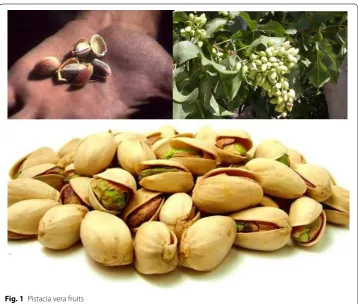
The pistachio is local to the Asia Minor region, from the islands of the Mediterranean in the west to India in the east. Furthermore, it is broadly found in Syria, Iraq and Iran. It presumably created in inside wilderness zones, since it demands extended, warm sum-mers for organic product development, is dry season and salt tolerant, in addition to that has a high winter severe prerequisite. Figure 1 explains Pistacia vera fruits.
Several researchers have discussed the replacement of sand by many types of waste materials; Ganiron studied the use of recycled glass bottles as fine aggregates in con-crete mixture. He concluded that the use of recycled glass bottles as an alternative fine aggregate for concrete mix decreases the unit weight of concrete, the value of modulus of elasticity and cost of concrete, he also concluded that the use of recycled bottles as an alternative of fine aggregate is not recommended for structural members such as col-umns, beams and suspended slabs [2].
Sada et al. investigated the use of groundnut as a replacement of fine Aggregate; they found that the use of groundnut shell in concrete reduces the concretes workability due to the high absorption of water by the groundnut shell; the densities and compressive strength of concrete decreased with the increase in groundnut shell percentage [3].
Obilade conducted experimental study on rice husk as fine aggregates in concrete; he found that the density reduces with the increase in the percentage of husk rice, he also concluded that there is a high potential for the use of rice husk as fine aggregate in the production of lightly reinforced concrete [4].
Mortar is a mixture of sand, cement and water. The main difference between mortar and concrete is mortar does not have coarse aggregate.
Mohammed stated that as a result of the heterogeneity of the mortar, its technique of conduct under various load impacts is subject to the properties of the constituents of the mortar. Sand has an important effect on the characteristics of the mortar because it forms the master volume of mortar; therefore the chosen of convenient aggregates in mortar is very substantial [5].
De Schutter and Poppe demonstrate an exceptionally noteworthy impact of the sand sort on the mortar properties [6].
Mortar is the material responsible for the dividing of stresses in building structures; therefore studying the properties of mortar is significant to ensure a good performance of masonry structures [7].
Lenczner stated that the main purpose of mortar is to adhesively join the individual masonry units together. It also provides defense against the permeation of air and water through the joints in a masonry assembly. Mortar also links the non-masonry elements of an assembly such as joint reinforcement and ties. Minor dimensional variations in the masonry units have also been compensated by mortar. Finally, mortar joints have impor-tant effect on architectural quality of construction through colour and shadow [8].
Mortars are characterized into four Types: M, S, N and O by ASTM C 270, 2006 [9]:
• Type N mortar: General universally aims mortar with great binding abilities and workability.
• Type S mortar: General universally aims mortar with higher flexural bond quality.
• Type M mortar: High compressive-quality mortar, however not exceptionally work-able.
• Type O mortar: Low-strength mortar, utilized generally for inside applications and reclamation.
Materials and methods
Cement
Ordinary Portland Cement (OPC) according to ASTM C150 Type 1 [10] commercially accessible in Kufa cement plant.
Test results indicated that the embraced cement adjusts to Iraqi specifications IQS No. 5/1984 [11].
The chemical composition and physical properties of this OPC were given in Tables 1, 2 respectively.
Sand
The fine aggregate utilized throughout this work are brought from AL-Ekhadir region. Tests have been completed to decide the gradation, fineness modulus, and sulfate con-tent. Results demonstrated that the fine aggregate were conformed to the requirements of IQS No. 45/1984 [12] as shown in Tables 3, 4.
Pistachio shells
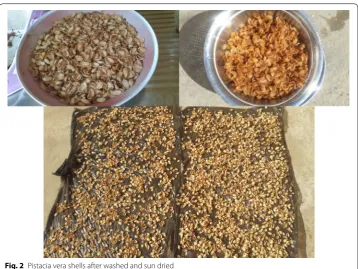
pieces), afterward the Pistachio shells were squashed utilizing electric power grinder machine shown in Fig. 3 to diminish it to sizes similar to fine aggregate as determined in IQS No. 45/1984 [12].
Table 1 Chemical composition of cement
Compound composition Chemical composition Percentage by weight Limits of IQS 5:1984
Lime CaO 60.77 _
Silica SiO2 19.35 _
Alumina Al2O3 5.2 _
Iron oxide Fe2O3 3.6 _
Magnesia MgO 2.95 < 5
Sulfate SO3 2.5 < 2.8
Loss on ignition L.O.I 1.15 < 4
Insoluble residue I.R 0.2 < 1.5
Lime saturation factor L.S.F 0.5 0.66–1.02
Main compounds (Bogue’s equation) percentage by weight of cement
Tricalcium silicate (C3S) 53.0569
Dicalcium silicate (C2S) 15.5296
Tricalcium aluminate (C3A) 7.696
Tetraclcium aluminoferrite (C4AF) 10.944
Table 2 Physical properties of cement
Physical properties Test results Limits of (IQS NO. 5/1984)
Setting time (Vicat’s Method)
Initial, (min) 124 ≥ 45 min
Final, (min) 420 ≤ 600 min
Fineness (Blaine Method), m2/kg 307 ≥ 230 m2/kg
Table 3 Grading of fine aggregate
No. Sieve size (mm) Passing % Limits of Iraqi specification no. 45/1984 for zone 2
1 9.5 100 100
1 4.75 98.2 90–100
2 2.38 80.7 75–100
3 1.18 69.8 55–90
4 0.59 50.6 35–59
5 0.30 27.7 8–30
6 0.15 4.2 0–10
Table 4 Physical and chemical properties of fine aggregate
No. Properties Test results Limits of Iraqi specification no. 45/1984
2 SO3 content 0.42% ≤ 0.5%
The pistachio shells were sieved by utilizing 4.75 mm sieve to dispense with harmful materials and curiously large particles.
Some physical tests performed on pistachio shells sample are displayed in Table 5. For determining the specific gravity of pistachio shells, flask, measuring balance, fil-tered water and a drying material were utilized as a part of the assurance of specific gravity of pistachio shells. Vacuous, pure and arid specific gravity flask with its plug was measured (W1). The flask was filled to 33% full with the pistachio shells specimen and
Fig. 2 Pistacia vera shells after washed and sun dried
rebalanced (W2). A little quantity of filtered water was then included and the jug
sub-stance vibrated to evacuate trapped air. Vibration proceeded and more water included until the point that the container was full. The plug was embedded and abundance water cleaned on flask and measured (W3). The container from that point was discharged,
alto-gether cleaned and swabbed dry and after that loaded with filtered water and the plug embedded and overabundance water swabbed and measured (W4).
Calculation of specific gravity for pistachio shells were as follows:
where: W1 = weight of empty flask, (85 gm), W2 = weight of flask + cement, (109 gm),
W3 = weight of flask + cement + water, (206 gm), W4 = weight of flask + water, (383
gm).
Experimental set up
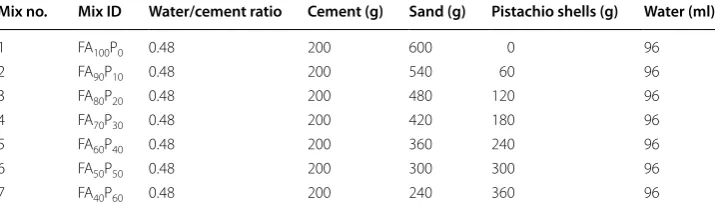
Mixing by weight approach was embraced in this examination work. A blend propor-tion of 1:3 (by weight of cement: fines) with a water cement proporpropor-tion of 0.48 were kept constant for all the blends. The substitution ratios of fine aggregate with pistachio shells were 0, 10, 20, 30, 40, 50 and 60% by weight of the fine aggregate to study the impacts of various extents of the pistachio shells on a few properties of mortar. Table 6 displays the computed masses of constituent materials for all blends. The 0% substitution filled in as control for different blends. Compressive strength as per B.S 1881-part 4—1989 [13], by utilizing 200 KN limit testing machine was done on mortar samples that were molded utilizing steel molds of sizes (70.6, 70.6, 70.6 mm). The molds were amassed and greased up preceding molding for simple evacuation of cubes; machine vibration was utilized through the molding. The mortar solid shapes were de-formed 24 h subsequent to mold-ing and were cured for 7, 14, 28 days.
(1)
S.G =
W2−W1
(W4−W1)−(W3−W2)
Table 5 Physical properties of pistachio shells
Physical properties Test results
Fine modulus 2.582
Specific gravity 0.12
Table 6 Mix proportions for one cube
Mix no. Mix ID Water/cement ratio Cement (g) Sand (g) Pistachio shells (g) Water (ml)
1 FA100P0 0.48 200 600 0 96
2 FA90P10 0.48 200 540 60 96
3 FA80P20 0.48 200 480 120 96
4 FA70P30 0.48 200 420 180 96
5 FA60P40 0.48 200 360 240 96
6 FA50P50 0.48 200 300 300 96
A similar process to ASTM C642-06 standard test method [14] for density, absorption, and voids in hardened concrete was used to measure density and absorption.
Density test was done on mortar shape before testing of compressive strength such mortar solid shape was weighted and separated weight on volume of mold rate of three molds was computed for each blend and each age.
Absorption test
After 28 days curing the specimens were taken out from curing tank. Specimens are dried in an oven at 105 °C for 24 h. The dry specimens were cooled to room temperature (25 °C) weighed accurately and noted as dry weight. Then dry specimens were immersed in a water container. Weight of the specimen at predetermined intervals was taken after wiping the surface with dry cloth. This process is to be continued not less than 48 h or up to constant weight are to be obtained in two successive observations.
The dry weight of mortar solids were measured and noted as weight (w1). Then the dry
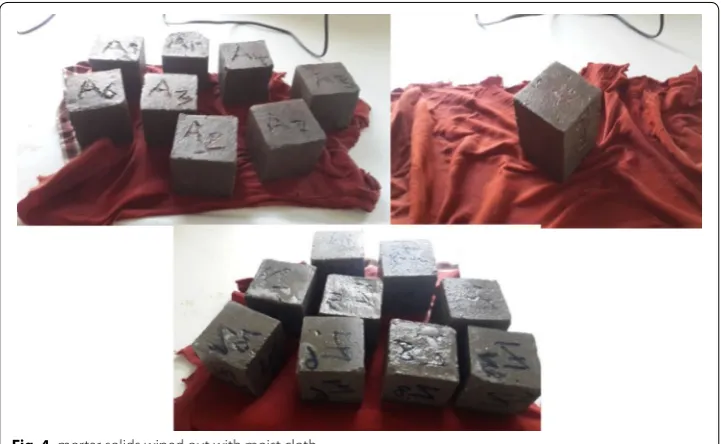
mortar solid were totally inundated in water at room temperature for 24 h. Following 24 h the mortar solids were expelled from the water, permitted to deplete and any hints of water were wiped out with moist material as appeared in Fig. 4. At that point this weight was noted as the wet weight (w2). From the raise in weight of the samples, water
absorption amounts were obtained as percentage of dry weight. Calculation of water absorption was as follows:
where: w1 = dry weight of mortar solid, (gm), w2 = weight of solid mortar after 24 h
immersion in water, (gm).
(2) Water absorption% =
w2−w1 w1
Fully 84 mortar cubes were molded with 12 cubes for each mixture ratio. From 84 mortar cubes 21 cubes were utilized to calculate the average water absorption and 63 cubes were utilized to calculate the average density and compressive strength.
Each specimen was weighed to detect the density before subjecting the specimens to compression test.
Result and discussion
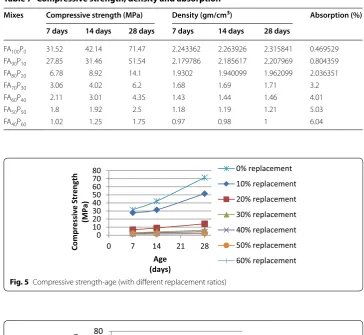
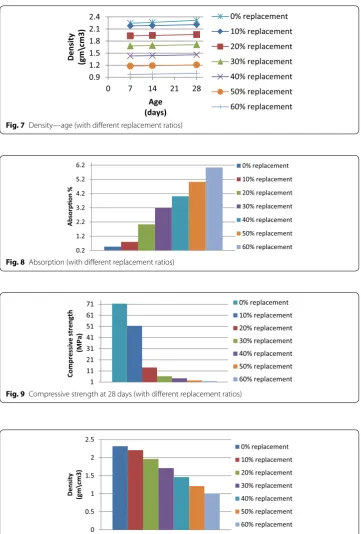
The results of compressive strength, density and absorption are shown in Table 7. Figures 5 and 6 show change of compressive strength with age and with variable of replacement ratios, respectively. Figure 7 shows variable of density with age at differ-ent replacemdiffer-ent ratios. Figure 8 explains absorption at different replacement ratios.
Table 7 Compressive strength, density and absorption
Mixes Compressive strength (MPa) Density (gm/cm3) Absorption (%)
7 days 14 days 28 days 7 days 14 days 28 days
FA100P0 31.52 42.14 71.47 2.243362 2.263926 2.315841 0.469529
FA90P10 27.85 31.46 51.54 2.179786 2.185617 2.207969 0.804359
FA80P20 6.78 8.92 14.1 1.9302 1.940099 1.962099 2.036351
FA70P30 3.06 4.02 6.2 1.68 1.69 1.71 3.2
FA60P40 2.11 3.01 4.35 1.43 1.44 1.46 4.01
FA50P50 1.8 1.92 2.5 1.18 1.19 1.21 5.03
FA40P60 1.02 1.25 1.75 0.97 0.98 1 6.04
0 10 20 30 40 50 60 70 80
0 7 14 21 28
Compressive
Strengt
h
(MPa
)
Age (days)
0% replacement 10% replacement 20% replacement 30% replacement 40% replacement 50% replacement 60% replacement
Fig. 5 Compressive strength-age (with different replacement ratios)
0 10 20 30 40 50 60 70 80
0 0.1 0.2 0.3 0.4 0.5 0.6 0.7
Compressive
strength
MP
a
rao of replacement %
7 days 14 days 28 days
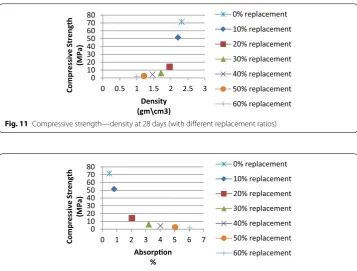
Figures 9 and 10 explain compressive strength and density at 28 days with differ-ent replacemdiffer-ent ratios, respectively. Figures 11 and 12 explain variable compressive strength and absorption with density at 28 days with different replacement ratios, respectively. 0.9 1.2 1.5 1.8 2.1 2.4
0 7 14 21 28
Densit y (gm\cm3 ) Age (days) 0% replacement 10% replacement 20% replacement 30% replacement 40% replacement 50% replacement 60% replacement
Fig. 7 Density—age (with different replacement ratios)
0.2 1.2 2.2 3.2 4.2 5.2 6.2 Absorpon % 0% replacement 10% replacement 20% replacement 30% replacement 40% replacement 50% replacement 60% replacement
Fig. 8 Absorption (with different replacement ratios)
1 11 21 31 41 51 61 71 Compressive strength (MPa ) 0% replacement 10% replacement 20% replacement 30% replacement 40% replacement 50% replacement 60% replacement
Fig. 9 Compressive strength at 28 days (with different replacement ratios)
0 0.5 1 1.5 2 2.5 Density (gm\cm3) 0% replacement 10% replacement 20% replacement 30% replacement 40% replacement 50% replacement 60% replacement
From Figs. 5, 6 were concluded that compressive strength increases with age and decreases with increasing ratio of replacement in agreement with Sada et al. who investi-gated the use of groundnut as a replacement of fine aggregate [3].
Neville, 2011 stated that the increasing in compressive strength with age that was because of continuation of hydration of anhydrate cement with time which composes a new output of hydration within the mortar mass [15].
The reduction in compressive strength with the increase in replacement levels might be attributed to the low workability of the mixture resulted from the absorption of water by the pistachio shells during mixing. Furthermore, the low density of pistachio shells as compared with that of fine aggregate may also contribute in the reduction of the compressive strength as shown in Fig. 10 and Table 7, which show that the density decreases with the increment in replacement ratio. This also coincides with the obser-vations of Obilade who studied the influence of replacing fine aggregates by husk rice on the concrete properties [4]. Also, it was clear that mortar with 30% replacement and above could be used for non-load bearing purposes, and mortar with 20% replacement and below could be used for loading bearing purposes according to the requirements of ASTM C270, 2014 [9].
It also clear that mixes at 50 and 60% replacement level achieve lightweight mortar density requirement according to BS EN 998-2, 2010 [16].
From Figs. 7, 10 illustrate that density increase with age that was because of hydration of cement and close the pores and make the mortar denser [15], but density decrease with increase of replacement because of pistachio shells have less density than that of used sand. 0 10 20 30 40 50 60 70 80
0 0.5 1 1.5 2 2.5 3
Compressive Strengt h (MPa ) Density (gm\cm3) 0% replacement 10% replacement 20% replacement 30% replacement 40% replacement 50% replacement 60% replacement
Fig. 11 Compressive strength—density at 28 days (with different replacement ratios)
0 10 20 30 40 50 60 70 80
0 1 2 3 4 5 6 7
Compressive Strengt h (MPa ) Absorp on % 0% replacement 10% replacement 20% replacement 30% replacement 40% replacement 50% replacement 60% replacement
From Fig. 11 shows that compressive the strength decrease with the decrement in den-sity at 28 days with different replacement levels. The reduction might be attributed to increasing pores with decreasing density.
From Fig. 12 illustrates that the compressive strength decreases with increasing absorption at 28 days with different replacement levels, this might be due to absorption of water of hydration.
Conclusions
1. Compressive strength decreases with the increment in replacement level of pistachio shells and increases with age.
2. Density decreases with the increment in replacement level of pistachio shells due to low density of pistachio shells as compared with that of used fine aggregate.
3. Density increases with age that was because of hydration of cement and closes the pores and makes the mortar denser.
4. Absorption increases with the increment in replacement level of pistachio shells might be due to porous texture of pistachio shells.
5. Compressive strength decrease with increasing absorption. 6. Compressive strength decreases with decrement in density.
7. Mortar with 30% replacement and above could be used for non-loading bearing pur-poses.
8. Mortar with 20% replacement and below could be used for loading bearing purposes. 9. Mortar at 50% and 60% replacement level achieve lightweight mortar.
Abbreviations
W1: weight of empty flask; W2: weight of flask + cement; W3: weight of flask + cement + water; W4: weight of
flask + water; S.G: specific gravity; w1: dry weight of mortar solid, (gm); w2: weight of solid mortar after 24 h immersion in water, (gm).
Acknowledgements
I wish to thanks College of Water Resources Engineering\Al-Qasim Green University for providing an opportunity to do research work in the laboratory.
Competing interests
The author declares that she has no competing interests.
Availability of data and materials Not applicable.
Consent for publication
The author consents to the publication process.
Ethics approval and consent to participate The author consents to the ethics.
Funding
No funding Information available (no fund organization but I will pay the fees for publishing).
Publisher’s Note
Springer Nature remains neutral with regard to jurisdictional claims in published maps and institutional affiliations.
References
1. Nwangwu AC. Genetic variability in a representative ‘Kerman’ x ‘Peters’ population of pistachio (Pistacia vera L.) orchard. M.sc. Thesis of Biotechnology in the College of Science and Mathematics California State University, Fresno May 2015.
2. Ganiron TU Jr. Use of recycled glass bottles as fine aggregates in concrete mixture. Int J Adv Sci Technol. 2013;61:17–28.
3. Sada BH, Amartey YD, Bakoc S. An Investigation Into the Use of Groundnut as Fine Aggregate Replacement. Niger J Technol. 2013;32(1):54–60.
4. Obilade IO. Experimental study on rice husk as fine aggregates in concrete. Int J Eng Sci. 2014;3(8):9–14. 5. Mohammed A, Hughes TG, Abubakar A. Importance of sand grading on the compressive strength and stiffness of
lime mortar in small scale model studies. Open J Civil Eng. 2015;5:372–8. https://doi.org/10.4236/ojce.2015.54037. 6. De Schutter G, Poppe AM. Quantification of the water demand of sand in mortar. Construct Build Mater.
2004;18(7):517–21.
7. Vladimir GH, Graça V, Paulo BL. Influence of aggregates grading and water/cement ratio in workability and hard-ened properties of mortars. Constr Build Mater. 2011;25:2980–7.
8. Lenczner D. Elements of loadbearing brickwork. Oxford: Pergamon Press; 1972.
9. ASTM C. 270 standard specification for mortar for unit masonry, annual book of standards. 04th ed. West Consho-hocken: ASTM International; 2006.
10. ASTM C. 150 standard specification for Portland cement. West Conshohocken: American Society for Testing and Materials; 2005.
11. Iraqi Specification. No.5, Portland cement. Baghdad; 1984.
12. Iraqi Specification. No.45, Aggregate from natural sources for concrete and construction. Baghdad; 1984. 13. BS. 1881- Part 4, Method for determination of compressive strength of cement mortar. British Standard 1989. 14. ASTM C. 642 Standard test method for density, absorption, and voids in hardened concrete. West Conshohocken:
ASTM International; 2006. https://doi.org/10.1520/C0642-06.
15. Neville AM. Properties of concrete. New York and Longman: Wiley; 2011. p. 844.