R E S E A R C H
Open Access
Associating conditional cash transfer to
universal access to treatment could be the
solution to the HCV epidemic among drug
users (DUs)
Philippe Chossegros
1*and Fiorant Di Nino
2Abstract
Background:To understand the limits of HCV screening programs to reach all drug users (DUs).
Method:The association of the recruitment of a representative sample of a population of DUs in a specific area with the use of a questionnaire that included 250 items allowed the use of uni- and multifactorial analysis to explore the relationship between HCV screening and dimensions until now restricted to qualitative studies.
Results:We recruited, in less than 2 months, 327 DUs representing about 6% of the total population of DUs. They belonged to a single community whose drug use was the only common characteristic. While almost all DUs (92.6%) who had access to care providers had been screened, this proportion was much lower in out-of-care settings (64%). HCV prevalence among those who had performed a test was low (22.8%). For DUs, the life
experience of hepatitis C has not changed in the last 10 years. Screening, studied for the first time according to this life experience, was not influenced by a rational knowledge of the risk taken or the knowledge of treatment efficacy, showing a gap between DUs’representations and medical recommendations which explains the low level of active screening. Police crackdown on injections, disrupting the previous illusion of safe practices, was the only prior history leading to active screenings. Screenings were related to an access to care providers. GPs held a preponderant position as a source of information and care by being able to give appropriate answers regarding hepatitis C and prescribing opioid substitution treatments (OST). If 48 % of DUs screened positive for HCV had been treated, half of them had been prescribed before 2006.
Conclusion:While hepatitis has become a major issue for society and, consequently, for services for DUs (SDUs) and GPs, it is not the case for DUs. A widespread screening, even in a city where the offer of care is diversified and free, seems unlikely to reach a universal HCV screening over a short time. The model of respondent-driven
sampling recruitment could be a new approach to conditional cash transfer, recruiting and treating DUs who remain outside the reach of care providers, a prerequisite for the universal access to HCV treatments to impact the HCV epidemic.
Keywords:Drug use, Respondent-driven sampling, HCV, Epidemic, Social networks
* Correspondence:[email protected]
1UHSI de Lyon, Centre Hospitalier Lyon SUD, Hospices Civils de LYON,
Chemin du Grand Revoyet, 69495 Pierre-Bénite, France Full list of author information is available at the end of the article
Background
Viral infections of DUs and more particularly hepatitis C [1] are recognized as a public health problem. Hepatitis B vaccination prevents new HBV infections [2], antiviral treatments of hepatitis B [3, 4] and AIDS [5] control the evolution of these diseases, and direct-acting antivirals (DAA) make it possible to cure almost all hepatitis C [6]. Despite their effectiveness, their impact on the course of these epidemics will not be fully realized as long as pa-tients are left untreated [7, 8]. A universal screening is a prerequisite to succeed [9].
Due to the illegal nature of drug use, part of the popu-lation of DUs remains hidden. Understanding the course of this epidemic suffers from variation in the coverage and quality of existing research and, most of all, of con-venience sampling which may be responsible for repre-sentative bias [10,11]. This lack of reliable data has been emphasized by most international reviews [12–14] as well as French recommendations [15]. More precise data on coherent territories are needed. Different approaches have been proposed to recruit a representative sample of DUs active in a given territory.
Apart from the use of drugs, DUs differ from the general population by their socio-economic situation and by their particularly high risks of contamination by infectious agents. Although HCV prevalence has been frequently studied, other elements such as the influence of their use of drugs, their social networks, their fears, their projects, their sources of information, and their opioid substitution treatment on their access to screening have been little studied. In 2008, Treloar and Rhodes, reviewing 31 former papers in a qualitative meta-ethnographic analysis of the social production of hepatitis risk, concluded that, for injecting DUs, HCV hepatitis is a liminal illness, a risk accepted rather than avoided and that symbolic know-ledge systems, rather than biomedical risk calculus, and especially narratives of hygiene and trust, played a primary role in shaping interpretations of HCV risk [16]. However, non-injectors were excluded, and they did not analyze the relationship of this life experience with HCV screening. The most recent studies were only conducted among intravenous DUs (IVDUs) attending primary and second-ary care services. Strauss et al. found a low knowledge of hepatitis C among injectors and non-injectors who were unaware of the existence of HCV education opportunities [17]. Barocas et al., in Southern Wisconsin, found that access to healthcare was an important determinant of regular HCV screening, indicating that self-initiated screening was less successful than provider-initiated HCV screening, consistent with a previous study conducted in San Francisco and New York [18, 19]. For Swan et al., HCV was considered as a relatively benign infection, com-peting with other priorities. Difficulties in accessing spe-cialized care and treatment were improved by trust in
providers and education on HCV infection [20]. Walley et al. “interested” attendants of a methadone clinic in HCV treatment after an education program [21].
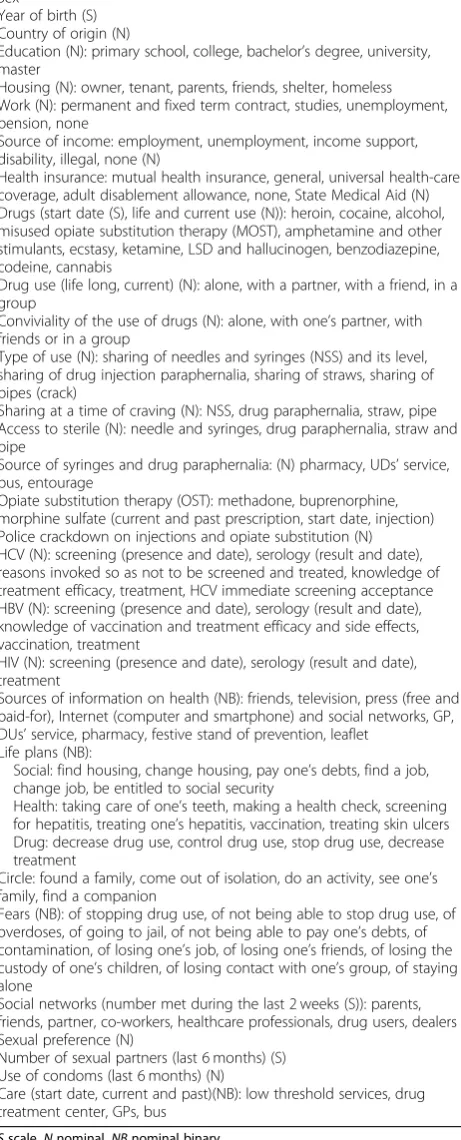
In 2011, we decided to improve the quality of our care by a better knowledge of DUs. First, in a partnership be-tween professionals and DUs attending services for DUs (SDUs), we wrote a questionnaire including all relevant information that would help to understand DU’s life (Table1). Then, the same year, we used it to study DUs recruited by a snowball sampling initiated in all the SDUs of the greater Strasbourg. Nobody was paid. If the content of the questionnaire has been validated by its analysis, the snowball recruitment was a failure, since it was only able to recruit 145 DUs for a period of 1 year with 2 DUs outside of the health care system. This failure led us to consider another method to recruit a representa-tive sample of Strasbourg’s population of DUs.
Respondent-driven sampling (RDS) is currently one of the most popular. It has been applied in more than 460 peer-reviewed surveys conducted in 69 countries throughout the world [22]. It is used by the Centers for Disease Control and Prevention to track the HIV epi-demic [23, 24]. Yet, studies that have applied this method to DUs have been almost constantly limited to risk behaviors, search for viral prevalence, and access to care.
This RDS study was funded in 2015 through a grant of the“Fonds de dotation Gilead Sciences.”
We present the analysis of this database from the per-spective of HCV screening, contamination, and treat-ment. To our knowledge, it is the first study to focus, in a representative sample of DUs in a well-defined area, on the relation between HCV screening history and the elements that may have influenced this past deci-sion or that could lead to further screening and treatment, information that could help build a more effective strategy to eradicate hepatitis C among DUs.
Methods
Study design
critical for prevention that non-injectors understand the HCV related risks involved in sharing both injection and non-injection drug use equipment [17].
We started with 3 “seeds” randomly recruited among DUs attending the same SDU. They were asked the number of DUs they had met in the previous 14 days (network size) and were given 3 coupons to recruit 3 re-spondents among their own social network who were due to show up less than 14 days later. Each wave of respon-dents, following the same rules, recruited the next wave until the final sample size was achieved. Our budget allowed financing the recruitment of 300 DUs represent-ing a sample of 6% of the total population of UDs of the greater Strasbourg area [27].
The completion of a 250-item auto-questionnaire by each respondent was followed by a cross-examination of their answers in a private space by the same professional interviewer to assessed their quality and completeness. HCV serostatus was categorized according to partici-pants’ self-report. No one had to perform a new HCV screening. The monetary recruitment incentive was 30€ for the completion of the interviewer-administered ques-tionnaire and 20 € for each recruited UD. This amount was considered to be a fair salary, recognizing an actual work, by the DUs who had validated the questionnaire. Since giving money unconditionally regarding its use to homeless and other low-income individuals, among which DUs, has constantly been shown to improve their empowerment, this approach was considered ethical [28–30]. The conduct of the study was in line with the ethical checklist (respect, beneficence, justice, and safe-guards) provided by Semaan and al. [31].
Patients provided informed consent to participate in the study and to publish its results. This study was approved by the French Commission Nationale de l’Informatique et des Libertés (CNIL).
Statistical analysis
Data were anonymized before analysis. RDS allows statis-tical adjustments for differential network sizes to produce estimates representative of the sampled population’s net-work. RDS data weighting was used to compare the ob-served distribution of HCV screening between the observed and the weighted population as well as their homophily for sex and age using RDSAT version 7.1.46: (http://www.respondentdrivensampling.org/reports/RDSA T_7.1-Manual_2012-11-25.pdf; http://www.respondent- drivensampling.org/download/RDSATv7.1.46/RDSAT_-windows-x64_7_1_46.exe). Equilibrium was calculated for participant’s age, sex, injection, HCV screening, and HCV prevalence.
The items considered pertinent to understand HCV screening (HCV screening, HCV contamination, know-ledge of the efficacy of HCV treatment, plans for the future, fear of contamination) were compared to all the other variables. For ordinal or categorical vari-ables, chi-square and odds ratio or Kendall tau-b were
Table 1Items covered in the questionnaire
Sex
Year of birth (S) Country of origin (N)
Education (N): primary school, college, bachelor’s degree, university, master
Housing (N): owner, tenant, parents, friends, shelter, homeless Work (N): permanent and fixed term contract, studies, unemployment, pension, none
Source of income: employment, unemployment, income support, disability, illegal, none (N)
Health insurance: mutual health insurance, general, universal health-care coverage, adult disablement allowance, none, State Medical Aid (N) Drugs (start date (S), life and current use (N)): heroin, cocaine, alcohol, misused opiate substitution therapy (MOST), amphetamine and other stimulants, ecstasy, ketamine, LSD and hallucinogen, benzodiazepine, codeine, cannabis
Drug use (life long, current) (N): alone, with a partner, with a friend, in a group
Conviviality of the use of drugs (N): alone, with one’s partner, with friends or in a group
Type of use (N): sharing of needles and syringes (NSS) and its level, sharing of drug injection paraphernalia, sharing of straws, sharing of pipes (crack)
Sharing at a time of craving (N): NSS, drug paraphernalia, straw, pipe Access to sterile (N): needle and syringes, drug paraphernalia, straw and pipe
Source of syringes and drug paraphernalia: (N) pharmacy, UDs’service, bus, entourage
Opiate substitution therapy (OST): methadone, buprenorphine, morphine sulfate (current and past prescription, start date, injection) Police crackdown on injections and opiate substitution (N) HCV (N): screening (presence and date), serology (result and date), reasons invoked so as not to be screened and treated, knowledge of treatment efficacy, treatment, HCV immediate screening acceptance HBV (N): screening (presence and date), serology (result and date), knowledge of vaccination and treatment efficacy and side effects, vaccination, treatment
HIV (N): screening (presence and date), serology (result and date), treatment
Sources of information on health (NB): friends, television, press (free and paid-for), Internet (computer and smartphone) and social networks, GP, DUs’service, pharmacy, festive stand of prevention, leaflet
Life plans (NB):
Social: find housing, change housing, pay one’s debts, find a job, change job, be entitled to social security
Health: taking care of one’s teeth, making a health check, screening for hepatitis, treating one’s hepatitis, vaccination, treating skin ulcers Drug: decrease drug use, control drug use, stop drug use, decrease treatment
Circle: found a family, come out of isolation, do an activity, see one’s family, find a companion
Fears (NB): of stopping drug use, of not being able to stop drug use, of overdoses, of going to jail, of not being able to pay one’s debts, of contamination, of losing one’s job, of losing one’s friends, of losing the custody of one’s children, of losing contact with one’s group, of staying alone
Social networks (number met during the last 2 weeks (S)): parents, friends, partner, co-workers, healthcare professionals, drug users, dealers Sexual preference (N)
Number of sexual partners (last 6 months) (S) Use of condoms (last 6 months) (N)
Care (start date, current and past)(NB): low threshold services, drug treatment center, GPs, bus
calculated. t test or one-way ANOVA was performed for scale variables. Since multiple comparisons were performed, statistical significance was considered at an alpha of 0.01 to prevent the occurrence of too many statistically but not clinically relevant associa-tions. To measure the association between dependent and independent variables, the significant variables were entered into binary logistic regression multivariate models and automatically chosen by forward stepwise se-lection procedure (two sides,p< 0.05). Odds ratios (OR) and 95% confidence intervals (CI) were calculated from β coefficients and their standard errors. The Hosmer-Lemshow test was used to determine the goodness of fit of the models. The data was analyzed using IBM SPSS version 19.
Results
Respondent-driven sampling and characteristics of drug users
Recruitment started with 3 seeds: 2 men (1 low threshold service, 1 drug treatment center) and 1 woman (needle and syringe exchange program). The first chain recruited 117 UDs and was interrupted at the sixth wave. The sec-ond and third chains included 96 and 114 DUs, respect-ively, and were interrupted at the fourth wave. A total of 327 UDs were recruited in less than 2 months (February to March 2015). All the participants enrolled met the eligi-bility criteria. None of the 3 chains was interrupted for lack of new respondents. The mean number of DUs en-countered by each respondent during the 15 days preced-ing the interview was 13.6 (95% CI 11.6–15.5). Whatever item is chosen, a tendency toward in-group recruitment coexisted with considerable cross-group recruitment, but no barrier was observed between the groups as shown in Table2. Sex was the only characteristic demonstrating a negative homophily.
There was no statistical difference between the ob-served and weighted distribution of screening compared to injection (Table3).
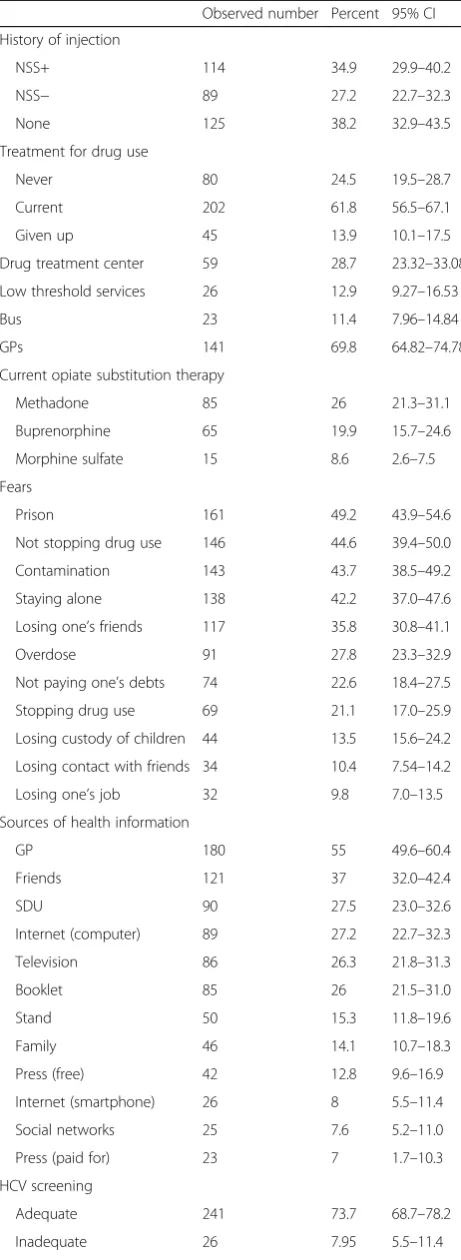
The mean age of our sample was 33.4 years (95% CI 32.3–34.4). Mean age of the first drug experimentation was 15.02 years. Age of the first injection was 21 years (95% CI 20.25–21.67). The mean number of drugs con-sumed during life was 8.66 (95% CI 8.39–8.94). Socio-economic and drug-related characteristics of the participants are presented in Tables4and5.
HCV screening
Testing was not related to any socio-demographic char-acteristic such as sex, nationality, education, profession, social coverage, or housing. If friends were the second most frequent source (37%) of health information after GPs (55%) and before SDUs (27.5%), their opinion did not influence HCV screening. No specific plan for the
future was associated with a previous test. There was no difference between DUs whose screening result was positive or negative.
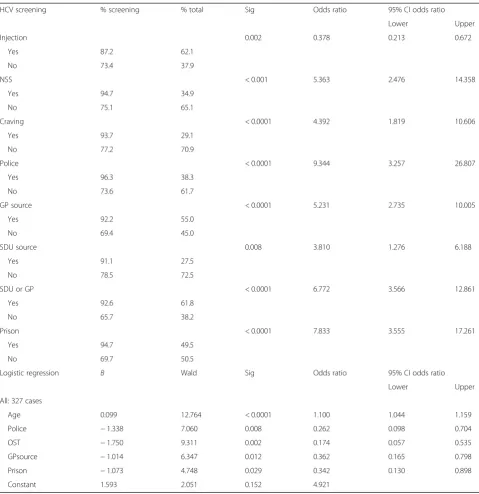
HCV screening was associated with age (screening + 35.01 (95% CI 33.95–36.08)/screening−25.90 (95% CI 23.33–28.46),p< 0.0001) as well as duration of drug use (screening + 19.46 (95% CI 18.43–20.49)/screening − 11.37 (95% CI 8.76–13.99), p< 0.0001) and duration of injection (screening + 14.79 (95% CI 13.14–16.44)/ screening −2.87 (95% CI 1.60–4.14), p< 0.0001). The results of the other significant univariate tests and multivariate logistic regression models measuring the association of past year HCV testing and selected par-ticipant characteristics are presented in Table 6.
Multiples reasons (54/60) were given by respondents to explain the absence of screening. An absence of concern (85.2%, 95% CI 73.4–92.3) came first, followed by prob-lems with blood access (22.2%, 95% CI 13.20–34.94). A fear of the result was mentioned by seven, and only three reported being unaware of voluntary testing sites. How-ever, two thirds (61.3%) accepted the theoretical proposal
Table 2Homophily for sex, age, intravenous drug use, and HCV screening and serology
Homophily
Male 0.093
Female −0.137
Age
< 20 0.198
20–29 0.08
30–39 0.114
40–49 0.073
> 50 0.054
Non-IVDU 0.135
IVDU 0.118
HCV screening+ HCV+ 0.159
HCV screening+ HCV− 0.125
HCV screening− 0.154
Homophily refers to the tendency to recruit in the same category with a metric between 1 (recruited and recruits in the same category) and−1 (recruited and recruits in a different category). Heckathorn suggests any value of homophily≥0.3 as intermediate homophily and any value≤ −0.3 as strong heterophily
Table 3Observed and weighted distribution of the cross-tabulation of screening by injection
Screening\Injection Yes, 95% CI No, 95% CI
Observed
Yes 54.1, 48.6–59.6 7.6, 4.8–105
No 27.8, 23–33 10.4, 7.3–14.2
Weighted
Yes 50.8, 42.5–58.8 9.8, 5.3–16.6
for immediate screening, significantly lower (86%) than those who had previously been screened (odds ratio 0.26, 95% CI 0.11–0.61,p< 0.001).
HBV (67.8%, 95% CI 67.79–72.63), HIV (86.8%, 95% CI 82.70–90.06), and HCV screening were very closely linked (HBV/HCV odds ratio 36.52, 95% CI 14.90– 89.55; HIV/HCV odds ratio 23.53, 95% CI 10.87–50.92) and were also linked to the same items (duration of drug
use, access to treatment of drug use and, for HBV, police crackdown on injections).
HCV contamination and treatment
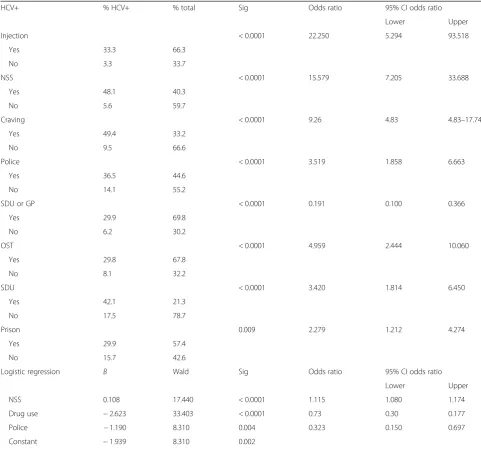
HCV prevalence (observed 22.8%, weighted 21%) was low. In a univariate analysis, HCV contamination was related to the risks related to drug use such as its dur-ation (HCV −17.9 years, 95% CI 16.8–22.9/HCV+ 24.9, 95% CI 22.9–26.9), needle and syringe sharing (NSS), episodes of craving or police crackdown on injections, and history of care; once the level of risks and the dur-ation of drug use were taken into account, care disap-peared because they were strongly related to age and duration of drug use (Table 7). Sharing of works was not an additional risk of contamination. Access to ster-ile works was considered easy by 88.7% of current in-jectors who used syringe-dispensing machine, needle exchange program, bus, and pharmacy at the same time. It was not related to HCV screening or contamin-ation. The high odds ratio associated with OCT is ex-plained by this correlation.
A spontaneous clearance of HCV was reported in 11 cases (18%, 95% CI 10.4–29.5). Among those who had not spontaneously cleared HCV, 23 had been treated (46%, 95% CI 33–59.6, mean year 2005, range 1990– 2015). Treatment had been completed in 21 cases, and 13 believed they had been cured. The decision to be treated was favored in 14 cases (60.9%) by trust in the specialist or in the medical team. Among the 27 who had not been treated, the main reason was an absence of severity of hepatitis (59.2%). The main cause of patients’ refusal was side effects (33.3%), followed by not feeling ill (25.9%) and by problems with venous access (22.2%). Alcohol was presented as preventing treatment for doc-tors (2 cases) as well as for patients (6 cases).
HBV (5.3%, 95% CI 2.99–9.26) and HIV (1.7%, 95% CI 0.75–4.03) were too low for a statistical analysis. Two of the 11 HBV-positive and 2 of the 5 HIV-positive DUs had never injected.
Fear of contamination
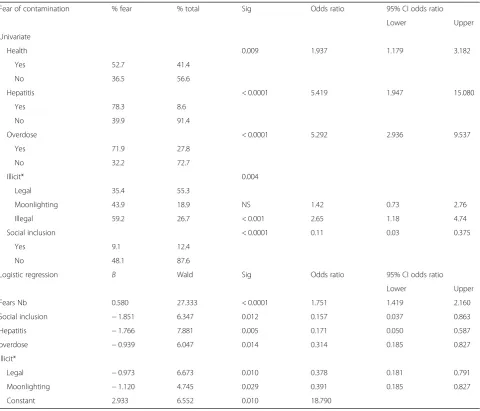
Fear of contamination was neither related to any previous risk of contamination (drug or condom use) nor to the duration of drug use or a previous HCV test. It was asso-ciated with planning a future HCV test that did not in-crease the rate of acceptance of an immediate screening proposal. Among the factors associated with fears of con-tamination, other fears (total number and fear of over-doses) came first (Table8). For once, socio-demographic characteristics were concerned with a protection for DUs who worked with social security coverage and a stable housing and an increased prevalence among DUs with il-legal incomes.
Table 4Socio-professionnal characteristics of DUs (semiquantitative)
Observed nb Percent 95% CI
Sex
Men 243 74.3 69.6–79.0
Women 84 25.7 21.0–30.4
Nationality
French 275 84.1 80.1–88.1
Foreigner 52 15.9 11.9–19.9
Housing
Stable (owner or rent) 141 43.1 37.9–48.5
Parents 38 11.6 8.6–15.6
Friends 22 6.7 4.5–10.0
Shelter 37 11.3 8.3–15.2
Homeless, squat 89 27.2 22.7–32.3
Education
Primary 10 3.1 1.7–5.5
Secondary 225 68.9 63.6–73.6
Bachelor 52 15.9 12.3–20.3
Higher education 40 12·2 8.7–15.8
Home
Parents 49 15 11.1–18.9
Couple 103 31.5 26.5–36.5
Alone 145 44.3 38.9–49.7
Other 30 9.1 6.0–12.2
Profession
Studying 10 3.1 1.0–5.0
Permanent contract 32 9.8 6.6–13.0
Fixed term contract 38 11.6 8.1–15.1
Unemployed 58 17.7 13.6–21.8
Disability 9 2.8 1.0–4.6
Pension 1 0.3 −0.3-0.9
None 179 54.7 49.3–60.1
Active solidarity income 150 45.9 40.6–51.3
Prison 162 49.5 44.08–54.92
Sexual preference
Heterosexual 295 90.2 85.5–93
Bisexual 26 8 5.5–11.4
Knowledge of the efficacy of HCV treatments
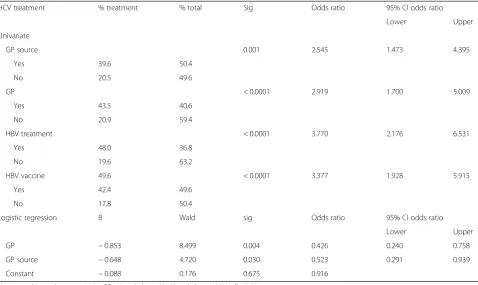
An accurate knowledge of the efficacy of HCV treat-ments (37.9%; OR CI 32.6-43.4) was higher among sero-positive DUs (+ 72.1/others 30.2%; odds ratio 95% CI 3.23–11.14;p< 0.0001). The knowledge of the efficacy of HBV and HCV treatments and of HBV vaccination were higher among HCV-positive respondents than HCV-negative ones. Among seronegative cases, GPs were the only source of accurate knowledge (Table9).
Plans for the future
Looking for a job (62.4%; 95% CI 56.9–67.7) was the main concern among the 28 possible projects. It was followed by taking care of one’s teeth (58.7%; 95% CI 53.2–64.1), returning to activity (42.8%; 95% CI 37.4– 48.4), reducing drug use (40.7%; 95% CI 35.3–46.2), and making a health check (40.4%; 95% CI 35–45.9). Making a health check was unrelated to age, NSS, HCV screening, and serology results as well as seeking health information from GPs or DUs’services. A more specific project of HCV screening (11.9%; 95% CI 8.6–15.9) and engaging in one’s hepatitis treatment (5.8%; 95% CI 3.5–8.9) ranked 25th and 28th, respectively. The only item significantly associated with plans of a future screening for hepatitis was the fear of contamination.
Discussion
This study, the first to use the RDS method to recruit DUs in France, recruited a population younger and with lower HCV prevalence than those of other French stud-ies that included IV- and non-IVDUs [32–34] because of the inclusion of users left outside treatments for drug use (38.2%) who were previously not studied. Compared to the previous snowball sampling, RDS was significantly superior to recruit this hidden population (OR 115.4, 95% CI 28.12–474.81) The interviews con-firmed Heckathorn’s initial hypothesis that money was not the only reason for participating in the investiga-tion [35]. Respondents were eager to have the oppor-tunity, for once, to tell the story of their lives. All these
Table 5Characteristics related to drug use
Observed number Percent 95% CI
History of injection
NSS+ 114 34.9 29.9–40.2
NSS− 89 27.2 22.7–32.3
None 125 38.2 32.9–43.5
Treatment for drug use
Never 80 24.5 19.5–28.7
Current 202 61.8 56.5–67.1
Given up 45 13.9 10.1–17.5
Drug treatment center 59 28.7 23.32–33.08
Low threshold services 26 12.9 9.27–16.53
Bus 23 11.4 7.96–14.84
GPs 141 69.8 64.82–74.78
Current opiate substitution therapy
Methadone 85 26 21.3–31.1
Buprenorphine 65 19.9 15.7–24.6
Morphine sulfate 15 8.6 2.6–7.5
Fears
Prison 161 49.2 43.9–54.6
Not stopping drug use 146 44.6 39.4–50.0
Contamination 143 43.7 38.5–49.2
Staying alone 138 42.2 37.0–47.6
Losing one’s friends 117 35.8 30.8–41.1
Overdose 91 27.8 23.3–32.9
Not paying one’s debts 74 22.6 18.4–27.5
Stopping drug use 69 21.1 17.0–25.9
Losing custody of children 44 13.5 15.6–24.2
Losing contact with friends 34 10.4 7.54–14.2
Losing one’s job 32 9.8 7.0–13.5
Sources of health information
GP 180 55 49.6–60.4
Friends 121 37 32.0–42.4
SDU 90 27.5 23.0–32.6
Internet (computer) 89 27.2 22.7–32.3
Television 86 26.3 21.8–31.3
Booklet 85 26 21.5–31.0
Stand 50 15.3 11.8–19.6
Family 46 14.1 10.7–18.3
Press (free) 42 12.8 9.6–16.9
Internet (smartphone) 26 8 5.5–11.4
Social networks 25 7.6 5.2–11.0
Press (paid for) 23 7 1.7–10.3
HCV screening
Adequate 241 73.7 68.7–78.2
Inadequate 26 7.95 5.5–11.4
Table 5Characteristics related to drug use(Continued)
Observed number Percent 95% CI
Absent 60 18.3 15.5–22.9
Positive 61 22.8a 18.2–28.3
Negative 206 77.2a 71.8–81.8
Unknown 60 18.4b 14.5–22.9
NSSneedles and syringes sharing,GP sourceGP as source of health information,noneno injection,SDUservice for drug users,SDU sourceservice for drug users as source of health information,Source of informationsource of health information,HCV screeningadequate less than 1 year or absence of injection since the last test,Inadequatecurrent injector with more than 1 year since the lest test,absentno test
a
Prevalence among screened DUs b
DUs belonged to a diverse community whose only common feature was drug use with no barriers be-tween injectors and non-injectors. HCV prevalence was low (overall 22.8%, IVDUs 33.3%), and HIV and HBV prevalence (5.3 and 1.7%) were too low to allow any statistical analysis.
Our results have points of divergence and concordance with respect to previous studies on the same subject.
1. The main difference concerns the socio-economic dimensions almost always present outside France [17,36]. In our study, it had a very little influence Table 6Factors significantly associated with an HCV test in univariate tests and binary logistic regression (forward stepwise selection)
HCV screening % screening % total Sig Odds ratio 95% CI odds ratio
Lower Upper
Injection 0.002 0.378 0.213 0.672
Yes 87.2 62.1
No 73.4 37.9
NSS < 0.001 5.363 2.476 14.358
Yes 94.7 34.9
No 75.1 65.1
Craving < 0.0001 4.392 1.819 10.606
Yes 93.7 29.1
No 77.2 70.9
Police < 0.0001 9.344 3.257 26.807
Yes 96.3 38.3
No 73.6 61.7
GP source < 0.0001 5.231 2.735 10.005
Yes 92.2 55.0
No 69.4 45.0
SDU source 0.008 3.810 1.276 6.188
Yes 91.1 27.5
No 78.5 72.5
SDU or GP < 0.0001 6.772 3.566 12.861
Yes 92.6 61.8
No 65.7 38.2
Prison < 0.0001 7.833 3.555 17.261
Yes 94.7 49.5
No 69.7 50.5
Logistic regression B Wald Sig Odds ratio 95% CI odds ratio
Lower Upper
All: 327 cases
Age 0.099 12.764 < 0.0001 1.100 1.044 1.159
Police −1.338 7.060 0.008 0.262 0.098 0.704
OST −1.750 9.311 0.002 0.174 0.057 0.535
GPsource −1.014 6.347 0.012 0.362 0.165 0.798
Prison −1.073 4.748 0.029 0.342 0.130 0.898
Constant 1.593 2.051 0.152 4.921
Hosmer and Lemeshow test, 0.101; CC—screening+, 94.8%; screening−, 44.8%; all, 85.8%
Logistic regression odds ratios—police: absent/present, injection: NSS−and no injection/NSS+, OST: absent/present, GP source: absent/present
on HCV screening, in spite of 17.7% of unemployed, a high rate of respondents outside of the labor force (54.7%), or without a stable housing (45.2%). These differences may be related to the French welfare model, with a universal and free access to OST, and to the rich and diversified supply of free harm reduction programs and healthcare services in Strasbourg.
2. With an overall reported screening rate of 82% and 46% of those found PCR-positive treated, one could consider these results as optimal, much higher than usually reported [7,13,37]. However, once analyzed following subpopulations of DUs, it did not appear so positive. First, if 92.6% of DUs attending SDUs had been screened, this rate fell to 75.6% for those who had dropped out and 58.8% for those who had Table 7Factors significantly associated with an HCV positive (HCV+) test in univariate tests and binary logistic regression (forward stepwise selection)
HCV+ % HCV+ % total Sig Odds ratio 95% CI odds ratio
Lower Upper
Injection < 0.0001 22.250 5.294 93.518
Yes 33.3 66.3
No 3.3 33.7
NSS < 0.0001 15.579 7.205 33.688
Yes 48.1 40.3
No 5.6 59.7
Craving < 0.0001 9.26 4.83 4.83–17.74
Yes 49.4 33.2
No 9.5 66.6
Police < 0.0001 3.519 1.858 6.663
Yes 36.5 44.6
No 14.1 55.2
SDU or GP < 0.0001 0.191 0.100 0.366
Yes 29.9 69.8
No 6.2 30.2
OST < 0.0001 4.959 2.444 10.060
Yes 29.8 67.8
No 8.1 32.2
SDU < 0.0001 3.420 1.814 6.450
Yes 42.1 21.3
No 17.5 78.7
Prison 0.009 2.279 1.212 4.274
Yes 29.9 57.4
No 15.7 42.6
Logistic regression B Wald Sig Odds ratio 95% CI odds ratio
Lower Upper
NSS 0.108 17.440 < 0.0001 1.115 1.080 1.174
Drug use −2.623 33.403 < 0.0001 0.73 0.30 0.177
Police −1.190 8.310 0.004 0.323 0.150 0.697
Constant −1.939 8.310 0.002
Hosmer and Lemeshow test, 0.991; CC—HCV+, 51.8%; HCV−,90.3%; all, 81%
Injectionhistory of injection,NSSneedle and syringe sharing,CravingNSS at a time of craving,Policepolice crackdown on injections,SDUservice for drug users, GPmedical practice of a general practitioner,OSTopiate substitution therapy,Drug treatment centerattending SDU or GP,Drug useduration of drug use,CC correctly classified
never attended a SDU. Moreover, 7.9% of the screening had been performed more than 1 year before our study. Overall, an optimal screening would have missed 33.9% (95% CI 28.8–39.4) of the recruited DUs. If hepatitis C had been a major concern of the DUs, the screenings would have been the result of active and rational approaches, correlated with past risk-taking, sources of concern about possible contaminations, and a search for information about the effectiveness of treatments. Our data, at odds with this presumption, favor the hypothesis of a moderate interest of the UDs for the hepatitis C inducing little active screening. (a) First, 85.2% of the DUs who had not been
screened explained this absence by their lack of
concern about HCV hepatitis. Then, we did not find any correlation between the presence of appropriate screening and previous risk-taking. A belief in the efficacy of HCV treatments was present in only 30.1% of those DUs who had not been screened positive, and 42.8% of those who had been screened DUs had no opinion concerning the efficacy of HCV treatments. This limited knowledge is consistent with the litera-ture [17]. At last, the main plans for the future had a concrete and immediate dimension such as work, teeth, and housing. Hepatitis ranked almost last when DUs did not know they were infected. Our study provides elements to understand this lack of correlation: Table 8Factors significantly associated with fear of contamination in univariate tests and binary logistic regression
Fear of contamination % fear % total Sig Odds ratio 95% CI odds ratio
Lower Upper
Univariate
Health 0.009 1.937 1.179 3.182
Yes 52.7 41.4
No 36.5 56.6
Hepatitis < 0.0001 5.419 1.947 15.080
Yes 78.3 8.6
No 39.9 91.4
Overdose < 0.0001 5.292 2.936 9.537
Yes 71.9 27.8
No 32.2 72.7
Illicit* 0.004
Legal 35.4 55.3
Moonlighting 43.9 18.9 NS 1.42 0.73 2.76
Illegal 59.2 26.7 < 0.001 2.65 1.18 4.74
Social inclusion < 0.0001 0.11 0.03 0.375
Yes 9.1 12.4
No 48.1 87.6
Logistic regression B Wald Sig Odds ratio 95% CI odds ratio
Lower Upper
Fears Nb 0.580 27.333 < 0.0001 1.751 1.419 2.160
Social inclusion −1.851 6.347 0.012 0.157 0.037 0.863
Hepatitis −1.766 7.881 0.005 0.171 0.050 0.587
overdose −0.939 6.047 0.014 0.314 0.185 0.827
Illicit*
Legal −0.973 6.673 0.010 0.378 0.181 0.791
Moonlighting −1.120 4.745 0.029 0.391 0.185 0.827
Constant 2.933 6.552 0.010 18.790
Hosmer and Lemeshow test, 0.777; CC—Fear+, 71.9%; Fear−, 85.1%; all, 79.9%
Logistic regression odds ratios: social inclusion (forward stepwise selection) (266 cases: exclusion of HCV+ DUs)
We have found a positive impact of a police crackdown on injections on HCV screening, already known to increase contaminations [38,39]. When one believes, rightly or wrongly, that his usual drug use does not present a specific risk, police interventions, modifying these routines, reveal a risk that has not been internalized and lead to an active hitherto nonexistent decision of screening, even in the absence of a current contact with healthcare providers. As in any educational approach, one is faced with the difficulty of trivializing (internalization of imposed norms) a non-trivial (human) subject [40].“Being not concerned,”given as the main reason for not having performed HCV tests, may be considered as reflecting a denial, allowing the acceptance of what has become an unconscious contradiction and repressing any conscious thought of an inevitable death [41]. This blindness is favored by the absence of clear messages hierarchizing the risks [16,17]; if NSS and sharing of works are placed at the same level
as sexual intercourse without a condom, sharing sniffing or smoking paraphernalia, toothbrushes, and razors as well as tattoos, is it possible to avoid contamination?
Fear of contamination that affected almost half of the respondents was independent of the use of drugs (history of injection or NSS), of sexual practices (use of condoms), or of a previous screening. It had only one“medical” association: the project of a future HCV screening. But this plan did not result in a better acceptance of an immediate screening. If drug use was one of its key determinants (strong relationship between fear of
contamination and overdoses), other factors came into play such as the total number of fears. It was reduced by a very good social integration and increased by illegal activities. This can be seen as inexplicable with respect to the actual risks of contamination, but from DUs’point of view, it can be considered as the result of individual“ecological” imaginary constructs reflecting the diversity of their priorities among which the
Table 9Factors significantly associated with the knowledge of the efficacy of HCV treatment in univariate tests and binary logistic regression (forward stepwise selection) among HCV negative respondents
HCV treatment % treatment % total Sig Odds ratio 95% CI odds ratio
Lower Upper
Univariate
GP source 0.001 2.545 1.473 4.395
Yes 39.6 50.4
No 20.5 49.6
GP < 0.0001 2.919 1.700 5.009
Yes 43.5 40.6
No 20.9 59.4
HBV treatment < 0.0001 3.770 2.176 6.531
Yes 48.0 36.8
No 19.6 63.2
HBV vaccine 49.6 < 0.0001 3.377 1.928 5.915
Yes 42.4 49.6
No 17.8 50.4
Logistic regression B Wald sig Odds ratio 95% CI odds ratio
Lower Upper
GP −0.853 8.499 0.004 0.426 0.240 0.758
GP source −0.648 4.720 0.030 0.523 0.291 0.939
Constant −0.088 0.176 0.675 0.916
Hosmer and Lemeshow test, 0.104; CC—Knowledge+, 0%; Knowledge−, 100%; all, 69.9%
Logistic regression odds ratios: GP absent/present, GP source: absent/present (266 cases: exclusion of HCV+ DUs)
understanding of the message associated with the risks of contamination is part of a global representation of a dangerous lifestyle. (b) If hepatitis B and C screenings, like hepatitis
B vaccinations, were not associated with any risk previously taken, they were correlated with attendance to SDUs and, in particular, with the relationship (sources of information,
prescription) of DUs with GPs. This finding is in accordance with a passively accepted screening already observed by Jordan et al. [19]. The significant role of the screening proposed systematically at the entry into prison as well as the acceptance of an immediate test by all seronegative DUs whose tests were too old illustrates this passive position and the need to remind professionals of the value of repeating tests when risk-taking persists even if DUs do not require it. In our experience, this passive acceptance, like that of liver biopsies or hepatitis treatments, works often as a reciprocal tradeoff-like exchange where the test (biopsy, treatment) operates, besides and in addition to trust, as a symbolic payment (counter-gift) for the initial gift of the care, provided that its payment is not considered to have been paid in full [42]. Accept-ance of screening was favored by the capacity of the professional to provide accurate information on hepatitis B and C and on their treatments as well as on vaccinations as underlined by the cen-trality of GPs among all health care providers. Observation is already made by Walley and al. [21]. This capacity to explain is mandatory to make the existence of a life-threatening disease credible whose only symptom is most often a non-specific fatigue and of its possible cure [43,
44]. It is the reason for the success of integrated care interventions [45–47] practiced in Stras-bourg with an overall rate of treatment higher than usually reported [48,49].
Ten years later, our assumptions are in line with Treloar and Rhodes’s and expand their conclusion [16]. Justifying our inclusion of non-injectors, we show, for the first time, that there is no difference in this life ex-perience between injectors and non-injectors, confirm-ing the difficulty encountered in understandconfirm-ing and integrating prevention messages which hinder the ac-cess to screening and treatment [18].
The low prevalence of HCV and HIV infections ob-served confirms the trend toward a decline of both inci-dence already observed in France [32–34,50] and in other countries [51]. Since we have shown, after others, that risk-taking is not associated with a clear understanding of
viral contaminations, this trend cannot be attributed to changes in behavior following a rational risk analysis. It is more likely that the lasting impact induced by the AIDS epidemic on behaviors followed a group mimicry which can be likened to a heuristic strategy [52] known to spread among social networks like epidemics [53–56]. Its impact was favored by access to syringes (in France as early as 1987), OST (in France universal and free access in 1996), and other harm reduction programs where DUs meet care providers. In spite of these positive findings, we can conclude that the control of the HCV epidemic will not come by improving the delivery of targeted prevention message. They will never have the efficacy of the early AIDS messages that had all the characteristics required of a message to perform [57]; it was simple (HIV infection led to death), unexpected (people paid attention), concrete (it was understood and remembered), credible (people agreed and believed), and emotional (people feared) and led people to act (a credible story was told with a simple solution: condoms and sterile works). In addition, access to sterile works was considered satisfying by more than four fifth of injectors and will be difficult to improve sig-nificantly. Last, limited access to DAA to the most ad-vanced liver diseases, besides its inefficiency to control the epidemic, maintains the confusion of the messages. Treat-ment of what is presented as a life-threatening disease would be eligible to only one third of infected UDs if their contamination is old enough to result in a severe liver dis-ease, and, even in that case, the continued use of drugs or alcohol could be sufficient to deny it [13,58,59].
Conclusion
decision [64], improve the rate of acceptance of HCV screenings and treatments. This access, possible in France, removes any concern about the ethical nature of this in-centive. This approach would have the additional benefit of improving SDUs through a better knowledge of drug use and DUs’expectations in the targeted area, and the in-duced behavioral changes could spread among the DU community through peers’ example [53–56, 65]. Condi-tional cash transfer has already been successfully used for diverse health programs [66–69]. This hypothesis will need an actual study to be verified.
Abbreviations
DAA:Direct-acting antiviral; DU: Drug user; NSS: Needle and syringe exchange; OST: Opioid substitution treatment; RDS: Respondent-driven sampling; SDU: Service for DUs; Source: Source of health information
Acknowledgements
We thank Ithaque’s team and the DUs who helped us to build the questionnaire.
Funding
This research was funded by the“Fonds de dotation Gilead Sciences.” The grand was awarded by a committee independent of Gilead Sciences. Role of the funding source, GILEAD, had no role in the study design; the collection, analysis, or interpretation of the data; or in the writing or submission of the manuscript.
Availability of data and materials
The datasets used and/or analyzed during the current study are available from the corresponding author on reasonable request.
Authors’contributions
PC and FDN conceived the study and supervised all aspects of its conduct. PC conducted the statistical analysis. PC and FDN wrote the first and subsequent manuscript drafts. Both authors read and approved the final manuscript.
Authors’information
PC was involved in the treatment of hepatitis B, C, and D since the end of the 1970s and of HIV infections since the beginning of the AIDS epidemic. He was the co-founder of a healthcare network for DUs in Lyon in 1993 and participated in the creation of the National Healthcare Network in 1997 of which he has been President until 2003.
Ethics approval and consent to participate
This study was approved by the French Commission Nationale de l’Informatique et des Libertés (CNIL). The database was anonymized. Apart from the three initial seeds to whom the study was presented by FD, all the other respondents were recruited by peers who explained the setting of the study. They decided voluntarily to be included in the study even before getting in touch with FD. All recruited DUs gave an informed consent to participate and to publication.
Competing interests
The authors declare that they have no competing interests (FDs’salary was paid by the grant).
Publisher’s Note
Springer Nature remains neutral with regard to jurisdictional claims in published maps and institutional affiliations.
Author details
1UHSI de Lyon, Centre Hospitalier Lyon SUD, Hospices Civils de LYON,
Chemin du Grand Revoyet, 69495 Pierre-Bénite, France.2Association ITHAQUE, 12 rue Kuhn, 67000 Strasbourg, France.
Received: 9 December 2017 Accepted: 6 March 2018
References
1. Nelson PK, Mathers BM, Cowie B, Hagan H, Des Jarlais D, Horyniak D, Degenhardt L. Global epidemiology of hepatitis B and hepatitis C in people who inject drugs: results of systematic reviews. Lancet. 2011;378(9791):571– 83.https://doi.org/10.1016/S0140-6736(11)61097-0.
2. La Torre G, Mannocci A, Saulle R, Colamesta V, Meggiolaro A, Mipatrini D, Sinopoli A. Economic evaluation of HBV vaccination: a systematic review of recent publications (2000–2013). Hum Vaccin Immunother. 2016;12: 2299–311.
3. Viganò M, Invernizzi F, Lampertico P. Optimal therapy of chronic hepatitis B: how do I treat my HBeAg-negative patients? Liver Int. 2015;35(Suppl 1):107–13.
4. Lin CL, Yang HC, Kao JH. Hepatitis B virus: new therapeutic perspectives. Liver Int. 2016;36 Suppl 1:85–92.
5. Poorolajal J, Hooshmand E, Mahjub H, Esmailnasab N, Jenabi E. Survival rate of AIDS disease and mortality in HIV-infected patients: a meta-analysis. Public Health. 2016;139:3–12.https://doi.org/10.1016/j.puhe.2016.05.004. 6. Burki T. Elimination on the agenda for hepatitis C. Lancet Infect Dis.
2014;14:452–3.
7. Lazarus JV, Sperle I, Maticic M, Wiessing L. A systematic review of hepatitis C virus treatment uptake among people who inject drugs in the European region. BMC Infect Dis. 2014;14(Suppl 6):S16. https://doi.org/10.1186/1471-2334-14-S6-S16.
8. Bonner JE1, Barritt AS 4th, Fried MW, Evon DM. Time to rethink antiviral treatment for hepatitis C in patients with coexisting mental health/ substance abuse issues. Dig Dis Sci 2012; 57(6):1469–1474.https://doi.org/ 10.1007/s10620-012-2141-4.
9. Coward S, Leggett L, Kaplan GG, Clement F. Cost-effectiveness of screening for hepatitis C virus: a systematic review of economic evaluations. BMJ Open. 2016;6(9):e011821.https://doi.org/10.1136/bmjopen-2016-011821. 10. Sutton AJ, Hope VD, Mathei C, Mravcik V, Sebakova H, Vallejo F, et al. A
comparison between the force of infection estimates for blood-borne viruses in injecting drug user populations across the European Union: a modelling study. Viral Hepat. 2008;15:809–16.
11. Philippe Chossegros (October 19th 2012). HCV and Drug Use–What Can Be Learned from the Failure to Control This Epidemic?, Addictions, David Belin, IntechOpen.https://doi.org/10.5772/50836. Available from:https:// www.intechopen.com/books/addictions-from-pathophysiology-to- treatment/hcv-and-drug-use-what-can-be-learned-from-the-failure-to-control-this-epidemic.
12. Rafiq SM, Banik GR1, Khan S, Rashid H, Khandaker G. Current Burden of Hepatitis C Virus Infection Among Injecting Drug Users: A Mini Systematic Review of Prevalence Studies. Infect Disord Drug Targets. 2014;14:93-100. 13. Wiessing L, Ferri M, Grady B, Kantzanou M, Sperle I, Cullen KJ, EMCDDA
DRID group, Hatzakis A, Prins M, Vickerman P, Lazarus JV, Hope VD, Matheï C. Hepatitis C virus infection epidemiology among people who inject drugs in Europe: a systematic review of data for scaling up treatment and prevention. PLoS One. 2014;9(7):e103345.https://doi.org/10.1371/journal. pone.0103345.
14. Cooke GS, Hallett TB. HCV and HIV: shared challenges, shared solutions. Lancet Infect Dis. 2016;16:755–6.
15. Dhumeau D. Prise en charge des hépatites recommandation hépatites B et C. ANRS-AFEF 2014 Available at :http://www.sante.gouv.fr/IMG/pdf/ Rapport_Prise_en_charge_Hepatites_2014.pdf. Accessed Jan 2018. 16. C T, Rhodes T. The lived experience of hepatitis C and its treatment among
injecting drug users: qualitative synthesis. Qual Health Res. 2009;19:1321–34.
https://doi.org/10.1177/1049732309341656.
17. Strauss SM, Astone-Twerell J, Munoz-Plaza CE, Des Jarlais DC, Gwadz M, Hagan H, Osborne A, Rosenblum A. Drug treatment program patients’ hepatitis C virus (HCV) education needs and their use of available HCV education services. BMC Health Serv Res. 2007;8(7):39.
18. J B, Brennan MB, Hull SJ, Stokes S, Fangman JJ, Westergaard RP. Barriers and facilitators of hepatitis C screening among people who inject drugs: a multi-city, mixed-methods study. Harm Reduct J. 2014;11:1.https://doi.org/10. 1186/1477-7517-11-1.
qualitative study. Harm Reduct J. 2013;10:10. https://doi.org/10.1186/1477-7517-10-10.
20. Swan D, Long J, Carr O, Flanagan J, Irish H, Keating S, Keaveney M, Lambert J, McCormick PA, McKiernan S, Moloney J, Perry N, Cullen W. Barriers to and facilitators of hepatitis C testing, management, and treatment among current and former injecting drug users: a qualitative exploration. AIDS Patient Care STDs. 2010;24:753–62.https://doi.org/10.1089/apc.2010.0142. 21. Walley AY, White MC, Kushel MB, Song YS, Tulsky JP. Knowledge of and
interest in hepatitis C treatment at a methadone clinic. J Subst Abus Treat. 2005;28:181–7.
22. White RG, Hakim AJ, Salganik MJ, Spiller MW, Johnston LG, Kerr L, Kendall C, Drake A, Wilson D, Orroth K, Egger M, Hladik W. Strengthening the Reporting of Observational Studies in Epidemiology for respondent-driven sampling studies:“STROBE-RDS”statement. Clin Epidemiol. 2015;68(12): 1463–71.https://doi.org/10.1016/j.jclinepi.2015.04.002.
23. Sionean C, Le BC HK, Oster AM, Wejnert C, Hess KL, Paz-Bailey G, NHBS study group, Centers for Disease Control and Prevention (CDC). HIV Risk, prevention, and testing behaviors among heterosexuals at increased risk for HIV infection--National HIV Behavioral Surveillance System, 21 U.S. cities, 2010. MMWR Surveill Summ. 2014;63:1–39.
24. Centers for Disease Control and Prevention. HIV infection risk, prevention, and testing behaviors among men who have sex with men—National HIV Behavioral Surveillance, 20 U.S. cities, 2014. HIV Surveillance Special Report 15. Available at:http://www.cdc.gov/hiv/library/reports/surveillance/#panel2
Published January 2016. Accessed Nov 2018.
25. Methods and definitions. European Monitoring Centre for Drugs and Drug Addictionhttp://www.emcdda.europa.eu/stats07/PDU/methods(accessed in jaanuary 2018).
26. Scheinmann R, Hagan H, Lelutiu-Weinberger C, Stern R, Des Jarlais DC, Flom PL, Strauss S. Non-injection drug use and Hepatitis C Virus: a systematic review. Drug Alcohol Depend. 2007;15(89):1–12.
27. Janssen E, Bastie A. Usage problématique de drogues en France: les prévalences en 2011.: OFDT Focus. 2103. /Consommation et conséquences. Available at:http://www.ofdt.fr/BDD/publications/docs/epfxejt9.pdf. Accessed Nov 2018.
28. Blackender L, Prestidge J. Pan London personalized budgets for rough sleepers. J Integr Care. 2014;22:23–6. https://doi.org/10.1108/JICA-07-2013-0024.
29. Bregman R. Utopia for realists and how we can get there. Bloomsbury paperback; 2018
30. Festinger DS, Dugosh K, Kirby KC, Seymour BL. Contingency management for cocaine treatment: cash vs. vouchers. J Subst Abus Treat. 2014;47(2):168– 74.https://doi.org/10.1016/j.jsat.2014.03.001.
31. Semaan S, Santibanez S, Garfein RS, Heckathorn DD, Des Jarlais DC. Ethical and regulatory considerations in HIV prevention studies employing respondent-driven sampling. Int J Drug Policy. 2009;20(1):14–27.https://doi. org/10.1016/j.drugpo.2007.12.006.
32. Jauffret-Roustide M, Le Strat Y, Couturier E, Thierry D, Rondy M, Quaglia M, et al. A national cross-sectional study among drug-users in France: epidemiology of HCV and highlight on practical and statistical aspects of the design. BMC Infect Dis. 2009;9:113.
33. Jauffret-Roustide M, Pillonel J, Weill Barillet L, Leon L, Le Strat Y, Brunet S et al. Estimation de la séroprévalence du VIH et de l’hépatite C chez les usagers de drogues en France. Premiers -résultats de l’enquête ANRS Coquelicot 2011. Bull Epidemiol Hebd 2013; 39–40:504–9. Available at:http://opac.invs.sante.fr/doc_ num.php?explnum_id=9257 (Accessed in Nov 217).
34. Cadet-Taïrou A, Dambélé S. Les CAARUD en 2010 - Analyse des rapports d’activité annuels standardisés ASA-CAARUD. OFDT 2014 Trend. Available at:
http://www.ofdt.fr/publications/collections/rapports/rapports-d-etudes/ rapports-detudes-ofdt-parus-en-2014/les-caarud-en-2010-analyse-des-rapports-dactivite-annuels-standardises-asa-caarud-avril-2014/. Accessed Nov 2018.
35. Heckathorn DD. Respondent-driven sampling: a new approach to the study of hidden populations. Soc Probl. 1997;44(2):174–99.
36. Islam MM, Topp L, Day CA, Dawson A, Conigrave KM. The accessibility, acceptability, health impact and cost implications of primary healthcare outlets that target injecting drug users: a narrative synthesis of literature. Int J Drug Policy. 2012;23:94–102.
37. Colvin HM, Mitchell AE, Institute of Medicine (U.S.), Committee on the Prevention and Control of Viral Hepatitis Infections, Institute of Medicine (U. S.), Board on Population Health and Public Health Practice. Hepatitis and
liver cancer a national strategy for prevention and control of hepatitis B and C. Washington, DC: National Academies Press; 2010.
38. Aitken C, Moore D, Higgs P, Kelsall J, Kerger M. The impact of a police crackdown on a street drug scene: evidence from the street. Int J Drug Policy 2002; 13:189–198. Available at:http://www.popcenter.org/Responses/ police_crackdowns/PDFs/Aitken_etal_2002.pdf. Accessed in Nov 2017. 39. Cooper H, Moore L, Gruskin S, Krieger N. The impact of a police drug
crackdown on drug injectors’ability to practice harm reduction: a qualitative study. Soc Sci Med. 2005;61:673–84.
40. Baraldi C, Corsi G. Niklas Luhmann: Education as a social system. Springer; 2017.
41. Makridakis S, Moleskis A. The costs and benefits of positive illusions. Front Psychol 2015;6:859. doi:https://doi.org/10.3389/fpsyg.2015.00859. eCollection 2015.
42. Mauss M. The Gift: Expanded Edition. Hau; 2016.
43. Spiegel BM, Younossi ZM, Hays RD, Revicki D, Robbins S, Kanwal F. Impact of hepatitis C on health related quality of life: a systematic review and quantitative assessment. Hepatology. 2005;41:790–800.
44. Batki SL1, Canfield KM, Smyth E, Ploutz-Snyder R. Health-related quality of life in methadone maintenance patients with untreated hepatitis C virus infection. Drug Alcohol Depend 2009 1;101:176–182.https://doi.org/10. 1016/j.drugalcdep.2008.12.012.
45. Birkhead GS, Klein SJ, Candelas AR, O’Connell DA, Rothman JR, Feldman IS, Tsui DS, Cotroneo RA, Flanigan CA. Integrating multiple programme and policy approaches to hepatitis C prevention and care for injection drug users: a comprehensive approach. Int J Drug Policy. 2007;18:417–25. 46. Evon DM, Simpson K, Kixmiller S, Galanko J, Dougherty K, Golin C, Fried MW.
A randomized controlled trial of an integrated care intervention to increase eligibility for chronic hepatitis C treatment. Am J Gastroenterol. 2011;106: 1777–86.https://doi.org/10.1038/ajg.2011.219.
47. Kramer JR, Kanwal F, Richardson P, Giordano TP, Petersen LA, El-Serag HB. Importance of patient, provider, and facility predictors of hepatitis C virus treatment in veterans: a national study. Am J Gastroenterol. 2011;106:483– 91.https://doi.org/10.1038/ajg.2010.430.
48. Mehta SH, Genberg BL, Astemborski J, Kavasery R, Kirk GD, Vlahov D, Strathdee SA, Thomas DL. Limited uptake of hepatitis C treatment among injection drug users. J Community Health. 2008;33:126–33.https://doi.org/ 10.1007/s10900-007-9083-3.
49. Midgard H, Bramness JG, Skurtveit S, Haukeland JW, Dalgard O. Hepatitis C treatment uptake among patients who have received opioid substitution treatment: a population-based study. PLoS One. 2016;11:e0166451. doi:
https://doi.org/10.1371/journal.pone.0166451. eCollection 2016.
50. Lucidarme D, Duburque C, Bulois P, Filoche B. Evolution of HCV incidence in drug users in France. Epidemiol Infect. 2011;139:1287–95.https://doi.org/10. 1017/S0950268811000318.
51. van den Berg CH, Smit C, Bakker M, Geskus RB, Berkhout B, Jurriaans S, Coutinho RA, Wolthers KC, Prins M. Major decline of hepatitis C virus incidence rate over two decades in a cohort of drug users. Eur J Epidemiol. 2007;22:183–93.
52. Gigerenzer G, Gaissmair W. Heuristic decision making. Annu Rev Psychol. 2011;62:451–82.
53. Kramer AD, Guillory JE, Hancock JT. Experimental evidence of massive-scale emotional contagion through social networks. Proc Natl Acad Sci U S A. 2014;111:8788–90.
54. Christakis NA, Fowler JH. The collective dynamics of smoking in a large social network. N Engl J Med. 2008;358:2249–58.
55. Rosenquist JN, Murabito J, Fowler JH, Christakis NA. The spread of alcohol consumption behavior in a large social network. Ann Intern Med. 2010;152: 426–33 W141.
56. SC M, Christakis NA, Fowler JH. The spread of sleep loss influences drug use in adolescent social networks. PLoS One. 2010;5:e9775.https://doi.org/10. 1371/journal.pone.0009775.
57. Kenny-Walsh E. The natural history of hepatitis C virus infection. Clin Liver Dis. 2001;5:969–77.
58. European Association for Study of Liver. EASL Recommendations on Treatment of Hepatitis C 2015. J Hepatol. 2015;63:199–236.https://doi.org/ 10.1016/j.jhep.2015.03.025.
60. Sidibé M, Zuniga JM, Montaner J. Leveraging HIV treatment to end AIDS, stop new HIV infections, and avoid the cost of inaction. Clin Infect Dis 2014; 59(Suppl 1):S3–S6. [PubMed: 24926030].
61. Granich RM, Gilks CF, Dye C, De Cock KM, Williams BG. Universal voluntary HIV testing with immediate antiretroviral therapy as a strategy for elimination of HIV transmission: a mathematical model. Lancet. 2009;373:48–57. 62. Thaler R, Sunstein C. Nudge improving decisions about health, health and
happiness. Penguin books; 2009.
63. Halpern D. Inside the nudge unit: how small changes can make a big difference. Ebury press 206.
64. Elwyn G, Edwards A, Thompson R. Shared decision making in health care: achieving evidence-based patient choice. Oxford: Oxford University Press; 2016.https://doi.org/10.1093/acprof:oso/9780198723448.001.0001. 65. MacLellan J, Surey J, Abubakar I, Stagg HR, Mannell J. Using peer advocates
to improve access to services among hard-to-reach populations with hepatitis C: a qualitative study of client and provider relationships. Harm Reduction Journal201714:76.https://doi.org/10.1186/s12954-017-0202-x
66. Festinger DS, Marlowe DB, Dugosh KL, Croft JR, Arabia PL. Higher magnitude cash payments improve research follow-up rates without increasing drug use or perceived coercion. Drug Alcohol Depend. 2008;96:128–35.
67. Crawford ND, Vlahov D. Progress in HIV reduction and prevention among injection and noninjection drug users. J Acquir Immune Defic Syndr. 2010; 55(Suppl 2):S84–7.
68. McCoy SI, Njau PF, Fahey C, Kapologwe N, Kadiyala S, Jewell NP, Dow WH, Padian NS. Cash vs. food assistance to improve adherence to antiretroviral therapy among HIV-infected adults in Tanzania: a randomized trial. AIDS. 2017;31:815-25.