Synopsis of the tribe Stipeae (Poaceae) in Nepal
Marcin Nobis1,2, Polina D. Gudkova2,3, Colin A. Pendry4
1 Institute of Botany, Faculty of Biology, Jagiellonian University, Gronostajowa 3 st., 30-387 Kraków, Po-land 2 Research laboratory “Herbarium”, National Research Tomsk State University, 36 Lenin ave., 634050, Tomsk, Russia 3 Faculty of Biology, Altai State University, 61 Lenin ave., 6560496, Barnaul, Russia 4 Royal Botanic Garden Edinburgh, 20a Inverleith Row, Edinburgh EH3 5LR, Scotland, UK
Corresponding author:Polina D. Gudkova ([email protected])
Academic editor:Maria Vorontsova | Received 18 March 2019 | Accepted 17 July 2019 | Published 19 August 2019
Citation: Nobis M, Gudkova PD, Pendry CA (2019) Synopsis of the tribe Stipeae (Poaceae) in Nepal. PhytoKeys 128: 97–119. https://doi.org/10.3897/phytokeys.128.34637
Abstract
In Nepal the Stipeae consists of six genera: Achnatherum, Orthoraphium, Piptatherum, Ptilagrostis, Stipa,
Trikeraia, and 15 species. Two new combinations, Ptilagrostis duthiei (Hook. f.) M.Nobis & P.D.Gudkova and Achnatherum staintonii (Bor) M.Nobis & P.D.Gudkova, are proposed, and new country records for
Stipa klimesii, Ptilagrostis dichotoma, Ptilagrostis concinna and Achnatherum jacquemontii are reported. The records of Stipa roborowskyi, S. przewalskyi, S. capillata, S. consanguinea, S. mongholica, and S. sibirica, previously thought to occur in Nepal were based on misidentifications, and these have been excluded from the list of Nepalese Stipeae. We present keys for the identification of genera and species, and a checklist in-cluding information on nomenclatural types, regional and national distribution, and habitat. A lectotype is designated for Stipa brandisii Mez.
Keywords
Checklist, Identification key, Nepal, Poaceae, Stipeae
Introduction
The tribe Stipeae L. (feather grasses) is composed of extratropical and high-mountain grasses consisting of about 680 species distributed on all continents except Antarctica (Tzvelev 1977; Barkworth 2007; Romaschenko et al. 2008, 2010, 2011, 2012; Soreng et al. 2003, 2015, 2017, Nobis et al. 2019). It is an early divergent, highly specialized, monophyletic lineage within the subfamily Pooideae Benth. The Stipeae are character-ized by their single-flowered spikelets without rachilla extensions, lemmas with apical awns where the awn is the result of fusion between the central and two lateral vascular http://phytokeys.pensoft.net
Copyright Marcin Nobis et al. This is an open access article distributed under the terms of the Creative Commons Attribution License (CC BY 4.0), which permits unrestricted use, distribution, and reproduction in any medium, provided the original author and source are credited.
traces, florets with three (rarely two) lodicules, and usually the palea is concealed by the lemma (if the palea is exposed when the floret is closed, then the palea is coriaceous (Roshevitz 1934; Tzvelev 1976; Freitag1985).
Although agrostologists have maintained a broad concept of the genus Stipa L. since its description (Hitchcock 1935, Clayton and Renvoize 1986; Freitag 1985; Co-lumbus et al. 2019 and others), recent molecular phylogenetic studies suggest that ca. 34 genera should be recognized within the tribe (Hamasha et al. 2012; Nobis et al. 2019; Peterson et al. 2019). However, the species composition of some genera still requires further study.
All previous treatments of the Stipeae in Nepal have followed a broad generic concept. The Annotated checklist of the flowering plants of Nepal (Press et al. 2000,
http://www.efloras.org/flora_page.aspx?flora_id=110) and the Flora of Mustang, Nepal (Ohba et al. 2008) recognized 11 species of Stipa: Stipa breviflora Griseb., S. capillata L.,
S. consanguinea Trin. & Rupr., S. duthiei Hook. f., S. koelzii R.R.Stewart, S. mongholica
Turcz. ex Trin., S. przewalskyi Roshev., S. roborowskyi Roshev., S. roylei (Nees) Mez., S.
sibirica (L.) Lam. and S. staintonii Bor and three species of Oryzopsis: O. gracilis (Mez)
Pilg., O. lateralis (Regel) Stapf ex Hook. f. and- O. munroi Stapf ex Hook.f. Two other species have recently been reported from Nepal, Ptilagrostis milleri (Noltie) M.Nobis & A.Nobis (=S. milleri Noltie), and S. krylovii Roshev. (Nobis et al. 2015; Gudkova et al. 2017a). Unfortunately, identification of Nepalese feather grasses is difficult due to the lack of recent, comprehensive, regional taxonomic studies. The main goal of this paper is to provide an identification key and checklist including information on types, nomenclature, distribution, and habitat for all Nepalese species of Stipeae.
Materials and methods
Our treatment is based on herbarium specimens deposited in BM, E, GOET, K, KATH, KRA, KUN, LE, M, NY, P (Thiers 2018). Each species is listed with complete nomen-clatural and type information (the type specimens examined has exclamation mark after a herbarium code) synonyms, habitat requirements, and Nepalese and general distribution. The distribution within Nepal is given by District (Fig. 1). Elevation ranges and habitat re-quirements have been determined from herbarium specimen labels and from the literature.
Morphological analyses
Figure 1. Districts of Nepal.
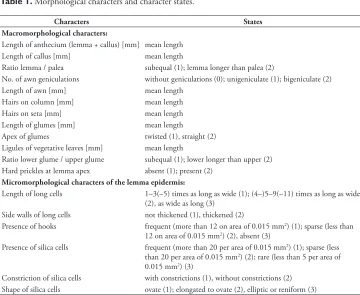
Table 1. Morphological characters and character states.
Characters States
Macromorphological characters:
Length of anthecium (lemma + callus) [mm] mean length Length of callus [mm] mean length
Ratio lemma / palea subequal (1); lemma longer than palea (2)
No. of awn geniculations without geniculations (0); unigeniculate (1); bigeniculate (2) Length of awn [mm] mean length
Hairs on column [mm] mean length Hairs on seta [mm] mean length Length of glumes [mm] mean length Apex of glumes twisted (1), straight (2) Ligules of vegetative leaves [mm] mean length
Ratio lower glume / upper glume subequal (1); lower longer than upper (2) Hard prickles at lemma apex absent (1); present (2)
Micromorphological characters of the lemma epidermis:
Length of long cells 1–3(–5) times as long as wide (1); (4–)5–9(–11) times as long as wide (2), as wide as long (3)
Side walls of long cells not thickened (1), thickened (2)
Presence of hooks frequent (more than 12 on area of 0.015 mm2) (1); sparse (less than
12 on area of 0.015 mm2) (2), absent (3)
Presence of silica cells frequent (more than 20 per area of 0.015 mm2) (1); sparse (less
than 20 per area of 0.015 mm2) (2); rare (less than 5 per area of
0.015 mm2) (3)
Stipeae Dumort., Observ. Gramin. Belg. 83, 88, 134 (1824)
Plants perennial, usually cespitose, occasionally rhizomatous. Culms erect, unbranched. Leaf blades flat or convolute, abaxial surface smooth, scabrous or pubescent, adaxial surface prominently ribbed, with 0.05–1 mm long hairs. Ligules membranous. Inflo-rescence a dense or open panicle. Spikelets with one bisexual floret. Glumes clearly un-equal to subun-equal, membranous, obtuse or acute, tapering into a long tip. Awns scabrid to plumose, straight, uni- or bi-geniculate. Lemmas narrowly lanceolate, terete, usually leathery, usually hairy. Callus rounded or acute to sharply pointed.
Results and discussion
Detailed analyses of macro- and micromorphological structures of the lemma epider-mis of Nepalese species of Stipeae confirmed that they form two main clusters, one with three subclusters (Fig. 2). The clusters correspond to the four lemma epidermal patterns (LEP): Stipa-like, Ptilagrostis-like, Piptatherum-like and Achnatherum-like (Fig. 3). The taxa from cluster I belonging to Stipa have long cells and hooks on the lemma epidermis in an ordered saw-like pattern (Romaschenko et al. 2012; Fig. 3a). Within subcluster A of cluster II, there are three genera, Ptilagrostis, Trikeraia and Orthoraphi-um (Fig. 2), that have LEPs dominated by elongated basal cells, frequent silica bodies and cork cells (Fig. 3b–d, h). However, the presence of deflexed, hard prickles in the case of Orthoraphium roylei (Fig. 3d), as well as 2–3 mm long awn-like lemma lobes
Figure 3. Lemma epidermal patterns (LEPs) of Old World Stipeae: aStipa breviflora [Kyrgyzstan, near Issyk-Kul Lake, M. Nobis (KRA)] bPtilagrostis concinna [India, Ladakh, Himalayas, L. Klimeš (KRA)]
c Ptilagrostis duthiei [India, Himalayas, J.F. Duthie 3585 (LE) dOrthoraphium roylei [India, Himalayas,
in the case of Trikeraia hookeri (Fig. 3e) are unique characters which distinguish them from other members of the subcluster. Subcluster B comprises species from the genus
Piptatherum. These species differ from those in subcluster A in their extremely short
callus, less numerous and rounded silica bodies on the lemma surface (Fig. 3f). Taxa in subcluster C, all of which belong to the genus Achnatherum, have a maize-like type of LEP (Romaschenko et al. 2012), characterized by numerous silica bodies and very short basal cells (Fig. 3g–h). All of these species have lemmas distinctly longer than paleas.
Key to genera
1 Lemma with deflexed (retrorse), apical prickles ...Orthoraphium
– Lemma lacking deflexed, apical prickles ...2
2 Lemma lobes awn-like, 2–3 mm long, setaceous ...Trikeraia
– Lemma without awn-like lobes, lobes (if present) flat and less than 1 mm long ...3
3 Awns straight, scabrous. Anthecium usually dorsally compressed. Callus up to 0.3 mm long ...Piptatherum
– Awns geniculate, scabrous or variously pilose. Anthecium not compressed or laterally compressed. Callus longer than 0.3 mm ...4
4 Callus longer than 0.9 mm. Lemma epidermis with numerous minute hooks (visible under high magnification) ...Stipa
– Callus up to 0.8 mm long. Lemma epidermis smooth or rarely with infre-quent minute hooks ...5
5 Lower segment of awn pilose, with hairs over 0.3 mm long. Surface of lemma epidermis covered with elongated basal cells (4–11 times longer than wider) and occasional, 1–3-constricted silica bodies ...Ptilagrostis
– Lower segment of awn scabrous, with hairs up to 0.1 mm long. Surface of lemma epidermis covered with rounded or once-constricted silica, underlying cells as wide as long or wider than longer ...Achnatherum
Orthoraphium Nees, Proc. Linn. Soc. Lond. 1: 94 (1841)
Type.Orthoraphium roylei Nees.
Orthoraphium roylei Nees, Proc. Linn. Soc. Lond. 1: 94 (1841).
≡ Stipa orthoraphium Steudel, Syn. Pl. Glumac. 1: 131 (1855) nom. superfl.;
≡ Stipa roylei (Nees) Duthie, Grasses North-Western India 27 (1883);
≡ Stipa roylei (Nees) Mez, Repert. Spec. Nov. Regni Veg. 17: 207 (1921).
General distribution. Himalayas: Bhutan, S China, Ladakh, N Myanmar, N In-dia, Nepal (Bor 1960; Freitag 1985; Wu and Phillips 2006).
Distribution in Nepal. Baglung, Bajura, Darchula, Dolkha, Humla, Jumla,
Lal-itpur, Mugu, Myagdi, Ramechhap, Rasuwa, Rukum, Sankhuwasabha, Solukhumbu, Taplejung.
Habitat. Alpine meadows, Rhododendron scrub, oak-laurel forests.
Altitudinal range. 2200–4000 m.
Selected Nepalese specimens studied. Baglung: Dhorpatan, Vallee de
Dhor-patan du cote est, 28°29'18"N, 83°4'1"E, 2800–3350 m, 16 Aug. 1981, M. Farille
81-168 (E). Bajura: Birseni – Porakya, 2250 m, 12 Aug. 1991, K.R. Rajbhandari
14829 (KATH). Darchula: Dopakhe, Dandar – Dopakhe, rocky slope, 2200 m, 28
Aug. 1980, K.R. Rajbhandari & K.J. Malla 5684 (KATH). Dolkha: Gyalche Khar-ka – Thang Dingma, 3100 m, 1 Sep. 1983, K.R. Rajbhandari 9744 (KATH); Bhitte Kharka – Patlo Pokhari, shady place in forest, 3700 m, 12 Sep. 1983, K.R. Rajbhandari
10123 (KATH); Bhitte Kharka – Patlo Pokhari, 3800 m, 12 Sep. 1983, K.R.
Rajb-handari 10164 (KATH). Humla: Tambe Danda, 2750 m, Q. semecarpifolia forest,
15 Aug. 1977, K.R. Rajbhandari & B. Roy 2268 (KATH). Jumla: Jumla, 29°16'31"N, 82°11'0"E, H. Tabata, K.R. Rajbhandari & K. Tsuchiya 9327 (KATH). Lalitpur: Phulchoki, 27°34'14"N, 85°24'4"E, 2600 m, 14 Oct. 1990, K.R. Rajbhandari 4122
(KATH). Mugu: Chankheli Lagna, 29°38'21"N, 82°6'52"E, 3500 m, 9 Aug. 1979,
K.R. Rajbhandari & B. Roy 4445 (KATH). Myagdi: Gurjakhani, North-West of
Gur-jakhani, 28°36'N, 83°13'E, 3480–3490 m, 31 Jul. 1954, J.D.A. Stainton, W.R. Sykes
& L.H.J. Williams 3685 (BM, E, K). Ramechhap: Khola Kharka – Thare, 3600 m,
22 Jul. 1985, H. Ohba et al. 60583 (KATH); Bhandar – Deorali – Khasrubus – Shiva-laya, 2600 m, H. Ohba et al. 62276 (KATH). Rasuwa: Rupchet Kharka - Balchagam, 3200 m, 16 Aug. 1994, K.R. Rajbhandari 17910 (KATH); Laurebina Yak, 28°5'32"N, 85°22'52"E, 3450 m, 30 Jul. 1995, T. Hoshino et al. 9537289 (KATH). Rukum: Sing Khola – Farkama 3636 m, 18 Sep. 1976, H. Tabata, K.R. Rajbhandari & K. Tsuchiya 3720 (KATH). Sankhuwasabha: Hile Ghot, 27°24'N, 87°26'E, 3500 m, 20 Aug. 1972, J.F. Dobremez 1594 (BM, E). Solu Khumbu: Imja Khola Valley, Omoga, sandy clay, floor of north-west/south-east river valley, west facing slope, mossy slope in shade, 27°50'38"N, 86°47'10"E, 3600–2300 m, 26 Sep. 2005, DNEP3 AX131 (E, KATH); Chaurikharka, Q.semecarpifolia forest, mossy slope, 27°41'46"N, 86°43'31"E, 2729 m, 30 Sep. 2005, DNEP3 BY229 (E, KATH); Dudh Kund – Samakang, 27°41'N, 86°50'E, 3500 m, 24 Aug. 1995, F. Miyamoto et al. 9592410 (E); Samakang Kharka 27°41'N, 86°50'E, 3500 m, 24 Aug. 1995, F. Miyamoto et al. 9592410 (KATH); Beni Kharka, 3100 m, 3 Sep. 1985, H. Ohba et al. 62035 (KATH); Beni Kharka, 3600– 2300 m, 2 Sep. 1985, H. Ohba et al. 61907 (KATH); Loding, 27°32'N, 86°32'E, 2700 m, 5 Sep. 1985, H. Ohba et al. 62108 (KATH); 62155; Pike Bhanjyang, 3700 m, 6 Sep. 1985, H. Ohba et al. 62155 (KATH); Pike Dongshar, Rhododendron campanu-latum thicket, 27°30'N, 86°27'E, 2300–3600 m, 9 Sep. 1985, H. Ohba et al. 62192
(KATH); Rangdu Kharka, 27°8'N, 86°48'E 3550 m, 9 Aug. 1997, K.R. Rajbhandari
9740203 (KATH); Tangnag – Mosom Kharka, in forest on mossy ground, 3700 m, 21
27°32'59"N, 86°35'13"E, 3750 m, 2 Aug. 1995, K. Tsuchiya 40841 (KATH); Sen-gephuk, Beni VDC, 3580 m, 29 Aug. 1995, K. Tsuchiya 41782 (KATH); Luminasa, Basa Valley, Beni, 3780 m, 8 Aug. 1995, K. Tsuchiya 42188 (KATH). Taplejung: for-est ridge et Manedhanjang, N end of Milke Danda Ridge, Rhododendron / Bamboo forest, caespitose grass, 27°27'N, 87°28'E, 3340 m, 22 Oct. 1991, D.G. Long et al. 966 (E, KATH); Topke Gola, Arun-Tamur watershed S of Topke Gola, on slopes, 27°38'25"N, 87°34'59"E, 3940 m, 13 Sep. 1956, J.D.A. Stainton 1728 (BM, E).
Stipa L., Sp. Pl. 1: 78 (1753)
Type.Stipa pennata L.
Key to the genus Stipa
1 Upper part of awn (seta) scabrous, with hairs up to 0.4 mm long ...2
– Upper part of awn (seta) pilose, with hairs over 0.4 mm long ...3
2 Upper part of awn and tips of glumes spirally twisted ...S. capillacea
– Upper part of awn and tips of glumes not twisted ...S. krylovii
3 Ligules of vegetative shoots up to 0.3 mm long. Awn column with 0.6– 0.7 mm long hairs ...S. breviflora
– Ligules of vegetative shoots over 2 mm long. Awn column with 1.5–2.5 mm long hairs ...S. klimesii
Stipa breviflora Griseb., Nachr. Ges. Wiss. Göttingen, Math.-Phys. Kl. 3:82 (1868).
= S. aliciae Kanitz, Növényt. Gyujtesek Eredm. Grof Szechenyi Bela Keletazsiai
Utja-bol 61, t. 7 (1891).
Type. (China) Tibet, Gnari (Nari) Khorsum, Schlagentweit 7105 (holotype GOET!,
isotype LE!).
General distribution. China, Kyrgyzstan, N India, Mongolia, Nepal (Grubov
1982; Tzvelev 1968, 1976; Freitag 1985; Wu and Phillips 2006).
Distribution in Nepal. Mustang.
Habitat. High altitude steppes, scree.
Altitudinal range. 2750–3600 m.
Selected specimens studied. Mustang: Entre Jomsom et Kagbheni, dans la
steppe aride a Caragana gerardiana et C. brevispina (limite), 28°46'51"N, 83°43'27"E, 2750 m, 17 Sep. 1981, M.A. Farille 81-362 (E); Muktinath, on open slopes near cul-tivations, 28°48'58"N, 83°51'47"E, 3640 m, 8 Jun 1954, J.D.A. Stainton, W.R. Sykes
Stipa klimesii M.Nobis, Phytotaxa 174(3): 166–168 [174–176] (2014).
= Stipa basiplumosa Munro ex Hook. f., Fl. Brit. India 7(22): 229 (1896) var.
longearista-ta Munro ex Hook. f., Fl. Brit. India 7(22): 229 (1896).
Type. India, NW India, Jammu and Kashmir State, Ladakh, Indus Vy: Zhung (Leh),
Ganglas – upper part, springs with drinking water, 3880–4000 m, 30 Jul. 2001, 34°12.3'N, 77°36.8'E, L. Klimeš 1155, 1156 (holotype KRA!, isotype PRA!).
General distribution. Bhutan, China (Tibet), India (Ladakh, Sikkim), Nepal,
Pa-kistan, (Nobis et al. 2014, 2015).
Distribution in Nepal. Mustang.
Habitat. High mountain steppes and alpine mats, among subalpine shrubs and
on rocky ledges.
Altitudinal range. 3500–5000 m.
Notes. These specimens were previously identified as S. roborowskyi, but this
spe-cies does not occur in Nepal. This spespe-cies differs from S. klimesii in having shorter ligules on the vegetative shoots [0.5–1.5(–2) vs. (2–)3.5–7.5(–9) mm], shorter an-thecium [(6–)6.5–7.5(–7.7) vs. (7–)8.3–9.5(–10) mm] and shorter hairs on seta [(0.3)0.5–1.1(–1.4) vs. (1–)1.3–2(–2.3) mm long, respectively].
Selected specimens studied.Mustang: Damodar, on dry sandy slope, 29°11'N,
83°58'E, 28 Jul. 1979, P.R. Shakya, S.R. Adhikari & K.R. Amatya 5111 (KATH); Kun-da, 28°59'9"N, 84°9'26"E, 4720–4740 m, 11 Aug. 2001, S. Noshiro, M. Amano & T.
Kurosawa 20104179 (KATH).
Stipa krylovii Roshev., Izv. Glavn. Bot. Sada S.S.S.R. 28: 379 (1929).
≡S. sareptana subsp. krylovii (Roshev.) Cui, Fl. Xinjiang. 6: 299 (1996);
≡ S. sareptana var. krylovii (Roshev.) Kuo & Sun, Fl. Reipubl. Popularis Sin. 9(3): 275,
pl. 65, f. 37–41 (1987).
= S. capillata var. coronata Roshev., Fl. Aziat. Ross. 1(12): 168, pl. 8, 8b (1916);
= S. densiflora P.A.Smirn., Repert. Spec. Nov. Regni Veg. 26: 265 (1929) hom. illeg.
non Hughes;
= S. densa P.A.Smirn., Del. sem. Hort. Bot. Univ. Mosquensis 15 (1930);
= S. decipiens P.A.Smirn., Ucen. Zap. Moskovsk. Gosud. Univ. 2: 338 (1934).
Type. Selenginskaya Dauriya, gory mezhdu Temnikom i Dzhidoi, yugo-zapadnaya
chast khr. Borgoiskogo, na sklonakh so stepnoi rastitelnostyu, 28 Jul. 1912, V. Smirnov 524 (lectotype: LE!, designated by Tzvelev 1976).
General distribution. Widely distributed throughout Central Asia (Eastern
Distribution in Nepal. Mustang (Gudkova et al. 2017a).
Habitat. High mountain semi-desert.
Altitude range. 3900–4000 m.
Notes. These specimens were previously identified as S. capillata, but this species
does not occur in Nepal. Stipa krylovii differs from S. capillata mainly in having a ring of hairs at the top of the lemma.
Selected specimens studied. Mustang: s.loc., on dry sandy ground, 29°14'N,
83°52'E, 13000 ft, 3 Aug. 1954, Stainton, Sykes, Williams 2161 (E, K, BM).
Stipa capillacea Keng, Sunyatsenia 6(2): 100, pl. 15 (1941).
= S. koelzii R.R.Stewart, Brittonia 5: 441 (1945).
Type. Open grass land in rear of Shaowusze Agricultural Station, Taining district,
Si-kang province, 22 Jul. 1940, K.L. Chü 7449 (holotype: N, isotype: PE!).
General distribution. Bhutan, S China, N India, Nepal, Pakistan, (Freitag 1985;
Noltie 2000; Wu and Phillips 2006).
Distribution in Nepal. Mustang, Rasuwa, Solukhumbu.
Habitat. Alpine meadows.
Altitudinal range. 2800–4100 m.
Note. These specimens were previously identified as Stipa consanguinea, but this
species does not occur in Nepal. Stipa capillacea differs from other species of the genus in awns twisted together at top of panicle.
Selected specimens studied.Mustang: Kali Gandaki, Thulo Bugin, ESE Lete, S-
fac-ing steep slope, 28°38'4"N, 83°36'20"E, 2820 m, 10 Oct. 1977, G. Miehe 762b (BM); at edge of field, 13000 ft, 3 Aug. 1954, J.D.A. Stainton, W.R. Sykes & L.H.J. Williams 2150
(BM, K); Rasuwa: Langtang, 28°13'N, 85°3'E, 3900 m, 7 Aug. 1970 J.F. Dobremez 522
(BM, E); Kyanjin Gompa, 28°12'42"N, 85°34'1"E 11500–12500 ft, 10 Aug. 1969, A.
Richard 103 (BM); Ganesh Himal, 28°20'N, 85°10'E, Apr. 1975 - May 1975, B. Yon 252
(E). Solukhumbu: Orsho, east facing slope open ground, grazed area with scattered Juni-perus indica, 27°52'15"N, 86°48'44"E, 4100 m, 19 Sep. 2005, DNEP3 AX83 (E, KATH).
Ptilagrostis Griseb., Fl. Ross. 4(13): 447 (1852)
Type.Ptilagrostis mongholica (Turcz. ex Trin.) Griseb.
Key to the genus Ptilagrostis
1 Awn with 0.3–0.5 mm long hairs on column. Seta scabrous ...P. duthiei
2 Glumes, lemma and palea distinctly unequal (lower glume 1.5–3.5 mm longer than the upper and lemma 1–2.5 mm longer than palea) ...P. yadongensis
– Glumes, lemma and palea equal or only slightly unequal ...3
3 Panicles open, 3–5 cm wide, branches up to 6 cm long, spreading ... ...P. dichotoma
– Panicles compressed, 0.7–2 cm wide, branches 0.3–2.8 cm long, suberect or narrowly ascending ...P. concinna
Ptilagrostis duthiei (Hook.f.) M.Nobis & P.D.Gudkova, comb. nov.
urn:lsid:ipni.org:names:77200949-1
Stipa duthiei Hook.f., Fl. Brit. India 7: 232, 1896. (Basionym).
≡ Achnatherum duthiei (Hook.f.) Kuo & Lu, Fl. Reipubl. Popularis Sin. 9(3): 322, pl.
80, f. 9–14 (1987).
Type. [India] Tehri Garwhal, Lekhus, below Srikanta, 12000–13000ft, 11 Aug. 1853,
Duthie 273 (holotype K 32097!).
General distribution. China, N India, Kashmir, Nepal (Freitag 1985; Wu and
Phillips 2006).
Distribution in Nepal. Myagdi.
Habitat. Mountain shrublands.
Altitudinal range. 3400–3800 m.
Selected specimens studied. Myagdi: North of Barse, among dwarf
Rhododen-dron, 3940 m, [28°35'N, 83°11'E], 14 Aug. 1954, J.D.A. Stainton, W.R. Sykes & L.H.J.
Williams 3844 (E 690624).
Ptilagrostis dichotoma Keng ex Tzvelev, Rast. Tsentr. Azii 4: 43 (1968).
Type. China, Kansu and Tsinghai border [in regione opp. Labrang], I.C. Wu 478
(hol-otype N, is(hol-otype LE!).
General distribution. Bhutan, Birma, China (Tibet), N India, Nepal (Wu and
Phillips 2006; Nobis et al. unpbl).
Distribution in Nepal. Bajhang, Bajura, Dolakha, Jumla, Mustang, Myagdi,
Ra-mechhap, Rasuwa, Rukum, Solukhumbu.
Habitat. Alpine meadows, grassy mountain slopes.
Altitudinal range. 3300–5000 m.
Note. These specimens were previously identified as Ptilagrostis mongholica [=Stipa
mongholica] (Bor 1960; Freitag 1985), but the two species are easily distinguished as
P. dichotoma has a tuft of short hairs at the apex of anthers (glabrous in P. mongholica).
Selected specimens studied. Bajhang: Manane Lekh 29°36'45"N, 80°59'35"E, 3830 m, 14 Jul. 2009, Bajhang 09 20917078 (E, KATH); Saipal, 29°57'51"N, 81°13'6"E, 3909 m, H. Tabata, K.R. Rajbhandari & K. Tsuchiya 1808 (KATH); Saipal, 29°57'51"N, 81°13'6"E, 30 Jul. 1976, H. Tabata, K.R. Rajbhandari & K. Tsuchiya 4024
(KATH); Saipal, 29°57'51"N, 81°13'6"E, 31 Jul. 1976, H. Tabata, K.R. Rajbhandari
& K. Tsuchiya 4028 (KATH). Bajura: Chauki Lekh, 29°35'34"N, 81°38'5"E, 4427 m,
15 Aug. 2017, BSH C42; Chauki Lekh, 29°37'16"N, 81°34'30"E, 4427 m, 16 Aug. 2017, BSH C52. Dolakha: Dudh Kunda, 4550 m, 5 Sep. 1983, K.R. Rajbhandari 9915 (KATH). Dolpa, Nahure, 14,000 ft, 24 Jun. 1952, Polunin, O.V., Sykes, W.R.
& Williams, L.H.J. 1434. Jumla: Maharigaon, 15,000 ft, 20 Jul. 1952, Polunin, O.V.,
Sykes, W.R. & Williams, L.H.J. 226. Mustang: Muktinath Himal, Muktinath Range,
28°44'37"N, 83°53'14"E, 480–5000 m, 18 Sep. 1981, M.A. Farille 81-415 (E); Muk-tinath Himal, MukMuk-tinath Range, hab dans la praire alpine, 28°44'37"N, 83°53'14"E, 4800–5000 m, 18 Sep. 1981, M.A. Farille 81-415 (E); Kaisang – Omang Kharka 3800 m, 1 Aug. 1996, K.R. Rajbhandari 9672251 (KATH); Muktinath, 28°48'58"N, 83°51'47"E, 4180 m, 12 Oct. 1976, H. Tabata, K.R. Rajbhandari, K. Tsuchiya & Y.
Kon-no 6310 (KATH); Muktinath, alpine grassland, 28°48'58"N, 83°51'47"E, 4120 m, 12
Oct. 1976, H. Tabata, K.R. Rajbhandari, K. Tsuchiya & Y. Konno 6342 (KATH). My-agdi: 28°32'0"N, 83°13'0"E, 3360 m, 20 Sep. 1996, M. Mikage, R. Hirano, A.
Taka-hashi & K. Yonekura 9682900 (KATH). Ramechhap: Thare Og, 27°45'N, 86°28'E
24 Jul. 1985, H. Ohba, M. Wakabayashi, M. Suzuki, N. Kurosaki, K.R. Rajbhandari &
S.K. Wu 60657 (KATH). Rasuwa: Gosainkund, 28°4'58"N, 85°24'51"E, 4300 m, 27
Jul. 1995, T. Hoshino, K. Dan, H. Koba, Y. Omori, C.P. Rauniyar, M. Sato, P. Shrestha
& S. Takatsuki 9537190 (KATH); Gosainkund, 4350 m, 28°4'58"N, 85°24'51"E, 27
Jul. 1995, T. Hoshino, K. Dan, H. Koba, Y. Omori, C.P. Rauniyar, M. Sato, P. Shrestha
& S. Takatsuki 9537218 (KATH); Gosainkund, 28°4'58"N, 85°24'51"E, 4300 m, 28
Jul. 1995, T. Hoshino, K. Dan, H. Koba, Y. Omori, C.P. Rauniyar, M. Sato, P. Shrestha
& S. Takatsuki 9537221, 9537–222 (KATH). Rukum: Chalikhe Pahar, near Chalike
Pahar, exposed south facing slopes, 28°40'N, 83°4'E, 4240 m, 17 Jun 1954, J.D.A.
Stainton, W.R. Sykes & L.H.J. Williams 3163 (E). Solukhumbu: Seto Pokhari (4810m)
– Chhomalang Base Camp (4495), 27°47'N, 86°57'E, 4810 m, 17 Aug. 1995, F.
Miyamoto, M. Amano, H. Ikeda, C.M. Joshi, K. Arai & T. Komatsu 9592313 (E); Beni,
alpine meadow, 27°32'59"N, 86°35'13"E 4600 m, K. Tsuchiya 42693 (KATH).
Ptilagrostis yadongensis Keng & Tang, J. SouthW. Agric. Univ. 4: 44 (1985).
≡ Ptilagrostis macrospicula Cai, Acta Bot. Boreal.-Occid. Sin. 23(11): 2018 (2003).
superfl. name.
= Stipa milleri Noltie, Edinburgh J. Bot. 56(2): 288 (1999); ≡ Ptilagrostis milleri
(No-ltie) M.Nobis & A.Nobis, Nordic J. Bot. 31: 623 (2013).
Type. China. Xizang: Yadong, 14 Sep. 1974, Qinghai-Xizang Exped. 74–2496 (lapsus
General distribution. Bhutan, China (Tibet), Nepal (Noltie 1999; Nobis and Nobis 2013; Nobis et al. 2015; Zhang et al. 2016).
Distribution in Nepal. Bajhang, Dolkha, Rasuwa, Solukhumbu.
Habitat. Alpine meadows, moist grassy places, under shrubs, swampy places,
Ko-bresia moors.
Altitudinal range. 3600–4600 m.
Note. These specimens were previously identified as P. concinna which also occurs
in Nepal and which can be distinguished by its subequal glumes, lemma and palea. It has also been confused with Ptilagrostis bhutanica (Noltie) M.Nobis (basionym: Stipa
bhutanica Noltie 1999: 289; Nobis et al. 2016), from Bhutan and China. However,
these two taxa differ in the upper part of the awn which is scabrous in P. bhutanica and shortly pilose (with hairs over 0.5 mm long) in P. yadongensis.
Selected specimens studied.Bajhang: Saipal Aletsoura, 29°57'51"N, 81°13'6"E,
4333 m, 31 Jul. 1976, H. Tabata, K.R. Rajbhandari & K. Tsuchiya 1941 (KATH).
Dolkha: Rolwaling Dudh Kunda, 4520 m, 15 Jul. 1975, P.R. Shakya, K.R.
Rajb-handari & H.K. Saiju 75/2978 (KATH). Rasuwa: Ya La, 3600 m, 29 July 1972,
A.Maire, AMA 250 (E); Upper Langtang, 4600 m, 30 Sep. 1986, G. Miehe 13090
(KATH). Solukhumbu, Chola Tsho, north side of lake, SE facing slope, rocks and sand near lakeside, Juniperus indica dwarf scrubland with Rhododedron setosum and Potentilla fruticosa, 27°55'18"N, 86°47'50"E, 4500 m, 21 Sep. 2005, DNEP3 AX98 (E, KATH).
Ptilagrostis concinna (Hook. f.) Roshev., Fl. URSS 2: 75 (1934).
Stipa concinna Hook. f., Fl. Brit. India 7(22): 230 (1897) (Basionym).
Type. Sikkim-Himalaya, Tibetan region, 14000–16000ft, 1861, Hooker (holotype K!,
isotypes G, GOET!, LE 9267!).
General distribution. Himalayas: China (Tibet), India (Ladakh and Sikkim),
Ne-pal (Freitag 1985; Wu and Phillips 2006).
Distribution in Nepal. Solukhumbu, Mustang.
Habitat. Alpine meadows, moist grassy places, under shrubs, swampy places,
Ko-bresia moors.
Altitudinal range. 4400–5300 m.
Selected specimens studied. Solukhumbu: Seto Pokhari, 27°47'N, 86°55'E,
4495–4810 m, 17 Aug. 1995, F. Miyamoto, M. Amano, H. Ikeda, C.M. Joshi, K. Arai &
T. Komatsu 9592313 (KATH). Mustang: Thorung La, 5200–5300 m, 19 Sep. 1981,
M.A. Farille 81-434 (E 189114).
Achnatherum P.Beauv., Ess. Agrostogr.: 19, 146, pl. 6, f. 7 (1812)
Key to the genus Achnatherum
1 Glumes distinctly unequal. Lemma apex with ring of hairs over 3 mm long. Callus 0.5–0.7 mm long, acute at the apex ...A. staintonii
– Glumes equal or almost so. Lemma apex with ring of hairs up to 2 mm long. Callus up to 0.5 mm long, rounded at the apex ...2
2 Lemma and palea clearly unequal. Leaves filiform, inrolled. Culms up to 45 cm long. Panicle with very short branches ...A. jaquemontii
– Lemma and palea subequal. Leaves flat. Culms over 60 cm long. Panicle with widely spreading branches ...A. brandisii
Achnatherum brandisii (Mez) Z.L.Wu, Acta Phytotax. Sin. 34: 154 (1996).
Stipa brandisii Mez, Repert. Spec. Nov. Regni Veg. 17(13–18): 207 (1921) (Basionym).
= Stipa subeffusa Ohwi, Acta Phytotax. Geobot. 17: 15 (1957).
Type. [India] N. W. Himalaya, Kulla, Oct. 1876, Brandis 1005 (lectotype K 32092!
selected and labeled by H. Freitag on 15 March 1984 but designated here).
General distribution. Afghanistan, Bhutan, China, NW India, Nepal, Pakistan
(Freitag 1985; Wu and Phillips 2006).
Distribution in Nepal. Dolpa, Manang, Mustang.
Habitat. Open dry slopes, among shrubs and in Bamboo (Sinarundinaria sp.) thicket.
Altitudinal range. 2400–4000 m.
Note.Stipa brandisii was described by Mez (1921) based on a specimen housed at
B but destroyed during the Second World War. In his original description of the species Mez (1921) reported that the species had been collected in ‘Western-Himalaya, Kulla ([by] Brandis)’, but did not provide further information about the date of specimen col-lection, number and place where it was housed. In the absence of the original material, the specimen at K (http://apps.kew.org/herbcat/getImage.do?imageBarcode=K000032092) was selected as lectotype by H. Freitag in 1984 and subsequently cited as the holotype (Freitag 1985). We designate this here as the lectotype.
Selected specimens studied. Dolpa: Above Chong, near Tibrikot Growing,
among shrubs on open slopes, 29°1'40"N, 82°46'22"E, 2580 m, 11 Sep. 1952,
O.V. Polunin, W.R. Sykes & L.H.J. Williams 3314 (E). Manang: Humde, Bhraka,
open place, 3400 m, Aug. 1983, K.R. Rajbhandari 8786 (KATH); Boraga, Entre Braga et Ghyaru, 28°39'24"N, 84°2'22"E, 3500 m, 22 Sep. 1981, M.A. Farille
81-486 (E); Boraga, Entre Braga et Ghyaru, bois ouvert xerophile, 28°39'24"N,
rocks], environnement rocheux, mais dans les touffes d’epineux oub d’Artemisia, 28°46'51"N, 83°43'27"E, 2750 m, 16 Sep. 1981, M.A. Farille 81-358 (E); Om-mang 28°44'N, 83°45'E, 3600 m, 31 Jul. 1996, T. Hoshino, M. Amano, H. Koba, N.
Miyoshi, K.R. Rajbhandari, M. Sato, P. Shrestha & S. Takatsuki 9662100 (KATH);
Jomsom, 28°46'51"N, 83°43'27"E, 3350 m, 31 Jul. 1996, T. Hoshino, M. Ama-no, H. Koba, N. Miyoshi, K.R. Rajbhandari, M. Sato, P. Shrestha & S. Takatsuki
9670079 (KATH); Kali Gandaki, Tangdung-Khola, S-facing, wind-blown slope,
2490–2480 m, Aug. 1977, G. Miehe (BM); Cha Lungpa, NE-facing slope, alpine pastures 3940 m, 27 July 1977, G. Miehe 351b (BM); NW of Tukche, valley of Yamkin Khola, in Bamboo (Sinarundinaria sp.) thicket, 28°41'15"N, 83°37'35"E, 2840 m, 20 Sep. 1995, M. Mikage & K. Yonekura 9552331 (KATH); Tukucha (Kali Gandaki), 3180 m, [28°42'33"N, 83°38'37"E], 21 Aug. 1954, J.D.A. Stainton, W.R.
Sykes & L.H.J. Williams 7363 (BM, E 619028); Tukucha, Kali Gandaki, amongst
hillside shrubs, 28°42'33"N, 83°38'37"E, 3030 m, 12 Sep. 1954, J.D.A. Stainton,
W.R. Sykes & L.H.J. Williams 7813 (E); Chimgaon (N of Tukucha) Kali Gandaki, on
dry slopes, 28°43'38"N, 83°40'45"E, 2880 m, 14 Sep. 1954, J.D.A. Stainton, W.R.
Sykes & L.H.J. Williams 9887 (BM).
Achnatherum jacquemontii (Jaub. & Spach) P.C.Kuo & S.L.Lu, Fl. Reipubl. Pop-ularis Sin. 9(3): 323, pl. 80, f. 15–19 (1987)
Stipa jacquemontii Jaub. & Spach, Ill. Pl. Orient. 4: 60, pl. 339 (1851) (Basionym).
≡ Lasiagrostis jacquemontii (Jaubert & Spach) Munro ex Boiss., Fl. Orient. 5:
506 (1884);
≡ Lasiagrostis jacquemontii (Jaub. & Spach) Munro ex Aitch., J. Linn. Soc., Bot. 18:
107 (1880).
= Stipa jacquemontii Jaub. & Spach subsp. chuzomica Noltie, Edinburgh J. Bot. 56(2):
290, f. 1Q–U (1999).
Type. [India] ad ruped in excelsis Emodi Cashemyrianim 2750 m, 1831, Jacquemont
994, (holotype P, isotype K!).
General distribution. E Afghanistan, Bhutan, China (Tibet), NW India, Nepal,
Pakistan (Freitag 1985; Noltie 2000; Wu and Phillips 2006).
Distribution in Nepal. Mustang.
Habitat. Dry mountain slopes, especially in rock crevices.
Altitudinal range. 2500–3000.
Selected specimens studied. Mustang: Marpha, pentes rocheues arides,
Achnatherum staintonii (Bor) M.Nobis & P.D.Gudkova, comb. nov. urn:lsid:ipni.org:names:77200950-1
Stipa staintonii Bor, Bull. Bot. Surv. India 7: 133 (1965) (Basionym).
≡ Stipella staintonii (Bor) Röser & Hamasha, Pl. Syst. Evol. 298: 365 (2012), nom. inval.;
≡ Stipellula staintonii (Bor) Röser & H.R. Hamasha, Schlechtendalia 24: 92 (2012).
Type. Nepal, near Seng Khola, 12500 ft [3810 m.], exposed cliffs, 4 Okt 1954,
Stain-ton, Sykes & Williams 4677 (holotype K!, isotype BM!).
General distribution. Nepal (endemic; Bor 1965; Freitag 1985).
Distribution in Nepal. Baglung, Dolpa, Manang, Mustang, Rukum.
Habitat. open rocky or stony sandy slopes and scrublands.
Altitude. 3000–4200 m.
Note. Although Achnatherum staintonii has been confused with Stipa przewalskyi,
the latter species does not occur in Nepal. Achnatherum staintonii is easily distinguished from Stipa przewalskyi by having maize-like vs. saw-like LEPs and in having unequal glumes and distinctly longer lemma than palea vs. glumes as well as lemma and palea subequal, respectively. Röser (2012) transferred five species of Stipa, including Stipa
staintonii, into their new genus Stipellula on the basis of his earlier molecular analysis
(Hamasha et al. 2012). Stipellula is characterized by its maize-like lemma epidermal pattern which clearly distinguishes it from Stipa and confirms that these species belong to the achnatheroid group of grasses within the Stipeae. However, there are no unique, diagnostic morphological characters to separate Stipellula from Achnatherum which is itself polymorphic and highly polyphyletic (Romaschenko et al. 2012; Hamasha et al. 2012). Thus, we prefer to treat Stipa staintonii as a member of Achnatherum.
Selected specimens studied.Baglung: Sing Khola, wet rocky cliff, 18 Sep. 1976,
H. Tabata, K.R. Rajbhandari & K. Tsuchiya 3711 (KATH). Dolpa: Ringmo, dry
hillslope, 29°10'20"N, 82°55'50"E, 3400 m, 2 Aug. 1973, S. Einarsson, L. Skärby &
B. Wetterhall 3128 (BM); Barbung Khola, 28°52'N, 83°15'E, 3030 m, 18 Jul. 1963,
J.D.A. Stainton 4417 (BM); Barbung Khola, 28°52'N, 83°18'E, 3030 m, 13 Jul. 1963,
J.D.A. Stainton 4417 (E); Suligad, Rhagaon, rocky slope, 29°28'N, 82°55'E, 2600 m,
25 Sep. 1982, K.R. Rajbhandari & K.J. Malla 6740 (KATH); Karnali, Ringmigaon, on dry hilslope, 3400 m, 2 Aug. 1973, S. Einarsson, L. Skärby, B. Wetterhall 3126
(UPS); Karnali, Manang: Bhraka, Humde, open rocky slope, 28°38'24"N, 84°5'36"E, 3400 m, 3 Aug. 1983, K.R. Rajbhandari 8814 (KATH); Marsyandi valley, Tangi above Manangbhot, on stony sandy places, 28°39'56"N, 84°1'33"E, 3800 m, 12 Oct. 1969, T. Wraber 36427 (E); Tangi, above Manangbhot, Tangje, on stony sandy places, 28°39'22"N, 84°2'2"E, 3800 m, 12 Oct. 1969, T. Wraber 479 (BM). Mustang: Entre Marpha et Syang; Syang, Marpha, 28°45'11"N, 83°41'28"E, 2650 m, 16 Sep. 1981, M.A. Farille 81-340 (E); Entre Larjung et Tukuche, 2550 m, 14 Sep. 1981,
M.A. Farille 81-313 (E); Cha Lungpa, in E-facing Cupressus forest, 3030 m, 3 Oct.
Aug. 2002, F. Miyamoto, N. Kurosaki, S. Akiyama, H. Ikeda, Y. Iokawa, Y. Takahashi,
M. Tsusaka & M.N. Subedi 20210022 (KATH); Phalyak to Pongio Kharka, 28°49'0"N,
83°45'0"E, 3800–4000 m, 9 Aug. 2002, F. Miyamoto, N. Kurosaki, S. Akiyama, H.
Ikeda, Y. Iokawa, Y. Takahashi, M. Tsusaka & M.N. Subedi 20220034 (KATH); Chele –
Samar, 28°57'43"N, 83°48'6"E, 3450-3670 m, 4 Aug. 2001, S. Noshiro, M. Amano, Y.
Iokawa, T. Kurosawa, & M.N. Subedi 20105005 (KATH); Tukuche, open rocky slope,
28°42'33"N, 83°38'37"E, 2630 m, 19 Jul. 1983, K.R. Rajbhandari 7991 (KATH); Jomsom, open slope, 28°46'51"N, 83°43'27"E, 2760 m, 21 Jul. 1983, K.R. Rajbhandari 8072 (KATH); Jomsom to Sayang, cliffs in dry valley with scrub (Caragana, Clematis, Rosa etc.), 28°46'51"N, 83°43'27"E, 2700 m, 19 Sep. 1999, Shrestha et al. 1014 (E); Tukuche, 28°42'33"N, 83°38'37"E, 3180 m, 21 Aug. 1954, J.D.A. Stainton, W.R.
Sykes & L.H.J. Williams 7352 (BM). Rukum: Sen Khola, 28°42'54"N, 82°57'21"E,
3790 m, 4 Oct. 1954, J.D.A. Stainton, W.R. Sykes & L.H.J. Williams 4677 (BM).
Piptatherum P.Beauv., Ess. Agrostogr.: 17: 173 (1812)
Type.Piptatherum coerulescens (Desf) P. Beauv.
Key to the genus Piptatherum
1 Panicle compressed ...2
– Panicle lax ...3
2 Awn terminal ...P. laterale
– Awn subterminal ...P. gracile
3 Lemma almost equal to glumes, apical part gradually narrowed into a persis-tent awn...P. aequiglume
– Lemma much shorter than glumes, apical part abruptly contracted into a slender, caducous awn ...P. munroi
Piptatherum aequiglume (Duthie ex Hook.f.) Roshev., Bot. Mater. Gerb. Bot. Inst. Komarova Akad. Nauk SSSR 14: 113 (1951).
Oryzopsis aequiglumis Duthie ex Hook. f., Fl. Brit. India 7(22): 234 (1896) (Basionym).
= Piptatherum sinense Mez, Repert. Spec. Nov. Regni Veg. 17(486–491): 211 (1921).
Type. India: distr. Jansar, Gamble 15143 (lectotype K! designated by Bor 1970).
General distribution. Afghanistan, Bhutan, S China, NW India, Nepal, Pakistan
(Freitag 1975; Noltie 2000; Wu and Phillips 2006).
Habitat. Moist mesophytic forests.
Altitude range. 3500–4000 m.
Selected specimens studied.Rukum: near Dogadi Khola, 3660 m, 8 Aug. 1954,
J.D.A. Stainton, W.R. Sykes & L.H.J. Williams 3801 (E 814753); nr. Dogadi Khola,
3790 m, 8 Aug. 1954, J.D.A. Stainton, W.R. Sykes & L.H.J. Williams 3794 (E 814768).
Piptatherum gracile Mez, Repert. Spec. Nov. Regni Veg. 17(486–491): 211 (1921).
≡ Oryzopsis gracilis (Mez) Pilg., Notizbl. Bot. Gart. Berlin-Dahlem 14: 347 (1939:).
Type. Tibet occ., 3900–4000 m., Thomson s.n. (lectotype W designated by Freitag
1975, isolectotype K!).
General distribution. Afghanistan, China, N India, Nepal, Pakistan, Tajikistan
(Freitag 1975; Wu and Phillips 2006).
Distribution in Nepal. Mustang.
Habitat. alpine steppes and meadows.
Altitude range. 2500–4000 m.
Selected specimens studied. Mustang: Marpha, 28°45'11"N, 83°41'28"E,
2670 m, 16 Sep. 1981, M.A. Farille 81-336 (E); Jomsom, 28°46'51"N, 83°43'27"E, 3200 m, Versant de Muksant Range, faisant face a Jomsom, 500 m au dessus du vil-lage, on rocks, 16 Sep. 1981, M.A. Farille 81-352 (E); Jharkot – Kagbeni, 28°50'17"N, 83°47'3"E, 2800–3550 m, 17 Sep. 1981, M.A. Farille 81-359 (E); 10 Jul. 2000, Y.
Iokawa, M.N. Subedi, Y. Takahashi & K. Kano 20020054 (E); Dzong Pura (Muktinath),
28°49'41"N, 83°51'19"E 3640 m, 29 July 1954, J.D.A. Stainton, W.R. Sykes & L.H.J.
Williams 2087 (E); Tange, 29°0'38"N, 83°56'45"E, 3640 m, 1 Aug. 1954, J.D.A.
Stainton, W.R. Sykes & L.H.J. Williams 2125 (E); Kagbeni, 28°50'17"N, 83°47'3"E,
3030 m, 8 Jun 1954, J.D.A. Stainton, W.R. Sykes & L.H.J. Williams 5659 (E); Ekle Bhatti, on sunny rocky steep slope at pathside, 2270 m, 22 Sep. 1995, M. Mikage et
al. 9552384 (E 224287).
Piptatherum munroi (Stapf ex Hook.f.) Mez, Repert. Spec. Nov. Regni Veg. 17: 212 (1921).
Oryzopsis munroi Stapf ex Hooker, Fl. Brit. India 7(22): 234 (1897) (Basionym).
= Oryzopsis stewartiana Bor, Kew Bull., 272 (1953);
= Oryzopsis geminiramula Ohwi, Acta Phytotax. Geobot. 17: 14 (1957).
Type. NW India, Chenab Himalayas, 1852, Thomson (lectotype E 360583!,
desig-nated by Freitag 1975).
Distribution in Nepal. Dolpa, Jumla, Mustang, Sankhuwasabha, Solukhumbu.
Habitat. Among dwarf Rhododendron shrubland and in coniferous forest.
Altitude range. 3490–4500.
Selected specimens studied. Dolpa: Sangdan, 28°55'N, 83°41'E, 4550 m, 21
Jul. 1963, J.D.A. Stainton 4443 (E). Jumla: Maharigaon, grassy slope, 29°19'50"N, 82°22'15"E, 4090 m, 18 Jul. 1952, O.V. Polunin, W.R. Sykes, & L.H.J. Williams 219 (E). Mustang: 2800 m, 16 Sep. 1981, M. Farille, 81-348 (E); Lo Tsho Dhyum, Nr. Kali Grandaki River, Dhi (Dhee) area, stony river bank, scattered open vegeta-tion, 22 Jul. 1998, W.R. Sykes 285/98 (E). Sankhuwasabha: Thudam, 27°45'31"N, 87°32'59"E, 3490–3480 m, 2 Nov 1971, L.W. Beer, C.R. Lancaster & D. Morris 10679
(E). Solukhumbu: Namche Bazar, along the trail to Phurte, South east facing grassy slopes, open grassy slopes with bushes of Juniperus, 27°48'24"N, 86°42'46"E, 3420 m, 13 Sep. 2005, F.M. Watson et al. DNEP3 AX33 (E, KATH).
Piptatherum laterale (Regel) Munro ex Nevski, Trudy Bot. Inst. Akad. Nauk SSSR Ser. 1, Fl. Sist. Vyssh. Rast. 4: 217 (1937).
Milium laterale Regel, Trudy Imp. S.-Peterburgsk. Bot. Sada 7: 645 (1881) (Basionym).
≡ Oryzopsis lateralis (Regel) Stapf ex Hook. f., Fl. Brit. India 7(22): 234 (1896);
≡ Piptatherum laterale (Regel) Roshev., Bot. Mater. Gerb. Inst. Bot. Akad. Nauk
Ka-zahsk. SSR 14: 117 (1951).
= Oryzopsis pubiflora Hack., Denkschr. Kaiserl. Akad. Wiss., Wien Math.-Naturwiss.
Kl. 50(2): 8 (1885); ≡ Piptatherum pubiflorum (Hack.) Roshev., Bot. Mater. Gerb. Bot. Inst. Komarova Akad. Nauk SSSR 14: 111 (1951).
= Oryzopsis vavilovii Roshev., Trudy Prikl. Bot. Selekts. 19(1): 123 (1928); ≡
Pip-tatherum vavilovii (Roshev.) Roshev., Bot. Mater. Gerb. Inst. Bot. Akad. Nauk
Kazahsk. SSR 14: 118 (1951).
Type. Afghanistan, Kurram valley, Sikarm, common at 3650 m., dry localities, 1879,
Aitchison (holotype LE!, isotype K).
General distribution. widely distributed species, occurring from Turkey up to
Bhutan and S China (Freitag 1975, Tzvelev 1976).
Distribution in Nepal. Although we did not find any specimens of Piptatherum
laterale during this study, it is known from nearby regions of Bhutan, China, India
(Freitag 1975, Noltie 2000, Wu and Phillips 2006), so it is very likely also to be pre-sent in Nepal.
Trikeraia Bor, Kew Bull. 9(4): 555, f. s.n. (1954)
Trikeraia hookeri (Stapf) Bor, Kew Bull. 9(4): 555–556 (1954).
Stipa hookeri Stapf, J. Linn. Soc., Bot. 30: 120 (1894) (Basionym).
≡ Achnatherum hookeri (Stapf) Keng, Claves Gen. Sp. Gram. Prim. Sinic. 106, 213
(1957).
= Timouria aurita Hitchc., J. Wash. Acad. Sci. 23: 134 (1933).
Type. Tibet, 4500 m, sheltered nullahs near water, Jul-Sep. 1891, Thorold 124
(holo-type K!, iso(holo-type C).
General distribution. China (Tibet), India (Sikkim, Ladakh), Pakistan (Freitag
1985; Wu and Phillips 2006).
Distribution in Nepal. Although we did not find any specimens of Trikeraia
hook-eri during this study we include it here because it is known from nearby regions (Fre-itag 1975, Wu and Phillips 2006), so it is very likely to be present in Nepal. Fre(Fre-itag (1985) reported this species from Nepal based on Sufed 104 (K), Mt. Everest, Tinkye palin, 4270 m, but this specimen appears to have been collected on the Tibetan side of Mt Everest.
Habitat. Scrublands, alpine mats.
Altitude range. 4000–4300 m.
Note. The 2005 DNEP3 expedition to Solukhumbu collected several specimens
which were identified as Trikeraia oreophila Cope by H. Noltie [Dingboche, on trail south to the Lobuche Khola bridge, east facing valley side, 27°52'50"N, 86°49'7"E, 4230 m, 23 Sep. 2005, M.F. Watson et al. DNEP3 AX107 (E, KATH)]. These speci-mens are characterized by having 4–6 mm long lemma lobes, the awn arising below the middle of the lemma and ovary with two stigmas. Recently, Trikeraia oreophila was found to be conspecific with Sinochasea trigyna Keng (WCSP 2019). Morphological and molecular studies have shown that the genus Sinochasea is distinct not only from
Trikeraia, but also from all the other genera of the tribe Stipeae, and therefore it was
transferred to the tribe Phaenospermateae Renvoize & Clayton (Schneider et al. 2011; Romaschenko et al. 2012; Kellogg 2015).
Acknowledgements
References
Barkworth ME (2007) Stipeae Dumort. In: Barkworth M, Capels KM, Long S, Anderton LK, Piep MB (Eds) Flora of North America North of Mexico, vol. 24. Oxford University Press, New York, 109–186.
Bor NL (1960) Grasses of Burma, Ceylon, India and Pakistan (excluding Bambuseae). Perga-mon Press, 767 pp.
Bor NL (1965) New species in Gramineae. Bulletin of the Botanical Survey of India 7(1–4): 132–133.
Bor NL (1970) Graminae. In: Rechinger KH (Ed.) Flora Iranica, vol. 70. Academische Druck-und Verlagsanstalt, Graz-Austria, 1–573. [72 tables]
Clayton WD, Renvoize S (1986) Genera Graminum: Grasses of the world. Her Majesty’s Sta-tionery Office, London, 389 pp.
Columbus TJ, Smith JP, Goldman DH (2019) California Flora, The Japson eFlora. http:// ucjeps.berkeley.edu/eflora/search_eflora.php?name= [accessed 10.07.2019]
Freitag H (1975) The genus Piptatherum (Gramineae) in southwest Asia. Notes from the Royal Botanic Garden Edinburgh 33: 341–408.
Freitag H (1985) The genus Stipa (Gramineae) in southwest and south Asia. Notes from the Royal Botanic Garden Edinburgh 42: 355–489.
Grubov VI (1982) Key to the vascular plants of Mongolia (with an atlas). Nauka, Leningrad, 443 pp.
Gudkova PD, Olonova MV, Feoktisov DS (2017a) The comparison of ecologo-climatic niches of two species feather grass Stipa sareptana A.K. Becker and S. krylovii Roshev. (Poaceae). Ukrainian Journal of Ecology 7(4): 263–269. https://doi.org/10.15421/2017_115
Gudkova PD, Pendry CA, Nobis M, Bayahmetov E (2017b) Stipa krylovii Roshev. (Poaceae), a new record for the flora of Nepal. Check List 13(1): 2056. https://biotaxa.org/cl/article/ view/13.1.2056
Hamasha HR, von Hagen KB, Röser M (2012) Stipa (Poaceae) and allies in the Old World: molecular phylogenetics realigns genus circumscription and gives evidence on the origin of American and Australian lineages. Plant Systematics Evolution 298: 351–367.https://doi. org/10.1007/s00606-011-0549-5
Hammer O, Harper DAT, Ryan PD (2001) PAST: Paleontological Statistic software package for education and data analysis. Paleontologia Eletronica 4: 1–9.
Hitchcock AS (1935) Manual of Grasses of the United States. US Department of Agriculture Miscellaneous Publication 200: 1–1040. https://doi.org/10.5962/bhl.title.65333
Kellogg EA (2015) Flowering plants. Monocots: Poaceae. In: Kubitski K (Ed.) The Families and Genera of Vascular Plants, vol. 13. Springer International, Cham, 1–416.
Mez C (1921) Gramineae novae vel minus cognitae. Repert. Spec. Nov. Regni Veg. 17: 204–214.
https://doi.org/10.1002/fedr.19210171310
Nobis M, Nobis A, Nowak A, Nowak S (2014) Stipa klimesii (Poaceae), a new species from Western Himalayas (India). Phytotaxa 174(3): 173–180. https://doi.org/10.11646/phyto-taxa.174.3.6
Nobis M, Nowak A, Ebel AL, Nobis A, Nowak S, Gudkova PD, Verkhozina AV, Erst AS, Łazarski G, Olonova MV, Piwowarczyk R, Bobrov AA, Khrustaleva IA, Plášek V, Silantye-va MM, Zalewska-Gałosz J (2015) Contribution to the flora of asian and European coun-tries: New national and regional vascular plant records, 3. Acta Botanica Gallica 162(2):
103–115. https://doi.org/10.1080/12538078.2015.1010105
Nobis M, Nobis A, Klichowska E, Nowak A, Nowak S, Gudkova PD (2016) Stipa dickorei sp. nov. (Poaceae), three new records and a checklist of feather-grasses of China. Phytotaxa 267(1): 29–39. https://doi.org/10.11646/phytotaxa.267.1.3
Nobis M, Gudkova PG, Nowak A, Sawicki J, Nobis A (2019) A revision of the genus Stipa
(Poaceae) in Middle Asia, including a key to species identification, an annotated checklist and phytogeographic analysis. Annals of the Missouri Botanical Garden.
Noltie HJ (1999) Notes relating to the flora of Bhutan: XXXVIII. Gramineae I, tribe Stipeae. Ed-inburgh Journal of Botany 56(2): 285–292. https://doi.org/10.1017/S0960428600001141
Noltie HJ (2000) The Grasses of Bhutan. Flora of Bhutan, vol. 3, part. 2. Royal Botanic Garden Edinburgh & Royal Government of Bhutan, Edinburgh, 1–883.
Ohba H, Iokawa Y, Sharma LR (2008) Flora of Mustang, Nepal. Tokyo: Kodansha Scientic, 1–506. Pazij VK (1968) Stipa L. In: Kovalevskaya SS (Ed.) Opredelitel rastienii sredniei Azii (Conspectus florae Asiae Mediae), vol. 1. Editio Academiae Scientiarum UzSSR, Taschkent, 64–82, 200–201.
Peterson PM, Romaschenko K, Soreng RJ, Valdés Reyna J (2019) A key to the North American genera of Stipeae (Poaceae: Pooideae) with descriptions and taxonomic names for species
of Eriocoma, Neotrinia, Oloptum, and five new genera: Barkworthia, ×Erionella,
Pseudoerio-coma, Ptilagrostiella, and Thorneochloa. PhytoKeys 126: 89–125. https://doi.org/10.3897/
phytokeys.126.34096
Press JR, Shrestha KK, Sutton DA (2000) Annotated check-list of the flowering plants of Ne-pal. The Natural History Museum, London, 1–430.
Romaschenko K, Peterson PM, Soreng RJ, Garcia-Jacas N, Futorna O, Susanna A (2008) Molecular phylogenetic analysis of the American Stipeae (Poaceae) resolves Jarava sensu lato polyphyletic: Evidence for a new genus, Pappostipa. Journal of the Botanical Research Institute of Texas 2(1): 165–192.
Romaschenko K, Peterson PM, Soreng RJ, Garcia-Jacas N, Susanna A (2010) Phylogenetics of
Stipeae (Poaceae: Pooideae) based on plastid and nuclear DNA sequences. In: Seberg O,
Petersen G, Barfod A, Davis JI (Eds) Diversity, Phylogeny, and Evolution in the Monocot-yledons: Proceedings of the Fourth International Conference on the Comparative Biology of the Monocotyledons and the Fifth International Symposium on Grass Systematics and Evolution. Aarhus Universitetsforlag, Aarhus, Denmark, 511–537.
Romaschenko K, Peterson PM, Soreng RJ, Futorna O, Susanna A (2011) Phylogenetics of
Pip-tatherum s. l. (Poaceae: Stipeae): evidence for a new genus, Piptatheropsis, and resurrection
Romaschenko K, Peterson PM, Soreng RJ, Garcia-Jacas N, Futorna O, Susanna A (2012) Sys-tematics and evolution of the needle grasses (Poaceae: Pooideae: Stipeae) based on analy-sis of multiple chloroplast loci, ITS, and lemma micromorphology. Taxon 61(1): 18–44.
https://doi.org/10.1002/tax.611002
Röser M (2012) Stipellula, a new genus, and new combinations in feather grasses (Poaceae tribe Stipeae). Schlechtendalia (Halle) 24: 91–93.
Roshevitz RYu (1934) Ptilagrostis Griseb., Stipa L. In: Komarov VL (Ed.) Flora SSSR, vol. 2. Editio Academiae Scientiarum URSS, Leningrad, 74–112, 740–741.
Schneider J, Winterfeld G, Hoffmann MH, Roser MR (2011) Duthieeae, a new tribe of grasses (Poaceae) identified among the early diverging lineages of subfamily Pooideae: Molecular phylogenetics, morphological delineation, cytogenetics and biogeography. Systematics and Biodiversity 9(1): 27–44. https://doi.org/10.1080/14772000.2010.544339
Sokal RR, Sneath PH (1963) Principles of numerical taxonomy. San Francisco, W.H. Freeman, 1–395.
Soreng RJ, Peterson PM, Davidse G, Judziewicz EJ, Zuloaga FO, Filgueiras TS, Morrone O (2003) Catalogue of New World grasses (Poaceae): IV. subfamily Pooideae. Contributions from the United States National Herbarium 48: 1–730.
Soreng RJ, Peterson PM, Romaschenko K, Davidse G, Zuloaga FO, Judziewicz EJ, Filgueiras TS, Morrone O (2015) A world-wide phylogenetic classification of the Poaceae (Gramineae). Journal of Systematics and Evolution 53(2): 117–137. https://doi.org/10.1111/jse.12150
Soreng RJ, Peterson PM, Romaschenko K, Davidse G, Teisher JK, Clark LG, Barberá P, Gillespie LJ, Zuloaga FO (2017) A worldwide phylogenetic classification of the Poaceae (Gramineae) II: An update and a comparison of two 2015 classifications. Journal of Sys-tematics and Evolution 55(4): 259–290. https://doi.org/10.1111/jse.12262
Thiers B (2018) Index Herbariorum. A global directory of public herbaria and associated staff. New York Botanical Garden’s Virtual Herbarium. http://sweetgum.nybg.org/science/ih
[accessed: 14. 06. 2018]
Tzvelev NN (1968) Zlaki (Gramineae). In: Grubov VI (Ed.) Rastieniya Centralnoi Azii. Po ma-terialam Botanicheskogo Instituta im. VL Komarova (Plantae Asiae Centralis, secus mater-ies Instituti botanici nomine VL Komarovii), vol. 4. Nauka, Leningrad, 1–243. [12 maps] Tzvelev NN (1976) Grasses of the Soviet Union. Nauka, Leningrad, 786 pp.
Tzvelev NN (1977) On the origin and evolution of Feathergrasses (Stipa L.). In: Lebedev DV, Karamysheva ZV (Eds) Problemy ekologii, geobotaniki, botanicheskoi geografii i floristiki. Academiya Nauk SSSR, Leningrad, 139–150.
WCSP (2019) World Checklists of Selected Plant Families. https://wcsp.science.kew.org/home. do [accessed 08.03.2019]
Wu ZL, Phillips SM (2006) Tribe Stipeae. In: Wu ZY, Raven PH, Hong DY (Ed.) Flora of China (Poaceae), vol. 22. Science Press Beijing and Missouri Botanical Garden Press St. Louis, 188–212.
Zhang ZS, Zhu XY, Li LL, Jiang SW, Chen WL (2016) A new synonym of Ptilagrostis
ya-dongensis and a new record of Stipa bhutanica to the flora of China (Poaceae). Phytotaxa