Open Access
Research
Patterns of walking for transport and exercise: a novel application
of time use data
Catrine Tudor-Locke*
1, Michael Bittman
2, Dafna Merom
3and
Adrian Bauman
3,4Address: 1Department of Exercise and Wellness, Arizona State University East, Mesa, Arizona, USA, 2Social Policy and Research Centre, The University of New South Wales, Sydney, New South Wales, Australia, 3School of Public Health and Community Medicine, University of New South Wales, Sydney, New South Wales, Australia and 4School of Public Health, University of Sydney, New South Wales, Australia
Email: Catrine Tudor-Locke* - [email protected]; Michael Bittman - [email protected]; Dafna Merom - [email protected]; Adrian Bauman - [email protected]
* Corresponding author
Exercise/physical activitysurveys
Abstract
Background: Walking for exercise is a purposeful or structured activity that can be captured relatively easily in surveys focused on leisure time activity. In contrast, walking for transport is an incidental activity that is likely to be missed using these same assessment approaches. Therefore, the purpose of this analysis was to utilize 1997 Australian Bureau of Statistics (ABS) Time Use Survey diary data to describe nationally representative patterns of walking for transport and for exercise.
Methods: Household members ≥ 15 years of age were recruited from over 4,550 randomly selected private dwellings in Australia. Time use diaries were collected for two designated days during all four seasons over the calendar year. 3,471 males and 3,776 females (94% household response rate and 84% person response rate) provided 14,315 diary days of data. The raw diary data were coded and summarized into bouts and minutes that included walking for transport and for exercise.
Results: Walking for transport was indicated on a higher proportion of days compared to walking for exercise (20 vs. 9%). Based on participant sub-samples ('doers'; those actually performing the activity) walking for transport was performed over 2.3 ± 1.4 bouts/day (12.5 minutes/bout) for a total of ≈28 mins/day and walking for exercise over 1.2 ± 0.5 bouts/day (47 minutes/bout) for a total of ≈56 mins/day.
Conclusion: Although walking for transport is typically undertaken in multiple brief bouts, accumulated durations approximate public health guidelines for those who report any walking for transport.
Published: 17 May 2005
International Journal of Behavioral Nutrition and Physical Activity 2005,
2:5 doi:10.1186/1479-5868-2-5
Received: 15 September 2004 Accepted: 17 May 2005
This article is available from: http://www.ijbnpa.org/content/2/1/5 © 2005 Tudor-Locke et al; licensee BioMed Central Ltd.
Background
Public health recommendations for physical activity (PA) state that all individuals should minimally accumulate 30 minutes or more of daily moderate intensity activity, such as brisk walking [1-3]. Regular walking for exercise has been associated with numerous health benefits including reduced risk of coronary heart disease[4,5] and diabe-tes[6], weight loss/weight maintenance[7], and lowered blood pressure[8]. There is also evidence that less struc-tured walking, i.e., walking for transport, has similar health benefits [9-11]. The Compendium of Physical Activities[12] indicates that both types of walking meet minimal intensity requirements for health-related PA. Specifically, walking for exercise (Compendium code 17200) is a 3-MET activity and walking for transport (code 17270) is a 4-MET activity. A MET is a multiple of meta-bolic requirements at rest; ≥ 3 METs is considered at least moderate intensity[1].
In the USA, walking for exercise is consistently the most prevalent leisure-time PA[13,14] and the most frequently reported activity among adults who meet public health PA recommendations[14]. Nevertheless, Rafferty et al[15] found that only 21% of self-defined walkers did so a min-imum of 30 minutes five or more times per week. Similar findings have been documented for the Australian popu-lation. For example, in the Active Australia 1999 survey, 35% of 3,814 adults surveyed reported walking 5+ 'ses-sions' in the immediate past week [16]. A secondary anal-ysis of the 2001 Australian Sport Commission's Exercise, Recreation and Sport Survey indicated that walking was the most commonly reported activity undertaken by 13,659 individuals ≥ 15 years of age surveyed, yet only 16.8% engaged in a sufficient frequency of walking for health benefit (i.e., ≥ 5 days/wk) throughout the previous year[17]. Finally, based on a survey of 1,773 healthy workers and homemakers aged 18–59 years (living in the Perth greater metropolitan area of Western Australia), Giles-Corti and colleagues[18] found that although 72.1% reported any walking for transport and 68.5% reported any walking for exercise in the previous two weeks, only 17.2% of all walkers performed a sufficient amount likely to accrue health benefits.
Walking for exercise is a purposeful or structured activity that can be captured relatively easily in surveys focused on leisure time activity. In contrast, walking for transport is an incidental activity that is likely to be missed using these same assessment approaches[19]. Although some surveil-lance systems are beginning to introduce questions related to walking for transport, their measurement prop-erties and health benefits remain largely unknown at this time. Consequently, we are unfamiliar with patterns (e.g., daily bouts or their length) of walking for transport and are therefore limited in our ability to determine its relative
importance to health. There is evidence to suggest that short-term recall and diaries are a more appropriate approach for capturing such incidental walking behav-iours[20]. In the hierarchy of PA assessment approaches, diaries are considered to be direct methods of measure-ment, and therefore preferred, measures of PA[21]. The 1997 Australian Bureau of Statistics (ABS) Time Use Survey provides a unique opportunity to examine the pat-terns and relative contributions of these two types of walk-ing to recommended levels of health-related PA. This nationally representative survey captures a detailed diary (recorded in 5-minute intervals) of all of a person's activ-ities over the course of two consecutive days. In addition to providing an exhaustive record of daily time spent in sport/exercise, and more specifically, walking for exercise, it includes information on time spent in various modes of transport (including by walking). Therefore, the purpose of this population analysis was to utilize these existing data to describe the patterns of walking for transport and for exercise in relation to sports/exercise participation and meeting health-related PA recommendations.
Methods
Australian Bureau of Statistics (ABS) Time Use Survey The data analysed in this paper was collected by the ABS. Subject's informed consent, their anonymity and the con-fidentiality of the data they provide is guaranteed by the legislation which established the ABS. This is in compli-ance with the Helisinki Declaration. The 1997 Time Use Survey recruited household members ≥ 15 years of age from over 4,550 randomly selected private dwellings in Australia. Time use diaries were collected for two specifi-cally designated consecutive days (representing each day of the week in equal proportions) for each person during all four seasons over the calendar year. Collection and analysis of two days of data is common in time use research; further, in large samples such as this we can expect atypical days to be minimized in the aggregate, assuring generalizability of findings[22]. The ABS diaries were formatted in five-minute time intervals, with space for respondents to record (in their own words) their pri-mary activity, 'what else' they were doing at the same time (i.e., secondary activity), the location of the activity, oth-ers present during the activity, and who they did this activ-ity for[23].
classification. Most contemporary activity classifications are derived from this source including those used in Aus-tralian time use surveys [23]. The raw diary data were coded accordingly and summarized into bouts and min-utes of primary and secondary activities representing nine major activity categories: 1) personal care; 2) employ-ment; 3) education; 4) domestic; 5) child care; 6) purchas-ing; 7) voluntary work and care; 8) social and community interaction; and, 9) recreation and leisure. A coding scheme was also available for associated travel (including walking for transport) under each of these categories. Associated travel was always coded as a primary activity. The final sample included 7,247 persons (3,471 males and 3,776 females; representing 94% household response rate and 84% person response rate) providing 14,315 diary days of data. The age breakdown was as follows: 15– 24 years = 18.5%, 25–39 years = 30.2%, 40–49 years = 32.1%, and 60+years+19.2%. Almost 74% of the sample was Australian-born, 62% were married or in a common-law relationship, and modal income (40%) was less than $300AU per week.
The most widely accepted benchmark for time use data quality is the average number of activity bouts recorded in each diary, with diaries containing over 20 bouts consid-ered to have reached the threshold of acceptable qual-ity[25,26]. The average number of bouts recorded in the ABS 1997 Time Use Survey was 29.1 for Day 1 and 27.5 for Day 2, confirming the good quality of the data. Data treatment and statistical analysis
Common to time use research in the social sciences, the unit of analysis was diary day. This is similar to incidence density expressed as person time of exposure in epidemi-ology. This approach permits us to determine population participation in target activities on any given day. In the development of its 1987 pilot survey, the Australian Bureau of Statistics compared the data quality from field tests of 24-hour, 48-hour and 7-day diaries and concluded that a 48-hour diary (i.e., representing two full days) pro-duced data as good as a 24-hour one and that data quality fell off sharply beyond 48-hours of record keeping[27]. Regardless, before proceeding we confirmed that there were no differences in mean time spent in target activities (described below in detail) between the two days by veri-fying that all of the means for one day lay within the 95% CI of the second day, and vice versa (data not shown). This process validated the use of the diary day, rather than the individual as the unit of analysis.
Bouts and minutes of walking for exercise were con-structed from two separate recreation and leisure category variables: walking (including for exercise) and hiking/ bushwalking. Similarly, bouts and minutes of
sport/exer-cise were constructed from four recreation and leisure cat-egory variables: general sport and outdoor activities, organised sport (e.g., competitive sports), informal sport (e.g., non-competitive sports), and exercise (excluding walking). Minutes and bouts of walking for transport were constructed for each of the nine major activity categories. Finally, minutes and bouts of walking for exercise and for transport were combined to create a variable capturing total walking. Descriptive data are presented as mean ± SD and median (and 25th and 75th quartiles of distribution) for the entire sample of days and for the participant sub-sample. Although arguably not representative of the pub-lic health impact, study of the participant sub-sample allows us to examine behaviour patterns in the 'doers'. This terminology (i.e., doers) is accepted in time use research referring to the participant sub-sample perform-ing the said activity and was laid down durperform-ing the founda-tional work of Szalai et al. [24]; it is appropriate to continue use of common terminology in this application of time use data to PA and public health concerns. Day of week patterns were examined for the proportion of days indicating any walking for exercise or transport as well as the number of bouts, and the accumulated time engaged in these activities. Between-day differences were modelled using logistic regression (i.e., using GEE in SAS) taking into account the clustered nature of the data. Analyses were not weighted since weighting did not produce differ-ent sample means (due to the very large number of days). Achievement of public health guidelines on any given day was evaluated using two different strategies: 1) by recorded participation in ≥ 30 accumulated minutes of either walking for exercise, walking for transport, all walk-ing, other sports/exercise (excluding walking), and for all PA (sports/exercise/all walking); and, 2) recorded partici-pation in ≥ 30 minutes of said activities where the shortest eligible bout was ≥ 10 minutes. The first strategy does not put a minimal requirement on bout length and values all time in moderate to vigorous intensity activity as indica-tive of increased energy expenditure. The second strategy is more rigorous and is based on empirical data that sup-ports a minimal bout length to elicit cardiorespiratory and other health benefits [28-30].
Results
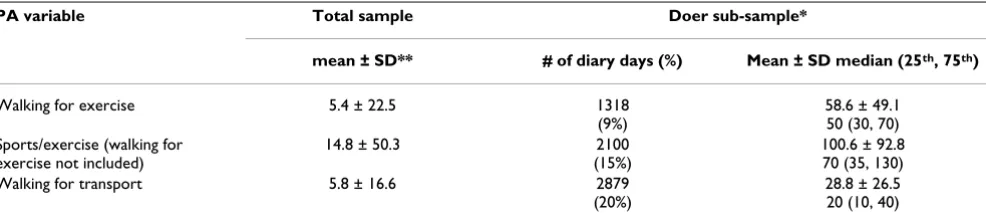
representing 15% of diary days) provided the most accu-mulated minutes of PA over 1.4 ± 0.8 bouts/day (72 min-utes/bout), followed by walking for exercise (1318 or 9%) over 1.2 ± 0.5 bouts/day (47 minutes/bout), and finally walking for transport (2879 or 20%) over 2.3 ± 1.4 bouts/ day (12.5 minutes/bout).
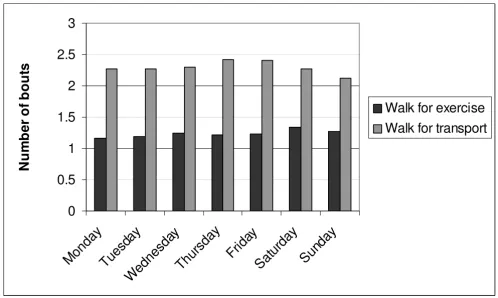
Figures 1, 2, 3 present the proportion of days, the number of bouts, and the accumulated minutes of walking for exercise and transport, respectively, by day of the week for those reporting any of these target activities. On any given day of the week, there was relatively greater participation in any walking for transport vs. walking for exercise (Fig-ure 1; logistic regression p < .05). Logistic regression also indicated that walking for transport participation was sig-nificantly more likely on either Wednesday or Thursday and that walking for exercise was more likely to occur on Sunday, Saturday or Wednesday (all p < .05). With regards to Figure 2, walking for transport showed a significantly greater number of daily episodes compared to walking for exercise, although the number of episodes for both types of walking did differ by the day of the week, the most evi-dent drop in walking for transport was between weekday and weekend day (all p < .05).
For those who report any walking, walking for exercise was approximately 30 minutes longer than walking for transport (Figure 3; p < .05). Regardless, walking for trans-port provides almost 30 accumulated minutes of PA most days of the week for those who report any. The time spent walking for transport or walking for exercise did not vary significantly by the day of the week (p > 0.05).
Accumulated time spent walking as a mode of transport as related to each of the nine standard time use activity cate-gories is presented in Table 2. The greatest proportion of daily time spent walking for transport (i.e., proportionate to total time walking for transport) was related, in
descending order, to purchasing (31.9%), employment (23.3%), social and community interaction (13.1%), and recreation and leisure (10.2%).
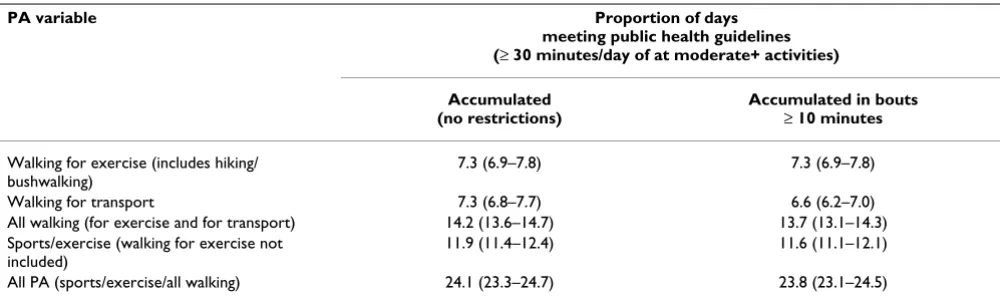
The proportion of diary days on which public health guidelines are achieved are presented in Table 3. Approxi-mately 24% (95% CI = 23.3–24.7) of days met public health guidelines when all accumulated minutes were considered collectively for walking for exercise, walking for transport, and sports/exercise. Similar proportions of days met the guidelines solely through accumulated min-utes walking for transport or walking for exercise. Imple-menting the more stringent criteria of counting only activity bouts of ≥ 10 minutes did not affect the propor-tion of days meeting the guidelines through walking for exercise (indicating that walking for exercise was under-taken consistently in minimal 10 minute bouts); the remaining categories were only reduced by less than 1%.
Discussion
Although time use data have been used previously to study leisure activities ranging from sports/exercise to tel-evision watching[22], this exploration represents the first application of time use data and methods to PA and pub-lic health concerns. The detailed diary data collected by the ABS 1997 Time Use Survey represents a unique oppor-tunity to study population walking patterns, relative to both exercise and transportation purposes. Time use data and methods have been extensively validated[22]. Although walking for exercise (typically undertaken in a singular lengthy bout) can be measured easily using ques-tionnaire approaches to PA assessment, the incidental nature of walking for transportation (i.e., brief and epi-sodic) makes it elusive to all but direct measures, as con-firmed by the detailed records captured by time use methods. In addition, time use data do not suffer from social desirability bias associated with questionnaire approaches to PA measurement, since respondents are not
Table 1: Total sample (n = 14315 diary days) and doer sub-samples* of accumulated daily minutes in walking for exercise, sports/ exercise, and walking for transport
PA variable Total sample Doer sub-sample*
mean ± SD** # of diary days (%) Mean ± SD median (25th, 75th)
Walking for exercise 5.4 ± 22.5 1318
(9%)
58.6 ± 49.1 50 (30, 70) Sports/exercise (walking for
exercise not included)
14.8 ± 50.3 2100
(15%)
100.6 ± 92.8 70 (35, 130)
Walking for transport 5.8 ± 16.6 2879
(20%)
28.8 ± 26.5 20 (10, 40)
a priori charged with recording any specific activity. In PA epidemiology, such detailed daily records are considered direct measures of PA and are often used to validate other surveys and subjective indices of PA[31]. Another strength of these data is the very high response rate observed. Under Australian legislation respondents selected for offi-cial surveys can be required to participate. This nominal power, however, has rarely been enforced for a sample survey, and the ABS stringently imposes confidentiality and data security. Regardless, its existence is a likely expla-nation for the very high response rate to this survey. Walking prevalence is typically inferred from PA question-naires that focus on the respondents who report engage-ment (to a specified level, including any) in that activity over a specific recall period (i.e., the past week, a typical week, the last month, etc.). In contrast, the detailed diaries collected as part of the time use methodology permit a unique examination beyond mere prevalence to the pat-terns of bouts and time spent walking for exercise and transport. The care taken in obtaining a nationally repre-sentative sample of diaries covering all days of the week
and all seasons permit us to make confident conclusions about expected population behaviour on any given day. The fact that, for the total sample, all PA variable medians and quartile cut points were zero is a notable finding but one that is familiar to time use researchers. In fact, the conventional use and interpretation of time use statistics based on doer sub-samples is largely a result of earlier comment on the limitations of per capita average daily duration of activities [24]:"if we learn that with a group of people a per capita average of eight minutes is spent daily on reading newspapers, we still do not know anything about the proportion of people who effectively read a newspaper on any given day, nor do we know how much time is devoted to newspaper reading by those people who do in fact indulge in this kind of activity. In short, aggregate average daily duration data as described above disclose nothing about typical duration of the individual at all – neither about the typical frequency with which it is being performed during the day, nor about the propor-tion of its 'doers' in the observed populapropor-tion on an aver-age day."
Number of diary days of walking for exercise and transport by day of the week
Figure 1
Number of diary days of walking for exercise and transport by day of the week.
0
5
10
15
20
25
30
M
on
day
Tu
es
da
y
W
edn
es
da
y
Thur
sda
y
Fr
id
ay
Sa
tu
rda
y
Su
nd
ay
P
e
rcent
p
ar
ti
ci
p
a
ti
ng
In terms of prevalence, however, we can conclude that on any given day, 24.1% of Australians achieve public health recommendations for PA (regardless of source). That is, they accumulate 30 minutes or more of at least moderate intensity PA (see Table 2). Achieving public health guide-lines also requires participation at a minimal intensity level (i.e., at least moderate intensity). Although the ABS diaries do not require the respondent to record intensity, PA records are typically scored using the Compendium of Physical Activities[12]. Accordingly, and as stated previ-ously, both walking for exercise and for transport meet these minimal intensity requirements. As further support, walkers tend to naturally self-select a pace sufficient to meet these recommendations[32,33].
Although the 10-minute minimal bout has empirical sup-port for cardiorespiratory benefits [28-30], logic suggests, that in terms of energy balance at least, any PA that con-tributes to energy expenditure is important. Implement-ing the more strImplement-ingent criteria for determinImplement-ing days achieving PA guidelines only reduced most proportions by less than 1% and had no effect at all on achieved PA
guidelines by walking for exercise only. Expressed as a proportion of all related bouts (without limitation to only those days achieving PA guidelines), 35% of all walking for transport bouts were less than 10 minutes, compared to 5% for walking for exercise and 4% for sports/exercise (walking for exercise not included). Taken together, across a population, 35% of walking for transportation bouts might be missed with surveys that focus only on 10 minute bouts, but the impact on associated conclusions about achieving daily PA guidelines is minor.
A remaining concern is that people are not engaging in activity frequently enough during the week (i.e., most if not all days of the week) to elicit important health bene-fits[15,18,34,35]. Although public health guidelines are worded to encourage daily PA, five days out of the week is considered an acceptable minimal participation rate. Unfortunately, the ABS survey was limited to two days of data collection, so we are unable to make direct conclu-sions about the prevalence of meeting these behavioural criteria in the context of a week. As noted previously, time use researchers have documented that data quality falls off Number of bouts of walking for exercise and transport by day of the week in participant sub-sample (i.e., those reporting any of the target activity)
Figure 2
Number of bouts of walking for exercise and transport by day of the week in participant sub-sample (i.e., those reporting any of the target activity).
0
0.5
1
1.5
2
2.5
3
M
onda
y
Tuesd
ay
W
ednesda
y
Thur
sday
Fr
id
ay
Sa
tur
day
Su
nday
N
um
be
rof
bout
s
after 48 hours, a point after which a detailed diary becomes burdensome to respondents [27]. Although each individual only contributed 2 days, the study was designed to have days of the week well represented, throughout the year. This strategy, combined with the very large sample size, makes it very likely that the patterns observed are reflective of population behaviour. Hypo-thetically, during a week of days, the specific individuals who make up daily doer sub-samples will change repeat-edly. As stated previously, Giles-Corti and colleagues[18] indicated that 72.1% of respondents to a 2-week recall self-reported performing any walking for transport and 68.5% had self-reported any walking for recreation (comparable to walking for exercise herein). The large dis-crepancy in doer sub-samples may be due in part to the longer time frame queried.
Walking for exercise accounted for less than half of all walking compared to walking for transport (9% vs. 20%), yet either walking classification resulted in similar proportions meeting (≈7%) public health recommenda-tions on any given day. This suggests that although the
doer sub-sample approximates (≈28 mins/day) the public health recommendations, they do not exactly meet the cut point (i.e., 30 mins/day). This is confirmed in Table 3. Giles-Corti et al[18] reported that only 13.6% of respond-ents achieved recommended PA levels by walking for transport in the previous 2 weeks compared to 31.7% of those who walked for recreation only. As stated above, the differences between this earlier study and the one herein are largely due to the different measurement approaches. The time use diary is a direct and unbiased record of two days that coded associated travel separately (and as a pri-mary activity) from any other activity performed, there-fore it is unlikely that either walking for transportation or walking for exercise were missed. In contrast survey meth-ods ask for a general recall of any walking in the previous set time frame. This approach is considered to be indirect and is known to suffer from recall bias as well as social desirability bias[31]. Given these differences, the time use diary results are more likely to reflect the true state of affairs.
Accumulated mean minutes of walking for exercise and transport by day of the week in participant sub-sample (i.e., those reporting any of the target activity)
Figure 3
Accumulated mean minutes of walking for exercise and transport by day of the week in participant sub-sample (i.e., those reporting any of the target activity).
0
10
20
30
40
50
60
70
M
onda
y
Tuesd
ay
W
ednesda
y
Thur
sday
Fr
id
ay
Sa
tur
day
Su
nday
A
c
c
u
m
u
la
te
dm
e
a
nm
in
u
te
s
Regardless, these ABS diary data indicate that, on any given day, walking for exercise appears to be less prevalent than walking for transport. Walking for exercise is typi-cally undertaken in a single bout of approximately 47 minutes in duration compared to walking for transport which is performed in just over 2 bouts of 13 minutes each. Walking for exercise is a salient and purposeful activity, characteristic of those activities that can more eas-ily be recalled in questionnaire approaches to PA assess-ment. Although not directly comparable, the median duration walking for exercise bout for participants was 20 minutes here, less than the median 30 minutes reported by American adults in the 1987, 1994, and 2000 Behavio-ral Risk Factor Surveillance System [36]. In contrast walk-ing for transport is brief and can be incidental, characteristics that make it more elusive to capture by these traditional approaches but detectable using diaries. To emphasize, walking for transport that occurs with reg-ularity as part of a lifestyle routine will be more easily encapsulated by recall compared to incidental, spontane-ous, or haphazard bouts undertaken in the course of day-to-day living.
Although walking is arguably a feature of other daily activ-ities (e.g., household chores), we believe that we accounted for the preponderance of walking-related
trans-port associated with the nine activity categories captured. Indeed, the level of detail derived from the time use dia-ries permitted identification of the specific activity catego-ries most commonly associated with walking for transport: purchasing, employment, social and commu-nity interaction, and recreation and leisure. This demonstrates the advantages of using population data from non-health sector sources for a component of popu-lation health surveillance.
Recent research has suggested that living within walking distance (defined as a 20-minute walk from home) of a department, discount or hardware store; or a park, biking or walking trail, was significantly related to higher ped-ometer-determined PA[32]. These findings have implica-tions for improved design of PA questionnaires to capture these more elusive bouts of walking. For example, prompts should be regularly used to elicit maximal response about walking for transport related at least to purchasing, employment, social and community interac-tion, and recreation and leisure. As stated above however, it does not appear to be important to solicit bouts less than 10 minutes since their impact on achievement of PA guidelines is minimal. On a side note, it is interesting that approximately 10% of walking for transport was associ-ated with recreation/leisure (walking to facilities, etc.);
Table 2: Total sample (n = 14315 diary days) and doer sub-samples* of accumulated daily minutes walking for transport related to nine major activity categories
Activity Category Total sample Doer sub-sample*
mean ± SD** # of diary days (%)
Mean ± SD median (25th, 75th)
Personal care 0.02 ± 0.59 18
(0.1%)
13.9 ± 9.5 10 (5,20)
Employment 1.36 ± 7.17 942
(6.6%)
20.6 ± 19.6 15.0 (10,25)
Education 0.52 ± 4.69 261
(1.8%)
28.8 ± 19.9 25 (15,40)
Domestic 0.05 ± 1.32 34
(0.2%)
21.1 ± 17.4 17.5 (8.8, 30)
Child care 0.49 ± 5.41 209
(1.5%)
33.6 ± 30.0 25, (10,45)
Purchasing 1.86 ± 8.61 1216
(8.5%)
21.9 ± 20.8 20 (10,25)
Voluntary work and care 0.14 ± 2.10 99
(0.7%)
19.9 ± 15.8 15 (10,30)
Social and community interaction 0.76 ± 5.58 472
(3.3%)
23.1 ± 20.7 20 (10,30)
Recreation and leisure 0.60 ± 5.51 323
(2.3%)
26.4 ± 25.8 20 (10, 32.5)
this type of walking for transport may be interpreted as part of the total recreation/leisure experience.
Although participation in walking for exercise is highest on a Sunday, the number of bouts and time spent walking for exercise on Sunday is similar to other days of the week. In contrast, the percent participating, number of bouts, and duration of walking for transport trips was less on Sundays compared to other days of the week. The overall impact is that participation in all walking (in terms of total days) is lowest on Sundays. The negative effect of Sunday on overall walking behaviours has been shown before in American populations using pedometers that are sensitive to ambulatory activities [37-41].
Conclusion
In summary, we used a novel application of existing Aus-tralian time use data to examine the patterns of walking for transport and for exercise in relation to sports/exercise participation and health-related PA recommendations. These detailed records permitted evaluation of participa-tion, bout length, and duration of walking behaviours on a daily basis in a nationally representative sample. Walk-ing for transport is more common than walkWalk-ing for exer-cise on any given day. Further, although walking for transport is typically undertaken in multiple brief bouts, the accumulated time approximates public health guide-lines for those who report any walking for transport. It is therefore likely an important source of healthy PA. In the future, time use data can be used to examine relationships between demographic variables, environment characteris-tics (for example, rural vs. urban residency) and behav-iour. Although the ABS time use diaries do not collect simple health information such as height and weight at this time, it is possible that this improvement might yield more fruitful explorations of behaviour related to body mass index. It is also possible to ask sub-samples of time
use study participants to wear motion sensors in order to capture another objective direct measure of physical activ-ity behaviour. Obviously these time use data are robust and numerous questions can be investigated that are beyond the scope of this initial exploration of the utility of time use data for public health purposes, specifically with regards to PA behaviour patterns. Since similar time use data exist for numerous countries stretching back over several decades, this resource represents a promising ave-nue of exploration of PA time trends and international comparisons.
Competing interests
The author(s) declare that they have no competing interests.
Authors' contributions
CTL contributed to study design, analyses, and interpreta-tion and led the writing of the manuscript. MB led the analysis and contributed to study design, interpretation, manuscript preparation. DM contributed to study design, analysis, interpretation and manuscript editing. AB con-tributed to study design, interpretation, and manuscript editing. All read and approved the final manuscript.
References
1. Pate RR, Pratt M, Blair SN, Haskell WL, Macera CA, Bouchard C, Buchner D, Ettinger W, Heath GW, King AC, Kriska A, Leon AS, Marcus BH, Morris J, Paffenbarger RS, Patrick K, Pollock ML, Rippe JM, Sallis J, Wilmore JH: Physical activity and public health: a recommendation from the Centers for Disease Control and Prevention and the American College of Sports Medicine.
JAMA 1995, 273:402-407.
2. U.S. Department of Health and Human Services: Physical Activity and Health: A Report of the Surgeon General. Atlanta, GA, US Department of Health and Human Services, Centers for Disease Control and Prevention, National Center for Chronic Disease Pre-vention and Promotion; 1996.
3. Commonwealth Department of Health and Aged Care (DHAC):
National Physical Activity Guidelines for Australians. Can-berra, Australia, Commonwealth Department of Health and Aged Care (DHAC); 1999.
Table 3: Proportion of diary days (and 95% CI) meeting public health guidelines by walking for exercise, walking for transport, all walking, sports/exercise (walking for exercise not included), and all PA
PA variable Proportion of days
meeting public health guidelines (≥ 30 minutes/day of at moderate+ activities)
Accumulated (no restrictions)
Accumulated in bouts
≥ 10 minutes
Walking for exercise (includes hiking/ bushwalking)
7.3 (6.9–7.8) 7.3 (6.9–7.8)
Walking for transport 7.3 (6.8–7.7) 6.6 (6.2–7.0)
All walking (for exercise and for transport) 14.2 (13.6–14.7) 13.7 (13.1–14.3) Sports/exercise (walking for exercise not
included)
11.9 (11.4–12.4) 11.6 (11.1–12.1)
Publish with BioMed Central and every scientist can read your work free of charge "BioMed Central will be the most significant development for disseminating the results of biomedical researc h in our lifetime."
Sir Paul Nurse, Cancer Research UK
Your research papers will be:
available free of charge to the entire biomedical community
peer reviewed and published immediately upon acceptance
cited in PubMed and archived on PubMed Central
yours — you keep the copyright
Submit your manuscript here:
http://www.biomedcentral.com/info/publishing_adv.asp
BioMedcentral
4. Manson JE, Hu FB, Rich-Edwards JW, Colditz GA, Stampfer MJ, Wil-lett WC, Speizer FE, Hennekens CH: A prospective study of walk-ing as compared with vigorous exercise in the prevention of coronary heart disease in women. N Engl J Med 1999,
341:650-658.
5. Manson JE, Greenland P, LaCroix AZ, Stefanick ML, Mouton CP, Oberman A, Perri MG, Sheps DS, Pettinger MB, Siscovick DS: Walk-ing compared with vigorous exercise for the prevention of cardiovascular events in women. New England Journal of Medicine
2002, 347:716-725.
6. Hu FB, Signal RJ, Rich-Edwards JW, Colditz GA, Solomon CG, Willett WC, Speizer FE, Manson JE: Walking compared with vigorous physical activity and risk of type 2 diabetes in women. JAMA
1999, 282:1433-1439.
7. Fogelholm M, Kukkonen-Harjula K, Nenonen A, Pasanen M: Effects of walking training on weight maintenance after a very-low-energy diet in premenopausal obese women. Arch Intern Med
2000, 160:2177-2184.
8. Braith RW, Pollock ML, Lowenthal DT, Graves JE, Limacher MC:
Moderate- and high-intensity exercise lowers blood pressure in normotensive subjects 60 to 79 years of age. American Jour-nal of Cardiology 1994, 73:1124-1128.
9. Hayashi T, Tsumura K, Suematsu C, Okada K, Fujii S, Endo G: Walk-ing to work and the risk for hypertension in men: The Osaka health survey. Ann Intern Med 1999, 131:21-26.
10. Hu G, Pekkarinen H, Hanninen O, Tian H, Guo Z: Relation between commuting, leisure time physical activity and serum lipids in a Chinese urban population. Annals of Human Biology 2001, 28:412-421.
11. Hu G, Pekkarinen H, Hanninen O, Yu Z, Guo Z, Tian H: Commut-ing, leisure-time physical activity, and cardiovascular risk factors in China. Med Sci Sports Exerc 2002, 34:234-238. 12. Ainsworth BE, Haskell WL, Whitt MC, Irwin ML, Swartz AM, Strath
SJ, O'Brien WL, Bassett DR, Schmitz KH, Emplaincourt PO, Jacobs DR, Leon AS: Compendium of physical activities: An update of activity codes and MET intensities. Med Sci Sports Exerc 2000,
32(9 Suppl):S498-S504.
13. CDC: Prevalence of leisure-time and occupational physical activity among employed adults -- United States, 1990.
MMWR Morb Mortal Wkly Rep 2000, 49:420-424.
14. Rafferty AP, Reeves MJ, McGee HB, Pivarnik JM: Physical activity patterns among walkers and compliance with public health recommendations. Med Sci Sports Exerc 2002, 34:1255-1261. 15. Rafferty AP, Reeves MJ, McGee HB: Compliance with physical
activity recommendations by walking for exercise --- Michi-gan, 1996 and 1998. MMWR Mord Mortal Wkly Rep 2000,
49:560-565.
16. Armstrong T, Bauman A, Davies J: Physical activity pattern of Australian adults. Results of the 1999 National Physical Activity Survey. Canberra, Australia, Australian Institute of Health and Welfare; 2000.
17. Merom D, Bauman A, Ford I: The public health usefulness of the exercise recreation and sport survey (ERASS) surveillance system. J Sci Med Sport 2004, 7:32-37.
18. Giles-Corti B, Donovan RJ: Relative influences of individual, social environmental, and physical environmental correlates of walking. American Journal of Public Health 2003, 93:1583-1589. 19. Tudor-Locke C, Myers AM: Challenges and opportunities for
measuring physical activity in sedentary adults. Sports Medicine 2001, 31:91-100.
20. Tudor-Locke C, Ainsworth BE, Adair LS, Popkin BM: Physical activ-ity in Filipino youth: the Cebu Longitudinal Health and Nutrition Survey. Int J Obes Relat Metab Disord 2003, 27:181-190. 21. Ainsworth BE, Sternfeld B, Slattery ML, Daguise V, Zahm SH: Physi-cal activity and breast cancer: Evaluation of physiPhysi-cal activity assessment methods. Cancer 1998, 83:611-620.
22. Pentland WE, Harvey AS, Lawton MP, McColl MA: Time Use Research in the Social Sciences. New York, Kluwer Academic/ Plenum Publishers; 1999.
23. McLennan W: Time Use Survey, Australia: Users Guide 1997.
Canberra, Australia Bureau of Statistics; 1998.
24. Szalai A: The use of time: daily activities of urban and subur-ban populations in twelve countries. Paris, Mounton; 1972. 25. Juster FT: The validity and quality of time use estimates
obtained from recall diaries. In Time, Goods, and Well-Being Edited
by: Juster FT and Stafford FP. Ann Arbor, University of Michigan; 1985.
26. Robinson JP: The validity and reliability of diaries versus alter-native time use measures. In Time, Goods, and Well-Being Edited by: Juster FT and Stafford FP. Ann Arbor, University of Michigan; 1985:33-62.
27. Wilson J: Information Paper: Time Use Pilot Survey Sydney May-June 1987. Sydney, Australia, Australian Bureau of Statistics; 1988.
28. Woolf-May K, Kearney EM, Owen A, Jones DW, Davison RC, Bird SR: The efficacy of accumulated short bouts versus single daily bouts of brisk walking in improving aerobic fitness and blood lipid profiles. Health Educ Res 1999, 14:803-815.
29. Murphy MH, Hardman AE: Training effects of short and long bouts of brisk walking in sedentary women. Med Sci Sports Exerc 1998, 30:152-157.
30. Murphy M, Nevill A, Neville C, Biddle S, Hardman A: Accumulating brisk walking for fitness, cardiovascular risk, and psychologi-cal health. Med Sci Sports Exerc 2002, 34:1468-1474.
31. LaMonte MJ, Ainsworth BE, Tudor-Locke C: Assessment of physi-cal activity and energy expenditure. In Obesity: Etiology, assess-ment, treatassess-ment, prevention Edited by: Andersen RE. Champaign, IL, Human Kinetics; 2003:111-137.
32. Murtagh EM, Boreham CA, Murphy MH: Speed and exercise intensity of recreational walkers. Preventive Medicine 2002,
35:397-400.
33. Spelman CC, Pate RR, Macera CA, Ward DS: Self-selected exer-cise intensity of habitual walkers. Med Sci Sports Exerc 1993,
25:1174-1179.
34. Whitt M, Kumanyika S, Bellamy S: Amount and bouts of physical activity in a sample of African-American women. Med Sci Sports Exerc 2003, 35:1887-1893.
35. Eyler AA, Brownson RC, Bacak SJ, Housemann RA: The epidemiol-ogy of walking for physical activity in the United States. Med Sci Sports Exerc 2003, 35:1529-1536.
36. Simpson ME, Serdula M, Galuska DA, Gillespie C, Donehoo R, Macera C, Mack K: Walking trends among U.S. adults: the Behavioral Risk Factor Surveillance System, 1987-2000. American Journal of Preventive Medicine 2003, 25:95-100.
37. Michaud PA, Cauderay M, Narring F, Schutz Y: Assessment of physical activity with a pedometer and its relationship with VO2max among adolescents in Switzerland. Soz Praventivmed
2002, 47:107-115.
38. Bassett Jr. DR, Ainsworth BE, Swartz AM, Strath SJ, O'Brien WL, King GA: Validity of four motion sensors in measuring moderate intensity physical activity. Med Sci Sports Exerc 2000,
32(9Suppl):S471-S480.
39. Hatano Y: Use of the pedometer for promoting daily walking exercise. International Council for Health, Physical Education, and Recreation 1993, 29:4-8.
40. Tudor-Locke C, Jones GR, Myers AM, Paterson DH, Ecclestone NA:
Contribution of structured exercise class participation and informal walking for exercise to daily physical activity in community-dwelling older adults. Res Q Exerc Sport 2002,
73:350-356.