Two new species and a new species record of
Aglaia
(Meliaceae) from Indonesia
Caroline M. Pannell1,2,3,4*, Jan Schnitzler4,5*, Alexandra N. Muellner-Riehl4,5
1 University of Oxford, Department of Plant Sciences and Daubeny Herbarium (FHO), South Parks Road, Oxford OX1 3RB, United Kingdom 2 Royal Botanic Gardens, Kew (K), Richmond, Surrey TW9 3AE, United Kingdom 3 Queen’s University Belfast, Marine Laboratory, 12–13 The Strand, Portaferry, County Down, BT22 1PF, United Kingdom 4 Leipzig University, Institute of Biology, Department of Molecular Evolution and Plant Systematics & Herbarium (LZ), Johannisallee 21–23, D-04103 Leipzig, Germany 5 German Centre for Integrative Biodiversity Research (iDiv) Halle-Jena-Leipzig, D-04103 Leipzig, Germany
Corresponding author: Alexandra N. Muellner-Riehl ([email protected])
Academic editor: Marc Appelhans | Received 1 May 2020 | Accepted 8 July 2020 | Published 7 August 2020
Citation: Pannell CM, Schnitzler J, Muellner-Riehl AN (2020) Two new species and a new species record of Aglaia
(Meliaceae) from Indonesia. PhytoKeys 155: 33–51. https://doi.org/10.3897/phytokeys.155.53833
Abstract
Two new species of Aglaia from Indonesia are described, Aglaia monocaula restricted to West Papua, and Aglaia nyaruensis occurring on Borneo (Kalimantan, Brunei, Sabah and Sarawak). A phylogenetic analysis using nuclear ITS and ETS, and plastid rps15-ycf1 sequence data indicates that the two new species of Aglaia are also genetically distinct. Aglaia monocaula belongs to section Amoora, while A. nyaruensis is included in section Aglaia. A dichotomous key, drawings and three-locus DNA barcodes are provided as aids for the identification of the two new species of Aglaia. In addition, the geographic range of Aglaia mackiana (section Amoora) is expanded from a single previously known site in Papua New Guinea to West Papua, Indonesia.
Keywords
Aglaia, conservation status, Indonesia, Meliaceae, phylogeny, taxonomy
Introduction
The classification of the family Meliaceae continues to be refined (Muellner et al. 2003, 2005, 2009a, b, Muellner and Mabberley 2008, Pennington and Muellner
* Joint first authorship.
2010, Köcke et al. 2015, Clarkson et al. 2016, Gama et al. 2020) and new taxa are
still being discovered and described (e.g., Pannell 2004, 2019). Aglaia Lour. is the
largest genus of the family, and, with at least 120 arborescent species, presents more taxonomic problems in species delimitation than any other genus of the family
(Pannell 1992, 1995, 1998a, b, 2004, Muellner et al. 2005, 2008a). Aglaia forms
an important component of the moist tropical forest in the Indomalesian region. The distribution range comprises the tropics of southeastern Asia from Sri Lanka and India to Australia (Queensland, Northern Territory, and Western Australia) and eastwards to the island of Samoa in Polynesia and north to the Mariana (Saipan, Roti, and Guam) and Caroline Islands (Palau and Ponape) in Micronesia (Pannell 1992). A monograph of the entire genus throughout its range has been published (Pannell 1992), of the Malesian species, including New Guinea, in Flora Malesiana (Pannell 1995), and of the Bornean species in the Tree Flora of Sabah and Sarawak (Pannell 2007).
From the 1990s, the genus received increasing scientific focus due to its bioac-tivity potential (Muellner et al. 2005, and references therein), including inhibiting activity against Ebola-, corona-, Zika-, Chikungunya- and hepatitis E-viruses (Mül-ler et al. 2018, 2020). A recent research call in the field of “Biodiversity and Health”, funded by the German Federal Ministry of Education and Research, has led to a surge of interest in the taxonomic investigation of plant groups of potential interest for the future development of new antiinfective compounds. A taxonomic survey of
Aglaia in Indonesia in the course of this research program has led to the discovery of two new species. We here describe these two new species from Indonesia. In
addi-tion, we report a new record of Aglaia from Indonesia, previously known only from
Papua New Guinea.
Materials and methods Morphology
The two new species are described based on field observations and examination of herbarium specimens at BO, FHO, K, L, and A, using morphological characters
that distinguish them from all other species in the genus Aglaia. Descriptions were
Total genomic DNA was extracted for representative samples of each species of Aglaia de-scribed herein (Table 1) using a Macherey-Nagel NucleoSpin Plant II kit. The protocol was
modified by adding 40 ul β-mercaptoethanol and 2% polyvinylpyrrolidone (PVP). ITS
was amplified either as a whole using the primer combination 17SE_m/26SE_m (Grudin-ski et al. 2014) or, if this failed, adding two internal primers (F1_ITS/R1_ITS, Muellner et al. 2005) to amplify the first and second part of the ITS region separately. ETS was amplified using the primers 18S_ETS (Baldwin and Markos 1998) and a newly designed primer, 18S_MEL [5’-GTG TGA GTG ATT GGA T-3’; this study]. The plastid region
rps15-ycf1 was amplified using the primer pair rps15-IGSR/ycf1-IGSR (Prince 2015). For all amplifications, we used the Phusion High-Fidelity DNA Polymerase (New England BioLabs, Ipswich, MA, United States) according to the manufacturer’s pro-tocol. Annealing temperature for ITS (whole region or in two parts) and ETS was
51.5 °C, and for rps15-ycf1 51 °C. PCR products were cleaned using the NucleoSpin
Extract II Kit (Macherey-Nagel, Düren, Germany). Sequencing reactions and analyses were run by LGC Genomics (Berlin, Germany).
All sequences were assembled and edited using Geneious (v7.06, Kearse et al. 2012). Consensus sequences were aligned using MUSCLE (v.3.8.31 Edgar 2004) as implemented in Geneious, and all alignments were thoroughly checked and further refined manually. For ITS, sequences were explored for the presence of several structural motifs, allowing for the detection of pseudogenes: the conserved angiosperm motif GGCRY–(4 to 7n)–GYGY-CAAGGAA (Liu and Schardl 1994); the conserved (C1–C6) and variable (V1–V6) do-mains determined for plant ITS2 sequences (Hershkovitz and Zimmer 1996); and the con-served angiosperm motif 5´-GAATTGCAGAATCC-3´ within the 5.8S rRNA gene (Jobes and Thien 1997). Secondary structure predictions were confirmed by hemi-compensatory base changes and full compensatory base changes that preserved the predicted folding
pat-tern. Sequences for the new species were deposited in GenBank (http://www.ncbi.nlm.nih.
gov/; Table 1). Voucher information, geographic origin, and GenBank accession numbers
for all samples included in this study are provided in Suppl. material 1: Table S1.
Phylogenetic analyses
Newly generated sequences of ITS were combined with the data from Muellner et al. (2008b) and an improved and reduced version of the data matrix used in Grudinski et
Table 1. Voucher information and GenBank accession numbers for Aglaia monocaula and A. nyaruensis.
Taxon Locality Voucher ITS ETS rps15-ycf1
A. monocaula West Papua Polak 1221 (FHO) MT439806 MT439713 MT409504 A. nyaruensis Kalimantan Sidiyasa et al. 1422 (L) MT439808 MT439716 MT409506
Kalimantan G. Laman et al. 1397 (A) MT439807 MT439715 MT409505
al. (2014), which included representatives of all sections of Aglaia and outgroups. The best-fit model of nucleotide substitution, as determined using the Akaike information criterion (AIC) in jModelTest 2.1.10 (Darriba et al. 2012), was GTR+G for ITS and
rps15-ycf1, and GTR+G+I for ETS. Phylogenetic analyses for each individual mark-er and combined datasets (both nuclear markmark-ers, all markmark-ers) wmark-ere pmark-erformed using MrBayes v3.2.7 (Huelsenbeck and Ronquist 2001, Ronquist and Huelsenbeck 2003) with four runs (six Markov chains each) for 20–25 million generations (depending on the marker), sampling every 10,000 steps. In the combined analyses, datasets were partitioned according to the genetic markers with model parameters being unlinked across the partitions. Efficient chain mixing and convergence of the runs to the same posterior distribution, as well as the adequacy of sampling (using the Effective Sample Size [ESS] diagnostic) were evaluated by examining the log files in Tracer v1.7 (Ram-baut et al. 2018). For each analysis, a majority-rule consensus tree was constructed after excluding the first 20% of samples as burn-in.
results and discussion Taxonomy
SectionAmoora
1. Aglaia monocaula C.M. Pannell, sp. nov.
urn:lsid:ipni.org:names:77210863-1
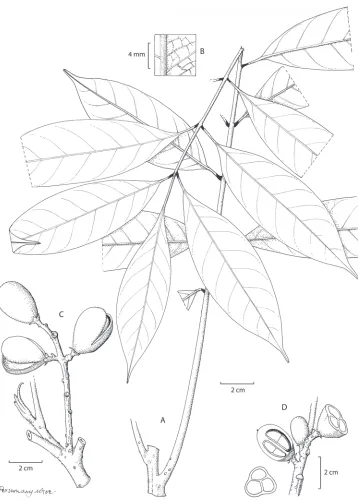
Fig. 1
Diagnosis. Aglaia monocaula resembles Aglaia flavida, from which it differs through being a smaller, unbranched tree with reticulation subprominent and no indumentum on the lamina of the lower surface of the leaflets. It is unique in the genus in having a dark blackish-brown, slightly swollen, region at the base of the petiolules.
Holotype. Indonesia. West Papua: Kecamatan Ayfat, neighborhood of Ayawasi,
fr. 12 Feb. 1995, K. Yumte 126 (L)
Tree, 3–10 m high, unbranched, with a terminal tuft of spirally inserted leaves; bole
4 cm in diameter; latex white. Twigs greyish-brown with large orange-brown pustules, densely covered with orange-brown and dark brown compact stellate hairs at the apex, glabrescent on older wood.
veins 5–14, ascending and curved upwards near the margin, not anastomosing, lat-eral veins and reticulation subprominent; midrib prominent below with sparse stellate scales, absent from lower leaflet surface, upper and lower leaflet surfaces minutely rugu-lose; petiolules 10–15 mm on lateral leaflets, slender, 20–40 mm long on terminal leaf-let, all with a dark blackish-brown, slightly swollen, region at the base of the petiolules.
Inflorescences not seen.
Infructescence 11 cm long, 7 cm wide; peduncle 6 cm long, the peduncle and fruit stalks with few to numerous hairs like those on the twigs, glabrescent. Fruits 2.8 cm long, 1.8 cm wide, ovoid, pericarp bright scarlet or pinkish-red, inner pericarp white, dehiscent with three locules each containing 1 seed; seed white where attached to the central axis of the fruit by a large hilum, aril orange.
Distribution. Known only from the area around Ayawasi village in West Papua.
Ecology. Primary open forest on limestone ridge to 600 m, with an abundant growth of moss. Fruits eaten by kuskus.
Use. Wood used for house beams.
Vernacular. sapa sai (K.Yumte)
Etymology. The specific epithet of Aglaia monocaula refers to the unbranched habit of this small tree.
Conservation. This species is known from only two fruiting specimens collected near Ayawasi village and is therefore assessed to be Data Deficient (provisional). Further collecting and monitoring is necessary to allow more conclusive estimations about the rareness and vulnerability of the species. However, the collections seen were made 24 and 25 years ago, so the likelihood of obtaining further material from this species is not great.
Additional specimen. Indonesia. West Papua: top ridge of limestone hills south
of Ayawasi village, fr., 1 May 1996, Polak 1221 (FHO)
Notes. This new species is represented by two fruiting specimens of monocaul trees that have leaves with a long petiolule on the terminal leaflet.
SectionAglaia
2. Aglaia nyaruensis C.M. Pannell, sp. nov.
urn:lsid:ipni.org:names:77210864-1
Fig. 2
Diagnosis.Aglaia nyaruensis resembles A. foveolata, from which it differs in its smooth leaflet lower surface, with the lateral veins and reticulation not prominent. These char-acters, combined with numerous pits on the leaflet upper and lower surfaces, make this species unique in the genus.
Holotype. Indonesia. Kalimantan: Central, Nyaru Menteng Arboretum, off km
28 road to Sampit, alt. 50m, fl., 28 Jan 1995, K. Sidyasa with Ambriansyah, Arifin &
Priyono 1422 (holotype BO; isotypes K, L).
or brown and fibrous, sapwood pale yellow, heartwood white; latex white or absent. Young twigs densely covered with reddish-brown stellate hairs and scales.
Leaves 25–31(–60) cm long, 14–21(–34) cm wide; petiole 7–9 cm long, the petiole, rhachis and petiolules densely covered with reddish-brown stellate hairs. Leaflets 11–15, the laterals subopposite, lamina 5.5–11.0 cm long 2.5–4.0 cm wide, narrowly oblong or elliptical, pale brownish-green when dry, rounded to cordate at the asymmetrical base, acuminate at apex with the acute acumen narrow and to 15 mm long; lateral veins 10–15, ascending and curved upwards near the margin, anastomosing some distance from the margin and with further reticulation between this and the margin of the leaflet, with shorter lateral veins in between. Midrib prominent below, lateral veins and reticulation not raised and barely visible in dried leaflets, the midrib on the upper surface of leaflet with numerous pale brown stellate hairs and scales, the midrib on the lower surface dense-ly covered with reddish brown stellate hairs and scales, numerous on the lower leaflet sur-face when young, glabrescent, becoming sparse on the mature lamina near the midrib and absent from the rest of both surfaces of the lamina, with numerous pits on both surfaces; petiolules to 3 mm long on lateral leaflets to 10 mm long on terminal leaflet.
Male inflorescence 20 cm long, 10 cm wide; peduncle 8–9 cm long, the peduncle, rachis and first branches densely covered with reddish-brown stellate hairs and scales; higher orders of inflorescence branches with numerous reddish-brown stellate hairs and scales. Male flower 2 mm long, 2 mm wide; pedicel 1 mm long, the calyx and pedicel densely covered with reddish-brown stellate hairs and scales; calyx cup-shaped, deeply divided into five rounded lobes, petals 5, 1.75 mm long, 1 mm wide, yel-low, obovate; staminal tube 1.5 mm long, 1.5 mm wide, obovoid with a wide mouth 1.5 mm across, anthers 6, 0.75 mm long, 0.25 mm wide, inserted half way down the tube inside and protruding through the aperture; ovary 0.5 mm long, 0.5 mm wide, ovoid, densely covered with brown stellate hairs and scales on the outside, with two locules each containing one vestigial ovule. Female flowers not seen.
Infructescence 24 cm long, 26 cm wide, peduncle 8 cm; peduncle rachis and branches densely covered with reddish-brown stellate hairs and scales. Young fruits 2 cm long, 1.5 cm wide, ellipsoid, reddish-orange, densely covered with reddish-brown stellate hairs and scales.
Distribution. One record each from Kalimantan, Brunei, Sabah and Sarawak.
Ecology. Peat swamp forest, swampy forest on white sand, on ultrabasic soil or on yellow-brown sandy soil over Tertiary clays, with deep litter and abundant humus and living roots. Altitude to 400 m.
Vernacular name. Jalongan sasak (Bejang b. Sitam).
Etymology. The specific epithet of Aglaia nyaruensis refers to the type locality, Nyaru Menteng in Kalimantan.
Conservation (provisional). This species is known from one locality each in Ka-limantan, Brunei, Sabah and Sarawak and is therefore considered to be Vulnerable.
Additional specimens. Malaysia. Sarawak: Sibu, Haman Forest Reserve, c.
3 m alt, fr 18 June 1958, Bejang b. Sitam 9169 (K); Sabah: Sandakan, Bt Tawai
4°38'41"N, 114°30'20"E, 30 m alt., sterile, 8 March 2004, A.N. Muellner, C.M. Pan-nell, G. Challen, Jangurun, Muhd Yussof, Ibrahim ANM2039 (K).
New record for West Papua, Indonesia
Aglaia mackiana Pannell, Kew Bull. 52(3): 715. 1997.
Fig. 3
Remark. Previously known only from the type locality in Papua New Guinea, this tall
tree species in section Amoora, has the largest fruits recorded for the genus Aglaia.
Col-lections from West Papua are of immature fruits and flower buds.
Distribution. Indonesia, two records from West Papua. In Papua New Guinea, known only from the type locality in Chimbu Province.
Ecology. Primary lowland forest on the coastal plain and to 450 m altitude;
can-opy 25–45 m high; associate species include Celtis, Sterculia, Pometia, Ficus,
Oncosper-mum, and sundry Rubiaceae. Canopy tree to 45 m tall, branching above; bole c. 1 m
diameter, buttressed below; bark tan, smooth, somewhat round flaky; fruits 12–16 cm diameter, light brown, lactiferous, 3-lobed. In Papua New Guinea, the fruit either de-hisces on the tree and the seeds fall to the ground or the whole fruit falls from the tree and dehisces on impact with the ground. The seeds are swallowed whole by the Dwarf Cassowary and defaecated at up to 1000 m from the parent trees (Mack 1995a, b;
Pan-nell 1997). A fruit bat (probably Dobsonia moluccensis) carries seeds shorter distances,
reportedly less than 100 m, away from the parent tree. Germination is semi-hypogeal, within a few days of deposition of seeds; the two large cotyledons persist at ground level for up to two years after germination.
Vernacular. ‘sapa peka’ (Wanda Ave 4394)
Etymology. Named after Andrew Mack, who discovered this species in the course of his field work on the Dwarf Cassowary.
Conservation. This species is known from only three localities, two in Papua and one in Papua New Guinea. It is therefore assessed to be Data Deficient (provisional). Further collecting and monitoring is necessary to allow more conclusive estimations about the rareness and vulnerability of the species. However, the collections seen were made 24, 25, 27, and 28 years ago, so the likelihood of obtaining further material from this species is not great.
Additional specimens. Indonesia. West Papua: surroundings of Ayawasi, 1°09'S,
132°12'E, c. 450m, fruit, 30 April 1996, Wanda Ave 4394 (L); Sarmi, coastal plain,
1–3 km N of Sewan on the Waske River. 2°4'S, 138°46'E, 10–20 m, fr., 3 June 1993
McDonald and Ismail 3786 (BO, L, K). Papua New Guinea. Chimbu Province:
of Aglaia in Malesia
To accommodate the three species the following couplets (in bold, labelled (i) and (ii),
can be inserted into the existing key to Malesian Aglaia by Pannell (1995, pp. 201–212)]
1a Leaf always a single blade ...2
1b Leaves trifoliolate or imparipinnate ...7
7a (1) Leaflets with few or no hairs or scales on the lower surface, the reticulation continuous and subprominent on one or both surfaces ...8
7b Leaflets with at least some scales or hairs on the lower surface, although these may be few and difficult to see, reticulation not continuous and sub-prominent on either surface, or if subsub-prominent, then with indumentum on lower surface of leaflet ...10
8a (7) Leaflets with reticulation subprominent on the lower surface ....8a (i) & (ii) 8a(i) Tree branched, leaflets 2–7, fruits indehiscent ...66. A. cumingiana 8a(ii) Tree unbranched, leaflets 15, fruits dehiscent ...A. monocaula 8b Leaflets with reticulation subprominent on both surfaces ...9
10a (7) Leaflets linear-lanceolate or narrowly elliptical, most being at least 5 times longer than wide ...11
10b Leaflets ovate, elliptical, oblong, obovate, lanceolate or oblanceolate, most less than 5 times longer than wide ...14
14a (10) Indumentum dense, of white or pale brown hairs or scales which totally conceal the lower surface of leaflet ...15
14b Indumentum reddish-brown or, if pale, not totally concealing the lower surface of leaflet ...20
20a (14) Lower surface of leaflet so densely covered with reddish-brown or orange brown hairs or scales, that the surface is not or barely visible between them ...21
20b Hairs or scales absent from the lower surface or, when present, the lower surface of leaflet readily visible between them ...24
24a (20) Indumentum of peltate scales, sometimes with stellate scales interspersed ....25
24b Indumentum of stellate hairs or scales; peltate scales absent ...69
25a (24) Indumentum of peltate scales only ...26
25b Indumentum of peltate and stellate scales (or with at least some of the scales with a long fimbriate margin) ...60
26a (25) Scales densely covering lower surface of leaflet ...27
26b Scales ± absent to numerous on lower surface of leaflet ...31
31a (26) Scales few to numerous on lower surface of leaflet ...32
31b Scales ± absent from lower surface of leaflet but may densely cover the midrib below and immediately adjacent to it and occasionally on the lateral veins ...46
46b Scales ± absent from lower surface of leaflet...54
47a (46) Scales large (many 0.2 mm across), orange-brown, reddish-brown or almost white, with a tendency to flake off ...48
47b Scales less than 0.2 mm across or if larger, then dark reddish-brown or
purplish-brown and adhering closely to the leaflet ...50
50a (47) Anthers and/or staminal tube with simple white hairs ...51
50b Anthers and staminal tube without hairs ...52
52a (50) Leaflets with purplish-brown fimbriate peltate scales densely covering
the midrib below and ± absent from the rest of the lower surface of the
leaflet ...34. A. glabrata
52b (50) Leaflets with dark reddish-brown peltate scales numerous on the midrib below ...53
53a (52) Leaflets 7–23, stellate scales absent ...53a (i) & (ii)
53a(i) Leaflets 11–23, 50–88 cm long, 36–54 cm wide, fruits dehiscent, at least
12.5 cm long and 10 cm wide...A. mackiana
53a (ii) Leaflets (7-)9–13(-15), 5–18.5 cm long, 1.5–4.5 cm wide, fruits
indehis-cent, 1.5–3 cm long, 2–3.5 cm wide ...33. A. scortechinii
53b Leaflets 3–5(-7), some stellate scales interspersed among the peltate scales .
...50. A. odoratissima
69a (24) Leaflets with few to densely covered with stellate hairs or scales on the lower surface; when sparse, some hairs or scales occur evenly distributed between
the veins and their presence visible with the naked eye ...70
69b Leaflets without or with few hairs on the lower surface, with scales visible
only with a lens or densely covered with hairs on the midrib only, few and
unevenly scattered on the rest of the lower surface ...88
88a (69) Lower surface of leaflet with numerous stellate or peltate scales ...89
88b Leaflets with hairs or scales few on the lower surface between the veins
when mature, but sometimes densely covering the midrib ...93
93a (88) Stellate hairs or scales more than 0.15 mm in diam., numerous on or dense-ly covering the midrib, sometimes also on the lateral veins, almost absent elsewhere ...94
93b Stellate hairs or scales either very small, less than 0.15 mm in diameter, or
almost totally absent from the midrib below and from the rest of the lower surface of leaflet ...109
94a (93) Leaves ± sessile or with a short peduncle of not more than 1 cm; the basal part
of leaflets much smaller than the rest and subrotund ...61. A. subsessilis
94b Leaves not sessile, the basal leaflets only slightly smaller than the rest and of
similar shape ...95
95a (94) Reticulation subprominent on lower surface and often on upper surface of leaflet ...96
95b Reticulation may be visible, but not subprominent ...97
98a (97) Tree unbranched; leaflets shiny ...69. A. coriacea
98b Tree branched; leaflets not shiny ...99
99a (98) Fruit c. 0.5 cm in diameter, with few stellate scales ...64. A. aherniana
99b Ripe fruit 1 cm or more in diameter, with dense indumentum ...100
100a (99) Leaflet apex with a parallel-sided acumen...101
100b Leaflet apex with a tapering acumen ...102
101a (100) Leaflets coriaceous ...42. A. forbesii
101b Leaflets not coriaceous ...101b (i) & (ii)
101b(i) lateral veins subprominent ...40. A. leptantha
101b(ii) lateral veins not raised ...43a A. nyaruensis
Markers and trees
The final lengths of our alignments were 1006 bp (ITS), 515 bp (ETS), and 600 bp (rps15-ycf1). The results of our phylogenetic analyses of the combined nuclear data were largely congruent with the infrageneric relationships of Grudinski et al. (2014). Indi-vidual analysis of the plastid data, however, resulted in a largely unresolved tree (tree not shown). Furthermore, the combination of all markers led to an overall decrease of reso-lution and support as compared to the nuclear dataset (partly due to the high degree of
missing data in the rps15-ycf1 data). Given that we did not find any strongly supported
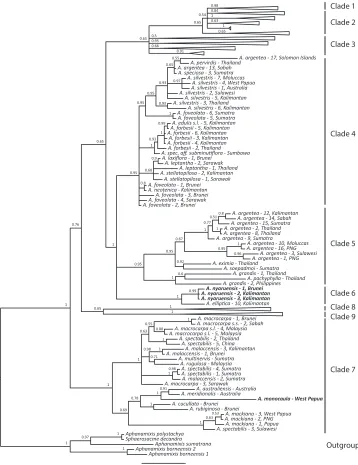
disagreements between the plastid and nuclear data, we here present only the results of the analyses of the combined nuclear (ITS and ETS) dataset (Fig. 4). Both new species
were found to be phylogenetically well supported. Aglaia monocaula was found to be
closely related to other members of section Amoora (A. meridionalis, A. australiensis)
from Australia. All samples of A. nyaruensis formed a strongly supported clade (pp =
0.99), with an accession of A. elliptica from Kalimantan as sister species. Both species
belong to section Aglaia and have an indumentum of stellate hairs and scales.
DNA barcodes
Three-locus DNA barcodes (Table 1) are provided as aids for the identification of the
two new species of Aglaia. On purpose, we did not use the 2-locus combination of rbcL
and matK as originally recommended by the CBOL Plant Working Group
Figure 4. Majority-rule consensus tree of the combined nuclear dataset (ITS and ETS). Node values indicate Bayesian posterior probabilities. Clade numbers on the right refer to the clades identified by Gru-dinski et al. (2014). Clades outside the focus of this study were collapsed. Accessions of the new species (A. nyaruensis and A. monocaula) are highlighted in bold.
0.02 1 0.71 0.95 1 0.95 0.95 1 0.54 1 0.77 0.6 1 0.88 0.69 0.66 0.99 0.65 0.68 1 0.65 0.97 0.63 0.93 1 0.67 0.98 1 1 0.78 0.63 1 0.8 0.65 0.91 1 0.5 0.95 0.92 0.95 1 1 1 0.84 0.98 0.91 1 0.93 1 0.97 0.55 0.95 0.51 1 0.96 1 1 1 0.53 1 0.63 0.8 0.55 0.95 1 1 0.98 0.65 0.76 0.65 1 0.93 0.99 0.9 1 1 0.65
A. argentea - 13, Sabah
A. foveolata - 1, Brunei
A. silvestris - 2, Sulawesi
A. edulis s.l. - 5, Kalimantan
A. forbesii - 3, Kalimantan
A. foveolata - 3, Brunei A. foveolata - 5, Sumatra
A. argentea - 2, Thailand
A. soepadmoi - Sumatra A. forbesii - 2, Thailand
A. argentea - 1, PNG A. silvestris - 1, AustraliaA. silvestris - 4, West Papua
A. argentea - 12, Kalimantan
A. grandis - 2, Philippines A. stellatopilosa - 2, Kalimantan
A. speciosa - 3, Sumatra
A. forbesii - 6, KalimantanA. forbesii - 5, Kalimantan
A. foveolata - 2, Brunei
A. nyaruensis - 2, Kalimantan
A. argentea - 10, Moluccas
A. nyaruensis - 1, Brunei
A. pervirdis - Thailand
A. grandis - 1, Thailand A. argentea - 9, Sumatra A. silvestris - 3, Thailand
A. spec. aff. subminuflora - Sumbawa A. silvestris - 7, Moluccas
A. argentea - 14, Sabah A. laxiflora - 1, Brunei
A. foveolata - 6, Sumatra
A. neotenica - Kalimantan A. foveolata - 4, Sarawak
A. silvestris - 5, Kalimantan
A. argentea - 15, Sumatra
A. nyaruensis - 3, Kalimantan
A. leptantha - 1, Thailand
A. argentea - 8, Thailand
A. eximia - Thailand
A. argentea - 17, Solomon Islands
A. argentea - 16, PNG A. silvestris - 6, Kalimantan
A. pachyphylla - Thailand A. argentea - 3, Sulawesi A. leptantha - 2, Sarawak
A. forbesii - 4, Kalimantan
A. ellipca - 10, Kalimantan A. stellatopilosa - 1, Sarawak
A. malaccensis - 1, Brunei
Aphanamixis polystachya
A. spectabilis - 1, Sumatra
A. australiensis - Australia A. spectabilis - 5, China
A. spectabilis - 4, Sumatra
Sphaerosacme decandra
A. meridionalis - Australia A. macrocarpa s.l. - 5, Malaysia
A. malaccensis - 2, Sumatra A. macrocarpa s.s. - 2, Sabah
A. rugulosa - Malaysia
Aphanamixis borneensis 2
A. monocaula - West Papua
A. macrocarpa - 1, Brunei
A. rubiginosa - Brunei
A. mackiana - 2, PNG
Aphanamixis borneensis 1 A. cucullata - Brunei
A. malaccensis - 3, Kalimantan
A. spectabilis - 3, Sulawesi A. mackiana - 3, West Papua A. mackiana - 1, Papua A. spectabilis - 2, Thailand
A. mulnervis - Sumatra
Aphanamixis sumatrana
A. macrocarpa s.l. - 4, Malaysia
A. macrocarpa - 3, Sarawak
Clade 2 Clade 3 Clade 8 Clade 4 Clade 5 Clade 6 Clade 9 Clade 7 Outgroup Clade 1
In previous phylogenetic studies of Aglaia, ITS has so far been shown to constitute
dicating that this marker might be a useful barcode region. Finally, tests across several Meliaceae genera indicated that ETS might be another useful, i.e. informative, marker.
Acknowledgements
We would like to thank the directors and curators of the following herbaria for permission to remove samples from herbarium specimens for DNA extraction and sequencing: Naturalis, Leiden (L), Royal Botanic Gardens, Kew (K), Harvard University Herbaria (A), Smithsonian Institution, Washington (US), Daubeny Herbarium, University of Oxford (FHO), living collections and Herbarium of the University of Vienna (WU) and L for a loan received and processed by the National Botanic Gardens of Ireland (DBN); Claudia Krüger for assistance in DNA laboratory work; Rosemary Wise for the detailed botanical illustration of the species; and David Kenfack as well as an additional anonymous reviewer and the editors for useful comments on the manuscript. Financial support for this study was provided by the project “Indonesian Plant Biodiversity and Human Health – BIOHEALTH” (BMBF grant no. 16GW0120K) to Alexandra N. Muellner-Riehl. Jan Schnitzler is currently supported by the German Centre for Integrative Biodiversity Research (iDiv) Halle‐Jena‐Leipzig funded by the German Research Foundation (DFG – FZT 118).
references
Baldwin BG, Markos S (1998) Phylogenetic Utility of the External Transcribed Spacer (ETS) of 18S-26S rDNA: Congruence of ETS and ITS Trees of Calycadenia (Compositae). Molecular Phylogenetics and Evolution 10(3): 449–463. https://doi.org/10.1006/mpev.1998.0545
Chase MW, Salamin N, Wilkinson M, Dunwell JM, Kesanakurthi RP, Haidar N, Savolainen V (2005) Land plants and DNA barcodes: Short-term and long-term goals. Philosophi-cal Transactions of the Royal Society of London. Series B, BiologiPhilosophi-cal Sciences 360(1462): 1889–1895. https://doi.org/10.1098/rstb.2005.1720
Clarkson JJ, Pennington TD, Chase MW, Haynes G, Engstrand R, Kaye M, Michalak I, Mu-ellner-Riehl AN (2016) Phylogenetic relationships in Trichilia (Meliaceae) based on riboso-mal ITS sequences. Phytotaxa 259(1): 6–17. https://doi.org/10.11646/phytotaxa.259.1.4
Darriba D, Taboada GL, Doallo R, Posada D (2012) jModelTest 2: More models, new heuristics and parallel computing. Nature Methods 9(8): 772. https://doi.org/10.1038/nmeth.2109
Dong W, Liu J, Yu J, Wang L, Zhou S (2012) Highly Variable Chloroplast Markers for Evaluat-ing Plant Phylogeny at Low Taxonomic Levels and for DNA BarcodEvaluat-ing. PLoS One 7(4): e35071. https://doi.org/10.1371/journal.pone.0035071
Edgar RC (2004) MUSCLE: Multiple sequence alignment with high accuracy and high through-put. Nucleic Acids Research 32(5): 1792–1797. https://doi.org/10.1093/nar/gkh340
Gama RL, Muellner-Riehl AN, Demarco D, Pirani JR (2020) Evolution of reproductive traits in the mahagony family (Meliaceae). Journal of Systematics and Evolution.
Grudinski M, Pannell CM, Chase MW, Ahmad JA, Muellner-Riehl AN (2014) An evalua-tion of taxonomic concepts of the widespread plant genus Aglaia and its allies across Wal-lace’s Line (tribe Aglaieae, Meliaceae). Molecular Phylogenetics and Evolution 73: 65–76.
https://doi.org/10.1016/j.ympev.2014.01.025
Hershkovitz MA, Zimmer EA (1996) Conservation patterns in angiosperm rDNA ITS2 sequences. Nucleic Acids Research 24(15): 2857–2867. https://doi.org/10.1093/ nar/24.15.2857
Hollingsworth PM, Forrest LL, Spouge JL, Hajibabaei M, Ratnasingham S, van der Bank M, Chase MW, Cowan RS, Erickson DL, Fazekas AJ, Graham SW, James KE, Kim K-J, Kress WJ, Schneider H, van AlphenStahl J, Barrett SCH, van den Berg C, Bogarin D, Burgess KS, Cameron KM, Carine M, Chacon J, Clark A, Clarkson JJ, Conrad F, Devey DS, Ford CS, Hedderson TAJ, Hollingsworth ML, Husband BC, Kelly LJ, Kesanakurti PR, Kim JS, Kim Y-D, Lahaye R, Lee H-L, Long DG, Madrinan S, Maurin O, Meusnier I, Newmaster SG, Park C-W, Percy DM, Petersen G, Richardson JE, Salazar GA, Savolainen V, Seberg O, Wilkinson MJ, Yi D-K, Little DP (2009a) A DNA barcode for land plants. Proceedings of the National Academy of Sciences of the United States of America 106(31): 12794–12797.
https://doi.org/10.1073/pnas.0905845106
Hollingsworth ML, Clark AA, Forrest LL, Richardson J, Pennington RT, Long DG, Cowan R, Chase MW, Gaudeul M, Hollingsworth PM (2009b) Selecting barcoding loci for plants: Evaluation of seven candidate loci with species-level sampling in three divergent groups of land plants. Molecular Ecology Resources 9(2): 439–457. https://doi.org/10.1111/j.1755-0998.2008.02439.x
Huelsenbeck JP, Ronquist F (2001) MrBayes: Bayesian inference of phylogenetic trees. Bio-informatics (Oxford, England) 17(8): 754–755. https://doi.org/10.1093/bioinformat-ics/17.8.754
IUCN (2012) IUCN Red List Categories and Criteria - version 3.1, (2nd edn). IUCN, Gland
and Cambridge, 32 pp. https://portals.iucn.org/library/node/10315
Jobes DV, Thien LB (1997) A conserved motif in the 5.8S ribosomal RNA (rRNA) gene is a useful diagnostic marker for plant internal transcribed spacer (ITS) sequences. Plant Mo-lecular Biology Reporter 15(4): 326–334. https://doi.org/10.1023/A:1007462330699
Kearse M, Moir R, Wilson A, Stones-Havas S, Cheung M, Sturrock S, Buxton S, Cooper A, Markovitz S, Duran C, Thierer T, Ahton B, Meintjes P, Drummoned A (2012) Geneious Basic: An integrated and extendable desktop software platform for the organization and analysis of sequence data. Bioinformatics (Oxford, England) 28(12): 1647–1649. https:// doi.org/10.1093/bioinformatics/bts199
Köcke AV, Muellner-Riehl AN, Cáceres O, Pennington TD (2015) Cedrela ngobe (Meliaceae), a new species from Panama and Costa Rica. Edinburgh Journal of Botany 72(2): 225–233.
https://doi.org/10.1017/S0960428615000098
Scienc-pnas.0503123102
Liu J-S, Schardl CL (1994) A conserved sequence in internal transcribed spacer 1 of plant nuclear rRNA genes. Plant Molecular Biology 26(2): 775–778. https://doi.org/10.1007/ BF00013763
Mack A (1995a) Seed dispersal by the Dwarf Cassowary, Casuarius bennettii in Papua New Guinea. Ph.D. dissertation, University of Miami. https://www.researchgate.net/publica- tion/34803848_Seed_dispersal_by_the_Dwarf_Cassowary_Casuarius_bennetti_in_Pap-ua_New_Guinea#fullTextFileContent
Mack A (1995b) Distance and non-randomness of dispersal by the Dwarf Cassowary, Casu-arius bennettii. Ecography 18(3): 286–295. https://doi.org/10.1111/j.1600-0587.1995. tb00131.x
Muellner AN, Mabberley DJ (2008) Phylogenetic position and taxonomic disposition of Tur-raea breviflora Ridl. (Meliaceae), a hitherto enigmatic species. Blumea 53(3): 607–616.
https://doi.org/10.3767/000651908X607549
Muellner AN, Samuel R, Johnson SA, Cheek M, Pennington TD, Chase MW (2003) Molecular phylogenetics of Meliaceae (Sapindales) based on nuclear and plastid DNA sequences. American Journal of Botany 90(3): 471–480. https://doi.org/10.3732/ ajb.90.3.471
Muellner AN, Samuel R, Chase MW, Pannell CM, Greger H (2005) Aglaia (Meliaceae): An evaluation of taxonomic concepts based on DNA data and secondary metabolites. Ameri-can Journal of Botany 92(3): 534–543. https://doi.org/10.3732/ajb.92.3.534
Muellner AN, Samuel R, Chase MW, Coleman A, Stuessy TF (2008a) An evaluation of tribes and of generic relationships in Melioideae (Meliaceae) based on nuclear ITS ribosomal DNA. Taxon 57(1): 98–106.
Muellner AN, Pannell CM, Coleman A, Chase MW (2008b) The origin and evolution of In-domalesian, Australasian and Pacific island biotas: Insights from Aglaieae (Meliaceae, Sap-indales). Journal of Biogeography 35(10): 1769–1789. https://doi.org/10.1111/j.1365-2699.2008.01935.x
Muellner AN, Pannell CM, Greger H (2009a) Genetic diversity and geographic structure in Aglaia elaeagnoidea (Meliaceae, Sapindales), a morphologically complex tree spe-cies, near the two extremes of its distribution. Blumea 54(1–3): 207–216. https://doi. org/10.3767/000651909X476175
Muellner AN, Pennington TD, Chase MW (2009b) Molecular phylogenetics of Neotropical Cedreleae (mahogany family, Meliaceae) based on nuclear and plastid DNA sequences reveal multiple origins of “Cedrela odorata”. Molecular Phylogenetics and Evolution 52(2): 461–469. https://doi.org/10.1016/j.ympev.2009.03.025
Muellner AN, Schaefer H, Lahaye R (2011) Evaluation of DNA barcodes for economically im-portant timber species of the mahogany family (Meliaceae). Molecular Ecology Resources 11(3): 450–460. https://doi.org/10.1111/j.1755-0998.2011.02984.x
Müller C, Schulte FW, Lange-Grünweller K, Obermann W, Madhugiri R, Pleschka S, Zie-burh J, Hartmann R, Grünweller A (2018) Broad-spectrum antiviral activity of the eIF4A inhibitor silvestrol against corona- and picornaviruses. Antiviral Research 150: 123–129.
Müller C, Obermann W, Schulte FW, Lange-Grünweller K, Oestereich L, Elgner F, Glitscher M, Hildt E, Singh K, Wendel HG, Hartmann RK, Ziebuhr J, Grünweller A (2020) Com-parison of broad-spectrum antiviral activities of the synthetic rocaglate CR-31-B (−) and the eIF4A-inhibitor Silvestrol. Antiviral Research 175: 104706. https://doi.org/10.1016/j. antiviral.2020.104706
Pannell CM (1992) A taxonomic monograph of the genus Aglaia Lour. (Meliaceae). Kew Bul-letin Additional Series XVI. HMSO, London, United Kingdom, viii + 1–379.
Pannell CM (1995) Aglaia. In: Mabberley DJ, Pannell CM, Sing AM (Authors), Meliace-ae. Flora Malesiana I(12): 194–314. Foundation Flora Malesiana, Leiden, Netherlands.
https://www.semanticscholar.org/paper/Flora-Malesiana%3A-Series-I.-Spermatophyta-Volume-12%2C-Mabberley-Pannell/f7bfe88a821e26ccb1289d502b9988b7a3011490
Pannell CM (1997) A new, cassowary-dispersed, species of Aglaia (Meliaceae, section Amoora) from Papua New Guinea. Kew Bulletin 52(3): 715–717. https://doi.org/10.2307/4110302
Pannell CM (1998a) Taxonomy, ecology and reproductive biology of Aglaia (Meliaceae). In: Hopkins HCF, Huxley CR, Pannell CM, Prance GT, White F (Eds) The biological mono-graph: The importance of field studies and functional syndromes for taxonomy and evolu-tion of tropical plants, A Festschrift for Frank White. Royal Botanic Gardens Kew, Lon-don, United Kingdom, 59–77. https://link.springer.com/article/10.2307/2666614
Pannell CM (1998b) Species delimitation in Aglaia. In: Hopkins HCF, Huxley CR, Pannell CM, Prance GT, White F (Eds) The biological monograph, The importance of field studies and functional syndromes for taxonomy and evolution of tropical plants, A Festschrift for Frank White. Royal Botanic Gardens Kew, London, United Kingdom, 124–127. https:// link.springer.com/article/10.2307/2666614
Pannell CM (2004) Three new species, two new subspecies and five new combinations at the subspecific level in Aglaia Lour. (Meliaceae). Kew Bulletin 59(1): 87–94. https://doi. org/10.2307/4111078
Pannell CM (2007) Aglaia (Meliaceae). In: Soepadmo E, et al (Eds) Tree Flora of Sa-bah and Sarawak 6: 24–107. https://www.nhbs.com/3/series/tree-flora-of-sabah-and-sarawak?qtview=154602
Pannell CM (2019) Aglaia mabberleyi Pannell (Meliaceae), a new species from Borneo. Gardens’ Bulletin (Singapore) 71(Suppl. 2): 189–195. https://doi.org/10.26492/ gbs71(suppl.2).2019-02
Pennington TD, Muellner AN (2010) A monograph of Cedrela. DH Books, Sherborne, UK, 1–112. https://www.nhbs.com/a-monograph-of-cedrela-book
Prince LM (2015) Plastid primers for angiosperm phylogenetics and phylogeography. Applica-tions in Plant Sciences 3(6): 1400085. https://doi.org/10.3732/apps.1400085
Rambaut A, Drummond AJ, Xie D, Baele G, Suchard MA (2018) Posterior summarization in Bayesian phylogenetics using Tracer 1.7. Systematic Biology 67(5): 901–904. https://doi. org/10.1093/sysbio/syy032
Ronquist F, Huelsenbeck JP (2003) MRBAYES 3: Bayesian phylogenetic inference under mixed models. Bioinformatics (Oxford, England) 19(12): 1572–1574. https://doi.org/10.1093/ bioinformatics/btg180
Table S1. Voucher information, origin, and GenBank accession numbers for all species included in this study
Authors: Caroline M. Pannell, Jan Schnitzler, Alexandra N. Muellner-Riehl Data type: molecular data
Explanation note: New GenBank accessions (this study) are highlighted in bold. Copyright notice: This dataset is made available under the Open Database License
(http://opendatacommons.org/licenses/odbl/1.0/). The Open Database License
(ODbL) is a license agreement intended to allow users to freely share, modify, and use this Dataset while maintaining this same freedom for others, provided that the original source and author(s) are credited.