Reviewable v1 Grant Proposal
Biotic interactions, community assembly, and
eco-evolutionary dynamics as drivers of long-term
biodiversity–ecosystem functioning relationships
Nico Eisenhauer , Michael Bonkowski, Ulrich Brose, Francois Buscot, Walter Durka , Anne Ebeling, Markus Fischer, Gerd Gleixner, Anna Heintz-Buschart , Jes Hines, Annette Jesch, Markus Lange, Sebastian Meyer, Christiane Roscher, Stefan Scheu, Holger Schielzeth, Michael Schloter , Stefanie Schulz , Sybille Unsicker, Nicole M. van Dam, Alexandra Weigelt, Wolfgang W. Weisser, Christian Wirth, Jochen Wolf , Bernhard Schmid
‡ Leipzig University, Leipzig, Germany
§ German Centre for Integrative Biodiversity Research (iDiv) Halle-Jena-Leipzig, Leipzig, Germany | Zoological Institute, University of Cologne, Zülpicher Strasse 47b, D-50674, Cologne, Germany ¶ Friedrich Schiller University Jena, Jena, Germany
# UFZ Centre for Environmental Research, Leipzig, Germany
¤ Helmholtz Centre for Environmental Research – UFZ, Community Ecology, Halle, Germany « German Centre for Integrative Biodiversity Research (iDiv), Halle-Jena-Leipzig, Leipzig, Germany » University of Bern, Bern, Switzerland
˄Max Planck Institute for Biogeochemistry, Jena, Germany
˅German Centre for integrative Biodiversity Research (iDiv) Halle-Jena-Leipzig, Leipzig, Germany ¦ Technical University of Munich, Munich, Germany
ˀHelmholtz Centre for Environmental Research (UFZ), Leipzig, Germany
ˁGeorg-August-University Göttingen, J.F. Blumenbach Institute of Zoology and Anthropology, Göttingen, Germany
₵Helmholtz Zentrum München, Munich, Germany
ℓ Max Planck Institute for Chemical Ecology, Jena, Germany
₰Ludwig-Maximilians-Universität München, Munich, Germany
₱University of Zurich, Zurich, Switzerland
Corresponding author: Nico Eisenhauer ([email protected])
Received: 03 Oct 2019 | Published: 04 Oct 2019
Citation: Eisenhauer N, Bonkowski M, Brose U, Buscot F, Durka W, Ebeling A, Fischer M, Gleixner G, Heintz-Buschart A, Hines J, Jesch A, Lange M, Meyer S, Roscher C, Scheu S, Schielzeth H, Schloter M, Schulz S, Unsicker S, van Dam NM, Weigelt A, Weisser WW, Wirth C, Wolf J, Schmid B (2019) Biotic interactions, community assembly, and eco-evolutionary dynamics as drivers of long-term biodiversity–ecosystem functioning relationships. Research Ideas and Outcomes 5: e47042. https://doi.org/10.3897/rio.5.e47042
‡,§ | ¶ # ¤,«
¶ » ˄ § § ˅
˄ ¦ ˀ ˁ ¶
₵ ₵ ℓ § ‡
¦ ‡ ₰ ₱
Abstract
The functioning and service provisioning of ecosystems in the face of anthropogenic environmental and biodiversity change is a cornerstone of ecological research. The last three decades of biodiversity–ecosystem functioning (BEF) research have provided compelling evidence for the significant positive role of biodiversity in the functioning of many ecosystems. Despite broad consensus of this relationship, the underlying ecological and evolutionary mechanisms have not been well understood. This complicates the transition from a description of patterns to a predictive science. The proposed Research Unit aims at filling this gap of knowledge by applying novel experimental and analytical approaches in one of the longest-running biodiversity experiments in the world: the Jena Experiment. The central aim of the Research Unit is to uncover the mechanisms that determine BEF relationships in the short- and in the long-term. Increasing BEF relationships with time in long-term experiments do not only call for a paradigm shift in the appreciation of the relevance of biodiversity change, they likely are key to understanding the mechanisms of BEF relationships in general. The subprojects of the proposed Research Unit fall into two tightly linked main categories with two research areas each that aim at exploring variation in community assembly processes and resulting differences in biotic interactions as determinants of the long-term BEF relationship. Subprojects under “Microbial community assembly” and “Assembly and functions of animal communities” mostly focus on plant diversity effects on the assembly of communities and their feedback effects on biotic interactions and ecosystem functions. Subprojects under “Mediators of plant-biotic interactions” and “Intraspecific diversity and micro-evolutionary changes” mostly focus on plant diversity effects on plant trait expression and micro-evolutionary adaptation, and subsequent feedback effects on biotic interactions and ecosystem functions. This unification of evolutionary and ecosystem processes requires collaboration across the proposed subprojects in targeted plant and soil history experiments using cutting-edge technology and will produce significant synergies and novel mechanistic insights into BEF relationships. The Research Unit of the Jena Experiment is uniquely positioned in this context by taking an interdisciplinary and integrative approach to capture whole-ecosystem responses to changes in biodiversity and to advance a vibrant research field.
Keywords
List of participants
Jeannine Cavender-Bares (University of Minnesota, Minneapolis, USA), Miklós Dombos (Hungarian Academy of Sciences, Budapest, Hungary), Susanne Dunker (Helmholtz Centre for Environmental Research (UFZ), Leipzig, Germany), Forest Isbell (University of Minnesota, Minneapolis, USA), Birgitta König-Ries (Friedrich Schiller University Jena, Jena, Germany), Liesje Mommer (Wageningen University, Wageningen, The Netherlands), Kevin Mueller (Cleveland State University, Cleveland, USA), Koen Verhoeven (NIOO, Wageningen, The Netherlands), Michael Vohland (Leipzig University, Leipzig, Germany), Nils Wagemaker (Radboud University, Nijmegen, The Netherlands)
State of the art and preliminary work
Temporal changes of biodiversity effects on ecosystem functions
A plethora of experimental studies has shown that the magnitude and stability of ecosystem functions increase with biodiversity (Cardinale et al. 2012, Isbell et al. 2015). Short-term experiments mostly predict a saturating relationship between biodiversity and ecosystem functions, implying that biodiversity effects are stronger at low biodiversity, and the loss of species at higher biodiversity levels has little effect (Cardinale et al. 2011, Cardinale et al. 2012). However, the few existing long-term experiments have challenged this view by demonstrating the strength of the biodiversity effect to increase with time, i.e., the saturating BEF relationship to become (more) linear (Reich et al. 2012, Guerrero-Ramírez et al. 2017). In fact, biodiversity effects seem to become increasingly important when more environmental contexts, functions, and experimental years are considered (Isbell et al. 2011, Eisenhauer et al. 2018 These findings contrast with the notion of saturating biodiversity effects, and thus have fundamentally different implications for the consequences of biodiversity change as well as the many related functions and services for humankind. Long-term biodiversity experiments are, therefore, not only key to understand mechanisms underlying BEF relationships at ecological equilibrium (Eisenhauer et al. 2012a, Eisenhauer et al. 2012b), but also to provide better-informed recommendations for land managers and policy makers (Hungate et al. 2017, Isbell et al. 2017). The Jena Experiment is one of the few existing long-term experiments that allows scientists to assess whether short-term and long-term biodiversity effects are indeed qualitatively different and to uncover the mechanistic basis of divergence of short- versus long-term effects.
While the diverging trends are apparent, it is currently unclear whether strengthening biodiversity effects are attributable to
1. deteriorating performance of low diversity communities,
2. improving performance of high diversity communities, or
Since low-diversity plant communities are widely used in landscapes managed for production, such as agricultural systems and tree plantations (Isbell et al. 2017), deteriorating low-diversity communities over time may have important implications for the long-term provisioning of vital ecosystem services in managed ecosystems. A recent meta-analysis of 26 long-term grassland and forest biodiversity experiments shows that biodiversity–ecosystem functioning relationships strengthen mainly by greater increases in functioning in high-diversity communities in grasslands and forests (Guerrero-Ramírez et al. 2017). In grasslands, however, biodiversity effects also strengthen due to decreases in functioning in low-diversity communities. The synthesis of multiple ecosystem functions in the Jena Experiment also suggests that both deteriorating performance at low diversity and improving performance at high diversity contribute to strengthening BEF relationships over time (Meyer et al. 2016). The generality of those findings and the paucity of experiments that capture long-term effects puts long-term studies in the unique position to unravel the mechanisms that are responsible for increasing biodiversity effects over time (Eisenhauer 2018). Moreover, in order to derive such a mechanistic understanding, potential confounding influences of calendar year have to be ruled out by comparing ecosystems of different age in the same calendar years, as we do in the Field Experiment that we set up in preparation of the requested Research Unit (see below). Thus, the Jena Experiment in particular allows in-depth understanding of the full range of biotic interactions and eco-evolutionary dynamics and how they interactively influence ecosystem functioning in the short- and in the long-term.
Potential mechanisms underlying temporal changes of biodiversity effects
Figure 1.
A. Conceptual diagram of the mechanistic approach of the planned Research Unit. B.
Ecological processes, such as changes in the competitive environment as well as antagonistic and beneficial multitrophic interaction partners above and below the ground impose selective pressures on members of the community and thereby create ‘eco-to-evo’ feedbacks (Hendry 2016). The subsequent evolutionary changes, in turn, will alter the conditions for other members of the community via ‘evo-to-eco’ feedbacks (Whitham et al. 2006, Lipowsky et al. 2011, van Moorsel et al. 2018), giving rise to complex eco-evolutionary dynamics (Fig. 1). Some changes in plant traits will be plastic responses, while others are genetic or epigenetic in origin, and lead to adaptation and differences along the diversity gradient (Whitham et al. 2006, Lipowsky et al. 2011, van Moorsel et al. 2018). Understanding the relative role of these components is of importance, because the mechanisms determine how reversible the changes are and how much they contribute to long-term BEF relationships. Open-ended questions are if variation in trait expression is related to micro-evolutionary changes as well as the role of traits that may be relevant for biotic interactions and feedback effects, such as defense traits at the physiological level. Evolutionary changes, such as increased niche differentiation (Zuppinger-Dingley et al. 2014), and increased resource-use complementarity due to community assembly processes (Reich et al. 2012, Roscher et al. 2013), will slowly build up and can thus produce increasing biodiversity effects over time (Fig. 1). Yet, it remains unexplored whether short-term and long-term biodiversity effects are qualitatively different, such that short-term effects may be dominated by phenotypic plasticity and community assembly, while long-term effects may be co-determined by eco-evolutionary dynamics that may continue to produce divergence in plant community performance in the long-term. Ultimately, ecological and evolutionary processes are intertwined, and long-term experiments are needed not only to gain basic understanding of the relative importance as well as interactions of these processes, but also to apply these concepts to better provisioning of ecosystem functions and stability (Tilman and Snell-Rood 2014).
The proposed Research Unit will address this knowledge gap by asking the overarching question: Are increasing biodiversity–ecosystem functioning relationships with time caused by changing biotic interactions due to the interplay between multitrophic
community assembly processes and eco-evolutionary dynamics? As community
assembly, biotic interactions, and eco-evolutionary processes strongly interact in influencing plant traits and signals in space and time, collaboration across the proposed subprojects in targeted and unique plant history and soil history experiments using cutting-edge technology will produce significant synergies and novel mechanistic insights into BEF relationships.
Project-related publications
Spokesperson and principle investigators highlighted.
Cornelissen JHC, Craine JM, De Luca E, Ebeling A, Griffin JN, Hector A, Hines J, Jentsch A, Kattge J, Kreyling J, Lanta V, Lemoine N, Meyer ST, Minden V, Onipchenko V, Polley WH, Reich PB, van Ruijven J, Schamp B, Smith MD, Soudzilovskaia NA, Tilman D, Weigelt A, Wilsey B, Manning P (2018) Multiple facets of biodiversity drive the diversity-stability relationship. Nature Ecology & Evolution 2: 1579-1587.
2. Eisenhauer N, Dobies T, Cesarz S, Hobbie SE, Meyer RJ, Worm K, Reich PB (2013) Plant diversity effects on soil food webs are stronger than those of elevated CO and N deposition in a long-term grassland experiment. Proceedings of the National Academy of Sciences USA 110: 6889-6894.
3. Eisenhauer N , Herrmann S, Hines J, Buscot F, Siebert J, Thakur MP (2018b) The dark side of animal phenology. Trends in Ecology and Evolution 33: 898-901.
4. Guerrero-Ramirez NR, Craven D, Reich PB, Ewel JJ, Isbell F, Koricheva J, Parrotta JA, Auge H, Erickson HE, Forrester DI, Hector H, Joshi J, Montagnini F, Palmborg C, Piotto D, Potvin C, Roscher C, van Ruijven J, Tilman D, Wilsey B and Eisenhauer N (2017) Diversity-dependent temporal divergence of ecosystem functioning in experimental ecosystems. Nature Ecology & Evolution 1: 1639-1642.
5. Isbell F, Craven D, Connolly J, Loreau M, Schmid B, Beierkuhnlein H, Bezemer TM, Bonin C, Bruelheide H, de Luca E, Ebeling A, Griffin J, Guo Q, Hautier Y, Hector A, Jentsch A, Kreyling J, Lanta V, Manning P, Meyer ST, Mori AS, Naeem S, Niklaus PA, Polley HW, Reich PB, Roscher C, Seabloom EW, Smith MD, Thakur MP, Tilman D, Tracy BF, van der Putten WH, van Ruijven J, Weigelt A, Weisser WW, Wilsey B, Eisenhauer N (2015) Biodiversity increases the resistance of ecosystem productivity to climate extremes. Nature 526: 574-577.
6. Lange M, Eisenhauer N, Sierra CA, Bessler H, Engels C, Griffiths RI, Mellado-Vázquez PG, Malik A, Roy J, Scheu S, Steinbeiss S, Thomson BC, Trumbore SE, Gleixner G (2015) Plant diversity drives soil carbon storage by increased soil microbial activity. Nature Communications 6: 6707.
7. Reich PB, Tilman D, Isbell F, Mueller K, Hobbie SE, Flynn DFB and Eisenhauer N (2012) Impacts of biodiversity loss escalate through time as redundancy fades. Science 336: 589-592.
8. Scherber C, Eisenhauer N, Weisser WW, Schmid B, Voigt W, Schulze E-D, Roscher C, Weigelt A, Allan E, Beßler H, Bonkowski M, Buchmann N, Buscot F, Clement LW, Ebeling A, Engels C, Fischer M, Halle S, Kertscher I, Klein A-M, Koller R, König S, Kowalski E, Kummer V, Kuu A, Lange M, Lauterbach D, Middelhoff C, Migunova VD, Milcu A, Müller R, Partsch S, Petermann JS, Renker C, Rottstock T, Sabais ACW, Scheu S, Schumacher J, Temperton VM and Tscharnke T (2010) Bottom-up effects of plant diversity on biotic interactions in a biodiversity experiment. Nature 468: 553-556.
9. Schuldt A, Ebeling A, Kunz M, Staab M, Guimarães-Steinicke C, Bachmann D, Buchmann N, Durka W, 10, Fichtner A, Fornoff F, Härdtle W, Hertzog L, Klein A-M, Roscher C, Schaller J, von Oheimb G, Weigelt A, Weisser WW, Wirth C, Zhang J, Bruelheide H,
Eisenhauer N (2019) Multiple plant diversity components drive consumer communities across ecosystems. Nature Communications 10: 1460.
10. Schwarz B, Barnes AD, Thakur MP, Brose U, Ciobanu M, Reich PB, Rich RL, Rosenbaum B, Stefanski A and Eisenhauer N (2017) Warming alters energetic structure and function but not resilience of soil food webs. Nature Climate Change 7: 895-900.
Objectives, concept and approach
New objectives based on a strong research history
The previous Research Units within the Jena Experiment have yielded unique insights into the role of plant diversity for multiple ecosystem functions and trophic levels (e.g., Scherber et al. 2010, Allan et al. 2013, Lange et al. 2015, Lefcheck et al. 2015, Schuldt et al. 2019), stability of ecosystem functions (e.g., Isbell et al. 2015, Wright et al. 2015, Craven et al. 2018), as well as first insights into the role of eco-evolutionary dynamics (e.g., Zuppinger-Dingley et al. 2014, Zuppinger-Zuppinger-Dingley et al. 2016, van Moorsel et al. 2018). However, our understanding of the ecological mechanisms (Laforest-Lapointe et al. 2017, Guerrero-Ramírez et al. 2017) and eco-evolutionary feedbacks (van Moorsel et al. 2018, Schmid et al. 2019) underlying changes in BEF relationships over time is still in its infancy. Considering multitrophic community assembly and exploring subsequent biotic interaction variation as determinant of long-term BEF relationships will be key to advance this field of research (Hines et al. 2015, Barnes et al. 2018). Specifically, the combination of the unique research infrastructure of the Jena Experiment and novel experimental approaches with cutting-edge technology in microbiology, chemical ecology, proximal sensing, genomics, and food web modelling will allow the proposed Research Unit to take a leading role in BEF research. We propose to zoom in on the underlying mechanisms of long-term BEF by investigating the different influences that plants experience in their interactions with plant and consumer communities.
The subprojects (SPs) of the proposed Research Unit fall into two main categories and four tightly linked research areas (RA) (Fig. 2). Subprojects under “Microbial community
assembly” (RA1) and “Assembly and functions of animal communities” (RA2) mostly
above-belowground communities and subsequent feedback effects, as well as plant trait expression and micro-evolutionary processes. Notably, these two main categories are closely linked as plastic micro-evolutionary responses of plants are supposed to be strongly influenced by above-belowground community assembly and their feedback
effects, and vice versa (Fig. 1). These conceptual links are exemplified by the many
collaborations of subprojects across categories and research fields (Fig. 2).
All of the proposed subprojects will utilize common experimental setups that explore the eco-evolutionary history of plant and soil communities. Community-level studies will explore BEF relationships as affected by plant history and/or soil history. Plant history refers to the abiotic and biotic selection pressures that plants have experienced in their respective communities since the start of the Jena Experiment, while soil history encompasses abiotic and biotic soil properties that have emerged from plant-soil interactions (Bever 2003, Schmid et al. 2019). Plant individual-specific studies will advance the mechanistic understanding of community-level responses and processes by exploring plants’ investments into growth and/or defense, interactions with microorganisms and animals above and below the ground, and how plant diversity-induced alterations in genetic diversity and trait expression change the performance of the plants and the interactions with their abiotic and biotic environment.
Novel tools to study temporal changes in biotic interactions and BEF effects
Figure 2.
Notably, addressing the main objectives of the proposed Research Unit with these
novel techniques requires a stepwise approach. In the proposed first phase of the
Research Unit, we plan to build on recently established (Field Experiment; see below) and envisaged experiments (Ecotron Experiment and Microcosm Experiments; see below and individual SP’s proposals, respectively) to study the effects of plant history and soil history on BEF relationships and to separate those from potentially confounding climate effects. These experiments have sophisticated designs and provide the unique framework to describe microbial and animal community assembly patterns, morphological and chemical mediators of plant-biotic interactions, intraspecific plant diversity and micro-evolutionary changes, as well as the linkages to ecosystem functioning. Many novel tools will for the first time be employed in a BEF context and will thus contribute to describing new BEF patterns and develop hypotheses inspiring future experimental work that will
build the basis for the second phase of the proposed Research Unit. For instance, the
detailed investigation of microbial communities, comprising plant antagonists and mutualists, is an important first step to identify and cultivate potential key taxa that may then be manipulated in future experiments in the second phase. Similarly, the identification of important chemical traits and signals in the first phase of the Research Unit could allow us testing their role in biotic interactions and BEF relationships by targeted manipulations and/or lab experiments. The exploration of energy fluxes through food webs may enable us to detect key nodes that could be manipulated in subsequent experiments. Moreover, the discovery of key biological activity periods may guide the timing of future sampling campaigns. Taken together, we see the proposed research in the first phase of the Research Units as the prerequisite for future mechanistic studies, an approach that is already exemplified by the Microcosm Experiments.
Complementary expertise facilitates the “Research Unit’s functioning”
The previous Research Units in the framework of the Jena Experiment have had a unique role in BEF research by exploring whole-ecosystem responses to changes in biodiversity. Thus, the Jena Experiment is internationally widely known and respected as a key pillar in BEF research as well as one of the few running long-term biodiversity experiments in grassland. The proposed Research Unit will build on the unique strengths of the Jena Experiment, yet taking a novel approach in studying BEF relationships. The interdisciplinary approach (collaboration between animal ecologists, biochemists, plant ecologists, soil ecologists, soil microbiologists, evolutionary ecologists, and
food web modelers) is highly innovative and world-leading. In order to address some
campaigns. The proposed Research Unit includes scientists and collaborators from various universities and research institutes in Germany and Switzerland. German participation includes the universities of Göttingen, Halle, Jena, Köln, Leipzig, Frankfurt, TU and LMU Munich, the German Centre for Integrative Biodiversity Research (iDiv) Halle-Jena-Leipzig, the Max Planck Institutes for Biogeochemistry and Chemical Ecology (both in Jena), as well as the Helmholtz-Centres for Environmental Research in Halle/Leipzig and for Health and Environment Munich, and we propose to strengthen this team through close collaborations with Mercator Fellows (Prof. Dr. Jeannine Cavender-Bares, Prof. Dr. Forest Isbell, Prof. Dr. Liesje Mommer, Prof Dr. Kevin Mueller) that will complement our expertise and connect us with international scientists and experimental infrastructures.
Joint work programme including proposed research methods
Cutting-edge techniques meet novel experimental approaches
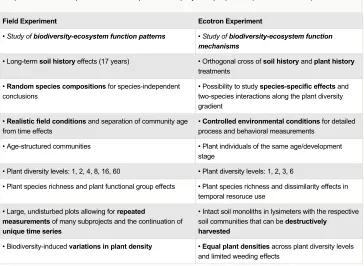
We propose to use a set of three complementary experimental approaches (see Table 1 for the core experimental infrastructures) to advance the mechanistic understanding of BEF relationships by focusing on trait variation and biotic interaction variation caused by multitrophic community assembly as well as eco-evolutionary feedbacks as determinants of long-term plant diversity effects on ecosystem functioning (Fig. 1). While the Field
Experiment allows to test important patterns in BEF relationships and the role of soil
history, the Ecotron Experiment and Microcosm Experiments enable zooming in on the underlying mechanisms and to study effects of plant history and soil history (Fig. 2). The unifying rationale of the planned Research Unit is that plant interactions and interactions of plants with higher trophic levels (including microorganisms and animals) determine phenotypic plasticity and micro-evolutionary processes that
together trigger ecosystem functioning. The planned Research Unit will embrace this
plasticity of traits and their multitrophic interaction environment as well as their long-term evolutionary changes. In all experimental approaches, studying plant and soil eco-evolutionary history effects and their interactions will be the main ingredients to better understand why diverse plant communities function better than low-diversity plant communities and why this difference increases over time (Reich et al. 2012, Guerrero-Ramírez et al. 2017).
controlled Ecotron environment will allow to study species interactions and perform sophisticated process measurements that currently are impossible under field conditions. Further Microcosm Experiments will focus on isolating mechanisms underlying focal interactions. While all planned subprojects will work in the Field Experiment and Ecotron Experiment, allowing for collaborations and synergies among subprojects, Microcosm Experiments will have more subproject-specific foci (Fig. 2). Common phytometer species and plant species-specific analyses will further link the research activities of all subprojects across experimental set-ups (Fig. 2).
Field Experiment Ecotron Experiment
• Study of biodiversity-ecosystem function patterns • Study of biodiversity-ecosystem function
mechanisms
• Long-term soil history effects (17 years) • Orthogonal cross of soil history and plant history
treatments • Random species compositions for species-independent
conclusions
• Possibility to study species-specific effects and two-species interactions along the plant diversity gradient
• Realistic field conditions and separation of community age from time effects
• Controlled environmental conditions for detailed process and behavioral measurements
• Age-structured communities • Plant individuals of the same age/development stage
• Plant diversity levels: 1, 2, 4, 8, 16, 60 • Plant diversity levels: 1, 2, 3, 6
• Plant species richness and plant functional group effects • Plant species richness and dissimilarity effects in temporal resoruce use
• Large, undisturbed plots allowing for repeated
measurements of many subprojects and the continuation of
unique time series
• Intact soil monoliths in lysimeters with the respective soil communities that can be destructively harvested
• Biodiversity-induced variations in plant density • Equal plant densities across plant diversity levels and limited weeding effects
The Field Experiment – objectives and hypotheses
Studies on changes in biodiversity effects with community age (years since the start of the experiment) all have the problem that time (calendar year) is confounded with age. The Field Experiment (established in 2016 in preparation of this proposal; for design see Suppl. material 1; for one-page summary [“Cheat Sheet”], see Suppl. material 2) for the first time allows to compare communities of different ages at the same point in time. We set up the same communities in 2016 as we had set up in 2002 and can now observe them at ages 5 and 19 in 2020, 6 and 20 in 2021, and so on. To make the comparison, the communities of the same species compositions but different ages are located on the same plots. The ‘with plant history, with soil history’ treatment is represented by the undisturbed soil and plant
Table 1.
communities, which have been maintained since 2002 (Roscher et al. 2004). We also established a ‘without plant history, without soil history’ treatment in order to replicate the soil situation as in 2002. Therefore, we used soil from a nearby agricultural crop field (no plant and no soil history from the old experiment; very similar to the conditions before the Jena Experiment was sown on a former agricultural field in 2002). In addition, we set up a treatment where the soil of the old experimental plot was broken up and mixed before sowing the new experiment with new seed material (‘without plant history, with soil history’). The setup of this new experiment on the plots of the Main Experiment is a first significant step towards separating environmental correlates of time (such as climatic trends) from community age effects caused by plant–soil eco-evolutionary dynamics (Schnitzer et al. 2011, Eisenhauer et al. 2012a, Zuppinger-Dingley et al. 2014, Roscher et al. 2015, van Moorsel et al. 2018, Schmid et al. 2019). This allows us to experimentally explore community-age effects, such as eco-evolutionary soil history effects (plant community-specific soil history) and eco-evolutionary niche differentiation (plant community-specific plant history), on the strength of biodiversity effects independently of confounding temporal trends under the same climate conditions. In addition to the community-level analyses, we will employ a phytometer approach and plant species-specific assessments to study plant-species-specific eco-evolutionary responses to the experimental treatments in a standardized way and in concerted actions (Suppl. material 1).
According to the proposed mechanisms underlying strengthening BEF relationships in time (Eisenhauer et al. 2012a, Zuppinger-Dingley et al. 2014, Meyer et al. 2016), we expect the slope of the BEF relationship to differ among the treatments of the Field Experiment (Fig. 3): we hypothesize a steeper and more significant BEF relationship in the treatment ‘with
Figure 3.
plant history, with soil history’ than in the treatment ‘without plant history, with soil history’, because of increased niche differentiation in plants with eco-evolutionary history of coexistence. This means that low-diversity communities in the “with plant history, with soil history” treatment should perform worst in comparison to all other treatments, e.g., due to the accumulation of plant antagonists and nutrient limitation (due to one-sided nutrient use); and the high-diversity communities in this treatment should perform best, e.g., due to resource use complementarity and an accumulation of plant growth facilitators. The treatment ‘without plant history, without soil history’ is predicted to have the shallowest BEF slope, because of lower niche differentiation in plant mixtures and missing plant community-specific soil effects (Fig. 3).
Preliminary results from the Field Experiment provide support for the prediction of a steeper slope in the ‘with plant history, with soil history’ treatment for absolute and relative plant biomass production (Vogel et al. 2019). Moreover, soil nematode community composition and soil microbial functioning (carbon use efficiency) differed substantially among the experimental treatments (Vogel et al. 2019). Thus, already one year after establishment of the experiment, the BEF slopes of the treatments ‘without plant history, without soil history’ and ‘without plant history, with soil history’ differed significantly, suggesting that soil and plant history are both important, and motivating the complementary Ecotron Experiment (see below). This proposal for a new Research Unit will allow us to assess whether the effects consolidate and allows to probe the relevant
Figure 4.
mechanistic processes. Notably, the ‘with plant history, with soil history’ treatment can only serve as a reference in the Field Experiment, because the respective plots were not disturbed like in the other treatments, and because the plant history treatment cannot be studied independent of the soil history treatment. Thus, plant history versus soil history effects can only be studied in the planned Ecotron Experiment.
Since the establishment of the Field Experiment has already been successfully accomplished in preparation of this proposal, there are no establishment risks, and
the new research questions can be addressed immediately . The Field Experiment
provides the ideal infrastructure for large collaborative initiatives on the mechanisms underlying BEF relationships (Fig. 2) and allows testing our overarching hypothesis as well as SP-specific hypotheses (see individual SP proposals).
The Ecotron Experiment – objectives and hypotheses
The comprehensive study of plant history and soil history effects requires complementary approaches, e.g., for testing general relationships under field conditions (large species pool and random community mixtures in the Field Experiment), as well as more specific process and interaction assessments in highly-controlled setups (species- and interaction-specific effects and responses). The planned Ecotron Experiment allows us to do this along a well-established plant diversity gradient (for details on the design, see Suppl. material 4; for one-page summary [“Cheat Sheet”], see Suppl. material 5). It thus builds on the strengths of the Jena Experiment, while complementing the Field Experiment in several important aspects. While the Field Experiment and the Ecotron Experiment share the objectives provided above on the mechanisms of increasing BEF relationships over time, the unique objectives of the Ecotron Experiment are to (1) orthogonally separate plant history from soil history effects, (2) study plant species- and interaction-specific effects at all diversity levels, and (3) study the mechanisms underlying BEF relationships via
sophisticated process measurements (see Table 1 for differences between the Field
Experiment and the Ecotron Experiment). Thus, many SPs complement the assessments they also perform in the Field Experiment (mentioned above and in more detail in the SPs’ proposals) with more detailed analyses of certain processes and interactions in the Ecotron Experiment.
resource use complementarity (Fig. 1). Finally, we hypothesize slightly steeper BEF slopes in the treatment ‘with plant history, without soil history’ (brown, dashed line), because the selection of plants towards increased defense (Fig. 1) may not be of benefit in a soil with low pathogen pressure (plant growth-defense trade-off). At high plant diversity, however, ecosystem functioning might be higher because of reduced niche overlap (Fig. 1).
Anticipated total duration of the project
Four years.
Research data and knowledge management
Regular meetings
The Central Coordination will organize at least two meetings per year (one in spring before the field season, one in autumn; ‘Jena Retreat’) to guarantee a high level of transparency and information flow for all participating scientists and technicians. Typically, the Jena Retreat starts with a series of talks by each subproject (subproject-specific results and plans), which is followed by time for break-out groups for working on specific projects, planning of joint sampling campaigns, experiments, and analyses. These regular updates and opportunities to plan collaborations have been very successful in fostering interdisciplinary work in the Jena Experiment (as exemplified by the high number of joint publications in the consortium; >280 papers by April 2019, see Google Scholar account).
Communication, open platform, and workshops
Database and international collaboration
From the past Research Units, we have learned that collaborative research requires a well-functioning database. The culture of data sharing and joint analyses is a great strength of the Jena Experiment and has already resulted in important contributions to the field (e.g., Scherber et al. 2010, Allan et al. 2013, Meyer et al. 2016, Meyer et al. 2018). In addition, the Jena Experiment contributed data to impactful across-experiment syntheses (e.g., Isbell et al. 2011, Isbell et al. 2015, Lefcheck et al. 2015, Craven et al. 2016, Guerrero-Ramírez et al. 2017, Craven et al. 2018) and has established the database infrastructure as well as data use and publication policies to facilitate similar work in the future. These measures have inspired other German research consortia (e.g., the Biodiversity Exploratories, BEF China) that use very similar databases, data use and publication policies, as well as project and paper proposals (see below). Further, the Jena Experiment is regularly disseminating data to the scientific community. For instance, the Jena Experiment has published several thousand datasets at Pangaea and the iDiv Data Repository.
The Jena Experiment has many collaborations in Germany and beyond, and researchers from the Jena Experiment have contributed to many syntheses and meta-analyses of BEF relationships in the last decade. Strong connections have been established to the other two long-term grassland biodiversity experiments in Cedar Creek (e.g., Isbell et al. 2011, Reich et al. 2012, Thakur et al. 2015, Craven et al. 2018), and more recently to the global network of tree diversity experiments (TreeDivNet; Guerrero-Ramírez et al. 2017), BEF-China (Schuldt et al. 2019), and the Biodiversity Exploratories (M. Jochum et al., unpubl. data). The planned collaborations with the requested Mercator Fellows will further strengthen these international collaborations, e.g., by closely linking to the other two running long-term grassland biodiversity experiments, BioCON and BioDIV (Reich et al. 2012).
Other information
Local institutions provide unprecedented infrastructure support
In the requested Research Unit, the FSU Jena, iDiv, UFZ, and the MPI-BGC in Jena take over the full infrastructure costs (~EUR 1,590,000.00 for the requested four years), and all the requested funds are only related to scientific projects. This is an exceptional investment into the requested Research Unit and reflects the major interest of the collaborating institutions in this initiative.
Potential impact on the research area and local research environment
The Jena Experiment is one of the longest-running biodiversity experiments in the world, and recent research has shown that these few long-term experiments (Jena, BioCON and BioDIV) are particularly valuable for studying BEF relationships and the underlying mechanisms, including the relevance of community assembly processes (e.g., Reich et al. 2012, Guerrero-Ramírez et al. 2017) and eco-evolutionary dynamics (e.g., Zuppinger-Dingley et al. 2014, van Moorsel et al. 2018). The Jena Experiment with its integrative and multidisciplinary approach thus is ideally positioned to advance BEF research and inform relevant decision bodies about the consequences and mechanisms of biodiversity change. This research is not only based on the unique long-term plots of the Jena Experiment, but also on the setup additional field treatments focusing on soil history effects as well as on the local research infrastructure of the iDiv Ecotron. This facility was recently established to study the role of biotic interactions across trophic levels and above-belowground compartments to zoom in on the mechanisms of BEF relationships in complex communities (Eisenhauer and Türke 2018). The novel and complementary technologies applied in the BEF context for the first time (see above) will guide the field into a more process- and mechanism- centered direction. Taken together, we believe that the proposed research consortium in combination with the well-established Field Experiment and Ecotron facility will enable unique advancements of this area of research and produce the respective inspiring research outputs.
Measures to advance research careers
An important means to support the development of early career researchers is the
frequent scientific exchange between PhD students, postdocs, and PIs, which is greatly
facilitated by two scientific and organizational meetings per year. PhD students present their research plans and results twice a year, which is an ideal practice and allows learning of the skills for presenting their research and discussing their ideas at international conferences. Further, early career researchers have the possibility to attend workshops
on statistical analyses and paper writing organized by the Central Coordination of the
Jena Experiment. Those workshops have always been very helpful for PhD students and thus are very well attended. The last paper writing workshop was organized by the PhD students themselves to let them define the input they needed from speakers and supervisors. Moreover, the PhD students have meetings at every Jena Retreat and are represented by two elected PhD representatives. The contents of the PhD meetings are discussed in the whole plenum. Finally, early career researchers greatly benefit from the
integrative and multidisciplinary approach, such as exemplified by the many successful
scientific careers of Jena Experiment alumni.
In addition to these options provided by the Jena Experiment itself, PhD students will have the possibility to attend courses at the Graduate School of iDiv, called yDiv. While it will not be obligatory for PhD students to participate in a graduate school, many students will be hosted in Jena and Leipzig, and/or will have many scientific meetings and experimental samplings in that region, which is why they will have the opportunity to combine their stays in Central Germany with yDiv courses. yDiv offers young researchers unmatched opportunities of tutoring, teaching, and networking. The uniqueness of the curriculum stems from active exchange between theoreticians and empiricists in ecology. In addition to research-centered classes, yDiv offers different soft skill courses, such as presentation skills, scientific writing, proposal writing, ‘how to manage your supervisor’, good scientific practice, supervision of students, career consultation, and many more.
National and international cooperation and networking
As outlined above, the Jena Experiment has always been an open research platform for national and international collaboration, such as in the framework of the former EU-network EXPEER (Distributed Infrastructure for EXPErimentation on Ecosystem Research). Any researcher can submit project proposals to the scientific coordination of the Jena
Experiment. After an initial check of potential overlaps with already planned work and
attracting funds by non-German research foundations) and the strong interest of scientists to conduct their research in the Jena Experiment.
The Jena Experiment has organized many international conferences and workshops, facilitating scientific exchange and collaboration among different experiments. Data from the Jena Experiment frequently enters international syntheses and meta-analyses. In addition, first syntheses have been conducted and are in preparation integrating data from the Jena Experiment and BEF China (Schuldt et al. 2019) and the Biodiversity Exploratories, respectively. Continued exchange is guaranteed through Nico Eisenhauer’s involvement as a PI in the new International Research Training Group TreeDì in the framework of BEF China, as well as the lead roles of Markus Fischer and Wolfgang Weisser in the Biodiversity Exploratories, and of Stefan Scheu in EFForTS. Moreover, as head of the MyDiv experiment (Ferlian et al. 2018), Nico Eisenhauer is member of TreeDiv Net, an international network of tree diversity experiments. First joint data analyses of grassland and forest biodiversity experiments suggest that integration is possible and may allow identifying general BEF patterns and mechanisms across ecosystem types (Guerrero-Ramírez et al. 2017, Schuldt et al. 2019).
Requested budget for coordination of the Research Unit
Description of how joint objectives and the joint work programme will be implemented in the coordination project
As outlined above, the described scientific objectives will be achieved via a plethora of communication and interaction channels that have proven successful in facilitating integrative BEF research. Regular meetings (Jena Retreats) provide the basis for mutual trust and collaboration. We will use multiple communication channels to guarantee the highest level of transparency, including regular email updates, webpage, Twitter, and Google Scholar accounts, a common database, a clear data use policy, and a common
project- and paper proposal system. These means as well as central coordination of
experimental setups and sampling campaigns will be strongly supported by SP Z1 (see SP Z1 proposal). Accordingly, the spokesperson has made sure that all research plans proposed in this Research Unit are highly complementary and all contribute to the common goal to study biotic interactions, community assembly, and eco-evolutionary dynamics as drivers of long-term biodiversity–ecosystem functioning relationships.
Requested modules
Coordination module
campaigns, including repeated or additional measurements. A total of EUR 40,000.00 coordination funds are requested (standard rate of EUR 10,000.00 per year).
Total sum of requested funds in ‘Coordination Module’: EUR 40,000.00
Network Funds Module (Funding for Staff, Direct Project Costs and Instrumentation)
Notably, substantial financial support by the contributing institutions, particularly of the FSU Jena (funding the Scientific Coordinator, a technician, and gardeners) facilitates the scientific network. In addition to the database infrastructure support provided by iDiv, we request a data curator (50% E13), who will be responsible for data quality control and scientific computation help for PhD students, compliance with reproducible science principles, post-processing meta-data, Jena Experiment homepage, data policy implementation and checking, supervision of data transfer within and beyond the Research Unit, long-term time-series updates and publication, and preparation of synthesis datasets.
Gender Equality Measures in Research Networks Module
Similar to the previous phases of the Jena Experiment, the proportion of female PIs is relatively high (~35%), surpassing the proportion of female professors at German universities by far (~20% in 2015). Female researchers are involved in all proposed SPs, either as PIs or as key contributors, which shows that female researchers are well integrated into the network and also hold leading positions, e.g., as PIs in the Central Coordination (SPZ). Notably, the careers of several female researchers have benefited from the Jena Experiment as a Research Unit in the past. They now hold professorships or permanent positions at various universities or research institutes. In the last Research Unit, the proportion of female researchers was ~42% among postdocs and ~69% among PhD candidates. Obtaining a PhD is a critical phase in a scientific career towards a professorship as females often wish to start a family. If they do not receive any help to balance their time-consuming academic work when having their first child, and in addition receive support to explore future career options, they often drop out of science. With the proposed large group of young female scientists and more experienced PIs – with kids – there is great potential for role model interactions that will show that it is possible to combine career and family, also as a female scientist. In the proposed Research Unit, we explicitly aim to engage specific tools to support young female researchers to build up a successful academic career.
leading PIs. For these reasons, we plan to continue with those yearly workshops in the period as specified in the current proposal. The second important means is flexible support. The career-limiting issues that female researchers may experience due to pregnancy, maternity leave, and childcare duties, are very individual. These can only be addressed by having a flexible support system. For instance, some female researchers needed some family-friendly support, such as child-care during workshops, conferences, or school holidays. We will further support female researchers during pregnancy and maternity leave by, e.g., equipping home offices or giving field assistance by student helpers. We would like to keep this flexibility to provide individual support. Third, another measure that has been proven successful to empower females striving for a career in science, is the provision of mentoring programs to promote leadership qualities, improve work-life balance, or to support applications and interviews for professorships. We will set up mentoring groups, where peers support each other in an organized manner. Each year, female scientists in the group will be asked to specify which type of course or activity would be the most appropriate. Moreover, the more advanced female PIs will be asked to give role model talks, e.g., during lunch at Jena Retreats.
Total sum of requested funds in ‘Gender Equality Measures’: EUR 60,000.00
Project-Specific Workshop Module
We are planning to organize at least one synthesis workshop that brings together data from multiple experiments across ecosystems to study long-term BEF relationships and their context-dependency and to foster international collaboration and networking. This workshop will facilitate the synthesis work of the requested plant postdoc in SPZ (WP6) and will help consolidating the Jena Experiment as a global leader in BEF synthesis. We are not requesting any money in this proposal, but will apply to sDiv workshop funds or use coordination funds (Coordination Module).
Mercator Fellow Module
To foster scientific exchange with international colleagues and add complementary expertise to the consortium, we plan to invite four Mercator fellows with expertise in belowground plant-plant- and plant-fungal interactions (Dr. Liesje Mommer), soil
biogeochemistry and element cycling (Dr. Kevin Mueller), data synthesis and strong
link to long-term biodiversity experiments in Cedar Creek (Dr. Forest Isbell), and plant
physiology and plant eco-evolutionary dynamics (Dr. Jeannine Cavender-Bares). For
each of these international collaborators, we calculated with a four-week stay in Jena or Leipzig that can also be split into multiple visits. For each Mercator Fellow, we calculated with the monthly DFG standard salary for professors (EUR 8,675.00) and travel costs of EUR 2,500.00 per fellow. However, we are requesting money for only two of the four Mercator Fellows in this proposal and will apply to sDiv sabbatical funds and/or use coordination funds (Coordination Module).
Public Relations Module
The efficient communication of scientific findings to the public and policy makers is essential for the broad appreciation of the consequences of biodiversity change. During the last years, there has been increasing interest in the research of the Jena Experiment by the public (e.g., at the yearly Open Day; requested funds: EUR 5,000.00) as well as print, radio, and TV press, also facilitated by the outstanding work of iDiv’s press office (>100 media coverages; reaching >15 million people between November 2014 and April 2019). During the running funding period, we regularly offered information for press releases and institutional newsletters. An exceptionally successful tool to communicate the rationale and results of the Jena Experiment is the new image movie that is available in English and German. Moreover, the Jena Experiment now has its own Twitter, and Google Scholar accounts. In the requested Research Unit, we plan to represent the Jena Experiment at important local public relations events, such as the MINT exhibition in Jena and the Long Night of Sciences in Leipzig. The Jena Experiment also serves as a teaching
platform. We gave regular excursions for groups from the University of Bayreuth (course
“Monitoring and Experiments in Ecology”), FSU Jena (“Ecological Excursion”, “Field Practical”), University of Koblenz, University of Bonn (module “Biodiversity and Ecosystem Functions”), the graduate school of iDiv (yDiv), the summer school of iDiv, and the graduate school of the MPIs (summer school IMPRS). We propose to follow up this active role in public relations and teaching in the proposed Research Unit and feel encouraged that the relevance of the results of the Jena Experiment is widely appreciated, such as exemplified by the recent speech at the iDiv Ecotron inauguration by Karl Eugen Huthmacher, Department Head at the German Federal Ministry of Education and Research (BMBF), who stated that “…biodiversity change is at least as important as climate change for humans”. Moreover, a new, up-to-date homepage is needed that will be developed with support from the FSU Jena.
Total sum of requested funds in ‘Public Relations Module’: EUR 5,000.00
Project requirements
Employment status information
Eisenhauer, Nico; Prof. Dr.; W3 Professor at Leipzig University, currently DFG-funded through iDiv; permanent position at Leipzig University.
First-time proposal data
Composition of the project group
The Coordination of the proposed Research Unit will be supported by the Scientific Coordinator Dr. Anne Ebeling (FSU Jena, permanent), the gardener team and field technician of the Jena Experiment (all FSU Jena, permanent), a foreign language secretary (Kathrin Greyer; iDiv, fixed-term contract), the Ecotron Scientific Coordinator Dr. Anja Schmidt (iDiv, fixed-term contract), and the two Ecotron technicians (one iDiv-funded, fixed-term contract; one UFZ-funded, permanent contract).
Cooperation with other researchers
See above for collaborations with other large research consortia. Moreover, Prof. Dr. Birgitta König-Ries was a PI in the former database project of the Jena Experiment and is a leading expert in data management for ecological research, FAIR data, and reproducible research; she will provide advice regarding data management and publication.
Scientific equipment
Coordinating the Research Unit also means to provide all scientist with reliable data on plot-specific soil properties and site specific meteorological data. Therefore, a main
meteorological station as well as a CanBus system were installed in 2002, and in the
past, these data have been shown to be of central relevance for long-term times-series analyses within and syntheses beyond the Jena Experiment. After 17 years of operation, the technical equipment has to renewed and needs regular maintenance. The maintenance itself will be done by a technician from the central project.
Weather Station Maintenance (EUR 2,500.00 per year): EUR 10,000.00
CanBus System Renewal: EUR 9,110.33
CanBus Maintenance (EUR 2,400.00 per year): EUR 9,600.00
Total sum of requested funds in ‘Scientific equipment’: EUR 28,710.33
Overall budget and requested personnel
Total sum of requested funds in the Coordination Proposal: 300.060,00 €
Total sum of requested funds in the Research Unit: 5,317,500 €
Requested number of PhD positions: 11 (65%)
Requested number of postdocs: 1 (100%)
Requested number of data curators: 1 (50%)
Acknowledgements
We thank the eight reviewers for their very helpful feedback on our research plan and the positive evaluation. We thank the Deutsche Forschungsgemeinschaft (DFG; German Research Foundation) for financial support (FOR 456, FOR 1451, FOR 5000) as well as the Friedrich-Schiller-University Jena, Max-Planck-Institute for Biogeochemistry Jena, Leipzig University, and the German Centre for Integrative Biodiversity Research (iDiv) Halle-Jena-Leipzig, funded by the German Research Foundation (FZT 118), for financial and logistical help with the set-up and maintenance of the Jena Experiment. We also thank the gardeners for their great help maintaining the experimental plots and Ernst-Detlef Schulze for initiating the Jena Experiment. Moreover, we thank Anja Vogel for coordinating the setup of the Field Experiment as well as Kathrin Greyer and Svenja Haenzel for her help preparing this proposal and the on-site evaluation.
Funding program
Research Unit (Forschungsgruppe)
Conflicts of interest
The authors have declared that no competing interests exist.
References
• Allan E, Weisser W, Fischer M, Schulze E, Weigelt A, Roscher C, Baade J, Barnard R, Beßler H, Buchmann N, Ebeling A, Eisenhauer N, Engels C, Fergus AF, Gleixner G, Gubsch M, Halle S, Klein A, Kertscher I, Kuu A, Lange M, Le Roux X, Meyer S, Migunova V, Milcu A, Niklaus P, Oelmann Y, Pašalić E, Petermann J, Poly F, Rottstock T, Sabais AW, Scherber C, Scherer-Lorenzen M, Scheu S, Steinbeiss S, Schwichtenberg G, Temperton V, Tscharntke T, Voigt W, Wilcke W, Wirth C, Schmid B (2013) A comparison of the strength of biodiversity effects across multiple functions. Oecologia 173 (1): 223‑237. https://doi.org/10.1007/s00442-012-2589-0
• Barnes A, Jochum M, Lefcheck J, Eisenhauer N, Scherber C, O’Connor M, de Ruiter P, Brose U (2018) Energy Flux: The Link between Multitrophic Biodiversity and Ecosystem Functioning. Trends in Ecology & Evolution 33 (3): 186‑197. https://doi.org/10.1016/ j.tree.2017.12.007
• Berg J, Coop G (2014) A Population Genetic Signal of Polygenic Adaptation. PLoS Genetics 10 (8). https://doi.org/10.1371/journal.pgen.1004412
• Bever J (2003) Soil community feedback and the coexistence of competitors: conceptual frameworks and empirical tests. New Phytologist 157 (3): 465‑473. https://doi.org/10.1046/ j.1469-8137.2003.00714.x
• Cardinale B, Matulich K, Hooper D, Byrnes J, Duffy E, Gamfeldt L, Balvanera P, O'Connor M, Gonzalez A (2011) The functional role of producer diversity in ecosystems. American Journal of Botany 98 (3): 572‑592. https://doi.org/10.3732/ajb.1000364
• Cardinale B, Duffy JE, Gonzalez A, Hooper D, Perrings C, Venail P, Narwani A, Mace G, Tilman D, Wardle D, Kinzig A, Daily G, Loreau M, Grace J, Larigauderie A, Srivastava D, Naeem S (2012) Biodiversity loss and its impact on humanity. Nature 486 (7401): 59‑67. https://doi.org/10.1038/nature11148
• Cardinale BJ, Wright JP, Cadotte MW, Carroll IT, Hector A, Srivastava DS, Loreau M, Weis JJ (2007) Impacts of plant diversity on biomass production increase through time because of species complementarity. Proceedings of the National Academy of Sciences 104 (46): 18123‑18128. https://doi.org/10.1073/pnas.0709069104
• Craven D, Isbell F, Manning P, Connolly J, Bruelheide H, Ebeling A, Roscher C, van Ruijven J, Weigelt A, Wilsey B, Beierkuhnlein C, de Luca E, Griffin J, Hautier Y, Hector A, Jentsch A, Kreyling J, Lanta V, Loreau M, Meyer S, Mori A, Naeem S, Palmborg C, Polley HW, Reich P, Schmid B, Siebenkäs A, Seabloom E, Thakur M, Tilman D, Vogel A, Eisenhauer N (2016) Plant diversity effects on grassland productivity are robust to both nutrient enrichment and drought. Philosophical Transactions of the Royal Society B: Biological Sciences 371 (1694). https://doi.org/10.1098/rstb.2015.0277
• Craven D, Eisenhauer N, Pearse WD, Hautier Y, Isbell F, Roscher C, Bahn M, Beierkuhnlein C, Bönisch G, Buchmann N, Byun C, Catford JA, Cerabolini BEL,
Cornelissen JHC, Craine JM, De Luca E, Ebeling A, Griffin JN, Hector A, Hines J, Jentsch A, Kattge J, Kreyling J, Lanta V, Lemoine N, Meyer ST, Minden V, Onipchenko V, Polley HW, Reich PB, van Ruijven J, Schamp B, Smith MD, Soudzilovskaia NA, Tilman D, Weigelt A, Wilsey B, Manning P (2018) Multiple facets of biodiversity drive the diversity-stability relationship. Nature ecology & evolution 2 (10): 1579‑1587. https://doi.org/10.1038/ s41559-018-0647-7
• Dell A, Bender J, Branson K, Couzin I, de Polavieja G, Noldus LJ, Pérez-Escudero A, Perona P, Straw A, Wikelski M, Brose U (2014) Automated image-based tracking and its application in ecology. Trends in Ecology & Evolution 29 (7): 417‑428. https://
doi.org/10.1016/j.tree.2014.05.004
• Ebeling A, Pompe S, Baade J, Eisenhauer N, Hillebrand H, Proulx R, Roscher C, Schmid B, Wirth C, Weisser W (2014) A trait-based experimental approach to understand the mechanisms underlying biodiversity–ecosystem functioning relationships. Basic and Applied Ecology 15 (3): 229‑240. https://doi.org/10.1016/j.baae.2014.02.003
• Ebeling A, Rzanny M, Lange M, Eisenhauer N, Hertzog L, Meyer S, Weisser W (2018) Plant diversity induces shifts in the functional structure and diversity across trophic levels. Oikos 127 (2): 208‑219. https://doi.org/10.1111/oik.04210
• Eisenhauer N (2012) Aboveground–belowground interactions as a source of complementarity effects in biodiversity experiments. Plant and Soil 351: 1‑22. https:// doi.org/10.1007/s11104-011-1027-0
• Eisenhauer N, Reich P, Isbell F (2012a) Decomposer diversity and identity influence plant diversity effects on ecosystem functioning. Ecology 93 (10): 2227‑2240. https://
• Eisenhauer N, Reich P, Scheu S (2012b) Increasing plant diversity effects on productivity with time due to delayed soil biota effects on plants. Basic and Applied Ecology 13 (7): 571‑578. https://doi.org/10.1016/j.baae.2012.09.002
• Eisenhauer N (2018) Aboveground-belowground interactions drive the relationship between plant diversity and ecosystem function. Research Ideas and Outcomes 4 https:// doi.org/10.3897/rio.4.e23688
• Eisenhauer N, Türke M (2018) From climate chambers to biodiversity chambers. Frontiers in Ecology and the Environment 16 (3): 136‑137. https://doi.org/10.1002/fee.1784
• Eisenhauer N, Herrmann S, Hines J, Buscot F, Siebert J, Thakur M (2018a) The Dark Side of Animal Phenology. Trends in Ecology & Evolution 33 (12): 898‑901. https://
doi.org/10.1016/j.tree.2018.09.010
• Eisenhauer N, Hines J, Isbell F, van der Plas F, Hobbie SE, Kazanski CE, Lehmann A, Liu M, Lochner A, Rillig MC, Vogel A, Worm K, Reich PB (2018b) Plant diversity maintains multiple soil functions in future environments. eLife 7 https://doi.org/10.7554/eLife.41228 • Ferlian O, Cesarz S, Craven D, Hines J, Barry K, Bruelheide H, Buscot F, Haider S, Heklau
H, Herrmann S, Kühn P, Pruschitzki U, Schädler M, Wagg C, Weigelt A, Wubet T, Eisenhauer N (2018) Mycorrhiza in tree diversity-ecosystem function relationships: conceptual framework and experimental implementation. Ecosphere 9 (5). https:// doi.org/10.1002/ecs2.2226
• Fornara DA, Tilman D (2008) Plant functional composition influences rates of soil carbon and nitrogen accumulation. Journal of Ecology 96 (2): 314‑322. https://doi.org/10.1111/ j.1365-2745.2007.01345.x
• Guerrero-Ramírez N, Craven D, Reich P, Ewel J, Isbell F, Koricheva J, Parrotta J, Auge H, Erickson H, Forrester D, Hector A, Joshi J, Montagnini F, Palmborg C, Piotto D, Potvin C, Roscher C, van Ruijven J, Tilman D, Wilsey B, Eisenhauer N (2017) Diversity-dependent temporal divergence of ecosystem functioning in experimental ecosystems. Nature Ecology & Evolution 1 (11): 1639‑1642. https://doi.org/10.1038/s41559-017-0325-1 • Hendry A (2016) Eco-evolutionary Dynamics. Princeton University Press, Princeton, 416
pp. [ISBN 9780691145433]
• Hines J, van der Putten W, De Deyn G, Wagg C, Voigt W, Mulder C, Weisser W, Engel J, Melian C, Scheu S, Birkhofer K, Ebeling A, Scherber C, Eisenhauer N (2015) Chapter Four - Towards an Integration of Biodiversity–Ecosystem Functioning and Food Web Theory to Evaluate Relationships between Multiple Ecosystem Services. In: Woodward G, Bohan D (Eds) Advances in Ecological Reasearch - Ecosystem Services: From Biodiversity to Society, Part 1. 53. Elsevier, 340 pp. URL: https://doi.org/10.1016/bs.aecr.2015.09.001 [ISBN 9780128038857].
• Hungate B, Barbier E, Ando A, Marks S, Reich P, van Gestel N, Tilman D, Knops JH, Hooper D, Butterfield B, Cardinale B (2017) The economic value of grassland species for carbon storage. Science Advances 3 (4). https://doi.org/10.1126/sciadv.1601880 • Hutchinson GE (1978) An Introduction to Population Ecology. No. 574.5 H88. Yale
University Press, New Haven.
• Isbell F, Calcagno V, Hector A, Connolly J, Harpole WS, Reich P, Scherer-Lorenzen M, Schmid B, Tilman D, van Ruijven J, Weigelt A, Wilsey B, Zavaleta E, Loreau M (2011) High plant diversity is needed to maintain ecosystem services. Nature 477 (7363): 199‑202. https://doi.org/10.1038/nature10282
Kreyling J, Lanta V, Manning P, Meyer ST, Mori AS, Naeem S, Niklaus PA, Polley HW, Reich PB, Roscher C, Seabloom EW, Smith MD, Thakur MP, Tilman D, Tracy BF, van der Putten WH, van Ruijven J, Weigelt A, Weisser WW, Wilsey B, Eisenhauer N (2015) Biodiversity increases the resistance of ecosystem productivity to climate extremes. Nature 526 (7574): 574‑7. https://doi.org/10.1038/nature15374
• Isbell F, Adler P, Eisenhauer N, Fornara D, Kimmel K, Kremen C, Letourneau D, Liebman M, Polley HW, Quijas S, Scherer-Lorenzen M (2017) Benefits of increasing plant diversity in sustainable agroecosystems. Journal of Ecology 105 (4): 871‑879. https://
doi.org/10.1111/1365-2745.12789
• Ives A, Cardinale B, Snyder W (2005) A synthesis of subdisciplines: predator-prey interactions, and biodiversity and ecosystem functioning. Ecology Letters 8 (1): 102‑116. https://doi.org/10.1111/j.1461-0248.2004.00698.x
• Jesch A, Barry K, Ravenek J, Bachmann D, Strecker T, Weigelt A, Buchmann N, de Kroon H, Gessler A, Mommer L, Roscher C, Scherer-Lorenzen M (2018) Below-ground resource partitioning alone cannot explain the biodiversity-ecosystem function relationship: A field test using multiple tracers. Journal of Ecology 106 (5): 2002‑2018. https://
doi.org/10.1111/1365-2745.12947
• Kulmatiski A, Beard K, Heavilin J (2012) Plant–soil feedbacks provide an additional explanation for diversity–productivity relationships. Proceedings of the Royal Society B: Biological Sciences 279 (1740): 3020‑3026. https://doi.org/10.1098/rspb.2012.0285 • Laforest-Lapointe I, Paquette A, Messier C, Kembel S (2017) Leaf bacterial diversity
mediates plant diversity and ecosystem function relationships. Nature 546 (7656): 145‑147. https://doi.org/10.1038/nature22399
• Lange M, Eisenhauer N, Sierra CA, Bessler H, Engels C, Griffiths RI, Mellado-Vázquez PG, Malik AA, Roy J, Scheu S, Steinbeiss S, Thomson BC, Trumbore SE, Gleixner G (2015) Plant diversity increases soil microbial activity and soil carbon storage. Nature communications 6: 6707. https://doi.org/10.1038/ncomms7707
• Latz E, Eisenhauer N, Rall B, Allan E, Roscher C, Scheu S, Jousset A (2012) Plant diversity improves protection against soil-borne pathogens by fostering antagonistic bacterial communities. Journal of Ecology 100 (3): 597‑604. https://doi.org/10.1111/ j.1365-2745.2011.01940.x
• Lefcheck J, Byrnes JK, Isbell F, Gamfeldt L, Griffin J, Eisenhauer N, Hensel MS, Hector A, Cardinale B, Duffy JE (2015) Biodiversity enhances ecosystem multifunctionality across trophic levels and habitats. Nature Communications 6 (1). https://doi.org/10.1038/ ncomms7936
• Leimer S, Oelmann Y, Eisenhauer N, Milcu A, Roscher C, Scheu S, Weigelt A, Wirth C, Wilcke W (2016) Mechanisms behind plant diversity effects on inorganic and organic N leaching from temperate grassland. Biogeochemistry 131 (3): 339‑353. https:// doi.org/10.1007/s10533-016-0283-8
• Lipowsky A, Schmid B, Roscher C (2011) Selection for monoculture and mixture
genotypes in a biodiversity experiment. Basic and Applied Ecology 12 (4): 360‑371. https:// doi.org/10.1016/j.baae.2011.03.005