AUT J. Civil Eng., 2(1) (2018) 79-86 DOI: 10.22060/ajce.2018.13198.5250
Evolutionary Polynomial Regression-Based Models to Estimate Stability of Gravity
Hunched Back Quay Walls
S. Karimnader-Shalkouhi1, M. Karimpour-Fard 2*, M. A. Lashteh Neshaei1 1 Faculty of Engineering, University of Guilan, Rasht, Iran
2 School of Civil Engineering, Iran University of Science and Technology, Tehran, Iran
ABSTRACT: This paper presents a new approach, based on Evolutionary Polynomial Regression (EPR), for predicting the safety factors of a quay wall against sliding, overturning and bearing capacity failure as functions of the soil’s shear strength parameters, geometry of the wall and loading conditions. To this end, a database of around 80000 data sets was created based on a conceptual model, employing a MATLAB-aided program. Based on input and output values of this database and employing EPR, three different models for the estimation of safety factors were developed and their results were compared with the values in the database. Investigation into the performance of the developed models indicates that these models are capable of estimating the stability of quay walls with a precision of around 95%. Parametric analyses were performed on the models to identify parameters with a key role in the stability of quay walls. The parametric studies were indicative of the models’ ability in capturing the effects of individual parameters on the wall safety factors, therefore proving the models helpful as tools in the preliminary design of gravity quay walls.
Review History:
Received: 25 July 2017 Revised: 29 November 2017 Accepted: 4 January 2018 Available Online: 1 October 2018
Keywords:
Hunched Back Quay Wall Sliding
Overturning Bearing Capacity
Evolutionary Polynomial regression
1- Introduction
Gravity quay walls are one of the most common waterfront structures owing to being highly durable, simple to construct and having the capacity to reach deep seabed levels. One of the biggest limitations in the use of gravity quay walls rises from bearing capacity problems associated with their heavy weight. Unsatisfactory seismic performance is another issue which has in the past resulted in large displacements and
damage to the backfill infrastructures. Modifying the
back-face shape of a wall can be an effective way to enhance performance. Hunched Back Quay walls have been developed with the intention of resolving such issues [1].
A negative batter angle in a landward-leaning wall has
the advantage of a smaller wedge in the wall backfill. As a
consequence, a smaller lateral thrust is generated. However, the larger weight of the wall can result in bearing capacity issues, larger inertial forces during seismic events and expenses entailed for the extra material. Contrary to this, a seaward-leaning wall with a positive batter angle would lower costs, but lead to a larger failure wedge and a greater lateral thrust. A hunched back wall is essentially a combination of the aforementioned walls, developed to take advantage of their
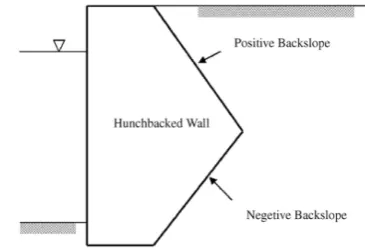
assets while toning down the flaws (Figure 1). The negative
batter at deeper elevations leads to a reduction of the lateral thrust while the positive batter angle at shallower elevations
where the lateral pressures are small limits expenses and wall weight [2, 3].
Corresponding author, E-mail: [email protected]
Figure 1. Definitions of negative and positive back-slopes
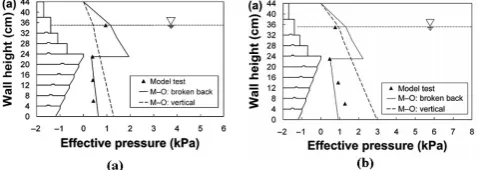
the results with the model tests indicated that the M-O method was capable of predicting the magnitude and overall distribution of the lateral active pressure on the broken-back walls. Figure 2 shows the pressure distribution pattern on the walls obtained through model tests and the M-O method as presented by Sadrekarimi.
Figure 2. Effective lateral pressure distributions, measured from physical modeling tests and calculated by the
Mononobe-Okabe method in (a) static and (b) dynamic conditions (after Sadrekarimi [4])
Sadrekarimi [3] investigated the seismic displacement of broken-back quay walls through reduced-scale shaking table model experiments. Complete quay wall collapse was not witnessed in any of the model experiments and damage was in the form of excessive displacement. Thus, the author proposed the use of performance-based design scenarios for such walls in seismic areas in a way that the design accounts for the likely displacement in addition to calculating the usual factors of safety. Sadrekarimi [5] employed pseudo-static limit equilibrium analyses to calculate the lateral earth pressures on broken-back retaining walls and evaluate their stability in sliding and overturning while a cost reduction analysis was conducted as well to comparing the external
stability and the efficiency of broken-back walls with those
of vertical-back walls. Results showed that a broken-back
wall could be designed at a significantly reduced cost while
maintaining sliding and overturning stability of a wall.
1- 1- Loads acting on a hunched back gravity quay wall The methodology proposed by “Technical Standards and Commentaries for Port and Harbor Facilities in Japan”, OCDI (2002), has been adopted to determine the loads acting on the hunched back gravity quay wall as follows: surcharge, deadweight of the wall, earth pressure in static and dynamic conditions and dynamic water pressure during an earthquake [6].
Okabe [7] and Mononobe and Matsuo [8] developed a pseudo-static method to integrate the seismic earth pressures on retaining structures into the soil thrust on the wall. Pseudo-static accelerations in the form of ah = kh.g in the horizontal
and av = kv.g in the vertical direction are applied to the active
(or passive) wedge. Next, similar to the static Coulomb theory, force equilibrium of the failure wedge is used to obtain the pseudo-static soil thrust. Vertical accelerations are usually ignored. According to the M-O method, the lateral effective active pressure on the wall can be calculated using equation 1.
(1)
cos
AE AE sub
P
=
K
γ
z
∑
where KAE is the pseudo-static seismic active earth pressure
coefficient obtained from equation 2, is the submerged unit weight of the backfill soil, and z is the soil depth. and
are the angle of wall’s rear face and PAE with
the horizon, respectively, and is the interface friction angle
between the wall and the backfill soil, taken as about 50% of the internal friction angle of the backfill soil, [1, 4, 9].
sub
γ
α
(= − −α δ 90 )∑
δ
φ
2
2 2
sin ( )
sin( )sin( )
cos sin sin( )[1 ]
sin( )sin( )
AE
K α θ ϕ
ϕ δ ϕ β θ θ α α θ δ
α θ δ α β
− + =
+ − −
− − +
− − + (2)
where is the backfill slope angle (assumed nil), and is the apparent seismic angle defined as:β θ
(3)
1
tan [ ] 1
s h s G k G
θ= −
−
where Gs is the specific gravity of backfill soil [7, 8].
Equation 4 is used to calculate the hydrodynamic force of the
free water in the backfill.
(4) 2
7 12
wd h w P
P = k Hγ
where yw is the water depth and Hp the total water depth.
This forced is applied at a height of 0.4Hp above the base. The total hydrodynamic force is twice the value of equation 4 to include both the positive pore pressures in front and the negative pressures behind the wall [10].
1- 2- Stability analyses
Based on the Technical Standards and Commentaries of Port and Harbor Facilities in Japan, OCDI (2002), three failure modes are investigated: sliding, bearing capacity of the foundation and overturning. Equations 5 and 6 are used to obtain the safety factor against sliding and overturning respectively.
s fW
F P
= (5)
(6) s
Wt
F
Ph
=
where W and P are the resultant vertical and horizontal
forces on the wall respectively, f is the coefficient of friction
between the bottom of the wall and the foundation, t is the distance between the line of application of W and the front toe, h is the height of the application line of P on the wall, above the bottom and Fs is the safety factor. To evaluate the bearing capacity of the wall foundation the circular arc analysis based
on the simplified Bishop method has been chosen [6].
2- Methodology and Modeling
2- 1- Evolutionary polynomial regression
Evolutionary polynomial regression (EPR) is a data-driven regression method, developed by Giustolisi and Savic (2006) based on evolutionary computing. In EPR the evolutionary procedure searches for the exponents of a polynomial function
with a fixed maximum number of terms [11]. During one
numbers of terms up to a limit set by the user to allow the optimum number of terms to be selected [12]. In general, EPR is a two-stage method to construct models using polynomial
structures. In the first stage, EPR searches for exponents of
polynomial expressions by employing a genetic algorithm. In the second stage, numerical regression is used to compute the constant values of the previously selected terms by solving a least squares problem. To apply the EPR procedure, the evolutionary process starts from a constant mean of output values. By increasing the number of evolutions, it gradually picks up different participating parameters in order to form equations describing the relationship between the parameters of the system. The EPR procedure stops when the termination criterion (the maximum number of terms in the expression, the maximum number of generations, or a particular allowable
error) is satisfied [13].
2- 2- Database and conceptual model
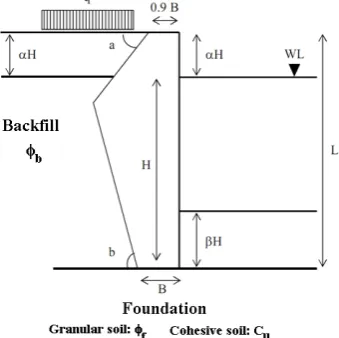
In the preliminary stage of a quay wall design, the aim is to obtain the dimensions required to withstand the loading conditions while minimizing expenses. In this paper, the aim is to create EPR models for quick and simple preliminary designs of gravity quay walls which can then, be followed by a more elaborate analysis. A large database of hypothetical cases of hunched back gravity quay walls based on the conceptual model of Figure 3 was created. A series of parameters related to geometry, the shear parameters of the
foundation and backfill soil and loading conditions are used to define this model.
Figure 3. Employed conceptual model of a gravity hunched back quay wall
The large database used in the EPR-based models was created by the introduction of variables shown in Table 1. By changing these variables in the applicable range, more than 80000 hypothetical gravity quay walls were created. About 90% of these hypothetical cases were used in the development of the models while the remaining 10% were set aside for the validation of the models after their development. The methodology covered in section 1.2 was used to obtain the safety factors of each hypothetical wall against sliding, overturning and bearing capacity failure. The stability analyses were programmed in MATLAB R2012b (8.0.0.783) to facilitate the calculations. Variables shown in Table 1 were then entered as inputs and the obtained safety factors against
sliding, overturning and bearing capacity failure as outputs to develop the EPR models.
The geometry of the quay wall is defined using the following
parameters: two parameters to determine the top and bottom wall rear-face batter angles (a and b respectively), the wall height (L) and the width of the wall at the top and bottom. The width at the bottom of the wall is shown with B while the width at the top has been assumed to be 90% of B. The parameter determines the embedment depth of the wall, while the water level, assumed to be equal in front and behind
the wall is shown with H. The wall’s freeboard is defined with
the parameter .
In the stability analysis of a gravity quay walls during a
seismic event, four different scenarios can be defined in terms of pore pressure generation in the backfill. The first scenario would be the absence of water or a dry backfills (Case 1). In case of a submerged backfill three scenarios are considered:
no pore water generation (Case 2); complete liquefaction of
the backfill (Case 4) and the intermediate case between case
2 and 4 (Case 3). Here it is assumed that the generation of
extra pore water pressure in the backfill during seismicity
is unlikely due to the fact that in practice highly permeable
compacted granular materials are used as the wall backfill to
enhance the seismic performance of the wall and avoid the generation of excess pore water pressures. In the conceptual
model, the backfill material are assumed as granular with no
cohesion but two conditions are assumed for the soil beneath the foundation of the quay wall: drained condition where the soil is considered as granular and the internal friction angle, , is considered as the sole shear strength parameter and the undrained condition for cohesive soils in short-term conditions where undrained shear strength parameter, Cu, is used in the analysis. The internal friction angle of the
backfill soil is shows with . Surcharge load behind the wall is defined by the parameter q. Seismic loading is defined by horizontal pseudo-static coefficient, kh.
3- Performance analysis 3- 1- Fitting parameters analysis
Different statistical approaches have been used to evaluate the performance of the prediction models. These parameters
are the coefficient of determination (COD), root mean square error (RMSE) and the coefficient of residual mass (CRM) defined by Equations 7, 8 and 9 respectively.
Table 1. Descriptive statistics of the variables used in the EPR models
Parameter (kPa)Cu (degree) (degree) (kN/m)q kh (degree)a (degree)b (m)H L/B
Minimum 200 25 35 0 0 60 45 0.1 0 5 2
Maximum 800 35 45 55 0.2 89.9 75 0.2 0.2 10 4
Mean 466.67 30 40 23.33 0.1 74.97 60 0.15 0.1 7.5 3
Standard
Deviation 249.45 4.08 4.08 23.21 0.082 12.21 12.25 0.05 0.08 2.04 0.82
where Mi is the actual value and Pi the predicted value,
the mean of the acutal data and n is the number of data. The RMSE is the variance of the residual error, and should be
minimized when the outputs fit a set of data. In the case of a perfect fitting the RMSE is zero. The lower the RMSE, the higher the accuracy of the model predictions. The coefficient
of residual mass, CRM, represents the difference between the actual data and the predicted values. The optimum value of CRM is zero. Positive values of CRM indicate underestimation and vice-versa.
3- 2- Parametric analysis
For further verification of the models and to analyze
the individual contribution of each input parameter on the outputs, parametric analyses have been performed. The method of parametric analysis is based on changing one predictor variable at a time while the other predictor variables are kept constant at the average values of their entire data sets. Parametric analysis investigates the response of the predicted values from the EPR models to a set of input data generated over the training ranges of the minimum and maximum data. These variables are presented to the prediction model and the output is calculated. This procedure is repeated using another variable until the model response is tested for all input variables.
4- Results and Discussions
4- 1- EPR models for safety factors of quay wall in drained conditions
The following ten input variables were used to model the safety factors of quay walls against three modes of failure in drained condition: , , q, kh, L, L/B, B, a, b and .
The following models are obtained for safety factors against sliding, overturning and bearing capacity failure respectively:
β
α
f
ϕ
ϕ
bM
f
ϕ
ϕ
b β(10)
( )
0.5
0.5 1
0.5 2 0.5
5.075 0.016 0.0054
0.012 0.02 1.804
h Sliding
b f b
L
FS k q ab
B B
φ β φ φ
= − − −
+ + +
(11)
( )
0.5 2 2
2 6 0.5 2
2.57 0.007 0.0003
.0006 1.057 10 4.79 h
Overturning
b
L
FS k q b
B
a −φ a b
= − − −
− + × +
(12)
( ) 2 6 2
3
0.5 0.5 0.5 0.5
6.098 0.0012 3.93 10 0.237 0.019 1.02
h Bearing
f b
FS b k b q
a L B
β φ φ
−
= − − ×
− + +
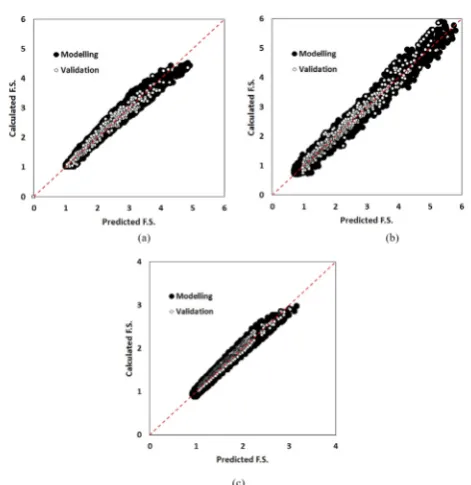
Next the EPR models are validated using both the data used in the development of the models and the data set aside for validation. Figure 4 shows the predicted values of safety factors using the models versus the actual database values obtained from stability analysis for. Comparison of the results indicates that the developed equations are capable of
predicting safety factors within a 95% confidence interval.
Table 2 presents the performance of the EPR prediction models.
Figure 4. Predicted safety factors against values obtained from deterministic analyses for: a) sliding b) bearing capacity failure
c) overturning; (drained conditions)
The values of COD, RMSE and CRM obtained for both the model and the validation data illustrate the high accuracy of the models. The model for the prediction of safety factor against overturning seems to have the least scatter among others, however its accuracy is at the same level of other models with a COD of 95%.
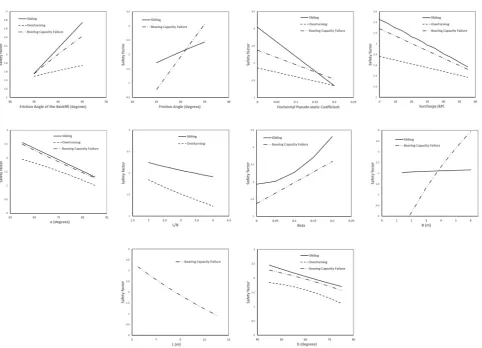
Parametric studies have been performed for further
verifications of the developed models. Figure 5 presents the
Table 2. Performance of the EPR model for safety factors (drained conditions)
Output COD RMSE CRM
Model Validation Model Validation Model Validation
FS1 (sliding) 96% 96% 0.15 0.15 0 0
FS2 (overturning) 95% 97% 0.09 0.06 0 -0.011
FS3 (bearing capacity) 97% 97% 0.18 0.17 0 0
Figure 5. Parametric study results on the safety factor prediction models
Increasing internal friction angles of backfill and foundation,
the embedment depth and the wall width increases the safety factor against sliding, although the safety factor against sliding seems not that sensitive to the wall width.
Increasing surcharge, horizontal pseudo-static coefficient,
(L/B) and back slope angles leads to the reduction of safety factor against sliding, however it seems the (L/B) has a less pronounced effect in the reduction of the safety factor of the quay wall against sliding.
According to the sensitivity analysis illustrated in Figure 5, increasing the internal friction angle leads to an increase in safety factor against overturning. Increasing the rest
of variables such as surcharge, horizontal pseudo-static
coefficient, back slope angle, “a” and “b” and (L/B), the
4- 2- EPR models for safety factors of quay wall in undrained conditions
The following 10 input parameters were used for modeling the safety factors of quay walls against three modes of failure in undrained conditions: Cu, φf, q, kh, L, L/B, B, a, b and .
The following models are obtained for predicting safety factors against sliding, overturning and bearing capacity failure respectively:
β
(13)
( )
2 0.5
2 5 0.5
1 Sliding
0.5 0.5
59.37 2.058 10 0.46
0.0018 0.0011 0.91
u h
u u b
L L
FS B ab C k
B B
C q C
β
φ
−
= − × −
− + −
(14)
( )
0.5 0.5
2 2 Overturning
2 7 0.5 2
1.6 0.0071 0.0002
0.0005 9.86 10 4.79
h
b
L L
FS k q b
B B
a −φ a b
= − − −
− + × +
(15)
( ) 2 5 0.5
3 Bearing capacity
0.5
2 2 0.5
0.007 2.84 10 8 2.65 10
0.946 0.003 0.0015
u u u
u h u b
L
FS C C b q C a L B
L
C a b k B Cφ
−
= − × − − ×
+ + +
Figure 6 shows the predicted values of safety factors in undrained conditions versus the actual database values used in the development of the model and the values set aside for validation. Comparison of the results illustrates the high accuracy of the developed models for both the model and the validation data. Table 3 presents the performance of the EPR prediction models in undrained conditions.
It is obvious from the values of COD, RMSE and CRM that the proposed equations are highly accurate. In the undrained condition, the model for predicting the safety factor against overturning has the least scatter.
Figure 6. Predicted safety factors against values obtained from deterministic analyses for: a) sliding b) bearing capacity
failure c) overturning; (undrained conditions)
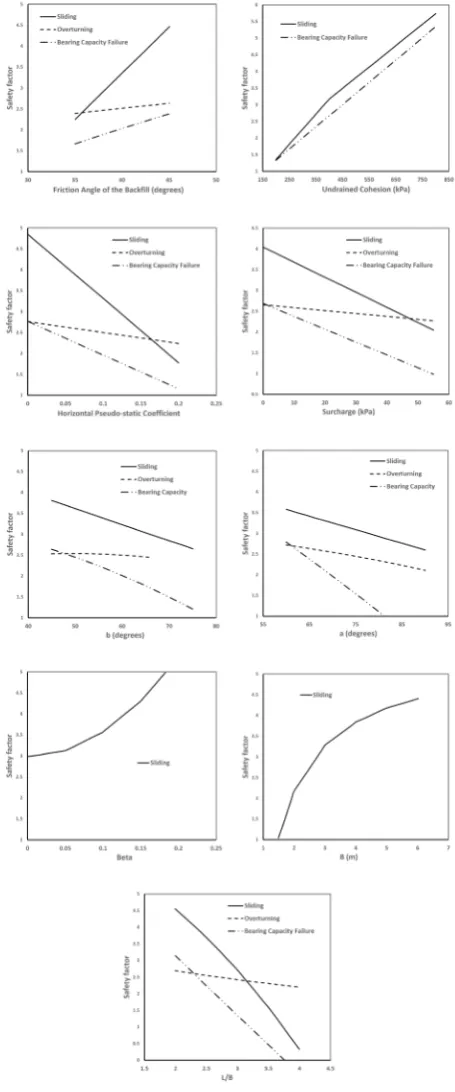
Figure 7 present the results of the parametric study on the EPR models in the undrained condition. As can be seen in
Figure 7, increasing the internal friction angle of the backfill,
the undrained shear strength of the soil beneath the foundation and the width and the embedment depth of the wall leads to an increase in the safety factor against sliding. Increasing variables such as the surcharge, the horizontal pseudo-static
coefficient, the back-slope angle of quay walls and (L/B)
decreases the safety factor against sliding.
Table 3. Performance of the EPR model for safety factors (undrained conditions)
Output COD RMSE CRM
Model Validation Model Validation Model Validation
FS1 (sliding) 96% 96% 0.24 0.25 0 0
FS2 (overturning) 95% 93% 0.09 0.12 0 0.06
FS3 (bearing capacity) 95% 96% 0.24 0.22 0 0
The safety factor against overturning increases with
increasing internal friction angle of the backfill however
increasing variables such as surcharge, horizontal
pseudo-static coefficient, quay wall back slope angles and (H/B)
leads to a decrease in this safety factor.
As expected increasing the undrained shear strength of the soil underneath the foundation as well as the internal friction
angle of the backfill increases the safety factor against
bearing capacity failure. Increasing surcharge, horizontal
pseudo-static coefficient, back slope angles of the quay wall
and (L/B) causes a decrease in foundation bearing capacity safety factor.
5- Conclusions
This paper presents models developed using evolutionary polynomial regression, EPR, for predicting the safety factors of quay walls against sliding, overturning and bearing capacity failure. In the EPR approach, there is no need to preprocess, normalize or scale the data. An intriguing feature of EPR is its ability to present more than one model for a complex phenomenon. The best models are chosen based on their performance on a set of data. Hence, the geotechnical properties of the soil and the geometric parameters of the wall as well as loading conditions have been employed to estimate the safety factors of a quay wall in the drained and undrained conditions. By introducing these variables in their common range, around 80000 hypothetical cases were created and their stability estimated using a MATLAB aided program based on OCDI (2000) methodology of quay wall stability analysis. Results of these analyses were collected as a data bank with the variables effective on the soil-quay wall stability as inputs and three values of calculated safety factors against sliding, overturning and bearing capacity failure as outputs. Around 90% of the values in the data bank were used to develop the models while the rest were used to validate the models afterwards. The results of the developed EPR models have been compared with the values in the data bank. Comparison of the results demonstrates that the developed models provide highly accurate predictions. The performance of these prediction models was examined by three statistical approaches. The results show the precision of the model predictions are around 95%. The results of sensitivity analyses also show that the geometry of the wall has a paramount effect on the stability of quay walls. Embedment depth could increase the stability of quay walls greatly mainly when the walls are subjected to seismic loading. Results from parametric studies indicated that the developed models are able to capture the effects of individual parameters on the quay wall safety factors and therefore the models can be employed in a preliminary design of the quay
wall geometry and then assess the stability of this preliminary design with more sophisticated approaches.
Nomenclature
a Wall Top Batter Angle
av Vertical Pseudo-Static Acceleration, m/s2
ah Horizontal Pseudo-Static Acceleration, m/s2
b Wall Bottom Batter Angle B Wall Width at the Bottom, m
Cu Undrained Shear Strength of the Soil Beneath the Foundation, kN/m2
COD Coefficient of Determination CRM Coefficient of Residual Mass
f Coefficient of Friction Between the Bottom of the
Wall and the Foundation Fs Factor of safety
g Gravitational Acceleration, m/s2
Gs Specific Gravity of Backfill Soil
h Height of the Application Line of the Resultant Horizontal Forces Acting on the Wall Above the Bottom of the Wall, m
H Water Level, m
Hp Total Depth of the Water, m
KAE Pseudo-Static Seismic Active Earth Pressure
Coefficient
kh Horizontal Pseudo-Static Seismic Coefficient
kv Horizontal Pseudo-Static Seismic Coefficient
L Wall Height, m
P Resultant Horizontal Force Acting on the Wall, kN/m
pAE Lateral Effective Active Pressure on the Wall, kN/m2
PAE Lateral Active Force on the Wall, kN/m
Pwd Hydrodynamic Force of the Free Water in the
Backfill on the Wall, kN/m
q Surcharge Load Behind the Wall RMSE Root Mean Square Error
t Distance Between the Line of Application of the Resultant Vertical Forces on the Wall and the Front Toe, m W Resultant Vertical Force Acting on the Wall, kN/m yw Depth of Water, m
z Soil Depth, m
Greek symbols
Ratio of the Wall Freeboard to the Wall Height Ratio of the Embedment Depth of the Wall to the Wall Height
Submerged Unit Weight of the Backfill Soil, kN/m3
Interface Friction Angle Between the Wall and the
Backfill
Apparent Seismic Angle
Angle of Lateral Active Force on the Wall with the
α
β
δsub
γ
θ
Horizon
Internal Friction Angle of the Backfill Soil
Friction Angle of the Soil Beneath the Foundation References
[1] PIANC, Seismic Design Guidelines for Port Structures, Balkema, 2001.
[2] A. Sadrekarimi, A. Ghalandarzadeh, J. Sadrekarimi, Static and dynamic behavior of hunchbacked gravity quay walls, Soil Dynamics and Earthquake Engineering, 28(2) (2008) 99-117.
[3] A. Sadrekarimi, Seismic displacement of broken-back gravity quay walls, Journal of Waterway, Port, Coastal, and Ocean Engineering, 137(2) (2011) 75-84.
[4] A. Sadrekarimi, Pseudo-static lateral earth pressures on broken-back retaining walls, Canadian Geotechnical Journal, 47(11) (2010) 1247-1258.
[5] A. Sadrekarimi, Gravity Retaining Walls: Reinvented, in: 6th International Conference on Earthquake Geotechnical Engineering, Christchurch, New Zealand, 2015.
[6] T.O.C.A.D.I.o.J. (OCDI), Technical Standards and Commentaries for Port and Harbour Facilities in Japan, OCDI, 2002.
b
ϕ
fϕ
[7] S. Okabe, General Theory of Earth Pressure and Seismic Stability of Retaining Wall and Dam, Journal of the Japanese Society of Civil Engineers, 10(5) (1924) 1277– 1323.
[8] N. Mononobe, H. Matsuo, On the determination of earth pressures during earthquakes, in: World Engineering Congress, Tokyo, 1929.
[9] M. Ichihara, H. Matsuzawa, Earth pressure during earthquake, Soils and Foundations, 13(4) (1973) 75-86.
[10] H.M. Westergaard, Water pressures on dams during earthquakes, Transactions of the American Society of Civil Engineers, 95 (1933) 418-433.
[11] O. Giustolisi, D.A. Savic, A symbolic data-driven technique based on evolutionary polynomial regression, Journal of Hydroinformatics, 8(3) (2006) 207-222.
[12] A. Ahangar-Asr, A. Faramarzi, N. Mottaghifard, A.A. Javadi, Modeling of Permeability and Compaction Characteristics of Soils Using Evolutionary Polynomial Regression, Computers and Geosciences, 37(11) (2011) 1860-1869.
[13] M. Rezania, A.A. Javadi, O. Giustolisi, An evolutionary-based data mining technique for assessment of civil engineering systems, Engineering Computations, 25(6) (2008) 500-517.
Please cite this article using:
S. Karimnader-Shalkouhi, M. Karimpour-Fard, M. A. Lashteh Neshaei, Evolutionary Polynomial Regression-Based Models to Estimate Stability of Gravity Hunched Back Quay Walls, AUT J. Civil Eng, 2(1) (2018) 79-68.