Journal of Theoretical and Applied Vibration and Acoustics 1 (1) 48- 61 (2015)
I S A V
Journal of Theoretical and Applied
Vibration and Acoustics
journal homepage: http://tava.isav.ir
A Semi-Analytical Solution for Flexural Vibration of Micro Beams
Mehdi Hashemi
*
, Mohsen Asghari
Mechanical Engineering Department, Sharif University of Technology, Azadi St., Tehran, Iran
K E Y W O R D S
A B S T R A C T
Micro-beams
Strain gradient Elasticity Non-classical
Continuum theory Size effect Free vibrations
In this paper, the flexural free vibrations of three dimensional micro beams are investigated based on strain gradient theory. The most general form of the strain gradient theory which contains five higher-order material constants has been applied to the micro beam to take the small-scale effects into account. Having considered the Euler-Bernoulli beam model, governing equations of motion are written by utilizing the Hamilton’s principle. Then, the state-space solution technique is used to find some solutions for natural frequencies of the beam under various boundary conditions. The numerical results show that the resonant frequencies are significantly dependent on the length scale parameter of the micro beam. The less the non-dimensional length scale is, the more deviation appears between results obtained for natural frequencies of micro shaft by strain gradient theory and classical continuum theory. Moreover, except for a micro shaft which is simply supported at both ends, the extra type of boundary conditions emerges from using strain gradient theory significantly affects the results.
©2015 Iranian Society of Acoustics and Vibration, All rights reserved
1. Introduction
Thin beams are one of the most applicable structural elements extensively used in micro–electro-mechanical systems (MEMS), as sensors and actuators (Hall et al., 2006; Moser and Gijs, 2007; Boer et al., 2004). There are many applications such as vibration shock sensor, atomic force microscopes and resonant testing devices that dynamic mechanical behaviors of these beams are utilized for obtaining desired performance (Lun et al., 2006; Wang and Hu, 2005; Roy and Mehregany, 1996). It is worth mentioning that the thickness of these beams is typically in the order of microns and sub-microns. This shows that for precise analysis of these structures the size effects should be addressed. This is due to fact that it has been experimentally verified that the length scale has profound effect on static and dynamic behaviors of micro beams (Fleck et al., 1994; Lam et al., 2003; McFarland and Colton, 2005).
investigated the size dependencies of natural frequencies of Euler-Bernoulli micro beams by using the modified couple stress theory which requires only one additional internal material length scale parameter.
On the basis of strain gradient elasticity theory, the static and dynamic of micro beams are analyzed by Kong et al. (2009) considering Euler-Bernoulli beam model and Wang et al. (2010) using Timoshenko model. It should be noted that in this theory, there are three independent higher-order materials length scale parameters for isotropic linear elastic materials, as well as higher order differential terms in governing equations of the motion. The results show that natural frequencies obtained for a cantilever beam are dependent on higher-order materials length scale parameters.
Furthermore, Asghari et al. (2010a) investigated the size-dependent behavior of functionally graded micro beams based on modified couple stress theory. On the basis of this theory, the nonlinear forms of equations of motion have also been developed by Asghari et al. (2010b) and Ke et al. (2010) for Timoshenko beam and Xia et al. (2012) for Euler-Bernoulli beam. Besides that, the size-dependent behavior of functionally graded micro beams based on the strain gradient theory have also inspected by Ansari et al. (2011, 2013) for Timoshenko beam and Kahrobaiyan et al. (2012, 2013) for Euler-Bernoulli beam. On the basis of this theory, the nonlinear forms of equations of motion have also been developed by Asghari et al. (2012), Kahrobaiyan et al. (2011) and Ghayesh et al. (2013) for Euler-Bernoulli beam and Ramezani et al. (2012) for Timoshenko beam.
Although many models and formulations have been proposed by researchers to show the size dependencies of micro beams, unfortunately no solutions are presented for natural frequencies that is capable to cover all boundary conditions, when strain gradient theory is employed. As a consequence, in this paper, the state-space solution technique is used to find the semi-analytical solutions for natural frequencies of micro beams based on the most general form of strain gradient theory under various boundary conditions. A three dimensional micro beam for flexural vibration study is considered based on Euler-Bernoulli model. The governing equations of the motion are derived based by using Hamilton’s principle. In a numerical example, the effect of variation of material length scale parameters on resonant frequencies of the micro beam is illustrated under various boundary conditions.
2. Preliminaries
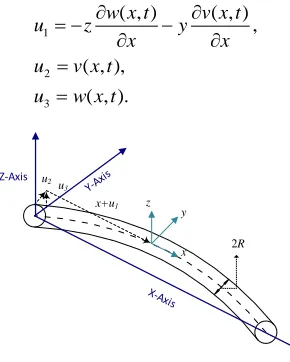
Consider a three dimensional flexible and slender circular beam shown in Fig. 1 with radius of R and length L,
whose axial axis is aligned with x direction of three-dimensional Cartesian coordinates (x, y, z). The coordinate system is located in the centroid of the cross section at one end of the beam. If u1, u2 and u3 denote displacement components in x, y and z directions, respectively, according to Euler-Bernoulli beam model, they are expressed as:
1
2
3
( , ) ( , ) , ( , ),
( , ).
w x t v x t
u z y
x x
u v x t u w x t
(1)
u2u 3
Z-Axis
2R x+u1
x y z
Fig. 1: A micro circular beam
(2)
where the λ and μ are the Lame constants, and ai (i = 1, 2,…,5) are the material higher-order constants. If
2 2
2 2 2
1 2 3
2 2 2 2
2
4
115 ,
0 115
22 ,
4
115
22 ,
4 13
2a
l
l
a
l
l
l
a
l
l
a
l
l
and
2 2
1 2
5 2 3
a
l l , the strain density reduces the one used in strain gradient theory with three material higher-order constants li (i = 0, 1, 2) which is adopted by many researchers of this field (See for example Ansari et al., 2011; 2013). Moreover, it should be noted that Lame constants are related to the Young modulus E and the Poisson ratio
as
E
1 2
1
and
E 2 1
. In addition,
ij and
ijk (i, j, k=1, 2, 3) are strain tensor components and the third order strain gradient tensor components respectively; these components can be written in terms of displacement components as follows:
1 , 2 T ε u u ξ u (3)
3. Governing equations of the motion
To derive governing equations of motion of the beam, the strain energy U and the Kinetic energy T of the beam should be determined. By substituting Eqs. (1) and (3) into Eq. (2), the strain energy of the beam with volume of V
is expressed as:
3 3 2 2
1 0 3 3 2 2
2 2 2
2 0 2 , L L V
v w v w
x x
U u d
x x
V I dx I dx
(4)where
1a
1
a
2
a
3a
4
a
5and
2
2
4
a
3
a
4
R
2 .Furthermore, the Kinetic energy of the beam can be obtained as follows:
2 22 2 2 2 2
1 2 3
0 1 , 2 2 L V w v
T u u u dV Av Aw I I dx
x x
(5)in which ρ is the density, A is circular cross-section and I is cross-section area-moment of inertia of the beam. Now, Hamilton’s principle is employed as:
2 1 0, t tT U W dt
(6)where
W
is the work done by external forces acting on the micro beam during a virtual variation in the configuration of the beam and can be expressed as2 2
2 2
0
ˆ ˆ
ˆ ˆ ˆ ( ) ˆ ( ) ( ) ( ) ,
x L
h h
y z y z y z
x
v w v w
W V v V w M M Q Q
x x x x
(7)
Where Vˆy and
V
ˆ
z are the resultant shear forces in y and z directions caused by the classical stresses acting on a section of the shaft. In addition, Mˆy andM
ˆ
z are the resultant moments in y and z directions, respectively, which1 2 3 4 5
1
,
2
ii jj ij ij ijj ikk iik kjj iik jjk ijk ijk ijk kjiare produced by the classical and higher-order stresses on a section. Moreover, Qˆhy and
Q
ˆ
hz denote the higher-order resultants caused by higher-order stresses acting on a section.Performing mathematical operations in accordance with the variational calculus, we get the following equations for lateral motion of micro beam:
2
1 2 2
2
1 2
6 4
6 4
6 4
6 4 2
0, 0. A v v v v x x w w x x I x A w w I x (8)
Moreover, different boundary conditions at each end of the beam defined as:
Simply supported:
2 1
2 4
2 4
2 4
2 1 4
2 0, 0. 0, z y v v M I x x w w M I x x v w (9) Clamped: 0 0, , v w x x
v w
(10)
Free:
3 5
2 3 1 5
3 5
2 3 1 5
2 4
2 2 1 4
2 4
2 2 1 4
0, d d 0, d 0, 0. y z y z v v I x x w w I x x w w I x x v V I x M v x V M (11)
There are also other boundary conditions that emerge from using strain gradient theory which are defined as:
BC type 1:
2 2
2 2 0,
v w x x
(12)
3 1 3 3 1 3 0, 0. h y h z w M I x v M I x (13)
4. Solution method
To solve Eq. (8), at the beginning dependent and independent variables presented in this equations are Non-dimensionalized by defining vv R w, w R, t
L4 1
,and xx L. Thus, Eq. (8) is rewritten as:2 2 2 2 2 6 4 2 6 4 2 6 4 2 6 2 2 1 2 2 4 2
2 2 2
1 0 0 4 , . 4
v v L v
L x w w L v R x x
w w L
R
x x x
(14)
To obtain natural frequencies of the beam, the time-dependent part of displacements is considered in the following form:
( ) ( )
iwt
v V x e w W x
(15)
in which ω, is the angular frequency. Substituting Eq. (15) into (14), we get the following set of ordinary differential equations. 2 2 2 1 2 2 2 1 2 2 6 4 2 6 4 2 2 6 4 2 6 4 4 0, 4 0.
d V d V V L
V R
dx dx
d V d W L
R
L d
dx
L d W
W d
dx dx x
(16)
In order to reduce the system of Eq. (16) to a state-space form, the components of the state vector Z(x) are defined as follows:
2 3 4 5
1 , 2 , 3 2 , 4 3 , 5 4 , 6 5 . ,
dQ d Q d Q d Q d Q
Z Q Z Z Z Z Z Q V W
dx dx dx dx dx
(17)
Thus, Eq. (16) is expressed in following form:
{ } [ ( )]{ }
d
A
dx Z Z (18)
(19)
A formal solution to the Eq. (18) is given by:
[ ]
{ }
Z
e
A x{ }
k
(20)Here {k} is a constant column vector associated with the boundary conditions while e[A]xis expressed as:
1
6 [ ]
0
[ ]
[ ]
0
xA x T
x
e
e
S
S
e
(21)
where λi (i = 1, 2, . . . , 6) as a function of ω, denote the distinct eigenvalues of [A] while [S] denotes the matrix of eigenvectors of [A]. Substitution of Eq. (20) into the boundary conditions associated with the edges x = 0 and L
results in a homogeneous system of equations,
0
ij jM k
(22)In which i, j= 1, 2, …, 6. For nontrivial solution of Eq. (22), the determinant [M] should be zero:
0
M
(23)Hence, the natural frequencies are those that result in satisfying Eq. (23).
5. Numerical example
To illustrate the effects of size-dependencies on resonant frequencies of the micro beam under various boundary conditions some numerical results are presented. The beam is assumed to be made of epoxy with E1.44GPa,
0.38
and
1.22 10 3kg m (Lam et al., 2003). The material higher-order constants for epoxy were defined by Lam et al. (2003) as l=l0=l1=l2=17.6µm. It is also assumed that the ration of the beam length to its radius L/R=10. It should be noted that the values computed for angular natural frequencies ωn are normalized as
* 4 2
2
n n L R
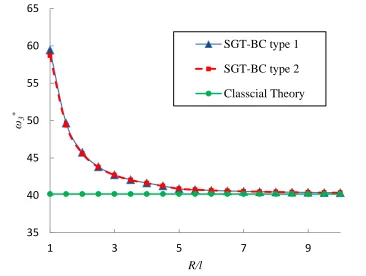
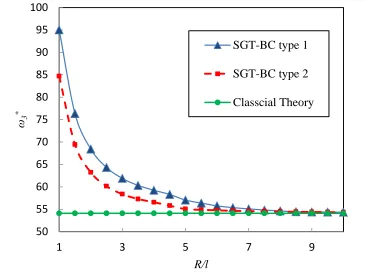
where n indicate corresponding mode number.In Fig. 2, the variations of the first, the second and the third normalized natural frequencies
1*,
*2and
3* of simply supported-simply supported micro beam are depicted respectively, versus the dimensionless length scale parameterR/l for BC type 1 and BC type 2. As it is observed, whether the BC type 1 or BC type 2 is applied, the values for * *
1
,
2
and
3* are almost the same for simply supported-simply supported micro beam. Furthermore, the results for these normalized natural frequencies by using classical theory are also plotted in these figures. It can be clearly seen2 2
1 2
2
0 1 0 0 0 0
0 0 1 0 0 0
0 0 0 1 0 0
0 0 0 0 1 0
[ ( )]
0 0 0 0 0 1
2 L 0 0 0
R A
L
that the deviation of results between classical theory and strain gradient theory (SGT) dramatically increases, as R/l
decreases.
(a)
(b)
4
4.5
5
5.5
6
6.5
7
1
3
5
7
9
ω
1*
R/l
SGT-BC type 1
SGT-BC type 2
Classcial Theory
16
18
20
22
24
26
28
1
3
5
7
9
ω
2*
R/l
SGT-BC type 1
SGT-BC type 2
(c)
Fig. 2: The variation of (a) the first, (b) the second and (c) the third normalized natural frequency of simply supported-simply supported micro beam versus the dimensionless length scale parameter R/l for BC type 1, BC type
2 and classical theory.
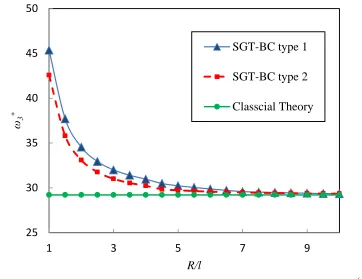
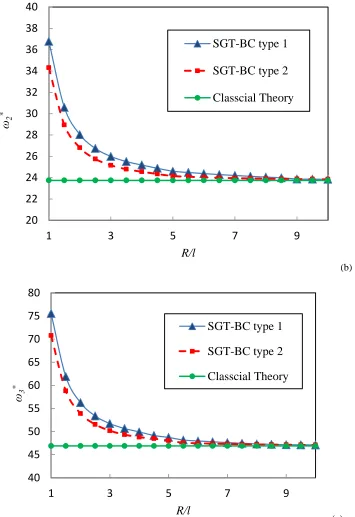
Furthermore, the variations of
1*,
*2and
3* of clamped-free, clamped-clamped and clamped-simply supported micro beam are illustrated versus R/l for BC type 1 and BC type 2 in Figs 3-5. In contrast to previous boundary conditions, the type of BC emerged from using strain gradient theory in here, obviously have affected
1*,
2*and* 3
. In addition, similar to the simply supported-simply supported micro beam, there are constant rise in
1*,
2*and *3
, as R/L goes down, whereas this size-dependencies cannot be observed in classical theory.35
40
45
50
55
60
65
1
3
5
7
9
ω
3*
R/l
SGT-BC type 1
SGT-BC type 2
(a)
(b)
1
1.2
1.4
1.6
1.8
2
2.2
2.4
2.6
2.8
3
1
3
5
7
9
ω
1*
R/l
SGT-BC type 1
SGT-BC type 2
Classcial Theory
8
9
10
11
12
13
14
15
16
17
18
1
3
5
7
9
ω
2*
R/l
SGT-BC type 1
SGT-BC type 2
(c)
Fig. 3: The variation of (a) the first, (b) the second and (c) the third normalized natural frequency of clamped-free
micro beam versus the dimensionless length scale parameter R/l for BC type 1, BC type 2 and classical theory.(a)
25
30
35
40
45
50
1
3
5
7
9
ω
3*
R/l
SGT-BC type 1
SGT-BC type 2
Classcial Theory
8
10
12
14
16
18
20
1
3
5
7
9
ω
1*
R/l
SGT-BC type 1
SGT-BC type 2
(b)
(c)
Fig. 4: The variation of (a) the first, (b) the second and (c) the third normalized natural frequency of clamped-clamped micro beam versus the dimensionless length scale parameter R/l for BC type 1, BC type 2 and classical theory.
20
22
24
26
28
30
32
34
36
38
40
1
3
5
7
9
ω
2*
R/l
SGT-BC type 1
SGT-BC type 2
Classcial Theory
40
45
50
55
60
65
70
75
80
1
3
5
7
9
ω
3*
R/l
SGT-BC type 1
SGT-BC type 2
(a)
(b)
6
7
8
9
10
11
12
1
3
5
7
9
ω
1*
R/l
SGT-BC type 1
SGT-BC type 2
Classcial Theory
20
25
30
35
40
45
50
55
1
3
5
7
9
ω
2*
R/l
SGT-BC type 1
SGT-BC type 2
(c)
Fig. 5: The variation of (a) the first, (b) the second and (c) the third normalized natural frequency of clamped-simply supported micro beam versus the dimensionless length scale parameter R/l for
BC type 1, BC type 2 and classical theory.
6. Conclusion
On the basis of the most general strain gradient elasticity theory the flexural free-vibrations of three dimensional micro beams are studied analytically. Having considering the Euler-Bernoulli beam model, governing equations of motion are written by utilizing the Hamilton’s principle. Then, the state-space solution technique is used to find some solutions for natural frequencies of the beam under various boundary conditions. The numerical results show that the resonant frequencies are significantly dependent on the length scale parameter of the micro beam. As the radius of the beam decreases, the deviation of results obtained for natural frequencies of micro beam by strain gradient theory and classical continuum mechanics theory increase. Moreover, except for a micro beam which is simply supported at both ends, the extra type of boundary conditions emerges from using strain gradient theory clearly affects the results.
References
1. Aifantis, E.C, Strain gradient interpretation of size effects. Int. J. Fract. 95(1999) 299-314.
2. Ansari, R. Gholami, R. Faghih Shojaei, M. Mohammadi, V. Sahmani, S., Size-dependent bending, buckling and free vibration of functionally graded Timoshenko microbeams based on the most general strain gradient theory. Compos. Struct. 100 (2013) 385-397.
3. Ansari, R. Gholami, R. Sahmani, S, Free vibration analysis of size-dependent functionally graded microbeams based on the strain gradient Timoshenko beam theory. Compos. Struct. 94(2011)221-228.
4. Asghari. M, Kahrobaiyan, M. H, Ahmadian M.T, A nonlinear Timoshenko beam formulation based on the modified couple stress theory. International Journal of Eng. Sci. 48 (2010a) 1749-1761.
5. Asghari.M. Ahmadian, M.T, Kahrobaiyan, M.H, Rahaeifard, M, On the size-dependent behavior of functionally graded micro-beams. Materials & Design 31,(2010b) 2324-2329.
50
55
60
65
70
75
80
85
90
95
100
1
3
5
7
9
ω
3*
R/l
SGT-BC type 1
SGT-BC type 2
6. Asghari. M, Kahrobaiyan, M.H, Nikfar. M, Ahmadian. M.T, A size-dependent nonlinear Timoshenko microbeam model based on the strain gradient theory. Acta Mech. 223 (2012) 1233-1249.
7. Beskou. S.P, Polyzos. D, Beskos. D.E, Dynamic analysis of gradient elastic flexural beams. Struct. Eng. Mech. Material 15, (2003a)705-716.
8. Beskou. S.P, Tsepoura. K.G, Polyzos. D, Bending and stability analysis of gradient elastic beams. Int. J. Solid Struct. 40 (2003b) 385-400.
9. Boer. M.P.D, Luck. D.L, Ashurst. W.R, High-performance surface-micromachined inchworm actuator. J. Microelectromech. System 13(2004) 63-74.
10. Danesh. V, Asghari. M, Analysis of micro-rotating disks based on the strain gradient elasticity. Acta Mech.(2013).
11. Fleck. N.A, Muller. G.M, Ashby. M.F, Strain gradient plasticity: theory and experiment. Acta Metallurgica et Materialia 42, (1994) 475-487.
12. Ghayesh. M.H, Amabili. M, Farokhi, H, Nonlinear forced vibrations of a microbeam based on the strain gradient elasticity theory. Int. J. Eng. Sci. 63 (2013) 52-60.
13. Hall. N.A, Okandan. M, Degertekin. F.L, Surface and bulk-silicon-micromachined optical displacement sensor fabricated with the Swift-Lite process. J. Microelectromechanic System 15 (2006) 770-776.
14. Kahrobaiyan. M.H, Asghari. M, Ahmadian. M.T, Strain gradient beam element. Finite Elements in Analysis and Design 68 (2013) 63-75.
15. Kahrobaiyan. M.H, Asghari. M, Rahaeifard. M, Ahmadian. M.T, A nonlinear strain gradient beam formulation. Int. J. Eng. Sci. 49 (2011) 1256-1267.
16. Kahrobaiyan. M.H, Rahaeifard. M, Tajalli. S.A, Ahmadian. M.T, A strain gradient functionally graded Euler– Bernoulli beam formulation. Int. J. Eng. Sci. 52(2012) 65-76.
17. Kang. X and Xi. Z.W, Size effect on the dynamic characteristic of a micro beam based on cosserat theory. J. Mech. Strength 29(2007) 1-4.
18. Ke. L-L, Wang. Y-S, Yang. J, Kitipornchai. S, Nonlinear free vibration of size-dependent functionally graded microbeams. Int. J. Eng. Sci. 50(2012) 256-267.
19. Kong. S, Zhou. S, Nie. Z, Wang. K, The size-dependent natural frequency of Bernoulli–Euler micro-beams. Int. J. Eng. Sci. 46 ( 2008) 427-437.
20. Kong. S, Zhou. S, Nie. Z, Wang. K, Static and dynamic analysis of micro beams based on strain gradient elasticity theory. Int. J. Eng. Sci. 47(2009) 487-498.
21. Lam. D.C.C, Yang. F, Chong. A.C.M, Experiments and theory in strain gradient elasticity. J. Mech. Phys. Solid 51(2003) 1477-1508.
22. Lun. F.Y, Zhang. P, Gao. F.B, Jia. H.G, Design and fabrication of micro-optomechanical vibration sensor. Microfabrication Tech. 120 (2006) 61-64.
23. McFarland. A.W, Colton. J.S, Role of material microstructure in plate stiffness with relevance to microcantilever sensors, J. Micromechanic Microengi. 15(2005) 1060-1067.
24. Mindlin. R.D and Eshel. N.N, On first strain-gradient theories in linear elasticity, Int. J. Solid Struct. 4 (1968)109-124.
25. Moser. Y, Gijs. M.A.M, Miniaturized flexible temperature sensor. J. Microelectromech. Sys. 16 (2007) 1349-1354.
26. Ramezani. S, A micro scale geometrically non-linear Timoshenko beam model based on strain gradient elasticity theory. Int. J. Non-Linear Mech. 47(2012) 863-873.
27. Roy. S.F.S and Mehregany. M, Determination of Young’s modulus and residual stress of electroless nickel using test structures fabricated in a new surface micromachining process. Microsystem Tech. 2(1996) 92-96.
28. Wang. B, Zhao. J, Zhou. S, A microscale Timoshenko beam model based on strain gradient elasticity theory. Euro J. Mech. A/Solid 29 (2010) 591-599.
29. Wang. WL, Hu. S.J, Modal response and frequency shift of the cantilever in a noncontact atomic force microscope. App. Physic Letters 87(2005) 18350-18356.