TELL, Vol. 7, No. 2, Fall & Winter 2013, pp.127-150
Collaborative versus individual learning of
English letter writing via short texting
Gholam Reza Zarei
Assistant Professor, Isfahan University of Technology,Iran
Alireza Jalilifar1
Associate Professor, Shahid Chamran University of Ahvaz, Iran
Saeed Khazaie
Ph.D. Candidate, Shahid Chamran University of Ahvaz, Iran
Received on July 28, 2013 Accepted on October17, 2013
Abstract
This study aimed at uncovering the extent to which individual and collaborative learning and practicing English letter writing via short texting (SMS) affect Iranian students' English letter writing ability. Accordingly, 60 intermediate university students who managed to complete the second stage of a letter writing test (Hulteinus, 2010) were divided into two groups, collaborative and individual, to learn 30 English letter writing features in ten virtual sessions through the medium of short texting; that is, three new notes per session. Using SMS, the first group of learners, divided into 10 triple groups, received the didactic materials from educational center (i.e., intelligent server) and then learned and practiced them collaboratively, while the learners in the second group received the same content from the same channel, but practiced it individually. Finally, the students took part in a test of letter writing, namely, a battery composed of three subtests, the data of which were analyzed through descriptive and inferential statistics. Also, to study the participants' attitudes about individual or collaborative ways of practicing English through SMS, they were required to answer a Likert type attitude
1
128 TELL, Vol. 7, No. 2
Zarei, Jalilifar and Khazaie
questionnaire. Analyzing learners' performance in the test battery indicated that the learners who practiced learning content (English letter writing notes) with their peers outperformed their counterparts in the second group who learned the materials individually. In addition, although both groups displayed favorable attitudes towards collaborative learning and the application of SMS as a medium, the amount of tendency for m-learning was higher among the learners of the collective group.
Keywords: collaborative learning, individual learning, letter writing notes, short texting
1. Introduction
Short message service (SMS) as a medium for sending and receiving messages is a pseudo-conversational form of communication (Gains, 1998) that affords a window through which it is possible to view how learners interact in non-classroom settings. Parallel with the reinforcement of such facility as a salient facet of cell-phones, new theories and research studies have emerged on language, and even more on learning (Pica, 2002). Thus, application of mobile learning (m-learning) to the study of language teaching and learning seems very fruitful. With the prevalent use of English as a lingua franca, large institutions and organizations around the world have developed their own SMS systems for instant sending and receiving short messages for learning materials and pedagogical issues. In addition to didactic content delivery, other studies have utilized short texting as a device for the purpose of promoting learner-learner interaction. For instance, Dias (2002) offered a web board accessible via SMS so that learners were enabled to do the text-based asynchronous exchanges.
TELL, Vol. 7, No. 2 129
Collaborative versus individual learning of English letter writing
that "technology is both exciting and frustrating as a field of research and practice; it is exciting because it is complex, dynamic and quickly changing and it is frustrating for the same reasons" (p. 1). And this is not surprising as, much earlier, Bley-Vroman (1990) had noted, “… that people by and large like to do what they are good at" (p. 56); that is, they become accustomed to the conventional method of delivery of learning content. Thus, it is necessary that material developers reconsider the conventional manner of practicing, which is limited to the classroom context and involves the directed flow of information from a teacher as a reliable source to a student as a receptacle to deal with new environments of learning via technology (Raine & Collett, 2003). Through instructional design that deals with the selection and sequencing of language content (Kumaravadivelu, 2006), teachers will be able to provide learners with opportunities to work out what they are going to say and how they are going to say it. Bull and Kukulska–Hulme (2009, p. 2), quoting Macaro (1997), argue that "this is best done within an environment where learners have a certain degree of autonomy (i.e. the freedom to make some decisions about their learning such as taking responsibility for objectives and content)". In a similar vein, Kasper (2001) emphasizes the creation of learning opportunities both inside and outside the classroom to help students focus their attention on and seek out practice opportunities.
130 TELL, Vol. 7, No. 2
Zarei, Jalilifar and Khazaie
milieu and engage with interactive environments is the main issue to be pursued in this study.
Furthermore, as social individuals, we need to keep in touch with other members of society. Social correspondence gives people the chance to respond to messages they have received, to maintain ties of affection, and to find out what is happening in the lives of people they care about (Jafari Gohar, 1995). In a globalized world, letter writing serves as a fundamental medium for information transmission and communication, as about 75% of all mails (electronic version of letter) in the world are written in English (Talebinezhad & Rezaei, 2013). In addition, with the ascending trend in the number of students around the world and as the mobile-mediated courses and programs continue to grow in higher educational settings, students are increasingly demanding permanent communication through the medium of wireless technology. Moreover, short texting is one of the new types of communication medium that has coterminous points with conventional one. With a wide availability of cell-phones and the new ability of m-learning to receive didactic contents anytime, anywhere, and on any mobile devices (Chabra & Figueiredo, 2002), it seems that the continual engagement of students in the letter writing process will be one immediate and efficient way for many of them to share their wishes, understandings, and thoughts within the educational environments. Accordingly, in the new arena of technology, the use and constant refinement of both linguistic and pragmatic knowledge can lead to the enhancement of students' understandings (Kumaravadivelu, 2006). Hence, it is important for language researchers and syllabus designers to consider how choices of technology interact with pedagogical choices and non-English learners' learning behaviors (Hudson, 2006).
TELL, Vol. 7, No. 2 131
Collaborative versus individual learning of English letter writing
2. Purpose of the Study
Prompted by the deficiencies and scarcity of domestic EFL learning research through the medium of mobile technology, the present study was expected to cast further light on the role of collaborative and individual learning in letter writing and learners' attitudes towards the mobile technology, and in particular SMS. Thus, the main questions addressed in this study were as follows:
1. Do Iranian students learn English letter writing differently through different modes of content practicing; that is, collaborative vs. individual in a mobile-enhanced environment? 2. Is there any relationship between students' attitudes towards the
manner of practicing English letter writing and their performance in mobile-based content delivery?
3. Method
3.1 Participants
The study was conducted with the participation of 60 (19-23 years old) junior students of engineering at Isfahan University of Technology. Selection was made from four groups (i.e. mechanics, chemistry, agriculture, and textile) and they were homogenized as level two (see Appendix A) of letter writing proficiency on the basis of the scale proposed by Hultenius (2010). Completing the letter writing test was the basis of meeting proficiency level in letter writing. The selected students were randomly divided into two groups and each group went through one of the two modes of practicing, namely, collaborative vs. individual, handled in mobile enhanced environment through SMS.
3.2 Instruments
132 TELL, Vol. 7, No. 2
Zarei, Jalilifar and Khazaie
3.2.1 Attitude Questionnaire
To determine the students' attitudes towards the manner of employing SMS for practicing letter writing notes, an attitude questionnaire on the basis of the Likert scale, consisting of eight close ended questions, was exploited. It asked learners to provide information about whether or not they were interested in employing interactive form of texting in mobile-enhanced mode of language practicing. This questionnaire, as initially designed by Ahmadi (2011), aimed to investigate learners' beliefs and attitudes towards a range of social and personal behaviors in the new realm of m-learning. For each statement, the responses were coded 1 for 'strongly disagree' up to 5 for 'strongly agree'. Thus, the scores for each student combined together on the eight statements ranged from 10 to 40. Ranks 10-20, 21-30, and 31-40 were classified as showing 'negative', 'neutral', and ‘positive’ attitudes, respectively, towards the application of collaborative manner practicing in the realm of pedagogy . The items in the questionnaire were distributed and collected via short texting. Its reliability, calculated through Cronbach’s alpha, was 0.83. Its content validity was reconfirmed by five experts in the fields of teaching English as a foreign language (see Appendix B).
3.2.2 Letter Writing Ability Level Test
This test was administered to assess the learners' original knowledge of English letter writing points and principles with a view on excluding the notes, with which students were already familiar in the learning phase of the study and to make sure that the participants' knowledge of the notes was roughly the same. The English letter writing notes, basic level (level 2), were selected from
Handbook for Practical Letter Writing (Baugh, 1991). Some of the
elements of a letter, how to write a paragraph, and how to move from one topic to another without details using ordinary language comprised major parts of the letter writing ability test.
TELL, Vol. 7, No. 2 133
Collaborative versus individual learning of English letter writing
mistakes (Hultenius, 2010; see appendix A). This test contained 30 multiple-choice questions about letter writing (basic levels) and its reliability was calculated through KR-21 (r = 0.87). The content validity of the test was also confirmed by three experts in Teaching English as a foreign language (TEFL).
3.2.3 Intelligent Data Bank
The software system employed in the intelligent software had the capability of moment by moment recording of the events at the time of conducting the virtual sessions.
3.2.4 Letter Writing Notes (Didactic Content)
Thirty new letter writing notes from Effective Letter Writing (Tarafder, 2008), proficient level (level three) were selected to be taught to students in 10 sessions, three notes for every session (see appendix C).
3.2.5 Mobile-Assisted Letter Writing Test Battery
According to Slover (2012, p. 2), "Navigating any type of educational change is a complicated process, and the move to online assessments brings with it great opportunities and unique challenges." A 30-items test battery including three parts was conducted via short texting to measure the students' letter writing ability. The reliability of the test calculated through test-retest method was r = 0.75. Its content validity was confirmed by three experts in TEFL. The three types were as follows:
134 TELL, Vol. 7, No. 2
Zarei, Jalilifar and Khazaie
practiced in the major phase of the study as the letter writing tips. The third part, namely, recognizing and correcting or rectification part, indicated letters with error(s). The testees were to find the word(s) that needed correction. Then they were asked to write down correct forms (Jafarpur, 1997). Ten items of the test were of the recognition and correction type (see Appendix D).
3.3 Data Collection and Analysis
Sixty participants with level two of English writing ability who were randomly divided into two groups of collaborative (N = 30) and individual (N = 30) practicing modes participated in the major phase of study. The major phase included sending 30 English letter writing notes through the medium of short texting in 10 virtual sessions in afternoons with average frequency of three new written points. While the manner and medium of delivery of new notes were the same, the ways of practicing notes in two groups were different.
Group 1 (The collaborative group): In each virtual session, 30
learners of this group practiced SMS based notes in 10 triple circles.
Group 2 (The individual group): Thirty learner of this group
practiced the materials individually after SMS based notes were received in their cell-phones.
TELL, Vol. 7, No. 2 135
Collaborative versus individual learning of English letter writing
letter writing was done in triple circles via short texting, the individual manner of practicing was limited to the unidirectional or one-way delivery of the same materials from the same source and through similar medium. The learners were given about 30 minutes' time to practice their delivered contents.
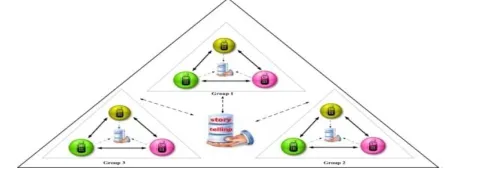
While each of the 30 students of the second group simply received the English notes on letter writing via SMS and practiced it individually, the students in the first group practiced the same notes using their cell-phones in 10 triple groups. In every session of practicing notes, the first group of learners had 30 minutes to write a letter in their respective group and to send it back to the data center via SMS (i.e. upon the completion of an intensive 30 minute session, each group would have to send the formulated letter to the server). Also, for addressing the questions of the study, an open-ended system accessible to anyone in nonclassroom environments via different types of mobile devices (i.e. PDA, and cell-phones) was designed (http://www.amoozeshyar.net). In addition, through the software package, all the rectified letters were collected, condensed into session lists, and posted as available resources on the website for other members of the group. In fact, conducting this type of collaborative practicing in triple virtual network was based on the triangular model which is displayed in Figure 1.
136 TELL, Vol. 7, No. 2
Zarei, Jalilifar and Khazaie
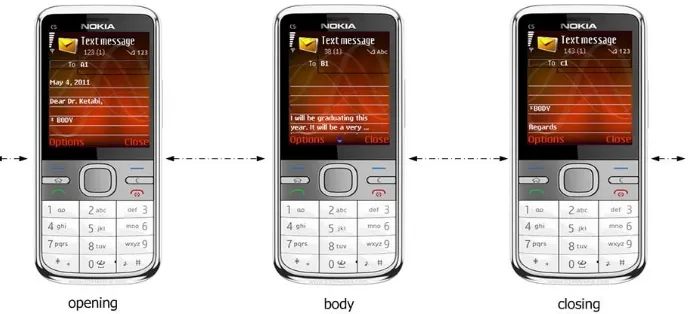
A sample of invitation letter which was practiced by a triple group of students is displayed in Figure 2. In this sample, the first student writes, for example, the opening part of the letter, sends it as a short message to the second student in the same group. In the same manner, the second member writes the body of the letter and passes it to the third member via SMS to complete it.
Figure 2: Sample of an invitation letter written by the collaborative group of students
Pedagogically, as Kukulska-Hulme and Shield (2008) argue, activities that capitalize on mobility and portability–the very rationale for using mobile technologies–are not as commonplace as one might hope. Although the anywhere factor is often not an issue, the anytime part is, where learners are sent messages by SMS at either fixed times, or times that suit the teacher, a tendency which seems to defeat the purpose of using mobile technologies. Hence, a hybrid mode composed of pull mode of operation in which a student can order specific information based on a menu of all listed contents on a web page or paper handout and the one-way, unsolicited message from teachers to the learners or push model (Mellow, 2005) was developed for deploying texting.
TELL, Vol. 7, No. 2 137
Collaborative versus individual learning of English letter writing
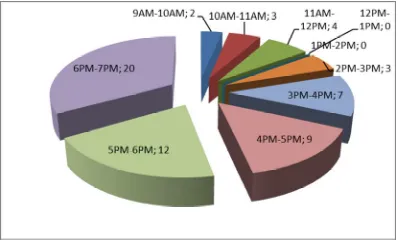
notes were taught to students of both groups through SMS mode of delivery. Proper time and text messaging frequency indicated by the students of the two groups in responses to inquiries are displayed in Figures 3 and 4, respectively.
Figure 3: Students' preferences for the timing of messages
Figure 4: Students' preferences for the frequency of messages
138 TELL, Vol. 7, No. 2
Zarei, Jalilifar and Khazaie
evaluation. Finally, the attitude questionnaire was distributed among the learners through SMS based delivery system.
4. Results
The first question of the study addressed the impact of manners (collaborative vs. individual) of practicing English letter writing notes and students' performances on letter writing test. The collected data were fed into the SPSS software. As the letter writing test battery was comprised of three subtests, after analyzing the data descriptively, Friedman test was used to find the possible significant results.
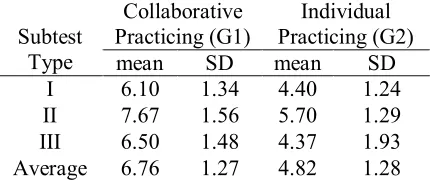
As shown in Table 1, practicing letter writing notes in triple circles resulted in higher achievements than practicing them in individual working configuration. In other words, the students of the second group underperformed their counterparts. The average score on each test battery was 6.67 and 4.82.
Table 1: Descriptive statistics of learners' performance in test battery for both groups
Subtest Type
Collaborative Practicing (G1)
Individual Practicing (G2)
mean SD mean SD
I 6.10 1.34 4.40 1.24
II 7.67 1.56 5.70 1.29
III 6.50 1.48 4.37 1.93
Average 6.76 1.27 4.82 1.28
Note. Subtests I, II, and II are completing the letter, completing the letter in multiple-choice format, and completing the letter in rectification format, respectively.
TELL, Vol. 7, No. 2 139
Collaborative versus individual learning of English letter writing
group's failure. High correlation between these two sub-tests bears testimony to such a result (r = 0.628, p = 0.006).
Moreover, the descriptive statistics analysis unveiled that learners of the first group did well on the second subtest; that is, the letter writing test in multiple-choice format. We also found that the first group failed to perform well on the completion test, probably arising from their individual rather than collaborative involvement. The aggregate result for the second group can be depicted as follows:
subtest II (multiple-choice) > subtest III (rectification) > subtest I (completion)
To observe if there were any significant differences between the scores obtained from the test battery in each group of instruction, a t-test was administered. As shown by the data in Table 2, statistically significant differences were found between the mean scores of the participants in the two groups of collaborative and individual modes both between subtests and the overall scores. This fact also casts light over the importance of collaborative manner of practicing (t = 9.23, p = 0.000).
Table 2: T-test for comparing the performance of learners in the groups
As to the second question, there were eight Likert type statements measuring students' attitudes towards the manner of practicing English. It is important to note that the questions in the questionnaire were arranged based on the 'feeling' and 'experience' of the learners one after another. That is, one question asked about the learners' feeling' of practicing a collective manner and then about 'self-evaluation' of their learning on that special occasion.
The learners in the first group who practiced the contents collaboratively with their partners in small groups showed favorable
Subtest Type
Mean Difference
T df sig.
I 1.7 8.09 29 0.004
II 1.97 8.20 29 0.000
III 2.13 7.3 29 0.000
140 TELL, Vol. 7, No. 2
Zarei, Jalilifar and Khazaie
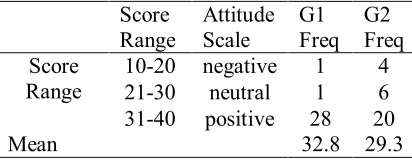
tendency towards virtual context group work activities as they believed that students' active participation in collaborative practicing was the major factor for doing well. Also, a great majority of the learners in the second group expressed their wish to learn English form of written correspondence in technology enhanced learning environment through group working activities. As a matter of fact, learners in both groups argued that in this way they could build on their previously received correspondences to move forward. Accordingly, the contents they had already learned could ultimately serve to help them make more efficient use of materials through the mobile-based instruction. Distribution of the ranges and students' attitudes towards manner of practicing new materials is shown in Table 3.
Table 3: Students' attitudes towards collaborative mode in mobile-enhanced environment
Score Range
Attitude Scale
G1 Freq
G2 Freq Score
Range
10-20 negative 1 4
21-30 neutral 1 6
31-40 positive 28 20
Mean 32.8 29.3
TELL, Vol. 7, No. 2 141
Collaborative versus individual learning of English letter writing
more than that of the second group (item 6). Familiarity with members of the group was the factor towards which learners of both groups showed a similar tendency as they both argued that acquaintance with peers may expedite the learning process in virtual networks (item 5). Indeed, this finding goes with the fact that learners naturally choose to work with people they know well (Wright, Betteridge, & Buckby, 2006). To the same extent, they agreed that receiving feedback from a familiar partner is more effective than the one received from non-acquaintance one (item 7). In this respect, a tiny minority of the learners voiced their concerns (22%) regarding finding partner(s) with similar level of English language proficiency. Overall, our analysis of the two groups' attitudes indicates that learners' constant access to their cell-phones, as a personal companion device, is desired and believed to boost the learning of language.
The analysis further focused on how the two groups' test scores were correlated with their attitudes. As discovered, group 1 or individual mode learners along with their counterparts in the second group showed a strong relationship between their scores and attitudes. While this relationship is (r = 0.674, p = 0.002) for the first group, it is in no way much less for the second group (r = 0.588, p = 0.006). This finding shows that the two groups recognize the significance of learning through collaboration which is mobile based.
The overall correlation between the two issues of attitude and performance on the test also reaffirms the importance. As shown in the table below (Table 4), the correlation amounts to (r = 0.564, p = 0.002), which was found to be significant.
Table 4: Spearman correlation between learners' attitude and performance on test
Correlation N Sig.
Attitude vs. Performance 0.546 60 0.002
142 TELL, Vol. 7, No. 2
Zarei, Jalilifar and Khazaie
5. Discussion and Conclusion
As demonstrated above, the results of the present study reveal that the mobile enhanced environment of learning may, under certain circumstances, play an effective role in developing students' competence in a foreign language. Additionally, the study demonstrates the significance of the attitudinal dispositions that learners develop towards their uses of such available tools. In this study, the superiority of learners who were engaged in collaboration with their partners in practicing new notes through the medium of SMS indicates that by establishing virtual learning environment for students, new technology motivates the students to make more efforts in foreign language contexts. In other words, the success of the learning through mobile-mediated communication (MMC) in small circles can be ascribed to the increased access to the world around that enhances learners' abilities to deploy their learning towards their own goals. Thus, it is believed that incorporation of new technologies in the education systems can make the walls of the learning space transparent, providing freedom for people to explore sources of information outside their institutions, which means greater opportunity for collaboration provided (OCED, 1994; Zarei, 2011).
TELL, Vol. 7, No. 2 143
Collaborative versus individual learning of English letter writing
consciousness is raised. That is, in discussing a proposed piece of writing with another student, the student writer is stimulated to attend to the errors committed and is more likely to adopt a successful reader-oriented approach to writing (Teferi, 2002). Likewise, Wright, Betteridge, and Buckby (2006) along with Barber (2011) stress that pair and group work and the provision of a virtual available space are of special value in ensuring the optimum opportunity for collaboration and practice in using language.
From a socio-psychological standpoint, the results of the study are also illuminating. Both peer work and the possibility of not imposing too much on others' privacy can instill in the learners the feeling of convenience and comfort (Barber, 2011). In this way, the learners can easily do away with the worries and concerns around the tasks and feel that they can complete the jobs by counseling with their partners. In fact, in mobile-based collaborative manner of learning, the technology not only helps the learners take advantage of every opportunity to interact, but also reduces foreign language anxiety, which has been considered an important barrier to learning (Alemi & Lari, 2012; Horwitz, 2001). As such, the participants' inclination towards the use of mobile based technology for learning implies that the very nature of interaction has to be mingled with the pleasure of learning to be successful. That is, the outperformance of the collaborative group might have arisen from pleasurable nature of the interaction and immediate corrective and explanatory feedbacks received through SMS (Karimkhanlouei, 2012).
144 TELL, Vol. 7, No. 2
Zarei, Jalilifar and Khazaie
learners are not trapped by the undesirable side of the new technology.
While the aforementioned results may cast some light over the issue of negotiation and interactivity induced by technology-enhanced language learning context, it is far from logic to read too much into a research of the present scale. On the whole, the results obtained in this study are to be taken as suggestive rather than definitive since a number of extraneous factors may moderate the impact of collaboration on learning, including student characteristics, group composition, and task characteristics (Lai, 2010).
References
Ahmadi, M. B. (2011, December 8). Social attitude questionnaire.
Retrieved August 8, 2013, from
http://www.iranmarketstrategy.blogfa.com
Alemi, M., & Lari, Z. (2012). SMS vocabulary learning: A tool to
promote reading comprehension in L2. International Journal of
Linguistics, 4(4), 275-287.
Anohina, A. (2005). Analysis of the terminology used in the field of
virtual learning. Educational Technology & Society, 8(3), 91-102.
Barber, V. (2011). Creating children's art games for emotional support.
London: Jessica Kingsley Publishers.
Baugh, S. (1991). Handbook for practical letter writing. Columbus:
McGraw-Hill.
Bley-Vroman (1990). What is logical problem of foreign language
learning? Linguistic Analysis, 20(1), 41-67.
Bull, S., & Kukulska–Hulme, A. (2009). Theory-based support for mobile
language learning: Noticing and recording. IJIM, 3(2), 12-18.
Chabra, T., & Figueiredo, J. (2002). How to design and deploy handheld
learning. Retrieved April 3, 2013, from Empowering Technologies: http://www.empoweringtechnologies.net/
Dias, J. (2002). Cellphones in the classroom: boon or bane? Calling
Japan, 10(2),16-22.
Gains, J. (1999). Electronic mail – a new style of communication or just a new medium?: An investigation into the text features of e-mail.
TELL, Vol. 7, No. 2 145
Collaborative versus individual learning of English letter writing
Horwitz, E. K. (2001). Language anxiety and achievement. Annual
Review of Applied Linguistics, 21, 112-126.
Hudson, R. A. (1996). Sociolinguistics. Cambridge: Cambridge University
Press.
Hultenius, G. (2010). How can I get a three on my letter? Retrieved May
27, 2013, from http://www.Teachersites.schoolworld.com
Jafari Gohar, M. (1995). Letter writing in English. Iran: Payame Noor
University.
Jafarpur, A. (1997). A course in language testing. Iran: Payame Noor
University.
Karimkhanlouei, G. (2012). Writing English letters. Iran: Azar Kelk.
Kasper, G. (2001). Four perspectives on pragmatic development. Applied
Linguistics, 22(4), 502-530.
Kessler, G. (2009). Computer assisted language learning: Critical
concepts in linguistics. New York: Routledge.
Kukulska-Hulme, A., & Shield, L. (2008). An overview of mobile assisted language learning: From content delivery to supported collaboration
and interaction. ReCALL, 20(3), 271-289.
Kumaravadivelu, B. (2006). Understanding language teaching: From
method to postmethod. NY: Routledge.
Lai, E. R. (2010). Collaboration: A literature review. India: Pearson
Education.
Macaro, E. (1997). Language and languages: An immersion method.
England: Multilingual Matters.
Markee, N. (2000). Conversation analysis. London: Lawrence Erlbaum
associates.
Mellow, P. (2005). The media generation: Maximize learning by getting
mobile. Paper presented at ASCILITE 2005 Conference: Balance, Fidelity, & Mobility: Maintaining the momentum? Abstract retrieved
January 20, 2013, from
http://www.ascilite.org.au/conferences/brisbane05/blogs/proceedings /53_ Mellow. pdf
Motallebzadeh, Kh., & Ganjali, R. (2011). SMS: Tool for L2 vocabulary
retention and reading comprehension ability. Journal of Language
Teaching and Research, 2(5), 1111-1115.
OECD Report (1994). New technology and its impact on educational
buildings. Paris: Organization for Economic Co-operation and Development.
Ostovar, F., & Hajmalek, M. (2010, October). Teachability of interaction
146 TELL, Vol. 7, No. 2
Zarei, Jalilifar and Khazaie
TELLSI Conference on CALL for Change in our Language
Teaching. Abstract retrieved January 20, 2013, from
http://www.tellsi8.alzahra.ac.ir
Pica, T. (2002). Subject matter content: How does it assist the interactional and linguistic needs of classroom language learners?
The Modern Language Journal, 85(1), 1-19.
Raine, D., & Collett, J. (2003). Problem-based learning in astrophysics.
European Journal of Physics, 24(2), 599-601.
Richards, J. C., & Bohlke, D. (2011). Creating effective language lessons.
New York: Cambridge University Press.
Richards, J. C., & Schmidt, R. (2002). Dictionary of language and applied
linguistics (3rd ed.). England: A Pearson Education Book.
Seliger, H. W. (1983). The language learner as linguist: Of metaphors and
realities. Applied Linguistics, 4(3), 179-191.
Slover, L. (2012, March 6). States to launch 'IT readiness' tool for common
assessments, Retrieved October 19, 2013, from
http://www.eschoolnews.com
Talebinezhad, M. R., & Rezaei, R. (2013). The Relationship between foreign language classroom anxiety, reading anxiety and reading
achievement among Iranian high school EFL students. Iranian EFL
Journal, 9(3), 131-151.
Tarafder, S.K. (2008). Effective letter writing. New Delhi: A.P.H.
Publishing Corporation.
Teferi, M. (2002). Instructors' provision of written responses to students'
business letter writing (master's thesis). Retrieved September, 17,
2013, from
http://www.oalib.com/search?kw=+M+Teferi&searchField=authors &__multiselect_searchField=&fromYear=2002&toYear=&=10&=10 &pageNo=3
Wright, A., Betteridge, D., & Buckby, M. (2003). Games for language
learning. Cambridge: Cambridge University Press.
Zarei, G.R. (2011). Prospect of university instructional materials:
Theoretical discussion for technological enhancement. Asian Journal
TELL, Vol. 7, No. 2 147
Collaborative versus individual learning of English letter writing
148 TELL, Vol. 7, No. 2
Zarei, Jalilifar and Khazaie
Appendix B: Likert Type Questionnaire
ﺶﺳﺮﭘ ﮫﻣﺎﻧ ﻦﺳ : ... ﺲﻨﺟ ... : رﺪﭘ تﻼﯿﺼﺤﺗ
... :
ردﺎﻣ تﻼﯿﺼﺤﺗ ... :
؟ﺪﯿﺘﺴھ هداﻮﻧﺎﺧ رد مﺪﻨﭼ ﺪﻧزﺮﻓ ...
هداﻮﻧﺎﺧ ناﺪﻧزﺮﻓ داﺪﻌﺗ : ... ١ رد ﮫﮐ ﺪﯾراد ﺖﺳود ﺪﺣ ﮫﭼ ﺎﺗ ﻦﻔﻠﺗ زا ﻊﻤﺟ
هاﺮﻤھ ؟ﺪﯿﻨﮐ هدﺎﻔﺘﺳا یﺮﯿﮔدﺎﯾ یﺎﺘﺳار رد نﺎﺗ ﻢﮐ ﯽﻠﯿﺧ ﻢﮐ ﻂﺳﻮﺘﻣ دﺎﯾز ﯽﻠﯿﺧ دﺎﯾز ٢ ﯽﻣ دﺎﯾ ار ﯽﺒﻠﻄﻣ ﯽھوﺮﮔ ﻞﮑﺷ ﮫﺑ و یزﺎﺠﻣ ﻂﯿﺤﻣ رد ﮫﮐ ﯽﺘﻗو سﺎﺴﺣا ﺪﺣ ﮫﭼ ﺎﺗ ﺪﯾﺮﯿﮔ
ﯽﻣ یﺮﯿﮔدﺎﯾ ﺪﯿﻨﮐ ﯽﻨﻏ نﺎﺗ
؟ﺖﺳا هﺪﺷ ﺮﺗ ﻢﮐ ﯽﻠﯿﺧ ﻢﮐ ﻂﺳﻮﺘﻣ دﺎﯾز ﯽﻠﯿﺧ دﺎﯾز ٣ هوﺮﮔ رد ﯽﺳرد یاﻮﺘﺤﻣ ﻦﯾﺮﻤﺗ ﺪﺣ ﮫﭼ ﺎﺗ ﺎﻤﺷ ﺮﻈﻧ ﮫﺑ ﯽﻣ
؟دﻮﺷ ﺮﺘﮭﺑ یﺮﯿﮔدﺎﯾ ﺚﻋﺎﺑ ﺪﻧاﻮﺗ ﻢﮐ ﯽﻠﯿﺧ ﻢﮐ ﻂﺳﻮﺘﻣ دﺎﯾز ﯽﻠﯿﺧ دﺎﯾز ۴ ﯽﻣ ﯽﺘﻗو ﮫﺘﮑﻧ ﺪﯿھاﻮﺧ ﮫﭼ ﺎﺗ ﺪﯾﺮﯿﮕﺑ دﺎﯾ ار یا
رد ﻦﯾﺮﯾﺎﺳ ﻊﯾﺮﺳ درﻮﺧزﺎﺑ زا ﺪﯾراد ﻞﯾﺎﻤﺗ ﺪﺣ
؟ﺪﯾﻮﺷ ﻊﻠﻄﻣ نﺎﺗرﺎﮐ درﻮﻣ ﻢﮐ ﯽﻠﯿﺧ ﻢﮐ ﻂﺳﻮﺘﻣ دﺎﯾز ﯽﻠﯿﺧ دﺎﯾز ۵ -ﯽﻣ نﺎﺘﺳود یزﺎﺠﻣ ﮫﮑﺒﺷ رد ﻦﯾﺮﻤﺗ ﺎﻤﺷ ﺮﻈﻧ ﮫﺑ ؟دﻮﺷ ﺮﺘﮭﺑ یﺮﯿﮔدﺎﯾ ﺚﻋﺎﺑ ﺪﻧاﻮﺗ
ﻢﮐ ﯽﻠﯿﺧ ﻢﮐ ﻂﺳﻮﺘﻣ ز دﺎﯾ ﯽﻠﯿﺧ دﺎﯾز ۶ هوﺮﮔ ﻢھ داﺮﻓا ﯽﺣﻼﺻا تﺎﯾﺮﻈﻧ ﺎﯾآ ﮫﻣﺎﻧ درﻮﻣ رد نﺎﺗ
ﯽﻣ ﯽﺴﯿﻠﮕﻧا نﺎﺑز ﮫﺑ یرﺎﮕﻧ ﺪﯿﻔﻣ ﺪﻧاﻮﺗ ؟دﻮﺷ ﻊﻗاو ﻢﮐ ﯽﻠﯿﺧ ﻢﮐ ﻂﺳﻮﺘﻣ دﺎﯾز ﯽﻠﯿﺧ دﺎﯾز ٧ -ﻢھ ﻊﯾﺮﺳ ﺪﻧارﻮﺨﺴﭘ ،ﺪﺣ ﮫﭼ ﺎﺗ هوﺮﮔ
ﯽﻣ ﺚﻋﺎﺑ نﺎﺗ ﮫﻣﺎﻧ ﺎﺗ دﻮﺷ
ﯽﺴﯿﻠﮕﻧا نﺎﺑز ﮫﺑ یﺮﺘﮭﺑ یﺎھ
؟ﺪﯿﺴﯾﻮﻨﺑ ﻢﮐ ﯽﻠﯿﺧ ﻢﮐ ﻂﺳﻮﺘﻣ دﺎﯾز ﯽﻠﯿﺧ دﺎﯾز ٨ -هوﺮﮔ رد ﺎﻤﺷ تﺎﺒﺗﺎﮑﻣ ﺎﯾآ ؟ﺪﺷ ﺪھاﻮﺧ ﺎﻤﺷ ﺮﺘﮭﺑ یﺮﯿﮔدﺎﯾ ﺚﻋﺎﺑ ﮏﭼﻮﮐ یزﺎﺠﻣ یﺎھ
TELL, Vol. 7, No. 2 149
Collaborative versus individual learning of English letter writing
Appendix C: Letter Writing Points Taught in Major Phase of Study
Effective letter writing notes for proficient students (Tarafder, 2008)
How to achieve the right tone (e.g., avoid jargon, use shorter
sentences, avoid using passive, …);
Adopt a clear layout;
Letter writing tips (e.g., keep in short and to the point, focus on
recipient needs, …);
Activities for developing objectives of letter (e.g., develop an
organizational system, choose a format and review sample letter, …);
Letter writing rules;
How to apply expressions for different types of letter (e.g.,
expression of dissatisfaction in letters of complaints)
150 TELL, Vol. 7, No. 2
Zarei, Jalilifar and Khazaie