Please cite this article as: X. Li, L. Han, H. Xu, Y. Yang, H. Xiao, Rolling Bearing Fault Analysis by Interpolating Windowed DFT Algorithm, International Journal of Engineering (IJE), IJE TRANSACTIONS A: Basics Vol. 32, No. 1, (January 2019) 121-126
International Journal of Engineering
J o u r n a l H o m e p a g e : w w w . i j e . i rRolling Bearing Fault Analysis by Interpolating Windowed DFT Algorithm
X. Li*a, L. Hanb, H. Xub, Y. Yangc, H. Xiaob
a College of Mechanical Engineering, Chongqing University, Chongqing, China
b School of Advanced Manufacturing Engineering, Chongqing University of Posts and Telecommunications, Chongqing, China c Chongqing Machine Tool (Group) Co. Ltd., Chongqing, China
P A P E R I N F O
Paper history: Received 08 July 2018
Received in revised form 25 August 2018 Accepted 26 October 2018
Keywords: Rolling Bearing
Teager-Kaiser Energy Operator Fault Diagnosis
Interpolated DFT
Fault Characteristic Frequencyl
A B S T R A C T
This paper focuses on the problem of accurate Fault Characteristic Frequency (FCF) estimation of rolling bearing. Teager-Kaiser Energy Operator (TKEO) demodulation has been applied widely to rolling bearing fault detection. FCF can be extracted from vibration signals, which is pre-treatment by TEKO demodulation method. However, because of strong noise background of fault vibration signal, it is difficult to extract FCF with high precision. In this paper, the improved algorithm of rolling bearing fault diagnosis is analyzed. Based on the envelope analysis by TKEO demodulation, it combines zero padding technique and the Improved Iterative Windowed Interpolation DFT (IIWIpDFT) algorithm to correct demodulated signal. Experimental result shows that the proposed algorithm decreases Root Mean Square Error (RMSE) of FCF(inner race) form about 2Hz~5.5Hz to about 0.5Hz for short data length, the same treatment also decreases RMSE form about 1.1Hz~3Hz to about 0.4~0.5Hz for longer data length in most cases. Meanwhile, the RMSE of FCF (outer race) improved 2.3 to 84.5% as compared to the application of traditional TEKO demodulation alone.
doi: 10.5829/ije.2019.32.01a.16
NOMENCLATURE
k0=f0/f∆ Normalized frequency expressed in bins ρ SL ratio coefficient
f∆=fs/N Frequency resolution Subscripts
q Frequency deviation s Sample
l Integer part of k0 w Windowed
SL Scalloping loss aw Arbitrary classical windows
Greek Symbols i Number of iterations
γ Amplitude ratio coefficient w-z Windowed zero
1. INTRODUCTION1
A number of rolling bearings are used in rotating machines, which are one of the most important component for rotating machinery. Faults of rolling bearing may cause severe damage of entire rotating machine. Therefore, condition monitoring of rolling bearing is crucial to ensure safety operation of rotating machines [1-3]. In early rolling bearing fault analysis, the Fault Characteristic Frequency (FCF) or low frequency defects is relatively quite weak, which is
*Corresponding Author’s Email: [email protected] (X. Li)
often flooded by heavy noise background. However, in normal conditions, different types of faults can be distinguished and confirmed by FCF. Therefore, effectively extract FCF and estimate it with high precision is the key step for identifying the fault type of rolling bearing.
methods for demodulating the fault information from fault vibration signal of rolling bearing. The vibration signal is demodulated with this two methods, and then Fast Fourier transform (FFT) of the demodulated signal is calculated. Finally, the envelope spectrum is concluded. Compared with Hilbert transform, TKEO has better demodulation effect and lower computational cost, therefore, TKEO is often used for implementing the demodulation of vibration signals. Tran et al. [6] applied the TKEO for bearing defects analysis with satisfactory results.
This paper investigates the problem of the estimation accuracy of FCF, which is rarely discussed in previous study. It is well known that Discrete Spectrum Correction (DSC) method is a powerful tool for signal’s parameters estimation (frequency, amplitude and phase). According to the recent developments in the area of DSC method, the Windowed Interpolated DFT (WIpDFT) algorithm is known as an excellent method of DSC, which is first proposed by Jain et al. [7]. However, the performances of WIpDFT are mainly affected by the window selection and polynomial approximations is universally required in WIpDFT. Belega further studied the theory of WIpDFT and proposed the simple high accuracy multi-frequency signal analysis interpolated DFT algorithms based on the Maximum Side-lobe Decay Windows (MSDWs) without polynomial approximations [8]. However, the traditional WIpDFT algorithms can only be applied for the particular type windows, which fundamentally limits the application of WIpDFT. Therefore, the Improved Iterative Windowed Interpolated DFT (IIWIpDFT) algorithms proposed by Luo et al. [9] to overcome the drawbacks of traditional WIpDFT algorithms, this kind of algorithm has unified iterative estimator for different windows and also without polynomial approximations.
The improved algorithm to enhance the estimation accuracy of FCF from vibration signal of fault rolling bearing is proposed by taking advantage of IIWIpDFT algorithm. Firstly, the demodulated signal is obtained from fault vibration signal by using TKEO. Then IIWIpDFT is applied to correct demodulated signal and accurate FCF can be obtained.
2. THEORETICAL BACKGROUND
2. 1. Teager-Kaiser Energy Operator TKEO was
introduced for the first time by Kaiser [10]. Consider a single-frequency signal u(t) sampled at fs frequency:
n A
2 f0 f n
n01 N1u cos s ,,..., (1)
where A, f0 and φ are, respectively, the amplitude, frequency and phase of signal, for a discrete time signal u(n), the TKEO is given by following experssion:
un
un 2u
n1
un1
(2)
From Equation (2), it can clearly see that the energy computation of each time instant only require three adjacent samples, that means TKEO is nearly instantaneous. It provides the excellent ability to detect impulsive signals effectively and it is perfectly suited for FCF extraction from vibration signal of fault rolling bearing.
2. 2. WIpDFT Correction Method Consider a
windowed mono-frequency signal uw(n)=u(n)·w(n), according to the convolution theorem and ignore negative frequency part, then the Discrete-Time Fourier Transform (DTFT) of uw(n) is given as follows:
k A2e W
kk0
k01 N1Uw j ,,..., (3)
where W(k) is the DTFT of window w(n) and k0 represents the normalized frequency expressed in bins,
f∆ is the frequency resolution. In practice, k0 is not an integer due to the asynchronous sampling, then f0 can be further expressed as:
N f q l f N k
f0 0 s s (4)
where k0 is divided into two parts: l is the integer (l is the index of largest magnitude, which can be easily obtained) and the fractional part q (-0.5≤q<0.5) is caused by the asynchronous sampling. That means k0 between index of the largest magnitude and index of the second largest magnitude. In other words, k0 between l and l+1(0≤q<0.5) or l-1 and l (-0.5≤q<0).
Based on the analysis above, a key issue in WIpDFT is to solve frequency deviation q, which can be obtained by the interpolation method. Set y1= |Uw(l-1)|, y2=|Uw(l)|,
y3=|Uw(l+1)|, for two-point interpolation algorithm, set a amplitude ratio coefficient γ is given by:
3 1 2 1 y y y
y
,
ory3 y2,y3y1 (5)
Furthermore, for Hanning window, q can be written explicitly as follows:
3 1 1
1 1 2
y y
q
or
1 3
1 1 1 2
y y
q
(6)
Then, the accurate frequency f0 can be obtained by Equation (4).
3. PROPOSED ALGORITHM
The classical WIpDFT method based on MSDWs presented in previous discussion. However, this traditional method does not apply to other classical non-MSDWs. For arbitrary classical windows, the following result can be obtained when k∈[-0.5, 0.5] [11].
where WHan(k) and Waw(k) are normalized spectrum of Hanning window and arbitrary classical windows, respectively, and ρ=SLHan/SLaw, SL denotes scalloping loss, which is defined in literature [12]. Equation (7) means that Equation (6) can be easily implemented for arbitrary classical windows to obtain q when k∈ [-0.5,0.5] , then Equation (5) is modified as:
y1 y2
y1y3 ,
or
y3 y2
, y3y1 (8)Meanwhile, Equation (8) can also improves
convergence speed. Then, the improved iterative estimator as shown below:
0.5
0.5
1,2,...5 . 0 5 . 0 2 3 1 i l U l U l U l U l l i w i w i w i w i
i
(9)
In Equation (9), in order to obtain precise initial value l1, the vibration signal of bearing is preprocessed firstly by Zero Padding Technique (ZPT). It is well known that the picket fence effect can be effectively reduced by ZPT in DFT [13] and many researches combine ZPT with different interpolation methods to discrete spectrum evaluation [11, 14]. Assume that the zero padded windowed vibration signal uw-z(n) is defined as follows:
,0,0,0,...0,0,0 0,..., 1 n u n n N
u
N w
z
w (10)
In a similar way of Equation (3), the DTFT of uw-z(n) is
Uw-z(k). Then, the initial value l1=0.5·(l0-q), where l0=l and l can be easily determined by coarse search. Where
q can be easily obtained from Equations (6) and (8). However, it is worth noting that y2=|Uw(l)| may be transform into |Uw-z(l+1)| or |Uw-z(l-1)| due to zero padding. Once l1 is determined, the frequency f0 can be determined using f0=li·f∆, where li is obtained from Equation (9) and the number of iterations depends on the required accuracy (usually, |li-li+1|<10-5).
WIpDFT has been applied to discrete spectrum correction for many years and has achieved satisfying results. TEKO as an effective demodulation method is widely used in vibration signal analysis of mechanical fault diagnosis. This study combines TEKO with IIWIpDFT, of which combination helps to provide a high precision for estimating FCF in most instances. The steps of proposal are described as follows:
(1) Calculate the output of bearing vibration signal u(n) by using Equation (2).
(2) Demodulated signal is weighted and truncated by an arbitrary classical windows with length N.
(3) DFT of windowed signal uw(n).
(4) Zero padded windowed vibration signal uw-z (n). (5) Perform a peak searching of Uw-z(k) to determine l0
and obtain q from Equation (6) and Equation (8) .
(6) Iterative calculation by Equation (9), and stop iterations when |li - li+1| <10-5.
(7) Finally, the corrected FCF can be obtained by: FCF=li·f∆.
4. EXPERIMENTAL TEST
In this section, the experimental test is performed to illustrate the proposed algorithm.
4. 1. Data Analysis To evaluate the performance of
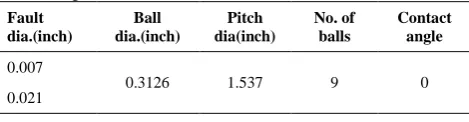
the proposal, the vibration data of fault bearing from the bearing data center of Case Western Reserve University(CWRU)1 is used in this section. This paper focus on the two different conditions of bearing vibration signals: inner race fault (IR) and outer Race fault (OR) with Motor Speed (MS) varied from 1797 to 1725 rpm, and the sample frequency is fs=12 kHz. The test bearing is the deep groove ball bearing (6205-2RS JEM SKF), in addition, bearing specifications and working condition data are listed in Table 1.
The FCF of inner race and outer race can be calculated by following equation, respectively:
cos
d d r b ir P B f n FCF 1 2 (11)
cos
d d r b or P B f n FCF 1 2 (12)
where fr is the rotational frequency in RPM (fr=MS/60),
nb is the number of balls, β is the contact angle.
4. 2. Diagnosis of Bearing with Inner Race Fault
The time waveform and frequency spectrum of inner race with fault diameter 0.021 (MS=1797, N=2048) is illustrated in Figure 1.
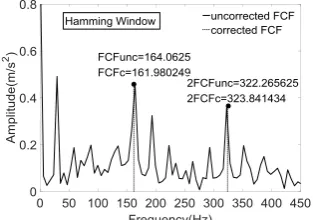
From Figure 1(a), the impact on the inner race fault bearing is quite obvious, which cause impulses sequence in the vibration signal. From Figure 1(b), it is difficult to identify FCF due to strong noise background. For comparison, Figure 2 shows the envelope spectrum and corresponding corrected FCF value (Hamming window) of the original signal as shown in Figure 1(a).
TABLE 1. Bearing specifications and working condition data of bearing Fault dia.(inch) Ball dia.(inch) Pitch dia(inch) No. of balls Contact angle 0.007
0.3126 1.537 9 0
0.021
Figure 1. Time domain waveform and frequency spectrum of the inner race fault signal
Figure 2. Demodulation spectrum of and corrected value
As shown in Figure 2, compared to the uncorrected FCF by TEKO, the FCF and its harmonics corrected by proposed algorithm are close to the theoretical values of FCF calculated by Equation (11). This shows that proposed algorithm is able to improve the precision of fault characteristics, which is extracted by TEKO from the vibration signal of fault bearing. In order to verify the applicability of proposed algorithm, removing effects on FCF identification that may be caused by artificial factors and data selection, etc. Root Mean Square Error (RMSE) is introduced to evaluate the performance of proposal. Figures 3 and 4 show RMSE of FCF by proposed algorithm based on Hamming window and traditional TEKO method with different data length (N=1024, 2048 and 4096) and different fault diameter (0.007 and 0.021).
Figure 3. RMSE of FCF (IR007)
Figure 4. RMSE of FCF (IR021)
As shown in Figures 3 and 4, firstly, the RMSE of traditional TEKO method is very larger in the case of
N=1024 (the maximum is nearly 6, and the minimum is also about 2). The proposed algorithm provides higher accuracy than TEKO in most cases. Secondly, the demodulation precision of TEKO increases as the data length increases, and the RMSE of proposed algorithm is inferior to TEKO in some cases (such as N=4096, MS=1721rpm, IR007; N=2048, MS=1752 rpm, IR021), because the FCF by TEKO is very close to theoretically value calculated by Eq. (11) in these cases. For example,
fir(TEKO)=158.203125Hz and the fir(calculated)= 157.944047Hz (N=2048, MS=1750rpm, IR007).
4. 3. Outer Race Fault with Different Positions
In this subsection, the performance comparison of the proposed algorithm and TEKO for outer race is shown in Tables 2 and 3. The defects are located at 6 o'clock and at 3 o'clock with different data length, respectively.
From comparison of presented data in tables, all the frequency errors of FCF are improved, RMSE of FCF improved 2.3 to 84.5%. That shows the proposed algorithm has a better performance of enhancing the identification accuracy than TEKO.
TABLE 2. RMSE of FCF for outer race (N=1024) Position Algorithm 1796 1773 1750 1725
6 o’clock
Proposed 0.31618 0.38237 0.42079 0.37254
TEKO 1.89528 0.46137 0.91279 2.40645
Improve 83.3% 17.1% 53.9% 84.5%
TABLE 3. RMSE of FCF for outer race (N=2048) Position Algorithm 1797 1774 1751 1725
3 o’clock
Proposed 0.42467 0.50909 0.46207 0.48182
TEKO 1.89528 0.52111 0.85305 2.40645
4. 4. Study of Windows Influence Window selection is a key issue in FFT, however, the window cannot get a narrow main-lobe width and good side-lobe behaviors simultaneously. In order to illustrate the window selection effect on accuracy of FCF, the proposed algorithm is used in four classic windows: Blackman window, Kaiser window(α=2.0), Blackman-Harris window and Dolph-Chebyshev window(α=3.0).
As it shows in Figures 5 and 6, it can be seen that firstly, in all cases, FCF can be estimated satisfactorily with these windows. RMSE decrease with the increase of data length, the reason of which is the demodulation precision of TEKO increases as the data length increases. Secondly, because of its relatively narrow main-lobe width (MW-3dB=0.039063), the proposed algorithm based on the Hamming window shows highest accuracy in most case. For this reason, the proposed algorithm based on Blackman-Harris window shows larger error due to its relatively wide main-lobe width (MW-3dB=0.0585). Thus, it is possible to conclude that the windows with narrow main-lobe width is favorable to improve identification accuracy. In general, the results is the best when using Hamming window due to its good frequency resolution caused by relatively narrow main-lobe width.
Figures 5. RMSE of FCF for inner race (fault dia.=0.007)
Figures 6. RMSE of FCF for inner race (fault dia.= 0.021)
5. CONCLUSION
6. FUNDING
This research is funded by Chongqing Research Program of Basic Research and Frontier Technology (Grant No. cstc2014jcyjjq70001 and Grant No. cstc2015jcyjbx0066), funded by National Natural Science Foundation of China (Grant No. 51605064) and also supported by Scientific and Technological Research of Chongqing Municipal Education Commission (Grant No. KJ1600428).
7. REFERENCES
1. Zaza, G., Hammou, A., Benchatti, A. and Saiah, H., "Fault detection method on a compressor rotor using the phase variation of the vibration signal", International Journal of Engineering-Transactions B: Applications, Vol. 30, No. 8, (2017), 1176-1181.
2. Heidari, M., "Fault detection of bearings using a rule-based classifier ensemble and genetic algorithm", International Journal of Engineering Transactions A: Basics, Vol. 30, No. 4, (2017), 604-609.
3. Eftekhari, M., "The effect of damping and stiffness of bearing on the natural frequencies of rotor-bearing system", International Journal of Engineering-Transactions C: Aspects, Vol. 30, No. 3, (2017), 448-455.
4. Smith, W.A. and Randall, R.B., "Rolling element bearing diagnostics using the case western reserve university data: A benchmark study", Mechanical Systems and Signal Processing, Vol. 64, (2015), 100-131.
5. Laha, S., "Enhancement of fault diagnosis of rolling element bearing using maximum kurtosis fast nonlocal means denoising", Measurement, Vol. 100, (2017), 157-163. 6. AlThobiani, F. and Ball, A., "An approach to fault diagnosis of
reciprocating compressor valves using teager–kaiser energy operator and deep belief networks", Expert Systems with Applications, Vol. 41, No. 9, (2014), 4113-4122.
7. Jain, V.K., Collins, W.L. and Davis, D.C., "High-accuracy analog measurements via interpolated fft", IEEE Transactions on Instrumentation and Measurement, Vol. 28, No. 2, (1979), 113-122.
8. Belega, D. and Dallet, D., "Multifrequency signal analysis by interpolated dft method with maximum sidelobe decay windows", Measurement, Vol. 42, No. 3, (2009), 420-426. 9. Luo, J., Xie, Z. and Xie, M., "Frequency estimation of the
weighted real tones or resolved multiple tones by iterative interpolation dft algorithm", Digital Signal Processing, Vol. 41, (2015), 118-129.
10. Kaiser, J.F., "On a simple algorithm to calculate the'energy'of a signal", in Acoustics, Speech, and Signal Processing, 1990. ICASSP-90., 1990 International Conference on, IEEE., (1990), 381-384.
11. Luo, J., Xie, Z. and Xie, M., "Interpolated dft algorithms with zero padding for classic windows", Mechanical Systems and Signal Processing, Vol. 70, (2016), 1011-1025.
12. Harris, F.J., "On the use of windows for harmonic analysis with the discrete fourier transform", Proceedings of the IEEE, Vol. 66, No. 1, (1978), 51-83.
13. Donciu, C. and Temneanu, M., "An alternative method to zero-padded dft", Measurement, Vol. 70, (2015), 14-20.
14. Borkowski, J. and Mroczka, J., "Lidft method with classic data windows and zero padding in multifrequency signal analysis",
Measurement, Vol. 43, No. 10, (2010), 1595-1602.
Rolling Bearing Fault Analysis by Interpolating Windowed DFT Algorithm
X. Lia, L. Hanb, H. Xub, Y. Yangc, H. Xiaob
a College of Mechanical Engineering, Chongqing University, Chongqing, China
b School of Advanced Manufacturing Engineering, Chongqing University of Posts and Telecommunications, Chongqing, China c Chongqing Machine Tool (Group) Co. Ltd., Chongqing, China
P A P E R I N F O
Paper history: Received 08 July 2018
Received in revised form 25 August 2018 Accepted 26 October 2018
Keywords: Rolling Bearing
Teager-Kaiser Energy Operator Fault Diagnosis
Interpolated DFT
Fault Characteristic Frequencyl
هديكچ
( تسکش هصخشم سناکرف ندوب قیقد هلئسم یور رب هلاقم نیا FCF
نویسلاودومد .دراد زکرمت یکتلغ درون )
روتارپا TKEO .تسا هدش هدافتسا کتلغ یاطخ ییاسانش یارب یا هدرتسگ روط هب FCF
یاه لانگیس زا دناوت یم
شور زا هدافتسا اب نامرد زا شیپ هک دوش جارختسا یشاعترا TEKO
لانگیس زیون یوق هقباس لیلد هب ،لاح نیا اب .تسا
جارختسا ،اطخ شاعترا FCF
هدش لمحت درون طلغ صیخشت هتفای دوبهب متیروگلا ،هلاقم نیا رد .تسا لکشم لااب تقد اب
رق لیلحت و هیزجت دروم طسوت تکاپ لیلحت و هیزجت ساسا رب .تسا هتفرگ را
TKEO رفص کینکت زا یبیکرت ار نآ ،
متیروگلا و هتسوپ DFT
هک دهد یم ناشن شیامزآ هجیتن .دشاب یم هلودومد لانگیس حلاصا یارب کرحتم یاه هرجنپ دوبهب
طسوتم عبرم یاطخ یداهنشیپ متیروگلا هشیر
RMSE و FCF ودح زا ار )ینورد داژن( د
2 Hz ~ 5.5Hz دودح هب
5.0 Hz نینچمه شور نیمه ،دهد یم شهاک ار هاتوک یاه هداد لوط یارب RMSE
دودح رد ار 1.1
Hz ~ 3Hz هب
دودح ٪ 5.0 ات 5.0 Hz ،لاح نیع رد .دوش یم لصاح دراوم رثکا رد ینلاوط یاه هداد لوط یارب RMSE FCF
داژن(
)ینوریب 2.2 ٪ هب 50.0 ٪ رد تسا هتفای شیازفا یتنس نویسلاودومد زا هدافتسا اب هسیاقم
TEKO .دشاب یم ییاهنت هب