Please cite this article as: S. Behjat, N. Nahavandi, A Mathematical Model and Grouping Imperialist Competitive Algorithm for Integrated Quay Crane and Yard Truck Scheduling Problem with Non-crossing Constraint, International Journal of Engineering (IJE), IJE TRANSACTIONS A: Basics Vol. 32, No. 10, (October 2019) 1464-1479
International Journal of Engineering
J o u r n a l H o m e p a g e : w w w . i j e . i r
A Mathematical Model and Grouping Imperialist Competitive Algorithm for
Integrated Quay Crane and Yard Truck Scheduling Problem with Non-crossing
Constraint
S. Behjat, N. Nahavandi*
Industrial & Systems Engineering Faculty, Tarbiat Modares University, Tehran, Iran
P A P E R I N F O
Paper history: Received 23 June 2019
Received in revised form 13 August 2019 Accepted 12 Septemaber 2019
Keywords: Grouping
Imperialist Competitive Algorithm Mathematical Model
Non-crossing Quay Crane Scheduling Yard Truck Scheduling
A B S T R A C T
In this research, an integrated approach is presented to simultaneously solve quay crane scheduling and yard truck scheduling problems. A mathematical model was proposed considering the main real-world assumptions such as quay crane non-crossing, precedence constraints and variable berthing times for vessels with the aim of minimizing vessels completion time. Based on the numerical results, this proposed mathematical model has suitable efficiency for solving small instances. Two versions of imperialist competitive algorithm (ICA) are presented to heuristically solve the problem. The grouping version of algorithm (G-ICA) is used to solve the large-sized instances based on considering the allocation of trucks as a grouping problem. Effectiveness of the proposed metaheuristics on small-sized problems is compared with the optimal results of the mathematical model. In order to compare the efficiency of the proposed algorithms for large-sized instances, several instances were generated and solved, and the performance of algorithms has been compared with each other. Moreover, a simulated annealing (SA) algorithm is developed to solve the problem and evaluate the performance of the proposed ICA algorithms. Based on the experimental results, the G-ICA has a better performance compared to the ICA and SA. Also an instance of a container terminal in Iran has been investigated which shows that the proposed model and solution methods are applicable in real-world problems.
doi: 10.5829/ije.2019.32.10a.16
1. INTRODUCTION1
Container terminals, especially in the recent years, play a significant role in worldwide transportation system. In 2017, based on UNCTAD review of maritime transport world container port throughput has increased up to 752 million 20-foot equivalent units (TEUs). In last three years, an average annual growth rate of 3.1% was reported [1]. Due to the rapid growth rate of transported container volume in the last decade, it is critical to improve the operational efficiency of container terminals .
In general, a container terminal consists of two main interfaces. These interfaces are quayside with berths for loading/unloading of vessels and landside to load or unload containers on trucks and store containers. As shown in Figure 1, there are three types of equipment
*Corresponding Author Email: [email protected] (N.
Nahavandi)
involved in the loading and unloading process in a container terminal, including quay cranes (QCs), yard trucks (YTs) and yard cranes (YCs).
For inbound material flow, when a vessel arrives, quay cranes unload containers from the vessel, and transfer containers to landside for the storage through
yard trucks. However, for outbound containers, this process occurs in the opposite direction. While quay cranes are used to load outbound containers and unload inbound containers, yard trucks provide ground transportation of containers between the quayside and the landside.
Due to fierce competition among container ports to attract customers, the services should have an acceptable level of quality [3]. Rapid loading and unloading of containers and adhering to the promised scheduling program of ships are considered among the major factors in assessing the performance of container ports [4].
The major operations in container ports includes berth allocation problem (BAP), quay crane assignment problem (QCAP), quay crane scheduling problem (QCSP), ground transport equipment scheduling, yard crane scheduling and storage space allocation [5]. Berths are important resources in container ports that should be allocated to the vessels. The berth allocation problem determines the time window and location which is assigned to a vessel. Quay cranes are also a critical resource in the quayside that should be assigned to vessels in a productive manner. Effective solutions for quay crane scheduling may lead to reduction in loading and unloading procedure duration. This means that more vessels can be served and better utilization of the resources is expected. Yard trucks as another resources in container terminals are used to transfer containers between quay cranes and yard cranes. Yard trucks assignment and scheduling with the objective of coordination of YTs and QCs received many attention in literature.
The QCSP and the YT scheduling problems are highly interrelated. So it is needed to make an effective coordination among these equipment to prevent a situation when quay cranes or trucks need to wait for each other. Therefore, this study focuses on joint quay cranes and trucks scheduling problem in a container terminal. Both loading and unloading operations have been considered.
2. LITERATURE REVIEW
The studies related to QCSP and YT scheduling can be categorized into three major groups. First one is about researches considering the quay crane scheduling problem. Research on the QCSP started thirty years ago with the work conducted by Daganzo [6]. He proposed a model considering multiple vessels and multiple cranes for a set of vessels. Kim and Park [7] investigated the QCSP; in addition to presenting a method based on branch and bound (B&B) algorithm, they also developed a heuristic method called greedy randomized adaptive search procedure (GRASP). The above was later on modified by Moccia et al. [8], Bierwirth and Meisel [9].
Moccia et al. [8] developed a solution method based on branch and cut (B&C) algorithm and obtained significantly better solutions for the benchmark set provided by Kim and Park [7]. Bierwirth and Meisel [9] developed a B&B algorithm which allows only unidirectional movement of the QCs in order to search within a reduced solution space [9]. This algorithm provides better results in both objective function value and computation time when compared to the algorithms developed by Kim and Park [7] and Moccia et al. [8]. The model of Kim and Park [7] was extended by Tavakkoli-Moghaddam et al. [10] considering a set of vessels in parallel with the objective to minimize the total weighted completion time of QCs and the total weighted tardiness of ships and proposed a genetic algorithm (GA). Recent studies on the QCSP have focused on modeling problems considering the typical attributes of the QCSP in real world. These attributes include safety margin between quay cranes (e.g. Nguyen et al., [11]; Kaveshgar et al., [12]), non-crossing of quay cranes (e.g. Liu et al., [13]; Emde, [14]) and precedence relationships between containers (e.g. Kim and Park, [7]; Sammarra et al, [15]). Liang et al. [16] studied the QCSP with the aim of determining the sequence of processing containers on QCs and determining the optimal number of QCs that should be allocated to each vessel. They developed a loop iteration method with the aim of finding the optimum number of quay cranes that should be allocated to each vessel and the sequence of processing containers on QCs. A new mathematical model for QCSP is addressed by Sun et al. [17] to handle the non-crossing constraint in an easier manner. Moreover an exact problem-solving method based on Benders decomposition has been developed for solving the problem. Kasm and Diabat developed an exact and computationally efficient method [18] to solve QCSP considering non-crossing and safety margin assumptions for only one vessel. A two-step technique incorporating a partitioning heuristic and Branch and Price algorithm has been presented proposed for solving this problem. The numerical experiments show that the presented technique is suitable for solving the problem within a reasonable period of time. See Bierwirth and Meisel [19, 20] for a comprehensive survey of applications and optimization models for the operations management in container terminals.
problem considering sequence-dependent processing times and different times of readiness for jobs. Further, a mathematical model and a GA have been developed for solving the problem [23]. Also there are numerous studies on the automated guided vehicles (AGVs) in automated container terminals [24, 25]. Implementation of AGVs instead of yard trucks can lead to higher efficiency and stability, cost reduction and safer environment in container terminals [26].
In the last years, a few studies have considered the interrelations between quay cranes operation and the trucks scheduling. Chen et al. [27] formulated the integrated operation of QCs, YTs, and YCs as a hybrid flowshop scheduling problem considering real world assumptions like precedence and blocking constraints. The problem has been simplified by assigning a given range of bays for each quay crane. They presented a metaheuristic algorithm for solving this problem. Cao et al. [28] studied the joint QC and YT scheduling problem for containers which are unloading and developed a mathematical model and a GA to solve the problem. Chen et al. [29] formulated the integrated QCs, YTs and YCs scheduling problem as a constraint programming model. They assumed a given assignment of the containers to QCs and proposed a three-stage algorithm to solve the problem. Tang et al. [5] proposed an integer programming model for the joint QC and truck scheduling problem. They developed several valid inequalities as well as two lower bounds for the model. A PSO algorithm has also been proposed for solving the problem and the solutions have been compared with the optimal results of mixed integer programming model and lower bounds for small sized and large sized problems, respectively.
Moreover, a mathematical model was developed by Kaveshgar and Huynh [30] for the joint QCs and YTs
scheduling for unloading inbound containers. They considered real world limitations such as safety margin, precedence relationships between containers and quay crane non-crossing. In this study, the number of quay cranes which are allocated to each vessel has been assumed as a constant and specific number. He et al. [31] addressed the integrated QCs, YTs and YCs scheduling problem considering the transportation energy consumption as the objective. They presented a mathematical model and a solution method based on simulation-optimization. The results indicated that there is a trade-off between completion time of the vessels and energy consumption. Karam et al. [32] developed a mathematical model considering assignment of quay cranes and yard trucks simultaneously. This study investigates the allocation of QCs to vessels and assignment of yard trucks to each quay crane. The results of this research suggest that the presented model has led to improved average berthing stay per vessel. Vahdani et al. [33] proposed a bi-objective model to coordinate the assignment of vessels to the container terminals, assignment of QCs to vessels and assignment of YTs to quay cranes. They proposed two meta-heuristic algorithms based on GA and particle swarm optimization (PSO) algorithm. The computational results show that joint assignment of the above mentioned equipment results in reduction of the remaining workload in the container terminals.
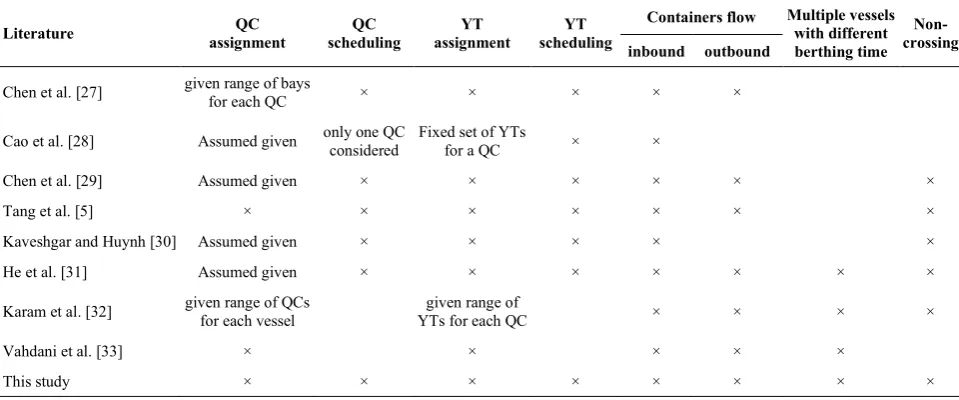
Table1summarizesrecentstudiesdealtwithintegrated quay crane and yard truck scheduling problem. In this research, the number of QCs assigned to each vessel has not been considered as a fix number. This assumption leads to a better utilization of quay cranes as an important resource in the container terminals. Moreover considering other constraints such as different berthing time for vessels causes more complexity in the problem.
TABLE 1. the summary of recent studies on joint QC and YT scheduling problem
Literature QC
assignment
QC scheduling
YT assignment
YT scheduling
Containers flow Multiple vessels with different berthing time
Non-crossing inbound outbound
Chen et al. [27] given range of bays
for each QC × × × × ×
Cao et al. [28] Assumed given only one QC
considered
Fixed set of YTs
for a QC × ×
Chen et al. [29] Assumed given × × × × × ×
Tang et al. [5] × × × × × × ×
Kaveshgar and Huynh [30] Assumed given × × × × ×
He et al. [31] Assumed given × × × × × × ×
Karam et al. [32] given range of QCs
for each vessel
given range of
YTs for each QC × × × ×
Vahdani et al. [33] × × × × ×
In this study, a novel integrated mixed integer programming model considering main real world assumptions is proposed based on flexible jobshop problem concept. To the best of our knowledge, there is no published work in the related literature that models this problem, considering the below mentioned assumptions, like the approach which is proposed in this study. Also a new grouping imperialist competition algorithm based on grouping concept is presented for solving this problem especially for the large-sized problems.
3. PROBLEM STATEMENT
Simultaneously quay cranes and yard trucks scheduling leads to better productivity in container ports. In terminal operations planning problems, usually a fixed number of trucks is assigned to each crane. Quay cranes are usually scheduled to process the inbound and outbound containers and then trucks are assigned to QCs. In this approach, the QCs and YTs may need to wait for each other. For example, consider the inbound process. If a container unloaded by a QC, but none of the YTs are ready to carry the container, the QC has to wait. In another way, if a QC has not finished unloading procedure of a container when a yard truck comes, the YT has to wait. Therefore, scheduling of these two resources (QCs and YTs) simultaneously may enhance the productivity of operations. The results have indicated that integrated methods lead to better solutions in comparison with non-integrated approach.
In this research, we specify allocation of containers to quay cranes and trucks. We also obtain the sequence and scheduling associated with processing of containers on quay cranes and trucks. The goal of the research is to find an integrated allocation and scheduling plan with the following assumptions to minimize the total completion time of ships:
• Each quay crane or truck serves only one container at the same time.
• The quay cranes can be allocated to any range of bays, but it should be considered that quay cranes cannot cross each other (non-crossing assumption).
• Once a quay crane starts working on a container, it will complete the process before starting another container.
• Both inbound and outbound containers have been considered.
• All of the vessels are not available in the beginning of the planning.
• There are precedence relationships among the containers. For example, containers in lower rows should be unloaded after the containers in upper rows. • The number of quay cranes and trucks, process time
of containers, berth allocation, container position in vessel and yard are considered as given.
• The same quay cranes and yard trucks have been established in the terminal.
• There is a sufficient number of yard cranes and there is not any bottleneck in the land-side.
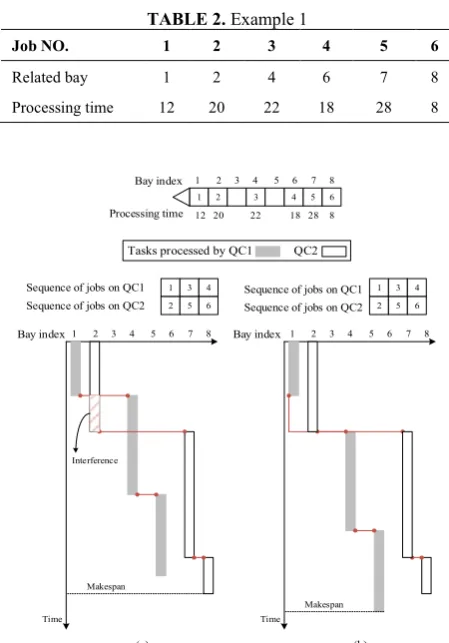
The main objective in this study is finding a sequence of processing containers on QCs and YTs which leads to minimum total completion time of vessels. Table 2 is an example of a vessel with 8 bays and 6 containers and related processing times.
Figure 2 shows an example with two QCs, without considering non-crossing assumption (a) and with considering this assumption (b). As shown in this figure, considering non-crossing assumption leads to an idleness in the schedule.
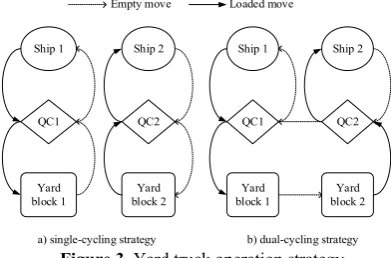
Yard trucks operation can be handled in two ways: one-cycle strategy, where each truck serves a specific quay crane and two-cycle strategy, where trucks can work with different quay cranes and minimize the empty moves. The performance of yard trucks based on these two strategies has been shown schematically in Figure 3. In this study, in order to better utilize the yard trucks, the two-cycle strategy has been selected.
TABLE 2. Example 1
Job NO. 1 2 3 4 5 6
Related bay 1 2 4 6 7 8
Processing time 12 20 22 18 28 8
1 2 3 4 5 6
1 2 3 4 5 6 7 8
Bay index
12 20 22 18 28 8
1 3 4
Sequence of jobs on QC1
2 5 6
Sequence of jobs on QC2 Bay index1 2 3 4 5 6 7 8
1 3 4
Sequence of jobs on QC1
2 5 6
Sequence of jobs on QC2 Bay index 1 2 3 4 5 6 7 8
Makespan Makespan
Time Time
Interference
(a) (b)
Tasks processed by QC1 QC2
Processing time
QC1
Yard block 1 Ship 1
QC2
Yard block 2 Ship 2
Empty move Loaded move
QC1
Yard block 1 Ship 1
QC2
Yard block 2 Ship 2
a) single-cycling strategy b) dual-cycling strategy
Figure 3. Yard truck operation strategy
4. MATHEMATICAL MODEL
In this study, the quay cranes and yard trucks scheduling problem has been formulated based on flexible jobshop problem concepts. In a flexible jobshop environment, n jobs with varying orders of process should be scheduled on m machines. The difference between flexible jobshop scheduling problems and jobshop scheduling problems is to allow each operation to be processed on one or more than one machine. The quay crane scheduling is a scheduling problem with spatial constraints, i.e. crane interference, which makes this problem more complex than the general jobshop problem.
A mathematical model is proposed in this study based on flexible jobshop concepts and considering the real world assumptions. Each container has two operations shown as , which means the hth operation of container
j. While for inbound containers, is unloading on a quay crane and is on a truck, outbound containers should be first carried by an YT and loaded on a vessel by a QC.
In this model, a dummy container, called reference container, is planned to be processed as the first container on each QC and YT. The parameters, decision variables, and the model are as follows:
4. 1. Parameters
Number of machines (sum of number of QCs and YTs)
Number of jobs (containers)
Number of vessels
, Jobs index
, ℎ, ′ Operations index
Quay crane index
Vessels index
Location of job j
Ω Set of precedence constrained tasks
Set of containers belonging to vessel v
Set of inbound containers
Set of outbound containers
Set of operations which should be processed on QCs
1, if machine k is capable to process the 0, o.w.
The readiness time of vessel v
A large number
The process time of on machine k if it is processed immediately after on machine
4. 2. Variables
1, if operation is processed immediately after operation on machine k
0, o.w.
ℎ, = 1,2 , = 1, … ,
= 1, … ,
$ Start time of operation ℎ = 1,2
= 1, … ,
% Completion time of operation ℎ = 1,2
= 1, … ,
& Completion time of the last job of
vessel v
'
1, if operation is processed on machine k
0, o.w.
ℎ = 1,2 = 1, … ,
= 1, … ,
'( 1, if operation is processed after
operation (not immediately) 0, o.w.
ℎ, = 1,2 , = 1, … ,
4. 3. The model ∑* &
+
∑ ∑+,∑ = 1 ∀ℎ = 1,2
∀ = 1, … , (1)
∑ ∑ ∑ ≤ 1 ∀ = 1,2
∀ = 1, … , (2)
∑ ∑ ≤
∀ℎ = 1,2
∀ = 1, … ,
∀ = 1, … ,
(3)
∑ ∑ , ≤ 1 ∀ = 1, … , (4)
∑ ∑ ≤ ∑ ∑( ( ( ( ∀ = 1, … , (5)
% ≥ %0 1 2 +
∑ ∑ ∑ .
∀ℎ = 1,2
∀ = 1, … , (6)
% ≥ % + ∑ . − 01 −
∑ 2
∀ℎ, = 1,2
∀ , = 1, … , (7)
$ ≥ % ∀0 , 2 ∈ Ω
∑ ∑ = '
ℎ = 1,2
= 1, … ,
= 1, … ,
(9)
7'( + '( 8 ≥ ∑ × ' −
∑ (× '
(
: + 1
ℎ, = 1,2
, = 1, … ,
∀ <
, ∈
(10)
$ + ∑ ∑ ∑ × = % ℎ = 1,2
= 1, … , (11)
$ ≥ ∀ = 1, … ,
∀ ∈ ∩ (12)
$ ≥ ∀ = 1, … ,
∀ ∈ ∩ (13)
% − $ + × '( ≥ 0
∀ℎ, = 1,2
∀ , = 1, … ,
(14)
% − $ − × 01 − '( 2 ≤ 0 (15)
& ≥ %
= 1, … ,
∈
ℎ = 1,2
∈
(16)
$ , % , & ≥ 0
∀ℎ = 1,2,
∀ = 1, … , ,
= 1, … ,
(17)
As mentioned before, the objective function is minimization of the total completion time of the vessels. Constraint set (1) ensures that operation is processed after exactly one operation. Constraint set (2) guarantees that at most one operation can be processed after the previous completed operation. Constraint set (3) ensures that the operation is processed on the machine that is capable to process the operation. For example, the first operation of outbound containers ( , ∈ 2) cannot be processed on a quay crane. Based on constraint set (4), after the dummy jobs, at most one job can be processed. Constraint set (5) guarantees that if the operation is not processed on machine k, any other operation cannot be processed after this operation on machine k. The completion time of the operation is calculated based on constraint set (6). Constraint set (7) ensures that each machine processes at most one operation at the same time. The precedence relationship between containers is considered in the constraint set (8). Constraint set (9) is incorporated into the model to determine which operation is processed on which machine.
Constraint set (10) is quay crane non-crossing constraints. For two containers, if '( + '( = 0 (means that and are processed simultaneously), the QC that processes is on the left side of the QC which processes if the location of container j is on the left side of the location of the container i. Constraint set (11) computes the start time of operations. Constraint sets (12) and (13) restrict the starting time of operations based
on the earliest time when the related vessel is on the berth. Constraint sets (14) and (15) are incorporated into the model to compute the '( variable, showing the
simultaneous processing of two operations. Constraint set (16) calculates the completion time of the last container on the vessel v.
The proposed research problem in this study can be easily reduced to a minimum makespan jobshop scheduling problem by considering only a vessel with inbound containers. Based on Pinedo [34], this problem is known to be NP-hard in the strong sense. Thus, the proposed research problem is NP-hard too, and a suitable metaheuristic algorithm should be developed to solve the problem efficiently, especially for large sized problems [35].
5. ICA ALGORITHM
Imperialist competitive algorithm (ICA) is a metaheuristic optimization algorithms which has been recently developed based on sociopolitical concepts. This algorithm can be classified as evolutionary algorithms, first presented by Atashpaz-Gargari and Lucas [36].
Based on this algorithm, the problem solutions are defined as country, which improve over the iterative course of the algorithm, eventually giving the solution. The countries are divided into two groups: imperialist and colony countries. Each imperialist consists of an emperorship and several colony countries. ICA algorithm moves according to movement of colonies towards the imperialist as well as the competition between imperialist countries towards the optimal solution. During the algorithm, each country tends to move towards its imperialist. Further, imperialists tend to absorb the colonies of other countries towards themselves by empowering their own Empire [37].
5. 1. Primary Empires In this algorithm, we start with a number of initial population (called country). “N_imp” number of the solutions with minimum objective function (powerful countries) are selected as imperialist. Each imperialist country will have a number of other countries (N_col) as colony. The number of colonies of each imperialist will be determined according to its relative power ( >) [38]:
>=∑ ?@?
@ @ABC D
(18)
&>= %>− max % (19)
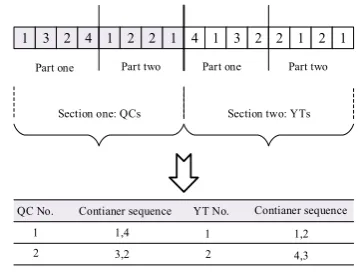
The first section represents process sequence and allocation of containers on quay cranes, while the second section deals with process sequence and allocation of containers on the yard trucks. In the first part of each section, the process sequence is specified, and in the second part it is determined what equipment will process each container.
5. 2. Calculation of the Power of Countries The objective function of the solution should be calculated to evaluate the power of each country. As in the proposed ICA algorithm the sequence of tasks is determined, to calculate the objective function the schedule of processing the containers on machines should also be specified. Considering different real-world assumptions such as precedence/succession of task processing and quay cranes non-crossing, sequence does not easily lead to the schedule. a procedure has been proposed for this aim. Based on this, containers are allocated according to the earliest time available for QCs and YTs. Then, given the operational constraints that should be applied, the machines may have to wait (for example, for outbound jobs, the QC should wait, until the container operations on YT finish). This duration when the QC has to wait in spite of equipment availability is called forced idleness. These waiting times will be added to the time of start of jobs processing according to the proposed procedure. The details of how operational constraints are applied to the schedule of containers are described.
The second operation of each container should
begin after completion of the first operations of that container. Evidently, the machine related to process of the second operations of each container should wait until completion of the container processing time on the previous machine. For example, for inbound jobs, YT (even if it is ready and available) cannot initiate the container process operations and should wait until the container processing operations on QC is finished.
The starting time of each container on QC should
be after the availability of that container (ship). In this research, considering the time of availability of ships in the berth, the operations of containers on QC should be scheduled after entrance of the relevant ship to the berth. Delay in start of operations can occur due to precedence relations. In precedence relations (A,B), which are mostly determined based on arrangement of containers in ships, processing of the container B will not begin, unless operations of the container A have been finished. In this way, we may have a forced idleness on QC. This waiting time will be calculated according to completion time of container A.
Considering the constraint of non-crossing of
cranes across each other, a QC may have to wait for some moment. According to the Figure 4, assume that QC1 is assigned to bay 3 and is going to process a container in bay 12. If QC2 is processing containers in
bay 8, then QC1 has to wait until completion of operations on this container. Accordingly, QC1 should be kept idle while a container in bay 12 is waiting to be processed.
When applying these constraints, some sequences may be infeasible due to the operational constraints. The objective function value for these solutions is assumed to be a large number.
5. 3. Inner Competition The original ICA algorithm for continuous optimization problems has been presented. As shown in Figure 5, the colony country moves by x units along the line connected to the imperialist with an angular deviation of θ.
In the proposed problem we are trying to determine the sequence of containers and allocate them into QCs and YTs. Accordingly, the algorithm should be modified in a way that it become applicable to this problem. To search the solution space, one point crossover and selection and replacement operators are used. Here, the colony country moves towards achieving the characteristics of the imperialist country.
According to crossover operator, one part of the solution of the imperialist country is chosen randomly and incorporated in the sequence of the colony country randomly. Note that this operator should generate feasible solutions.
Through selection and replacement operator, first we select a random number of elements we want to replace (r1). Then, we choose rl jobs among the imperialist’s jobs and place them in that position. Thereafter, we embed the rest of relevant colony elements with the same order in the new solution such that feasibility of the solution is still preserved. When colonies are moving, some of them may achieve a better position than the imperialist, in which case these two countries swap their positions.
bay 1 2 3 4 5 6 7 8 9 10 11 12
QC1 QC2
Figure 4. Illustration of non-crossing constraint
x
θ New position
colony
Imperialist
5. 4. Diversifying Technique To prevent the algorithm from being entrapped in a local optimality point, a diversifying technique should be applied to the solutions. In the imperialist competitive algorithm, this technique is equivalent to occurrence of revolution in countries and altered components of that country.
According to the technique proposed in this research, in each iteration of the algorithm, each country may experience revolution with a specific probability, represented by prev. In case of revolution, all components of a solution are abandoned and a new solution will be generated randomly.
5. 5. Outer Competition The main competition in this algorithm occurs among different empires. In this competition, each imperialist is seeking to enhance its empire power and the number of colony countries. Power of each empire is determined based on the power of its imperialist and plus a proportion of its average colonies power.
HIHJ IKL 0 2 = IKL 0 L J$ H2 +
M × LJ 0 IKL 0%I I L$ I HℎJH 22 (20)
where M is a positive coefficient that indicates participation proportion of colonies in the empire power.
In each iteration of this algorithm, the weakest empire is determined, the weakest country of that empire is allocated to another empire. During the algorithm process, weak empires with reducing numbers of colonies will collapse, and eventually all countries will remain as an empire. The remaining imperialist will be the optimal or near to optimal solution resulting from the algorithm.
5. 6. Grouping Version of the Algorithm (G-ICA) In grouping optimization problems, the aim is to divide the members of set G to a number of different groups, such that each member belongs a group. The main assumption in these problems is that the order of groups is not important. There are various problems in combinatorial optimization, known as grouping problems, including graph coloring problem, bin packing problem, batch–machine scheduling problem and packing/partitioning problems.
In this study, allocation of trucks can be considered as a grouping problem. Here, the set of containers are divided into several groups, each of which is allocated to a yard truck. In this problem, the order of allocation of container groups to trucks will not be different.
As mentioned before, the components of each country consist of two main sections. As shown in Figure 6, the first section represents process sequence and allocation of containers on quay cranes (QC), however the section two shows allocating containers on yard trucks (YT). Figure 7 shows an example of grouping. In the grouping based representation, the second section consists of item
part and group part. In the item part, it is specified to which group each container belongs. For example, a grouping problem with 2 containers, 2 quay cranes and yard trucks is represented as Figure 8.
In the grouping version of algorithm (G-ICA), to update the allocation and sequence of containers on QCs in each iteration, crossover as well as selection and replacement operators are used according to Figures 9 and 10. The container group’s allocation and sequence on the YTs will be updated according to the method proposed by Kashan et al. [39] based on Figure 11.
1 3 2 4 1 2 2 1 4 1 3 2 2 1 2 1
Section one: QCs Section two: YTs Part one Part two Part one Part two
QC No. Contianer sequence YT No. Contianer sequence 1
2
1 2 1,4
3,2
1,2 4,3
Figure 6. Solution representation
1,3 2,4,6
Group A Group B
― ―
― ABABCBC : ABC
5,7 Group C
Group part Item part
Figure 7. A sample of grouping
Part two
1 3 2 4 1 2 2 1 B A B A A B
Section one: QCs Section two: YTs
Part one Part two Part one
Figure 8. Grouping solution representation
1 3 5 4 2
2 4 1 3 5
1 3 2 4 5
imperialist
colony New colony
Figure 9. Crossover operator
1 3 5 4 2
2 4 1 3 5
4 3 1 5 2
imperialist
colony
New colony r1=2
1,4,6
A
2,3,7 5,8
B C
imperialist
3,7
D
1,4 2,6
E F
colony
G
5,8
(1) choice of crossover points
3,7
D
1,4 2,6
E F G
5,8 1,4,6
A
(2) Injection of groups from the imperialist into the colony
3,7
D G
5,8 1,4,6
A
(3) Elimination of groups containing doubles and empty groups Injected Emptied
Item 2 is inserted
3,7
D G
2,5,8 1,4,6
A
(4) Reinsertion of missing items. A problem depended heuristic is used to insert the
missing items back to groups
New colony
Figure 11. G-ICA crossover
6. NUMERICAL RESULTS
In order to investigate the efficiency of the presented mixed integer programming model as well as the performance of the proposed algorithms, 76 instances have been generated based on the random parameters proposed by Chen et al. [27] ranging from small to large-sized problems.
• The processing time of containers by QC: uniform random distribution [105,161]
• The departure time of trucks unloaded: uniform random distribution [60,130]
• The departure time of trucks loaded: uniform random distribution [100,170]
• The number of quay cranes: {2,3,4} • The number trucks: {4,6,8,10,12,14} • The number vessels: {2,3,4}
• The number of containers:
{6,8,12,16,18,20,24,30,32,40,50,75}
The proposed mathematical model has been coded based on concert technology and by C++ using Microsoft visual studio 2010 and IBM ILOG CPLEX 12.6. The sample problems have been solved on a laptop with 2.53 GH CPU and 4 G RAM. Further, the proposed ICA algorithm has also been coded by Matlab 2015 software and solved on the same system.
6. 1. Parameters Tuning The value of design parameters of the proposed ICA (number of countries, number of primary empires, ε and probability of revolution occurrence) affects the performance and results of the algorithm. Accordingly, to design a robust and efficient algorithm, the suitable level of the mentioned factors was determined. Response surface methodology (RSM) has been employed in this study to adjust the parameters related to the proposed algorithms. Table 3 reveals the different levels of each factor.
Considering the number of factors and level of each factor, 31 experiments were performed and based on the obtained objective function, a regression equation has been achieved. Using Minitab software and regression equation extraction, and optimizing it given the level of each factor, the optimal level of each parameter has been obtained. In this research, these values for the number of countries, number of primary empires, M and probability of revolution occurrence will be 15n, 25, 0.9, and 0.01, respectively.
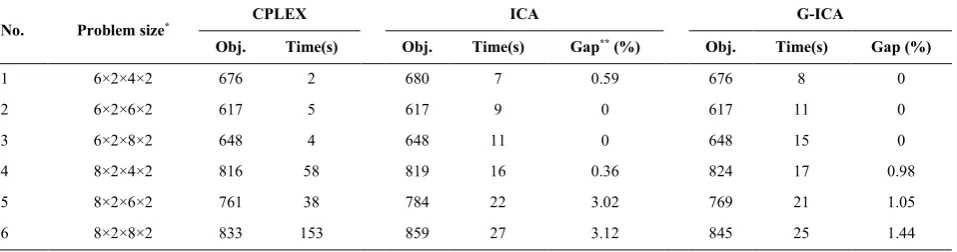
6. 2. Performance Assessment Objective function values obtained from the proposed ICA and solving the mathematical model by the CPLEX for small-sized problems are presented in Table 4. Due to NP-hard nature
TABLE 3. Different levels of algorithm parameters
Level -2 -1 0 1 2
Ncol 6n* 9n 12n 15n 18n
Nimp 5 10 15 20 25
M 0.1 0.3 0.5 0.7 0.9
prev 0.01 0.0125 0.016 0.025 0.05
n=number of containers
TABLE 4. Comparison of the solution methods for small-sized problems
No. Problem size* CPLEX ICA G-ICA
Obj. Time(s) Obj. Time(s) Gap** (%) Obj. Time(s) Gap (%)
1 6×2×4×2 676 2 680 7 0.59 676 8 0
2 6×2×6×2 617 5 617 9 0 617 11 0
3 6×2×8×2 648 4 648 11 0 648 15 0
4 8×2×4×2 816 58 819 16 0.36 824 17 0.98
5 8×2×6×2 761 38 784 22 3.02 769 21 1.05
6 8×2×8×2 833 153 859 27 3.12 845 25 1.44
of the problem, solving large-sized problems within a reasonable time is not possible. Though, the proposed model is efficient for solving small-sized instances using CPLEX. The dimensions of the problem for each instance are determined based on the number of QCs, YTs and containers.
As reported in Table 4, the proposed G-ICA found the optimal solution for three out of six instances. For remaining 3 instances, the gap ranges from 0.98 to 1.44. Whereas the proposed ICA algorithm found the optimal solution for two of instances. Mean gap for the proposed ICA and G-ICA algorithm is 1.18 and 0.57, respectively. Results for larger instances with three and four QCs are
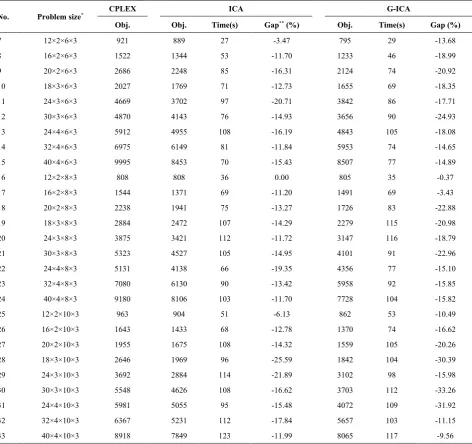
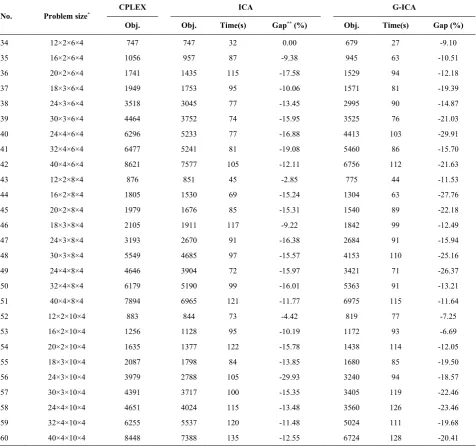
shown in Tables 5-7. The first and second columns in Tables 5 and 6 show the experiment number and problem size. It is worthy to note that CPLEX runs are time-restricted and the best solution obtained in 2 hours is reported in this table.
If one the following criteria is occurred, the proposed algorithms will be stopped:
- Weak empires are collapsed and all countries remained as an empire.
- Algorithm reached maximum time limit of 210 seconds.
- An improvement does not observed during 30 consecutive iterations.
TABLE 5. Comparison of ICA and G-ICA against CPLEX for instances with 3 QCs
No. Problem size* CPLEX ICA G-ICA
Obj. Obj. Time(s) Gap** (%) Obj. Time(s) Gap (%)
7 12×2×6×3 921 889 27 -3.47 795 29 -13.68
8 16×2×6×3 1522 1344 53 -11.70 1233 46 -18.99
9 20×2×6×3 2686 2248 85 -16.31 2124 74 -20.92
10 18×3×6×3 2027 1769 71 -12.73 1655 69 -18.35
11 24×3×6×3 4669 3702 97 -20.71 3842 86 -17.71
12 30×3×6×3 4870 4143 76 -14.93 3656 90 -24.93
13 24×4×6×3 5912 4955 108 -16.19 4843 105 -18.08
14 32×4×6×3 6975 6149 81 -11.84 5953 74 -14.65
15 40×4×6×3 9995 8453 70 -15.43 8507 77 -14.89
16 12×2×8×3 808 808 36 0.00 805 35 -0.37
17 16×2×8×3 1544 1371 69 -11.20 1491 69 -3.43
18 20×2×8×3 2238 1941 75 -13.27 1726 83 -22.88
19 18×3×8×3 2884 2472 107 -14.29 2279 115 -20.98
20 24×3×8×3 3875 3421 112 -11.72 3147 116 -18.79
21 30×3×8×3 5323 4527 105 -14.95 4101 91 -22.96
22 24×4×8×3 5131 4138 66 -19.35 4356 77 -15.10
23 32×4×8×3 7080 6130 90 -13.42 5958 92 -15.85
24 40×4×8×3 9180 8106 103 -11.70 7728 104 -15.82
25 12×2×10×3 963 904 51 -6.13 862 53 -10.49
26 16×2×10×3 1643 1433 68 -12.78 1370 74 -16.62
27 20×2×10×3 1955 1675 108 -14.32 1559 105 -20.26
28 18×3×10×3 2646 1969 96 -25.59 1842 104 -30.39
29 24×3×10×3 3692 2884 114 -21.89 3102 98 -15.98
30 30×3×10×3 5548 4626 108 -16.62 3703 112 -33.26
31 24×4×10×3 5981 5055 95 -15.48 4072 109 -31.92
32 32×4×10×3 6367 5231 112 -17.84 5657 103 -11.15
33 40×4×10×3 8918 7849 123 -11.99 8065 117 -9.56
TABLE 6. Comparison of ICA and G-ICA against CPLEX for instances with 4 QCs
No. Problem size*
CPLEX ICA G-ICA
Obj. Obj. Time(s) Gap** (%) Obj. Time(s) Gap (%)
34 12×2×6×4 747 747 32 0.00 679 27 -9.10
35 16×2×6×4 1056 957 87 -9.38 945 63 -10.51
36 20×2×6×4 1741 1435 115 -17.58 1529 94 -12.18
37 18×3×6×4 1949 1753 95 -10.06 1571 81 -19.39
38 24×3×6×4 3518 3045 77 -13.45 2995 90 -14.87
39 30×3×6×4 4464 3752 74 -15.95 3525 76 -21.03
40 24×4×6×4 6296 5233 77 -16.88 4413 103 -29.91
41 32×4×6×4 6477 5241 81 -19.08 5460 86 -15.70
42 40×4×6×4 8621 7577 105 -12.11 6756 112 -21.63
43 12×2×8×4 876 851 45 -2.85 775 44 -11.53
44 16×2×8×4 1805 1530 69 -15.24 1304 63 -27.76
45 20×2×8×4 1979 1676 85 -15.31 1540 89 -22.18
46 18×3×8×4 2105 1911 117 -9.22 1842 99 -12.49
47 24×3×8×4 3193 2670 91 -16.38 2684 91 -15.94
48 30×3×8×4 5549 4685 97 -15.57 4153 110 -25.16
49 24×4×8×4 4646 3904 72 -15.97 3421 71 -26.37
50 32×4×8×4 6179 5190 99 -16.01 5363 91 -13.21
51 40×4×8×4 7894 6965 121 -11.77 6975 115 -11.64
52 12×2×10×4 883 844 73 -4.42 819 77 -7.25
53 16×2×10×4 1256 1128 95 -10.19 1172 93 -6.69
54 20×2×10×4 1635 1377 122 -15.78 1438 114 -12.05
55 18×3×10×4 2087 1798 84 -13.85 1680 85 -19.50
56 24×3×10×4 3979 2788 105 -29.93 3240 94 -18.57
57 30×3×10×4 4391 3717 100 -15.35 3405 119 -22.46
58 24×4×10×4 4651 4024 115 -13.48 3560 126 -23.46
59 32×4×10×4 6255 5537 120 -11.48 5024 111 -19.68
60 40×4×10×4 8448 7388 135 -12.55 6724 128 -20.41
* No. of containers× No. of vessels × No. of YTs × No. of QCs ** Gap= (obj. - CPLEX obj.)/CPLEX obj.×100
Table 7 compares the ICA and G-ICA performance for large size instances. From the results we observe that in 11 instances the G-ICA has a better performance regarding to ICA algorithm.
In this study for comparison among solution methods a comparative factor called Relative Percentage Deviation (RPD) has been used. This performance measure is determined based on the following equation where IN represents the value of objective function of the given algorithm for the ith instance and IN O > denotes the best objective function obtained for the i th
instance. Also the number of instances is indicated by n [40]:
PQR = 0∑ STA1STABA@
STABA@ 2U × 100 (21)
Table 8 shows the RPD of the proposed algorithms for larger instances with three and four QC.
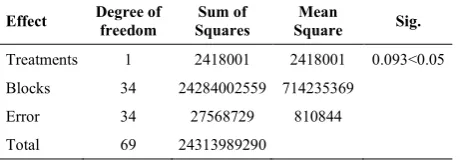
An experimental design based on Montgomery is used to assess the performance of the developed algorithms [41]. The significance level is assumed to be 5% and the experiments coded with IBM SPSS Statistics software.
TABLE 7. Performance of algorithms for large size instances
No. Problem size* ICA G-ICA
Obj. Obj.
61 150×3×12×3 35369 31151
62 150×3×14×3 34781 29918
63 150×3×12×4 30571 26491
64 150×3×14×4 29837 25274
65 200×4×12×3 41298 39650
66 200×4×14×3 37092 38292
67 200×4×12×4 36790 35833
68 200×4×14×4 35861 32472
69 225×3×12×3 48251 50231
70 225×3×14×3 47790 45466
71 225×3×12×4 44544 42835
72 225×3×14×4 39582 41138
73 300×4×12×3 64088 63452
74 300×4×14×3 61704 62964
75 300×4×12×4 55712 56866
76 300×4×14×4 55352 53967
* No. of containers× No. of vessels × No. of YTs × No. of QCs
TABLE 8. The RPD for the presented algorithms
No. of QCs
No. of YTs
No. of instances
Algorithms RPD (%)
ICA G-ICA
Three-QC 6 9 5.83 0.49
8 9 5.35 1.55
10 9 8.09 2.05
12 4 4.67 1.02
14 4 5.34 1.31
total 35 6.09 1.32
Four-QC 6 9 6.85 1.19
8 9 7.40 0.44
10 9 5.81 2.72
12 4 5.51 0.51
14 4 7.76 0.98
total 35 6.67 1.29
TABLE 9. ANOVA table for problems with three QCs
Effect Degree of freedom Squares Sum of Square Mean Sig.
Treatments 1 2418001 2418001 0.093<0.05
Blocks 34 24284002559 714235369
Error 34 27568729 810844
Total 69 24313989290
Moreover according to the significance of p-value (less than 0.05) for four machine problems in Table 10, the G-ICA is better than the proposed ICA algorithm.
6. 3. Simulated Annealing (SA) Algorithm For further evaluation of the proposed algorithms, the performance of the G-ICA has been compared with a general simulated annealing (SA) algorithm. The SA algorithm starts from an initial solution and consecutively moves to new neighboring solutions via algorithm loops. At every step, the simulated refrigeration considers a neighboring state and decides between proceeding to the new state and remaining the previous state probabilistically. If the new solution outperforms the current solution in terms of the value of objective function, the current solution is replaced by the new one. To avoid confinement by a local optimal solution, the algorithm accepts the new solution with a specific probability.
Table 11 shows the average deviation of the results of SA algorithm with the proposed G-ICA and ICA algorithms.
It shows that ICA and G-ICA algorithms performs better results than SA algorithm with average gap of 52 and 59%, respectively.
6. 4. Sensitivity Analysis For further evaluation of the proposed metaheuristics, the impact of the number of YTs on the objective function was investigated.
TABLE 10. ANOVA table for problems with four QCs
Effect Degree of freedom Squares Sum of Square Mean Sig.
Treatments 1 4682211 4682211 0.019<0.05
Blocks 34 18800325791 552950758
Error 34 26229447 771454
Total 69 18831237450
TABLE 11. Performance of the SA algorithm
No. of QCs
No. of YTs
No. of instances
Deviation (%)
(SA-ICA)/ICA (SA-GICA)/GICA
Three-QC
6 9 52.99 62.05
8 9 45.99 49.58
10 9 44.51 55.62
total 27 47.83 55.27
Four-QC
6 9 63.97 72.35
8 9 53.32 64.00
10 9 52.56 57.45
The value of objective function and utilization rate for YTs and QCs for different instances with 15 containers and a specific number of QCs in relation to different numbers of YTs is shown in Figure 12.
A significant relation between total completion time of vessels and the number of YTs is indicated based on this figure. Increasing the number of YTs leads to improvement in the value of objective function and better utilization of QCs which are main equipment of container terminals. However, as it is expectable, utilization rate of yard trucks decreases by increasing number of the YTs. It shows a tradeoff between more utilization of QCs and improvement in objective function and number of assigned YTs. Decision makers should find an optimal point which is the balance of cost of more YTs assignment and completion time related penalties.
In Figure 13, the total completion time obtained of G-ICA algorithm considering different number of quay cranes is shown. Each line in this figure shows the objective function value for different number of yard trucks. The increase in the number of quay cranes would
(a)
(b)
(c)
Figure 12. Effect of increasing number of YTs on objective function and utilization of machines for instances with (a) 2 QCs, (b) 3 QCs and (c) 4 QCs
Figure 13. Effect of increasing number of QCs on objective function
not lead to a considerable improvement in the value of objective function. It shows that increasing number of yard trucks for this problem size leads to better performance rather than increasing number of quay cranes. However, this proposition should be tested for other instances with different number of jobs. This sensitivity analysis is useful to find out the bottleneck of loading/unloading process and determine the optimal number of QCs or YTs in a container terminal.
As mentioned in section 3, two-cycle strategy for yard trucks assignment has been considered in this study. The effectiveness of this approach in yard trucks operation has been examined. For this purpose 9 instances with two quay cranes and different number of yard trucks have been solved. The results which are reported in Figure14 shows that two-cycle strategy leads to faster loading and unloading procedure.
As shown in Figure14 using dynamic assignment of yard truck to quay cranes helps to find solutions with average 9.7% better objective function. Evidently the gap between the solutions of these two approaches is tighter for the instances with the more number of yard trucks.
6. 4. A Real World Case The proposed algorithms are applied on the real data of a port in Iran to show the applicability of the research problem. This port is located in the north of Persian Gulf with the capacity of about 5 million TEUs annually.
Figure 14. Comparison of the YT assignment strategies (two-cycling vs. one cycling)
1500 2000 2500 3000 3500 4000 4500 5000 5500
1 2 3
T
im
e
(s
)
Number of QCs
2 YT 3 YT 4 YT 5 YT 6 YT 7 YT 8 YT 9 YT 10 YT
2000 3000 4000 5000 6000 7000
2 3 4 5 6 7 8 9 10
O
b
je
ct
iv
e
fu
n
ct
io
n
Number of YTs
The allocation of containers to QCs and YTs and also the schedule of processing of containers on QCs and YTs for a real case with the following input (Table 12) is determined.
The main assumptions of the proposed problem in this paper such as non-crossing and precedence are also practical in real world. The results are summarized in Table 13.
As shown in Table 13, the G-ICA has a better performance in comparison with the other proposed algorithms. Moreover the resources, including QCs and YTs, are utilized in a balanced manner. Based on the comments of experts of the port, the obtained schedule for processing the containers provides better solution to the above-mentioned instance compared to the regular scheduling procedure in the port.
TABLE 12. Parameters of the real case
Parameter Value
Number of QCs 6
Number of YTs 30
The processing time of
containers by a QC 144
The departure time of trucks 200
Number of containers 365
Vessel A Vessel B
Inbound containers 138 103
Outbound containers 0 124
Bays 19 19
TABLE 13. Analysis of the results for the real case
SA ICA G-ICA
Objective function 48816 32256 31752
Completion time of vessel A 23328 15768 15696
Completion time of vessel B 25488 16488 16056
Maximum number of containers
processed by a QC 67 68 68
Minimum number of containers
processed by a QC 55 55 54
Maximum number of containers
processed by a YT 28 22 19
Minimum number of containers
processed by a YT 1 5 5
7. CONCLUSION
In this study, joint quay crane and yard truck scheduling problem in a container terminal was investigated. A
mathematical model is extended for considering main real-world assumptions such as quay crane non-interference, precedence constraints and variable berthing times for vessels. Due to NP-hard nature of the problem, two versions of imperialist competitive algorithm (ICA) are proposed to heuristically solve the problem. The proposed metaheuristic algorithms can find optimal or near to optimal solutions, especially for small and medium size problems. Moreover, the G-ICA algorithm is proposed which is considering the YTs assignment problem as a grouping problem. The numerical results showed that G-ICA outperformed the ICA. Moreover, a simulated annealing (SA) algorithm is developed to solve the problem and evaluate the performance of the proposed ICA algorithms. It shows that performance of the proposed ICA algorithms is significantly better. Also an instance of a container terminal in Iran has been investigated which shows that the proposed model and solution methods are applicable in real world problems.
Considering uncertainty in processing times of containers on the QCs and YTs, non-identical equipment (QCs with different productivity rates) and considering multi objective optimization, are some of future studies that may be conducted.
8. REFERENCES
1. UNCTAD, Review of the maritime transport 2013, United
Nations Conference on Trade and Development, Geneva: Switzerland, 2013.
2. Ng, W.C. and Mak, K. L., “Quay crane scheduling in container
terminals”, Engineering Optimization, Vol. 38, No. 6, (2006),
723–737.
3. Zegordi, S.H. and Nahavandi, N., “Measuring productivity
indexes and efficiency in the container terminal at port Rajaei”,
Scientia Iranica, Vol. 9, No. 3, (2002), 248–254.
4. Tongzon, J. and Heng, W., “Port privatization, efficiency and
competitiveness: Some empirical evidence from container ports
(terminals)”, Transportation Research Part A: Policy and
Practice, Vol. 39, No. 5, (2005), 405–424.
5. Tang, L., Zhao, J. and Liu, J., “Modeling and solution of the joint
quay crane and truck scheduling problem”, European Journal of
Operational Research, Vol. 236, No. 3, (2014), 978–990.
6. Daganzo, C. F., “The crane scheduling problem”, Transportation
Research Part B: Methodological, Vol. 23, No. 3, (1989), 159–
175.
7. Kim, K.H. and Park, Y. M., “A crane scheduling method for port
container terminals”, European Journal of Operational
Research, Vol. 156, No. 3, (2004), 752–768.
8. Moccia, L., Cordeau, J.F., Gaudioso, M. and Laporte, G., “A
branch‐and‐cut algorithm for the quay crane scheduling problem
in a container terminal”, Naval Research Logistics (NRL), Vol.
53, No. 1, (2006), 45–59.
9. Bierwirth, C. and Meisel, F., “A fast heuristic for quay crane
scheduling with interference constraints”, Journal of Scheduling,
Vol. 12, No. 4, (2009), 345–360.
mathematical model for a quay crane scheduling problem in
container ports”, Computers & Industrial Engineering, Vol. 56,
No. 1, (2009), 241–248.
11. Nguyen, S., Zhang, M., Johnston, M. and Tan, K. C., “Hybrid evolutionary computation methods for quay crane scheduling
problems”, Computers & Operations Research, Vol. 40, No. 8,
(2013), 2083–2093.
12. Kaveshgar, N., Huynh, N. and Rahimian, S. K., “An efficient genetic algorithm for solving the quay crane scheduling problem”,
Expert Systems with Applications, Vol. 39, No. 18, (2012),
13108–13117.
13. Liu, J., Wan, Y.W. and Wang, L., “Quay crane scheduling at container terminals to minimize the maximum relative tardiness
of vessel departures”, Naval Research Logistics (NRL), Vol. 53,
No. 1, (2006), 60–74.
14. Emde, S., “Optimally scheduling interfering and non‐interfering
cranes”, Naval Research Logistics (NRL), Vol. 64, No. 6, (2017),
476–489.
15. Sammarra, M., Cordeau, J.F., Laporte, G. and Monaco, M. F., “A tabu search heuristic for the quay crane scheduling problem”,
Journal of Scheduling, Vol. 10, No. 4–5, (2007), 327–336.
16. Liang, C., Fan, L., Xu, D., Ding, Y. and Gen, M., “Research on coupling scheduling of quay crane dispatch and configuration in
the container terminal”, Computers & Industrial Engineering,
Vol. 125, (2018), 649–657.
17. Sun, D., Tang, L. and Baldacci, R., “A Benders decomposition-based framework for solving quay crane scheduling problems”,
European Journal of Operational Research, Vol. 273, No. 2,
(2019), 504–515.
18. Kasm, O.A. and Diabat, A., “The quay crane scheduling problem with non-crossing and safety clearance constraints: An exact
solution approach”, Computers & Operations Research, Vol.
107, (2019), 189–199.
19. Bierwirth, C. and Meisel, F., “A survey of berth allocation and quay crane scheduling problems in container terminals”,
European Journal of Operational Research, Vol. 202, No. 3,
(2010), 615–627.
20. Bierwirth, C. and Meisel, F., “A follow-up survey of berth allocation and quay crane scheduling problems in container
terminals”, European Journal of Operational Research, Vol.
244, No. 3, (2015), 675–689.
21. Bish, E. K., “A multiple-crane-constrained scheduling problem in
a container terminal”, European Journal of Operational
Research, Vol. 144, No. 1, (2003), 83–107.
22. Nishimura, E., Imai, A. and Papadimitriou, S., “Yard trailer
routing at a maritime container terminal”, Transportation
Research Part E: Logistics and Transportation Review, Vol. 41,
No. 1, (2005), 53–76.
23. Ng, W.C., Mak, K.L. and Zhang, Y. X., “Scheduling trucks in
container terminals using a genetic algorithm”, Engineering
Optimization, Vol. 39, No. 1, (2007), 33–47.
24. Hu, Z.H., Sheu, J.B. and Luo, J. X., “Sequencing twin automated stacking cranes in a block at automated container terminal”,
Transportation Research Part C: Emerging Technologies, Vol.
69, (2016), 208–227.
25. Sidoti, D., Avvari, G.V., Mishra, M., Zhang, L., Nadella, B.K., Peak, J.E., Hansen, J.A. and Pattipati, K. R., “A multiobjective path-planning algorithm with time windows for asset routing in a
dynamic weather-impacted environment”, IEEE Transactions
on Systems, Man, and Cybernetics: Systems, Vol. 47, No. 12,
(2016), 3256–3271.
26. Yang, Y., Zhong, M., Dessouky, Y. and Postolache, O., “An integrated scheduling method for AGV routing in automated
container terminals”, Computers & Industrial Engineering, Vol.
126, (2018), 482–493.
27. Chen, L., Bostel, N., Dejax, P., Cai, J. and Xi, L., “A tabu search algorithm for the integrated scheduling problem of container
handling systems in a maritime terminal”, European Journal of
Operational Research, Vol. 181, No. 1, (2007), 40–58.
28. Cao, J., Shi, Q. and Lee, D. H., “Integrated quay crane and yard
truck schedule problem in container terminals”, Tsinghua science
and technology, Vol. 15, No. 4, (2010), 467–474.
29. Chen, L., Langevin, A. and Lu, Z., “, 2013. Integrated scheduling of crane handling and truck transportation in a maritime container
terminal”, Research, European Journal of Operational, Vol.
225, No. 1, (2013), 142–152.
30. Kaveshgar, N. and Huynh, N., “Integrated quay crane and yard
truck scheduling for unloading inbound containers”,
International Journal of Production Economics, Vol. 159,
(2015), 168–177.
31. He, J., Huang, Y., Yan, W. and Wang, S., “Integrated internal truck, yard crane and quay crane scheduling in a container
terminal considering energy consumption”, Expert Systems with
Applications, Vol. 42, No. 5, (2015), 2464–2487.
32. Karam, A., ElTawil, A.B. and Harraz, N. A., “Simultaneous assignment of quay cranes and internal trucks in container
terminals”, International Journal of Industrial and Systems
Engineering, Vol. 24, No. 1, (2016), 107–125.
33. Vahdani, B., Mansour, F., Soltani, M. and Veysmoradi, D., “Bi-objective optimization for integrating quay crane and internal
truck assignment with challenges of trucks sharing”,
Knowledge-Based Systems, Vol. 163, (2019), 675–692.
34. Pinedo, M., Scheduling, Vol. 29, New York: Springer, 2012. 35. Yegane, B.Y., Kamalabadia, I.N. and Khanlarzadeb, N., “Critical
Path Method for Lot Streaming Problem in Flexible Job Shop
Environment”, International Journal of Engineering -
Transactions B: Applications, Vol. 30, No. 2, (2017), 261–269.
36. Atashpaz-Gargari, E. and Lucas, C., “Imperialist competitive algorithm: an algorithm for optimization inspired by imperialistic competition”, In 2007 IEEE congress on evolutionary computation, IEEE, (2007), 4661–4667.
37. Hosseinirad, S. M., “A Hierarchy Topology Design Using a Hybrid Evolutionary Algorithm in Wireless Sensor Networks”,
International Journal of Engineering - Transactions A: Basics,
Vol. 31, No. 10, (2018), 1651–1658.
38. Azizmohammadi, R., Amiri, M., Tavakkoli-Moghaddam, R. and Mohammadi, M., “Solving a redundancy allocation problem by a hybrid multi-objective imperialist competitive algorithm. , 26(9),
pp..”, International Journal of Engineering - Transactions C:
Aspects, Vol. 26, No. 9, (2013), 1031–1042.
39. Kashan, A.H., Kashan, M.H. and Karimiyan, S., “A particle
swarm optimizer for grouping problems”, Information Sciences,
Vol. 252, (2013), 81–95.
40. Behjat, S. and Salmasi, N., “Total completion time minimisation of no-wait flowshop group scheduling problem with sequence
dependent setup times”, European Journal of Industrial
Engineering, Vol. 11, No. 1, (2017), 22–48.
A Mathematical Model and Grouping Imperialist Competitive Algorithm for
Integrated Quay Crane and Yard Truck Scheduling Problem with Non-crossing
Constraint
S. Behjat, N. Nahavandi
Industrial & Systems Engineering Faculty, Tarbiat Modares University, Tehran, Iran
P A P E R I N F O
Paper history: Received 23 June 2019
Received in revised form 13 August 2019 Accepted 12 Septemaber 2019
Keywords: Grouping
Imperialist Competitive Algorithm Mathematical Model
Non-crossing Quay Crane Scheduling Yard Truck Scheduling
! " # ! $ %& & ! ' ! (& & )
.+%& ,
. /0 0 1 231 4 5 6 5 ! 78& / " # 9: ; : 5 ! $ %& & ! & < = > & ! ? 2 3?' / 4 $@ ! A$3B ' C
D E '
F %& .+%& , - (& & '
G 6 ? : <! . ! @ ? & !
& ' & ' 7 & ( H
/ 9% /
# .+%& & I
+
NP-hard
=J& < J H K3 73%& + 8 !
(ICA)
& ! 3 && 1 6 L J H !
M .+%& , - (& & 2
=J& K3 73%& + 8 !
39 / , 4 ; @N !
(G-ICA)
5 & ! $ : .+%& , - , & 7% J H
=J& K3 ! ! @ ? & !
O& # < ' 7 & ( H
! . & L /0
& ! P 7 & ( H
= H M .+%& , -2 =J& K3 9-% ! 9
(SA)
& / ' + N O& # ! =J& K3 ! ! @ ? 35 F %& .+%& , - , & 7% Q : ! G 6 ? G ! =J& K3 73%& + 8 ! 39 / ; @N , 4 !
3@ $ :
! =J& +9H5 K3
73%& + 8 !
9- , % % ! 9 & , R: . & 2
78& J H / & & & 5 % / 35 ' 31 4 & 8 Q
?5 $L / S . < !
! @ ? & 2
5 ( H ! 78& / , N3%& 8 ,
! % /
-.
![Figure 1. Schematic layout of a container terminal [2]](https://thumb-us.123doks.com/thumbv2/123dok_us/16753.2001682/1.595.325.526.583.669/figure-schematic-layout-container-terminal.webp)