A novel fast maximum power point tracking for a PV system
using hybrid PSO-ANFIS algorithm under partial shading
conditions
Javad Farzaneh
*, Reza Keypour
*, and Ali Karsaz
†It is highly expected that partially shaded condition (PSC) occurs due to the moving clouds in a large photovoltaic (PV) generation system (PGS). Several peaks can be seen in the P-V curve of a PGS under such PSC which decreases the efficiency of conventional maximum power point tracking (MPPT) methods. In this paper, an adaptive neuro-fuzzy inference system (ANFIS) is proposed based on particle swarm optimization (PSO) for MPPT of PV modules. After tuning the parameters of the fuzzy system, including membership function parameters and consequent part parameters, to obtain maximum power point (MPP), a DC/DC boost converter connects the PV array to a resistive load. ANFIS reference model is used to control duty cycle of the DC/DC boost converter, so that maximum power is transferred to the resistiveload. Comparing the proposed method with PSO alone method and firefly algorithm (FA) alone shows its efficacy and high speed tracking of MPP under PSC. Due to the fact that these optimization algorithms have online applications, the convergence time of the algorithms is very important. The simulation results show that the convergence time for the proposed ANFIS-based method is lower than 0.15 second, while it is nearly three second for PSO and FA methods.
Article Info
Keywords:
Adaptive Neuro-fuzzy inference system,
Maximum power point tracking, Partial shading condition Particle swarm optimization, Photovoltaic systems. Article History:
Received 2018-03-14
Accepted 2018-06-30
I.
I
NTRODUCTIONDue to the increase in electrical energy demands in industrial and individual sectors, more and more electrical power is required. However, since fossil fuels such as coal, oil, and etc. pollute the environment and increases the global temperature, the demand for renewable and sustainable energy increases every day. Since one of the most available energy resources is solar energy, PGS is one of the most frequently used technologies with rapid grown in the past decades. The advantages of PGS include low maintenance requirements and capability of operation without consumption of fuel which results in low cost and less environmental pollutions. The most important drawback of employing PGS is that its efficiency is low and has higher costs [1-4].
The main challenge in application of PGS is to deal with its nonlinear current–voltage (I–V) characteristics where its MPP changes with temperature and irradiance. The typical power-voltage (P–V) and (I-V) curves of PV module indicate a unique MPP at one specific operating point including irradiance and temperature conditions. PV module usually generates intermittent power mainly due to the time-varying solar radiation and panel temperature [5-7], therefore it is indispensable to develop online MPPT algorithm able to find MPP of the PV module in the real time. There are many approaches in the literature that extract the MPP of a PGS. Examples of such approaches include incremental conductance (INC) [8], perturb and observe (P&O) [9], fuzzy logic [10], and ripple correlation approaches [11]. These methods try to increase the efficiency and reduce the time under identical solar irradiance. Among aforementioned methods, perturb and observe method is most widely used.
This method is based on perturbation of voltage using the present P and previous operating power Pold, if the generated A
B
S
T
R
A
C
T
†
Corresponding Author: [email protected]
* Department of Electrical and Computer Engineering Faculty, Semnan University, Semnan, Iran
power by PV system increases, that is, the operational point moves towards the maximum power point, therefore in the next exploitation voltage, perturbation is created in direction of the previous exploitation voltage. This operation continues until MPP is reached, but if the power received from the PV system decreases, it means that it is far from MPP and therefore direction of the perturbation should be changed [12-14]. Although this method is very simple but its efficiency highly depends on the convergence speed and fluctuations around MPP, because if convergence speed increases, convergence accuracy decreases and fluctuations around MPP increase, thus parameters should be adjusted such that neither convergence speed is low nor fluctuation around MPP is high [15]. Rapid change of irradiance is another major challenge for P&O method which will probably lose its direction instead of tracking the true MPP. Such techniques are not fully adaptive and not very effective. Furthermore, most methods fail to track the true MPP under PSC and this is because multiple peaks (local and global peaks) specify the PV curves [16-18]. It is highly expected that the P&O algorithm get trapped in a local optimum and is not able to distinguish between local optimum and global optimum [19]. Having several peaks significantly decrease the efficiency of conventional MPPT methods, because probability of PSC occurrence is very high, thus it is required to develop appropriate MPPT methods which can track global MPP (GMPP) under PSC. To eliminate the barriers of GMPP tracking, meta-heuristic algorithms have also been used, such as Ant-colony optimization (ACO), firefly algorithm, artificial bee colony algorithm, particle swarm optimization, genetic algorithm, cuckoo search, grey wolf optimization, etc. [18, 20-27]. Several GMPP tracking methods are proposed for PGS operating under PSC. Authors of [28] used a scanning process to identify the regions in which there is a GMPP at the first step. Then, they applied P&O method to find the GMPP. Although this method can find GMPP efficiently, tracking speed is limited because almost all local maximum peaks (LMPs) must be found and checked to obtain the GMPP. In [29], in order to increase the convergence speed of PSO, the authors combined PSO with P&O. In this hybrid algorithm, P&O method first detects the nearest local MPP, and then PSO starts searching to find the global MPP. Merit of this method is the limited search space. In order to find GMPP of a modular PV system, ACO method is used [21]. The proposed method is able to track the global MPP with a single-current sensor at the output. In such situation, initial conditions specify the convergence speed of this method. Daraban integrated genetic algorithm (GA) with P&O method and makes one algorithm [22]. One benefit of this method is that it reduces the population size which decreases the number of iterations and results in faster detection of Global MPP. In [30], an artificial neural network (ANN) based MPPT is proposed whose parameters are optimized using a GA procedure for different irradiance and
temperatures conditions. The results are used for offline training of the ANN and this method tracking MPP under uniform irradiance. In [31], an adaptive Neuro-fuzzy inference system-based MPP tracker for PV module is proposed, where the tracking MPP is in uniform irradiance conditions and cannot track the global MPP in PSC. In [32], a MPPT for PV system using adaptive neuro-fuzzy inference system was proposed. In order to train ANFIS, incremental conductance method based on uniform irradiance approach was used. In [33] at first a wide range is overviewed to locate the MPP range over the voltage axis. Then a detailed search around the maximum point obtained in previous step is performed to locate GMPP. Even though this method is capable of tracking MPP under PSC, it has low speed due to overviewing all P-V curves in the first stage. Reference [16] tries to extract the maximum power in PSC by combining gray wolf algorithm and P&O method; firstly, by using gray wolf algorithm the range of global maximum power point is determined and then by using P&O method it tracks the MPP. Because of using P&O method in the second stage, speed of this method is acceptable but since this method works based on perturbation of voltage or current, fluctuations around the MPP are very high and this leads to loss of power.
In this paper, a hybrid method based on PSO-ANFIS is used to track GMPP under PSC in PGS. PSO is well-known as an optimization algorithm that finds the optimum point of a function. The inputs of fuzzy system are temperature and irradiation of each panel. The main objective is to achieve a system for finding the global MPP without the need to search the space and try several different points. The simulation results indicate that the convergence speed is very high and this hybrid method can find global MPP under PSCs.
This paper is organized in seven sections. In Section II characteristic of the PGS under PSC is explained. In Section III the FA method is described. In Section IV, the PSO method is briefly reviewed, and the Overview of ANFIS is described in V. In Section VI the application of PSO toward MPPT is described. In section VII the proposed hybrid PSO-ANFIS method is described. The simulation results are presented in Section VIII. Finally, the concluding marks are provided in Section IX.
II.
CHARACTERISTICS
OF
THE
PGS
U
NDERPSC
A.Basic Characteristics of a PV Array
parallel. In order to increase voltage, current and power, the PV cells need to be connected together. The output equation for the entire module in Fig. 1 can be written [34].
I I I ∗ exp 1 (1)
V (2) where
I Photocurrent [A].
V Terminal voltage of PV module [V]. I Diode Saturation current [A].
q Charge of the electron [C] Maintaining the Integrity. K Boltzmann’s constant (J/K).
T Junction temperature [K]. N' Number of cells in series.
R) Parallel resistance of PV module (Ω). R' Series resistance of PV module (Ω). A Diode ideality constant.
The characteristics of the PV module are given in Table I.
Fig. 1: Single-diode model of PV module
TABLE I.
Parameters of single PV module
200W Maximum Power
32.9V Nominal open circuit voltage (V +,)
26.3V Maximum power voltage (V- )
8.21A Nominal short circuit current (I +,)
7.61A Maximum power current (I- )
54 Number of cells in series N'
B.Effects of Solar Irradiance and Temperature
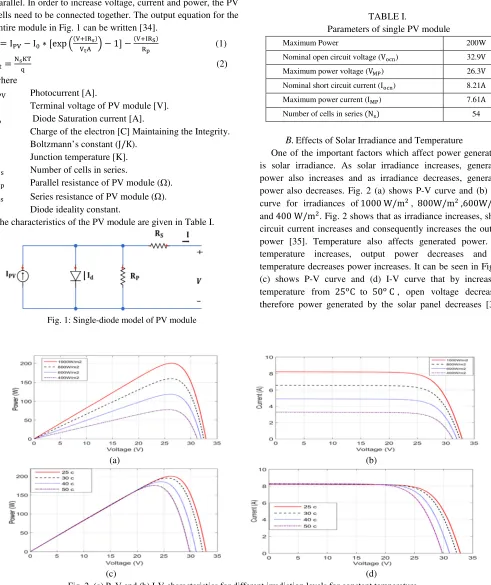
One of the important factors which affect power generation is solar irradiance. As solar irradiance increases, generated power also increases and as irradiance decreases, generated power also decreases. Fig. 2 (a) shows P-V curve and (b) I-V curve for irradiances of1000 W/m2, 800W/m2 ,600W/m2 and 400W/m2. Fig. 2 shows that as irradiance increases, short circuit current increases and consequently increases the output power [35]. Temperature also affects generated power. As temperature increases, output power decreases and as temperature decreases power increases. It can be seen in Fig. 2 (c) shows P-V curve and (d) I-V curve that by increasing temperature from 25 C to 50 C, open voltage decreases, therefore power generated by the solar panel decreases [36].
(a) (b)
(c) (d)
Fig. 2. (a) P–V and (b) I-V characteristics for different irradiation levels for constant temperature. (c) P–V and (d) I-V characteristics for different temperature levels and constant irradiance C.Effect of PSC on PV Array
In high dimensions, some part of the PV system might be shaded by clouds, trees or other objects and this created partial shading because irradiance is not uniform. When this
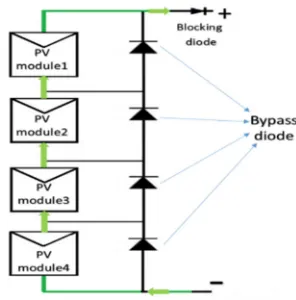
created and burns the part of the module which is shaded and creates open voltage. To avoid this problem the bypass diodes perch parallel with modules and these bypass diodes allow the current to flow in one direction [37]. In case of partial shading, current can pass from diode. This prevents the power loss in the panel and prevents the problem like hot spot. When there is a bypass diode in the system and under partial shading condition, PV curve becomes more complicated and several peaks are observed (one global and several local) [38]. In Fig. 3, four PV modules are connected in series in which various radiations reach them.
In Fig. 4, photovoltaic system P-V, P-I & I-V curve for various radiations are shown. In this curve uniform irradiance
of 1000W/m2 and two samples under PSC are drawn. In
sample 1 (case 1) 1000 W/m2,900W/m2, 800W/m2 and
700 W/m2 radiations and in second sample 1000W/m2,
800W/m2 600W/m2, 400W/m2 are given. Global MPP
under PSCs are specified in picture.
Fig. 3. Four series (4S) configuration under various irradiance.
(a) (b) (c)
Fig. 4. (a) P-V, (b) I-V, (c) P-I curve in uniform radiation and partial shading condition
III.
G
ENERALO
VERVIEW OFFA
One of the meta-heuristic algorithms is the Firefly algorithm which was proposed by Tung from Cambridge University in 2007 [39]. This algorithm is based on swarm like PSO. This algorithm employs an iterative process based on population with a high number of agents called firefly. These agents are allowed to search the search space better than distributed random search. For simplicity, three following rules are used to describe firefly algorithm:
1) All fireflies are unisex, such that a firefly is attracted to other fireflies regardless of its sex.
2) Attractiveness is proportional to their luminosity, therefore in each couple, the one with less luminosity moves towards the one with higher luminosity. Attractiveness is proportional to luminosity and both decrease as distance increases. If none of the fireflies has higher luminosity compared to the other one, movement would be random.
3) Luminosity of a firefly is determined or affected by perspective of the objective function.
There are two major problems in firefly algorithm: variations of luminosity and attraction formula. For simplicity, it can be assumed that attractiveness of a firefly is determined by its luminosity which is related to objective function. Since
attractiveness of the firefly is proportional to luminosity viewed by the adjacent firefly, attractiveness of a firefly can be defined as follows:
< < =>?@A (3) attractiveness at r = 0 and γ is attractiveness coefficient. Distance between each two fireflies i and j at xD and xE would be as follows.
rDE || GH GI || J∑MLNO xD,L xE,L 2 4 Movement of a firefly i attracted by a brighter firefly j is as follows.
xD O xDP β e>RSA
(xE- xD)P αԑD 5 The second term is in relationship with attractiveness. Third
term is randomization operation in which V is randomization operation and i is a vector of random numbers obtained from a Gaussian distribution or a uniform distribution.
IV.
G
ENERALO
VERVIEW OFPSO
Distribution of particles in the solution space is random. In each iteration, particles employ two final values to update themselves. Desired solution in the first value which the particle finds and it is called the best personal value, second final value is the desired solution which is identified by all particles and it is called the best global value. When the best solutions are found, particles update their acceleration and position according to the following equations.
(6)
VDL O
WVDLP CO randOL ZpbestDL xLD^ P C2 rand2L ZgbestDL xDL^
(7)
xDL O xDL P vDL O
where VDL is acceleration of particle ith from kth iteration, W is weight, CO and C2 are acceleration coefficients which are used to guide the search towards the personal and global solutions,
randO and rand2 are random numbers between 0 and 1. Among
all evolutionary methods, PSO is mainly used to track GMPP because this method is optimized based on swarm.
V.
O
VERVIEW OFANFIS
Neuro-fuzzy models which were developed by Jang in 1993, combine fuzzy logic and artificial neural networks to facilitate the learning and adaptation processes [41]. In fact, in neuro-fuzzy models, an adaptive network which is the general form of a multi-layer pioneer neural network is used to resolve the problem of identifying parameters of fuzzy inference system. An adaptive network is a multi-layer pioneer structure where its output behavior is determined through a set of modifiable parameters. Using such an adaptive neural network, the main problem of using fuzzy inference system which is obtaining “if-then” rules and optimizing parameters of the model is solved. Most commonly used fuzzy inference system which can be used in an adaptive network is Takagi-Sugeno fuzzy system the output of which is a linear relation and its parameters can be estimated through combining mean square error and back-propagation error based on gradient reduction.
Membership functions of x are in AOand A2, membership functions of y are in BO and B2 and pO, qO, rO, p2, q2, r2 are parameters of the output function. Fig. 5 shows ANFIS structure equivalent to the mentioned inference system.
Fig. 5: ANFIS configuration
VI.
A
PPLICATION OFPSO
FORMPPT
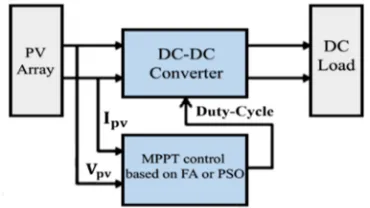
Fig. 6 shows a block diagram of MPPT scheme based on PSO method. The intended system has PV modules and a DC-DC boost converter is used as interface between load and PV system. The steps of tracking MPP based on PSO are described below.Step.1: Parameter selection. In the proposed system the position of particles are defined as the duty cycle DC-DC converter and all the power produced by PV systems is considered as a merit. A point to note is that if we consider a large number of particles, MPP tracking will guarantee the accuracy even under complex light patterns, but it increases the calculation time. So the number of particles should be considered in a way that we face neither an increase in the calculation time nor the accuracy cut. To achieve this aim we consider one particle for each module.
Step. 2: Initializing PSO. In the initialization phase of PSO, the particles in search space randomly are between dcD, and dcde values. dcde and dcD, are maximum and minimum duty cycle value for dc-dc converter, in this paper they have been considered between 0.1 and 0.9 respectively.
Step. 3: Calculation merit. After the PWM command was given to the DC-DC converter based on the position of the particle i, during the specified time that fluctuations became stable, the PV's voltage and current are measured. This value is calculated as the amount of particle's merit.
Step. 4: Updating values of gbest and pbest. If for a specific particle, its merit is better than its pbest, the merit value will be saved and replaced. If this amount is also better than gbest, this value will replace the gbest's value.
Step. 5: When all particles are evaluated, position and velocity of all particles of the population should be updated.
Step. 6: Determining convergence. Here, the simulation time is selected 3 sec for all methodologies, so after this time the algorithms will stop. But for evaluation, the number of repetitions of each algorithm is recorded when the average relative change in the best fitness function value over the 3 sec is less than or equal to a specific value.
Step. 7: Due to changes in solar radiation and temperature, the output power of photovoltaic system varies, in this situation particles swarm algorithm automatically runs again to track new optimum operating point.
VII.
P
ROPOSEDH
YBRIDPSO-ANFIS
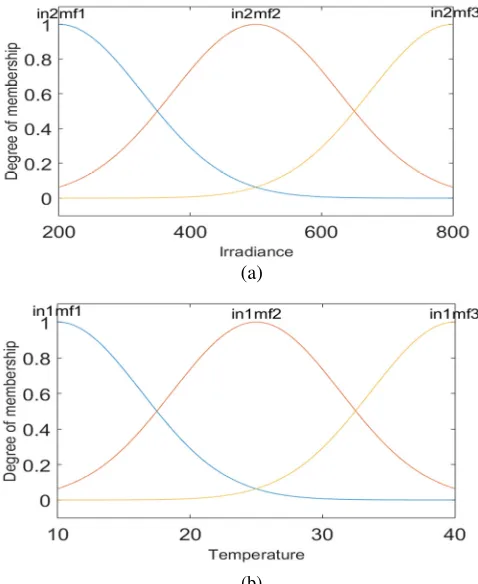
The block diagram of the proposed methodology is illustrated in Fig.7. PV system is connected to load through a boost converter. Irradiance level and operating temperature and their corresponding optimal duty cycle value of PV module are taken as the input-output training data set for the ANFIS. Optimal duty cycle is obtained by using PSO optimization algorithm for different operating scenarios. Temperatures as 10, 25 and 40o C and radiation on 200, 500 and 800 W/m2 are considered for each panel, which obtained 3 g 3 g 3 g 3 g 3 243 duty cycles totally. In Table II, some of operating scenarios which apply to ANFIS are illustrated. For the studied problem in this paper, the best value for the number of membership functions is obtained 5 by trial and error. After selection the best number of membership functions, the training procedure is started. Here, 80% of all input-output datasets as training and the rest of them as the test data are randomly selected. Such as any neural network training procedure there is a validation data, which is normally selected 5% of the training data. If the accuracy over the training data set increases, but the accuracy over that validation data set stays the same or decreases, then the training program will be stopped.
PSO algorithm parameters are as follows: CO 1.2, C2 1.7, W 0.97 and size of swarm are four. In order to regulate membership functions for ANFIS, 243 operating scenarios are considered by simulation results to trace maximum power of three collections, membership functions are on Fig. 8 for two inputs. Since membership functions are equal for radiation, only, one of them enters which is seen in Fig. 8(a). Fig. 8 shows (a) membership functions of ANFIS input (irradiance level) after learning and (b) Membership functions of ANFIS input (temperature) after learning. The proposed ANFIS controller is considered to have five inputs (one for temperature and four irradiances for each PV modules). By ignoring the slight differences of the temperature value among each PV modules, we would have one T parameter and four magnitude of radiations illustrated as Ir1 to Ir4 in Fig. 7.
Fig. 7. Matlab/Simulink model of hybrid PSO-ANFIS MPPT scheme
(a)
(b)
Fig. 8. (a) Membership functions of ANFIS input (irradiance level) after learning. (b) Membership functions of ANFIS input (temperature level) after learning
Table II
Some of modes which apply to training anfis
T(c) Ir 1 (W/m2)
Ir 2 (W/m2)
Ir 3 (W/m2)
Ir 4
(W/m2) Duty cycle
10 200 200 500 800 0.5342
10 200 500 500 800 0.4293
25 500 200 800 200 0.5517
25 800 800 800 800 0.4967
40 800 800 200 200 0.6578
40 500 800 500 800 0.3878
VIII. SIMULATION RESULTS
radiation sensor is used for each panel, and one temperature sensor for whole system as shown in Fig. 7. Sensors are the input of ANFIS system. In different situations of PSC and also sudden changes of radiation, ANFIS system gives out a proper duty cycle for MPPT as an output. For PSO and FA methods, voltage and current of the PV system are sampled for the MPPT block as shown in Fig. 6, then after a specified time, output power of the system is calculated and then duty cycle is calculated and applied to the circuit. This procedure is repeated several times and eventually, optimized duty cycle is achieved and DC-DC boost converter works based on that. In Fig. 6 block diagram of the control system based on PSO and FA methods is given.
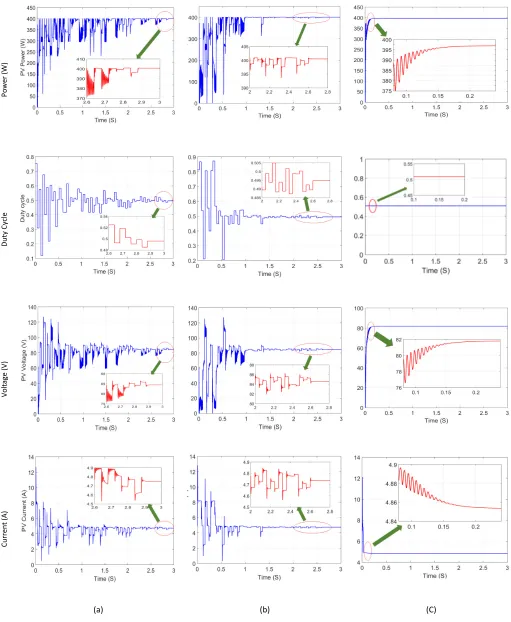
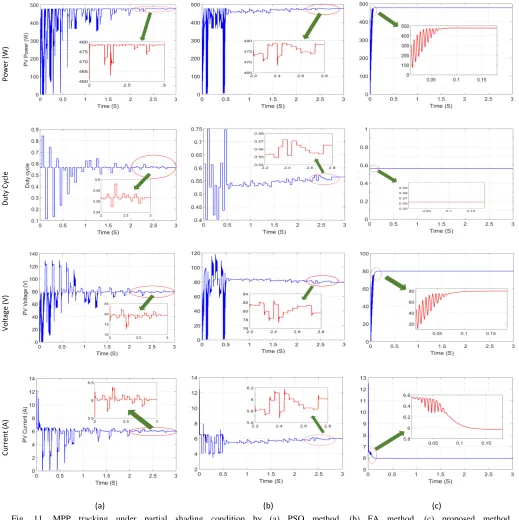
It is well-known that the choice of the controlling parameters for a heuristic-based algorithm is performed based-on trial and error methodologies over numerous independent trials and observing the performance of the algorithm. Therefore, for the studied problem domain, the best values of the parameters involved in the PSO, FA or ANFIS for a number of trial runs are selected. For example, in PSO algorithm, tO 1.2, t2= 1.6, u = 0.97 are selected by trial and error, and the number of repetition to the determining convergence is obtained 16 times. The number of particles is chosen as 4. Also for FA method < = 2, V = 0.35, v = 1 and number of repetition is obtained 6 times. In this paper, the number of fireflies is chosen as 4. Three techniques of MPPT are used as a controller for DC-DC boost converter with proper duty cycle for study and dynamic comparison of PV system’s responses in PS conditions. These methods are studied in terms of tracking time, convergence speed, oscillations around MPPT and tracking efficiency in different conditions of partial shading. Two different patterns of partial shading have been used in tracking efficiency. As first example, under PSC, radiation for each PV module is considered 1000 W/m2, 900 W/m2, 600 W/m2, and 300 W/m2 respectively. P-V curve is represented in Fig. 9(a). In this case, there are four peaks that GMPP is 400.92 W and its location is third peak in the curve. Fig.9(b) represents output power of the PV system for study case methods. According to this figure, it can be seen that all three methods, have succeeded to achieve GMPP. Details of the simulation results (i.e. power, voltage, current, and duty cycle of DC-DC boost converter) are given in Fig.10. with different MPPT techniques under PSC. As is shown in Fig 10 tracking based on PSO and FA started with random initial values. FA and PSO methods have tracked the GMPP at times 2.65sec and 2.85sec and have converged at powers equal to 400.25W and 400.13W respectively. The proposed method has tracked the GMPP in less than 0.15sec and converged at power 397.4W. In second investigated pattern of PSC, solar radiations are considered 800 W/m2. 800 W/m2, 800 W/m2and 500 W/m2, respectively. P-V diagram is represented in Fig 9(a). In this condition, global MPP is equal to 478.75W which has occurred at first peak of the P-V
diagram. Output power of the PV system for three methods is represented in Fig. 9(b). FA and PSO methods have been able to identify GMPP. FA and PSO methods have tracked the global maximum power at times 2.7sec and 2.9sec and have converged at powers equal to 478.23W and 478.05W respectively. The proposed method has also tracked the GMPP in less than 0.15sec and converged at power 477.65W. Details of the simulation results for PV system are shown in Fig. 11 with different MPPT techniques under second PSC pattern. Finally, it can be concluded that all the three algorithms are able to track GMPP, and also the efficiency of the proposed method is much better in comparison with FA and PSO, because it tracks the global MPP and converges in a very short time. Accuracy of the proposed method also can increase, if we increase the number of data, used in neural network training. Results of the simulation are given briefly in the Table III and also a qualitative comparison has been performed among different investigated methods of MPPT in the Table IV.
TABLE III
Performance comparison of PSO, FA methods and proposed method
%Tracking Efficiency Maximum power from
P-V curve Tracking Speed
(Second) Power (Watts)
Tracking Methods Shading pattern
99.80 99.83 99.12
400.92 2.85
2.65 0.15 400.13
400.25 397.4 PSO
FA
Proposed method
First case
99.85 99.89 99.75
478.75 2.9
2.7 0.15 478.05
478.23 477.65 PSO
FA Proposed method
Second case
TABLE IV
Qualitative comparison among different methods
Proposed Method FA
PSO Type
Not required Not required
Not required
Periodic Tuning
Very fast Medium
Medium
Tracking Speed
Accurate Highly Accurate
Highly Accurate
Tracking Accuracy
Zero Zero
Zero
Steady state oscillation
(a) (b)
P
o
w
e
r
(W
)
D
u
ty
C
y
cl
e
V
o
lt
a
g
e
(
V
)
C
u
rr
e
n
t
(A
)
(a) (b) (C)
P
o
w
e
r
(W
)
D
u
ty
C
y
cl
e
V
o
lt
a
g
e
(
V
)
C
u
rr
e
n
t
(A
)
(a) (b) (c)
Fig. 11. MPP tracking under partial shading condition by (a) PSO method, (b) FA method, (c) proposed method
IX. CONCLUSION
In this paper, adaptive Neuro-fuzzy inference system based on PSO for maximum power point tracking controller is proposed under PSC for a PV system. The operation of PSO-ANFIS based MPPT controller is investigated under PSC. After proper training of the presented ANFIS model with PSO algorithm, the ANFIS-based MPPT controller successfully tracks the maximum available power under partial shading condition. The advantage of this hybrid method is the
R
EFERENCES[1] B. Boukezata, A. Chaoui, J. P. Gaubert, and M. Hachemi, (2016) “An improved fuzzy logic control MPPT based P&O method to solve fast irradiation change problem,” J. Renew. Sustain. Energy, 8(4), 043505.
[2] Y. Soufi, M. Bechouat and S. Kahla, (2017) “Fuzzy-PSO controller design for maximum power point tracking in photovoltaic system,” Int. J. Hydrogen Energy, 42(13), 8680–8688.
[3] H. Rezk, A. Fathy and A. Y. Abdelaziz, (2017) “A comparison of different global MPPT techniques based on meta-heuristic algorithms for photovoltaic system subjected to partial shading conditions,” Renew. Sustain. Energy Rev., 74, 377–386.
[4] S. Kumar Dash, S. Nema, R. K. Nema, and D. Verma, (2015) “A comprehensive assessment of maximum power point tracking techniques under uniform and non-uniform irradiance and its impact on photovoltaic systems: A review,” J. Renew. Sustain. Energy, 7(6), 063113.
[5] M. Muthuramalingam and P. S. Manoharan, (2014) “Comparative analysis of distributed MPPT controllers for partially shaded stand alone photovoltaic systems,” Energy Convers. Manag., 86, 286–299.
[6] K. Sundareswaran, V. Vigneshkumar, P. Sankar, S. P. Simon, P. and S. Palani, (2016) “Development of an Improved P&O Algorithm Assisted Through a Colony of Foraging Ants for MPPT in PV System,” IEEE Trans. Ind. Informatics, 12(1), 187–200. [7] K.-H. Chao, Y.-S. Lin, and U.-D. Lai, (2015) “Improved particle swarm optimization for maximum power point tracking in photovoltaic module arrays,” Appl. Energy, 158, 609–618. [8] G. C. Hsieh, H. I. Hsieh, C. Y. Tsai and C. H. Wang, (2013) “Photovoltaic power-increment-aided incremental-conductance MPPT with two-phased tracking,” IEEE Trans. Power Electron., 28(6), 2895–2911.
[9] N. Femia, G. Petrone, G. Spagnuolo and M. Vitelli, (2005) “Optimization of perturb and observe maximum power point tracking method,” IEEE Trans. Power Electron., 20(4), 963–973. [10] I. H. Altas and A. M. Sharaf, (2008) “A novel maximum power fuzzy logic controller for photovoltaic solar energy systems,” Renew. Energy, 33(3), 388–399.
[11] T. Esram, J. W. Kimball, P. T. Krein, P. L. Chapman and P. Midya, (2006) “Dynamic maximum power point tracking of photovoltaic arrays using ripple correlation control,” IEEE Trans. Power Electron., 21(5), 1282–1290.
[12] S. Lyden and M. E. Haque, (2016) “A simulated annealing global maximum power point tracking approach for PV modules under partial shading conditions,” IEEE Trans. Power Electron., 31(6), 4171–4181.
[13] V. R. Kota and M. N. Bhukya, (2016) “A novel linear tangents based P & O scheme for MPPT of a PV system,” Renew. Sustain. Energy Rev., 1–11.
[14] B. Talbi, F. Krim, T. Rekioua, A. Laib, and H. Feroura, (2017) “Design and hardware validation of modified P&O algorithm by fuzzy logic approach based on model predictive control for MPPT of PV systems,” J. Renew. Sustain. Energy, 9(4), 43503.
[15] A. R. Jordehi, (2016) “Maximum power point tracking in photovoltaic (PV) systems: A review of different approaches,” Renew. Sustain. Energy Rev., 65, 1127–1138.
[16] H. Rezk and A. Fathy, (2017) “Simulation of global MPPT based on teaching–learning-based optimization technique for partially shaded PV system,” Electr. Eng., 99(3), 847–859. [17] K. M. Tsang and W. L. Chan, (2015) “Maximum power point tracking for PV systems under partial shading conditions using current sweeping,” Energy Convers. Manag., 93 249–258.
[18] A. soufyane Benyoucef, A. Chouder, K. Kara, S. Silvestre and O. A. Sahed, (2015) “Artificial bee colony based algorithm for maximum power point tracking (MPPT) for PV systems operating under partial shaded conditions,” Appl. Soft Comput., 32, 38–48. [19] H. Patel and V. Agarwal, (2008) “Maximum power point tracking scheme for PV systems operating under partially shaded conditions,” IEEE Trans. Ind. Electron., 55(4),1689–1698. [20] J. Ahmed and Z. Salam, (2014) “A maximum power point tracking (MPPT) for PV system using cuckoo search with partial shading capability,” Appl. Energy, 119, 118–130.
[21] L. L. Jiang, D. L. Maskell and J. C. Patra, (2013) “A novel ant colony optimization-based maximum power point tracking for photovoltaic systems under partially shaded conditions,” Energy Build., 58, 227–236.
[22] S. Daraban, D. Petreus and C. Morel, (2014) “A novel MPPT (maximum power point tracking) algorithm based on a modified genetic algorithm specialized on tracking the global maximum power point in photovoltaic systems affected by partial shading,” Energy, 74, 374–388.
[23] S. Mohanty, B. Subudhi, S. Member and P. K. Ray, (2016) “A new MPPT design using grey wolf optimization technique for photovoltaic system under partial shading conditions,” IEEE Trans. Sustain. Energy, 7(1), 181–188.
[24] K. Sundareswaran, S. Peddapati and S. Palani, (2014) “MPPT of PV systems under partial shaded conditions through a colony of flashing fireflies,” IEEE Trans. Energy Convers., 29(2), 463–472.
[25] R. Koad, A. F. Zobaa and A. El Shahat, (2016) “A Novel MPPT Algorithm Based on Particle Swarm Optimisation for Photovoltaic Systems,” IEEE Trans. Sustain. Energy, 8(2), 468– 476.
[26] K. Ishaque, Z. Salam, A. Shamsudin and M. Amjad, (2012) “A direct control based maximum power point tracking method for photovoltaic system under partial shading conditions using particle swarm optimization algorithm,” Appl. Energy, 99, 414–422. [27] K. Ishaque, Z. Salam, M. Amjad and S. Mekhilef, (2012) “An Improved Particle Swarm Optimization (PSO) Based MPPT for PV With Reduced Steady-State Oscillation,” IEEE Trans. Power Electron., 27(8), 3627–3638.
[28] E. Koutroulis and F. Blaabjerg, (2012) “A new technique for tracking the global maximum power point of PV arrays operating under partial-shading conditions,” IEEE J. Photovoltaics, 2(2), 184–190.
Photovoltaics, 4(2), 626–633.
[30] R. Ramaprabha, V. Gothandaraman, K. Kanimozhi, R. Divya and B. L. Mathur, (2011) “Maximum power point tracking using GA-optimized artificial neural network for solar PV system,” 1st Int. Conf. Electr. Energy Syst. IEEE, 264–268.
[31] R. K. Kharb, S. L. Shimi, S. Chatterji and M. F. Ansari, (2014) “Modeling of solar PV module and maximum power point tracking using ANFIS,” Renew. Sustain. Energy Rev., 33, 602– 612.
[32] S. S. Mohammed, D. Devaraj and T. P. I. Ahamed, (2016)“Maximum power point tracking system for stand alone solar PV power system using Adaptive Neuro-Fuzzy Inference System,” in Power and Energy Systems: Towards Sustainable Energy (PESTSE), 2016 Biennial International Conference on, 1– 4.
[33] R. S. Yeung, H. S. Chung, N. C. Tse and S. T. Chuang, (2017) “A global MPPT algorithm for existing PV system mitigating suboptimal operating conditions,” Sol. Energy, 141, 145–158.
[34] M. G. Villalva, and E. R. Filho, (2009) “Comprehensive approach to modeling and simulation of photovoltaic arrays,” IEEE Trans. Power Electron., 24(5), 1198–1208,.
[35] V. Salas, E. Olías, A. Barrado and A. Lázaro, (2006)"Review of the maximum power point tracking algorithms for stand-alone photovoltaic systems", Sol. Energy Materials and Solar Cells, 90(11), 1555-1578.
[36] S. Saravanan and N. Ramesh Babu, (2016) “Maximum power point tracking algorithms for photovoltaic system - A review,” Renew. Sustain. Energy Rev., 57, 192–204.
[37] M. Seyedmahmoudian, R. Rahmani, S. Mekhilef, A. Maung Than Oo, A. Stojcevski, T. K. Soon and A. S. Ghandhari, (2015) “Simulation and hardware implementation of new maximum power point tracking technique for partially shaded PV system using hybrid DEPSO method,” IEEE Trans. Sustain. Energy, 6(3), 850– 862.
[38] K. Chen, S. Tian, Y. Cheng and L. Bai, (2014) “An improved MPPT controller for photovoltaic system under partial shading condition,” IEEE Trans. Sustain. Energy, 5(3), 978–985.
[39] X.-S. Yang, (2008), Nature-Inspired Metaheuristic Algorithm, Beckington, U.K.: Luniver Press.
[40] R. Eberhart and J. Kennedy, (1995) “A new optimizer using particle swarm theory,” In proc. 6th Int. Symp. Micro Mach. Hum. Sci., 39–43.
[41] J.-S.R. JANG, (1993) “ANFIS: adaptive-network-based fuzzy inference system, IEEE Transactions on Systems, Man and Cybernetics, 23 (3), 665–685.
[42] H. Li, D. Yang, W. Su, J. Lu and X. Yu, (2018) "An Overall Distribution Particle Swarm Optimization MPPT Algorithm for Photovoltaic System under Partial Shading", IEEE Transactions on Industrial Electronics, pp. 1-1.
[43]S. Mirhassani, M. Razzazan and A. Ramezani, (2014) "An improved PSO based MPPT approach to cope with partially shaded condition", 22nd Iranian Conference on Electrical Engineering (ICEE), pp. 102-109.
Javad Farzaneh was born in Mashhad, Iran, in 1991. He received the B.Sc. degree from the Bahar institute, Mashhad, Iran, in 2014, the M.Sc. degree in electrical engineering from the Semnan University, Semnan, Iran, in 2017. His research interests are renewable energy, power electronics and optimization.
Reza Keypour received his B.Sc. degree in electrical engineering from Shahid Beheshti University and M.Sc. and Ph.D degrees from Tarbiat-modares University, Tehran, Iran. He is now with Semnan University. His research interests include renewable energy, power system operation & planning and restructuring.
Ali Karsaz received his B.S. degree in Electrical Engineering from the Amirkabir University of Technology (Tehran Polytechnic), Tehran, Iran, in 1999. He received his M.Sc. and Ph.D. degrees in Control Engineering both form Ferdowsi University of Mashhad, Iran, in 2004 and 2008, respectively.
Since 2008, he has been Assistant Professor of control and biomedical engineering at Khorasan Institute of Higher Education and he was Chair of the Division of Control Department from 2012 until now. He has consulted for Iranian Diabetes Society (IDS) in glucose-insulin modeling and control system design and he is developing an algorithm for automated plasma glucose control using optimal-based robust approach. He has also worked as a research scientist at the National Center of Medical Image Processing within the School of Medicine, Mashhad University of Medical Sciences form 2015 until now. In 2017, he also served as a consulting faculty at the Hashemi-Nezhad Refinary (Khangiran Gas Refinery) is some related research fields. He has received several awards including: Best Researcher Award, National Student Science Organization of Electrical Engineering (NSSOEE 2006), K. N. Toosi University’s (KNTU) Research Grant, 2006, FUM-ADO Award from the School of Medicine, 2015, The Outstanding Faculty of the Year Ph.D. Student Researcher Award, 2006, Outstanding Graduate Student Award in 2003.