20
MOBILE BUSINESS INTELLIGENCE APPLICATIONS
Marian Pompiliu Cristescu, PhD [email protected]
Ioana Andreea Bogoslov, PhD candidate [email protected]
Abstract:
In the paper there are presented, at a detailed level, the mobile applications, the types (standalone, network and web), their characteristics and a network-specific architecture. Also, the protocols and standards used in the device communication process are detailed, the protocols being grouped into mobile, internet, access and messaging. Attention is drawn to the features of mobile platforms and the importance of analyzing them in selecting a mobile application implementation platform.
Key words: mobile devices, business intelligence, mobile applications, communications standards.
J.E.L clasifications: O31, O32
Introduction
New developments in mobile device technology have opened the way for new applications designed to run on these devices. Initially, mobile devices provided limited functionality due to reduced memory capacity, computational power and difficult interaction.
At present, the features of mobile devices can be compared to previous PC variants, as this is possible because the available memory has increased considerably, mobile processors have improved their performance, interaction has become user friendly through the touch screen option.
These features allow for the development of complex mobile applications that use the available hardware capabilities.
Mobile applications
Business Intelligence applications help managers in making decisions based on quantitative methods applied to available business data. Business Intelligence mobile applications extend this functionality to devices for use by decision-making factors. (B. Ghilic,2008).
These applications have various forms:
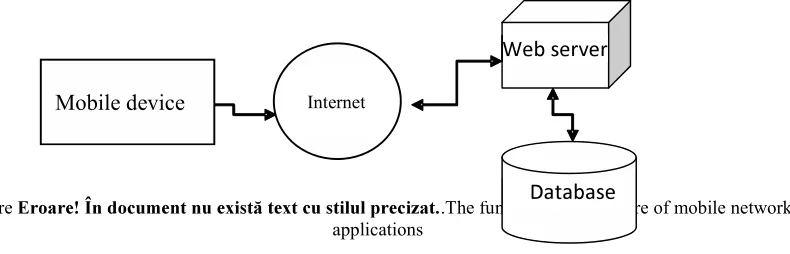
21 - network applications these applications have distributed components; some components are on
the mobile device and others on external systems; a network application can retrieve data from a server or web service and store the results on an external system (Figure 1); data and results can also be obtained and stored by the device itself as a standalone application, with solved problems being of medium complexity;
- web applications
Figure .The functional architecture of mobile network
applications
Running mobile networking applications for business management requires the following functioning components (W. Jansen, 2017):
- Mobile device capable of running an Internet browser: Microsoft Internet Explorer Pocket Edition, Palm Web Browser Pro etc.;
- Web server like Microsoft IIS or Apache Web Server;
- Web server extension that can add new features such as scripting files ASP, ASP.NET, JSP, PHP;
- Database server to store all the necessary information for the client: Oracle, SQL Server, DB2, MySQL.
All of these elements interact with computer networks, so this type of application is the most complex because the different security aspects, divided into components, are found in different locations. In order to be able to respond at any time and anywhere to IT requirements, mobile enterprise application integration is done through a mobile business management application that has the structure outlined in Figure 2. Such an application has features relative to: the possibility of integrating heterogeneous systems running on different platforms, real-time operation, portability and distributed architecture (P. Pocatilu, 2006). This business management architecture along with the XML technology and web services used have a very important role in making mobile network applications.
22 Figura 1. Application integration in the organization
Standalone applications are located at the level of the device itself using only its functionality. In their development, special kits are used to provide access to the mobile device's functionality. As a rule, mobile computing power requires many restrictions, so most software development kits offer only a subset of the features it delivers to PCs, and elements needed to access device-specific functionality are also added.
Client-server applications are made up of two components, one running on the client - the mobile device, and the second running on a server that has more computing power and takes on the execution of intensive operations.
All these types of applications require special security attention because sensitive information can be stored on the device in its memory, circulating on the network, stored and processed on external servers.
Communication protocols for mobile devices
There are many communications standards developed for mobile devices, a mobile application that can use different communication mechanisms to transfer information between devices:
- the WiMax standard (802.16 or 802.20) combines the best networks offering high bandwidth between access points;
- IrDA is a standard infrared interface that provides a wireless network for mobile phones or PDAs; the main technical drawbacks are the need for direct visibility between points and the fact that it is limited to point-to-point connections;
- Advance Mobile Phone Service - AMPS is an analog signal standard based on electromagnetic radiation that occupies the 800-900 MHz frequency band; D-AMPS is the second generation of this technology; Cellular Digital Packet Data - CDPD uses digital packets to transfer data on unused bands at speeds of up to 19.2 Kbps;
- CDMA2000 is a Code Division Multiple Access (CDMA) version of the IMT-2000 standard developed by the ITU (International Telecommunication Union), the data transfer speed being between 144 Kbps and 2 Mbps;
- DataTac as well as Mobitex are wireless standards using the 800 MHz bandwidth;
- Enhanced Data GSM Environment - EDGE is a faster version of the GSM service, being built on the standard structure using Time Division Multiple Access - TDMA and existing cellular network (provides data transfers up to 384 Kbps);
23 - Evolution Date Maximized - EVDO is based on CDMA2000 with a data transfer rate
between 400 Kbps and 2 Mbps;
- Nordic Mobile Telephone - NMT is an analog technology standard;
- Personal Digital Cellular - PDC is a TDMA-based standard used in Japan with a bandwidth between 800 MHz and 1.5 GHz;
- WCDMA is derived from CDMA and supports file transfer, data, and video on local networks with a downlink speed of up to 2 Mbps or on external networks up to 384 Kbps. Protocols are used to structure data on the transport environment, grouped into: mobile protocols, Internet protocols, access protocols, and messaging protocols. Mobile protocols used on a large scale are:
- Wireless Application Protocol - WAP is described as the de facto standard for the presentation and dissemination of wireless and mobile data;
Global System for Mobile - GSM is a mobile digital system that uses a TDMA variant and is the most used of the three wireless technologies (TDMA, GSM, CDMA). It compresses the data and then sends a channel to the rest of the data streams, each in a different position operating on one of the 900, 1800 and 1900 MHz frequencies; - General Packet Radio Services GPRS is a service-based wireless communications
network transmitted through complementary GSM services such as cellular and SMS channels with a transfer rate of at least 114 Kbps;
- Universal Mobile Communication System - UMCS;
- Code Division Multiple Access - CDMA is a wireless transmission method in which the message is encoded using a pseudo-random sequence, which corresponds to another communication channel associated with the receiver; this protocol is used to decode the received signal;
- Mobile Application Part MAP is a protocol that allows real-time communication at the level of a mobile network; this protocol is used to transfer VLR (Visitor Location Register) position information to the Home Location Register (HLR);Unstructured Supplementary Services Data USSD allows for transparent communication between MS (Mobile Station) and PLMN (Public Land Mobile Network);
- Short Message Service - SMS is a service that allows short messages between Short Message Entity and EMS (Enhanced Messaging Service);
- Short Message Peer to Peer - SMPP is a protocol for sending short messages between the SMS Center and the SMS application;
- Transaction Capability Application Part (TCAP) is a type of protocol used to send queries to and retrieve a database;
- The TCP / IP protocol consists of several protocols organized on two levels; Internet Protocol Control Protocol (ICMP) and Transmission Control Protocol (TCP) and UDP (User Datagram Protocol); TCP provides connection-oriented packets using sequence numbers to coordinate transmissions; FTP services, Telnet, HTTP and HTTP SMTP messages, each service has a port (the logical endpoint of a connection); IP protocol is responsible for getting a number, IP network;
The most popular protocols for infrared communication are as follows:
- Access Protocol Link - IrLAP provides data transfer;
- Protocol Link Management - IrLMP provides multisession support, enabling customers to use an IrLAP and IAS (Information Access Service);
- Infrared Object Exchange - IrOBEX is used to interchange data via infrared;
24 - Infrared Local Area Network - IrLAN allows an infrared device to connect to the network. The most important Bluetooth protocols are the following:
- Link Manager Protocol - LMP manages the behavior of wireless links, controls bandwidth and addresses security issues;
-Logical Link Control and Adaptation Protocol - L2CAP connects the band and the previous protocol by supporting segmentation and reassembly of data;
- Radio Frequency Communications - RFCOMM provides RS-232 port emulation for the L2CAP protocol;
- Service Discovery Protocol - SDP allows the device to discover other Bluetooth devices.
Features of Mobile Applications
When deciding how to build a mobile application, it is important to consider the features and goals it has to meet, as they play a major role in selecting the deployment platform and application type. Native mobile applications provide access to all device functionality, while web applications, depending on the development method you choose, do not allow all platforms to do so, or have delays in processing orders.
A reliable example is the capture of the electronic signature implemented in the native applications on each platform and web, where there are major differences and the native variant is chosen.
At each mobile platform considered, IOS, Android, and Windows, there are limitations that determine the selection of a particular platform in mobile app implementation (I. Ivan, 2010).
These limitations are determined by the ease with which the system resources, features offered (such as NFC and QR code support), the known development language, accessibility, a developer account for each platform (from this point of view, at least at Windows Phone level, there was no support for our country, but there are third entities through which applications can be developed).
The specific features of mobile devices running on these platforms are also detailed in (P. Pocatilu, 2006), the author also presenting practical ways to implement these applications, such as event handling, data storage and network access.
The Windows Phone 7 platform is based on Windows CE 6.0 and unlike previous versions of Windows Mobile, it does not allow an application to access another application's space. Each mobile app has an Isolated Storage in which data is stored on the disk.
According to (M. Mircea, 2012), when using business intelligence mobile applications, the user access sensitive data inside his or her organization.
Also, the results obtained in the form of reports are sensitive information that needs to be protected. In this scenario, security becomes an important aspect that needs to be considered. Each type of mobile applications with special features, security is implemented in specific ways.
Conclusions
Ensuring the quality of mobile applications is an important step to be taken to implement a quality component.
The quality of the application is ensured by: identifying mobile application features, setting target levels for them, measuring and calculating software metrics for them, and making decisions to correct deviations from set levels.
25 dependency, if the complexity of the mobile application increases, it lowers the application's reliability level.
References: [1]
Informatica Economica,
[2] ,The Security of the Mobile Citizen
Oriented Applications, vol. 10, nr. 1, pg. 22-33, ISSN 1582-7941, Economy Informatics, 2010,
[3] W. Jansen, R. Daniellou,
Technology, Created March 01, 2006, Updated February 19, 2017, U.S. Department of Commerce, Gaithersburg, MD, U.S.A.;
[4] B. Ghilic, M. Stoica, M. Mircea, (2008), How to Succeed in Business Intelligence Initiative: A Case Study for Acquisitions in Romania Public Institutions, WSEAS TRANSACTIONS on BUSINESS and ECONOMICS, Nr. 6, Vol.5/2008, ISSN: 1109-9526, pag. 298-309, 2008,
[5] M. Mircea, (2012) Computer and
Information Science - Numerical Analysis and Scientific Computing, ISBN
978-953-51-0019-5, pag. 1 107, 2012, INTECH Open science-Open minds, Management, London - United Kingdom, Administrative Office - Rijeka, Croatia - European Union;
[6]