23
Jou
rn
al o
f Mat
h
emat
ic
al
Nano
S
cie
n
ce
MARYAM JALALI-RAD
Department of Pure Mathematics, Faculty of Mathematical Sciences,
University of Kashan, Kashan, I. R. Iran
E-mail:[email protected]
ABSTRACT. A fullerene is a molecule composed of carbon in the shape of a hollow sphere,
ellipsoid, tube, and many other forms. The spherical ones are called buckyballs and they look like the balls used in football game. The first stable cluster of fullerenes was discovered by Kroto and his co-authors who received the Nobel Prize. In this paper, we introduced some classes of stable fullerene graphs.
Keywords: fullerene, leapfrog operation, dual graph, graph eigenvalue.
1. INTRODUCTION
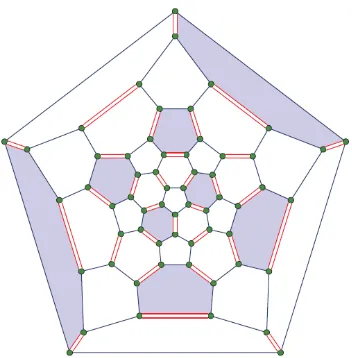
In graph theory a fullerene is a three connected cubic graph whose faces are pentagons and hexagons satisfying in Euler’s formula. The first and the most stable fullerene C60, namely is composed of 60 carbon atoms, 90 edges, 12 pentagons and 20
hexagons, see Figure 1. It is discovered in 1985 by Kroto et al. [11,12] who received the Nobel Prize for this discovery. It is not difficult to prove that the other classes of fullerenes have 12 pentagons, too. In other words, by using Euler’s theorem, a fullerene on n vertices has exactly 12 pentagons and n/2 10 hexagons while n is a natural number equal or greater than 20 and n 22, for more details about mathematics of fullerene graphs see Refs [2,4,8-10] as well as [13-16]. In the structure of C60 fullerene, all pentagons are isolated which introduce a new class of fullerenes
24
Jou
rn
al o
f Mat
h
emat
ic
al
Nano
S
ci
en
ce
Figure 1. 2-D graph of fullerene C60.
There is a list of groups that can act as a symmetry group of a convex polyhedron [3,6]. They can be divided into icosahedral, octahedral, tetrahedral, dihedral, cyclic and others. Symmetry of fullerenes has been studied deeply. The possible symmetry groups G for fullerenes are 28 point groups [5]. Babić, Klein and Sah in [1] classified all fullerenes up to 70 vertices with respect to their symmetry group. Fowler and Manolopoulos [6] found symmetry groups of all fullerenes with up to 100 vertices. For each symmetry group G they found the smallest G -fullerene and the smallest G -fullerene obeying IPR (isolated pentagon rule). They described how to create a new fullerene with the same symmetry group having more hexagonal faces and obeying IPR once a fullerene is given.
The dual of a fullerene is the plane graph obtained by substituting the roles of vertices and faces: the vertex set of the dual graph is the set of faces of the original graph and two vertices in the dual graph are adjacent if and only if the two faces share an edge in the original graph. The dual of a fullerene with n vertices is a plane graph where every face is a triangle. This operation is called triangulation. The triangulation on a fullerene provides one which contains 12 vertices of degree 5 and n/2 - 10 vertices of degree 6.
The Stellisation St(G) of the plane graph G, adds a vertex in the center of each face of a planar graph G, and connects the new vertex with each boundary vertex of the corresponding face. Notice that this operation is also a triangulation.
25
Jou
rn
al o
f Mat
h
emat
ic
al
Nano
S
cie
n
ce
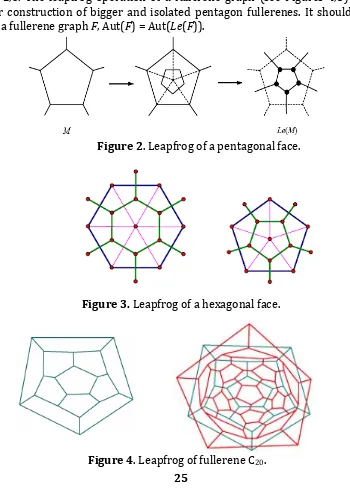
Figures 2,3. The leapfrog operation of a fullerene graph (see Figures 4,5) is usually used for construction of bigger and isolated pentagon fullerenes. It should be noted that for a fullerene graph F, Aut(F) = Aut(Le(F)).
Figure 2. Leapfrog of a pentagonal face.
Figure 3. Leapfrog of a hexagonal face.
26
Jou
rn
al o
f Mat
h
emat
ic
al
Nano
S
ci
en
ce
C34 fullerene Le(C34) = C102
Figure 5. Thefullerene C34 and Le(C102).
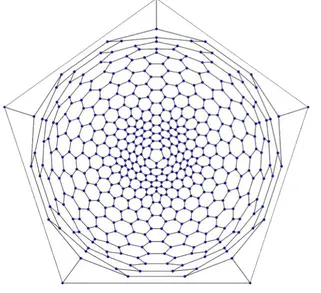
This means that the leapfrog of an icosahedral fullerene is also icosahedral. It is a well-known fact that among all fullerene graphs, icosahedral fullerenes are more stable. Hence, if we have an icosahedral fullerene, then we can construct an infinite family of stable fullerenes by using leapfrog operation. We can also apply our method to construct big stable fullerenes with icosahedral symmetries. For example, Le2(C60) is a
stable fullerene with 540 vertices and with an icosahedral symmetry, see Figure 6.
27
Jou
rn
al o
f Mat
h
emat
ic
al
Nano
S
cie
n
ce
graph is the number of zeros of the characteristic polynomial.
Since the fullerene graphs are not bipartite, the smallest eigenvalue is greater than -3. Some chemists believe that a necessary condition for the physical existence of a fullerene is that the graph should have exactly half its eigenvalues positive.
Lemma 1 [7]. If X is a cubic planar graph with leapfrog graph Le(X), then Le(X) has at
most half of its eigenvalues positive and at most half of its eigenvalues negative.
Theorem 2 [7]. If X is a cubic planar graph, then its leapfrog Le(X) has exactly half of
its eigenvalues negative. If, in addition, X has a face of length not divisible by three, then its leapfrog Le(X) also has exactly half of its eigenvalues positive.
Let F be a fullerene graph. According to Theorem 2, the leapfrog graph Le(F) has exactly half of its eigenvalues negative. Further, since F has a face of length not divisible by three (it has 12 pentagons), then its leapfrog Le(F) also has exactly half of its eigenvalues positive. This means that leapfrog fullerenes are more stable.
Corollary 3. Let F be a fullerene graph, then the nullity of Le(F) is an even integer
number.
Proof. Let the number of positive eigenvalues of F be k (k ≤ n/2), then according to
Theorem 2, Le(F) has 2k non-zero eigenvalues. This means that the nullity of Le(F) is
n-2k and the proof is completed.
It is well-known that a molecular graph with nullity zero is more stable. In other words, leapfrog fullerenes with nullity zero are more stable.
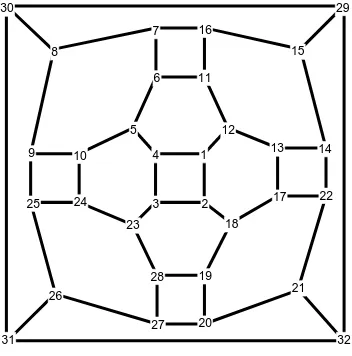
Example 1. Consider the polyhedral graph C32 depicted in Figure 7. By a direct
computation, one can see that the spectrum of F is as follows:
Spec F( ) 3 2.56 2 1.56 1 0 1 1.56 2 2.56 3 .
1 3 2 3 4 6 4 3 2 3 1
28 Jou rn al o f Mat h emat ic al Nano S ci en ce 4. Conclusions
Fullerenes are spherical carbon molecules that can be modeled as cubic plane graphs where all faces are pentagons or hexagons. Euler's formula implies that a fullerene with n vertices contains exactly 12 pentagons and n/2 - 10 hexagons. A rich mathematics of cubic planar graphs and fullerene graphs has developed since they were considered by Goldberg, Coxeter, and others and many mathematical properties of fullerenes have established simple and beautiful solutions. Yet many remarkable chemical and mathematical problems in the field remain unsolved. The stability of fullerenes is very important factor that in this paper, we introduced some mathematical properties for it.
1 4 2 3 5 6 7 16 8 15 11 12 18 17 22 14 32 21 20 27 28 19 31 26 25 9 10 24 29 30 23 13
Figure 7. Fullerene graph C32.
REFERENCES
[1] D. Babić, D.J. Klein, and C.H. Sah, Symmetry of fullerenes, Chem. Phys. Lett. 211 (1993) 235–241.
[2] A. Behmaram, Matching in fullerene and molecular graphs, Ph. D thesis, University of Tehran, 2013.
[3] P.R. Cromwell, Polyhedra, Cambridge University Press, Cambridge, 1997.
[4] M. Deza, M. Dutour Sikirić and P. W. Fowler, Zigzags, railroads, and knots in fullerenes, J. Chem. Inf. Comp. Sci. 44 (2004) 1282-1293.
[5] P.W. Fowler, D.E. Manolopoulos, D.B. Redmond, and R.P. Ryan, Possible Symmetries of Fullerene Structures, Chem. Phys. Lett. 202 (1993) 371–378.
[6] P.W. Fowler and D.E. Manolopoulos, An Atlas of Fullerenes, Clarendon Press, Oxford, 1995.
[7] C. Godsil, G. Royle, Algebraic Graph Theory, Springer, New York, 2001.
29
Jou
rn
al o
f Mat
h
emat
ic
al
Nano
S
cie
n
ce
1993.
[13] K. Kutnar, D. Marusic, On cyclic edge-connectivity of fullerenes, Discr. Appl. Math. 156 (2008) 1661–1669.
[14] K. Kutnar, D. Marusic, D. Janezic, Fullerenes via their automorphism groups, MATCH Commun. Math. Comput. Chem., 63 (2010) 267-282.
[15] P. Mani, Automorphismen von polyedrischen Graphen, Math. Annalen. 192 (1971) 279–303.