UDC 615.076 + 579.61 + 577.11
Development of the methoD for microbiological
purity testing of recombinant human
interleukin-7-baseD proDuct
O. Yu. GalkIN1, T. M. lUTSeNkO1,2, Yu. V. GOrShUNOV1, V. V. MOTrONeNkO1
1National Technical University of Ukraine “Ihor Sikorskii kyiv Polytechnic Institute”; 2Ua “PrO-PharMa” llC, kyiv, Ukraine;
e-mail: [email protected]
The goal of the work was justification of standardization parameters of the product based on recom -binant human IL-7 by “microbiological purity” parameter and development of its measurement method with consideration of the requirements of guideline documents regarding quality of medicinal pro ducts. Suitabi-lity assessment of microbiological purity testing procedures was performed. It has been established that the studied product in standard testing methods possessed antimicrobial activity against test microorganisms Basillus subtilis ATCC 6633 (on soybean casein digest agar and Sabouraud dextrose agar containing an antibiotic), Candida albicans АТСС 10231 (on soybean casein digest agar and Sabouraud dextrose agar con -taining an antibiotic), and possessed no antimicrobial activity against test microorganisms Staphylococcus aureus ATCC 6538 (on soybean casein digest agar) and Pseudomonas aeruginosa ATCC 9027 (on soybean casein digest agar). The efficacy of lecithin and polysorbate as substances eliminating antibacterial effect in combination with 50-fold dilution of the test sample has been suggested and proven for the purpose of antimi -crobial activity neutralization. The developed total aerobic mi-crobial count measurement procedure for the test product conforms to acceptance criteria provided by SPU (2.6.12), and can be used for its microbiological purity control.
K e y w o r d s: antimicrobial activity, microbiological purity, recombinant human interleukin-7.
I
nterleukin-7 (IL-7) is an immune cytokine playing a key role in T- and B-lymphocytes development and homeostasis, involved in de-velopment of dendritic cells, natural killers and cells-lymphoid tissue inducers, which are essential immunity links as well. IL-7 is capable of regula-ting immune system homeostasis due to the ability to maintain a balance between apoptosis and pro-liferation processes of thymocytes, naïve T-lympho-cytes and memory cells, and thus maintaining the consisten cy of abundance and functional activity of these populations [1-3].Recombinant proteins planned to be used in medicine for therapeutic or diagnostic purposes
have to conform to specific requirements which dif -ferentiate them from the proteins used exclusively
for research work [4, 5]. At the same time, specific
features of the use of recombinant proteins also
ap-ply specific requirements regarding their standardi -zation. One of the elements of analytical standardi-zation of pharmaceutical products is development of the methods for testing microbiological purity.
It should be noted that this work is part of a comprehensive work on the development of recom-binant human IL-7 preparation and methods of its biological standardization. At previous study steps, we have scientifically justified composition and technology of the product based on recombinant
hu-man IL-7 in the form of nasal spray (drops); quality profile of such product [6, 7], its biological (specific)
standardization methods have been developed [8, 9].
The goal of the work was scientific justification
of standardization parameters of the product based on recombinant human IL-7 in the form of nasal spray (drops) by “microbiological purity” parameter and development of the method for this parameter
© 2017 Galkin O. Yu. et al. This is an open-access article distributed under the terms of the Creative Commons Attribution License, which permits unrestricted use, distribution, and reproduction in any medium, provided the original author and source are credited.
measurement with consideration of the requirements of guideline documents regarding quality of medici -nal products.
materials and methods
Nutrient media. Nutrient media (NM) in
ac-cordance with requirements of SPU (State Phar -macopeia of Ukraine) 2.0 (2.6.12, 2.6.13) were used during the tests. The NM were prepared from dry nutrient media or individual ingredients; each nutri-ent medium batch was tested for sterility, growth and, when needed, inhibitory and indicator proper-ties. The media list, characteristics, and media suit-ability control results are shown in Table 1.
Test microorganisms. Test microorganisms in
accordance with requirements of SPU 2.0 (2.6.12,
2.6.13) were used during the testing. The list of test microorganisms is shown in Table 2 (source of ori-gin: Ukrainian collection of microorganisms).
The storage of test microorganisms was per-formed in accordance with for Quality Control of
Medicinal Products by Microbiological Parameters. Procedure of Receipt, Accounting, Storage and Maintenance of Microbial Test Strains
Test microorganism suspensions, prepared as detailed below, were used as inoculum for the testing . Test microorganisms were cultured, each separately, in an appropriate nutrient medium. Bac-terial test strains were cultured in soybean casein
di-gest broth at temperatures from 30 to 35 °С for 18 to
24 h. Fungal test strains were cultured at the surface
of Sabouraud dextrose agar at temperatures from 20 to 25 °С. Test microorganism Candida albicans was cultured for 2 days, and test microorganism Asper -gillus brasiliensis (niger) was cultured for 5-7 days till receipt of well-developed spores.
Ta b l e 1. Nutrient media used for testing the procedure suitability
Medium name Purpose
Soybean casein digest broth Preparation of bacterial test strains, enrichment medium for detection of Staphylococcus aureus, Pseudomonas aeruginosa
Soybean casein digest agar TAMC1 measurement
Sabouraud dextrose agar Preparation of fungal test strains Sabouraud dextrose agar
containing an antibiotic
TYMC2 measurement
Mannitol salt agar Differential diagnostic medium for Staphylococcus aureus isolation Cetrimide agar Differential diagnostic medium for Pseudomonas aeruginosa isolation Remarks: 1TAMC – total aerobic microbial count; 2TYMC – total yeast/mold count.
In order to prepare the starting suspensions of bacterial test strains, the broth cultures were diluted
using buffer solution with sodium chloride and pep
-tone рН 7.0 till formation of the suspension
contai-ning 103 to 104 CFU/ml of test microorga nism.
In order to prepare the starting suspension of test microorganism C. albicans, the culture was
washed from the surface of Sabouraud dextrose agar using buffer solution with sodium chloride and peptone рН 7.0, and diluted with the same solvent
till formation of the suspension containing 103 to
104 CFU/ml of test microorganism.
In order to prepare the starting suspension of test microorganism a. brasiliensis (niger), the
cul-ture was washed from the surface of Sabouraud dex
-trose agar using buffer solution with sodium chloride and peptone рН 7.0, which contained 0.05% of poly-sorbate-80, and diluted using buffer solution with sodium chloride and peptone рН 7.0 till formation of
the suspension containing 103 to 104 CFU/ml of test
microorganism.
Suitability testing of total aerobic microbial count measurement procedure. Total aerobic micro-bial count measurement procedure conforms to the
requirements of SPU 2.0 (2.6.12).
Sample preparation: Transfer 10 ml of the
product into a sterile volumetric vessel, make up the
volume to 100 ml with sterile buffer solution con
-taining sodium chloride and peptone рН 7.0, and mix thoroughly (sample А); transfer 10 ml of the product
into a sterile volumetric vessel, make up the volume
to 200 ml with sterile buffer solution containing so
-dium chloride and peptone рН 7.0, and mix
Ta b l e 2. Microorganisms used for testing the procedure suitability
Name of test microorganism Strain number Purpose
Bacillus subtilis ATCC 6633 Suitability testing of TAMC measurement procedure
Staphylococcus aureus ATCC 6538 Suitability testing of TAMC measurement procedure,
suitability testing of the procedure for identification
of individual microbial species
Pseudomonas aeruginosa АТСС 9027 Suitability testing of TAMC measurement procedure, suitability testing of the procedure for identification
of individual microbial species
Candida albicans АТСС 10231 Suitability testing of TAMC and TYMC measurement
procedure
Aspergillus brasiliensis (niger) АТСС 16404 Suitability testing of TAMC and TYMC measurement
procedure
into each of two Petri dishes with soybean casein
digest agar. For total yeast and mold count (TYMC) measurement, inoculate 1 ml portions of the
pre-pared sample A via double-layer technique into each of two Petri dishes with Sabouraud dextrose agar
containing an antibiotic.
Inoculum preparation. For each of test micro-organisms B. subtilis ATCC 6633, S. aureus ATCC 6538, P. aeruginosa АТСС 9027, C. albicans ATCC 10231 and a. brasiliensis (niger) ATCC 16404, star-ting suspension of the monoculture was prepared, which contained 103 l to 104 CFU/ml, as mentioned
above. The suspension was used as inoculums during suitability testing of TAMC and TYMC measurement procedure.
Procedure suitability testing. The samples were prepared as specified by the method detailed above,
using the sterile solvent. Five individual 10 ml por-tions were taken from the prepared sample B. Each portion was inoculated with monoculture of one of test microorganisms B. subtilis, S. aureus, P. aerugi-nosa, C. albicans, a. brasiliensis (niger), for which 0.1 ml of inoculums (containing 103 to 104 CFU/ml)
were added to 10 ml of the sample.
In control experiment 0.1 ml of the inoculum of the same microorganism was added to 10 ml of sterile solvent. Each inoculated sample (experimen-tal and control) in the amount of 1 ml was plated into
2 Petri dishes as specified in the procedure. Soybean
casein digest agar was used for plating the samples. The inoculations in soybean casein digest agar were incubated at temperatures from 30 to 35 °C. Incuba-tion of inoculaIncuba-tions containing bacterial test strains was performed within 3 days, and incubation of inoculations containing fungal test strains was
per-formed within 5 days. Two individual 10 ml portions were taken from the prepared sample A. Each por-tion was inoculated with monoculture of one of test microorganisms C. albicans, A. brasiliensis (niger), for which 0.1 ml of the inoculums (containing 103
to 104 CFU/ml) were added to 10 ml of the sample.
In control experiment 0.1 ml of the inoculum of the same microorganism was added to 10 ml of sterile solvent; 1 ml of each inoculated sample
(experimen-tal and control) was plated into 2 Petri dishes as specified in the procedure. Sabouraud dextrose agar
containing an antibiotic was used for plating the
samples. Inoculations in Sabouraud dextrose agar
were incubated at temperatures from 20 to 25 °C for 5 days.
To obtain statistically significant results, the testing was performed for three different product
batches.
results and Discussion
Suitability of total aerobic microbial count measurement procedure. At the first stage of the
work, we have carried out suitability testing of to-tal aerobic microbial count measurement procedure, included to the Quality Control Methods draft for recombinant human IL-7 product in the form of na-sal spray (drops).
Upon inoculation into NM from the product
dilution 1 : 10 in phosphate buffer solution with so -dium chloride and peptone pH 7.0, the product pos-sessed antimicrobial activity against test microor-ganisms B. subtilis ATCC 6633 (in soybean casein
digest agar and Sabouraud dextrose agar containing
an antibiotic), C. albicans АТСС 10231 (in soybean
-taining an antibiotic). It has to be mentioned that,
ac-cording to the recommendations of SPU 2.0 (2.6.12),
during the procedure of suitability testing using plate inoculation method, mean arithmetic value of the number of colonies obtained in the presence of test sample and in the absence of test sample (in the control experiment) for each test microorganism has
to differ no more than twice.
The obtained results (Table 3) stimulated us to study the potential of elimination of the product
antimicrobial effect against microorganisms in soy
-bean casein digest agar and Sabouraud dextrose agar
containing an antibiotic, using direct inoculation method.
If growth inhibition of test microorganism is observed (CFU number decrease more than twice),
justification should be presented, and the standard procedure should be modified for the purpose of ob -taining the probable test results. Literature [4] de-scribes the following approaches to elimination and/
or neutralization of antimicrobial activity: first, the
increase of the volume of solvent or nutrient
me-dium; second, addition of specific or non-specific
inactivators to the solvent; third, use of the
mem-brane filtration method. A combination of the men
-tioned approaches can be used. The most adequate
approach, in our opinion, is the use of neutralizers;
it does not require additional testing steps and in -volvement of additional material and technical means, which is of special importance for routine
testing of product batches. In view of the product formulation (including nipagin as a preservative) and with consideration of the literature data and out own experience [4, 9-13], we focused on the compounds
potentially exerting neutralizing effect against para -bens – lecithin and polysorbate.
Thus, non-specific inactivators polysorbate-80
and lecithin, which were added to the solvent and nu-trient medium, as well as dilution method were used
for neutralization of antimicrobial effects. Phosphate buffer solution (PBS) with sodium chloride and pep
-tone рН 7.0 and neutralizing fluids (NF), different
by polysorbate-80 and lecithin concentrations, were used as solvents for the sample preparation.
During the study of antimicrobial effect neu -tralization potential, the product test samples were prepared using a sterile solution, and monoculture suspension of one of the following test microorga-nisms: B. subtilis ATCC 6633 or C. albicans АТСС 10231, was added to the sample so that 1 ml of the inoculated sample contained about 100 CFU of test microorganism. In the control experiment, the same
quantity of microorganism monoculture suspension
was added to the sterile solvent. Each inoculated sample (experimental and control) in the amount of
1 ml was plated into 2 Petri dishes with soybean ca -sein digest agar. Incubation of inoculations was per-formed at temperatures from 30 to 35 ºC for no more than 3 days, and the number of colonies grown on NM was calculated.
Ta b l e 3. Results of suitability testing of total aerobic microbial count measurement procedure in the product (batch 0116)
Test microorganism
Mean CFU value of test
microorganism on Petri dishes Ratio of mean CFU value in
the absence and in the presence of the product
NM name In the presence
of product
In the absence of product
ТАМС measurement
B. subtilis ATCC 6633 13 27 2.08 Soybean casein
digest agar
S. aureus ATCC 6538 54 60 1.11
P. aeruginosa ATCC 9027 83 84 1.01
C. albicans ATCC 10231 18 43 2.39
a. brasiliensis ATCC 16404 9 26 2.89
TYMC measurement
C. albicans ATCC 10231 20 46 2.30 Sabouraud dextrose
agar containing an antibiotic
Additionally, it was suggested to use the dilu-tion 1 : 50, which assures partial neutralizadilu-tion of
antimicrobial effects, and receipt of reliable results of
viable cells calculation. Dilution increase to 1 : 100 is not correct, as in case of using such dilution during control of the product containing maximum permissible microbial count – 1000, growth of no more than 10 colonies will be observed on each dish, which essentially increases the risk to obtain either false positive or false negative test results, as well as
affects reliability of the obtained results. The results
of studies on neutralization of the product
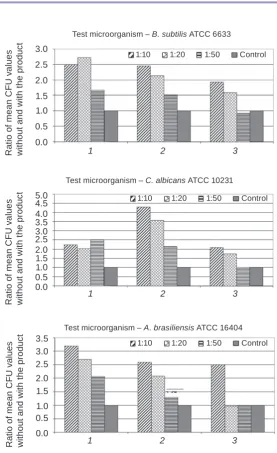
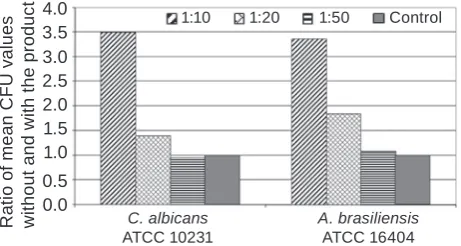
antimi-crobial effects (Table 4 and Fig. 1-2) confirm that the
suggested procedure allows us to eliminate the
prod-uct antimicrobial activity effectively in antimicrobial
purity testing conditions.
The product microbiological purity standar-dization has been established in accordance with
requirements of SPU 2.0 (5.1.4) as for non-sterile
medicinal products for nasal use: the product may contain total aerobic microbial count (TAMC) no more than 102 CFU/ml, total yeast and mold count
Ta b l e 4. Results of studying the product antimicrobial activity neutralization potential
Dilution Solvent
Mean CFU count on Petri dishes*
B. subtilis ATCC 6633
C. albicans
АTCC 10231 a. brasiliensis ATCC 16404
Soybean casein digest agar
1 : 10
PBS with sodium
chloride and
peptone, рН 7.0
12 20 11
1 : 20 11 22 13
1 : 50 18 18 17
Control 30 45 35
1 : 10
NF with 30 g/l polysorbate-80, 3 g/l lecithin
13 10 12
1 : 20 15 12 15
1 : 50 21 20 24
Control 32 43 31
1 : 10
NF with 50 g/l polysorbate-80, 5 g/l lecithin
14 21 12
1 : 20 17 25 31
1 : 50 29 46 30
Control 27 44 30
Sabouraud dextrose agar containing an antibiotic
1 : 10
NF with 50 g/l polysorbate-80, 5 g/l lecithin
Not performed 12 11
1 : 20 Not performed 30 20
1 : 50 Not performed 44 34
Control Not performed 42 37
Remark: * the data of three consecutive experiments are presented (р < 0.05)
(TYMC) no more than 101 CFU/ml, the presence of
Staphylococcus aureus in 1 ml and the presence of Pseudomonas aeruginosa in 1 ml is not permitted.
In order to unify the product microbiological purity testing by various parameters during TAMC and TYMC measurement, as well as during tests for detection of individual microbial species (S. aureus, P. aeruginosa), we have suggested to use the same
solvent (neutralizing fluid) with the same product
dilution (1 : 50). It has been established that, in sug-gested testing conditions the product does not exert
antimicrobial effects against test microorganisms
S. aureus ATCC 6538 (on soybean casein digest agar) and P. aeruginosa ATCC 9027 (on soybean casein digest agar).
Thus, the conducted studies are indicative of the fact that the developed procedure of total aero-bic microbial count measurement for the test product
conforms to the acceptance criteria of SPU 2.0
Fig. 1. Results of studies of antimicrobial effect neutralization using various test microorganisms on soybean casein agar. Solvents variants: 1 – PBS with sodium chloride and peptone, pH 7.0; 2 – NF with 30 g/l poly -sorbate-80, 3 g/l lecithin; 3 – NF with 50 g/l poly-sorbate-80, 5 g/l lecithin
Test microorganism – C. albicans ATCC 10231
R at io o f m e a n C F U v a lu e s w it h o u t a n d w it h t h e p ro d u c t 3.0 2.0 1.0 2.5 1.5 0.5 0.0 5.0 4.0 4.5 3.5
1 2 3
R at io o f m e a n C F U v a lu e s w it h o u t a n d w it h t h e p ro d u c t
1 2 3 Test microorganism – B. subtilis ATCC 6633
3.0 2.0 1.0 2.5 1.5 0.5 0.0
Test microorganism – A. brasiliensis ATCC 16404
R at io o f m e a n C F U v a lu e s w it h o u t a n d w it h t h e p ro d u c t 3.0 2.0 1.0 2.5 1.5 0.5 0.0 3.5
1 2 3
Scientific standardization of recombinant hu -man interleukin-7 based product in the form of nasal spray has been performed: the product may contain total aerobic microbial count (TAMC) no more than 102 CFU/ml, total yeast and mold count (TYMC) no
more than 101 CFU/ml; the presence of S. aureus in
1 ml is not permitted, the presence of P. aeruginosa
in 1 ml is not permitted. Suitability assessment of
microbiological purity testing procedures was per-formed. It has been established that the test product in standard testing methods possessed antimicro-bial activity against test microorganisms B. subti-lis ATCC 6633 (on soybean casein digest agar and
Sabou raud dextrose agar containing an antibiotic),
C. albicans АТСС 10231 (on soybean casein digest
agar and Sabouraud dextrose agar containing an
antibiotic), and possessed no antimicrobial activity against test microorganisms S. aureus ATCC 6538 (on soybean casein digest agar) and P. aeruginosa ATCC 9027 (on soybean casein digest agar). The
efficacy of lecithin and polysorbate as substances eliminating antibacterial effect in combination with
50-fold dilution of the test sample has been suggest-ed and proven for the purpose of antimicrobial activ-ity neutralization. The developed procedure of total aerobic microbial count measurement for the test
1:10 1:20 1:50 Control
1:10 1:20 1:50 Control
Fig. 2. Results of studies of antimicrobial effect neut ralization using various test microorganisms on Sabouraud dextrose agar. Solvent: NF with 50 g/l polysorbate-80, 5 g/l lecithin
R
at
io o
f m
e
a
n C
F
U v
a
lu
e
s
w
it
h
o
u
t a
n
d w
it
h t
h
e p
ro
d
u
c
t
C. albicans
ATCC 10231 3.0
2.0
1.0 2.5
1.5
0.5 0.0
A. brasiliensis
ATCC 16404 4.0
3.5 1:10 1:20 1:50 Control
product conforms to acceptance criteria provided by
SPU 2.0 (2.6.12), and can be used for its microbio -logical purity control.
РозРобка методу випРобування мікРобіологічної
чистоти пРепаРату на основі Рекомбінантного інтеРлейкіну-7 людини
О. Ю. Галкін1, Т. М. Луценко1,2, Ю. В. Горшунов1, В. В. Мотроненко1
1Національній технічний університет України «Київський політехнічний
інститут імені Ігоря Сікорського»; 2ТОВ «УА «ПРО-ФАРМА», Київ, Україна;
e-mail: alexf [email protected]
Метою роботи було обґрунтування параметрів стандартизації препарату на основі рекомбінантного інтерлейкіну-7 людини за показником «мікробіологічна чистота» та розробка методу визначення цього показни
-ка з урахуванням вимог керівних документів щодо якості лікарських засобів. Проведе
-но оцінку придат-ності методик визначення мікробіологічної чистоти. Встановлено, що досліджуваний препарат за стандартних методів дослідження виявляв антимікробну активність по відношенню до тест-мiкроорганiзмiв Bacillus subtilis ATCC 6633 (на соєво-казеїновому агарi
та Сабуро-декстрозному агарі з антибіотиком), Candida albicans АТСС 10231 (на соєво-казеїновому агарi та Сабуро-декстрозному агарі з антибіотиком) і не виявляв антимiкробну дiю
вiдносно тест-мiкроорганiзмiв Staphylococcus aureus ATCC 6538 (на соєво-казеїновому агарi)
та Pseudomonas aeruginosa ATCC 9027 (на соєво-казеїновому агарi). З метою нейтралізації антимікробної активності було запропоно
-вано та доведено ефективність використан
-ня лецитину та полісорбату як речовин, що знімають антибактеріальний ефект за роз
-ведення досліджуваного зразка у 50 разів. Розроблена методика визначення загально
-го числа життєздатних мікроорганізмів для досліджуваного препарату, за вимогою ДФУ, відповідає критеріям придатності та може бути використана для контролю його мікробіологічної чистоти.
К л ю ч о в і с л о в а: антимікробна активність, мікробіологічна чистота, рекомбінантний інтерлейкін-7 людини.
РазРаботка метода испытания
микРобиологической чистоты пРепаРата на основе Рекомбинантного интеРлейкина-7 человека
А. Ю. Галкин1, Т. Н. Луценко1,2, Ю. В. Горшунов1, В. В. Мотроненко1
1Национальный технический университет Украины «Киевский политехнический
институт имени Игоря Сикорского»; 2ООО «УА «ПРО-ФАРМА», Киев, Украина;
e-mail: alexf [email protected]
Целью работы было обоснование параме
-тров стандартизации препарата на основе ре
-комбинантного интерлейкина-7 человека по показателю «микробиологическая чистота» и разработка метода определения этого показате
-ля с учетом требований руководящих докумен
-тов по качеству лекарственных средств. Прове
-дена оценка пригодности методик определения микробиологической чистоты. Установлено, что исследуемый препарат при стандартных мето
-дах исследования проявлял антимикробную активность в отношении тест-микроорганизмов
Bacillus subtilis ATCC 6633 (на соево-казеиновом
агаре и Сабуро-декстрозном агаре, содержащем антибиотик), Candida albicans АТСС 10231 (на соево-казеиновом агаре и Сабуро-декстроз
-являл антимикробное действие по отношению к тест-микроорганизмам Staphylococcus aureus ATCC 6538 (на соево-казеиновом агаре) и Pseudomonas aeruginosa ATCC 9027 (на соево-казеиновом агаре). С целью нейтрализации ан
-тимикробной активности было предложено ис
-пользование лецитина и полисорбата и доказана их эффективность как веществ, снимающих ан
-тибактериальный эффект при разведении иссле
-дуемого образца в 50 раз. Разработанная методи
-ка определения общего числа жизнеспособных микроорганизмов для исследуемого препарата, предъявляемым ГФУ, соответствует критериям пригодности и может быть использована при контроле его микробиологической чистоты.
К л ю ч е в ы е с л о в а: антимикробная ак
-тивность, микробиологическая чистота, реком
-бинантный интерлейкин-7 человека.
references
1. Fry TJ, Mackall CL. Interleukin-7: from bench to clinic. Blood. 2002; 99(11): 3892-3904.
2. Gilchuk PV. Evaluation of renaturation methods
for industrial obtaining of recombinant proteins from escherichia coli inclusion bodies in biologically active form”. Biopolym Cell. 2004; 20(3): 182-192. (In Russian).
3. Slyvka AV, Okunev OV. Molecular mechanisms
of versatile biological activity of interleukin-7 . Biopolym Cell. 2014; 30(5): 349-357.
4. Galkin OYu, Shyrobokov VP, Grygorenko AA,
Dugan O, Lutsenko TM, Komar AG. Biotechnological bases of creation of tools for serological diagnosis of infectious and
non-infectious diseases. Ed. Shyrobokov VP. Kiev, Ukraine: NTUU “KPI”, 2015; 204 p. (In
Ukrainian).
5. State Pharmacopoeia of Ukraine: in 3 volumes -
2nd edition. Kh.: Pharmacopoeia Ukrainian
Center for Quality of Medicines. 2015; 1: 1128. (In Ukrainian).
6. Lutsenko TM, Andryukova LM, Fetisova OG, Marintsova NG, Galkin OYu. Development of composition and technology of preparation based on recombinant human interleukin-7. Visnyk Nat Univ “lvivska Politekhnika”. 2016; (841): 174-180. (In Ukrainian).
7. Lutsenko TM, Galkin OYu, Karpenko OYa,
Duhan OM. Substantiation of parameters for
standardization of drugs based on recombinant human interleukin-7. Visnyk Nat Univ “lvivska Politekhnika”. 2015; (812): 175-183. (In Ukrainian).
8. Lutsenko TM, Starosyla DB, Rybalko SL,
Galkin OYu. Methods for assessing biological activity of recombinant human interleukin-7, and stability studies of the drug based on it. Naukovi Visti NTUU “kPI”. 2016; 3: 48-54. (In Ukrainian).
9. Lutsenko TN, Kovalenko MV, Galkin OYu. Validation of biological activity testing
procedure of recombinant human interleukin-7. Ukr Biochem J. 2017; 89(1): 82-89.
10. Gunar OV, Builova IA. Microbiological Quality Control of Biotechnological Pharmaceuticals.
Pharmac Chem J. 2016; 50(2): 108-113. (In Ukrainian).
11. Gunar OV. Determination and neutralization of
antimicrobial action of drugs. Farmaciya. 2004; (3): 5-7. (In Russian).
12. Gunar OV, Kalamova NI, Evtushenko NS.
Determination of antimicrobial action of drugs - practical approaches. Farmaciya. 2002; (2): 4-7. (In Russian).
13. Zhemerova EG, Dunay EV, Galkіn AYu, Mulder L, van Hemert S. Development of quality control methods and research of probiotic
preparation for the treatment and prevention of allergy and dysbiosis. Ukr J Clin Lab Med. 2012; 7(4): 169-174.