Information Databases Influential in the Implementation of
Customs Policy in the See Countries
Mr.Sci. Genc Beqiri
European College Dukagjini, [email protected]
Doi:10.5901/ajis.2014.v3n2p147
Abstract
SEE countries are in the process of developing and preparing to join European Union. All companies in SEE Countries have an imposition to import various kinds off items. Some for production input, technology enhancement, and some as trading items, since they are not produced in the country itself. The Government is always trying to simplify and improve the process of documenting and control of the importation of these items. This is included in the customs policy of every SEE country in the region. The classical approach is to just bring the materials to the customs, pay the taxes and then use them for everyday needs of the companies. This is very simple and convenient, since it assures all documents processing in the very beginning of on goings within the country. Since SEE countries are in the developing process, they need to be further stimulated in circulating goods that are crucial for the development and fulfilling of the needs of the population. In order to stimulate this, a new way of handling the import process is implemented. This is a way to bring the items inside the country and pay the necessary taxes only after they have been put into circulation. This kind of a procedure is called “Bonded Goods Warehouse” (“Depo Doganore” - Customs Warehouse). There are some regulations that apply to holding this kind of warehouse. Customs trust the companies to keep the goods in safekeeping for a period of time until they have a need for them. They are not obligated to pay any kind of fee in the meantime. All the obligations start at the moment the items that are kept in “Bonded Goods Warehouse” are put in circulation. Another benefit is that companies are obligated to pay customs and VAT (Value Added Tax) for only the items and quantities put into circulation, not for the entire content of an invoice or a Customs input document. The only problem is that it has to be done with a method of FIFO (First In First Out) processing. This naturally requires both database applications and a developed network. These privileges offered by Customs to have a “Bonded Goods Warehouse” for the imported goods, are very attractive since they enable us to have the goods waiting to be put into circulation at a time of our convenience. In order to use this privilege we have to fully comply with the rules given by the Customs. Apart from the database processing and the mathematical apparatus that has to be used in this case. This paper purpose is to provide a way and mathematical methods of FIFO INPUT – OUTPUT processing. Through the paper are set the rules, order and formulas that enable the use of FIFO INPUT – OUTPUT database processing, in order to enable the companies to profit from the Customs privilege of having a “Bonded Goods Warehouse” without affecting their own ability to response quickly to the market request for fast and qualitative supply, The method use in the paper is an exact method of implementing the formulas and doings in order of getting proper results. The results are practically confirmed both in practical reporting and by mathematical methods. We are going to be dealing with division of the Summarized Nomenclatures of the goods used by Customs application database processing, into individual items used by the Companies application database processing, and after the completion of the circulation and INPUT – OUTPUT of these items, transforming them again into Nomenclatures that can be reported and processed by the Customs application database.
Keywords: SEE Countries, Wireless, databases, Networks
1. Introduction
The problem that has to be resolved is that in a large group of items that are grouped in various ways for to meet the demands of documentation, branding and market requests, we have to identify each separate item and apply the FIFO means of processing at the very moment that any of these specific items comes into circulation.
This calls for a developed It Network, especially if the company branches are spread throughout the country. Improvements have been implemented in the trading between groups of countries that are of the same former federation (Former Yugoslavia), that are released from customs obligations (CEFTA -https://dogana.rks-gov.net/sq/CEFTA).
mentioned item is being used for output. This means that a very precise supervision of every input and output progression and a linkage between them is crucial for the successful implementation of the FIFO method in supervision of the “Bonded Goods Warehouse”.
Another problem is that all these data are to be processed in two various applications, one is the Customs application that is processing the data within the Customs database, and another one is the Companies application that is processing the data in the Companies database. Therefore the companies have to be careful in determining the operations that should achieve a synchronization of steps between data processing in a synchronized manner. The document use in inputting and outputting the items is named Single Administrative Document (SAD).
2. Problem Exposition and Manners of Resolve
Since a “Bonded Goods Warehouse” is a privilege that a Company applies for, there are rules that the Company has to comply. These rules are very strict. They are mathematically defined and have to be executed in a very strict order.
For to resolve of the problem, we have to determinate a few more facts.
The term goods used until now refers to a customs term used for describing physical stuff that belongs to a certain organization manner dictated by the customs. In Customs this is ordinary named “Nomenclature”
Nomenclature (goods) has to:
- Have the same customs number
- Consist of the same kind of materials
- Have the same final destination of usage
In an example, a t-shirt and trousers are not the same kind of Nomenclature (goods).
On the other side an item is an individual article that belongs to the Nomenclature (goods) and of which the category Nomenclature consists of. This means that one good can consist of hundreds of items of the same kind.
Here is a technical description of the documentation of depositing the Nomenclature (goods): A. Deposition of physical
1. Every import that is destined for “Bonded Goods Warehouse” has to be joined with a document called Single Administrative Document that has a unique ID. This is done through a envisaged procedure named IM7.
a) This requires certain mathematical tool and data storing management
2. The goods are stored in a special Warehouse that is not mixed with other kind of input.
a) There is an issue on what is considered “Nomenclature” (goods) and what an Item in this case. One Nomenclature (good) can and usually does consist of a number of items of the same kind.
3. After these demands are met, the deposition of physical goods can be done B. Circulation of the deposited Nomenclature (goods)
1. There are a few ways on how the deposited good are to be output of stock a) Re-exporting the items out of the country (procedure EX3)
b) Physical liquidation of the items that are degraded and are not appropriate for use (procedure IM9) c) Using the items for production (procedure IM5)
d) Putting the items into Circulation through Invoicing ore internal locomotion within the same Company C. Stocking of the deposited Nomenclature (goods)
a) Every movement of the items has to reflect the stock of the individual items inside the “Bonded Goods Warehouse”
3. FIFO method
The before mentioned procedure of processing “Bonded Goods Warehouse” circulation along with keeping track of every input, output and stock Quantities can only be done using a FIFO (First In Firstr Out) method of database processing. which stands for "first-in-first-out," is an inventory costing method which assumes that the first items placed in inventory are the first sold.) FIFO is one method used to determine Cost of Goods Sold for a business. (Murray, pp. FIFO)
Together with the analogies and differences of the Couple Nomenclature (goods) – Items mentioned before, we have to add a few more postulates that are needed to make the problem analyses practical and to enable us to resolve the problem with an elegant solution. The complete documentation processed by the customs application deals with the elements that are ordered as described in the next section. We shouldn’t forget that one thing that FIFO processing imposes is that every change committed during the circulation period has to be reverted to meet the conditions first applied when the object had at the beginning of the process. This is the very idea that we use in appropriateness (adaptation) of both Customs application database processing and Companies application database processing. We start from Nomenclature (goods), into both databases, translate that into detailed individual items, process the item INPUT-OUTPUT circulation, all in Companies application database, then revert the transformation to Item – Nomenclature, and reprocess the OUTPUT into Customs application database.
4. Procedures and Methods to be used for FIFO processing
A. Deposition
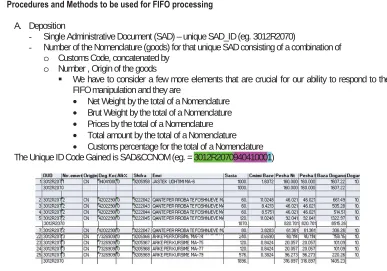
- Single Administrative Document (SAD) – unique SAD_ID (eg. 3012R2070)
- Number of the Nomenclature (goods) for that unique SAD consisting of a combination of
o Customs Code, concatenated by o Number , Origin of the goods
We have to consider a few more elements that are crucial for our ability to respond to the I/O FIFO manipulation and they are
• Net Weight by the total of a Nomenclature
• Brut Weight by the total of a Nomenclature
• Prices by the total of a Nomenclature
• Total amount by the total of a Nomenclature
• Customs percentage for the total of a Nomenclature The Unique ID Code Gained is SAD&CCNOM (eg. = 3012R2070940410001)
Table 1- Unique ID Code Gained is SAD&CCNOM
B. Circulation of the deposited goods (Nomenclature)
- The goods in the “Bonded Goods Warehouse” are now ordered by Nomenclature and can be processed in that order.
- The Companies divide the Nomenclatures into Items and use them differently from the Nomenclature grouping.
(eg 9205958)
The whole circulation Processed within the “Bonded Goods Warehouse” is based on this. Therefore this has to be added to the key used by the database in Customs application, now
- In the Companies database application, we use a new key composed of a combination of SAD&CCNOM&ItemID (eg. = 3012R20709404100019205958)
C. Circulation tracking
Enables us to track the movement of every item that inputs ore/and outputs the stock of the “Bonded Goods Warehouse” precisely.
- In every kind of movement we can document
o Single Administrative Document (SAD) – unique SAD_ID (eg. 3012R2070)
o Number of the Nomenclature (goods) for that unique SAD consisting of a combination of Customs Code Eg (94041000)
Number , Origin of the goods Eg (1)
o ItemID Eg (9205958)
Usin this ID in all the processes of INPUT and OUTPUT circulation of our Items, we are going to be able to identify each individual movement of every separate Item belonging to a specific ID = SAD&CCNOM&ItemID (eg. = 3012R20709404100019205958)
D. Stock tracking
- Since by definiton and any mathematical method, stock is the difference between INPUT and OUTPUT that in this case tracks changes chronologically. Naturally FIFO method imposes the stock to consist of the goods most recently placed in inventory.
- Our Item Stock without FIFO
a) starts from the starting Stock of a PREVIOUS INPUT (PI) b) increases by the quantity added by the CURRENT INPUT (CI)
c) decreases by the quantity subtracted by OUTPUT from the PREVIOUS INPUT (PO) d) decreases by the quantity subtracted by OUTPUT from the CURRENT INPUT (CO)
- Formula Applying FIFO method, we get
o Stock of the PREVIOUS INPUT by a) minus c), and after this becomes zero o Stock of the CURRENT INPUT by b) minus d)
- So in the case that PREVIOUS INPUT is not spent completely we shall have PREVIOUS INPUT stock as a PARTIAL REMAIN, and CURRENT INPUT stock COMPLETE
After we translate this into a classic formula, we have the stock based on FIFO Processing method and it should look like this:
ܵݐܿ݇ ൌ ሼۃܲܫ െ ܱܲۄ ۃܥܫ െ ܥܱۄሽ
There is an exceptional case when we can have PARTIAL REMAIN stock from both inputs. This is the case when we have had specially prepared export case of EX3 or a stock transfer from a “Bonded Goods Warehouse” to another “Bonded Goods Warehouse”.
5. Actual Case - FIFO Method
We will present and illustrate the FIFO method that we described above, in an actual case.
The data needed to present the case for one specific Item of Nomenclatures from various SAD a. Customs Code
b. Previous INPUT SAD
c. OUTPUT from Previous INPUT SAD d. Current INPUT SAD
e. OUTPUT from Current INPUT SAD
f. Stock at the moment queried consisting of remaining of Previous and Current INPUT – OUTPUT process. We will start from the end, so first we will list the customs card of the item with ID = 9339031.
Table 2 - INPUT – OUTPUT is processed the item card FIFO order
For to came here the chronological order of steps is going to be:
1. Customs Code of the Item is “69111000”, it is a statik information. This information is going to be used through the whole FIFO process .
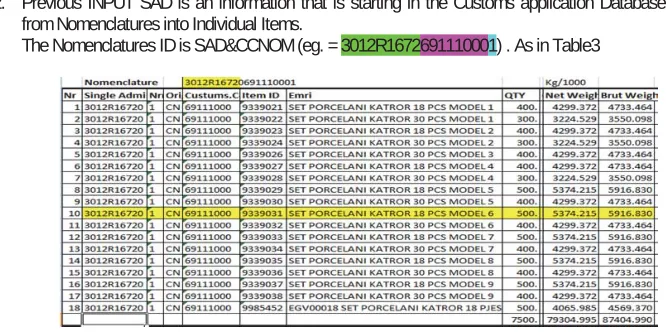
2. Previous INPUT SAD is an information that is starting in the Customs application Database being devided from Nomenclatures into Individual Items.
The Nomenclatures ID is SAD&CCNOM (eg. = 3012R1672691110001) . As in Table3
Table 3 - The Nomenclatures ID is SAD&CCNOM previousINPUT
This is completed by the Item ID and in the Company’s application Database that same Nomenclatures is divided in a number of items and the ID for the specific item we are tracing is SAD&CCNOM&ItemID (eg. = 3012R16726911100019339031) as in table 3 but with the Item ID added to the Nomenclature.
3. OUTPUT from Previous INPUT SAD
As we see in the Item Card we have three Outputs before the new INPUT a. ( On 24.12.2013, E12/10.0000P/13)
b. ( On 31.12.2013, E12/10.0000P/13) c. ( On 31.01.2014, E01/10.0000P/14) and two after it.
d. ( On 25.02.2014, E02/10.0000P/14) e. ( On 23.03.2014, E03/10.0000P/14)
In all these cases the ID of the processed data is 3012R16726911100019339031 for the FIFO procedure to be in charge.
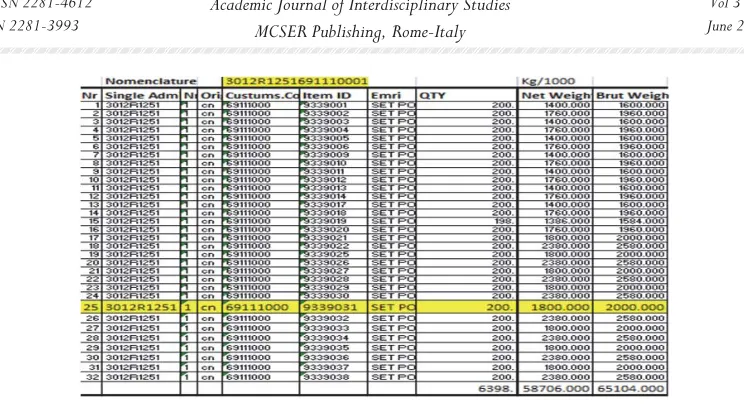
4. Current INPUT SAD gives us information starting in the Customs application Database being devided from Nomenclatures into Individual Items.
Table 4 - The Nomenclatures ID is SAD&CCNOM Current INPUT
The ID of the processed data is 3012R16726911100019339031 for the FIFO procedure to be in charge. So now we see that the part of the FIFO responsible ID is dependent on th SAD and the other part of the ID being 6911100019339031 remains the same.
5. OUTPUT from Current INPUT SAD
The Item Card gives us two outputs of the Current INPUT SAD (green) a. ( On 23.03.2014, E03/10.0000P/14)
b. ( On 31.03.2014, E03/10.0000P/14)
6. Stock at the moment queried consisting of remaining of Previous and Current INPUT – OUTPUT process. As it can be noticed from the Item card Stock QTY is 46
This has to be reflected in e direct stock report table5
Table 5 - Item card Stock QTY
In e case of both Previous and Current nonzero INPUT – OUTPUT process the stock is consisted of both quantities. In table5 as we see the quantities from Previous INPUT are not spent yet, so the Current INPUT is untouched.
Table 6 - Item INPUT - OUTPUT card FIFO
Table 7 - Item card Stock QTY for 2 SAD stock
6. Conclusion
Using Database processing of The FIFO models is a very valuable asset. In this paper we explained how it can give us a chance to use Customs privileges without affecting our ability to conduct business in a very effective way.
If we want to use the privileges offered by Customs and have a “Bonded Goods Warehouse” for the imported goods, we have to fully comply with the rules given by the Customs. I use the word rules and not low because it really is not forced by low in any way. It is a very useful idea that helps both sides, the Companies and Customs, to create a partnership, allowing the companies to stock imported goods for a while, and be prepared for season changes and other kind of increased requirement.
Apart from the database processing and the mathematical apparatus that has to be used in this case because of the use of FIFO INPUT – OUTPUT method, the main problem in dealing with it is the division of the Summarized Nomenclatures of the goods used by Customs application database processing, into individual items used by the Companies application database processing, and after the completion of the circulation and INPUT – OUTPUT of these items, transforming them again into Nomenclatures that can be reported and processed by the Customs application database.
Once again we mention that making a division of the data used in Customs application database processing from a Nomenclature and using them in FIFO INPUT – OUTPUT processing method is the main issue that this paper is dealing with.
Data processing of concrete cases is important for to represent actual data processed in this manner.
References
Abrams, B. NET Framework Standard Library Annotated Reference, Volume 2: Networking Library, Reflection Library, and XML Library, 2008.
Adams, A., Lee, A. J. and Mossé, D. "Receipt-Mode Trust Negotiation: Efficient Authorization Through Outsourced Interactions," (ASIACCS 2011), 2011.
Beaulieu, A. Learning SQL. O’Reilly Media Inc, Sebastopol CA, 2009.
Date, C.J. An Introduction to Database Systems, 8th Edition. Addison-Wesley, Reading MA, 2003.
Davidson, L. Ten Common Database Design Mistakes, http://www.simple-talk.com/sql/database-administration/ten-common-database-design-mistakes/, 2007.
Elmasri, R. and Navathe, S. Fundamentals of Database Systems, 6th Edition. Addison-Wesley, Reading MA, 2010.
Mauring, F. Development and Transition. Available at: http://www.kosovo.undp.org/repository/docs/Dev_transit_eng.pdf , 2007. Rosen, A. “The E-Commerce Question and Answer Book: A Survival Guide for Business Managers”,AMACOM Div American Mgmt
Assn, 2002.
Silberschatz, A., Korth, H.F. and Sudarshan, S. Database System Concepts, 6th Edition. McGraw-Hill, New York, 2010.
Internet sources
CEFTA -https://dogana.rks-gov.net/sq/CEFTA).
“FIFO Inventory Cost Method” By Jean Murray http://biztaxlaw.about.com/od/glossaryf/g/fifo.htm http://www.ehow.com/how_5067715_calculate-lifo-fifo.html
https://dogana.rks-gov.net/sq/Depot-dhe-tregtaret-e-mallrave-akcizore https://dogana.rks-gov.net/sq/Udhëzime Mbi Deponimin Doganor