Chapter 7
Learning objectives
• After this lecture, you will be able to:
– evaluate the different alternatives for acquiring BIS; – distinguish between the typical stages involved in
building BIS;
– explain the purpose of each stage in building a system;
Management issues
From a managerial perspective, this lecture
addresses the following areas:
• What are the alternatives for systems acquisition
and how is the most suitable approach selected?
• What alternative models are there for the different
stages for introducing a BIS? Which is most
appropriate?
Introducing BIS acquisition
• BIS acquisition: The process of evaluating and implementation for a BIS.
• Systems development lifecycle (SDLC): Any
information systems project follows a logical series of development phases. These are known as the
systems development lifecycle.
• SDLC stages: Initiation, feasibility study, analysis of business requirements, systems design, system build and implementation and, finally, review and
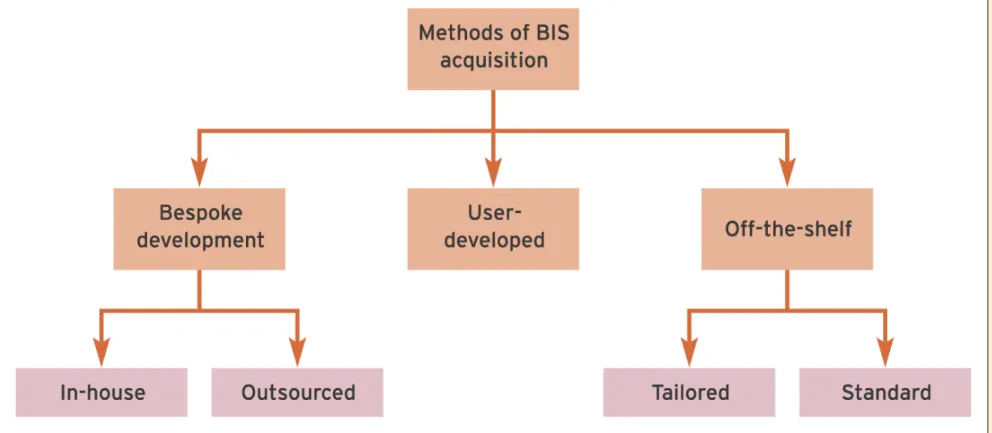
Bespoke development
•
Bespoke development
: An IS is developed ‘from
scratch’ by an IS professional to suit the business
requirements of the application.
• Benefits:
– Tailored to requirements of business
– May confer specific competitive advantage.
• Problems:
– Expense – Most expensive way of developing a new information system
– Time – Development is often delayed
Off-the-shelf purchase
•
Off-the-shelf purchase
: An acquisition method
that involves direct purchase of a pre-written
application used by more than one company.
• Benefits:
– Time – Quick purchase
– Cost – Low cost due to economies of scale
– Quality – Should offer stability and be feature-rich.
• Disbenefits:
– May omit some features specifically required by individual customer
Off-the-shelf purchase
• A
tailored off-the-shelf
purchase is an
off-the-shelf purchase that has specific programming
development or extensive configuration tailored
to the needs of the customer.
End-user-developed software
•
End-user-developed software
: Software written
by non-IS professionals, i.e. the business users.
• Benefits:
– Tailored to the needs of end-users – Often relatively fast.
• Problems:
– May not achieve wider business objectives
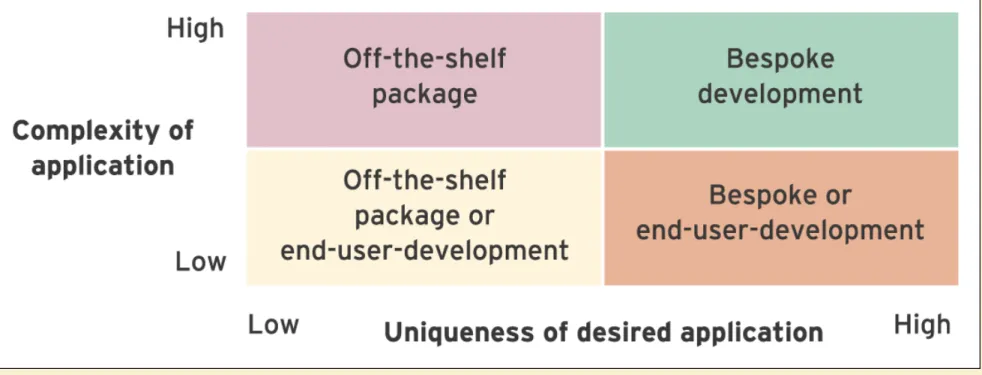
Other factors affecting selection
• Size of the organisation
• Size of in-house IT capability
• Complexity of information system (are there
special issues for the market the company
operates in)
• End-user experiences
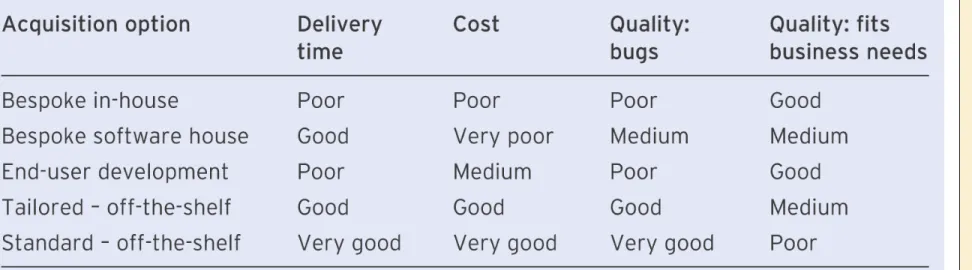
Summary – acquisition alternatives
Waterfall model of systems development
•
Waterfall model
: Outlines the series of steps that
should occur when building an information
system. The steps usually occur in a predefined
order with a review at the end of each stage
Initiation phase
•
Initiation phase
:
– The startup phase in an IS development project. Its aims are to establish whether the project is feasible and then prepare to ensure that the project is
successful.
•
Initiation phase context
:
– Input: creative thought and/or systematic evaluation of IS needs.
Feasibility assessment
• Feasibility assessment: An activity at the start of the project to ensure that the project is a viable business proposition. The feasibility report analyses the need for and impact of the system and considers different alternatives for acquiring software.
• Feasibility assessment context:
• Input: idea for initiation of a new information system. • Output: feasibility report and recommendation to
Systems analysis
• Systems analysis: The capture of the business
requirements of a system from talking to or observing end-users and using other information sources such as existing system documentation. Defines what the system will do.
• Systems analysis context:
– Input: terms of reference in feasibility report describing outline requirements.
– Output: detailed requirements specification
Systems design
• Systems design: Defines how the system will work in key areas of user interface, program modules,
security and database structure and transactions. • Systems design context:
– Input: requirements specification.
System build
• System build: Describes the creation of software by programmers. It involves writing the software code (programming), building release versions of the
software, constructing and populating the database and testing by programmers and end-users. Writing of documentation and training may also occur at this
stage.
• System build context:
– Input: requirements and design specification
System implementation
• System implementation: Involves the transition or changeover from the old system to the new and the preparation for this, such as making sure the
hardware and network infrastructure for a new system are in place; testing of the system; and also human issues of how best to educate and train staff who will be using or affected by the new system.
• System implementation context:
– Input: working system, not tested by users.
SSADM
• Structured systems analysis and design method (SSADM): A methodology that defines the methods of analysis and design that should occur in a large-scale software development project. It is used extensively in the UK, particularly in government and public
organisations
• Feasibility study, requirements analysis, review of
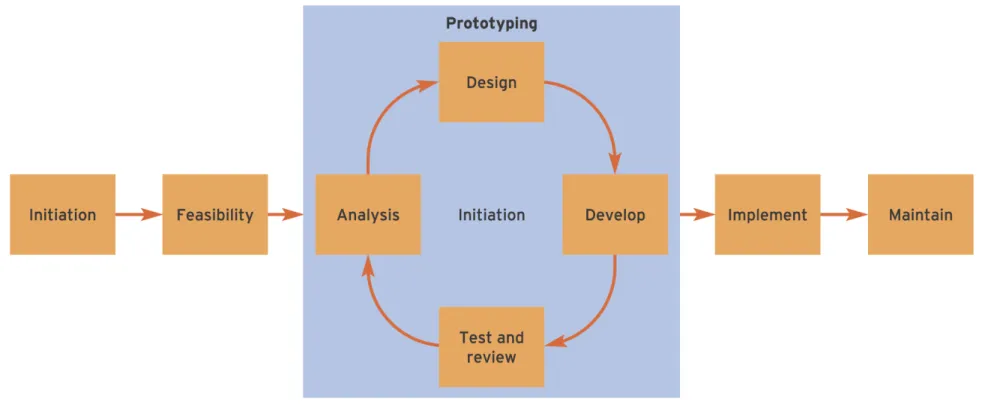
Rapid applications development (RAD)
• Rapid applications development (RAD): A method of
developing information systems that uses prototyping to achieve user involvement and faster development compared to
traditional methodologies such as SSADM.
• Prototyping: A prototype is a preliminary version of part or a
framework of all of an information system which can be reviewed by end-users. Prototyping is an iterative process where users suggest modifications before further prototypes and the final information system is built.
• Characteristics
– Rapid
– Small teams
– User involvement
Spiral model
• Spiral model: An iterative systems development model in which the stages of analysis, design, code and review repeat as new features for the system are identified
• The four main activities of this model are as follows:
– Planning. Setting project objectives, defining alternatives.
– Risk analysis. Analysis of alternatives and the identification and solution of risks.
– Engineering. Equivalent to the build phase of the SDLC with coding and testing.
Agile and lean software development
• The lean approach to software development emphasises what is essentially an incremental approach to software development where software is developed and deployed in small and useful feature sets which work incrementally. This ‘feedback-driven’
approach to software development is in contrast to the traditional waterfall model where software development proceeds in a series of discreet steps, each of which should be completed before the next one can proceed
• Agile Software Development tends to relate more to the software engineering aspects of systems development. The term ‘Agile Methods’ has been around since 2001 and today encompasses a number of agile software development methods including Adaptive Software Development (ASD), Agile Unified Process (AUP),
Dynamic Systems Development
Methodology (DSDM)
• Dynamic Systems Development Methodology
(DSDM): A methodology that describes how RAD can be approached.
1. Active user involvement is imperative.
2. DSDM teams must be empowered to make decisions.
5. Iterative and incremental development.
6. All changes during development are reversible.
7. Requirements are baselined at a high level. 8. Testing is integrated throughout the lifecycle.
9. A collaborative and co-operative approach between all stakeholders is essential.