Management Approaches and Experiences
Sludge Treatment and Disposal
By ISWA’s Working Group on Sewage & Waterworks Sludge Albrecht R. Bresters, The Netherlands Isabelle Coulomb, France Bela Deak, Hungary Bernhard Matter, Switzerland Alice Saabye, Denmark Ludivico Spinosa, Italy Ådne Ø. Utvik, Norway
Lise Uhre, Project Co-ordinator International Solid Waste Association
Sludge Treatment and Disposal
© 1997 European Environment Agency
LEGAL NOTICE
Neither the European Commission, the European Environment Agency, the International Solid Waste Association, nor any person or company acting on their behalf is responsible for the use which may be made of the information in this publication. The contents of this publication do not necessarily reflect the official opinions of the European Community, its institutions, or the international organisa-tions and individual countries involved in preparing this report. The designations employed and the presentation of material in this publication do not imply the expression of any opinion whatsoever on the part of the European Community or the European Environ-ment Agency concerning the legal status of any coun- try, territory, city or area or its authorities.
ALL RIGHTS RESERVED
No part of this publication may be reproduced in any form or by any means electronic or mechanical, including photocopying, recording or by any information storage retrieval system without the permission in writing from the copyright holder and publisher.
Cover and layout: Folkmann Design & Promotion ISBN 87-90402-05-7 European Environment Agency
Kongens Nytorv 6 DK-1050 Copenhagen K Denmark
Tel. (+45) 33 36 71 00 Fax (+45) 33 36 71 99 E-mail: [email protected] Home page: http:// www.eea.eu.int ISWA
Læderstræde 9, 2. DK-1201 Copenhagen K Denmark
1. Introduction ... 9
2. Background... 10
3. Sludge characterisation... 13
3.1. Introduction ... 13
3.2. Characterisation Parameters ... 13
3.2.1. Agricultural Use ... 14
3.2.2. Composting ... 14
3.2.3. Incineration ... 14
3.2.4. Landfilling ... 14
3.3. Stabilisation ... 14
3.4. Solid-Liquid Separation ... 15
3.5. Concluding Remarks ... 15
4. Transportation and storage ... 17
4.1. Introduction ... 17
4.2. Storage ... 17
4.2.1. Operation Description ... 17
4.2.2. Equipment ... 17
4.3. Transportation ... 18
4.3.1. Operation Description ... 18
4.3.2. Equipment ... 19
4.4. Concluding Remarks ... 19
5. Agricultural Use... 20
5.1. Conditions for Agricultural Use ... 20
5.1.1. Sludge Types and Sludge Quality ... 20
5.1.2. Legislation ... 20
5.2. Description of Agricultural Use ... 20
5.3. Advantages/Disadvantages of Agricultural Use ... 21
5.4. Financial Estimate ... 21
6. Composting... 22
Sludge Treatment and Disposal
6.2. General Description of the Process
of Composting and Plant Conception Factors ... 23
6.3. Advantages/Disadvantages of Composting ... Sludges ... 24
6.4. Financial Estimates ... 25
6.5. Concluding Remarks ... 26
7. Drying... 27
7.1. Introduction ... 27
7.2. Conditions for Drying of Sludge - Amounts and Drying Rates ... 27
7.2.1. Quality ... 28
7.3. Drying and Dryers ... 28
7.3.1. Indirect Dryers ... 29
7.3.2. Direct Dryers ... 29
7.4. Advantages/Disadvantages of Drying ... 30
7.5. Financial Estimate ... 30
8. Incineration (Vitrification, Co-incineration)... 31
8.1. Designated Sludge Incinerators -a Gener-al Description ... 31
8.2. Co-incineration - a General Description ... 33
8.3. Advantages and Disadvantages ... 34
8.4. Financial Estimate ... 34
8.5. Concluding Remarks ... 35
9. Landfilling... 36
9.1. Conditions for Application ... 36
9.1.1. The Character and Treatment of Sludge before Final Disposal on Landfill ... 36
9.1.2. Regulations Governing the Construction of Sludge Disposal Sites ... 37
9.2. Practical Solutions ... 37
9.2.1. Mono-deposits ... 38
9.2.2. Mixed Deposits ... 38
10. New Technologies (Gasification, Wet Oxidation)... 42
10.1. Gasification of Sludge ... 42
10.1.1. The Gasification Process ... 42
10.2. Wet Oxidation ... 42
10.3. Plasma Pyrolysis ... 42
11. Environmental Impact Assessments... 44
11.1. General ... 44
11.2. Set-up of the EIA ... 44
11.3. Procedure ... 45
12. How to Decide on Sludge Disposal... 46
12.1. Legal Boundaries ... 46
12.2. Costs ... 46
12.3. Decision Tree ... 46
13. Appendices... 49
13.1. Legislation on Waste Water Sludge as per 1 October 1996 ... 49
13.1.1. EU Countries ... 49
13.1.2. USA ... 50
13.2. Plant Utilisation of Nutrients in Sludge ... 50
13.2.1. Nitrogen ... 50
13.2.2. Phosphorus ... 50
13.3. Basic Characterisation ... 50
13.3.1. Particle Size Distribution ... 51
13.3.2. Water Retention ... 51
13.3.3. Rheological Properties ... 52
14. References... 53
14.1. Sludge Characterisation ... 53
14.2. Storage and Transportation ... 53
14.3. Agricultural Use ... 53
14.4. New Technologies ... 54
Sludge Treatment and Disposal
Figures and tables
6
Figure 2.1. Percentage of the population served
by Waste Water Treatment Facilities in 1990 ... 10
Figure 2.2. Sludge Generation in member states before and after the Urban Waste Water Treatment Directive ... 11
Figure 2.3. Different methods of pre-treatment of sludge ... 11
Figure 2.4. Treatment and disposal routes for sludge ... 12
Table 3.1. Disposal and use operations parameters ... 13
Figure 4.1. Volume to area ratio for storing same volumes of different sludges ... 18
Figure 6.1. Sludge composting plant of Tortona (Italy): example of a turned pile composting system with forced aeration in corridor silos ... 24
Figure 6.2. Sludge composting plant of La Roche sur Foron (France): example of an in-vessel composting system 25 Figure 7.1. General flow sheet for a drying process ... 27
Figure 7.2. Example of a disc dryer ... 28
Figure 8.1. Sludge incineration plant of Dordrecht (Netherlands) 31 Figure 8.2. Process scheme of the sludge incineration plant of Dordrecht (the Netherlands). Courtesy: Lurgi ... 32
Figure 8.3. Injectors of sludges used in the incineration plant of Monaco (France) ... 33
Figure 8.4. Process scheme of the incineration plant of Monaco 34 Figure 9.1. Disposal of sewage sludge and solid waste at mixed deposit ... 39
Figure 9.2. Sewage sludge landfill disposal... 40
Table 9.1. EU-Directives on waste ... 41
Figure 10.1. Sludge gasification - flow sheet. Courtesy of Schelde Milieutechnologie B.V. ... 43
Table 12.1. Treatment costs in DEMper tonne of dry substance .. 46
Figure 12.1. Sludge Treatment Decision Tree ... 47
Table 12.2. Comments on key words in figure 12.1 ... 48
Table 12.3. Explanation of numbers contained in the decision tree ... 48
Table 14.1. Utilisation of nitrogen from different types of sludge ... 51
Foreword
Wastewater treatment plants are becoming more advanced and more common world wide. In recent years, significant progress has been made in several countries to curb water pollu-tion from municipal wastewater. Almost the entire populapollu-tion of Denmark is now served by wastewater treatment facilities and more than 90% of the population in Sweden, the Nether-lands and Luxembourg is served by treatment plants. A problem that needs to be considered carefully is the efficient and environmentally sound management of the sludge generated by these plants. When processing sludge it is critical not to fall into the trap of simply redirect-ing the pollution that originally affected water, to other media, such as soil and air. This can happen through the use of inappropriate technologies or by applying disposal approaches unsuitable for the local conditions.
This report describes various methods of sludge treatment and disposal: it is intended for those charged with the task of determining the fate of sludge, providing them with the information necessary to select among action alternatives. The report has been developed thanks to co-operation between the European Environment Agency (EEA) and the Interna-tional Solid Waste Association (the Working Group on Sewage and Waterworks Sludge.) This collaboration has allowed not only the analysis, condensation and assessment of the quality of this information in an efficient and comprehensive manner but also the organisation of this document in the structured presentation found here.
One of programmes of the EEA is to develop documents to address environmental issues that may support more efficient implementation of environmental policies. This responds to two main objectives: the pooling of existing information on different techniques without promoting or supporting specific ones; and the dissemination of relevant facts and figures to promote the wise management of natural resources. We believe that this publication – which aims to give a balance between technical and practical information – is a significant step towards meeting these objectives. The EEA is aware of the controversy raised by incineration, which has to be considered very carefully, but to respect the original idea of the programme we had to assure that the full range of techniques used today were covered. The final choice is left to the users of this information.
The reader will find a discussion on sludge characterisation by physical, chemical and biological parameters, described by Ludivico Spinosa, who also developed the work on transportation and storage. Agricultural use of sludge was prepared by Alice Saabye, which is followed by a section on composting of sludge by Isabelle Coulomb. Drying techniques are illustrated in Chapter Seven by Ådne Ø. Utvik. A chapter on incineration including vitrifica-tion and co-incineravitrifica-tion was prepared by Isabelle Coulomb. A secvitrifica-tion on accumulavitrifica-tion and landfilling of sludge was prepared by Bela Deak. The report ends with a look at new tech-nologies and environmental impact assessments, also presenting a tree for sludge disposal. Legislation related to sludge treatment and disposal is given in the Appendix.
We would like to thank all contributors and reviewers of this document who have co-oper-ated to produce this important report.
Alice Saabye Domingo Jiménez-Beltrán
Chair Executive Director
International Solid Waste European Environment Agency (EEA)
Association (ISWA) Working Group on
1. Introduction
This booklet gives a general perspective of the alternative methods for handling and disposing sewage waste water sludge. It provides an overview of the different meth-ods for processing and disposing sludge generated by waste water treatment plants.
The booklet is intended to be a helping hand to both technical experts as well as politicians, public officials, decision makers and others who need to see things in a
broader perspective when faced with the choice between alternative methods of handling and disposal of sludge.
This booklet has been written by members of the ISWA Working Group on Sewage & Waterworks Sludge.
2. Background
The percentage of the population served by sewage waste water treatment facilities varies considerably among the countries of the EU. The differences among thirteen member countries of the Organisation for Economic Co-operation and Development (OECD) are illustrated in figure 2.1.
For some countries an improvement in the number, size and efficiency of the treatment plants would have significant positive im-pacts on the quality and health of aquatic environments.
Dry weight per capita production of sewage sludge resulting from primary and secondary treatment is about 90 grams per day per person, which is more or less the same in all EU countries where municipal communities are served by two stage physical, mechanical and biological processing plants. After the implementation of the Urban Waste Water Treatment Directive (UWWTD) (91/271/ EEC), the vast majority of the EU 15 popula-tion will be served by sewage treatment facilities by the year 2005. This is expected to result in the generation of about 10.7 million tons (dry weight) of sewage sludge every year
Percentage of the population served by Waste Water Treatment Facilities in 1990 Source: The World Resource Institute „World Resources, 1994-95“ Oxford University Press, Oxford, 1994, p. 331
Austria
Denmark Fin
land
France
Ger
many
(Fed. Rep.) Ger
many
(Dem. Rep)
UK
Sweden
Spain
Portugal
Netherlands
Luxenbour
g
It
aly
100 90 80 70 60 50 40 30 20 10 0
Per
centage
Figure 2.1.
or about a 38% increase from the 7.7 million tons produced today. This cumulative per-centage is distributed among the member states as shown in figure 2.2.
Information on the methods and approaches used by different member states for the final disposal of sewage sludge is still uncertain. In some European countries the main practice is landfilling (50 to 75%), while the rest is disposed in agricultural fields as soil condi-tioner/fertiliser (25 to 35%) or other recy-cling outlets (e.g. parks, land restoration and landscaping).
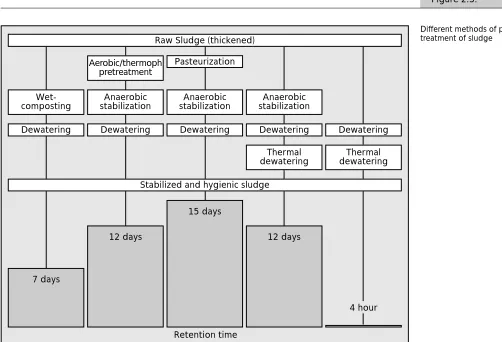
Figure 2.3.
Dewatering Dewatering Dewatering Dewatering Dewatering Aerobic/thermoph
pretreatment
Pasteurization
Wet-composting stabilizationAnaerobic stabilizationAnaerobic stabilizationAnaerobic Raw Sludge (thickened)
Thermal
dewatering dewateringThermal Stabilized and hygienic sludge
Retention time
12 days 15 days
12 days
7 days
4 hour
Different methods of pre-treatment of sludge
Sea dumping is now prohibited, and landfilling will also be regulated if the new Landfill Directive is passed and the removal of the organic content is made mandatory. The final disposal of sewage sludge remains therefore an unsolved problem; both
be-cause the amount generated will increase and also because agriculture can absorb only a limited number of field applications.
The problem could be particularly difficult for the 10 accession countries (Bulgaria,
Sludge Generation in member states before and after the Urban Waste Water Treatment Directive Source: European Waste Water Group, „EU Waste Water Strategy“: Obser-vation From the Euro-pean Waste Water Group“, direct communi-cation to ISWA, London, October 10, 1997
Austria
Denmark Fin
land
France
UK
Sweden
Spain
Portugal
Netherlands
Luxenbour
g
It
aly
Quantity in dry solids/tons/per annum
1500000 4000000
2000000 2500000 3000000 3500000
1000000 500000 0
Belgium Ger
many
Gr
eece
(Norway)
Ir
eland
Current
After UWWT Directive
Figure 2.2.
11
Czech Republic, Estonia, Hungary, Latvia, Lithuania, Poland, Romania, Slovakia and Slovenia) which will have to transpose the UWWTD and phase in plant treatment and disposal of about 4 million tons of sewage sludge generated every year.
Plant treatment of sludge generated by anaerobic or aerobic digestion, mechanical de-watering and incineration, usually ac-counts for up to 50% of the total investment in the complete facility. Plant treatment can dramatically reduce the size of the final and more complex disposal problem. Therefore it is important to consider the full range of
alternatives for sludge handling and disposal when planning sewage management strate-gies.
An overview of the pre-treatment methods adopted for transforming and concentrating raw and wet sludge is presented in figure 2.3.
In some countries, thin sludge is still utilised directly as fertiliser in agriculture. However, an increasing part of thin sludge is now processed. The methods used most fre-quently for treatment and disposal are shown in Figure 2.4.
Treatment and disposal routes for sludge
Figure 2.4.
Composting Agriculture
Sludge incineration Gasification
Drying Waste incineration Landfill Reuse
Digested sludge
Concentration Dewatering
Combined heat and power plant
3. Sludge Characterisation
By Ludovico Spinosa13.1. Introduction
Sewage sludges exhibit wide variations in their properties depending on origin and previous treatment, but their characterisa-tion based on history only gives qualitative information. Many parameters have there-fore been introduced and tests developed to measure specific properties of sludge in relation to particular methods of treatment.
Some of them have been adopted as national standard methods, others as international ones, but essential differences between them remain. For this reason, a vast standardisa-tion activity aiming at defining European standard methods is currently in progress in Europe, under the action called CEN/ TC308/WG1.
Conventional characterisation parameters can be grouped in physical, chemical and biological parameters:
• physical parameters give general infor-mation on sludge processability and handlability;
• chemical parameters are relevant to the presence of nutrients and toxic/danger-ous compounds, so they become neces-sary in the case of utilisation in agricul-ture;
• biological parameters give information on microbial activity and organic mat-ter/pathogens presence, thus allowing the safety of use to be evaluated.
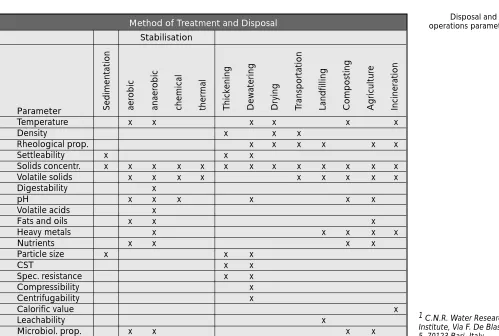
A list of parameters which can be used, and their relevance to treatment and disposal steps, is presented in table 3.1.
3.2. Characterisation Parameters
The sludge characteristics which are
impor-13
1 C.N.R. Water Research Institute, Via F. De Blasio 5, 70123 Bari, Italy
Parameter
Temperature x x x x x x
Density x x x
Rheological prop. x x x x x x
Settleability x x x
Solids concentr. x x x x x x x x x x x x x
Volatile solids x x x x x x x x x
Digestability x
pH x x x x x x
Volatile acids x
Fats and oils x x x
Heavy metals x x x x x
Nutrients x x x x
Particle size x x x
CST x x
Spec. resistance x x
Compressibility x
Centrifugability x
Calorific value x
Leachability x
Microbiol. prop. x x x x
Sedimentation aer
obic
anaer
obic
chemical thermal Thickening Dewatering Drying Transpor
tation
Landfilling Composting Agricultur
e
Incineration
Method of Treatment and Disposal operations parametersDisposal and use
Table 3.1.
tant to know, strictly depend on the handling and disposal methods adopted. Below, the most important parameters in relation to the disposal/use operations listed in table 3.1 are briefly discussed.
3.2.1. Agricultural Use
Dry Matter
Dry matter plays a role in the transport, application and spreading operations. Methods and systems of application to land also depend to a great extent on rheological properties.
Volatile Solids (Organic Matter)
The reduction of volatile solids through stabilisation is very important, mainly to avoid odour problems. Organic matter also exerts beneficial effects on land, but changes in the content of organic matter do not significantly modify sludge applicability.
Table 3.1 Disposal and use operations parameters
Nutrients, Heavy Metals, Organic Micro-pollutants, Pathogens, pH
Application rates are affected by the content of nutrients, heavy metals and organic micropollutants in sludge and soil, while hygienic risks are associated with the patho-gens presence. All of the above factors are influenced by pH.
3.2.2. Composting
Temperature, Dry Matter, Volatile Solids
The process performance strictly depends on temperature, dry matter and volatile solids in terms of both biological evolution and hygienization (pathogens reduction). In particular, a concentration of solids of 40-60% and a temperature around 60°C are generally required.
Nutrients
The C/N ratio is very important to ensure a proper process evolution and a good end product. Values of 25-30 should be main-tained.
Heavy Metals, Organic Micropollutants Heavy metals and organic micropollutants can either prove to be toxic to the process or reduce application rates of compost.
3.2.3. Incineration
Temperature, Dry Matter, Volatile Solids, Calorific Value
The economics of incineration depend to a great extent on auxiliary fuel requirements
and, therefore, the above parameters are all important to ensure an autogeneous com-bustion.
Rheological Properties
Rheological properties are important as far as the feeding system is concerned.
Heavy Metals, Organic Micropollutants The toxicity of emissions (gaseous, liquid, solid) depend on the presence of heavy metals and organic micropollutants at origin and/or when improper operating conditions occur.
3.2.4. Landfilling
Dry Matter
It is important to know whether the sludge is consistent enough to be landfilled. Addition-ally, rheological properties are essential in relation to the sludge bearing capacity.
Volatile Solids
The amount of volatile solids has an impact on the development of malodours and process evolution, including biogas produc-tion.
Heavy Metals
Heavy metals can negatively affect the evolution of the biological process and the quality of the leachate.
From the above it follows that dry matter and volatile solids are the most important param-eters in sludge characterisation involved in all the application/disposal methods. They can be modified through stabilisation and solid-liquid separation processes, which are operations almost always present in a waste water treatment system.
3.3. Stabilisation
Stability can be defined as the quality of being stable over the course of time; gener-ally, it is mainly related to biological and chemical aspects, and not physical (struc-tural) ones.
Many parameters are potentially available [2], but the concept of stability is usually associated with that of odour, which depends on particular compounds difficult to analyti-cally detect and also to correlate with a certain degree of stability.
odorifer-ous gases until the odour is no longer de-tected. These tests are cumbersome, expen-sive and cannot be conducted in the field.
The volatile/total solids ratio and/or the percentage of volatile solids destroyed can be used as stability index. Ratios below 0.60 and percentages above 40% are, generally, an indication of achieved stabilisation. Oxygen uptake rates less than 2 mg/g-volatile-solids/h at 18 °C are indicative of a stable sludge.
The measurement of stability can also involve the evaluation of the organic substrate concentration, such as volatile suspended solids, COD, BOD5 and organic carbon, ATP and enzymatic activity [3].
3.4. Solid-Liquid Separation
Solid-liquid separation processes include thickening and dewatering.
Thickening is defined as the capacity of a sludge to increase its concentration of solids (normally by 2-3 times) by filtration and gravitational/centrifugal acceleration. Ability to thicken is commonly evaluated by allow-ing sludge to settle in a graduate cylinder. This measure is subjected to several errors (wall effects, bridging, liquid depth) which can be overcome by using proper column diameter (100 mm) and height (500-1000 mm) and incorporating a slowly rotating stirrer [1]. Another technique is based on the use of a low-speed stroboscopic centri-fuge: the test is fast and requires only a small amount of sludge [5].
Dewatering is the further increase of concen-tration of solids; it can be accomplished by filtration or centrifugation, usually preceded by conditioning. Dewaterability can be evaluated by general parameters and specific tests, the latter referred to as a specific technique.
The classical parameter used to evaluate filterability is the Specific Resistance to Filtration, which represents the resistance offered to filtration by a cake deposited on the filter medium having a unit dry solids weight. Values of the order of 10-12 m/kg or less are indicative of good industrial filter-ability (raw sludges generally exceed 10-14 m/ kg ); specific resistance can be reduced by conditioning, most commonly performed by chemicals (organic or inorganic). By measur-ing resistance at different pressure, the
Compressibility coefficient is obtained, which provides information on the most suitable operating pressure level.
The CST (Capillary Suction Time) is a simple, useful and rapid way to evaluate filterability, but only for comparative evalua-tions; the multi-probe CST apparatus enables a direct, but less precise, estimate of the specific resistance.
Specific tests to evaluate vacuum-filter and beltpress performance are also available. The filter-leaf test reproduces the vacuum-filter cycle [9], while tests including draining and filtration under vacuum or pressure allow a prediction of beltpress performance [4], [6].
Centrifugability is defined as the aptitude of a sludge to be dewatered under the action of centrifugal force; moreover, sludge consist-ency must be such that it can be easily con-veyed by the screw. However, it is not possible to reproduce on a laboratory scale all the conditions actually occurring in a full scale machine, so centrifugability parameters (settleability, scrollability, floc strength) must be separately measured. The method pro-posed by Vesilind [8], allows both settling and scrolling properties to be evaluated. Vesilind and Zhang [10], showed that sludge can be characterised by correlating the final solids concentration to the number of gravities and the time of centrifugation. Another method is based on the calculation of a Specific Resistance to Centrifugation index based on the sludge floc strength, consisting of the measurement of CST after different periods of standard stirring [7].
3.5. Concluding Remarks
Many physical, chemical and biological parameters and tests are available for the characterisation of sewage sludge, thus allowing its behaviour when processed and impact on the environment when disposed/ used to be evaluated.
A problem relating to the tests discussed above is that the methodologies adopted are generally conducted in individual laborato-ries under different conditions, thus produc-ing rarely comparable results. In order to overcome this problem, the European Committee for Standardization (CEN) has set up a Technical Committee (TC308) for the standardisation of methods applied to characterise sludges.
15
Furthermore, conventional parameters are often specific to the method of treatment and disposal/use adopted, so parameters and tests able to give more basic information on the sludge in question would be needed. For this reason, many recent research
4. Transportation and Storage
By Ludovico Spinosa24.1. Introduction
The effective optimisation of a sewage sludge treatment and disposal system requires correct planning of the operations linking the treatment steps to those of disposal/use, i.e. storage and transportation.
Storage systems integrated into the process-ing sequence allow the speed and capacity of the various waste water and sludge handling aggregates to be adapted, while transporta-tion is a consequence of the fact that the disposal sites are almost invariably far from those of production.
4.2. Storage
4.2.1. Operation Description
The main function to be ensured by storage is the equalisation between a continuously entering sludge flow (production) and a discontinuously exiting one (disposal) [8].
A more uniform composition for mixtures of different batches and the possibility of isolating different batches could also be achieved, thus guaranteeing a more constant quality and facilitating analytical controls.
The elimination of differences between input and output is particularly important in the case of agricultural use as this practice is subjected to a great variability in time de-pending on cultivation type and weather conditions. Consequently, sufficient sludge storage capacity must be provided when unfavourable conditions occur.
Although certain short-term storage possibili-ties are available within the waste water treatment system (clarifiers, aeration tanks, etc.) and the sludge treatment system (thick-eners, digesters, etc.), sludge storage is generally accomplished by separate facilities: they can be internal to the waste water treat-ment plant itself or external when a central-ised sludge treatment platform serving se-veral plants is planned.
The selection of the most suitable method of storage basically depends on whether the sludge is in the liquid or dewatered state, i.e. it depends on its dry matter content. In
addition, knowledge of the sludge’s physical consistency, through its rheological charac-terisation, is of great help when defining what kind of installation to choose.
Moreover, during storage several phenom-ena can occur, including:
• development of malodours, due to anaerobic conditions, which can be reduced through stabilisation;
• variation in the fertilising value, includ-ing mineralization of organic matter with loss of ammonia;
• hygienization, as a consequence of pathogens reduction.
It follows that factors of primary importance to be considered when designing sludge storage facilities are:
• solids concentration (which can be increased through solid-liquid separation processes such as mechanical
dewatering),
• rheological properties,
• stability (increased through stabilisation processes, also able to perform some hygienization),
• nutrient and organic matter contents,
• pathogens content (reduced through disinfection processes).
4.2.2. Equipment
For liquid sludge, the most suitable ways of storing are in [8]:
• tanks/vessels having a square, rectangu-lar or circurectangu-lar cross section with vertical walls;
• excavated lagoons/ponds, normally lined at the bottom, with inclined walls.
Since open tanks can be the source of unpleasant odours, they should be covered and/or placed at a convenient distance from urbanised areas. Often, installation of aeration and mixing equipment is useful to
2 C.N.R. Water Research Institute, Via F. De Blasio 5, 70123 Bari, Italy
perform additional stabilisation and homog-enisation. Closed tanks should also be fitted with special equipment to counteract the risk of dangerous gases escaping from the tanks. A lagoon normally occupies an area at least double that of a classic vessel. Pumps are normally used for filling/emptying opera-tions.
The most widely used systems of storage for dewatered sludge are dumps, basins and containers, depending on the obtainable sludge volume ratio in terms of m3-storage/ m2-occupied-area (Figure 4.1): it ranges from 1.50 to 0.80 for sludges behaving similarly to solids, 0.80 to 0.40 for those showing a certain degree of plasticity and below 0.40 for more liquid sludges. The storage of dewatered sludge generally requires a drainage control for water and gases and, in areas with heavy rainfall, covering and sealing systems. Filling/ emptying operations can be performed by a wide range of equipment, including belt-, screw-, pneumatic- and positive displacement type-conveyors, chutes and inclined planes, bucket elevators, grapple buckets, etc. The equipment sometimes has to be fitted with a special apparatus to prevent it from blocking during operation.
4.3. Transportation
4.3.1. Operation Description
Sludge must almost invariably be transported from the point of production to the dis-posal/use site, possibly via a centralised processing platform.
Generally, the transport step is a large share of costs for works serving large
municipali-Volume to area ratio for storing same volumes of different sludges (solid > 0.80; plastic < 0.60; liquid < 0.30)
Figure 4.1.
(m) 1.8 1.5 1.2 0.9 0.6 0.3 0
(m³/m²)
(m)
0 1 2 3 4 5
solid
liquid plastic
ties, as they must transport great amounts of sludge over a great distance to reach a suitable disposal site. However, higher costs as a consequence of great distances could be counterbalanced by savings due to large transported volumes. The cost problem is generally less important for small communi-ties, and they can reduce investments in dewatering equipment and plan centralised solutions.
Sludges can be transported by pipeline, barge, rail or truck.
Transport by pipeline is a practice suitable for moving large quantities of sludge having a quite low solids concentration, generally below 10%. The main disadvantages lie in high installation costs, relatively long con-struction time and, above all, in the fact that the pipeline has to be shut down during maintenance and repair works. The design of the pipeline can be carried out simply by multiplying figures for clean water by empiri-cal coefficients, but the application of such simple criteria could be misleading, so more reliable procedures are suggested [6], [3].
Transport by rail and barge is more conven-ient for moving large quantities of sludge over long distances. In this case the availabil-ity of suitable waterways and railway connec-tions is a further essential condition.
4.3.2. Equipment
In pumping, sludges with solids concentra-tion of less than 2-4% behave like water, while above 10% it is necessary to use volu-metric pumps (single- or double-acting piston or helicoidal rotor) or rotodynamic ones with radial, axial or mixed flow. Highly concentrated sludges (with a concentration above 20%) can be transported by eccentric helicoidal rotor pumps provided with a hopper and fed by a screw-drive [9]. Selec-tion criteria for pumps were defined by Frost [2], [4], while criteria enabling the most economical pipe diameter and the pumping system to be designed and optimised, for whatever fluid may be pumped, are reported in Castorani et al. [1].
All other transport systems require the most suitable container/tanker to be chosen according to the physical state of the sludge. For vehicles equipped with loading/unload-ing systems, the knowledge of sludge fluidodynamic and consistency characteris-tics, i.e. rheological properties, are of great importance as well.
Tanker trucks for transportation of liquid sludge are usually of uniform design. Larger tankers are best suited to distances exceed-ing 20 km and annual transport volumes of 4000 m3 at least. These vehicles are normally designed with a vacuum suction system for collecting waste water and sludge, which is afterwards discharged by gravity.
Trucks for transportation of dewatered sludge are equipped with unusually large watertight hatches for the loading/unloading opera-tions. In order to make optimal use of various types of loading equipment, such tankers are fitted with large loading hatches and a seal to prevent odours from escaping. The interior of the tank is fitted with baffle plates to counter-act movement of the sludge during accelera-tion and braking. Rapid unloading is ensured by tipping the tank to a maximum of about 30° so that the sludge falls through the rear trap door, which can be swung open. When closed, this door is rendered impermeable by seals and rotary locks. In tankers designed for transporting dewatered sludge with a solids concentration exceeding 30%, the interior baffle plates can be extended and retracted in order to adapt to the sludge viscosity. Sliding doors on top of the vehicle can facilitate the loading operation (Spinosa and Sportelli, 1986). All equipment and fittings of trucks must be designed to exclude any possibility of sludge leakage during the various handling procedures.
A very important factor in a sludge transport system is the loading and unloading equip-ment: it must be of simple and reliable design and permit rapid operations, espe-cially for short distances (to be covered in less than 1 h).
In any case, the rheological characterisation of sludge is very useful in the selection of the best equipment to be used and optimal procedure adopted.
4.4. Concluding Remarks
Storage and transportation of sludge must not be regarded as isolated problems, but be considered as part of an integral system of treatment and disposal: this will ensure that the overall system is used to its full capacity and, consequently, that overall costs are reduced.
In particular, storage allows the production capacity of sludge to be adapted to that of disposal/use, while proper transport systems involve consistent reduction of costs and avoid possible environmental problems, due to sludge leakage and malodour diffusion.
Several systems for sludge storage and transportation are available. The selection mainly depends on the dry matter content and the consistency of sludge, so, in addition to the conventional evaluation of solids concentration, the rheological characterisa-tion appears to be a very useful tool in the prediction and estimate of the sludge behav-iour when submitted to the above-mentioned operations and, therefore, in the equipment selection.
A generally valid financial estimate for storage and transport systems is not possible because it is strongly affected by oil and labour costs, which vary widely depending on local conditions and economics. In some cases, national tariffs exist.
19
5.1. Conditions for Agricultural Use
The purpose of using sludge in agriculture is partly to utilise nutrients such as phosphorus and nitrogen and partly to utilise organic substances for soil improvement.
5.1.1. Sludge Types and Sludge Quality
In principle, all types of sludge can be spread on farmland if they fulfil the quality requirements (heavy metals, pathogens, pre-treatment) laid down by the legislation of the relevant country (see Appendix 14.1).
Most often, the amounts of sludge allowed to be spread are limited by the amount of nutrients required by the plants and the total amount of dry solids (see Appendix 14.2).
5.1.2. Legislation
All Western European countries and the USA have acts or bills on the use of sludge on farmland, but their legislation differs a great deal. In Denmark, Sweden, Holland, Switzerland and the USA, the amount of nutrients is restricted by law. In Norway, Finland, Germany, Ireland, Italy and Spain, the amount of dry solids is subject to restric-tions, whereas in France and Great Britain, the amount of heavy metals places restric-tions on sludge spreading [1]. In some countries the regulations are so strict that only a minor part of the sludge can fulfil the conditions.
The following requirements are common to these regulations:
• Pre-treatment (reduction of the water-content in sludge, reduction of organic substances, reduction of pathogens)
• Restriction on the amount of heavy metals contained in sludge
• Restriction on the amount of dry solids and heavy metals spread per unit of land and time
• Restriction on the content of heavy metals in the soil on which sludge is spread, and requirements for the pH of the soil
5. Agricultural Use
By Alice Saabye3• Restriction on the amount of nutrients added to the soil (nitrogen and phos-phorus)
• Restriction on the choice of crops
• Restricted access conditions to farmland on which sludge is spread
• Legislative compliance control
5.2. Description of Agricultural Use
In general, the sludge is stored in the treat-ment plant or it is taken to the farmer for immediate storage.
Large amounts of sludge and limited storage capacity often make it necessary to dewater the sludge to reduce its volume.
The sludge is normally spread on farmland once or twice a year in connection with ploughing and seeding. Hence, the maxi-mum uptake of nutrients by the plants is obtained and thus a reduced washout of the nutrients to the ground and surface water.
In general, the farmers’ own equipment for spreading liquid and livestock manure is also used for spreading sludge. As the equipment is not ideal for this purpose, it is often difficult to comply with the legislative re-quirements in relation to the amounts of dry solids and nutrients allowed to be added.
Consequently, it is important that the amount of dry solids required in the sludge matches the equipment available. If not, it is necessary to invest in special spreading equipment.
After spreading, the sludge is ploughed into the soil. Legislation often requires that this must be done very shortly after the spreading to reduce odour nuisances.
Liquid sludge can be injected directly into the soil.
5.3. Advantages/Disadvantages of Agricultural Use
Spreading of sludge on farmland offers the following advantages:
• Utilisation of nutrients contained in the sludge, i.e. phosphorus and nitrogen
• Utilisation of organic substances con-tained in the sludge for improvement of the humus layer of the soil (i.e. soil improvement)
• Known regulation on its application
• Often the cheapest disposal route
Sludge spread on farmland may have the following disadvantages:
• Major investments in storage facilities as sludge can only be spread on farmland a few times a year
• Dependency on the individual farmers and considerable administration of agreements
• Lack of knowledge as to the content of organic micro-pollutants and pathogenic organisms in sludge and their impact on the food chains
• Thorough legislative compliance control
5.4. Financial Estimate
When making a financial estimate of sludge spread on farmland, the following costs must be taken into consideration:
• Transport costs from treatment plant to storage
• Storage investments and operating costs
• Transport costs from storage to farmer
• Investments in spreading equipment (can often be omitted as the farmer uses his own equipment)
• Expenses for spreading and ploughing (can often be omitted as the farmer uses his own equipment)
• Expenses for analysis of sludge quality
• Expenses for analysis of soil quality
• Administrative expenses for e.g. declara tion of sludge, conclusion of agreements with farmers and control of application.
The price for agricultural use of sludge is in the order of DEM 150-400/tonne of sludge with 20% dry solids. It should be noted, however, that the price depends on local conditions and may differ considerably from the above.
21
Sludge composting aims at biologically stabilising sludges while controlling pollu-tion risks in order to develop agriculture or other end use outlets exploiting the nutrient or organic value of sludges. It can be applied either to non-digested sludge (e.g. Italy, France) or to digested sludge (e.g. the Netherlands). Composting involves aerobic degradation of organic matter, as well as a potential decrease of the sludge water content, the efficiency of which depends on the composting process.
Since organic substances and nutrients, such as phosphorus and nitrogen, are in demand by farmers, compost, rich in organic nutri-ents, is considered a valuable soil improver. Sludges composted for agricultural end use are therefore of value to secondary markets. In the case of sludges treated by incinera-tion, waste sludges can be composted as a pre-treatment to decrease the water content, thus increasing the efficiency of the incinera-tion process.
Nevertheless, it may be too expensive to first compost and then incinerate the sludge. Besides, some of the organic matter will decompose, thus limiting the increase of the calorific value linked to sludge drying.
6.1. The Influence of Variable Conditions in Defining the Composting Process
Sludges can be composted if they have sufficient organic matter as well as a relevant water content. In order to effectively com-post materials, certain nutrients are re-quired, including nitrogen and phosphorus, as well as proper moisture and aeration levels that facilitate and enable, after mixing with a co-product, the sustainability of micro-organisms.
Since liquid sludges have a high water content, they alone are not sustainable mediums for micro-organism growth. How-ever, they can be composted when used in relevant quantities in a mixture with other highly fermentable organic wastes possessing a lower or a deficient water content.
Sludges with a water content greater than 15% are easily co-compostable, particularly
6. Composting
By Isabelle Coulomb4when mixed with bark or other structuring materials making the compostable mixture porous.
As a general reference, the water content of a compostable mixture of organic wastes should be around 55% while the organic matter content should be greater than 70%, facilitating effective bio-degradation. A high moisture content above 60%, reduces the temperature, porosity and thus the oxygen concentration while a low moisture content, below 50%, could limit the rate of compost-ing. At values of 10-15% the bacterial me-tabolism generally ceases to function. Bacte-rial activity is also influenced by pH, with the optimal values being between 5.5 and 8.
A balance of the nitrogen and carbon content is necessary for the proper growth of micro-organisms. The carbon to nitrogen ratio (C/N) of the mixture is therefore commonly used to define the optimum functional conditions. Although values ranging between 25 and 30 are recom-mended, the types of molecules concerned must be evaluated when establishing the ideal ratio.
Structuring composting conditions and mixture ratios naturally depend on the types of wastes to be treated as well as the quality specifications set for the resulting compost.
For example, the processing of organic materials would be different if the goal was to incinerate the end product, thus demanding that the water content of sludges should be reduced, than if the goal of the composting process was to produce a soil improver, as defined by a particular agricultural outlet, which would therefore require that specific nutritional and structural properties should be present in the end product.
Different ratios of wastes and different processing policies would have to be imple-mented under the constraints of each programme. Therefore the types of sludges to be treated, the quantitative/qualitative constraints for incorporating them into a composting process, and the efficiency of the composting biodegradation process itself, depend on the end product specifications as defined in any given project.
If, for instance, a compost end product targeted for an agricultural outlet is consid-ered, many market and regulatory con-straints will have an impact on the definition of the composting process itself. For exam-ple, although organic pollutants such as the pesticides, PCB, HAP, PCDD, PCDF do not have regulatory limits at European level because the concentration of these contami-nants has proven to be low, the contrary is true for the heavy metal content in com-posts.
The heavy metal content of the final com-post product is critical. The end product standards must meet the specifications defined by local and national legislation. Obviously, since the materials are composted at a temperature level sufficient to kill pathogens, the risk of pathogenic problems is minimised, an advantage supporting the processing of organic materials by com-posting over other treatment methods. In addition, microbial competition during composting also favours pathogen reduction.
Market conditions also have an impact on the process design of a compost system. In addition to their inclusion in some national regulations, aesthetic contaminants such as plastic, glass, metals or stones are undesir-able because they may limit the marketing potential of the final product.
In the case of agriculture end use composts, it must not only support local vegetation growth, it must also meet both the qualitative and quantitative demands of the local market; the compost end product must be nutritionally balanced to the local soil demand and produced in quantities which do not exceed the outlet application poten-tial.
For example, to utilise the final compost for a soil substrate application, the nutrient and salt content must be low while the water retention capacity must be sufficiently high, thus meeting the necessary water/aeration requirements of specific types of vegetation.
The pH of substrate also becomes an impor-tant criteria in designating the type of vegetation to be sustained and must be accounted for in compost end quality specifi-cations. Whether designated as a soil
improver or a substrate application, decom-position of organic material must be suffi-ciently high. In addition, the process of producing a quality end-product must ensure germination and sustainability of
plant growth and ensure that no germina-tion of foreign seeds occurs as a result of the compost.
The example of composting sludges as a pre-treatment method for incineration is techni-cally appealing because composting results in both mass reduction and decreased water content, thus providing a more efficient waste stream for incinerators. A financial and market analysis must, however, be completed to validate the viability of this option: is composting in itself viable, and is the level of bio-degradation necessary to justify the incineration of pre-treated, composted sludges over the incineration of raw un-treated sludges?
6.2. General Description of the Process of Composting and Plant Conception
Factors
The process of composting is based on aerobic degradation of organic matter, under variable conditions as described above. In essence, the activity of micro-organisms causes both an increase in tem-perature, hence the pathogen destruction, and a release of energy, CO2, H2O, NH3 and other gases, while consuming oxygen.
The rate of the bio-degradation process can thus be controlled by regulating aeration, moisture content and mechanical processing of the material. For instance, the composting process could be controlled and accelerated by:
• Forced aeration, which provides suffi-cient oxygen to meet demand, while providing an odour control mechanism;
• Mechanical turning of compost, which contributes to the mixing and the increased aeration of the material.
A particular market demand may also be accommodated by mechanical screening to a defined particle size.
In developing an actual plant to process organic wastes and sludges into compost, the following system development and costs must be taken into account:
• Waste reception and storage areas;
• Mechanical mixing system to be applied;
23
• Storage area for the compostable mixture, before aeration: Note, this step is not compulsory but can be interesting for the flexibility of the operation;
• Fermentation/ bio-reactor area. Note: reactors, containers, lockers, tunnels, channels as well as their process retention times, ranging from 10 days to five weeks, are defined in relation to the objectives of the programme;
• Storage area for compost maturation and final stabilisation of the product;
• Mechanical screening systems: the size of the screen depends on the local utilisation of the compost; the fine fraction can be stored, commercial-ised or eliminated whereas the raw fraction can be recycled as a structur ing material for composting;
• Control of variable local facility demands such as: sewage water, odours, dust control and control of other nuisances such as noise, flies, and the potential of foraging animals.
A wide range of composting systems exist world-wide, however they tend to be classi-fied into several general categories:
• Open composting systems (see Figure 6.1)
• static pile :
- natural ventilation
- forced aeration with suction or blowing in windrows or in silos • turned pile :
- natural ventilation
- forced aeration in corridor silos, in windrows or in tabular piles
• Closed composting systems functioning continuously or periodically with forced aeration (see Figure 6.2)
• rotating horizontal reactors (tube) • static vertical reactor (tower) • in-vessel systems (boxes)
The choice between the different systems depends on the technical and economic parameters. In general, when composting sludge, process control, reduction of labour, and sensitivity to weather generally necessi-tate forced aeration technologies.
6.3. Advantages/Disadvantages of Composting Sludges
Advantages
Composting offers several advantages in comparison with other sludge treatment methods. In comparison with the direct
Sludge composting plant of Tortona (Italy): example of a turned pile composting system with forced aeration in corridor silos
application of non-composted sludges in agriculture for example, composting allows:
• A reduction in the volume of materials to be transported for distribution in agricul-tural fields;
• A facilitation, with respect to sludge, of storage and use in places and at times far from those of production;
• A facilitation of the spreading process due to the lower water content of the product;
• Control of compost material specifica-tions, which results in a well-defined, stable end product composition with the potential of improving the soil humus layer and nutrient levels;
• Control of nutrient content as defined by application and vegetation standards;
• Product hygiene control before agricul-tural application;
Disadvantages
• The treatment cost is higher than simple direct raw sludge application;
• Aeration consumes energy;
• There is a need for an outlet market for the compost end product; competitive soil improvers exist;
The need for mixing sludge with other materials in order to obtain an optimal C/N ratio, can be considered either as an advan-tage when bulking agent is another waste to be treated (complementarity of treatment) or as a disadvantage when this bulking agent has to be bought.
Conclusion
Although costs are elevated when sludge is composted in contrast to, for example, direct application of sludges in agricultural crops, the market and health aspects such as pathogen risk, odour, and nutrient control in response to vegetation demand, often emphasise and necessitate the demand for alternative solutions, justifying composting as a viable and environmentally sound option.
6.4. Financial Estimates
Evaluating the costs of different treatment options for sludges is necessary. For exam-ple, the following costs must be taken into account when a sewage water treatment plant decides to compost its sludges:
Sludge composting plant of La Roche sur Foron (France): example of an in-vessel composting system.
Figure 6.2.
25
• The cost of transporting the sludge to the composting plant;
• Capital investment and engineering costs for the composting system itself and the plant infrastructure (buildings, aeration, odour and air cleaning equipment, machinery for turning and mixing the compost, sieves, conveyers if necessary, front loaders, ...);
• Plant operating costs: personnel, energy (electricity, fuel), bulking agents (includ-ing the cost of transport(includ-ing bulk(includ-ing agent to the composting plant if neces-sary), maintenance, overhead expenses, taxes,...;
• Quality control expenses: characterisa-tion of wastes and the compost end product as well as process evaluation;
• Marketing costs, including market studies and marketing materials;
• Cost of transporting the compost from the composting plant (when necessary).
An indication of price range for composting is between DEM 275 - 525/tonne in France. See Table 12.1.
6.5. Concluding Remarks
Although there are a lot of processes and patents in the composting profession, many systems are not viable under end product demand and market demand constraints; they are either too simple and not adaptable to either waste and/or market demands or, they are too capital investment heavy and/or labour intensive and the return on the investment is not justified. In developing an approach for the treatment of waste sludges by composting, all the intricate waste, end product, and market constraints must be evaluated in defining the process itself and structuring a facility.
7. Drying
By Ådne Ø. Utvik5 with contributions by Albrecht R. Bresters6 and Martin Würdemann7
7.1. Introduction
The purpose of this chapter is to describe different processing methods for drying of sludge.
7.2. Conditions for Drying of Sludge -Amounts and Drying Rates
Basically, there are no specific pre-conditions to be fulfilled in order to apply drying. This means that all known sludges from munici-pal waste water treatment plants may be processed in a properly designed and oper-ated drying plant. However, as in all indus-trial processes, the total cost per tonne increases when throughput decreases.
Presently, a small plant for municipal sludge removes less than 0.5 tonne of water/h, whereas a large plant evaporates nearly 30 tonnes of water/h.
The main reasons for this great variation in capacity are:
1) Size of one or more WWTPs (inlet flow, m_/h)
2) Pollution, kg dry solid/m_ of effluent water
3) Treatment process - chemical/biological etc.
4) Undigested or digested sludge
5) Dry solid content in dried sludge
Ad 4) When the sludge is digested, the dry solid content (DS) will be reduced by ap-proximately 20%, due to transformation of organics into biogas.
Ad 5) The DS is normally raised to 40-50% as preparation for immediate subsequent incineration. To make a storable product for multi purpose utilisation, for instance as fertiliser, soil conditioner, fuel etc., the DS is raised to 90-95% and granulated.
5 Stord International A/S, P.O.Box 9, N-5049 Sandsli - Bergen, Norway 6DRSH Zuivoringsslib BV, Hofplein 33, NL-3000 AZ Rotterdam, The Netherlands 7Haskoning, P.O. Box 151, 6500 Nijmegen, The Netherlands
THIN SLUDGE
Mechanical dewatering
Dewatered sludge Air
& vapour
Water to WWTP
Thermal drying direct/indirect
Dried sludge
Dust separation
Granulation whwn adequate
Emission to air
Heat recovery & odour removal
Water to WWPT
Cooling when adequate
PRODUCT
Generel flow sheet for a drying process
Figure 7.1.
7.2.1. Quality
The quality as fertiliser/soil conditioner and/or as fuel mainly depends upon:
1) Content of organic solids
2) Content of plant available fertilising components, mainly phosphorous, potassium and nitrogen
3) Ability to absorb and retain water
4) Content of heavy metals
5) Content of pathogenic bacteria and fungi viruses, helminth ova and toxins
6) Repopulation rate of pathogenic micro-organisms.
Whereas 2) and 4) depend upon the content in the effluent water and the treatment, 1) and 3) are influenced by digestion, which degrades organic material.
The possible presence of pathogens is a major concern and must be taken seriously. Proper drying, where the most relevant factors are retention time/retention time
distribution and temperature, particle size and heat conductivity, is regarded the safest method in this respect. Under certain drying conditions some N-NH3 may be lost. If this is predominant and damaging, the loss may be counteracted by additives.
The actual flow sheet depends upon a number of factors, of which type of dryer used (indirect/direct) and dry solids in end product (approx. 70% or 90%) are the most decisive ones. Heat recovery may be more efficient with indirect dryers, whereas some direct dryers may not require separate granulation.
7.3. Drying and Dryers
There are approx. 20 suppliers of drying equipment (please refer to ISWA literature and documentation, for instance the ISWA Yearbook). The two distinctly different drying methods are indirect and direct drying. In direct dryers there is a direct contact between the material to be dried -the sludge - and -the heated gas supplying -the required heat for evaporation and simultane-ously carrying the water vapour formed out of the system.
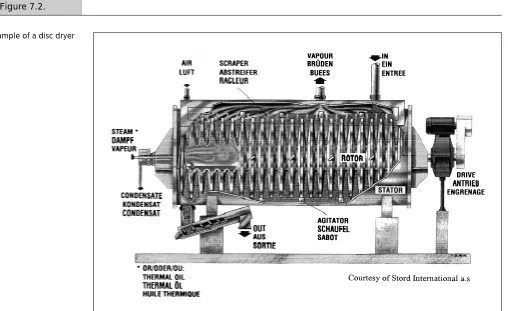
Example of a disc dryer
7.3.1. Indirect Dryers
In the other type, the indirect dryer, heat is transferred to the material to be dried indirectly by heat conduction through a heat transfer surface. Thus, the heating medium, for instance steam or thermal oil, is not in contact with the sludge. A small stream of air may be used for transport of the water vapour formed, although an indirect dryer may well be operated without any air, thereby keeping the odour removal cost at a mini-mum and heat recovery at a maximini-mum.
Among the indirect dryers the disc dryer is widely used. An example of a disc dryer is shown in figure 7.2.
A disc dryer is a slow, rotating machine. The concept is simple, and the dryer is easy to operate.
The stator consists of a nearly cylindrical, horizontal drum, enclosing the material to be dried. Scraper bars, acting as mixers, are attached to the drum. On the top of the stator there is an open space serving both as dust separator and as a collector and duct for the escaping vapours. The dryer is normally operated with a slight underpressure.
The rotor consists of parallel hollow discs welded to a horizontal shaft, and the steam -or other heating medium such as thermal oil or hot pressurised water - flows inside the discs. Agitators are welded on the top of the discs. A small flow of air is advantageous from an operational point of view, however, the drier may well be run without any air. Little or no air keeps dust separation and odour abatement costs at a minimum.
To ensure a permanently high heat transfer rate, it is crucial to maintain the heat transfer surface - the discs - clean. The stickiness of sludge is a challenge in this respect.
The ability of the disc dryer to handle sticky and ‘easy-to-coat’ materials is generally due to:
• The self cleaning ability of all of the heat transfer surface (the discs) due to gentle friction forces created when the discs turn in the material to be dried.
• The action of the agitators and the scrapers causing adequate mixing and turbulence and maintaining a high heat transfer rate simultaneously with causing the sludge to move through the dryer.
7.3.2. Direct Dryers
With direct dryers, the heat for drying is transferred from the hot gases to the sludge. This requires an intensive contact between gas and sludge material. The most important types of dryers are the revolving drum dryer and the fluidised bed dryer.
With revolving drum dryers the sludge is fed into one side of the dryer. Through the rotation of the drum and the internals in the drum, the sludge is transported to the other end and simultaneously comes into a very intensive contact with the hot gases. The result is a granulated sludge with a dry solid content of more than 90 %. In order to prevent clogging within the drum, the feed material should have a dry solid content of more than 65%. Therefore, back-mixing of dried sludge with dewatered sludge is nor-mally required before the material can be fed into the dryer.
With fluidised bed dryers, the intensive contact is realised by an upward flow of hot gases, carrying the sludge particles until they are dried, resulting in a very turbulent gas flow. Depending on the sludge type, the dried sludge has a dry solid content of more than 90% in the form of dust-free granules. The dust in the flue gas is transported by the gas stream, removed by cyclones and fed back into the dryer after mixing with dewatered sludge. Additionally, a heat exchanger can be included in the fluidised bed, resulting in an intermediate drying system between direct and indirect drying.
As a result of the intensive contact between gas and sludge and the good heat transfer, the specific performance of the direct dryers can be higher than that of the indirect dryers. Additionally, the mechanical design can be simpler.
On the other hand, direct dryers have the following disadvantages:
• The used gases contain a large amount of pollution, especially strong odorous components. This requires very substan-tial gas treatment.
• This type of dryer is less suitable for use with low temperature heat. This is especially the case for the revolving drum dryer.
• Explosions possible
It is, however, possible to recirculate part or
29
all of the used gases and vapours, but this leads to more complicated drying systems, through which the advantages of direct systems decrease substantially. The selection of a direct or indirect drying system there-fore depends on sludge characteristics and other specific and local conditions. Both systems are subject to much practical experi-ence.
7.4. Advantages/Disadvantages of Drying
In terms of energy, water removal by evapora-tion/drying is generally more expensive than mechanical methods such as pressing and centrifugation/ decanterisation. Prior to drying, proper mechanical dewatering must therefore be installed.
A drying plant, which in most cases includes granulation, is more expensive to install than most other methods. On the other hand, drying results in a great volume reduction and a storable free flowing and hygienic product. Due to the great volume reduction, dried sludge implies reduced costs for transportation, handling and storage.
The greatest advantage in having sludge in a dry form as compared with various other methods is the possibility of ‘marketing’ the product for a number of applications and at the most suitable time:
• Fertiliser/soil conditioner in agriculture and forestry
• Fuel in cement kilns, power plants and incinerators
• Top soil, landscaping, landfilling and disposal
For most applications it is of great impor-tance - and cost saving - that thermally dried sludge has been subject to safe hygienisation and considerable volume reduction.
7.5. Financial Estimate
As mentioned above, the disadvantage is the high investment cost relative to other meth-ods. No reliable and generally valid estimates are known since local factors influence heavily.
A few questions may clarify this point:
• It may for instance be questioned whether making biogas is favourable or not. What is the price per kW/h as compared with the market price for electric power?
• How much will digestion of sludge reduce the organic content and its value as fuel and fertilising/soil conditioning?
• The heat supplied to the dryer, for instance through steam, is still present, but at a lower temperature. Is there a need for this low temperature heat, and how should it be priced?
• Does the sludge owner have only one ‘customer’, except for deposit? How will this one and only customer pay him in the future, and what changes in the deposit cost are expected?
An example
A plant - without digestion - handling 2,400 tonnes of DS/year in the form of 12,000 tonnes of dewatered sludge (20% DS) a year, may have a cost of approx. NOK 1,300/t of DS (approx. DEM 295, FFR 1,000, GBP 130) including capital (investment NOK 5-6 mill.) and operating cost (lime, polymer, transport, etc.).
Today considered the last method used in the treatment of waste sludges, either alone or in combination with other wastes, treat-ment by incineration represents 15% of the total mass of sludges treated in Europe.
The agricultural use of sludges, by direct application, as well as landfilling of sludges are subject to more and more regulatory control. For this reason, incineration of sludges is expected to increase, even though it can be a capital intensive investment and it is also subject to strict regulation pertaining to combustion criteria, management of the off-gas treatment residues and treatment of fly and bottom ashes.
Incineration of sludges can be performed in designated incinerators or in municipal solid waste incinerators under the particular constraints for each type, where the process results in combustion of the organic matter of the sludges.
After pre-drying, sludges can also be inciner-ated in cement kilns because they have a
8. Incineration (Vitrification, Co-incineration)
By Isabelle Coulomb8 and A. Myrope9high calorific value. Pollutants are stabilised in the clinker which is an interesting way of treating polluted sludges.
From an economic point of view these methods of treatment are mainly justified for sludges not allowed to be used in agriculture or incinerated in municipal solid waste incinerators.
Another method of stabilisation is vitrifica-tion of the product. Japan has some experi-ence in this method, but the process remains too expensive. Therefore, these methods of treatment will not be further detailed in the following paragraphs.
8.1. Designated Sludge Incinerators - a General Description
Specific sludge incineration facilities have been operating for many years. Rotary kiln furnaces and the multiple hearth furnace of the classic or pyrolytic type are today more and more frequently being replaced by
8 SITA, 94 rue de Provence, BP 693, 75425 Paris Cedex 09, France 9Elyo, BP 4601, 235 avenue George Clemenceau, 92746 Nanterre Cedex, France
Sludge incineration plant of Dordrecht (Netherlands)
Figure 8.1.
fluidised bed systems, which tend to be easier to operate (see Figure 8.1).
The fluidized bed system consists of a vertical combustion chamber lined with a refractory material at the base of which a bed of sand is brought to high temperature and held in suspension due to a grate equipped with injectors forcing a flow of hot air. The sludges are introduced inside or above the bed of sand.
The gas must be heated to 850°C to ensure complete burn-out of the flue gas. There-fore, except in the case of fresh primary sludges, the incineration of sludges coming from mechanical dehydration machines is not able to be completed unless combustible energy is provided.
In order to limit the consumption of extra combustibles, a heat recovery system is installed for the hot gas leaving the combus-tion chamber. Three techniques are used to recover and reuse this heat: one heating the combustion air in a smoke/air exchanger, another one pre-drying the sludge above the furnace as a result of steam produced by a
recovery boiler, and the last one pre-drying the sludge in separate rotary disk dryers prior to incineration, the heat required for this drying process being recovered by steam boilers behind the furnaces.
The second process is thermally more productive than the first one as it enables an achievement of autocombustibility of sludges with a dry matter content of 20-25% and with a rate of volatile material/dry material of 60-70% before pre-drying. Extra recovery of the evaporation steam from the dryer, and on the condensates before they go back to the boiler tank, can also improve this result.
It should be noted, however, that this type of heavy equipment and investment can usually only be justified in the case of large installa-tions (capacity higher than 2.5 tonnes of evaporated water per hour). The third process is applied in some modern plants in Germany, the Netherlands and the UK, which are autotherm with sludges at a dry solid content of approximately 23% (see Figure 8.2).
Process scheme of the sludge incineration plant of Dordrecht (the Netherlands) Courtesy: Lurgi