Sensor based definition of buxus stem shearing behavior in
impact cutting process
Mohammad Reza Kamandar, Jafar Massah
*(Department of Agrotechnology, College of Abouraihan, University of Tehran, Tehran, Iran)
Abstract: The information of the shearing properties of buxus stalk plays an important role in the design and fabrication of buxus pruning machine. A series of laboratory tests were conducted to measure the shear force, shear consumption energy and shear strength of stem internodes of buxus stalk under impact cutting at four loading rates (1, 2, 3 and 4 m s-1), three internodes
(fifth, tenth and fifteenth), and moisture content level 72% w.b. In this test, the stalk specimens were served in impact cutting process by using a special cutting test apparatus that was designed, fabricated, and calibrated. To define the impact cutting force of buxus stem, the apparatus was attached with beam type load cell and shear blade. The variance analysis of the data results showed that the effect of loading rate and internode position on shear consumption energy and shear strength were significant (P<0.01). Also, the interaction of loading rate and internode position effect on mentioned parameters were significant (P<0.01). The results showed shear strength and shear consumption energy decreased with an increase in loading rate and upward from fifteenth to fifth internode position. The minimum and maximum values of shear consumption energy were obtained as 3.19 J at fifth internode and loading rate: 4 m s-1 and 19.6 J at fifteenth internode and loading rate: 1 m s-1,
respectively. The minimum and maximum values of shear strength were obtained as 0.06 MPa at fifth internode and loading rate: 4 m s-1 and 1.55 MPa at fifteenth internode and loading rate: 1 m s-1, respectively. Based on the statistical analysis, the
average values of shear strength and shear consumption energy were obtained as 13.8 J from 3.19 to 19.60 J, and 0.66 M Pa from o.71 to 1.03 MPa, respectively.
Keywords: buxus stem, impact cutting, shear energy, shear force, shear strength
Citation: Kamandar, M. R., and J. Massah. 2017. Sensor based definition of buxus stem shearing behavior in impact cutting process. Agricultural Engineering International: CIGR Journal, 19(4): 29–35.
1 Introduction
Now cities are not comparable to the past for many problems such as air and noise pollution of factories and vehicles. Some natural systems such as parks help to keep the stability of cities and improve the life quality of urbanites. The results of recent researches have shown that trees, shrubs and green spaces of parks make urban environments suitable for people's life. An evergreen shrub like boxwood or box with a scientific name of Buxus (Buxus Sp) has an important role in air pollution reduction and increases the beauty of city's view. Buxus
Received date: 2017-02-06 Accepted date: 2017-02-22 *Corresponding author: Massah, J., Associate Professor, Department of Agrotechnology, College of Abouraihan, University of Tehran, Tehran, Iran. Tel: +982136041058, Email: [email protected].
Semperviren and Euonymus Japonicus are prevalent cultivars of buxus that are widely cultivated in the parks and green spaces in Iran. Buxus is pruned by manual hedge trimmer in small area and electric or gasoline powered hedge trimmer in large area. Thus, the information of buxus stalk mechanical properties, like shear force, shear energy, and resistance to stem cutting, are necessary to design and fabrication of proper trimmer equipments. In recent years, several researches have been conducted to determine the mechanical properties of crop plants stem like barley, wheat, alfalfa, forge crops, safflower, sunflower and etc. Unfortunately, it seems that there is not any published work relating to the mechanical properties of buxus stem.
also reported that the energy requirement to cut the individual stalk increased both with stalk diameter and thickness of leading knife edge. Chancellor (1958) and Liljedahl et al. (1961) found that the specific energy increased with depth of material. Mohsenin (1963) stated that the mechanical properties of plant stalk were also different and depended on the heights of the plant stalk and loading rates. Bright and Kleis (1964) and Persson (1987) stated that the properties of the cellular material which are important in cutting are compression, tension, bending, shear, density, and friction. Pickett et al. (1969) studied the rheological properties of maize stalk under transverse loading. They observed that both stalk stiffness and resistance to penetration were affected by the diameter of the stalk. Prasad and Gupta (1975) stated that the cutting energy and maximum cutting force were directly proportional to the cross sectional area and inversely proportional to the moisture content of the stalk. Also, they used a pendulum type impact shear test apparatus to determine the cutting energy requirement of the stalk. Fisher et al. (1975) determined the energy requirement for cutting forage and they observed that the initial deformation of the stalk accounted for about 25% of the total cutting energy. Kanafojski and Karwowski (1976) considered that the cutting efficiency became less as the depth of material was increased. They also showed the total cutting force fell rapidly at cutting speeds up to 20 m.s-1
and then decreased relatively slowly. McRandal and McNulty (1978) have classified the results into three broad categories: quasi-static shearing (at velocities less than 30 mm.s-1), cutting with a counter-edge (at
velocities greater than 0-5 m.s-1) and impact cutting
without a counter-edge. Additionally, McRandal and McNulty (1978) compared the cutting energy per stem for the results of a number of workers and showed that the energies required for impact cutting were generally 1 or 2 orders of magnitude greater than those recorded for quasi-static or counter-edge cutting. O' degherty (1982) stated that the energy to cut forage stems had been measured by many experimenters, covering a wide range of plant species, cutting velocity, moisture content and stem size. The work ranges over quasi-static
severance (at speeds of 0.25-0.68 mm s-1) cutting against
a counter-edge and high speed impact cutting at speeds up to 60 m s-1. Kushwaha et al. (1983) experimented
some tests at speed of 0.005, 0.007, 0.001 and 0.015 mm.s-1 on the barely straw, and observed the effect of
velocity on shear strength and reported that the shear strength was independent of shear velocity. (Skubizs, 2001) used mechanical and x-ray methods to determine the mechanical properties of the stems of winter rape varieties, and found that the character of the changes in the rigidity, bending stress, static shear energy, and the dynamic shear energy properties over the length of the stem was best expressed by a quadratic polynomial equation. Ince et al. (2005) stated that the specific shearing energy of sunflower stalk residue decreased towards the upper regions. They also reported that the different physico-mechanical properties at different heights were observed due to the cross-sectional heterogeneity. Ince et al. (2005) stated that the mechanical properties were also different at different heights of plant stalk. Yiljep and Mohammed (2005) reported the high correlation between knife velocity, cutting energy requirement and cutting efficiency. Also they estimated the minimum cutting energy requirements for 20 and 120 mm stalk cutting height, 7.87 and 12.55 N.m respectively, at corresponding knife velocities of 2.91 and 3.54 m s-1. Tabatabaee
Koloor and Borgheie (2006) studied shear cutting of four rice variety and stated that the dynamic shearing strength decreased from 234.4 to 137.4 kPa with an increase in blade cutting angle speed from 0.6 to 1.5 m s-1. Nazari Galedar et al. (2008) reported that the
crops, and they observed that the cutting energy and cutting force were directly proportional to cross-sectional area and moisture content at the time of harvesting of pigeon pea crop. Taghinezhad et al. (2013) investigated that the ultimate stress and specific shearing energy decreased with an increase in size of cutting section in sugarcane stalks. Mathanker et al., (2015) investigated that specific shearing energy increased with an increase in sugarcane stalks shear velocity. Azadbakht et al. (2015) studied impact cutting of canola and reported that at blade velocity 2.64 m s-1, the
maximum and minimum cutting energy was measured 1.1 kJ in 25.5% w.b. moisture content at 10 cm cutting height and 0.76 kJ in 11.6% w.b. moisture content and 30 cm cutting height respectively at the time of cutting.
2 Materials and methods
A series of experimental tests were conducted to
measure the shear force, shear strength and shear energy consumption of buxus stem at impact cutting process as a function of a shear velocity and stalk region. As shown in Figure 1, the buxus semperviren (Common box, European
box, or Boxwood) used for the present study is one of the
prevalent cultivars of buxus in Iran and was obtained from green space of Aburaehan Campus, Pakdasht, Iran. The buxus stalk samples were collected at the last month of the spring season in 2016 and the ASAE (2005) was
used to measure the average moisture content of buxus stalk (Tavakoli et al., 2009; Nazari Galedar et al. 2008; ASAE, 2005). The initial moisture content of the samples was measured to be 72% on wet base. The buxus stalk diameter decreases towards to the top of the plant stalks, which means it shows different physico-mechanical properties at different heights of stalk due to the variable cross section area (O' degherty et al., 1995; Shahbazi and Nazari Galedar, 2012). The cross section area of buxus stalk is similar to oval, it was equally divided into three
regions downward from the stem terminal bud: (a) fifth internode position with small diameter ranges from 3.17 to 3.96 mm and large diameter ranges from 4.15 to 4.85 mm, (b) tenth internode position with small diameter ranges from 4.05 to 4.72 mm and large diameter ranges
from 5.12 to 5.88 mm and (c) fifteenth internode position with small diameter ranges from 4.45 to 5.05 mm and large diameter ranges from 5.35 to 5.88 mm (Figure 1).
Figure 1 Diagram of buxus stalk and three selected internode positions
2.1 Shear test method
It is difficult to investigate a theoretical method for
define shearing properties of plant stalks because the cutting process is complex. Thus, it is necessary to set up an experimental approach to determine these parameters for a single stalk (Prasad and Gupta, 1975). To determine the shear force of buxus stalk, an impact cutting tester was designed, fabricated and calibrated. It was similar to an Izod impact cutting tester for metals. A cutting blade
with sharpened angel of 23 degree and oblique angle of 60 degree was attached to the end of pendulum's arm (Figure 2), (Yiljep and Mohammed, 2005).
Figure 2 Schematic diagram of pendulum arm position before and after cutting
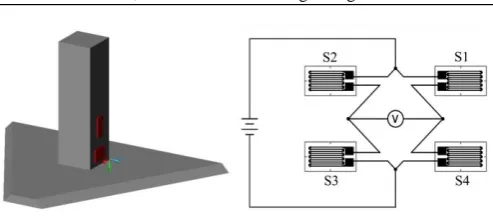
A data acquisition system was attached to pendulum
Figure 3 Schematic diagram of strain gages and blade position at the end of pendulum
2.2 Apparatus mechanical calibration
By the principle of conservation of potential energy to kinetic energy, the pendulum when released from φ1 is
expected to swing to the other side of equilibrium line and deflection through an angle φ2 and due to frictional
losses in the parts and air resistance, φ2 is normally less
than φ1. To delete the parts friction and air resistance
effects, the losses energy was computed by pendulum oscillation at loading rates without any cutting and was detracted of main energy values.
2.3 Apparatus electrical calibration
For calibration of data acquisition system, pendulum was released from distinct distance and the blade was contacted to strong sample. After contacting, the pendulum has been stopped and kinetic energy is converted to heat energy. The pendulum momentum is equal to multiplication of pendulum weight and contact speed or area under strain gage output volt versus time curve. Finally, the output volts of strain gages were converted to impact force by the usage of conversion ratio (Cr) which was calculated as in Equation (1) (Farahat and Brooghani, 2016).
. . . .
.
.
F dt m V and F Cr ν Cr ν dt mV Cr
mV ν dt
= =
=
(1)
where, F: Contact force (N); m: Pendulum weight (N); v: Output volt (V); V: Blade velocity of pendulum at contact time (m.s-1); Cr: Conversion ratio.
When the pendulum is normally released from one side of the equilibrium position by an angular deflection (φ1), it is swung to the other side of equilibrium line and
deflected through an angle (φ2). To obtain the different
velocities, the pendulum arm was released from different positions in the vertical plane on the upswing. The blade velocity and cutting energy in contact position to
specimen were calculated by Equation (2) and (3), respectively.
2 1
(cos cos )
t
E=W R φ − φ (2)
1
2 (1 cos ) [ w Rt φ ]
V L
I
−
= (3)
where, E: Shear consumption energy (J); φ2: Maximum
angular displacement of pendulum from vertical line after cutting (deg); φ1: Maximum angular displacement of
pendulum from vertical line before cutting (deg); Wt: Total weight of the pendulum including arm, load cell and cutting blade weight (N); R: Distance of the center of gravity of the pendulum from the axis of rotation (m); V: Blade velocity in the lowest position of pendulum (m s-1);
I: Mass moment of inertia of the pendulum about the axis of rotation (kg m2); L: Distance of the blade from the axis
of rotation (m).
The release angels (φ1) selected for this case are: 85,
60, 40 and 20 degrees and cutting velocities (4, 3, 2 and 1 m s-1) were calculated related to these angels. After
calibration, the impact shear force was applied to the buxus samples by releasing the pendulum arm in the testing machine up to the sample failure. The real-time applied force and cutting time were measured by data acquisition system.
3 Results and discussion
This study was planned as a completely randomized block design. The experimental tests were conducted with eight replications in each treatment and finally the collected data were analyzed using analysis of variances (ANOVA) and the means were separated by 5% and 1% probability levels by using Duncan’s multiple range test in SPSS (version 17, SPSS Inc., USA) software.
3.1 Test analysis
Table 1 Variance analyses of cutting buxus stalk under different loading rates and internode positions
Independent variable
Dependent variables Degree of
freedom
Shear energy, J
Shear strength, MPa Source of variation
Loading rate (A) 3 130.27** 0.56**
Internode position (B) 2 6.65** 0.21**
Interaction AB 6 0.23** 0.046**
Error 11 Note: ** Significant in statistic level of 1%.
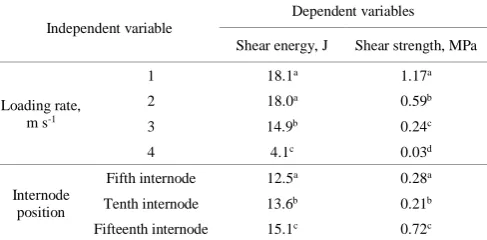
Based on the statistical analysis, the average values of shear strength, and shear consumption energy at impact test were obtained as 13.8 J from 3.19 to 19.60 J and 0.66 MPa from 0.71 to 1.03 MPa, respectively. The results of Duncan's multiple range tests for comparing the mean value of the mechanical properties of buxus stem at different loading rate and internode position was presented in Table 2.
Table 2 The means comparison of loading rate and internod position effect on the shearing properties of buxus stem
Independent variable
Dependent variables Shear energy, J Shear strength, MPa
Loading rate, m s-1
1 18.1a 1.17a
2 18.0a 0.59b
3 14.9b 0.24c
4 4.1c 0.03d
Internode position
Fifth internode 12.5a 0.28a
Tenth internode 13.6b 0.21b
Fifteenth internode 15.1c 0.72c
Note: Mean values followed by different letters are significantly different from others in the same column (∝=0.01).
The interaction effects of loading rate internode position on the shear consumption energy and shear strength were presented in Table 3. It illustrates that the minimum and maximum values of shear consumption energy were obtained as 3.19 J at fifth internode and loading rate: 4 m s-1 and 19.6 J at fifteenth internode and
loading rate: 1 m s-1, respectively. The minimum and
maximum values of shear strength were obtained as 0.06 MPa at fifth internode and loading rate: 4 m.s-1 and
1.55 MPa at fifteenth internode and loading rate: 1 m s-1,
respectively. As shown in Table 3, shear consumption energy and shear strength values decreased towards to the loading rate of 4 m s-1 and towards to the fifth internode
of buxus stalk. Because more accumulation mature fibers
and more cross section diameter are in lower region, and these parameters are greater in the lower region than the upper one (Ince et al., 2005). This effect of loading rate and internode position were also reported in maize stalk, sorghum stalk, pigeon pea stem, forge crops, canola stem, sorghum stalk and rice stem (Prasad and Gupta, 1975; McRandal and McNulty, 1978; Dange et al., 2011; Azadbakht et al., 2015; Alizade et al., 2011; Chattopadhyay and Pandey, 2001).
Table 3 Comparison of shear strength and shear consumption energy of buxus stem considering interaction effect between
loading rate and internode position
Loading rate, m s-1
Internode position
Shear consumption energy, J Shear strength, MPa Fifth Tenth Fifteenth Fifth Tenth Fifteenth 1 16.83a 18.33e 19.6c 0.60a 0.89e 1.55f
2 16.43a 17.88e 19.28c 0.34b 0.51a 0.93e
3 13.91b 15.14ab 15.82ab 0.14ce 0.21cd 0.38b
4 3.19cd 3.39cd 5.95d 0.06d 0.13ce 0.20cd
Note: Mean values followed by different letters are significantly different from others in the same column (∝=0.01).
Figure 4 Relationship between shear consumption energy and shear speed at different internod positions
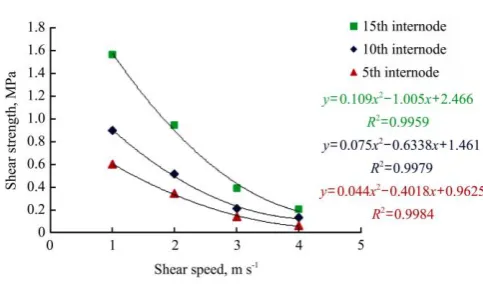
Figure 5 shows the interaction effect of loading rate internode position on buxus shear strength. In all regions and internode positions of Figure 4, the shear strength decreased polynomial with the increase of loading rate. The highest strength shear was obtained as 1.03 MPa for fifteenth internode of stalk at the speed rate of 2 m s-1 and
the lowest value was obtained as 0.14 MPa for fifth internode at the speed rate of 4 m s-1.
The models fitted to the data by using the regression techniques, which showed that the shear strength decreased Polynomial shape with the increase of loading rate for all stalk regions. The Figure 5 shows the best-fit regression equations, which were found for the relationship between them at each stalk internode position.
Figure 5 Relationship between shear strength and shear speed at different internode positions
4 Conclusions
In this study, the effects of shearing loading rate of buxus stem on shear strength and shear energy were investigated according to the internode positions of stem. Results indicated that an increase in shearing loading rate led to a decrease in the shear strength and the shear consumption energy. The reduction proportion of energy consumption at blade velocity of 1 to 4 m s-1 was about
3.3. It showed the shear consumption energy in low speed level of impact cutting was 3.3 times higher than that in high speed level cutting. Additionally, results showed that the shear consumption energy decreased upward from fifteenth to fifth internode position. Meanwhile, the increment proportion of shear consumption energy at internode position 15th to 5th was about 25%. By
considering to shearing results, shear strength strongly decreased with an increase of loading rate and was upward from fifteenth to fifth internode position. The reduction proportion of shear strength at blade velocity of 1 to 4 m s-1 is about 40 and the increment proportion of
shear strength at internode position 15th to 5th is about 2.5.
Moreover, the impact shear process was similar to dynamic process. In impact cutting, as the increase of loading rate, the primary compression decreased as a result's inertia and plastic behavior of buxus stalk material and the shear consumption energy decreased (Sitkei, 1986).
Acknowledgments
The authors would like to thank the University of Tehran and Pars Energy Company for providing the financial support and laboratory facilities for this research.
References
Alizade, M. R., F. R. Ajdadi, and A. Dabbaghi. 2011. Cutting energy of rice stem as influenced by internode position and dimensional characteristics of different varieties. Australian Journal of Crop Science, 5(6): 681–687.
ASAE S. 2005. Moisture relationships of plant-based agricultural products. St. Joseph, Mich: ASAE.
Azadbakht, M., E. Esmaeilzadeh, and M. Esmaeili-Shayan. 2015. Energy consumption during impact cutting of canola stalk as a function of moisture content and cutting height. Journal of the Saudi Society of Agricultural Sciences, 14(2): 147–152.
Bright, R. W., and R. W. Kleis. 1964. Mass shear strength of haylage. Transaction of the ASAE, 7(2): 100–101.
Chancellor, W. J. 1958. Energy requirement for cutting forage. Jornal of Agricultural Engineering Research, 39(10):
633–639.
Chattopadhyay, P. S., and K. P. Pandey. 2001. Impact cutting behavior of sorghum stalk using a flail -cutter-amathematical model and its experimental verification. Jornal of Agricultural Engineering Research, 78(4): 369–376.
Dange, A. R., S. T. Thakare, and I. Bhasharrao. 2011. Cuttting energy and force as required for pigeon pea stems. Journal of Agricultural Technology, 7(6): 1485–1493.
aluminum based composite foam. Modares Mechanical Engineering, 16(7): 219–228.
Fisher, D. A., J. J. Kolega, and W. C. Wheleer. 1975. An evaluation of the energy required to cut forage crop. Agricultural
Engineering, 37: 633–637.
Ince, A., S. Ugurluay, E. Guzel, and M. T. Ozcan. 2005. Bending and shearing characteristics of sunflower stalk residue. Biosystems Engineering, 92(2): 175–181.
Kanafojski, C., and T. Karwowski. 1972. Agricultural machines, theory and construction. In US Department of Commerce, National Technical Information Service, 25–60. Springfiled, Virginia.
Kushwaha, R. L., S. A. Vaishnav, and G. C. Zoreb. 1983. Shear sterngth of wheat straw. Canadian Agricultural Engineering, 25(2): 163–166.
Liljedahl, J. D., G. L. Jackson, R. P. Degraff, and M. E. Schroel. 1961. Measurement of shearing energy. Agricultural Engineering, 42: 298–301.
Mathanker, S. K., T. E. Grift, and A. C. Hansen. 2015. Effect of blade oblique angle and cutting speed on cutting energy for energycane stems. Biosystems Engineering, 133: 64–70. McRandal, D. M., and P. B McNulty. 1978. Impact cutting
behavior of forage crops-mathematical models and laboratory tests. Journal of Agricultural Engineering Research, 23(3): 313–328.
Mohsenin, N. N. 1963. Physical properties of plant and animal materials. New York: Gordon and Breach Science Publishers.
Nazari Galedar, M., A. Tabatabaeefar, A. Jafari, A. Sharifi, and S. Rafiee. 2008. Bending and shearing characteristics of alfalfa stems. Agricultural Engineering International: CIGR Journal, Manuscript FP 08 001. X.
O' degherty, M. J. 1982. A review of research on forage chopping. Journal of Agricultural Engineering Research, 27(4):
267–289.
O' degherty, M. J., J. A. Hubert, J. Dyson, and C. J. Marshall. 1995. A study of the physical and mechanical properties of wheat straw. Jornal of Agricultural Engineering Research, 62(2): 133–142.
Persson, S. 1987. Mechanics of cutting plant material. St Joseph, MI, USA: ASAE.
Pickett, L. K., J. B. Liljedahl, C. G. Haugh, and A. J. Ullstrup. 1969. Rheological properties of corn stalks subjected to transverse loading. Trans of the ASAE, 12(3): 392–399. Prasad, J., and C. P. Gupta. 1975. Mechanical properties of maize
stalk as related to harvesting. Jornal of Agricultural Engineering Research, 20(1): 79–87.
Prince, R. P., W. C. Wheeler, and D. A. Fisher. 1958. Discussion on energy requirements for cutting forage. Jornal of Agricultural Engineering Research, 39(10): 638–644.
Skubizs, G. 2001. Development of studies on the mechanical properties of winter rape stems. Internatinal Agrophysics, 15(3): 197–200.
Tabatabaee Koloor, R., A. Borgheie. 2006. Measuring the static and dynamic cutting force of stems for Iranian rice varieties. Journal of Agricultural Science and Technology, 8(3):
193–198.
Taghijarah, H., H. Ahmadi, M. Ghahderijani, and M. Tavakoli. 2011. Shearing characteristics of sugar cane stalks as a function of the rate of the force. Australian Journal of Crop Science, 5(6): 630–634.
Taghinezhad, J., R. Alimardani, and A. Jafari. 2013. Effect of moisture content and dimensional size on the shearing
characteristics of sugarcane stalks. Journal of Agricultural Technology, 9(2): 281–294.
Tavakoli, H., S. S. Mohtasebi, and A. Jafari. 2009. Effect of moisture content and loading rate on the shearing characteristics of barley straw by internode position. Agricultural Engineering International: CIGR Journal, 11:
Manuscript 1176 XI.