Enhancing le-conte pear trees performance by foliar spray with
different Iron concentrations
Mohamad F. El-Dahshouri
1*, Hassan A. Hamouda
1, Omaima M. Hafez
2,
Salwa A. Khafagy
2(1. Fertilization Technology Department,National Research Centre, Dokki, P.O. Box 12622, Cairo, Egypt; 2. Pomology Department,National Research Centre, Dokki, P.O. Box 12622, Cairo, Egypt)
Abstract: Pear trees cv. Le Conte (Pyrus communis, L.) budded on Pyrus communis rootstock, uniform in vigor, thirteen years old, grown in sandy soil spaced at 4×4 m, under drip irrigation system in a private orchard located at El-Tall El-Kepeer, Ismailia Governorate, Egypt. Trees were foliar sprayed by five mineral iron concentrations (0.0, 250, 500, 1000 and 2000 ppm) as ferrous sulphate (FeSO4.7H2O) form at two times (Mid May and June) during successive seasons 2014 and 2015.
This study was conducted with the aim to examine the response of leaf chlorophyll content, active iron, nutrient status, yield components quantity and quality of Le Conte pear trees to foliar feeding of iron concentrations as well as to evaluation the current status of foliar fertilization procedures to correct iron chlorosis in the newly soil reclaimed. Generally, results showed that all treatments had a positive effect on almost measurements in this study; such as nutrition status, fruit physical and chemical properties as well as fruit yield quantity and quality. The best treatment was achieved by foliar spray of iron at 1000 ppm in this respect. Authors can be concluded that foliar applications of Fe nutrient has an important positive effect on the yield and quality parameters of Le Conte pear fruits under this study conditions, with attaching by adding soil or foliar application of calcium fertilizer especially, at high iron foliar spray levels.
Keywords: pear, fruit yield quantity and quality, Iron foliar spray, physical and chemical properties, nutritional status
Citation: El-Dahshouri, M. F., H. A. Hamouda, O. M. Hafez, S. A. Khafagy. 2017. Enhancing le-conte pear trees performance by foliar spray with different Iron concentrations. Agricultural Engineering International: CIGR Journal, Special issue: 201–210.
1 Introduction
Non-Root Nutrition or Foliar Feeding or Foliar Fertilization considered the important marks to the development of modern agriculture where researches and experiments proved that the possibility of the supply to plants and fruit trees of various nutrients by spraying the plants with solvents these elements is an effective manner, where all the nutrients that can be absorbed by the roots also can be absorbed by the leaves as well as by the other parts that appear above the soil surface, such as stems and fruits.Also studies have shown that the absorption of
Received date: 2017-07-29 Accepted date: 2017-12-29 *Corresponding author:Mohamad Farouk EL-Dahshouri, Fertilization Technology Department National Research Center- El-Behoos St., Dokki, Cairo, Egypt. Email: mfarouknrc@ yahoo.com.
nutrients by the leaves usually have more speed and efficiency of absorption than through the roots, especially when the soil conditions are not suitable for the absorption of elements such as, high soil pH, presence of calcium carbonate and loss by washing. As result to farming a large area of calcareous and sandy soil poor in nutrients and expansion in the cultivation of horticultural crops increase the need of foliar micronutrients.Treatment of deficiency micro-elements using methods as soil fertilization so difficult under Egyptian soil conditions (alkaline, high soil pH and the presence of calcium carbonate). So, there are need to increases foliar micronutrients such as Iron, Zinc and Manganese (Tagliavini and Rombolà, 2000, El-Seginy et al., 2003,
Abd El-Wahab et al., 2005, and Samia et al., 2013).
The Le- Conte pear cultivar (Pyrus communis, L.) is
Egypt. It suffers from many factors which have a negative effect on growth, yield and fruit quality (Shoeib and El-Sayed, 2003 and Ahmed, 2005). Among these main factors which may attribute to malnutrition especially with iron. The main role of iron in the plant, it considered most important for the respiration and photosynthesis processes. It plays an important role in producing chlorophyll, a green pigment which involved in the absorption of light needed for plant growth (Fernándeza
et al., 2008). The main role of iron in plant, it plays an
essential role in respiration process and related to the composition of many enzymes such as Peroxidase, it plays a fundamental role in the conversion of leaf nitrogen to the protein, it has a major role in the protection of chlorophyll from severe sunlight (Al-Zerfey, 2012).
The mobility of iron in the plant is very low; it is present in two oxidation forms, Fe+3 (ferric) and Fe+2
(ferrous). In the presence of O2 Fe+2 is rapidly oxidized to
Fe+3, which is poorly soluble in water and becomes
unavailable to plants. When a plant grows in calcareous (high concentration of calcium carbonates) or alkaline soils (pH “7 to 9”), it develops symptoms of iron chlorosis that result because Fe isn’t found in an available form. New growth that emerges will be chlorotic (Tagliavini et al., 2008). So, rapid response is required to
correct a chlorotic condition by foliar spray with iron sulfate solution (Salazar-García, 1999, El-Jendoubi et al.,
2014 and Hamouda et al., 2015).
Foliar application of iron sources (Fe-EDTA, Fe-EDDHA and Fe-Mineral “FeSO4.7H2O”) led to
significantly increases of leaves and fruits nutrient, chlorophyll contents and active iron in the leaves, as well as there is a strong significant relationship between fruit nutrient contents, yield and pear fruit quality (Hamouda
et al., 2015). In this respect, several literature on pear
(Álvarez-Fernández et al., 2004; Álvarez-Fernández et al.,
2006; Álvarez-Fernández et al., 2011; Mansour et al.,
2008; Dar et al., 2012; Samia et al., 2013).
Balancing of micronutrients is important for plant system, depending on its life cycle, environment and its genotypic characteristics to realize its maximum genetic potential. Synergism and antagonism between two mineral nutrients become even more important when the contents
of both elements are near deficiency range (Malvi, 2011). The aim of this study is to examine the response of leaf chlorophyll content, active iron, nutrient status, yield components quantity and quality of Le Conte pear trees to foliar spraying of iron concentrations as well as to evaluation the current status of foliar fertilization procedures to correct iron chlorosis in the newly soil reclaimed.
2 Materials and Methods
2.1 Pear Orchard
Pear trees cv. Le Conte (Pyrus communis, L.) budded
on Pyrus communis rootstock grown in sandy soil in a
private orchard located at El-Tall El-Kepeer, Ismailia Governorate, Egypt. Trees on uniform in vigor thirteen years old spaced 4x4 m under drip irrigation system. The trees received the same horticultural practices that are recommended by The Egypt a Ministry of Agriculture and Land Reclamation. Complete randomized block design was adopted. The soil analysis of the experimental site characterized used with 0.35% organic matter, pH 8.16, E.C 0.47 dS m-1 and CaCO3 2.72%. The available
nutrients were as follows (P 0.26, K 19.2, Ca 235, Mg 11.2 and Na 14.6 mg 100 g-1) and (Fe 3.4, Mn 4.6, Zn 1.33 and Cu 0.18 ppm).
2.2 Iron Foliar Spray
Four mineral iron concentrations as (Fe+2) ferrous sulphate (FeSO4.7H2O) were (250, 500, 1000 and
2000 ppm) were foliar sprayed at two times in each season (Mid May and June). Control trees were sprayed with water. All spray solutions contained 0.1% Triton B as a wetting agent and were conducted during 2014 and 2015 seasons.
2.3 Determinations and Measurements
2.3.1 Chlorophyll Content of Leaves
Chlorophyll content of leaves was measured (after second spray) as reading by Hydro N- Tester (Minolta, Japan) 502 meter, using the blades of the fully mature leaves of pear.Chlorophyll meters permit storage of 30 individual meter readings according to Benedict and Swidler (1961).
2.3.2 Active Iron Content (ppm)
Two grams of fresh chopped plant leaves were weighed in triplicates and immediately transferred into 50 mL plastic cups contain 20 mL 1.5 N HCl. The cups were capped and shacked at room temperature for 24 hours on shaker Uni Jogger model and then filtered through filter paper Whatman No. 1. Fe was measured by atomic absorption.
2.3.3 Leaf Nutrient Contents
Samples of thirty leaves from the middle part of non-fruiting shoots were selected at random from each replicate. The leaves were washed, dried at 70ºC till constant weight, grind and dry ashing digestion method to determine the macro-nutrients (N%, P%, K%, Ca% and Mg%) and micro-nutrient (Fe, Zn, Mn and Cu ppm) contents (Rebbeca, 2004), and mineral analyses were done also in fruit.
2.3.4 Yield and Its Components
In August of each year (2014 and 2015) at harvesting time, the fruit yield/tree (kg) was estimated on basis of number and weight of fruits/tree (g). Also yield (ton)/fed were calculated.
2.3.5 Fruit Quality Determination
Samples of 15 fruits from each tree were randomly taken for determining the physical and chemical characteristics.
2.3.6 Physical Characteristics
Fruit weight (g), fruit length (L), fruit diameter (D) and L/D ratio were calculated. Also, fruit firmness was determined as Lb inch-2 by using fruit pressure tester model FT 327 (3-27 Lbs).
2.4 Chemical Characteristics
Total Soluble Solids percentage (TSS%) by using hand refractometer, Total Acidity (TA%) was estimated as percentage of Malic acid in fruit juice (AOAC, 2000), Maturity index (MI) was calculated as a ratio of Total Soluble Solids/Total Acidity. Total Sugars (g 100 g-1 FW) was determined using the phenol and sulfuric acid (Smith et al., 1956).
Statistical Analysis
The results were submitted to analysis of variance (Snedecor and Cochran, 1980). Differences among treatment means were determined by using the LSD test at a significance level of 0.05 (Waller and Duncan, 1969).
3 Results and Discussion
3.1 Leaves Chlorophyll and Active Iron Content
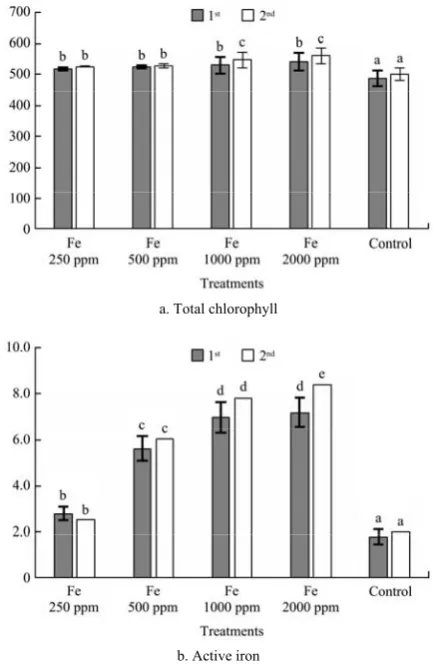
Figure 1 represents leaves chlorophyll and active iron of Le Conte pear as affected by different iron concentrations used in this work.
a. Total chlorophyll
b. Active iron Note: Fe: (FeSO4.7H2O).
Figure 1 Effectiveness of different iron foliar spray concentrations on leaves chlorophyll and active iron content during 2014 and 2015
seasons
In general, both leaf chlorophyll and active iron contents gradually increases by increasing the concentration (Conc.) of iron. The highest significant were achieved by high Conc. (1000 and 2000 ppm) with no differ between them, except the 2nd season in active
iron. Meanwhile, the lowest significant recorded by the check treatment (foliar with water) as compare with other treatments in both studied seasons. Our results are in agreed with many studies were tested iron (II) sulfate as a foliar fertilizer in several fruit crops led to increases in leaf chlorophyll content in kiwi (Rombolà et al., 2000),
citrus (Pestana et al., 2001;Pestana et al., 2003), peach
trees (Fernándeza et al., 2006 and 2008), grapevine
iron of pear trees (Álvarez-Fernández et al., 2004) and
(Hamouda et al., 2015).
3.2 Leaf Nutrient Contents
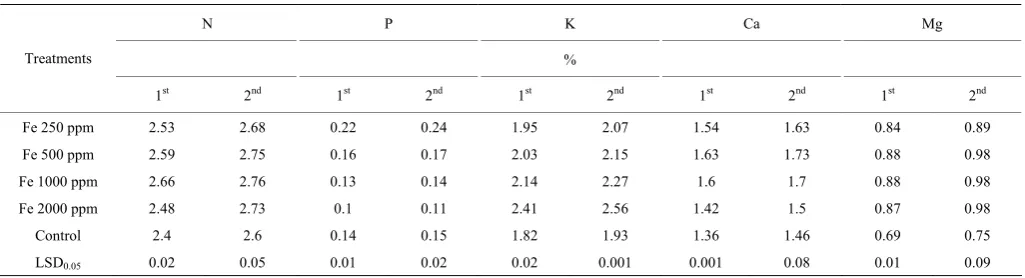
Macronutrients content (%), Data in (Table 1) shows the macronutrients leaves content of Le Conte pear. According to the table data, all treatments of iron foliar
spraying showed an increase in all nutrients concentration as compared to the control. The foliar spraying of iron was significantly increased concentration of nitrogen, phosphorus, potassium, calcium and magnesium, except phosphorus at the high concentration of iron (2000 ppm) in both seasons.
Table 1 Effectiveness of different iron foliar spray concentrations on leaf macronutrients content of Le Conte pear during 2014 and 2015 seasons
N P K Ca Mg
% Treatments
1st 2nd 1st 2nd 1st 2nd 1st 2nd 1st 2nd
Fe 250 ppm 2.53 2.68 0.22 0.24 1.95 2.07 1.54 1.63 0.84 0.89 Fe 500 ppm 2.59 2.75 0.16 0.17 2.03 2.15 1.63 1.73 0.88 0.98 Fe 1000 ppm 2.66 2.76 0.13 0.14 2.14 2.27 1.6 1.7 0.88 0.98 Fe 2000 ppm 2.48 2.73 0.1 0.11 2.41 2.56 1.42 1.5 0.87 0.98 Control 2.4 2.6 0.14 0.15 1.82 1.93 1.36 1.46 0.69 0.75 LSD0.05 0.02 0.05 0.01 0.02 0.02 0.001 0.001 0.08 0.01 0.09
Note: Fe: (FeSO4.7H2O).
3.3 Leaf N content
The highest significant value of leaves N content was obtained in the 1st season from Fe at 1000 ppm recorded (2.66%), followed by Fe at 500 ppm (2.59%). While, the lowest N content achieved with the untreated trees (2.40%). In the 2nd season, the same trend was obtained and the result are agree with (Hamouda et al., 2015)
mentioned that iron foliar addition led to increase of nitrogen content in Le Conte pear leaves.
3.4 Leaf P content
There is an inverse relationship between phosphorus leaves content and increasing of iron concentration was found. The highest statistical P content value revealed with low level of Fe at 250 ppm (0.22% and 0.24%), then Fe at 500 ppm (0.16% and 0.17%) in the two seasons. While, the significant reduction resulted by the high Fe level 2000 ppm (0.10% and 0.11%) in both seasons, respectively. Our results are agreement with (Malvi, 2011) mentioned that there were antagonism between iron and phosphorus especially in the high levels.
Leaf K content: Leaves potassium concentration gradually increased by increasing iron levels, where, Fe at 2000 ppm recorded the highest significant increment of leaf K content (2.41% and 2.56%), followed by Fe at 1000 ppm (2.14% and 2.27%) in both seasons, respectively. The lowest statistical value was found by
the control treatment (1.82% and 1.93%) in the 1st and the 2nd seasons, consecutively. The previous results are in line with (Malvi, 2011) mentioned that Fe foliar application led to enhancing K concentration in plant.
3.5 Leaf Ca content:
Data in Table 1 showed that there were significant differences effect between foliar sprayed of all Fe levels treatment and control on leaves Ca contents in both seasons, except the high level of Fe (2000 ppm). The best treatment induced the highest statistical increase of Ca content by ferrous sulphate dose at500 ppm (1.63% and 1.73%). Followed by 1000 ppm (1.60% and 1.70%), in both seasons, respectively. On the other hand, the control treatment gave the lowest decrease of leaf Ca content (1.36% and 1.46%) followed by the high level of iron 2000 ppm (1.42% and 1.50%) consecutively, in the two seasons.
The results in case of calcium agree with (Malvi, 2011) which proved that there is negative relationship between high iron levels and leaf calcium content. The reduction of leaf Ca content may be due to the presence of antagonism between high iron level and calcium.
3.6 Leaf Mg content:
compared with 250 ppm and unsprayed trees in both seasons. This results are in harmony by Twyman (1959) found that increasing the total iron supply increases caused to decreasing concentrations phosphorus, calcium and magnesium in leaves.
3.7 Micronutrients Content (ppm)
Data in Table 2 recorded the micronutrients content in leaves of Le Conte pear plant. Data showed that spray with different iron doses led to a significant increase in leaf iron content, but there were decrease in zinc, manganese and copper contents by gradual increase of the iron levels spray in both seasons.
The highest increment in leaf Fe concentration was reached with the high Fe level, while, the highest leaves content of Zn, Mn and Cu were found from the low Fe level. Whilst, the lowest significant leaf contents of Fe, Zn, Mn and Cu were recorded by the untreated treatment in both seasons. From the above results which revealed that foliar spray with iron led to enhance the absorption of other (most) nutrients as compared to control treatment, these results are in line with findings by (Fernándeza et al., 2008) on peach; (Álvarez-Fernández et al., 2011),
(Mansour et al., 2008), (Samia et al., 2013) on pear and
(Hamouda et al., 2016) on pomegranate.
3.8 Fruit Nutrient Contents
Macronutrients content (%)
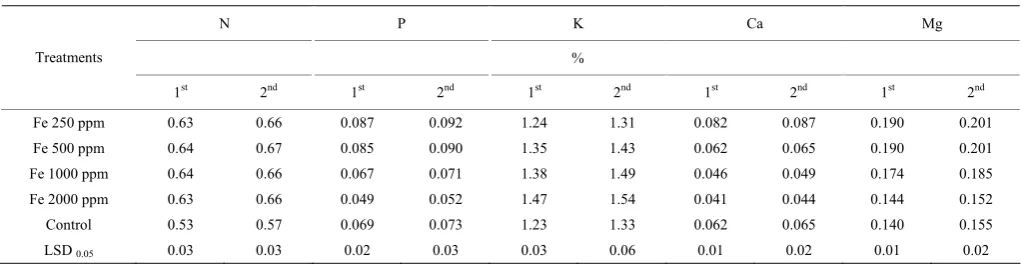
Data in Table 3 indicates to the macronutrients content of Le Conte pear fruit.
The results showed that slightly increase was observed in fruit content of nitrogen and potassium with increasing Fe levels (Table 3). The highest significant values of N (Fe 500 ppm) but no differ among the other treatments, Ca (Fe 250 ppm) and Mg (Fe 250 and 500 ppm) without differences among them. While, the lowest statistical values were achieved by the untreated trees except in P and Ca (Fe 2000 ppm). These results coordinated with Malvi (2011), found that there contrariness a relationship between iron foliar spray levels and the other macronutrients content.
3.9 Micronutrients Content (ppm)
Table 4 results indicated that all fruits micronutrient contents decreased by increasing of iron foliar spray except Fe content. The check treatment was gave the lowest content of all micronutrients in both seasons.
Table 2 Effectiveness of different iron foliar spray concentrations on leaf micronutrients content of Le Conte pear during 2014 and 2015 seasons
Fe Zn Mn Cu
ppm Treatments
1st 2nd 1st 2nd 1st 2nd 1st 2nd
Fe 250 ppm 152.2 161.5 190.0 201.6 257.8 273.5 12.98 13.78 Fe 500 ppm 286.1 303.6 189.1 200.6 251.5 266.8 12.28 13.26 Fe 1000 ppm 358.6 380.4 176.0 187.0 227.0 237.0 12.30 13.05 Fe 2000 ppm 389.0 412.7 158.2 167.8 176.1 186.9 12.13 12.87 Control 89.1 96.0 119.1 126.3 144.7 153.5 9.05 9.61
LSD0.05 11.6 5.7 2.8 1.5 4.7 2.4 0.09 0.09
Note: Fe: (FeSO4.7H2O).
Table 3 Effectiveness of different iron foliar spray concentrations on fruit macronutrients content of Le Conte pear during 2014 and 2015 seasons
N P K Ca Mg
% Treatments
1st 2nd 1st 2nd 1st 2nd 1st 2nd 1st 2nd
Fe 250 ppm 0.63 0.66 0.087 0.092 1.24 1.31 0.082 0.087 0.190 0.201 Fe 500 ppm 0.64 0.67 0.085 0.090 1.35 1.43 0.062 0.065 0.190 0.201 Fe 1000 ppm 0.64 0.66 0.067 0.071 1.38 1.49 0.046 0.049 0.174 0.185 Fe 2000 ppm 0.63 0.66 0.049 0.052 1.47 1.54 0.041 0.044 0.144 0.152
Control 0.53 0.57 0.069 0.073 1.23 1.33 0.062 0.065 0.140 0.155 LSD 0.05 0.03 0.03 0.02 0.03 0.03 0.06 0.01 0.02 0.01 0.02
Table 4 Effectiveness of different iron foliar spray concentrations on fruit micronutrients content of Le Conte pear during 2014 and 2015 seasons
Fe Zn Mn Cu
ppm Treatments
1st 2nd 1st 2nd 1st 2nd 1st 2nd
Fe 250 ppm 45.1 47.9 119.2 127.3 19.2 18.6 4.61 4.89 Fe 500 ppm 64.1 68.0 118.3 126.9 18.4 18.3 4.55 4.75 Fe 1000 ppm 74.0 74.2 116.8 123.3 14.8 15.6 4.10 4.35
Fe 2000 ppm 76.9 81.6 114.8 121.8 14.4 15.2 4.10 4.35
Control 23.1 24.5 113.3 120.2 11.3 12.0 1.65 2.00
LSD0.05 2.32 0.98 1.0 1.74 0.24 0.09 0.14 0.11
Note: Fe: (FeSO4.7H2O).
It is worth mentioning, leaves and fruits content of all nutrient elements increased with iron foliar spray than the control. While, by increasing Fe doses led to increase in leaves and fruits content of N, K and Fe but decreased in P, Ca, Mg, Zn, Mn and Cu. It may be these elements (P, Ca, Mg, Zn, Mn and Cu) need moderate concentration of iron foliar spray.
Our results were harmony with finding by Malvi (2011) revealed that there were antagonism between iron and phosphorus, calcium, manganese, zinc and copper. Increasing amount of iron reduce phosphorus, manganese,
zinc and copper.
3.10 Yield and Its Components
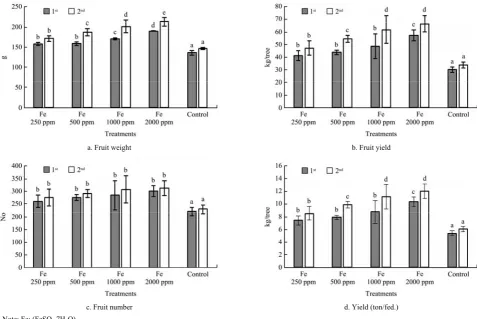
In Figure 2, results indicated that application of different Fe concentrations markedly produced higher fruit weight (g), number of fruits/tree, yield (kg)/tree and yield (ton)/fed of Le Conte pear trees that mentioned by increasing iron foliar spray levels. The largest of all aspects characteristics were achieved with Fe high level while, the lowest was recorded by the untreated one, for both studied seasons.
a. Fruit weight b. Fruit yield
c. Fruit number d. Yield (ton/fed.) Note: Fe: (FeSO4.7H2O).
The stimulation on nutritional status of the Le Conte pear trees in response to foliar application of Fe nutrients surely reflected on improving the yield and its components. These results are in conformity with the publications Álvarez-Fernández et al. (2003),
Álvarez-Fernández et al. (2006), Álvarez-Fernández et al.
(2011), Mansour et al. (2008), Samia et al. (2013), and
Hamouda et al. (2015), Hamouda et al. (2016).
3.11 Fruit Quality
Physical Characteristics
In general, all the physical properties of Le Conte pear fruits increased by trees treated with different iron levels, these increments proportional with increasing Fe levels except fruit shape (Table 5). The highest significant fruit length, diameter and firmness were obtained by treatments of Iron at 2000 ppm. While, the
lowest significant of the previous characters was achieved with the control. Whereas, the treatment of Fe 500 ppm showed the largest fruit shape, but the smallest came with spray of Fe 250 ppm.
3.12 Chemical Characteristics
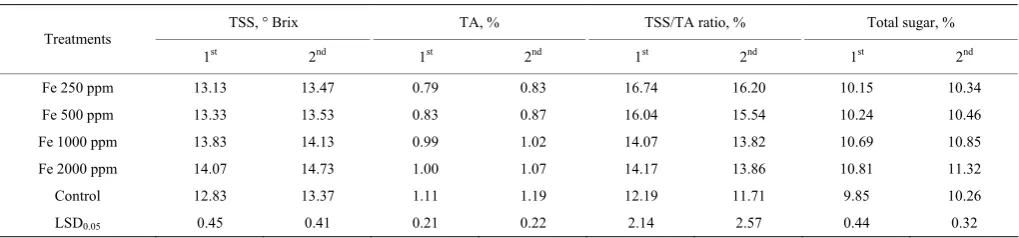
From data in Table 6, it can be noticed that the greatest significant fruit content of TSS and total sugars were recorded with trees treated of iron at 2000 ppm, in case TSS/TA ratio (Fe 250 ppm). Although, the TA was increased by increase Fe levels but this increment less than the control. The lowest statistical of TA was obtained by spraying of Fe 250 ppm, whereas the highest TA was recorded from the control. In contrast, the check treatment appeared the lowest significant fruit content of TSS, TSS/TA ratio and total sugars.
Table 5 Effectiveness of different iron foliar spray concentration on fruit physical characteristics of Le Conte pear during 2014 and 2015 seasons
Length (L), cm Diameter (D), cm Shape (L/D) Firmness, Lb inch-2
Treatments
1st 2nd 1st 2nd 1st 2nd 1st 2nd
Fe 250 ppm 8.00 8.33 6.33 6.44 1.25 1.29 19.03 19.83
Fe 500 ppm 8.72 8.94 6.67 6.75 1.30 1.32 19.17 20.57
Fe 1000 ppm 8.81 8.97 6.89 7.11 1.28 1.26 19.97 21.87
Fe 2000 ppm 8.97 9.20 6.94 7.14 1.29 1.29 20.22 21.92
Control 7.94 8.22 6.11 6.22 1.30 1.32 15.80 16.87
LSD0.05 0.09 0.09 0.05 0.07 0.02 0.02 1.17 2.1
Note: Fe: (FeSO4.7H2O).
Table 6 Effectiveness of different iron foliar spray concentrations on fruit chemical characteristics of Le Conte pear during 2014 and 2015 seasons
TSS, ° Brix TA, % TSS/TA ratio, % Total sugar, % Treatments
1st 2nd 1st 2nd 1st 2nd 1st 2nd
Fe 250 ppm 13.13 13.47 0.79 0.83 16.74 16.20 10.15 10.34 Fe 500 ppm 13.33 13.53 0.83 0.87 16.04 15.54 10.24 10.46 Fe 1000 ppm 13.83 14.13 0.99 1.02 14.07 13.82 10.69 10.85 Fe 2000 ppm 14.07 14.73 1.00 1.07 14.17 13.86 10.81 11.32 Control 12.83 13.37 1.11 1.19 12.19 11.71 9.85 10.26
LSD0.05 0.45 0.41 0.21 0.22 2.14 2.57 0.44 0.32
Note: Fe: (FeSO4.7H2O).
The best effect of iron on nutrition status, yield and its component and fruit quality of Le Cone pear trees may be due to the main role of iron in the plant, it is most important for the respiration and photosynthesis processes. Iron foliar spray increased concentration of photosynthetic pigments in the leaf, large increase in leaf chlorophyll content (Fernándeza et al., 2008),
macronutrients (N, P, K, Ca and Mg) and micronutrients (Fe, Zn, Mn and Cu) increased (Álvarez-Fernández et al.,
2011), resulted in larger fruit also lead to the early fruit ripening, it had the positive effect on gross yield and fruit quality (Álvarez-Fernández et al., 2006). In this
iron chlorosis by foliar sprays containing Fe resulted in larger oranges, with a repeat of more than 35% in the gross income of the grower. In addition, Samia et al.
(2013) found that foliar application of micronutrients on Le Conte pear trees under calcareous soil conditions, improved the physical and chemical characteristics of fruits.
3.13 Correlation Coefficient
Correlation coefficients of leaf nutrients content with pear fruit yield and quality (average 2 seasons).
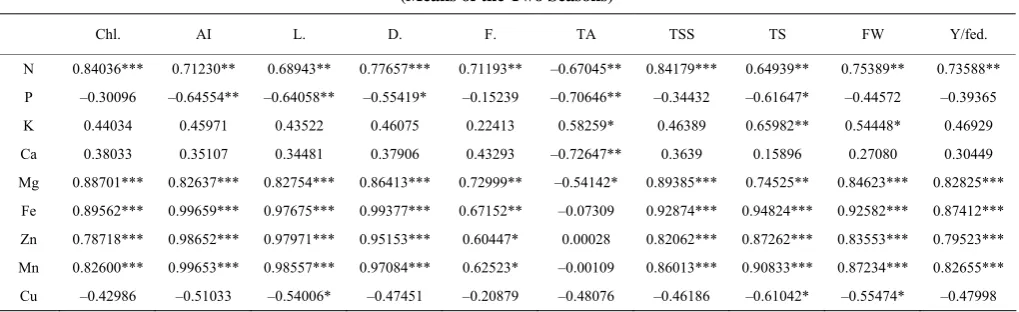
The relationship of leaves nutrient contents with fruit yield quantity and quality of Le Conte pear, as on average of the two seasons were detected in Table 7. Results indicated that very highly significant relationship between leaf N content and chlorophyll content, fruit diameter and Fruit TSS. Similar relationships were found between leaf
Mg, Fe, Zn and Mn content and chlorophyll content, active iron, fruit length, fruit diameter, fruit TSS, total sugar, fruit weight and yield/fed. At the same time, data revealed that highly significant relationship between leaf N content and active iron, fruit length, fruit firmness, TA, total sugar, fruit weight and yield/fed. On other hand, data show highly significant negative relationship between leaf P content and active iron, fruit length and TA, while the relationship were significant with fruit diameter and total sugars. Conversely, the results revealed that significant negative relationship between leaves Cu content and fruit length, total sugars and fruit weight. From data it has been observed that increasing concentration of iron by foliar application led to low concentration of calcium in leaves, and therefore fruit firmness affected by the decreasing of calcium content.
Table 7 Correlation coefficients between leaves nutrient contents and fruit yield quantity and quality of Le Conte pear (Means of the Two Seasons)
Chl. AI L. D. F. TA TSS TS FW Y/fed.
N 0.84036*** 0.71230** 0.68943** 0.77657*** 0.71193** –0.67045** 0.84179*** 0.64939** 0.75389** 0.73588** P –0.30096 –0.64554** –0.64058** –0.55419* –0.15239 –0.70646** –0.34432 –0.61647* –0.44572 –0.39365 K 0.44034 0.45971 0.43522 0.46075 0.22413 0.58259* 0.46389 0.65982** 0.54448* 0.46929 Ca 0.38033 0.35107 0.34481 0.37906 0.43293 –0.72647** 0.3639 0.15896 0.27080 0.30449 Mg 0.88701*** 0.82637*** 0.82754*** 0.86413*** 0.72999** –0.54142* 0.89385*** 0.74525** 0.84623*** 0.82825***
Fe 0.89562*** 0.99659*** 0.97675*** 0.99377*** 0.67152** –0.07309 0.92874*** 0.94824*** 0.92582*** 0.87412*** Zn 0.78718*** 0.98652*** 0.97971*** 0.95153*** 0.60447* 0.00028 0.82062*** 0.87262*** 0.83553*** 0.79523*** Mn 0.82600*** 0.99653*** 0.98557*** 0.97084*** 0.62523* –0.00109 0.86013*** 0.90833*** 0.87234*** 0.82655*** Cu –0.42986 –0.51033 –0.54006* –0.47451 –0.20879 –0.48076 –0.46186 –0.61042* –0.55474* –0.47998 Note: Chl. = Chlorophyll, AI = Active Iron, L= Length, D= Diameter, F=Firmness, TS = Total sugars, FW = Fruit weight, Y/fed. =Yield / fed.
r 0.05=0.514 , 0.01=0.641 , 0.001=0.760. * = Significant relationship, **= Highly significant relationship, *** = Very highly significant relationship.
For this reason at the higher foliar spray of iron levels it must be keep in mind using soil or foliar application of calcium fertilizer.
As the essential iron play a key and vital role in the growth of plants, which attributed the result of a relationship between the concentration of the element in the soil and plant in addition to fruit quality associated with it. This guide to get the maximum yield with quality (Kumar and Chandel, 2004and Dar et al., 2012).
4 Conclusion
Iron is very important for Le Conte pear trees (Pyrus communis, L.) because plays an important role in several
basic physiological functions. Also, it is consider one of
the key factors influencing the yield and fruit quality. Moreover, it plays a vital role in deciding the growth and development of the plant. This serves a guide to obtain maximum productivity of fruits quality. Thus, it can be concluded that foliar applications of Fe nutrient has an important positive effect on the yield and quality parameters of Le Conte pear fruits under this study conditions, with attaching by add calcium fertilizer especially, at high iron foliar spray levels.
Acknowledgment
References
Abd El-Wahab, A., M. Wafa, S. Mohamed, and A. M. Gihan. 2005. Effect of foliar application of some mineral elements on fruit set, yield, leaf and fruit mineral contents and storage ability of “Anna” apple fruits I- effect on fruit set, yield as well as leaf and fruit mineral contents. Journal Agricuture Science Mansoura University, 24(12): 7547–7557.
Ahmed, G. A. M. 2005. Effect of foliar application of some micronutrients on fruit quality changes and storage ability of “Desert Red” peach. Ph.D. Thesis, Fuc. Agric., Cairo Univ., Cairo, Egypt.
Àlvarez-Fernàndez, A., J. Abadía, and A. Abadía. 2006. Iron deficiency, fruit yield and fruit quality. In Iron Nutrition in Plants and Rhizospheric Microorganisms, 85–101.
Álvarez-Fernández, A., J. C.Melgar, J.Abadía, and A. Abadía.2011. Effects of moderate and severe iron deficiency chlorosis on fruit yield, appearance and composition in pear (Pyrus communis L.) and peach (Prunus persica (L.) Batsch). Environmental and Experimental Botany, 71(2): 280–286. Álvarez-Fernández, A., P. García-Laviña, C. Fidalgo, J. Abadía, A.
Abadía.2004. Foliar fertilization to control iron chlorosis in pear (Pyrus communis L.) trees. Plant Soil, 263(1): 5–15. Álvarez-Fernández, A., P. Paniagua, J. Abadía, and A.
Abadía.2003. Effects of Fe deficiency chlorosis on yield and fruit quality in peach (Prunuspersica L. Batsch). Journal of. Agriculture and Food Chemistry, 51(19): 5738–5744.
Al-Zerfey, M. T. H. 2012. Effect of spraying with two types of organic fertilizers Izomen and Laq Humus on growth hand propagation of Agave plant (Agave Americana). Kufa Journal of Agricultural Sciences, 4(1): 221–230.
AOAC. 2000. Official Methods of Analysis, 7thEd. pp1080.
Washington D.C., USA.
Benedict, H. M., R. Swidler. 1961. Nondestructive methods for estimating chlorophyll content of leaves. Science, 133: 2015–2016.
Dar, M. A., J. A. Wani, S. K. Raina, M. Y. Bhat. 2012. Effect of available nutrients on yield and quality of pear fruit Bartlett in Kashmir valley India. Journal of Environmental biology, 33: 1011–1014.
El-Jendoubi, H., S. Vázquez, A. Calatayud, P. Vavpetič, K. Vogel-Mikuš, P. Pelicon, J. Abadía, A. Abadía, and F. Morales. 2014. The effects of foliar fertilization with iron sulfate in chlorotic leaves are limited to the treated area. A study with peach trees (Prunus persicaL. Batsch) grown in the field and sugar beet (Beta vulgarisL.) grown in hydroponics. Frontiers in Plant Science, 5(2): 2.
El-Seginy, G. I., A. M. EI-Seginy, S. M. Malaka, W. M. A. E. Naiema, and G. I. Eliwa. 2003. Effect of foliar spray of some micronutrients and Gibberellin on leaf mineral content, fruit set, yield and fruit quality of “Anna” apple trees. Alexandria
Journal of Agricultural Research, 48(3): 137–143.
Fernándeza, V., V. D. Rio, J. Abadía, A. Abadía. 2006. Foliar iron fertilization of peach (Prunus persica (L.) Batsch): effects of iron compounds, surfactants and other adjuvants. Plant and Soil, 289(1-2): 239–252.
Fernándeza, V., V. D. Rio, L. Pumarino, E. Lgaruta, J. Abadia, and A. Abadia. 2008. Foliar fertilization of peach (Prunus persica (L.) Batsch) with different iron formulations: Effects on re-greening, iron concentration and mineral composition in treated and untreated leaf surfaces. Scientia Horticulturae, 117(3): 241–248.
Hamouda, H. A., M. F. El-Dahshouri, O. M. Hafez, and N. G. Zahran. 2015. Response of Le Conte pear performance, chlorophyll content and active iron to foliar application of different iron sources under the newly reclaimed soil conditions. International Journal of Chemistry Technolgy Research, 8(4): 1446–1453.
Hamouda, H. A., R. K. M. Khalifa, M. F. El-Dahshouri, and N. G. Zahran. 2016. Yield, fruit quality and nutrients content of leaves of pomegranate fruit as influenced by iron, manganese and zinc foliar spray. International Journal of Pharmtech Research, 8(4): 46–57.
Kumar, J. and J. S. Chandel. 2004. Effect of different levels of N, P and K on growth and yield of pear cv. Red Bartlett. Progressive Horticulture, 36(2): 202–206.
Malvi, U. R. 2011. Interaction of micronutrients with major nutrients with special reference to potassium. Karnataka Journal of Agricultural Sciences, 24(1): 106–109.
Mansour, A. E. M., F. F. Ahmed, E. A. Shaaban, A. A Fouad. 2008. The beneficial of using citric acid withsome nutrients for improving productivity of Le- Conte pear tree. Journal Research Journal of Agriculture and Biological Sciences, 4(3): 245–250.
Pestana, M., P. J. Correia, A. D. Varennes, J. Abadía, E. A. Faria.2001. Effectiveness of different foliar iron applications to control iron chlorosis in orange trees grown on a calcareous soil. Journal of Plant Nutrition, 24(4-5): 613–622.
Pestana, M., A. D. Varennes, E. A. Faria. 2003. Diagnosis and correction of iron chlorosis in fruit trees: a review. Journal of Food Agriculture and Environment, 1(1): 46–51.
Rebbeca, B. 2004. Soil Survey Laboratory Methods Manual, Soil Survey Investigation Report42. Natural Resources Conservation Services.
Rombolà, A. D., W. Bruggemann, M. Tagliavini, B. Marangoni, P. R. Moog. 2000. Iron source affects iron reduction and re-greening of kiwifruit (Actinidia deliciosa) leaves. Journal of Plant Nutrition, 23(11-12): 1751–1765.
Asad, S. A., N. A. A. El-Megeed, and E. S. Atalla. 2013. Effect of foliar application of micronutrients on “Le-Conte” pear trees under calcareous soil conditions. American Journal of Science, 9(7s): 123–128.
Shoeib, M. M., and A. El-Sayed. 2003. Response of “Thompson Seedless” grape vines to the spray of some nutrients and citric acid. Minia Journal of Agricultural Research and Development, 23(4): 681–698.
Smith, F. A., M. Gilles, K. J. Haniltun, A. P. Gedees. 1956. Colrimetric methods for determination of sugar and related substances. Analysis Chemistry, 28: 350.
Snedecor. G. W., W. G. Cochran. 1980. Statistical methods. 7thEd.
pp 507. Iowa State Univ. Press Ames. Iowa, USA
Tagliavini, M., and A. D. Rombolà. 2001. Iron deficiency and chlorosis in orchard and vineyard ecosystems. European Journal of Agronomy, 15(2): 71–92.
Tagliavinia, M., J. Abadíab, A. D. Rombolàa, A. Abadíab, C.
Tsipouridisc, and B. Marangonia. 2000. Agronomic means for the control of iron deficiency chlorosis in deciduous fruit trees. Journal of Plant Nutrition, 23: 2007–2022.
Takkar, P. N., N. P. Kaur. 1984. HCL method for Fe2+ estimation
to resolve iron chlorosis in plants.Journal of Plant Nutrition, 7(1-5): 81–90.
Twyman, E. S. 1959. The effect of iron supply on the yield and composition of leaves of tomato plants. Plant and Soil, 10(4): 375–388.
Waller. R. A., D. B. Duncan. 1969. A bays rule for the symmetric multiple comparisons problem. Journal of the American Statistical Association, 64(328): 1484–1503.