Environmental effects of the burning of the straw for energy
purposes
Miroslav Macak
*, Ladislav Nozdrovicky, Juraj Maga
(Department of Machines and Production Systems, Faculty of Engineering, Slovak University of Agriculture in Nitra, Tr. A. Hlinku 2, 949 76, Nitra, Slovakia)
Abstract: Long-term using of fossil fuels has caused global climatic changes. Using of the renewable energy sources based on the field crop biomass can be considered as a tool allowing compensating the negative consequences of the fossil fuels. Among different types of biomass based fuels the straw baled in the form of square bales plays an important role. Until now the research pays only small attention to the environmental effects related to the using of the straw for energy purposes. The aim of the paper was to analyze the effect of moisture content of the straw used for energy purposes. The straw has been baled to the form of large square bales. The straw bales were burned in special boiler. The quality of incineration process was monitored for different straw moisture content and also from the point of amount of CO2, CO, NO2, NO emissions which were released during the incineration process.
Based on the experimental results, we can confirm that the increased straw moisture content (15.9%) there were obtained lower values of concentrations of emissions, but the process of burning was significantly slower. There was a longer burning of the same amount of the straw material. It means that the total amount of emissions released from the combustion of material with higher moisture content is equal to the emissions produced during combustion of dry straw. In conclusion it can be stated that the handling of straw bales and the method of bales storage affect straw moisture content, which then affects the quality of combustion in terms of the amount of energy gained.
Keywords:
baled straw for energy purposes, laboratory experiments, straw burning, emission factors
Citation: Macak, M., L. Nozdrovicky and J. Maga. 2014. Environmental effects of the burning of the straw for energy purposes. Agric Eng Int: CIGR Journal, Special issue 2015: 18th World Congress of CIGR: 218-225.
1 Introduction
1In the context of EU energy policy biomass used for
energy purposes has become very important commodity.
Agricultural land, where the main crops are grown is
considered as the most important source of biomass
(Maga et al., 2008). Biomass as a secondary raw material
mostly comes from agricultural land in the form of straw
as by product from cereals cropping systems, as a hay or
also as a cuttings from cut of fruit trees and vine grapes.
Biomass can also be a major product in the case of energy
crops grown on arable land. A great source of biomass
Received date: 2014-09-12 Accepted date:2014-11-14 *Corresponding author: Miroslav Macak, Department of Machines and Production Systems, Faculty of Engineering, Slovak University of Agriculture in Nitra, Slovakia. Email: [email protected]
suitable for energy purposes are forests. From the energy
point of view the agricultural biomass can be used to
produce heat for space heating and water heating
(Hussein et al., 2012).
As mentioned by Barkoczi et al. (2012) claimed, the
using of biomass as renewable energy source brings the
following advantages:
- biomass is permanently produced yearly in the given
area,
- using of biomass for energy purposes has positive
effect on the economic growth of the rural areas,
- biomass can be considered as stable renewable
energy source as its amount, energy potential and
market price can be determined for longer period,
- production of energy from biomass is neutral in
- growing of crops for energy purposes has a positive
effect on the protection of soil and water regime in the
soil.
In connection with using of straw for energy purposes
the attention of the research is very often focused on the
environmental impacts of this kind of renewable energy
sources. During straw burning processes in order to
obtain heat, there are produced emissions. The amount
and sort of these emissions are subject of the permanent
investigation. As the main types of emissions resulting
from the combustion of straw can be considered: carbon
monoxide CO, nitrogen oxides N2O, NO and NO2.
Several sources indicate that the combustion is carbon
neutral because the amount of carbon dioxide produced is
comparable to the quantity consumed by plants during
their growth (photosynthesis). It is a simplified view
because the trees grow for years and the wood is burned
immediately. Combustion of the biomass causes
dangerous substances, but they can be affected by the
technology of combustion processes (Nikolaisen et al.
1998).
In connection to the above mentioned problems
related to the use of straw for energy purposes the main
aim of the presented paper it was to analyze the effect of
moisture content of the straw used for energy purposes.
2 Material a methods
The aim of the paper is to analyze the amount of
emissions produced as a result of burning of the straw for
energy purposes in relation to the straw storage
conditions and straw moisture content. According to the
used methodology there was used wheat straw baled by
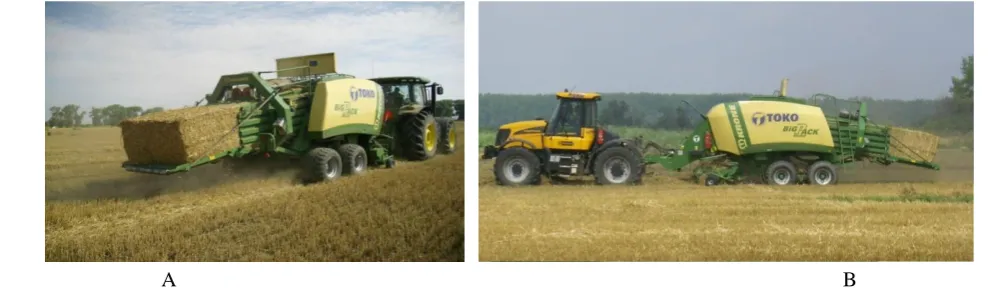
straw large square baler KRONE Big Pack 1290XC
trailed on the field by tractor JOHN DEERE 7200R and
JCB FasTrack 3200 (Figure1).
For the research purposes there was formulated the
scientific hypothesis:
“Handling of the straw bales and their storage in storage
facilities have an effect on the straw moisture content as
well as on the amount of emissions released during
burning process from the boiler.“
From the field the straw bales were transported to the
laboratory storage facilities. During storage the straw
moisture content was continuously measured by two
methods:
1st method was done by moisture content meter AGRI COMPUTER CZ 931(Figure 2) in the bale depth of 200
mm and 400 mm. The apparatus is programmed in order
to determine the moisture content of the 15 different
kinds of grain and seeds. The calibration of the moisture
meter is changing according to changes of the
surrounding air temperature and grain temperature. The
apparatus is equipped by the probe which allows to
determine the straw bale moisture content after inserting
the probe into the bale within the moisture content range
from 12% to 35%. If the moisture content is bellow12%,
A B
the display of the apparatus shows the symbol “LO”,
what means the lowest measured moisture content is 12%.
The same principle is used in case of the highest
measured moisture content, which is 35%. In case of
higher moisture content on the display there can be seen
the symbol “HI”.
Figure 2 Straw moisture content meter AGRI
COMPUTER CZ 931
2nd method was: gravimetric method when straw samples were taken from the bales. It is the most
accurate method of the determining the straw moisture
content based on standard EN 14774-1 “Solid biofuels
Determination of moisture content. Oven dry method. Part 1: &Total moisture. Reference method”.
The moisture content measured by above method is based on the mathematical Equation 1:
Mar=MM2−M3
2−M1∗ 100, % (1)
where:
Mar - moisture content, %
M1 - weight of the empty dish, g
M2 - weight of the full dish before draying, g
M3 - weight of the full dish after draying, g
By using of above method we have determined the
straw moisture content, which was purposefully
moisturized in order to know the effects of straw moisture
content changes on the amount on emissions during the
straws burning in laboratory conditions. For the
measuring of the weight of dishes and straw samples
there were used Sartorius Basic scales (precision ± 0.001
g). The straw was dried in “HS 61 A” drier, which was
equipped with the metal plates and dishes used for straw
samples drying.
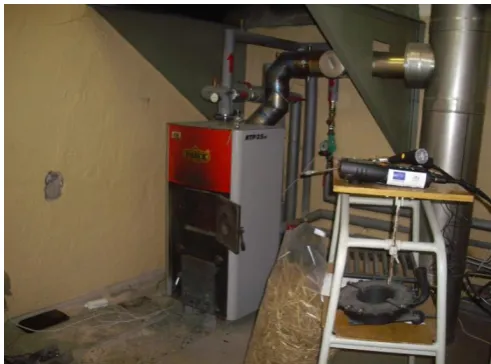
The samples of the straw taken from bales were burnt
in special hot water boiler KTP 256 m (ROJEK
manufacturer) with nominal output 25 kW (Figure 3).
Used boiler has a modern construction and effective
pyrolytic process with common burning out which
enables to burn different types of biomass (such as dry
solid biomass, damp wooden chips and fresh sawdust).
This hot water boiler is made of metal plates and is
completely isolated by thermal insulation. It is a new type
of energetic boiler having a patented design of the
incineration chamber. It is design allow to use the heat
developed by fuel burning. The grate cooled by the water
is part of a boiler attachment.
Figure 3 Hot water boiler KTP 256 m (ROJEK
manufacturer)
Incineration chamber is equipped by large-size fire
feeding doors allowing easy handling with the material
during placing the material into the chamber. Regulation
of the air flow allows to obtain a long time of burning
between each moment of fire feeding. On a front side of a
boiler there is located pressure indicator and thermometer.
The power is regulated manually or by the air input flow
regulator. On a pipe of chimney at the outlet of boiler
exhaust gases there are three measuring places to measure
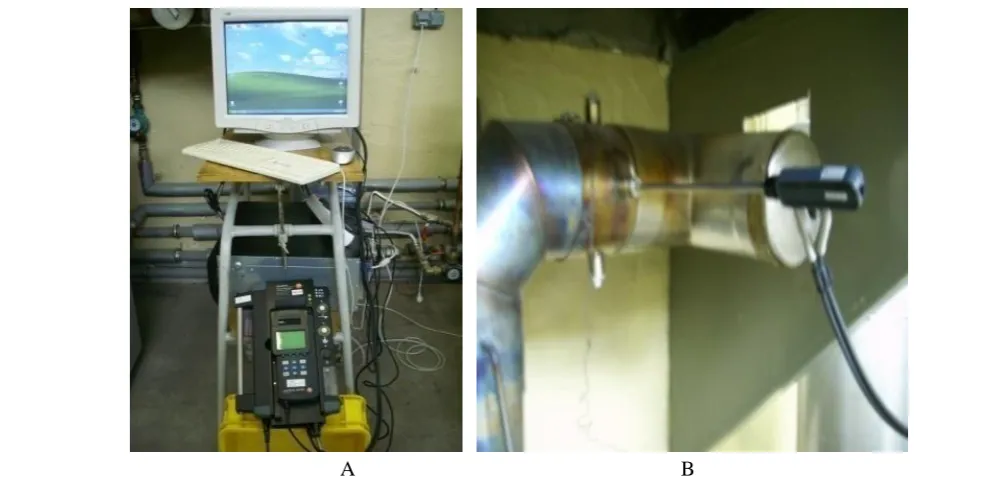
The boiler was directly connected with the portable
emission analyzer TESTO 350 XL (Figure 4) having a
sampling probe with the 500 mm length. During straw
burning the emission analyzer has allowed to measure the
following gases: CO, CO2, NO and NO2. The data were
subsequently statistically analyzed and evaluated.
3 Results
As it was above mentioned the wheat straw was
incinerated in a boiler KTP 25m (ROJEK manufacturer).
For the purpose of the automatic recording of the
obtained data we have used a computer which was
connected with the portable emission analyzer TESTO
350 XL. In order to make a fire in a boiler we have used
the wood and paper. In order to start the measuring of
amount of emissions the boiler should to reach the
temperature 60°C. On a pipe of chimney at the outlet of
boiler exhaust gases there were placed three exhaust
gases measuring points and portable emission analyzer
was connected. After making a fire in the boiler and
complete burning of a wood we have started gradually to
insert the straw with moisture content of 12%, and it was
burnt approximately for 37 min. The temperature of the
exhaust gases during burning was approximately 296°C.
After this stage we have started to burn the straw having
moisture content of 15.9%. During burning it was
necessary to rake up the straw as its higher moisture
content has caused the choking and fuming of the fire
place. It affected the process of emissions measuring. Due
to the permanent opening of the boiler doors the large
amount of the air has come to the area of the fire place.
The process of the moisturized straw burning lasted for
42 min and the temperature of the exhaust gases
temperature decreased compared with dry straw to an
average of 156°C. Uneven metering (dosing) of the straw
during its combustion caused a situation where emission
analyzer due to the low emission values was not able to
measure the values of emissions. The entire combustion
process was influenced by the dose of material and its
discontinuity.
The portable emission analyzer TESTO 350 XL is
calibrated for accurate measuring of emissions. The
evaluation of the data obtained has been based on
emissions limits, which are defined in the Collection of
Laws No. 706/2002. During our experiments we have
measured and evaluated the values of CO, CO2, NO a
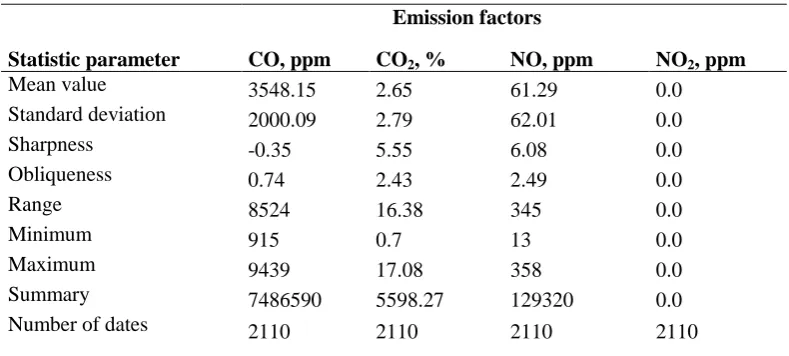
NO2 emissions. The results of experimental measuring
are presented in Tab. 36 a 37, where are shown the basic
A B
statistic parameters of selected data obtained during
experiments. The sum of the measured data shows the
diversity of the monitored files. The first statistic set there
were recorded 1485 data and the second set there it was
2110 data. The values of CO, NO and NO2 emissions are
expressed in internationally recognized units of ppm
(parts per million). (See Table 1 and Table 2)
3.1 Evaluation of the CO2 emissions
Based on the data obtained, it can be stated that values
of carbon monoxide CO emissions detected in exhaust
gases of straw having a 12% moisture content have
reached 3713.17 ppm (maximum 9265 ppm and
minimum 556 ppm. Values of carbon monoxide CO
emissions detected in exhaust gases of straw having a
15.9% moisture content have reached 3548.15 ppm
(maximum 9439 ppm and minimum 915 ppm. If we
compare values of carbon monoxide CO emissions
detected in both cases we can see the differences in mean
value, and maximal and minimal values. The mean value
(the average), we have used to determine the value, which
is close to the reference values of CO exhaust gas
emissions contained in the file. Downward trend was
observed in the second case, in case of straw with a
moisture content of 15.9% which decreased by 165.02
ppm. The maximum and minimum values of these
statistical parameters were increasing, and for the straw
Table 1 Descriptive statistics of a data characterizing the effect of straw moisture content 12% on the amount of emissions during straw burning
Emission factors Statistic parameter
CO, ppm CO2, % NO, ppm NO2, ppm
Mean value 3713.17 4.69 85.68 0.03 Standard deviation 1498.03 3.91 68.72 0.16
Sharpness 1.08 1.97 0.04 74.52
Obliqueness 0.54 1.56 1.02 8.05
Range 8709 18.21 323 1.8
Minimum 556 1.01 9 0
Maximum 9265 19.22 332 1.8
Summary 5491783 6946.5 126723 38.4
Number of dates 1479 1479 1479 1479
Table 2 Descriptive statistics of a data characterizing the effect of straw moisture content 15.9 % on the amount of emissions during straw burning
Emission factors
Statistic parameter CO, ppm CO2, % NO, ppm NO2, ppm
Mean value 3548.15 2.65 61.29 0.0
Standard deviation 2000.09 2.79 62.01 0.0
Sharpness -0.35 5.55 6.08 0.0
Obliqueness 0.74 2.43 2.49 0.0
Range 8524 16.38 345 0.0
Minimum 915 0.7 13 0.0
Maximum 9439 17.08 358 0.0
with moisture content of 15.9% the minimum value was
increased of 359 ppm and a maximum of 174 ppm.
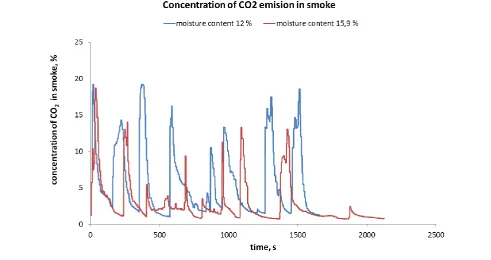
From the graph (Figure 5) it can be seen the
unevenness of the straw burning. From the curves we can
see the occurrence of extremely low and extremely high
levels of carbon dioxide emissions. Just extremely high
readings were recorded due to intermittent straw dosing
and its incomplete combustion. Since dosing material was
not provided by any metering device, but it was dosed
sequentially, this affected the measured emission values.
The emission analyzer has recorded this unevenness. We
suppose that due to these reasons there was observed the
largest air pollution by CO emissions.
3.2 Evaluation of the NO emissions
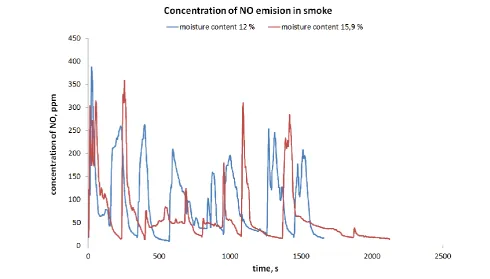
Mean value of the content of emissions of the nitric
oxide NO found in exhaust gases of straw with moisture
content 12% were on average 85.68 ppm when maximum
value was 332 ppm a minimum value was 9 ppm.
Temperature of the exhaust gases was 296°C. When the
straw moisture content was increased at the level 15.9%,
the mean value of the content of emissions of the nitric
oxide NO found in exhaust gases were on average 61.29
ppm, when maximum value was 358 ppm a minimum
value was 13 ppm and temperature of the exhaust gases
was 156°C. Increasing of the straw moisture content by
3.9% has caused the decrease of the mean value of the
content of emissions of the nitric oxide NO found in
exhaust gases by 24.4 ppm. The temperature of the
exhaust gases was decreased by 140°C. Decreasing of the
mean value of the content of emissions of the nitric oxide
NO in exhaust gases related to burning of straw with
higher moisture content was caused by decrease of
burning temperature. Based on results obtained it is
possible to state that creation of the NO emissions during
straw burning is significantly affected by incineration
temperature. Results obtained fully comply with emission
limits defined in the Collection of Laws No. 706/2002.
(See Figure 6)
Figure 5 Comparison of the course of the CO2 emissions in exhaust gases in case of burning of wheat straw having a
3.3 Evaluation of the NO2 emissions
Emissions of the nitrogen dioxide NO2 was measured
only in case of the burning of straw with 12% moisture
content. When there was burnt the straw with 15.9%
moisture content, the values of emissions of the nitrogen
dioxide NO2 was below 0.1 ppm and the sensor of the
emission analyzer was not able to record them. Therefore
we could evaluate statistic data characterizing the
emissions of the nitrogen dioxide NO2 related to the
burning of the straw with 12% moisture content. Mean
value was relatively low – only 0.03 ppm, when
maximum value was 1.8 ppm a minimum value was 0.0
ppm. Standard deviation in this case was 0.16 ppm. The
indicator of the statistical symmetry of the experimental
data (namely, sharpness and obliqueness) was high when
compared with above mentioned gases. They
characterized the concentration of the other values in the
file. In this case, both indicators were positive.
4 Conclusions
Based on the analysis of the burning of wheat straw
with moisture content of 12% and 15.9%, we can
conclude that the operation of straw burning in ROJEK
boiler (rated output of 25 kW) has been largely
influenced by the discontinuity of material metering and
moisture content of the burned straw. When burning the
straw with the moisture content of 12% there was
sufficiently used energy potential of the straw. This led to
the increase of the exhaust gas temperature at the level of
296°C. Conversely, when there was used straw with
moisture content moisture of 15.9%, the exhaust gas
temperature decreased to a value of 156°C. This decrease
can be explained by the fact that part of the energy
produced by straw burning was used to evaporate the
water contained in straw. The energy potential of the
straw as biofuel was not sufficiently used. Based on
results obtained it can be stated that amount of the NOx
emissions is first of all affected by the temperature of the
burning process. Therefore it is very important to secure
the continual metering of the straw during burning
process, as well as using of the straw with moisture
content around 12%.
In case of straw moisture content 12%, the following
average values of the emission factors were recorded – Figure 6 Comparison of the course of the nitric oxide NO emissions in exhaust gases in case of burning of wheat
CO: 3713.17 ppm, CO2: 4.69%, NO: 85.68 ppm, and
NO2: 0.03 ppm.
In case of straw moisture content 15.9%, the
following average values of the emission factors were
recorded – CO: 3548.15 ppm, CO2: 2.65%, NO: 61.29
ppm, and NO2: NA (not available).
Based on the experimental results, we can confirm
that the increased straw moisture content (15.9%) there
were obtained lower values of concentrations of
emissions, but the process of burning was significantly
slower. There was a longer burning of the same amount
of the straw material. It means that the total amount of
emissions released from the combustion of material with
higher moisture content is equal to the emissions
produced during combustion of dry straw. In conclusion
it can be stated that the handling of straw bales and the
method of bales storage affect straw moisture content,
which then affects the quality of combustion in terms of
the amount of energy gained.
Acknowledgements
The research leading to these results has received
funding from the European Community under project no
26220220180: Building Research Centre „AgroBioTech".
The Paper was supported by the projects:
Application of the information technologies to
increase the environmental and ecological sustainability
of the production agrosystem”, project ITMS
26220220014, EU Operational programme RESEARCH
and DEVELOPMENT
Development of International Cooperation for the
Purpose of the Transfer and Implementation of Research
and Development in Educational Programs conducted by
the Operational Program: Education, ITMS code:
26110230085
References
Barkoczi, J., L., Nozdrovicky, and M., MACAK. 2012. Vyuzitie informacnych technologii v procese realizacie systemu technologickych zariadeni pre spracovanie biomasy na energeticke ucely (In slovak). Using of information technologies in the process of realization of the system of technological equipments for processing of biomass for energy purposes, ed. 196. Nitra: Slovak University of Agriculture in Nitra.
EN 14774-1: 2010. European standard: Solid biofuels.Determination of moisture content.Oven dry method.Part 1: Total moisture.Reference method.
EN 14961-1: 2010. European standard: Solid biofuels. Fuel specifications and classes. Part 1:General requirements. Hussein, O. A., L., Nozdrovicky, and M. Macak. 2012. Study of
the opportunities of using of plant biomass for pellets production and evaluation of their properties,ed. 182. Nitra: Slovak University of Agriculture in Nitra, Faculty of Engineering.
MAGA, J. et al. 2008. Komplexny model vyuzitia biomasy na energeticke ucely. (In slovak). Complex mode of using of biomass for energy purposesl, ed. Nitra: Slovak University of Agriculture in Nitra.
Nikolaisen, L., C. Nielsen, M. G. Larsen, V. Nielsen, U. Zielke, J. K. Kristensen, and B. Holm-Christensen. 1998. Straw as energy resource. Straw for Energy Production, Technology - Environment - Economy, 9-12. Available at: