Relative Investigation of Structure of an Intze
Tank by Working Stress Method and Limit State
Method utilizing IS:3370(1965) and IS:
3370(2009)
Ruchi Bagrodia Anubhav Rai
M. Tech Student Assistant Professor Department of Civil Engineering Department of Civil Engineering
Gyan Ganga Group Of Institution, Jabalpur 482003, India Gyan Ganga Group Of Institution, Jabalpur 482003, India
Saurabh Pare
Assistant Professor Department of Civil Engineering
Gyan Ganga Group Of Institution, Jabalpur 482003, India
Abstract
Objectives of the study was to
1) To compare the design of an INTZE TANK done by WSM & LSM in reference to IS 3370 – 1965 and IS 3370 – 2009 (new version).
2) To study which method is more economical and proficient.
For designing, Intze water tank with top and bottom dome having effective depth 7.5 metres of capacity 5,00,000 liters of wat er has been designed .For design, M30 grade concrete and Fe-415 grade steel has been used. The graphs are included to show the comparison of outcomes.
The following outcome has been observed that
a) The cross-sectional area of members remained same for limit state design methods by IS:3370(2009) in limit state of collapse as well in deemed to satisfy criteria. However, the requirement of area of steel increased in IS:3370 (2009) ) in deemed to satisfy design criteria.
b) The cross-sectional area of members as well as reinforcement decreased for limit state design method by IS:3370 (2009) in comparison to working stress design method of both IS : 3370 (1965 ) and IS : 3370 (2009) provisions .
It was found that the provisions of IS:3370(2009) provides economical and more effective design. However, it was also felt th at IS:3370 (2009) should have incorporated direct tensile stress and compressive stress under flexure .
Keywor ds: Working Stress Method, Limit State Method, Intze Water tank, Crackwidth , Limit State of Serviceability, Deemed to Satisfy, Ultimate Limit State
_______________________________________________________________________________________________________
I. INTRO DUC TIO N
Elevated tanks are laid on staging which consists of masonry walls, reinforced towers reinforced columns interconnected with bracing system. The walls are levied to hydrostatic forces acting from inside the tank. The base slab is subjected to the pressure of water as well as the self weight. The staging is levied to the sum of the load of the complete tank along with the weight of the reserved water and also the wind forces depending on the terrain.
A. Limit State Method
Limit state design (LSD), also known as load and resistance factor design (LRFD) assume a circumstance of a structure beyond which it no longer satisfy the relevant design criteria. The situation may infer a degree of loading or other proceedings on the structure, while the criterion infer structural integrity, serviceability of use, durability or other design necessities.
There are two types of limit states: limit state of collapse and limit state of serviceability
2) Limit state of serviceability deals with deflection & cracking of structures under working loads, durability under workable environment during their predictable exposure conditions solidity of structures as a complete, fire resistance etc.
In this design approach, for each material and load, a partial safety factor is selected independently depending on the mater ia l characteristics and load characteristics. In this association, the material strength can be utilized to its utmost value during its workable period and loads can be estimated with probability of occurrence. LSM is commonly used majorly for rcc design because it ensures the consumption of material strength with the less capital investment.
II. LITREATURE REVIEW
In this study, working stress method is used to design an INTZE tank and members of the INTZE tank are designed by limit stat e method. Generally, for a given volume, circular shape is adopted because forces are uniform and lesser compared to other shapes. Lesser forces means, less quantities of construction material required which brings down the construction cost of water tanks. This analysis gives in short, theory, design and analysis of the INTZE type water tank. The main objective of this paper is to give best estimates of the required quantity of concrete and reinforcement for a given volume. Making the design, estimation, costing, analysis of designs and cost comparison of outp ut graphs for various inputs is included in this project. From this paper following conclusion were drawn:
The cost will reduce when bearing capacity of soil increases.
The output is that at 100 kN/m2 SBC, for 10 lack litre capacity, estimate is Rs 26, 41,564; for 20 lack litre capacity, estimate is Rs 69,50,741. Therefore, 2 tanks of 10 lack litre capacity instead of one 20 lack litre capacity tank should be adopted. It was deduced that in between 150 kN/m2 to250 kN/m2 SBC there is not so much variation in price. But from 75 kN/m2
to125 kN/m2 there is a appreciable variation in cost.
It was deduced that in between 5 lacks to 10 lacks capacity there is no so much of price variation, in this region price not so much dependent upon soil bearing capacity. Similarly in between 5 to 10 lack litres, there is not much of price variation with respect to wind speeds.
It was deduced that there is an appreciable variation in cost for 75kN/m2 to 100 kN/m2 SBC, So opt to construct water tank between 150 kN/m2 SBC to 250 kN/m2 SBC.
we analyzed that the price will increase when wind speed increases, so choose to locate the water tank where wind speed is less and SBC is high.
In this paper by performing the analysis of Intze tank, deflection shape due to water pressure t hen stresses, etc. are analysed. By taking out the research with help of the STAAD Pro Software, the following conclusion was deduced:
1) There is an increment in moment when the height of the tank increases.
2) When using rigid joint at the base there is notab le reduction in the base settlement. 3) This Intze tank is simplest form in comparison to the circular tank.
4) We have provided some angle to the staging pattern of water tank because at respected angle the tank works better than that type of straight one.
In this research water tanks are designed by both WSM and LSM.
Circular and square water tank are designed. Detailed analysis and design is carried out. Detailed drawings are made for all the cases. For better understanding the capital implications , cross-sectional area of concrete and steel were calculated. Exact amount of reinforcement required is estimated for each case as per detailed drawings. It was noted that in case of LSM investment needed is less. Obviously circular water tank is more economical as compared to square tank.
The reinforcement quantity needed found higher for a circular water tank design by WSM than that of LSM. The reinforcement quantity found larger for a square water tank design by WSM than that of LSM.
The Circular shaped tank is seen to be more economical than square shaped tank.
The recent inclusion in the LSM of design in IS :3370 Part 2:2009 and IS 456 : 2000 (with allowable crack width of 0.2 mm) in line with foreign codes of practice is seen to results in more rational and econo mical design compared to the conventional WSM. Aim of the study was to:
1) Compare the calculation of water storing structures done by WSM & LSM using IS 3370 – 1965 and IS 3370 – 2009 ( new version ).
2) To find out which method is more cost-effective and efficient. It has been seen that
a) The size of members remained unchanged for WSM by IS:3370(1965) and IS:3370 (2009). However, the requirement of steel increased in IS:3370 (2009) for overhead Intze type and rectangular water tanks as the allowable stresses in s teel were lower. The reinforcement required in square tank was approximatelysimilar in both the cases. However, the change in the clause of requirement of minimum steel decreased the reinforcement required in bottom dome in overhead Intze tank.
b) The size of members remained same for LSM by IS:3370(2009) in limit state of serviceability as well is deemed to fulfil the criteria for all the three tank designs. However, the requirement of steel increased in IS:3370 (2009) in serviceability des ign method as well in deemed to satisfy the criteria for all the three tank designs as the allowable stresses in steel were lower. c) The size of members as well as the requirement of steel decreased for LSM by IS:3370 (2009) in comparison to WSM of both
through the surface zones in IS:3370(2009) proves cost -effective and more effective steel. However, it was also seen that IS:3370 (2009) should have included direct tensile stress and compressive stress under moment and limit state.
For rapid cost estimation of water tanks, this study therefore studies the cost effectiveness in terms of amount of concrete and formwork used for Circular, Square and Rectangular overhead water tanks each of three capacities of 100kl, 150kl, 200kl and lined out reasonable outcome on tank’s shape design effectiveness. Each water tank was designed by LSM and then the crack width was checked by limit state of collapse IS 3370 (2009). The result have been shown in the form of graphs and tables and it has been seen out that Circular-shaped tank consumed less quantity of each material as compared to Square and Rectangular tanks. The amount of formwork needed for circular tank is also less than as compared to square and rectangular tanks thereby proving Circular-shaped tanks a more preferable selection over the rectangular and square Circular-shaped water tanks.
As the capacity increases, the quantity of materials for the structure also in creases. But, a rather imperfect proportionality resulted; i.e., a linear increase in the capacity would not, necessarily lead to a linear increase in any of the materials re quired. The amount of materials needed for the rectangu lar water tank were seen to be more than those required for square tank which
is more than the amount needed for the circular water tank, for different volumes.
It can observe from the graphs that the formwork required for the construction of water tank is minimum for circular shaped tank in comparison to square shaped and rectangular shaped tanks.
the construction material-output for all water tank capacities would be based on the choice of the design method and from the result obtained here points out that the circular shaped tank is the most cost effective among other two shapes opted for stu dy as per IS3370 – 2009 adopting LSM of design.
III. METHO DO LO GY
A. Comparison of IS: 3370-1965 & IS: 3370-2009
The revisions in IS 3370 (2009) comprise a number of chief amendments. Few are stated as follows -
Scope has been clarified further by describing barring of dams, pipes, pipelines, lined structures & damp proofing of basements.
Provision on exposure condition has been incorporated. Regarding method of design LSM or WSM can be adopted.
Provision on durability has been incorporated owing reference to IS 456 inspite of earlier provsion on safeguard against corrosion.
The clause of crack width calculations due to temperature and dampness has been included in limit state design.
Design an Intze water tank of capacity 5,00,000 litres. Adopt M30 grade concrete and Fe 415 grade HYSD bars. The design of tank should confirm to the stresses specified in IS : 456-2000, IS :3370-1965, IS : 3370-2009.
IV. RESULT AND DISC USSIO N
A. Comparative Result of INTZE Type Water Tank
Structural Element Working Stress Method Limit State Design Method IS 3370 – 1965 IS 3370 - 2009 Crack Theory Deemed to Satisfy
TOP DOME
Area of Steel Required 300 mm2 175 mm2 120 mm2 300 mm2
%age Change --- -41.66 % -60% ---
Thickness Required 100 mm 100 mm 100 mm 100 mm
%age Change -- Nil Nil Nil
TOP RING BEAM
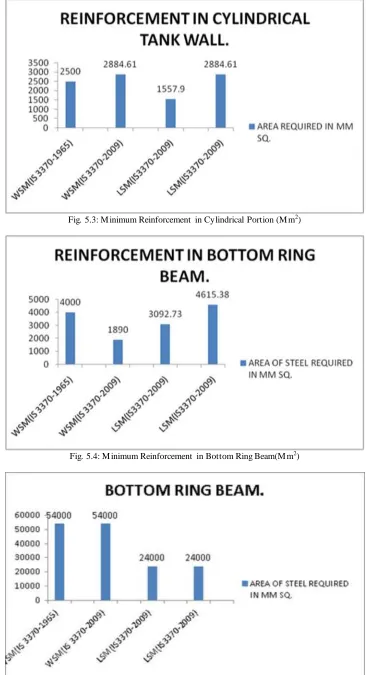
Area of Cross Section 34937.26 mm2 41182.39 mm2 62500 mm2 62500 mm2
%age Change -- +17.87% +78.90% +78.90%
Area of Steel Reqd. 600 mm2 468.38 mm2 252.97 mm2 468.38mm2
%age Change --- -21.93 % -57.83% -21.93 %
CYLINDRICAL TANK WALL
Base Level Thickness 300 mm 300 mm 300 mm 300 mm
%age Change --- --- --- ---
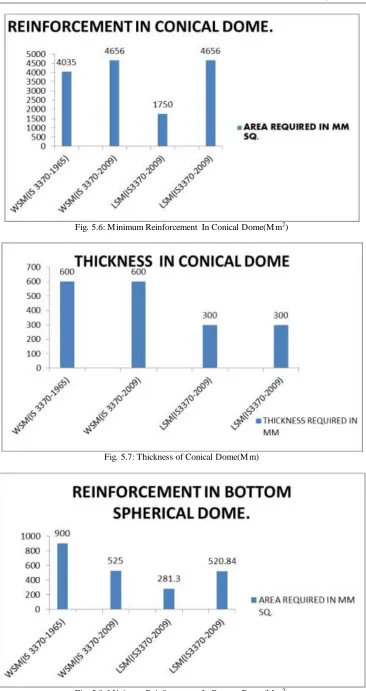
Steel at base 2500 mm2 2884.61 mm2 1557.9 mm2 2884.61 mm2
%age Change --- +15.38% -37.68% +15.38 %
Top Level Thickness 200 mm 200 mm 200 mm 200 mm
%age Change --- --- --- ---
Steel at top 600 mm2 576.92 mm2 311.5911 mm2 576.92mm2
%age Change --- -3.84 % -48.06% -3.84%
BOTTOM RING BEAM
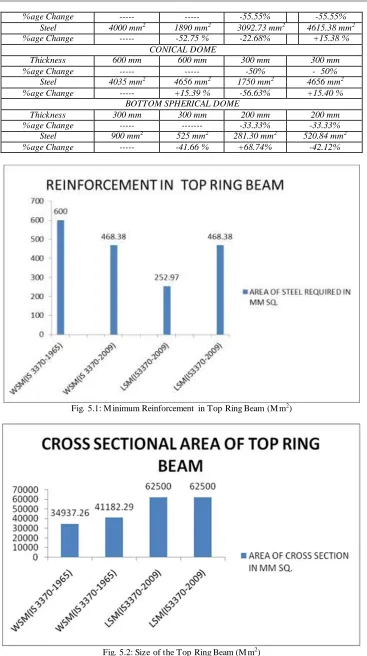
%age Change --- --- -55.55% -55.55%
Steel 4000 mm2 1890 mm2 3092.73 mm2 4615.38 mm2
%age Change --- -52.75 % -22.68% +15.38 %
CONICAL DOME
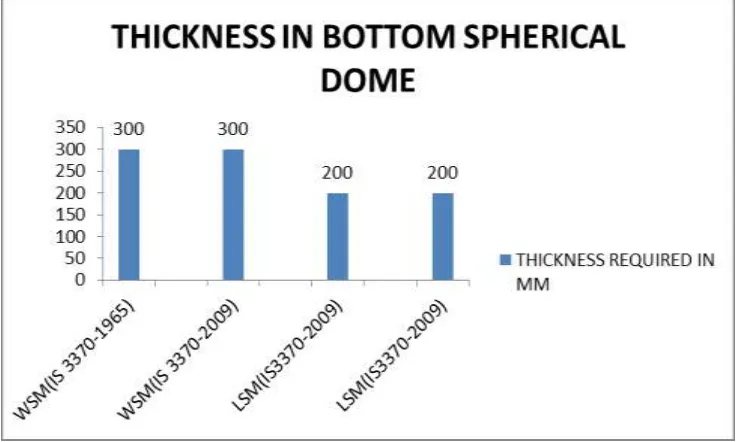
Thickness 600 mm 600 mm 300 mm 300 mm
%age Change --- --- -50% - 50%
Steel 4035 mm2 4656 mm2 1750 mm2 4656 mm2
%age Change --- +15.39 % -56.63% +15.40 %
BOTTOM SPHERICAL DOME
Thickness 300 mm 300 mm 200 mm 200 mm
%age Change --- --- -33.33% -33.33%
Steel 900 mm2 525 mm2 281.30 mm2 520.84 mm2
%age Change --- -41.66 % +68.74% -42.12%
Fig. 5.1: M inimum Reinforcement in Top Ring Beam (M m2)
Fig. 5.3: M inimum Reinforcement in Cylindrical Portion (M m2)
Fig. 5.4: M inimum Reinforcement in Bottom Ring Beam(M m2)
Fig. 5.6: M inimum Reinforcement In Conical Dome(M m2)
Fig. 5.7: Thickness of Conical Dome(M m)
Fig. 5.9: Thickness of Bottom Dome(M m)
V. CO NC LUSIO N
1) The size of members remained same for limit state design methods by IS:3370 (2009) in limit state of collapse as well in deemed to satisfy criteria. However, the requirement of area of steel increased in IS:3370 (2009) in deemed to satisfy crite ria as compared to serviceability design method .
2) The size of members as well as the requirement of steel decreased for limit state design method by IS: 3370 (2009) in comparison to working stress design methods of both IS : 3370 (1965 ) and IS : 3370 (2009) provisions.
A. Final Conclusion
Limit State Method was found to be cheaper and efficient for design of water tanks as the quantity of steel needed is less as compared to working stress methods of both the IS codes i.e IS 3370 (1967) and IS 3370 (2009) and it also included the crack theory.
REFERNC ES
[1] DESIGN, ANALYSIS AND OPT IMIZATION OF INTZE T YPE WATER T ANK FOR DIFFERENT PARAMETERS AS PER INDIAN CODES Bugatha
Adilakshmi1, Paliki Suribabu2, Reddi Ramesh3
[2] Analysis and Design of INTZE T ype Overhead Water Tank under the Hydrostatic Pressure as Per IS: 3370 & IS: 456 -2000 by Using ST AAD Pro Software Issar Kapadia1, Purav Patel2, Nilesh Dholiya3, Nikunj Patel4
[3] Comparative Study of Water T ank Using Limit State Method and Working Stress Method Miss. Neeta K. Meshram1,Dr. P.S.Pajgade2
[4] COMPARAT IVE ST UDY OF DESIGN OF WAT ER T ANKS WIT H REFERENCE T O IS : 3370 BHARAT BHUSHAN JINDAL