Vol. 12, No. 2, 2016, 161-167
ISSN: 2279-087X (P), 2279-0888(online) Published on 15 November 2016
www.researchmathsci.org DOI: 10.22457/apam.v12n2a7
161
Annals of
ADCSS-Labeling for Some Middle Graphs
B.S.Sunoj1 and T.K.Mathew Varkey2 1
Department of Mathematics, Government Polytechnic College, Attingal Kerala 695103, India
Email: [email protected] 2
Department of Mathematics, T.K.M.College of Engineering, Kollam Kerala 691005, India. Email: [email protected]
Received 12 October 2016; accepted 10 November 2016
Abstract. A graph labeling is an assignment of integers to the vertices or edges or both subject to certain conditions. The graph for which every edge label is the absolute difference of the sum of the cubes of the end vertices and the sum of the squares of the end vertices is called adcss labeling. It is also observed that the weights of the edges are found to be multiples of 2. Here we characterize middle graphs of paths, cycles, stars, bistars, centipede graphs, comb graphs for adcss labeling.
Keywords: Graph labeling, sum square graph, square sum graphs, cubic graphs, middle graphs.
AMS Mathematics Subject Classification (2010): 05C72
1. Introduction
All graphs in this paper are finite and undirected. The symbol V(G) and E(G) denotes the vertex set and edge set of a graph G. The graph whose cardinality of the vertex set is called the order of G, denoted by p and the cardinality of the edge set is called the size of the graph G, denoted by q. A graph with p vertices and q edges is called a (p,q)- graph. A graph labeling is an assignment of integers to the vertices or edges. Some basic notations and definitions are taken from [1-7]. Some basic concepts are taken from Frank Harary [3]. We introduced the new concept, an absolute difference of cubic and square sum labeling of a graph in [8]. In [8-15] it is shown that planar grid, web graph, kayak paddle graph, snake graphs, friendship graph, armed crown, fan graph, cycle graphs, wheel graph, 2 tuple graph of some graphs and total graph of some graphs have an adcss labeling. In this paper we investigated ADCSS labeling of some middle graphs.
2. Preliminaries
162
Definition 2. A graph in which every edge associates distinct values with multiples of 2 is called the sum of the cubes of the vertices and the sum of the squares of the vertices. Such a labeling is called an absolute difference of cubic and square sum labeling or an absolute difference css-labeling.
3. Main results
Definition 1. Let V(G) and X(G) denote the vertex set and the edge set of G, respectively. The middle graph M(G) of G whose vertex set is V(G) union X(G) where two vertices are adjacent if and only if
(i) They are adjacent edges of G or
(ii) One is a vertex and other is an edge incident with it.
Theorem 2. The middle graph M(Pn) of a path Pn admits ADCSS - labeling. Proof : Let G = M(Pn) and let v1,v2, . . ., v2n-1 are the vertices of G.
Here |V(G)| = 2n-1 and |E(G)| = 3n-4.
Define a function f : V → {1,2,3,. . ., 2n-1} by f(vi) = i , i = 1,2,…,2n-1.
For the vertex labeling f, the induced edge labeling ∗ is defined as follows ∗ ) = (i+1)2i+i2(i-1), i = 1,2,3, . . ., 2n-2 ∗ ) = (2i+2)2(2i+1) + (2i)2(2i-1) , i = 1,2,3, . . ., n-2.
All edge values of G are distinct, which are multiples of 2.That is the edge values of G are in the form of an increasing order. Hence M(Pn) admits adcss-labeling.
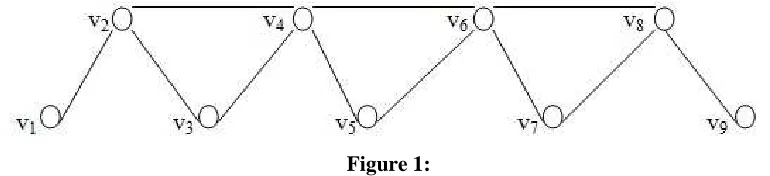
Example 3. The following illustration shows, the middle graph of path P5 admits adcss labeling.
Figure 1:
Theorem 4. The middle graph M(Cn) of a cycle Cn admits ADCSS - labeling. Proof: Let G = M(Cn) and let v1,v2, . . ., v2n are the vertices of G.
Here |V(G)| = 2n and |E(G)| = 3n.
Define a function f : V → {1,2,3, . . ., 2n} by f(vi) = i , i = 1,2, . . ., 2n.
For the vertex labeling f, the induced edge labeling ∗ is defined as follows ∗ ) = (i+1)2i+i2(i-1), i = 1,2,3, . . ., 2n-1 ∗ ) = (2i+2)2(2i+1) + (2i)2(2i-1) , i = 1,2,3, . . ., n-1. ∗ ) = (2n)2(2n-1) +4
163
All edge values of G are distinct, which are multiples of 2.That is the edge values of G are in the form of an increasing order. Hence M(Cn) admits adcss-labeling.
Example 5. The following illustration shows, the middle graph of cycle C3 admits adcss labeling.
Figure 2:
Theorem 6. The middle graph M(K1,n) of star graph K1,n admits ADCSS - labeling. Proof: Let G = M(K1,n) and let v1,v2, . . ., v2n+1 are the vertices of G.
Here |V(G)| = 2n+1 and |E(G)| = 2n +
.
Define a function f : V → {1,2,3, . . ., 2n+1} by f(vi) = i , i = 1,2,. . ., 2n+1.
For the vertex labeling f, the induced edge labeling ∗ is defined as follows ∗ ) = i2(i-1) + (2n+1)2(2n), i = 1,2, . . ., n ∗ ) = (i+n)2(i+n-1) + (i)2(i-1) , i = 1,2, . . .,n ∗ ) = (j)2(j-1) + (i+j)2(i+j-1), j = 1,2,. . ., n-1
i = 1,2,. . .,n-j
All edge values of G are distinct, which are multiples of 2.That is the edge values of G are in the form of an increasing order. Hence M(K1,n) admits adcss-labeling.
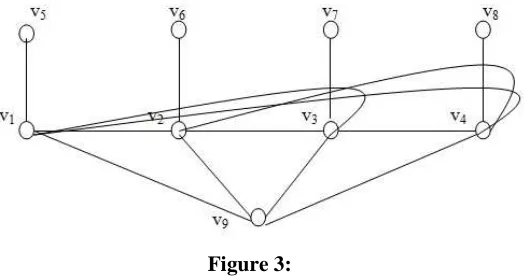
Example 7. The following illustration shows, the middle graph of star K1,4 admits adcss labeling.
164
Definition 8. The graph obtained from K1,n and K1,m by joining their centers with an edge is called a Bistar. It is denoted by B(m,n).
Theorem 9. The middle graph M{B(m,n)} of Bistar B(m,n) admits ADCSS - labeling. Proof: Let G = M{B(m,n)} and let v1,v2, . . ., v2m+2n+3 are the vertices of G.
Here, | V(G)| =2 m+2n+3 and |E(G)| = 2(m+n+1) + + . Define a function f : V → {1,2,3, . . ., 2m+2n+3} by
f(vi) = i , i = 1,2, . . ., 2m+2n+3.
For the vertex labeling f, the induced edge labeling ∗ is defined as follows ∗ ) = (m+n+2+i)2(m+n+1+i), i = 1,2,3, . . ., m+1. ∗ ) = (m+2)2(m+1) + (2m+n+2+i)2(2m+n+1+i) , i = 1,2,3, .. ., n + 1.
∗ ) = (i+1)2(i) + (m+n+2+i)2(m+n+1+i), i = 1,2,.. ., m
∗ ) = (m+2+i)
2
(m+1+i) + 2m+n+3+i)2(2m+n+2+i), i = 1,2, . . ., n
∗ ) = (m+n+3+j)2(m+n+2+j) +
(m+n+3+j+i)2(m+n+2+j+i),
j = 0,1,2, …, m-1 i = 1,2,3,…., m-j
∗ ) = (2m+n+3+j)2(2m+n+2+j) +
(2m+n+3+j+i)2(2m+n+2+j+i), j = 0,1,2,…,n-1 i = 1,2,3,…,n-j
All edge values of G are distinct, which are multiples of 2.That is the edge values of G are in the form of an increasing order. Hence M{B(m,n)} admits adcss-labeling.
Definition 10. The (n,2)-centipede tree, Cn,2, is the graph with
V(Cn,2) = { v1,v2,…,v3n}, and E(Cn,2) = {v3k-1 v3k-2, v3k-1 v3k , k = 1,2,…,n} {v3k-1 v3k+2 , k = 1,2,…,n-1}.
Theorem 11. The middle graph M{Cn,2} of (n,2) –centipede tree Cn,2 admits ADCSS - labeling.
Proof: Let G = M{Cn,2} and let v1,v2,…,v6n-1 are the vertices of G. Here |V(G)| = 6n-1 and |E(G)| = 12n-8.
Define a function f : V → {1,2,3,…, 6n-1} by f(vi) = i , i = 1,2,…, 6n-1.
For the vertex labeling f, the induced edge labeling ∗ is defined as follows ∗ ) = (i+1)2(i) + i2(i-1), i = 1,2,3,…,2n-2 ∗ ) = (2i-1)2(2i-2) + (2n-1+i)2(2n-2+i) , i = 1,2,3,…,n.
165
∗ ) = (4n-1+i)2(4n-2+i) + (5n-1+i)2(5n-2+i), i = 1,2,…, n ∗ ) = (2n-1+i)2(2n-2+i) + (4n-1+i)2(4n-2+i),
i = 1,2,…., n ∗ ) = (2i)2(2i-1) + (2n-1+i)2(2n-2+i),
i = 1,2,…,n-1 ∗ ) = (2i)2(2i-1) + (4n-1+i)2(4n-2+i),
i = 1,2,…,n-1 ∗ ) = (2i)2(2i-1) + (2n+i)2(2n-1+i),
i = 1,2,…,n-1 ∗ ) = (2i)2(2i-1) + (4n+i)2(4n-1+i),
i = 1,2,…,n-1 ∗ ) = (2i)2(2i-1) + (2i+2)2(2i+1), i = 1,2,…,n-2
All edge values of G are distinct, which are multiples of 2.That is the edge values of G are in the form of an increasing order. Hence M{Cn,2} admits adcss-labeling.
Definition 12. A graph obtained by adding a single pendant edge to each vertex of a path Pn is called a comb graph and is denoted by Comb(Pn)
Theorem 13. The middle graph M{ Comb(Pn)} of comb graph Comb(Pn) admits ADCSS - labeling.
Proof: Let G = M{ Comb(Pn)} and let v1,v2,…,v4n-1 are the vertices of G. Here |V(G)| = 4n-1 and |E(G)| = 7n-6.
Define a function f : V → {1,2,3,…, 4n-1} by f(vi) = i , i = 1,2, …, 4n-1.
For the vertex labeling f, the induced edge labeling ∗ is defined as follows ∗ ) = (i+1)2(i) + i2(i-1), i = 1,2,3,…,2n-2 ∗ ) = (2i-1)2(2i-2) + (2n-1+i)2(2n-2+i) ,
i = 1,2,3,…, n. ∗ ) = (2n-1+i)2(2n-2+i) + (3n-1+i)2(3n-2+i),
i = 1,2,…, n ∗ ) = (2i)2(2i-1) + (2n-1+i)2(2n-2+i),
i = 1,2,…, n-1 ∗ ) = (2i)2(2i-1) + (2n+i)2(2n-1+i),
i = 1,2,…, n-1 ∗ ) = (2i)2(2i-1) + (2n+i)2(2n-1+i),
i = 1,2,….,n-2.
All edge values of G are distinct, which are multiples of 2.That is the edge values of G are in the form of an increasing order. Hence M{ Comb(Pn)} admits adcss-labeling.
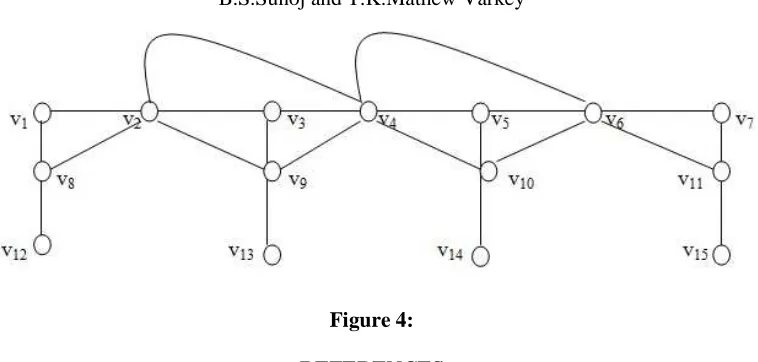
166 Figure 4:
REFERENCES
1. D.Michalak, On middle and total graphs with coarseness number equal 1, Springer Verlag Graph Theory, Lagow (1981) proceedings. Berlin Heidelberg, New York, Tokyo, pp. 139-150.
2. F.Harary, Graph Theory, Addison-Wesley,Reading, Mass, (1972)
3. Joseph A Gallian, A dynamic survey of graph labeling, The Electronic Journal of Combinatorics, (2015), #DS6
4. T.K.Mathew Varkey, Some Graph Theoretic Generations Associated with Graph Labeling, PhD Thesis, University of Kerala, 2000.
5. K.Thirusangu, P.P. Ulaganathan and P.Vijaya Kumar, Some cordial labeling of duplicate graph of ladder graph, Annals of Pure and Applied Mathematics, 8(2) (2014) 43-50.
6. K.Sutha, K.Thirusangu and S.Bala, Some graph labelings on middle graph of extended duplicate graph of a path, Annals of Pure and Applied Mathematics, 8(2) (2014) 169-174.
7. S.Philomena and K.Thirusangu, Square and cube difference labeling of cycle cactus, special tree and a new key graphs, Annals of Pure and Applied Mathematics, 8(2) (2014) 115-121.
8. T.K.Mathew Varkey and B.S.Sunoj, A note on absolute difference of cubic and square sum labeling of a class of trees, International Journal of Scientific Engineering and Applied Science, 2(8) (2016) 293-296.
9. T.K.Mathew Varkey and B.S.Sunoj, An absolute difference of cubic and square sum labeling of splitting graphs, International Journal of Computer & Mathematical Sciences, 5(8) (2016) 16-18.
10. T.K.Mathew Varkey and B.S.Sunoj, ADCSS labeling of cycle related graphs, International Journal of Scientific Research & Education, 4(8) (2016) 5702-5705. 11. T.K.Mathew Varkey and B.S.Sunoj, An absolute difference of cubic and square sum
labeling of certain class of graphs, International Journal of Mathematics Trends & Technology, 36(1) (2016) 77-79.
167
13. T.K.Mathew Varkey and B.S.Sunoj, ADCSS of product related graphs, International Journal of Mathematics and its Applications, 4(2B) (2016) 145-149.
14. T.K.Mathew Varkey and B.S.Sunoj, ADCSS –labeling of 2-tuple graphs of some graphs, IOSR Journal of Mathematics, 12(5) V-5(2016) 12-15.