Volume 11 Issue 2 Article 10
12-2013
Flawed Forensics and the Death Penalty: Junk Science and
Flawed Forensics and the Death Penalty: Junk Science and
Potentially Wrongful Executions
Potentially Wrongful Executions
Jessica Dwyer-Moss
Follow this and additional works at: https://digitalcommons.law.seattleu.edu/sjsj
Part of the Criminal Law Commons, and the Criminal Procedure Commons
Recommended Citation Recommended Citation
Dwyer-Moss, Jessica (2013) "Flawed Forensics and the Death Penalty: Junk Science and Potentially Wrongful Executions," Seattle Journal for Social Justice: Vol. 11 : Iss. 2 , Article 10.
Available at: https://digitalcommons.law.seattleu.edu/sjsj/vol11/iss2/10
Flawed Forensics and the Death Penalty: Junk
Science and Potentially Wrongful Executions
Jessica Dwyer-Moss
*In April 2012, the Washington Post ran a story announcing that the
Department of Justice (DOJ) knew that flawed forensic science had potentially led to the convictions of innocent people and for years did nothing to either investigate defendants’ possible innocence or to inform the defendants in question that the evidence used to convict them had been
severely undermined.1 A nine-year Federal Bureau of Investigation (FBI)
review of suspect cases involving hair comparisons concluded in 2004; however, the DOJ never told the prisoners whose cases showed anomalies that the evidence no longer demonstrated their guilt.2 The scandal sparked
public outcry and an increased emphasis on the fallibility of commonly accepted forensic techniques. Eventually the DOJ agreed to review thousands of cases involving microscopic hair analysis, some dating back as
far as 1985.3 This number is staggering—not dozens, not hundreds, but
thousands of people may have been convicted on the basis of flawed
* Jessica Dwyer-Moss is a 2013 JD candidate at Seattle University School of Law. She graduated from the University of Maryland in 2010 with BAs in both Government and Politics and History. She would like to extend warm thanks to Professor Paul Giannelli for his invaluable assistance locating a source and to Mr. Matthew Barr for his incredible support and patience.
1 Spencer S. Hsu, Convicted Defendants Left Uninformed of Forensic Flaws Found by
Justice Dept., WASH. POST, Apr. 16, 2012, http://www.washingtonpost.com/local/ crime/convicted-defendants-left-uninformed-of-forensic-flaws-found-by-justice-dept/ 2012/04/16/gIQAWTcgMT_story.html.
2 Id.
3 Spencer S. Hsu, Justice Dept., FBI to Review Use of Forensic Evidence in Thousands
microscopic hair analysis. And this is just one of many widely used forensic techniques. One must question how this is possible.
The term “forensic science” is something of a misnomer. In many cases, it is little more than guesswork. Precious little forensic science is supported by scientific data.4 Ballistics, fingerprints, shoe prints, teeth indentations—
none of these widely accepted forensic methodologies have been
demonstrated to be scientifically dependable.5 Despite their suspect
reliability, these and other forensic technologies are often used as evidence in criminal cases. How can this be? The implications are startling, particularly in murder cases. If our trust in forensics is misplaced, and convictions are overturned as a result of this FBI review, what does this mean for defendants in capital cases?
The scandal at the DOJ comes at a time when the nation is grappling more than ever before with the realities of the death penalty. In September 2011, about six months before the DOJ story broke, the state of Georgia executed a man named Troy Davis. His many supporters—including hundreds of thousands of people who signed petitions on his behalf, a former director of the FBI, Pope Benedict XVI, and former president Jimmy Carter—urged Georgia to reconsider Davis’s sentence, arguing that there
was too much doubt about his guilt.6 Davis was convicted largely on the
basis of eyewitness testimony,7 but over the course of the twenty years
between his trial and his execution, seven of the nine witnesses who
4 See, e.g., David L. Faigman, Anecdotal Forensics, Phrenology, and Other Abject
Lessons from the History of Science, 59 HASTINGS L.J. 979, 998–99 (2008). 5 Id. at 992.
6 Elizabeth Flock, Troy Davis Execution Sparks Anti-Death Penalty Backlash, Protests, WASH. POST, Sept. 22, 2011, http://www.washingtonpost.com/national/troy-davis-execution-sparks-anti-death-penalty-backlash-protests/2011/09/22/gIQAQawOoK_ story.html.
testified against him had recanted their testimony.8 In sworn affidavits,
witnesses wrote that they had felt pressured by police into implicating Davis or, in some cases, had not actually read their original statements before signing them.9
Despite the great uncertainty surrounding Davis’s guilt, the Georgia State
Board of Pardons and Parole denied Davis clemency,10 and the US Supreme
Court denied a last-minute stay of execution.11 Davis’s death is a seminal
moment in modern discussions of capital punishment. As President Carter said shortly after Davis’s death, “if one of our fellow citizens can be executed with so much doubt surrounding his guilt, then the death penalty system in our country is unjust and outdated.”12
Davis’s story, while not the topic of this article, is important to keep in mind. Any discussion of the death penalty would be incomplete without acknowledging the significance of his case to current national discourse on the topic. His death has mobilized death penalty abolitionists and sparked a difficult examination of the state of capital punishment today. Davis’s death forces us to confront an inescapable question: Is it possible that innocent people have been executed for crimes they did not commit?
8 Andy Coghlan, Troy Davis Execution Highlights Witness Unreliability, NEWSCIENTIST (Sept. 22, 2011), http://www.newscientist.com/article/dn20956-troy-davis-execution-highlights-witness-unreliability.html.
9 SeeUSA: ‘Where is the Justice for Me?’: The Case of Troy Davis, Facing Execution
in Georgia, AMNESTY INT’L (Feb. 1, 2007), http://www.amnestyusa.org/research/
reports/usa-%E2%80%98where-is-the-justice-for-me-the-case-of-troy-davis-facing-execution-in-georgia?page=show.
10 Kim Severson, Georgia Pardons Board Denies Clemency for Death Row Inmate, N.Y. TIMES, Sept. 20, 2011, http://www.nytimes.com/2011/09/21/us/troy-davis-is-denied-clemency-in-georgia.html?_r=2&ref=us.
11 Flock, supra note 6.
12 Elizabeth Flock, Cameron Todd Willingham, Others on Death Row Remembered as
The answer, unfortunately, is yes. Since 1973, over 140 defendants sentenced to death either had their convictions overturned or were granted
full pardons on the basis of new evidence.13 DNA evidence played a
substantial role in eighteen of those cases.14 While no person executed
under modern death penalty procedures15 has been posthumously
exonerated,16 several recent cases demonstrate, at the very least, a strong
possibility that a number of innocent men have been put to death for crimes they did not commit.17 But not all of those cases were built upon a shaky
foundation of eyewitness testimony, evidence that has been repeatedly
13 The Innocence List, D
EATH PENALTY INFO.CTR., http://www.deathpenaltyinfo.org/ innocence-list-those-freed-death-row (last visited Feb. 10, 2013).
14 Id. DNA evidence is only available in a small portion of crimes, which explains why the number of DNA-based exonerations is so low. See Myrna S. Raeder, Post-Conviction Claims of Innocence, 24 CRIM.JUST. 3 (2009), available at http://www.americanbar.org/ content/dam/aba/publishing/criminal_justice_section_newsletter/crimjust_cjmag_24_3_ raeder.authcheckdam.pdf.
15 I use “modern death penalty procedures” to refer to procedures that were instituted as a result of the reinstatement of the death penalty following Furman v. Georgia, 408 U.S. 238 (1972). A brief history of the modern death penalty follows shortly.
16 There are, however, cases of posthumous pardons. In 2011, the governor of Colorado pardoned Joe Arridy, who was executed in 1939. See Press Release, Governor Bill Ritter, Jr., Governor Ritter Grants Posthumous Pardon in Case Dating Back to 1930s (Jan. 7, 2011), available at http://www.deathpenaltyinfo.org/documents/ArridyPardon.pdf; see also Colorado Governor Grants Unconditional Pardon Based on Innocence to Inmate Who Was Executed, DEATH PENALTY INFO. CTR., http://www.deathpenaltyinfo.org/ colorado-governor-grants-unconditional-pardon-based-innocence-inmate-who-was-executed (last visited Oct. 12, 2012); see also Executed but Possibly Innocent, DEATH
PENALTY INFO. CTR, http://www.deathpenaltyinfo.org/executed-possibly-innocent (last visited Feb. 12, 2013) (naming, in addition to Joe Arridy, Thomas Griffin, Meeks Griffin, and Lena Baker as executed individuals who were formally pardoned). All of these cases, however, involve crimes committed before the imposition of modern death penalty procedures in 1976. Id.
17 Eleven, including Troy Davis. See Executed but Possibly Innocent,D
EATH PENALTY
proven to be unreliable.18 Some men19 with credible claims of innocence
were convicted and executed on the basis of forensic science.20
This article examines several of these cases and explores the strengths and weaknesses of various forensic techniques. Its scope is admittedly limited; an in-depth analysis of all defendants with credible claims of innocence executed on the basis of questionable forensic evidence (ranging from fingerprints to ballistics analysis, from fiber comparisons to shoe and tire tracks)21 is something better suited for a multi-volume treatise. Instead,
I examine two deeply flawed areas of forensic science—arson investigation and hair analysis—in comparison to DNA profiling, and then consider a
18 See, e.g.,Manson v. Brathwaite,432 U.S. 98, 112 (1977). “Usually the witness must testify about an encounter with a total stranger under circumstances of emergency or emotional stress. The witnesses’ recollection of the stranger can be distorted easily by the circumstances or by later actions of the police.” Id.; U.S. v. Wade, 388 U.S. 218, 228 (1967).
The vagaries of eyewitness identification are well-known; the annals of criminal law are rife with instances of mistaken identification. Mr. Justice Frankfurter once said: ‘What is the worth of identification testimony even when uncontradicted? The identification of strangers is proverbially untrustworthy. The hazards of such testimony are established by a formidable number of instances in the records of English and American trials. These instances are recent-not due to the brutalities of ancient criminal procedure.’
Id. (quoting Felix Frankenfurter, The Case of Sacco and Vanzetti, ATLANTIC, Mar. 1927, available at http://www.theatlantic.com/magazine/archive/1927/03/the-case-of-sacco-and-vanzetti/306625/)
19 Women are statistically very unlikely to receive the death penalty. While women constitute 10 percent of murder arrestees, they account for just 2.1 percent of death sentences imposed, and 0.9 percent of persons actually executed in the modern era. Victor Streib, Death Penalty for Female Offenders, January 1, 1973, through December 31, 2011, DEATH PENALTY INFO. CTR. 3 (2012), http://www.deathpenaltyinfo.org/ documents/FemDeathDec2011.pdf. It is certainly possible that a female defendant was executed on the basis of flawed forensic science, but my research at this point has not yielded such an example.
20 Seeinfra Section III. 21 See N
AT’L RESEARCH COUNCIL,STRENGTHENING FORENSIC SCIENCE IN THE UNITED
defendant convicted on the basis of such evidence who maintained a credible claim of innocence until his execution.
The first section explores some necessary background information regarding forensic science. I briefly examine the modern state of forensic science, a field riddled with documented inconsistencies and a troubling lack of national standards or certifications. Next, is a brief synopsis of the
Frye and Daubert standards for expert witness testimony, which are the
primary means of introducing novel scientific evidence into the courtroom.22
The second section focuses entirely on the death penalty, providing a brief overview of capital punishment as a modern institution. Starting with
Furman v. Georgia,23 the landmark Supreme Court case that temporarily
abolished capital punishment and ushered in a new era of death penalty procedures,24 I explain the protections granted to capital defendants and
how those protections have changed over time.
The third section discusses actual cases of potentially wrongful executions. Specifically, the section examines two deeply flawed forensic techniques: arson investigation and microscopic hair analysis. I explore the cases of Cameron Todd Willingham and Claude Jones, each of whom were convicted on the basis of questionable forensic evidence and maintained credible claims of innocence until they were executed. Next, I compare arson investigation and microscopic hair analysis to DNA profiling, exploring DNA profiling’s reliability and shortcomings.
The final substantive section offers recommendations for a complete overhaul of current forensic techniques. I argue for regulation of forensic investigators and laboratories, increased education for attorneys and judges,
22See A. Lustre, Post-Daubert Standards for Admissibility in State Courts, 90 A.L.R. 5th (2007).
and abolition of the death penalty.
I.FORENSIC SCIENCE—MODERN JUNK?
The field of forensic science is plagued with problems. Some techniques, like DNA profiling, are scientifically reliable when performed correctly.25
Experts testifying about DNA evidence during trials give “statistical statements adequately supported by data.”26 DNA profiling, though, stands
in stark contrast to other widely used forensic methodologies. “A large number of experts—in areas such as latent fingerprints, firearms identification, handwriting, bitemarks, and many others . . . have no such sound scientific footings.”27 Indeed, as the National Academy of Sciences
concluded in a 2009 report, “[w]ith the exception of nuclear DNA analysis, . . . no forensic method has been rigorously shown to have the capacity to consistently, and with a high degree of certainty, demonstrate a connection between evidence and a specific individual or source.”28
Unsubstantiated pseudo-scientific evidence has a lengthy history of admission in US courts, and courts have been slow to recognize and correct their decisions about the admissibility of novel forensic techniques. After thirty years of acceptance in courts, scientists demonstrated that the paraffin test for gunpowder residue was unreliable.29 Pioneered in the 1930s, the test
purportedly analyzed trace substances on a suspect’s hands to determine if he or she had recently fired a gun.30 Eventually, evidence “demonstrate[ed]
25 See, e.g.,N
AT’L RESEARCH COUNCIL,STRENGTHENING, supra note 21, at 130. “DNA typing is now universally recognized as the standard against which many other forensic individualization techniques are judged. DNA enjoys this preeminent position because of its reliability and the fact that, absent fraud or an error in labeling or handling, the probabilities of a false positive are quantifiable and often miniscule.” Id.
26 Faigman, supra note 4, at 979. 27 Id.
28 N
AT’L RESEARCH COUNCIL,STRENGTHENING, supra note 21, at 7.
29 Andre A. Moenssens, Admissibility of Scientific Evidence—An Alternative to the Frye
that the test results were not only nonspecific for gunpowder residues, but that the likelihood that an accurate conclusion could be drawn from the test was less than fifty percent.”31
More recently, in 2005, the FBI abandoned compositional analysis of bullet lead32 as a scientific method33 after the National Academy of Sciences
concluded that expert witnesses often overstated the strength of the
evidence.34 The National Research Commission cautioned that this
technology, which had allowed FBI agents to test bullet fragments too small or damaged for a traditional ballistics analysis for elemental similarities,
could be unreliable.35 The commission concluded that “[v]ariations among
and within lead bullet manufacturers make any modeling of the general manufacturing process unreliable and potentially misleading in CABL
comparisons.”36 Some defendants convicted on the basis of comparative
lead bullet analysis have since had their convictions overturned.37 The
downfall of bullet lead comparison suggests a troubling practice. In the words of Clifford Spiegelman, who served on the National Academy of Sciences panel that authored a highly critical report on comparative bullet analysis, the “FBI or other prosecution scientists are simply doing what it
31 Id. at554.
32 See William C. Thompson, Analyzing the Relevance and Admissibility of Bullet-Lead
Evidence: Did the NRC Report Miss the Target?,46 JURIMETRICS J. 65 (2005).
33 FBI Laboratory Announces Discontinuation of Bullet Lead Examinations, FBI (Sept. 1, 2005), http://www.fbi.gov/news/pressrel/press-releases/fbi-laboratory-announces-discontinuation-of-bullet-lead-examinations.
34 See N
AT’L RESEARCH COUNCIL, REPORT IN BRIEF,FORENSIC ANALYSIS:WEIGHING
BULLET LEAD EVIDENCE (2004), available at http://dels-old.nas.edu/dels/rptbriefs/ bullet_lead_final.pdf.
35 N
AT’L RESEARCH COUNCIL, FORENSIC ANALYSIS: WEIGHING BULLET LEAD
EVIDENCE 112 (2004), available at http://www.nap.edu/openbook.php?record_id= 10924&page=R1.
36 Id.
37 John Solomon, A Murder Conviction Torn Apart by a Bullet, W
takes to ‘get their man.’”38
Modern forensic science is in a sorry state. The 2009 report by the National Academy of Sciences sharply criticized common forensic practices. The report recognized that “great disparities” exist among forensic science laboratories across the country.39 Those disparities extend
to “funding, access to analytical instrumentation, the availability of skilled and well-trained personnel, certification, accreditation, and oversight.”40
Most jurisdictions do not require forensic technicians to be certified or
crime laboratories to be accredited.41 The National Academy of Sciences
cautioned that “[t]hese shortcomings obviously pose a continuing and serious threat to the quality and credibility of forensic science practice.”42
But even if all crime laboratories had to meet rigorous accreditation standards and every forensic technician was required to hold a graduate degree in the sciences, forensic science would still rest upon inadequate scientific foundations. “The simple reality is that the interpretation of forensic evidence is not always based on scientific studies to determine its validity. . . . [T]here is a notable dearth of peer-reviewed, published studies establishing the scientific bases and validity of many forensic methods.”43
In short, a significant number of widely practiced forensic techniques have very little demonstrated scientific merit.44
It is impossible to ignore the significant risk of erroneous convictions when DNA evidence has demonstrated that many inmates were actually
38 Id.
39 N
AT’L RESEARCH COUNCIL,STRENGTHENING, supra note 21, at 5. 40 Id.
41 Id. at 199. 42 Id. at 6. 43 Id. at 8.
innocent of the crimes for which they were convicted.45 According to the
National Academy of Sciences, “[t]he number of exonerations resulting from the analysis of DNA has grown across the country in recent years, uncovering a disturbing number of wrongful convictions—some for capital crimes—and exposing serious limitations in some of the forensic science
approaches commonly used in the United States.”46
Even widely accepted, run-of-the-mill forensic techniques have been called into question. Fingerprints, for instance, have long been accepted in US courts.47 But fingerprints have never been scientifically proven to be
unique.48 Fingerprint experts “use no probability models and have no
probability data to use.”49 Instead, they rely on “intuition and assumptions
that have not been tested rigorously.”50
What forensic evidence, then, is reliable? DNA profiling is quantitative rather than qualitative—analysts are able to demonstrate the probability that
two samples are from the same person.51 This makes DNA evidence unique
45 Facts on Post-Conviction DNA Exonerations, I
NNOCENCE PROJECT, http://www.innocenceproject.org/Content/Facts_on_PostConviction_DNA_
Exonerations.php (last visited Feb. 8, 2013). Since 1989, there have been 302 post-conviction DNA exonerations in the United States. Id.
46 N
AT’L RESEARCH COUNCIL,STRENGTHENING, supra note 21, at 42.
47 See, e.g., People v. Jennings, 252 Ill. 534, 546 (1911). “While the courts of this country do not appear to have had occasion to pass on the question, standard authorities on scientific subjects discuss the use of finger prints as a system of identification, concluding that experience has shown it to be reliable.” Id.
48 Michael J. Saks, Merlin and Solomon: Lessons From the Law’s Formative Encounters
with Forensic Identification Science,46 HASTINGS L.J. 1069, 1105–06 (1998). 49 Id.
50 Id. at 1106. See also N
AT’L RESEARCH COUNCIL,STRENGTHENING, supra note 21, at 139 (explaining that “assessment of latent prints from crime scenes is based largely on human interpretation,” and that the outcome of a print analysis “is not necessarily repeatable from examiner to examiner”).
51 See N
in the forensic field. Fingerprint experts, for instance, do not testify that there is a one in three-hundred-thousand chance that someone other than the suspect left a particular fingerprint.52 In contrast, DNA experts can state the
probability that two samples were left by two different people.53 Without
statistical data to support assertions, forensic science is little more than guesswork—many techniques amount to little more than a side-by-side visual comparison. It is scientifically meaningless, for example, to say that two hairs are a microscopic match when no study has ever been conducted to demonstrate how often certain hair characteristics occur in the general
population.54 However, when it comes to DNA evidence, numerous studies
demonstrate the uniqueness of an individual’s DNA in a given population.55
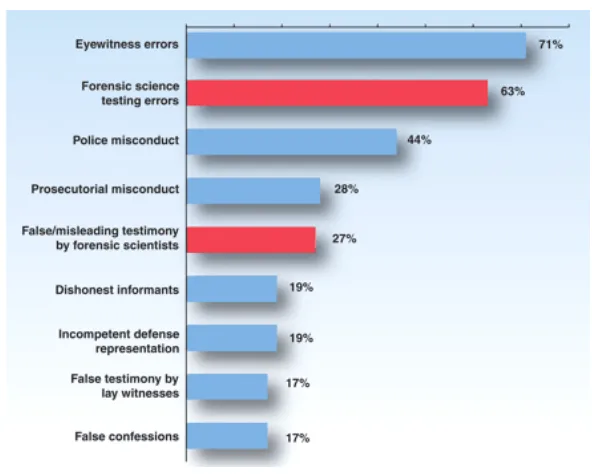
Inaccurate forensic expert testimony has far-reaching and potentially lethal ramifications. A 2005 study concluded that testimony by forensics experts was second only to eyewitness testimony in causing wrongful convictions.56 Erroneous forensic science was a factor in 63 percent of cases
in which a defendant was convicted and then later exonerated on the basis of DNA evidence.57
false positives; standard laboratory procedures subject to proficiency testing; and standards for analysis, interpretation, and reporting of results).
52 Id. at 139–40. “[P]opulation statistics for fingerprints have not been developed, and friction ridge analysis relies on subjective judgments by the examiner. Little research has been directed toward developing population statistic. . . .” Id.
53 See Thomas M. Fleming, Annotation, Admissibility of DNA Identification Evidence, 84 A.L.R. 4th 313 (1991). “DNA testing process relies on principles of statistics and population genetics to give statistical significance to DNA match, by indicating statistical frequency with which such matches might occur in population. . . .” Id.
54 N
AT’L RESEARCH COUNCIL,STRENGTHENING, supra note 21, at 157–60. 55 Id. at 40.
56 Michael J. Saks & Jonathan J. Koehler, The Coming Paradigm Shift in Forensic
Table 158
Defendants have a constitutional right to cross-examine the lab technicians who perform forensic analysis in their trials.59 According to
Sixth Amendment jurisprudence, technicians must be available for cross-examination because certificates or documents demonstrating positive
matches function as testimony.60 As the Supreme Court said in
Melendez-Diaz v. Massachusetts, “[a]bsent a showing that the analysts were unavailable to testify at trial and that petitioner had a prior opportunity to cross-examine them, petitioner was entitled to ‘be confronted with’ the
58 Id. at 892. Numbers exceed 100 percent because more than one factor was found in many cases. Id.
analysts at trial.”61 But what scientific testimony can be believed? Clearly
not all forensic methods are scientifically reliable. What standards must scientific evidence meet in order to be admissible in court?
Courts have spoken to these issues in two famous cases—Frye v. United
States62 and Daubert v. Merrell Dow Pharmaceuticals, Inc.63 While
Daubert would seem to conflict with Frye, it is only binding in federal courts; states are free to use whichever test they prefer, and Daubert has not been universally adopted. A sizeable minority of states still use the Frye
standard when determining the admissibility of scientific evidence and
accompanying expert witness testimony.64 Therefore, a discussion of both
standards is essential to understand both how admissibility rules function and how they differ on a national scale.65
A. The Frye Standard
In 1923, the Court of Appeals for the District of Columbia held that the results of a crude lie detector test were inadmissible.66 The court stated that,
in the field of scientific evidence, “the thing from which the deduction is
61 While this case revolved around drugs rather than a capital crime, the requirement that defendants be able to confront lab technicians certainly extends to murder trials. The precedent is both broad and important. “[T]he decision will have broader implications because the results of crime laboratory analysis are required whenever evidence such as a breath, hair, fiber, ballistic, soil, glass, paint, chemical, fingerprint, blood, DNA, or semen is crucial to support the prosecution’s case.” Bruce L. Ottley, Beyond the Crime Laboratory: The Admissibility of Unconfirmed Forensic Evidence in Arson Cases, 36 NEW ENG.J. ON CRIM.&CIV.CONFINEMENT 263, 264 (2010).
62 Frye v. United States, 293 F. 1013 (D.C. Cir. 1923).
63 Daubert v. Merrell Dow Pharmaceuticals, Inc., 509 U.S. 579 (1993). 64 Martin S. Kaufman, The Status of Daubert in State Courts, A
TLANTIC LEGAL FOUND. (Mar. 31, 2006), http://www.atlanticlegal.org/daubertreport.pdf (noting that thirty states have at least tacitly accepted Daubert, fourteen have rejected it, and seven have neither accepted nor rejected it).
65 Both standards are used in criminal and civil cases. Frye was a criminal case, while
Daubert was a tort action. There are not different standards for the admissibility of evidence in criminal proceedings. See Federal Rules of Evidence 101, 104.
made must be sufficiently established to have gained general acceptance in
the particular field in which it belongs.”67 This became the nationwide
standard for admissibility of scientific evidence.
The Frye standard admits only evidence that is generally accepted by the
scientific community.68 Thus, the Frye standard functions to limit the
admissibility of untested or unproven scientific methodologies that have not been generally accepted. There is debate about whether Frye is a more lax or more stringent standard to meet than Daubert.69
B. The Daubert Standard
Seventy years after Frye, the US Supreme Court articulated a new
standard for the admissibility of scientific evidence in federal courts.70 The
Court held that the Federal Rules of Evidence had superseded the widely
used Frye standard.71 Rule 702 speaks directly to the admissibility of
scientific evidence: “If scientific, technical, or other specialized knowledge will assist the trier of fact to understand the evidence or to determine a fact in issue, a witness qualified as an expert by knowledge, skill, experience, training, or education, may testify thereto in the form of an opinion or otherwise.”72
When determining whether expert testimony should be admitted, trial judges must engage in a two-part analysis, considering whether the expert will testify to scientific knowledge, and then whether that testimony will help the trier of fact understand or determine an issue in the case at bar.73
The Court listed four factors that the trial judge might consider: (1) whether
67 Id.
68 Id.
69 Edward K. Cheng, Does Frye or Daubert Matter? A Study of Scientific Admissibility
Standards, 91 VA. L. REV. 471 (2005).
70 Daubert v. Merrell Dow Pharmaceuticals, Inc., 509 U.S. 579, 587 (1993). 71 Id.
the technique has been tested; (2) whether the technique has been subjected to the rigors of peer review or publication; (3) the known or potential rate of error; and (4) whether the method has been generally accepted by the scientific community.74 The Court did not, however, provide guidance as to
which factors “were either necessary or sufficient components of an adequate criterion of the scientific method.”75
Like under the Frye standard, trial judges in Daubert jurisdictions
function as gatekeepers for scientific evidence, allowing only testimony
they deem to be founded in scientific data.76 But in cases of genuine
disagreement among scientific practitioners, judges essentially “resolve qualified scientists’ disagreements about whether work is or is not genuinely scientific.”77 Rather than defer to the scientific community, under
the Daubert standard, judges ultimately determine what is and what is not science.78
The Court clarified the Daubert standard in two other cases. In General Electric Co. v. Joiner, the Court held that appellate courts considering whether scientific testimony should have been included or excluded should
use the abuse of discretion standard.79 In Kumho Tire Co., LTD v.
Carmichael, the Court clarified that the Daubert factors apply to all expert testimony, whether scientific or not.80
While the Daubert standard would appear to impose more rigorous
74 Id. at 593.
75 Adina Schwartz, A “Dogma of Empiricism” Revisited: Daubert v. Merrell Dow Pharmaceuticals, Inc., and the Need to Resurrect the Philosophical Insight of Frye v. United States, 10 HARV.J.L.&TECH. 149, 159 (1997).
76 Id. at 156. 77 Id. at 158. 78 See id.
79 General Electric Co. v. Joiner, 522 U.S. 136 (1997); Craig Lee Montz, Trial Judges as
Scientific Gatekeepers after Daubert, Joiner, Kumho Tire,and Amended Rule 702: Is Anyone Still Seriously Buying This?, 33 UWLAL.REV. 87 (2001).
requirements on the admissibility of evidence, paradoxically, it also allows
“newly developed but well-reasoned theories” into the courtroom.81 It
remains unclear which of the four factors enunciated by the Court are necessary to admit scientific evidence, or even how many must be satisfied in order to allow expert testimony.82
The Daubert standard has been the subject of intense criticism.83 While
expert witnesses can be incredibly useful in helping juries determine technical points, asking lay members of the jury to decide whether a highly specialized and technical methodology is scientifically reliable is another matter entirely. Jury members simply lack the specialized knowledge necessary to reach such conclusions. As Paul Militch wrote just a year after the Daubert decision, “[i]n our rush to accept the very latest that modern science has to offer, we risk the absurd scenario of lay judges and juries judging the reliability of novel and controversial scientific evidence before science itself has completed its investigation and reached its own judgment.”84
C. Frye or Daubert—Does It Matter?
Some scholars have suggested that whether a state adopts the Frye test or the Daubert test is immaterial.85 Ultimately, some argue, Daubert increased
“the overall awareness of judges—in all jurisdictions—to the problem of unreliable or ‘junk’ science.”86 Since one of the four factors announced in
81 Montz, supra note 79, at 89 (quoting Philips v. Industrial Machine, 257 Neb. 256, 274 (1999)).
82 Id. at 97–98.
83 See, e.g.,Schwartz, supra note 75. See also Jay P. Kesan, An Autopsy of Evidence in a
Post-Daubert World, 84 GEO. L.J. 1985 (1996).
84 Paul S. Milich, Controversial Science in the Courtroom: Daubert and the Law’s
Hubris, 43 EMORY L.J. 913, 914 (1994).
85 See, e.g.,Edward K. Cheng & Albert H. Yoon, Does Frye or Daubert Matter? A Study
Daubert is general acceptance—essentially the Frye test—courts still engage in similar inquiries, regardless of whether their jurisdiction has
formally adopted Frye or Daubert. A 2001 study found that “state court
judges not only found general acceptance to be the most useful Daubert factor, but that state judges also had a strikingly poor understanding of the other Daubert factors such as falsifiability and error rate.”87
This appears to be true in the criminal context as well. A 2002 study of federal and state criminal appellate decisions on scientific admissibility over an eleven-year period found that “the adoption of the Daubert test, whether in state or federal court, had no statistically significant effect on admission rates.”88 Indeed, statistical data suggests that courts use a “generalized level
of scrutiny when considering the reliability of scientific evidence,
regardless of the governing standard.”89 Therefore, “debates about the
practical merits and drawbacks of adopting a Frye versus a Daubert
standard are largely superfluous.”90
However, the matter is not entirely settled. In order to understand the importance, if any, of different admission standards for evidence in the context of the death penalty, it is necessary to briefly consider the state of modern capital punishment in the United States. This background information will, in turn, inform evaluations of the reliability of certain areas of forensic science in capital cases.
II.THE DEATH PENALTY TODAY
As Justice O’Connor famously wrote, “the execution of a legally and factually innocent person would be a constitutionally intolerable event.”91 In
the past forty years, the Supreme Court has dealt with considerable
87 Id. at 478.
88 Id. at 478–79 (italics added). 89 Id. at 503.
90 Id. (italics added).
misgivings over the death penalty.92 The death penalty in its modern form
essentially began in 1972 with the Supreme Court’s decision in Furman v.
Georgia.93 In Furman, the Court halted all executions nationwide amid deep
concerns that defendants in capital cases were sentenced to death in the absence of any consistent standards governing the application of death sentences.94 The Court held that the imposition of death sentences in the
consolidated cases before it violated the Eighth Amendment’s prohibition of cruel and unusual punishment.95
While the Court did not produce a majority opinion (each Justice wrote separately; there are five concurring and four dissenting opinions), the strong language used even in the narrowest of the majority opinions denounced the arbitrary and capricious application of capital punishment. Justice Stewart, for instance, did not argue that the death penalty is always unconstitutional under the Eighth and Fourteenth Amendments, as Justices Brennan96 and Marshall97 did. Instead, Justice Stewart’s opinion was limited
to the application of the death sentence in the particular cases before the
92 See, e.g., Kennedy v. Louisiana, 554 U.S. 407 (2008) (holding that the Eighth Amendment prohibits death sentences for those convicted of child rape); Ring v. Arizona, 536 U.S. 584 (2002) (holding that the Sixth Amendment prohibits a judge from finding aggravating factors); McCleskey v. Kemp, 481 U.S. 279 (1987) (holding that apparent racial bias in the application of the death penalty was not unconstitutional because the defendant did not allege specific acts of racial bias in his own case); Coker v. Georgia, 433 U.S. 584 (1977) (holding that a death sentence for the rape of an adult woman violated the Eighth Amendment); Woodson v. North Carolina, 428 U.S. 280 (1976) (holding that a mandatory death sentence for first degree murder violates the Eighth Amendment).
93 Furman completely changed the death penalty, and when the Court held in1976 that a state’s death penalty statute was constitutional, the statute required the use of bifurcated procedures. Gregg v. Georgia, 428 U.S. 153 (1976). Because the death penalty today is so different from pre-Furman capital punishment, I only discuss cases more recent than 1972 in any great depth.
94 Furman v. Georgia, 408 U.S. 238 (1972). 95 Id.
Court.
These death sentences are cruel and unusual in the same way that being struck by lightning is cruel and unusual. For, of all the people convicted of rapes and murders in 1967 and 1968, many just as reprehensible as these, the petitioners are among a capriciously selected random handful upon whom the sentence of death has in fact been imposed. . . . I simply conclude that the Eighth and Fourteenth Amendments cannot tolerate the infliction of a sentence of death under legal systems that permit this unique penalty to be so wantonly and so freakishly imposed.98
After Furman, states reevaluated their death penalty procedures.99 It was
not until four years later, in Gregg v. Georgia, that a state’s process for applying capital punishment convinced the Court that imposition of a death
sentence would not violate the Eighth or Fourteenth Amendments.100 The
Gregg Court held that capital punishment does not always violate the Constitution—the bifurcated proceedings used in Georgia provided adequate protection against the arbitrary and capricious application of death sentences.101
Since the 1970s, protections for defendants in capital cases have been rolled back. In 1993, in Herrera v. Collins, the Supreme Court hinted that
98 Id. at 309–11 (Stewart, J., concurring).
99 C
ATHLEEN BURNETT, WRONGFUL DEATH SENTENCES: RETHINKING JUSTICE IN
CAPITAL CASES 21–22 (2010).
Furman gave the states the opportunity to rewrite their statutes if they wanted to reinstate the death penalty. Many states did so. . . . The approved statutes provided for guidance of jury discretion through consideration of mitigating and aggravating factors; bifurcation of trials so that first guilt could be decided and then sentence, in hopes that sentencing would be specific to the individual; automatic appellate review of convictions and sentences and proportionality review.
Id.
the execution of a factually innocent person might not necessarily violate the Eighth Amendment.102 The Court held that a claim of factual innocence
does not entitle a defendant to federal habeas corpus relief.103 Chief Justice
Rehnquist, writing for the Court, said that “[c]laims of actual innocence based on newly discovered evidence have never been held to state a ground for federal habeas relief absent an independent constitutional violation
occurring in the underlying state criminal proceeding.”104 While
Rehnquist’s majority opinion did not explicitly hold that executing an innocent defendant would be constitutionally permissible, the opinion did hold that a defendant convicted of a capital crime who claimed actual innocence did not have grounds for federal habeas relief.105
Federal habeas protections have been even further limited. The Antiterrorism and Effective Death Penalty Act (AEDPA), passed in the aftermath of the Oklahoma City bombings, significantly limits federal
judges’ power to grant relief.106 Under the AEDPA, federal judges are to
deny writs of habeas corpus for any claim heard in state court unless adjudication of the claim “resulted in a decision that was contrary to, or involved an unreasonable application of, clearly established Federal law, as determined by the Supreme Court” or “resulted in a decision that was based on an unreasonable determination of the facts in light of the evidence presented in the State court proceeding.”107 In a post-Herrera and AEDPA
world, defendants on death row have fewer opportunities to succeed in federal habeas claims, and claims of actual innocence do not constitute valid grounds for granting federal habeas relief.
In the past forty years, the Court has significantly limited the application
102 Herrera v. Collins,506 U.S. 390, 404 (1993).
103 Id. 104 Id. at 400. 105 Id.
of the death penalty. It was not until 1977 that the Supreme Court held that a death sentence imposed for rape of an adult woman is unconstitutional.108
(By implication, then, murder became the most common crime that might be eligible for a death sentence.) In 2002, the Court ruled that executions of “mentally retarded” defendants constituted cruel and unusual punishment
under the Eighth Amendment.109 And, until 2005, it was constitutionally
permissible to execute defendants who were minors at the time their crimes were committed.110
Today, death sentences are usually imposed only for murder.111 Capital
punishment’s policy justifications and effectiveness in deterring crime are hotly contested issues, but beyond the scope of this article. Seventeen states and the District of Columbia have abolished the death penalty altogether.112
108 Coker v. Georgia, 433 U.S. 584, 592 (1977) (holding that a death sentence for the crime of rape was unconstitutional because the Eighth Amendment prohibits excessive punishment).
109 Atkins v. Virginia, 536 U.S. 304 (2002). The Court did not create a bright-line rule regarding the point at which low IQs translate to mental retardation. Id. However, the Court relied upon studies and statistics indicating that those with IQs “between 70 and 75 or lower” are considered mentally retarded. Id. at 309, n.5. Surprisingly, some inmates with IQs clearly indicating mental retardation are still executed despite the Court’s ruling. On August 7, 2012, Texas executed Marvin Wilson, a man with an IQ of just 61.
Convicted Murderer with IQ of 61 Executed in Texas, CNN, Aug. 7, 2012, http://www.cnn.com/2012/08/07/justice/texas-execution/ index.html ?hpt =hp_t3. 110 In Roper v. Simmons, the Court declared that the executions of defendants who were under eighteen when their crimes occurred violated the Eighth and Fourteenth Amendments. Roper v. Simmons, 543 U.S. 551 (2005). Before Roper, juvenile executions occasionally occurred. See Stuart Banner, When Killing a Juvenile Was Routine, N.Y. TIMES, Mar. 5, 2005, http://www.nytimes.com/imagepages/2005/03/05/ weekinreview/20050306_BANNER_CHART.html. In 1944, South Carolina electrocuted George Junius Stinney, Jr., when he was fourteen. Id. Stinney was the youngest person executed in the twentieth century. Id.
111 This, of course, varies by jurisdiction. Some states also impose a death sentence for treason, aggravated rape, aggravated kidnapping, etc. See Crimes Punishable by the Death Penalty, DEATH PENALTY INFO.CTR., http://www.deathpenaltyinfo .org/crimes-punishable-death-penalty#BJS (last visited Oct. 8, 2012). But most death sentences today are the result of murder convictions. Seeid.
112Facts about the Death Penalty, D
Five more states have de facto moratoria, and several other states retain the penalty but, for various reasons, do not impose it.113 The states that retain
the death penalty use bifurcated proceedings—the trial phase determines guilt, and only at the sentencing phase does the jury consider whether the defendant should receive death for his crime.114
Although most death sentences are not carried out, there are still more
than three thousand people on death row.115 Indeed, as Professor James
Liebman argues, the current system considerably overproduces death sentences because “police, prosecutors, judges, and juries operate with strong incentives to generate as many death sentences as they can—reaping robust psychic, political, and professional rewards—while displacing the costs of their many consequent mistakes onto capital prisoners, post-trial review courts, victims, and the public.”116 This pressure to pursue the death
penalty is perhaps morbidly ironic in light of the Supreme Court’s view that the “quintessential miscarriage of justice is the execution of a person who is entirely innocent.”117 Is it possible that such an innocent has been executed?
III.POTENTIALLY WRONGFUL DEATH SENTENCES THAT DEPENDED ON QUESTIONABLE FORENSIC EVIDENCE
Death penalty cases are different than other criminal proceedings, and
Both Connecticut and New Mexico have prisoners on death row, sentenced before abolition, who might still be executed. Id.
113Death Penalty in Flux, D
EATH PENALTY INFO. CTR., http://www.deathpenaltyinfo.org/ death-penalty-flux (last updated Feb. 6, 2013). The actual number in this category varies, particularly since one of the drugs used in lethal injections has recently become difficult or illegal to obtain. See, e.g., Robbie Brown,
Arkansas Court Upends Death Penalty, N.Y. TIMES, June 22, 2012,
http://www.nytimes.com/2012/06/23/us/arkansas-justices-strike-down-death-penalty.html?_ r=0. 114 B
URNETT, supra note 99.
115 Facts about the Death Penalty, supra note 112.
116 James S. Liebman, The Overproduction of Death, 100 C
OLUM.L.REV. 2030, 2032 (2000).
courts have recognized this fact when dealing with issues of scientific evidence. In terms of DNA evidence, courts have
required a demonstration that accepted protocols established to ensure the authenticity of outcomes be followed before test results may be admitted in court. Surely, if there is one category of legal cases in which we should be certain that these important testing and evaluation protocols are followed, it is in death cases.118
The Supreme Court, too, has acknowledged the lack of an acceptable error rate.119 We turn our attention now to three areas of forensic science with
varying degrees of reliability and acceptance in the scientific community and the stories of men whose fates were sealed by those methods.
A. Arson Investigations
Scientific understanding of fire has changed dramatically in the last several decades. Fire investigators historically reached conclusions using
methods that have been thoroughly discredited today.120 It was not until
1992 that the National Fire Protection Association promulgated the first
scientifically based standards for arson investigations.121 Despite new
standards,
the history of arson investigation involves myths that have been passed down through generations of fire investigators. Although the science exists to debunk lingering fire investigation myths, junk science continues to enter courtrooms through the testimony of some fire investigators who continue to ignore the science behind fire and rely on the “art” of arson investigation.122
Formerly accepted arson investigation techniques have been thoroughly
118 Murray v. State, 838 So. 2d 1073, 1088 (Fla. 2002) (Anstead, J., concurring).
119 Schlup, 513 U.S. at 324–25.
120 Paul C. Giannelli & Kimberly Gawel, Arson Evidence, 47 No. 6 C
RIM.L.BULL.ART. 8 (2011).
discredited, calling into question expert testimony in many cases.123
As early as 1977, the DOJ acknowledged that “[a]lthough burn indicators are widely used to establish the causes of fires, they have received little or
no scientific testing.”124 Indeed, the DOJ said that, in terms of burn
indicators, “[t]here appears to be no published material in the scientific literature to substantiate their validity.”125 Thirteen years later, fire scientists
made a shocking discovery when they conducted the Lime Street experiment, which discredited traditional arson indicators.126
Up until the Lime Street experiment, fire investigators were taught to recognize certain signs of arson. Crazed glass (where glass takes on a cracked, spider web-like appearance), burn trails, puddle configurations, and soot marks shaped like the letter “V” were all traditional hallmarks of an intentionally set fire.127 Everything changed in 1990 when fire science
experts demonstrated that many of the telltale signs of arson actually
occurred in accidental fires.128 An experiment designed to recreate a
suspected arson—a crime for which the defendant faced the death penalty— led investigators to conclude that the original fire may have been
accidental.129 They observed that many of the phenomena traditionally
associated with arson were actually present in the absence of any type of accelerant.130 As David Grann explains, “[t]he Lime Street experiment . . .
123 Id.
124 Marc Price Wolf, Habeas Relief from Bad Science: Does Federal Habeas Corpus
Provide Relief for Prisoners Possibly Convicted on Misunderstood Fire Science?, 10 MINN.J.L.SCI.&TECH. 213, 216 (2009) (quoting JOHN F.BOUDREAU ET AL.,ARSON AND ARSON INVESTIGATION:SURVEY AND ASSESSMENT 88 (1977)).
125 Id.
126 John J. Lentini, The Lime Street Fire: Another Perspective, F
IRE & ARSON
INVESTIGATOR, http://www.firescientist.com/Documents/TheLimeStreetFire- AnotherPerspective.pdf (last visited Oct. 9, 2012).
127 David Grann, Trial by Fire,N
EW YORKER, Sept. 7, 2009, http://www.newyorker.com/ reporting/2009/09/07/090907fa_fact_grann.
128 Lentini, supra note 126; see also Grann, supra note 127. 129 Lentini, supra note 126.
demolished prevailing notions about fire behavior.”131 John Lentini, a noted
fire expert, remarked, “[t]his was my epiphany. I almost sent a man to die based on theories that were a load of crap.”132
Before the Lime Street experiment, fire investigators generally believed that rapidly spreading fires were caused by the presence of accelerants.133
Now, scientists recognize that the phenomenon of flashovers in accidental fires actually produce results that previously had been interpreted as clear signs of arson. Flashovers can occur with fires in enclosed spaces.134 Thick
layers of smoke near the ceiling rise in temperature, and if it approaches approximately 1,100 degrees Fahrenheit, the fire reaches a flashover point, causing everything nearby to combust.135
Post-flashover burning may be responsible for low-wall burning, floor-burn patterns, “and even holes in the floor. Each of these indicators has been used by fire investigators in the past to conclude that a fire was incendiary in origin. Moreover, a flashover can occur within one and one-half minutes from the initial spark or open flame.”136
A new understanding of flashovers is not the only recent paradigm shift to completely upset previously accepted fire investigation practices. Modern science has also indicated that collapsed springs, certain burn patterns, and damage to metals are not the dispositive indicators of arson they were once believed to be.137 These results can occur in accidental fires as well.
Even today, though, arson investigators may not rely on a firm foundation of science. In 1997, nearly a decade after the Lime Street experiment, the International Association of Arson Investigators filed a
131 Grann, supra note 127.
132 Id.
133 Wolf, supra note 124, at 221. 134 Id.
135 Id. 136Id.
brief arguing that arson investigators should not be required to use the scientific method.138 Arson investigation, they said, was “less scientific”
than other disciplines.139 In recent years, more than a dozen court opinions
have confronted the issue of allowing the testimony of canine handlers whose trained dogs indicated the presence of accelerants at a crime scene when samples sent to crime laboratories came back negative for any
accelerants.140 All but three have allowed the testimony, even though it
directly contradicted the labs’ findings.141 Courts in New Jersey and Illinois,
both Frye jurisdictions, rejected the uncorroborated testimony.142 “In
practice, the Frye test in arson cases means that techniques of investigation that have not been peer reviewed and gained ‘general acceptance’ within the arson investigation community are inadmissible. Only when the theory or
procedures have gained such acceptance are they admissible.”143 In 2009,
the National Academy of Sciences report on the state of modern forensics concluded that much more research is needed in the area of fire
investigations.144 “Experiments should be designed to put arson
investigations on a more solid scientific footing.”145
Arson investigations remain critical—if a fire was not caused by arson,
no crime has been committed.146 Despite significant advances in the
understanding of fire, defendants who have already been convicted of arson face difficulties in mounting successful legal challenges to their
138 Grann, supra note 127.
139 Id.
140 Ottley, supra note 61, at 267. 141 Id.
142 Id. at 284. 143 Id (italics added). 144 N
AT’L RESEARCH COUNCIL,STRENGTHENING, supra note 21, at 170–73. 145 Id.
146 Paul C. Giannelli, The Execution of Cameron Todd Willingham: Junk Science, an
convictions, especially in federal habeas claims.147 Marc Price Wolf, author
of Habeas Relief from Bad Science, argues that habeas claims are the most important post-conviction procedures available to arson defendants because those who were convicted under the old regime of fire science have probably exhausted all of their other post-conviction appeals.148 In order for
a defendant to prevail in a federal habeas suit, the underlying conviction would have to depend entirely upon investigators’ incorrect scientific findings.149 If there is any other circumstantial evidence, the court will
likely reject the habeas claim.150
1. Cameron Todd Willingham
In 2004, Cameron Todd Willingham was executed for the 1991 deaths of his three young children. The children died in a fire that swept through their
home in Corsicana, Texas.151 Local fire investigators observed
puddle-shaped patterns on the floor and spiderweb-like patterns on windows, which they interpreted as signs that a liquid accelerant had been used.152 They also
determined that there were multiple points of origin, indicating that the fire
had been purposefully set.153 With that determination, the fire became a
triple homicide, and Willingham the prime suspect.154
Willingham rejected a plea deal that would have taken a death sentence off the table, and his case proceeded to trial.155 The prosecution’s case
revolved around the testimony of deputy fire marshal Manuel Vasquez, who
147 Wolf, supra note 124, at 214.
148 Id. 149 Id. at 246. 150 Id.
151 Grann, supra note 127. 152 Id.
testified that he had found more than “twenty indicators” of arson.156 The
jury deliberated for only an hour.157 Willingham was convicted and then
sentenced to death.158 Willingham maintained his innocence for the rest of
his life.159
After his appeals were exhausted, and as Willingham’s execution date neared, his attorney sent a copy of the case file to renowned fire science
expert Dr. Gerald Hurst.160 Dr. Hurst reviewed floor plans, reports, and
videos of the scene.161 Dr. Hurst could not, of course, visit the scene, and so
it was impossible to determine precisely where the fire originated.162
However, his review of the case file led him to conclude that the fire was
probably accidental.163 Dr. Hurst made his findings as Willingham’s
execution date was drawing close. He drafted a report concluding that there was no evidence of arson and that “a man who had already lost his three children and spent twelve years in jail was about to be executed based on ‘junk science.’”164
Despite Dr. Hurst’s findings that nothing in the evidence supported a conclusion of arson, the Texas Board of Pardons and Paroles denied Willingham’s request for clemency.165 One of the board members later said,
“We get all kinds of reports, but we don’t have the mechanisms to vet them.”166 Willingham was executed on February 17, 2004.167 He proclaimed
his innocence until the very end. His final words were: “The only statement
156 Id.
I want to make is that I am an innocent man convicted of a crime I did not commit. I have been persecuted for twelve years for something I did not do. From God’s dust I came and to dust I will return, so the Earth shall become my throne.”168
Four experts contacted by the Chicago Tribune reviewed Willingham’s
case files and concluded that the initial investigation was deeply flawed—
the fire might have been accidental.169 Dr. Hurst again insisted that
Willingham was likely innocent, stating: “There’s nothing to suggest to any reasonable arson investigator that this was an arson fire.”170 A 2006 report
by the Arson Review Committee, commissioned by the Innocence Project, concluded that the fire was accidental.171 “The artifacts examined and relied
upon by the fire investigators . . . are the kind of artifacts routinely created
by accidental fires that progress beyond flashover.”172 The Committee
determined that the Corsicana fire had been “grossly misinterpreted.”173 The
Committee denounced the initial investigators’ conclusions, finding that “each and every one of the indicators relied upon have since been scientifically proven to be invalid.”174
Not everyone has embraced the new scientific understandings of fire. Although one of the state deputy fire marshals involved in the original investigation said that “[a]t the time of the Corsicana fire, we were still
168 Id.
169 Steve Mills & Maurice Possley, Man Executed on Disproved Forensics: Fire that
Killed His 3 Children Could Have Been Accidental, CHI. TRIB., Dec. 9, 2004, http://www.chicagotribune.com/news/nationworld/chi-0412090169dec09,0,7443588, full.story.
170 Id. 171 D
OUGLAS J. CARPENTER ET AL.,INNOCENCE PROJECT,REPORT ON THE PEER REVIEW OF THE EXPERT TESTIMONY IN THE CASES OF STATE OF TEXAS V.CAMERON TODD
WILLINGHAM AND STATE OF TEXAS V. ERNEST RAY WILLIS 3 (2006), available at
http://www.innocenceproject.org/docs/ArsonReviewReport.pdf. 172 Id.
testifying to things that aren’t accurate today. . . . We know now not to
make those same assumptions,”175 new arson investigation techniques have
been met with resistance. As Dr. Hurst said, “[y]ou’ve got tons of holdouts—good old boys who’ve investigated 5,000 fires, and they are doing it the same way they’ve always done it.”176 Indeed, in January 2011,
the Texas State Fire Marshal’s office told members of the Texas Forensic Science Commission (which had convened to consider the scientific validity of the 1991 arson investigation) that the office stands behind the investigation and its conclusions, even going so far as to say that the office might reach the same findings if the case were to be investigated today.177
Despite the rather considerable evidence that the fire that claimed his children’s lives was accidental, Willingham has not received a posthumous exoneration. In 2005, amid growing concerns about inadequate forensic procedures, Texas established the Forensic Science Commission to regulate the state’s crime labs.178 Just two days before the Commission was to hear
expert testimony condemning fire investigation techniques used in the Willingham case, Texas Governor Rick Perry replaced three committee members.179 Their replacements greatly limited the investigation.180 Perry
has maintained that Willingham was guilty, referring to him as a
175 Mills & Possley, supra note 169.
176 Maurice Possley, Arson Myths Fuel Errors: Debunked Theories Plague Fire Probes,
Lead to Wrongful Arrests, Prosecutions, CHI. TRIB., Oct. 18, 2004, http://articles.chicagotribune.com/2004-10-18/news/0410180222_1_arson-investigators-fires-ernest-willis.
177 Dave Mann, Fire Marshal: Willingham Case Was Fine and Dandy, T
EXAS
OBSERVER, Jan. 7, 2011, http://www.texasobserver.org/contrarian/fire-marshal-willingham-case-was-fine-and-dandy.
178 Matt Smith & Ed Lavandera, Perry ‘Squashed’ Texas Execution Probe, Ex-official
Says, CNN, Sept. 7, 2011, http://www.cnn.com/2011/POLITICS/09/07/ texas.execution.probe/index.html (citing a “series of embarrassing scandals” as the reason for establishing the Texas Forensic Science Commission in 2005).
“monster.”181
B. Hair Analysis
Before the advent of DNA testing, hair analysis involved the use of a microscope to compare the physical characteristics of two hairs. Today, hair can be analyzed for mitochondrial DNA, but microscopic comparisons are still conducted. The results from hair comparisons are not as conclusive as DNA analysis, but hair comparison can be useful in narrowing the suspect
pool.182 Hair examiners look at hair collected from a crime scene and
compare it to hair from a known subject.183 The technique was first used in
German courts in the 1860s, and it made its way into American courts within the subsequent twenty years.184
Though waning in popularity, the method is still used and does have some practical scientific groundings and applications.185 Hairs are compared
to one another to determine if they could have come from the same individual. But since there have been no studies demonstrating “the frequency with which particular characteristics of hair are distributed in the population,”186 the results of a comparative microscopic hair analysis could
only assist law enforcement officials in excluding certain individuals from the suspect pool.187 A DNA test might then be performed to test definitively
for a match. But without DNA profiling (or at least mitochondrial DNA profiling), microscopic hair analysis “cannot uniquely identify one
181Perry: Willingham ‘a Monster’, C
ORSICANA DAILY SUN, Oct. 14, 2009, http://corsicanadailysun.com/local/x546110996/Perry-Willingham-a-monster.
182 N
AT’L RESEARCH COUNCIL,STRENGTHENING, supra note 21, at 188. 183 B
ARRY SCHECK ET AL., ACTUAL INNOCENCE:WHEN JUSTICE GOES WRONG AND
HOW TO MAKE IT RIGHT 208 (2003). 184 Id.
185 N
AT’L RESEARCH COUNCIL,STRENGTHENING, supra note 21, at 188. 186 Id.
person.”188
The current scandal at the DOJ demonstrates the breadth of this problem—thousands of cases involving hair comparisons conducted by the
FBI have been called into question.189 The National Academy of Sciences
suggests that microscopic hair analysis can still be a valid technique, albeit one that must play a subordinate and supporting role to eventual DNA analysis. For example, a hair comparison might help technicians determine
which samples warrant the effort and expense of DNA testing.190 The
Academy stresses, though, that there are “[n]o scientifically accepted statistics . . . about the frequency with which particular characteristics of hair are distributed in the population.”191 Moreover, there are no standards
regarding the number of similar features required to constitute a match.192
In their 1996 article, Forensic Hair Comparison Analysis: Nineteenth
Century Science or Twentieth Century Snake Oil?, Clive Smith and Patrick Goodman considered the state of forensic hair analysis and concluded that “[i]t [was] time for a reevaluation. If the purveyors of this dubious science cannot do a better job of validating hair analysis than they have done so far, forensic hair comparison analysis should be excluded altogether from criminal trials.”193 Indeed, the authors argue that “forensic hair comparison
analysis has been accepted uncritically into criminal prosecutions, without being subjected to the validation required of any legitimate science.”194 The
complete lack of empirical studies demonstrating the reliability of hair comparison analysis renders the technique scientifically unsound.
188 Id.
189 Hsu, Forensic Evidence, supra note 3. 190 N
AT’L RESEARCH COUNCIL,STRENGTHENING, supra note 21, at 188. 191 Id.
192 Id.
193 Clive A. Stafford Smith & Patrick D. Goodman, Forensic Hair Comparison Analysis:
Nineteenth Century Science or Twentieth Century Snake Oil?, 27COLUM.HUM.RTS.L. REV. 227, 231 (1996).