Correlations of Biomechanical Characteristics with Ball Speed in Penalty Corner Push-In
Effect of Physical Education Programme and Game Specific Exercises on Selected Health
Related Physical Fitness and Physiological Variables among College Level Volleyball Players
Dr. R. Jagathesan
Guest Lecturer, Department of Physical Education Bharathidasan University, Tamilnadu, India.
Received 02nd August 2017, Accepted 5th October 2017
Abstract
The purpose of the study was to find out the effect of physical education programme and game specific exercises on selected health related physical fitness and physiological variables of men volleyball players. To achieve this purpose of the study sixty men volleyball players were selected studying Bachelor’s degree in the Department of Physical Education, Bharathidasan University, Tiruchirapalli TamiNadu, India at randomly. They were divided into three equal groups of each fifteen players as physical education programme group (Group I), game specific exercises training group (Group II) and act as control group (Group III). Group I and II were underwent their respective training programme for three days per week for six weeks who did not underwent any special training programme a part from their regular physical education curriculum. The following physical and physiological variables such as muscular endurance, flexibility, resting pulse rate and breath holding time were selected as criterion variables. All the subjects of three groups were tested on selected criterion variables at prior to and immediately after the training programme as pre and post test selected. Analysis of covariance (ANCOVA) was used to find out the significant difference if any, among the groups on each selected criterion variables separately. In all the cases, .05 level of confidence was fixed to test the significance, which was considered as an appropriate. There was a significant difference among physical education programme training group, game specific exercises training group and control group on physical and physiological variables among muscular endurance, flexibility, resting pulse rate and breath holding time.
Keywords: Physical Education Programme, Game Specific Exercises, Physical and Physiological variables.
© Copy Right, IJRRAS, 2017. All Rights Reserved.
Introduction
Sports science has made rapid progress in the last few decades. Theory and the methods of sports training was a subject of central importance among the various disciplines and it has developed rapidly. The growing of sophistication of soccer has placed proportionately greater demands upon the players and coaches. Modern coaching and training methods have focused of the development of basic components of the soccer and greater importance is given aerobic kind of development. Sports training are essentially a preparation of the individual so that they can withstand competition stress; soccer dements the specific type of endurance since the players have to keep going for whole match frequently sprinting both with and without the ball. Among the many physical and physiological variables, the researcher has selected variables such as muscular endurance, flexibility, resting pulse rate and breath holding time as they play an important role in sports performance.
In intensive care, physiological variables of the
Correspondence
Dr.R.Jagathesan
E-mail: [email protected], Ph. +9173580 61528
critically ill are measured and recorded in short time intervals. The proper extraction and interpretation of the essential information contained in this flood of data can hardly be done by experience alone. Typically, decision making in intensive care is based on only a few selected variables. Alternatively, for a dimension reduction, statistical latent variable techniques like principal component analysis or factor analysis can be applied. However, the interpretation of latent variables extracted by these methods may be difficult. A more refined analysis is needed to provide suitable bedside decision support. Graphical models based on partial correlations provide information on the relationships among physiological variables that is helpful for variable selection and for identifying interpretable latent components. In a comparative study we investigate how much of the variability of the observed multivariate physiological time series can be explained by variable selection, by standard principal component analysis and by extracting latent components from groups of variables identified in a graphical model.
High level of performance of volley ball players might be dependent upon their physiological make up. It was recognized that physiological proficiency was needed for high-level performance. Hence muscular endurance, flexibility, resting pulse rate and breath
International
Jagathesan 2017 ISSN: 2349 – 4891
holding time were selected as physical and physiological components for this investigation. For specific physiological systems of the body to be fit, they must function well enough to support the particular game the players are playing. Since different games make different demands upon the organism with respect to neurological, respiratory, circulatory and temperature functions, physiological fitness is specific to the activity; physiological systems are highly adaptive to exercise. The response of each system is distinctive, for example, hard work in the heat is necessary to improve the fitness of the temperature regulation mechanism. Each task has its major physiological components and fitness for the task requires effective functioning of appropriate systems. (Shaver, 1981). Resting pulse rate the average resting heart rate for an adult is between 60 and 100 beats per minute, while well -conditioned athletes can achieve between 40 and 60 beats per minute. The maximum pulse rate is 220 minus your age, and the target for a healthy pulse rate during, or just after exercise, is 60-80 per cent of this. Normal pulse rate for an adult is between 60 to 100 beats per minute resting. Pulse rate is one of the indicators of the health of your heart. The regularity of the pulse, strength of the pulse, blood pressure, and ECG readings all relate to the health of the heart. Generally, under normal circumstances, the lower the resting rate, the stronger the heart, because it means the heart is pumping so efficiently that it needs less beats to circulate the same amount of O2. (It also means your blood carries more red blood cells.) Pulse rate is the number of beats felt exactly for a minute. The average rate of the pulse in a healthy adult is 72 beats per minute. There may be variation of up to five beats per minute within normal range, (Shaver, 1981).
The pulse rate varies greatly in different people and in the same person under different situations. The American Heart Rate Association accepts as normal, a range from 50 to 100 beats per minute. Some endurance athletes with very strong and efficient hearts have rate as low as 45 beats per minute. Eugene Bannisher, the great miller, had a resting pulse rate of only 38 beats per minute. Women heart takes 5-10 beats faster than men. This is primarily due to their size. The average rate is 72 beats per minute but the rate can accelerate to 220 per minute, (Shaver, 1981). Regular participation in endurance activity such as jogging, cycling and distance swimming can be done to reduce the pulse rate. Good Cardio respiratory condition would be indicated by pulse rate of 60 for women and 50 for men. Lesser pulse rate gives good performance for all the sports and games.
Methodology
The purpose of the study was to find out the effect of physical education programme and game specific exercises on selected health related physical fitness and physiological variables of men volleyball players. To achieve this purpose of the study sixty men volleyball players were selected studying Bachelor’s degree in the Department of Physical Education Bharathidasan University, Tiruchirapalli, Tamil Nadu, and India at randomly. They were divided into three equal groups of each 20 players as physical education programme training group (Group I), game specific exercises training group (Group II) and act as control group (Group III). Group I and II were underwent their respective training programme for three days per week for six weeks who did not underwent any special training programme apart from their regular physical education curriculum. The following health related physical fitness and physiological variables such as muscular endurance, flexibility, resting pulse rate and breath holding time were selected as criterion variables. All the subjects of three groups were tested on selected criterion variables at prior to and immediately after the training programme as pre and post test selected. Analysis of covariance (ANCOVA) was used to find out the significant difference if any, among the groups on each selected criterion variables separately. In all the cases, .05 level of confidence was fixed to test the significance, which was considered as an appropriate.
Training Programme
During the training period, group I underwent physical education programme, group II underwent game specific exercises programme, for three days per week for six weeks in addition to their regular physical education activity, every day workout lasted about 45-60 minutes including warm-up and warm down exercises. Group III acted as control who did not participate any specific training, however, they per-form regular physical education program me.
Statistical Analysis
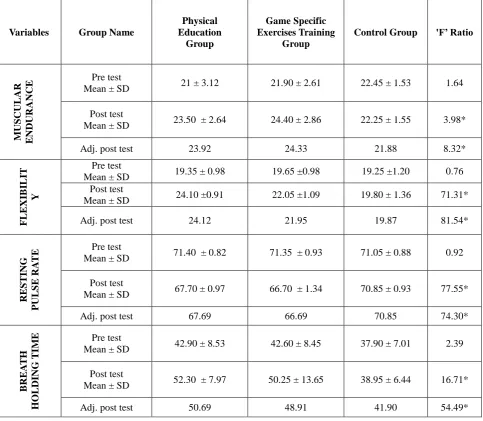
Table 1
Analysis of covariance on selected criterion variables among exercise groups and control group
Variables Group Name
Physical Education
Group
Game Specific Exercises Training
Group
Control Group 'F’ Ratio
M
USC
UL
A
R
E
NDUR
ANCE
Pre test
Mean ± SD 21 ± 3.12 21.90 ± 2.61 22.45 ± 1.53 1.64
Post test
Mean ± SD 23.50 ± 2.64 24.40 ± 2.86 22.25 ± 1.55 3.98*
Adj. post test 23.92 24.33 21.88 8.32*
F
L
E
X
IB
IL
IT
Y
Pre test
Mean ± SD 19.35 ± 0.98 19.65 ±0.98 19.25 ±1.20 0.76 Post test
Mean ± SD 24.10 ±0.91 22.05 ±1.09 19.80 ± 1.36 71.31*
Adj. post test 24.12 21.95 19.87 81.54*
RE
S
T
ING
P
UL
S
E
RA
T
E Pre test
Mean ± SD 71.40 ± 0.82 71.35 ± 0.93 71.05 ± 0.88 0.92
Post test
Mean ± SD 67.70 ± 0.97 66.70 ± 1.34 70.85 ± 0.93 77.55*
Adj. post test 67.69 66.69 70.85 74.30*
B
RE
A
T
H
H
O
L
DING
T
IM
E Pre test
Mean ± SD 42.90 ± 8.53 42.60 ± 8.45 37.90 ± 7.01 2.39
Post test
Mean ± SD 52.30 ± 7.97 50.25 ± 13.65 38.95 ± 6.44 16.71*
Adj. post test 50.69 48.91 41.90 54.49*
The pre-test mean value on resting pulse rate of physical education group, game specific exercises training group and control group were 23.92, 0.76, 0.92 and 2.39 respectively. The obtained 'f' ratio value 1.64, 0.76, 0.92 and 2.39 for pre-test means on resting pulse rate was less than the required table value 3.15 for significance at .05 level of confidence with df 2 and 57. The post-test mean value on resting pulse rate of physical education group, game specific exercises training group and control group were 24.13, 21.95and 19.87 respectively. The obtained 'f' ratio value 3.98,
71.31, 77.55and 16.71 for post -test means on resting pulse rate, was greater than the required table value 3.15 for significance at .05 level of confidence with df 2and 57. The adjusted post-test mean value on resting pulse rate of physical education group, game specific exercises training group and control group were 50.69, 48.91and 41.90 respectively. The obtained 'f' ratio value 8.32, 81.54, 74.30 and 54.49 for adjusted post-test means on resting pulse rate, was greater than the required table value 3.16for significance at .05 level of confidence with df 2and 56.
Jagathesan 2017 ISSN: 2349 – 4891
Table 2
Scheffĕ S Test for the Difference between the Adjusted Post-Test Mean of Selected Criterion Variables
Adjusted Post – Test Mean on MUSCULAR ENDURANCE Physical Education Group Game Specific Exercises training group
Control Group Mean
Difference
Confidence interval at 0.05 level
23.92 24.33 - 0.41 1.58
23.92 - 21.88 2.04* 1.58
- 24.33 21.88 2.45* 1.58
Adjusted Post – Test Mean on Flexibility
24.13 19.87 4.26* 0.88
24.13 21.95 2.18* 0.88
21.95 19.87 2.08* 0.88
Adjusted Post – Test Mean on RESTING PULSE RATE
67.69 66.69 - 1.00* 0.88
67.69 - 70.85 3.16* 0.88
- 66.69 70.85 4.16* 0.88
Adjusted Post – Test Mean on BREATH HOLDING TIME
50.69 48.91 - 1.77 2.22
50.69 - 41.90 8.79* 2.22
- 48.91 41.90 7.02* 2.22
* Significant at .05 level of confidence
Discussion on findings
Daily quality physical education in the nation’s schools is an important part of a student’s comprehensive, well-rounded education program and a means of positively affecting life-long health and well-being. The optimal physical education program will foster a lifetime commitment to physical activity as part of a healthy lifestyle. Ultimately, improved coordinated school health programs, of which physical education is a central component, will augment other prevention efforts and help to reverse the growing epidemic of childhood obesity which threatens to undo decades of progress in the fight against cardiovascular and other diseases. Effective efforts made now will help children avoid a lifetime of chronic disease and disability. The school physical education curricula were experienced across diverse racial, ethnic, and socioeconomic groups, among boys and girls, elementary-and high school students, and in urban and rural settings (Kahn et al, 2002).
There was a significant improvement on selected criterion variables such as flexibility, cardio respiratory endurance, breath holding time, strength, endurance and vital capacity due to physical education programmed and handball drill. Among them, the handball drill Group dominated in the improvement on selected criterion variables. Physical education programme influenced in the development of organic, neuron-muscular and emotional as well as physiological development of the learner WCEFA, (1990).
Conclusion
The following conclusions were drawn from the results of the study.
1. There was a significant difference among physical education group and game specific exercises training group and control group on muscular endurance, flexibility, resting pulse rate and breath holding time. 2. There was a significant difference improvement on among Physical Education group and game specific exercises training group and control group, on muscular endurance, flexibility, resting pulse rate and breath holding time
References
1. Bompa Tudor O. Periodation of Strength (Veritas Publishing Inc. Canada, 1996.
2. Burgomaster KA, heigenhauser GJ, Gibala MJ. Effect of Short Term Sprint Interval Training on Human Skeletal Muscle Carbohydrate Metabolism during Exercise and Time Trial Performance. Appl physical 2006; 100:6. 3. Dupont G. The Effect Of In Season, High
Intensity Interval Training in Soccer Players, Journal of Strength Conditioning Research, 2004; 18:3.
4. Edge J. Effect of High and Moderate-Intensity Training On Metabolium and Repeated Sprinters, Medicine and Swenca in Sports and Exercise 2005; 37:11.
5. Kotgamanidis C. The Effect Of Combined High Intensity Strength And Speed Training Program On The Running And Jumping Ability Of Soccer Players, J Strength Cond Res., 2005.
7. Pearce AJ, GW Thickbroom, ML Byrnes. Functional reorganization of the corticomotor projection to the hand in skilled racquet players Exp brain Res. 2000; 130:238-243