ISSN: 2333-5823 (Print), 2333-5831 (Online) Copyright © The Author(s). 2014. All Rights Reserved. Published by American Research Institute for Policy Development
Consensus Building as a Way of Enhancing Basic Education in Nigeria
Danjuma Abdullahi1 and Prof. Madya Dr. SitiAlida John Bt Abdullah
Abstract
Modern government operate by networking with other institutions such as nongovernmental organizations, family, private organization, unions etc for the achievement of aims and objectives of the government policy, such networking depend on the commitment from the stakeholders or parties involved. But in Nigeria the delivery of basic education lacks collaboration which create problems in basic education such as poor infrastructures, dilapidated buildings, influx of teachers from the teaching profession in search for greener pasture and increase in drop out.The paper relied on interviews, documents, newspapers and periodic reports of the organization in focus. Atlas ti7 was used to analyse the data. The findings revealed lack of proper coordination of the programme, lack of enligtment and poverty as a result there are many out of school children in the state, the paper recommends increase in collaboration between the stakeholder in order to achieved millennium development goals(primary education) as well as vision 2020.
Keywords: Consensus building; State and Education
1.0 Introduction
The paper examines the role of consensus building in enhancing basic education delivery particularly in Nigeria. All over the world the role of state is changing due to economic recession and government big size as well as the Weberian nature of the public administration.
Since the introduction of public management, the role of state is changing from provision of public goods to intervention, investment coordination, stimulation of stagnating enterprises and provision of subsidy to parastatals. NGOs, private sectors, family are complementing the role of government.
1 GhazaliShafieSchool of Government, College of law, Government and International Studies, Universiti
The NGOsfor instance plays a vital role in education development. In African countries like Burkina Faso, there are many NGOs, such as BorneFoonden and Save the Children Foundation which play a vital role in education provision. Similarly, in Gambia, there are several NGOs that provide education, like Future in Our Hands, Christian Children Fund in Mozambique, MozanbicanAssociation of Urban Development, German Agro Action and Canadian Cooperation International also play a vital role in education development (Birdsall, et al., 2005).
Mongolia, Nicaragua and Nepal have adopted a pragmatic approach to reduce costs; teachers are recruited based on training, and the private sector also contributes significant amount of their revenue toward education development as well as monitoring of input and output (Birdsall et al., 2005).
In Chile, besides the government injecting money into the education system, national performance award has been introduced in order to boost education. The policy recorded a tremendous success in education development (EFA, 2009). In Madagascar, the government adopted a policy of community involvement and strong local leadership and provided infrastructures. In Kenya, the school improvement system has worked towards promoting education development (Sunal, Sunal, Rufai, Inuwa& Haas, 2003).
The problem of classrooms and infrastructure are very prevalent in African countries; in Guinea for instance, 16% of its primary school classes lack chairs and tables; children sit on the floor due to shortage of infrastructure. The situation is worse in Burkina Faso, but in contrast, Malawi recorded tremendous achievements in the area of classroom provision as a result of increase in government spending in the sector. Also, in Ethiopia, the government works hand-in-hand with the private sector to enhance basic education provision, while at the same time, powers have been delegated to sub-units of the government through decentralisation (Birdsall, Levine & Ibrahim, 2005).
2.0 Education Provision in High Achieving States
Many decades ago, countries around the world started the journey of education provision which is similar to African conditions today. The secret of the education successes in most high achieving states is commitment to efficient resource allocation which metamorphoses into the achievement of policy objectives. For instance, in East Asian countries, their education success was the result of high rates of economic growth that the region experienced during the last five decades. The per capita income of Asian countries has grown tremendously. For example, in Korea, the GDP grew at 6.6 %, 5.1 % in Thailand and 6.3% in Singapore; while in sub-Sahara Africa, their GDP fell between 19651999. For example, Ethiopia experienced a decline at 0.3%, Ghana -0.7% and Madagascar -1.7% ( Peng&Fredriksen, 2008).
East Asia also stronglyprioritises primary education rather than higher education, in contrast to African countries giving high priority to higher education rather than primary education. In 1965, Singapore invested 58% of its budgetary allocation in education; similarly, Korea and Thailand invested 66% of their budgetary allocation in education (Peng et al., 2008).
The population explosion in Africa is also a hindrance to education delivery. The region over the past few decades has experienced population growth; the economy is agrarian that did not generate much income for the public to contribute toward education development, while Asia is experiencing low facility rate as a result of literacy rate. Another reason for education development in East Asia is due to their strong institutions, including visionary and political will, leadership, quality of bureaucracy and building consensus (Peng et al., 2008).
Evidence from Asian countries also shows that some countries adopted policy girl child education and encouraged their children to attend school. The government also eliminated school fees as well as provided feeding and mothersupportprogrammes. Institutional factors also affect primary education delivery, such as lack of transparency, poor management, poor incentives, poor networking among parents and school and weak commitment (Birdsall et al., 2005).
Lewis (2006) added that education failed to develop the world as a result of poor attitude to work, poor management and investment in unnecessary things. In an attempt to address the problems of basic education delivery, Uganda adopted top down approach, decentralisation of education system and reforming financial management. There was strong commitment by the president, involvement of civil society and good communication links.
Vietnam, for instance, despite being a poor country, has recorded good performance in basic education provision; 90% of its workers are literate, and the government has injected substantial portion of the budget for education development. Analysis of government expenditure reveals that there is drastic increase in government spending from the state budget, while higher education is in the form of cost sharing between the parents and the government (Peng et al., 2008).
Figure 1.0: World Ranking of High Education Achieving States
Source: World economic forum, 2013
0 5 10 15 20
Finland Switzerland Netherland United Kingdom Australia Cyprus Germany 1 2 3 4 5 6 7 8 9 10 1112 1314 1516 1718 1920 1.601 1.355 1.348 1.313 1.204 1.191 1.106 1.075 1.033 1.031 1.027 1.007 0.988 0.977 0.97 0.938 0.899 0.891 0.888 0.862 6.8 5.5 0 5.4 7.2 6.67.2 7.8 6.5 5.6 5.6 7.5 5.1 7 6.97.3 5 8.7 5.15.7
Among high education achieving states, Finland came first, followed by Canada,
Singapore, Switzerland, New Zealand and Estonia which was 20th in the ranking order.
Korea is one of the high achieving states in education provision. Korea adopted low cost approach in education development, i.e., triple shift in education provision. The government adopted egalitarian policy in an attempt to promote education development; entrance examination was abolished and the government allocated more resources to the sector (Peng et al., 2008).
In Thailand, despite the challenges of expanding education, government allocated more than 20% of budget to education; two thirds is for basic education development, primary education received more than 70% of the national budget and the government also introduced decentralisation of education (Peng et al., 2008).
The problem of education in Sub–Sahara Africa is a product of neglect by successive administrations over a long period of time. There was high enrolment in the educational institution despite the low rates of growth, as the region still remains anunder-developed part of the world (Banya&Elu, 2001).
A study on Asian miracle which proliferated in the 1990s gave a range of explanations for the remarkable Asian higher performance. Education was the basis for their growth and development (World Bank, 1993). For instance, to facilitate the process of modernisation, the Singaporean government expanded education at all levels and re-oriented it toward the production of industrial, clerical and professional manpower. The expansion and improvement in education has been tailored to involve the masses who are to provide the semi-skilled labour, as well as the technicians and professionals (World Bank, 1993).
SAP promoted growth in Latin America, but not in Africa. Also, the issue of fiscal federalism and vertical and horizontal fiscal imbalances since independence added to the problems. The search for appropriate mechanisms and method of sharing resources was particularly problematic (Shenggen&Neeth, 2003).
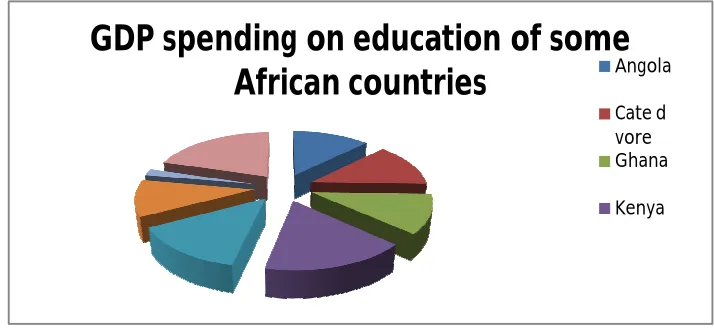
Figure 1.1 GDP spending of some African countries
Source: Yakubu (2011)
The Figure above shows the GDP of some African countries. The GDP of Nigeria on education is very low compared to countries like Ghana, Kenya, South Africa and Malawi.
Also, Canada, US, New Zealand and UK introduced the system of funding that favoured pupils from disadvantaged families. Likewise, in Singapore, the success was as a result of better monitoring and research on best practices of education. The explanations for the high performance in the education sector in the world suggest that the system is based on meritocracy and the utilisation of good monitoring and effective instructions (Huff, 2012).
GDP spending on education of some
African countries
AngolaCate d vore Ghana
Figure1.2:World Ranking of Education Performance (Africa)
Source: World economic forum, 2013
Likewise in Africa, Botswana ranked at 85th position, Kenya 90, Ghana 91,
South Africa 92, Cameroun 96, Benin 109 and Nigeria 116.
In Botswana, the government contributed 21% of education allocation to education; secondary education received 32%, vocational training received 23%, university 11%, teacher training 9% and others 4%.
South Korea and Finland came top in high education performing status; these are countries with the best education system in the world. The secret of their success could be deduced from high investment in education; the culture also supports learning and at the same time, there is respect for teachers (Huff, 2012).
Rank, 116
Scores, -1.411edu, 3.1GDP on
-20 0 20 40 60 80 100 120
Botswana
Kenya
Ghana
South Africa
Cameroon
Namibia
Tanzania Malawi
Uganda Benin Lesotho Senegal
Ethiopia Nigeria
In addition to that, schools are autonomous; there is better package for teachers, strong union and increase in private enrolment, decisions are made locally, there is adequate supply of instructional materials and proper utilisation of resources (Woessmann, 2001).
Table: 1.1: World High Education Performing States From 60s-2000s
1960S-70s 80s 90s 2000s
Israel New Zealand Japan France Belgium Hungary Germany Australia Finland UK Sweden Netherland Japan Netherland Korea Rep. Hungary Hong Kong Taiwan Korea Rep Japan Singapore Finland Slovakia Czech Rep. Australia Sylvania Hong Kong Bulgaria Australia Russia Netherland Hungary Sweden UK Canada Finland Korea Rep Taiwan Japan Singapore Estonia China. Australia Switzerland Hong Kong Belgium Czech Rep. France Australia Russia Netherland Hungary Sweden UK Canada Ireland
Source: Woessmann, 2001
Denmark spent three times of its national income on education as compared to Greece. The rate of education spending in the UK has declined. For instance, in 1975, it spent an average of 6.5 % of GDP on public education, while in the later 1990s, it declined to 4.5 % and then increased to 5.6 % in 2006 (Ansell, 2010). From the last
decade of 21st century, a number of countries came out with some mechanism of
Most of the African countries spent less on education expansion compared to their European counterparts. Analysis of education spending between Lesotho and Equatorial Guinea revealed that the former spent 10 times more than the former with similar demographic figures; as a result, Lesotho has higher education attainment than Equatorial Guinea(Ansell,2010).
3.0 Methods of Data Collection
The data were source through interviews. Interviews were conducted with the staff of UBE, as well as the parent teachers association, Non-governmental organizations, Nigerian union of teachers numbering ten. In order to validate the findings the study also reviewed past literatures such as text books, journals and newspapers. Atlas ti7 was used to analyse the data.
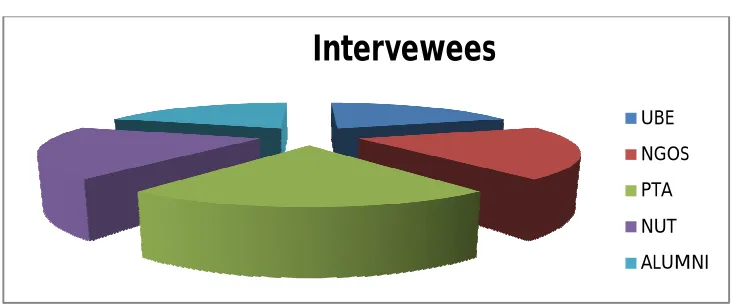
Figure 1.3: The Respondents Interviewed
The above table shows the respondents interviewed UBE (2), NGOS (2), PTA (2), NUT (2) and Alumni (2).
Intervewees
UBE
NGOS
PTA
NUT
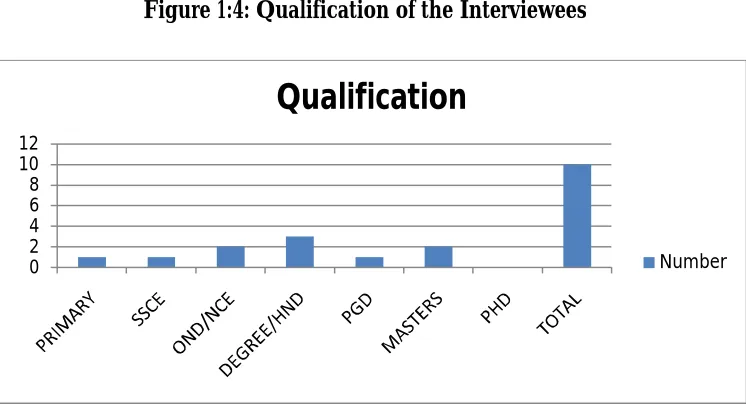
Figure 1:4: Qualification of the Interviewees
From the table above primary certificate has (1), SSCE(1), OND/NCE (2), Degree (3)PGD(1) and MASTERS (2).
Figure 1.5: Occupational Distributions of the Interviewees
The above table shows that majority of the respondents are public servants with 7 respondents followed by farmers with 2 respondents and others one respondent respectively.
0 2 4 6 8 10 12
Qualification
Number
0 2 4 6 8 10 12
Type Public
servants
Farmers Others Total
Occupation
Figure 1.6 : Age distributions of the Interviewees
From the table above,the ages of interviewees ranges from 41-45(2), 36-40 (2), 31-35 (2), 26-30 (3) and 25-25 (1).
4.0 Findings
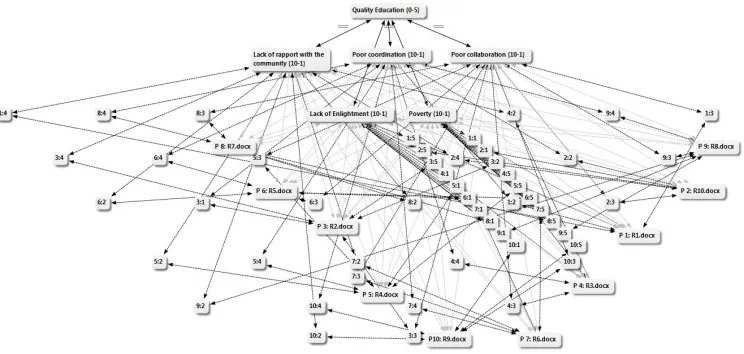
Building consensus involves cooperation among different levels of governments and stake- holders,and attracting them to invest in education.The rate of consensus building is very weak in Nigeria as observed by respondents. The figure below shows the themes and the interviewees:-
Figure 1.7 Interviewees and Coding
0 10
NUMBER
Age of the Intervewees
21-25
26-30
31-35
36-40
As a result of the interviews conducted above, the following are the problems of consensus building in basic education provision based on the responses from the interviewees.
Lack of enlightment:It is mandatory for every parent to enroll their wards to the school but due to lack of enlightenment, many parents did not enroll their children due to inability of government to provide adequate funding and lack of commitment (1:5, 2:5 & 4:1).
Interviews conducted also indicated that there are inadequate resources to embark on massive enlightenment (3:5). Not too long ago, the ministry asked each and every school to form school based management committee but many schools have not responded (4:1, 5:1 & 6:1). Only in few places, such committees are playing their role, in some places, school management built schools, toilet and libraries (7:1 & 8:1). School management committee just came in recently to monitor what is going on in the schools as well as effective implementation of the policy, to reduce political influence, the well to do among the committee members help in building and provision of infrastructure as well as enlightenment campaign (9:1). Even cooperation with the community is not there(10:1).
Poor collaboration: Parents also contribute toward development of education of their wards in the form of advice, and there is also school based management committee in which parents contribute towards development of their children both financially and materially.They do build classrooms, provide instructional materials, as well as other input such as chalks(10:1). As observed by a respondent No awareness especially at the village level, people are not being mobilised to know the importance of basic education, there is need for government to intervene to create more awareness in order to promote educational development (6:3).
The community needs to play a role in education but they are not being oriented even in the supervision which affects education development(2:3). In support of that, an interviewee stated that:-
Local communities also have roles to play in delivery of basic education such as provision of enabling environment to ensure proper implementation of education for all(9:3). The community should assist in provision of human and materials resources, maintenance and safety of infrastructure, but it is not doing so as observed by a respondent(1:3).
Poor coordination:The stakeholders, such as parents, NGOs, Alumni and community has a role to play in education but most of the stakeholders seem not play their role and responsibility in basic education delivery (6:4).The reason for poor enlightenment is because of inadequate funding of the organization (5.4). Another interviewee added that the problem has to do with the stakeholders - both the government, parents, NGOs, teachers etc. all of them have a role with regards to basic education, failure of stakeholders to play their role as and when due vividly affect education provision in Nigeria (3:1).Government is not giving much to the schools for the day-to-day running of the school, as a result the school came out with PTA charges in order to run the school effectively; the school charged N100 per student but many parents could not pay due to poverty” (10:4, 3:3, 2:2 & 9:4).
Poverty:The cost of education is very high for the parents, for instance parents buy uniforms, books, and pay levy, nothing is free as far as basic education is concerned; as a result, they could not send all their children to the school at once, they have to send them in batches due to poverty (1:1, 2:1, 3:2, 4:5, 5:5& 10:3). In addition many parents are poor they could not afford three square meals talk less of contributing money toward education advancement (6:5, 7:5, 8:5, 10:5 & 9:5).
In order to address the problem of imbalance in education within the states, the federal government came out with a community initiative project known as community initiated self-help project, i.e., if communities are willing to support self-help projects in their various localities, the federal government would provide some money as inducement but many communities are not mobile and ignorant of such kind of arrangement (5:2). The essence of the self-help project is to enhance the participation of communities and private sectors in education development by coming out with viable programmes as well as administration of schools (10.2).There is weak synergy among the stakeholders in basic education (6:5).
The stakeholders have a role to play in education but most of them are not aware of their responsibilities due to poor enlightenment; that is why there are many children begging for alms on the street. The law also prescribes punishment for parents who keep their children from school but lack of implementation of such laws renders the programme ineffective (Okafor&Anaduaka, 2013). In addition to the above, another interviewee stated that:-
Self-help project is designed to involve community in school affairs and encourage private participation, communities are expected to provide 10% but poverty constitutes the biggest problem toward such arrangement .The essence of self-help project is to provide basic infrastructure in the schools, improve stakeholder relations but low participation renders the arrangement ineffective (3:4).
Figure1.8: Self-help project by communities in Nigeria
Source: Impact Assessment of UBE (2012)
0 20000 40000 60000 80000 100000 120000 140000
2005
2006
2007
The figure above shows the self-help project embarked upon by various communities in Nigeria from 2005-2008. Due to the inability of the state to provide such goods and services, the self-help projects are decreasing due to poverty and lack of community participation.
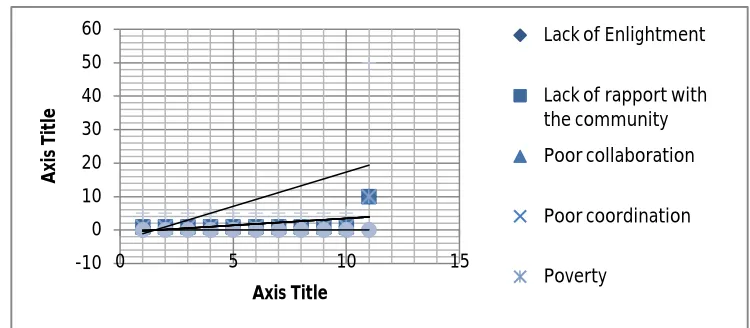
Figure 1.9: Summary of the Interviews
5.0 Discussion
From the interviews conducted with was discovered that one of the major problem affecting the institution is inadequate enlightment. People are not enlighten to know advantages of education as a result it led to poor funding and consequently affect the quality of education in Nigeria.
The interviews also revealed that there is poor coordination with the stake holders which invariably affect the quality of education. The stake holders are not mobilize to know the importance of education, as a result there is no adequate collaboration between the government, private sector and informal organization which affect the growth and development of education in Nigeria.
In addition to the above, the interviews also revealed poor coordination of the programme. This is as a result of poor enlightment and lack of commitment of the state to basic education provision.
-10 0 10 20 30 40 50 60
0 5 10 15
A
xi
s
T
it
le
Axis Title
Lack of Enlightment
Lack of rapport with the community
Poor collaboration
Poor coordination
The rate of poverty has also increased which affect the education provision in Nigeria. The National Office of Statistics reported that over 112 million Nigerians lives below the poverty line and earn less than a dollar per day, therefore contribute nothing towards betterment of their children as a result affect education delivery in Nigeria.
Finally, the relationship between the school and community is not cordial, the community see activities of school as encroachment of their land without full compensation which affect the education delivery.
6.0 Conclusion
The problem under investigation is state and consensus building inbasic education delivery in Nigeria, primary education being the bedrock of the educational system is beset with many problems which include poor commitment, poor coordination, lack of community involvement, poverty andpoor stake holder collaboration. As a result it created problems such as pupils drop out and decrease in quality of education which is fueling insecurity of lives and properties and emergency of militancy and other groups such as Boko Haram, Niger Delta militancy, prostitution and armed robbery and kidnapping in Nigeria.
7.0 Recommendations
The following are some of the recommendations with the hope that if put in place will help in addressing problems of universal basic education in Nigeria:-
i.Adequate funding: The major problem facing the commission is that there is no
adequate funding of the programme; government should try as a matter of urgency to ensure adequate funding of programme based on the UNESCO threshold of 26% budgetary allocation of the country.
ii.Partnership and consensus building:The commission can also collaborate with
private partnership and philanthropic donations which will contribute their quarter towards the development of primary education in Nigeria. The commission can also embark on annual launching so that philanthropic and well to do individuals will contribute their quarter towards primary education development in Nigeria.
iii. Also the unclear nature of role and responsibility of three tiers of government
iv. Government should enhance the autonomy of each an every tier of government especially state –local relations. The issue of joint account should be abolished.
v.Also the commission should ensure proper record keeping of the income and
expenditure of the commission.
vi. The government should ensure that the monies’ meant for enhancement of
primary education commission is been spent judiciously in accordance to the lied down rules and regulations. This could be achieving through transparency and accountability.
vii. Establishing independent body charge with the responsibility of employment.
viii. Attracting and retaining the competent bureaucrats through motivation such as
giving good package. It encourages hard work and lessen corruption (Hydeneel., 2003).
ix. Straightening the capacity of watchdog organizations such as public complaint
References
Ansell, B.W.(2010). From the ballot to the black board: The redistributive political economy of education. Cambridge: Cambridge university press.
Banya, K. &Elu J. (2001).Financing Higher education in sub- Sahara Africa.JSTORJournal of higher education vol. 42(1) 1-34
Birdsall, N. Levine, R, & Ibrahim, A.(2005).Toward universal primary education:Investments, incentives and institutions. London: Earthscan
EFA(2011). EFA Global monitoring report. Retrieved from
http://www.unesco.org/new/en/education/themes/leading-the-international- agenda/efareport/
Huff, P. (2012). Best education in the world: Finland, South Korea country ranking rated average. Retrieved from
http://www.huffingtonpost.com/2012/11/27/best- education-in-the wor_n_2199795.html
Lewis, M. (2004). Decentralizing education: Do communities and parents matter? Draft working paper. Center for Global Development Report, Washington, D.C.
Okafor, C.F. &Anaduaka, S.U. (2013) The UBE programme in Nigeria: Problems and prospects. Journal of education research 2(3) 42-48.
Peng, T. &Fredrikson, B. (2008).An African exploration of the East Asian education experience. Washington D.C.: World Bank
Shenggen F.&Neetha R. (2003) Public spending in developing countries: trends, determination, and impact, Environment and production technology development.Retrieved from https://www.docstoc.com/pass?docId=100978485&download=1
Sunal, C.S.; Sunal, D.W. Rufai, R. Inuwa , A.&Haas,M.E.(2003). Perception of unequal access to primary and secondary education.: Findings from Nigeria. African studies journal 46(1) 93-116
Woessmann,L.(2001). Why students in some countries do better. International evidence on the importance of education policy 1(2) 67-74
World Bank (1993). World development report, Washington D.C Retrieved from http://wdronline.worldbank.org/worldbank/a/c.html/world_development_report_19 93/back_matter/WB.0-1952-0890-0.back
World Bank development indicator (2012).Public expenditure on education. Retrieved fromhttp://wwwwds.worldbank.org/external/default/WDSContentServer/WDSP/IB /2008/08/24/000 .pdf