ISSN 2324-805X E-ISSN 2324-8068 Published by Redfame Publishing URL: http://jets.redfame.com
Perceptions of Father Involvement among Turkish Fathers with Pre-school
Children
Kazım Biber
Correspondence: Kazım Biber, Necatibey Education Faculty, Balıkesir University, Turkey
Received: February 14, 2016 Accepted: March 14, 2016 Online Published: March 25, 2016
doi:10.11114/jets.v4i6.1376 URL: http://dx.doi.org/10.11114/jets.v4i6.1376
Abstract
The purpose of this study is to compare father involvement among fathers with children in pre-school in terms of their status of having only one or more than one child. The study sample consisted of fathers of 3-5 year-old children who were enrolled in pre-schools in the district of Altıeylül, Balıkesir. Data pertaining to the involvement of fathers with one child and with more than one child were collected with the Father Involvement Scale (FIS) developed by Şendil and Sımsıkı (2014). Data was collected from a total of 325 fathers and Confirmatory Factor Analysis (CFA) was performed to test the construct validity of the FIS. The data derived from the Father Involvement Scale were collected in three sub-dimensions: DI (Discretionary Involvement), BC (Basic Care), RC (Responsiveness and Closeness), and were analyzed using hierarchical regression analysis. The results of the research revealed that the number of children had an impact on the discretionary involvement and responsiveness and closeness dimensions of father involvement and that fathers with only one child had higher levels of perception of the role of fatherhood and also higher levels of household task involvement compared to fathers with two or more children. According to these results, since a positive perception of the role of fatherhood is strongly and positively associated with family involvement activities, educators may provide support in enabling fathers and other family members to develop a positive perception of fatherhood. In providing this support, to avoid the differences stemming from the variable of being a father of a single child or of more than one child, planning activities together with fathers to provide real-life examples that promote time management and effective leisure time management may encourage fathers to spend more quality time with their children.
Keywords: fatherhood, father involvement, single child, multiple child, family involvement
1. Introduction
The quality of education provided in the pre-school period is directly related to how much the individuals that are in closest interaction with the child can support the process of education. The family is the first and closest group that characteristically carries the capability of being an educational resource in this period of the child's development. Achieving permanent behavioral changes in children at the pre-school level may be made possible only if the learning experiences planned in the school curriculum are followed up and continued in the family environment (Aral, Baran, Bulut, Çimen, 2000). Working to involve families in education and teaching during the pre-school period yields positive outcomes in terms of many aspects of education, including developing pupils' behavioral and social adjustment, reducing disciplinary issues in the school environment, increasing pupils' school attendance and academic achievement, and ensuring that students acquire more social skills (Kotaman, 2008). In addition, making a family education program and family involvement a part of education will make what is learned at the pre-school level continuously effective throughout the student's life (Hohman and Weikart, 2000).
1.1 Father Involvement
participating in school activities together with their children began to be accepted as a customary practice. With the advancement of technology, education, politics, science and industry, it became more readily understood that the role of the father in a child's development was as important as the role of the child's mother (Çatıkkaş, 2008). In response to changing social conditions and the evolving expectations of society from fathers, research began to reveal that the effective participation of fathers in the education of their children had a positive impact on the child's development (McBride and Lutz, 2004; McBride et al., 2004). Additionally, the increasing inclusion of women in the workforce changed fathers' roles to a significant degree and fathers realized the necessity of training themselves to be as effective in the household, in childcare and education, as the women in the family. Together with this, an increasing emphasis on the identity of a father and the importance of fathers as a role model in bringing up a child led to a rising interest on the part of fathers to become involved in their children's educational process (Gürşimşek et al., 2007).
When Allen and Daily's (2002) investigation into father involvement in education is studied, it can be seen that the researchers reached the conclusion that when fathers become involved in educational activities, their children's attitudes toward school becomes more positive and they spend more of an effort to succeed at school and participate in social events. The researchers report that the warm and supporting attitude of fathers toward their children has a significant impact on the children's being able to learn the moral values of the society in which they live. From a different perspective, teachers find the opportunity to become more acquainted with children's families when fathers are involved in the education and teaching process; teachers try to understand the father's point of view and become more sensitive toward the expectations of the family (Carter, 2003). Fagan and Iglesias (1999), in a study in which they conducted a pre-school family involvement activity where fathers were included, found that the children whose fathers had participated in the school activity displayed an improvement in their mathematical skills (as cited in Green, 2003). When fathers engage in warm relations with their children and actively participate in their education, the self-confidence of their children grows, they achieve a better academic performance, and they form healthier relations with their peers, display a healthier development in terms of gender roles and are better able to make use of economic resources (Green, 2001).
1.2 Factors that Affect Father Involvement
Research has shown that fathers with a higher educational background are better able to adapt to the role of participating in their children's school activities. Although education and income are closely associated, they have not been found to affect a father's involvement in the same way. While men with higher levels of education are more likely to participate in household duties, men with high incomes participate less (Model, 1981). Because of the higher quality of work that an educated father engages in and since higher paying jobs are more time-consuming, this leaves the father less time to become involved (Harris & Morgan, 1991). In another study, it was found that African-American fathers read to their children less but spend more time playing with them compared to other American fathers (Green, 2003; Halle and le Menestral, 1999).
Levine (1993) described the factors that act as barriers to father involvement in family involvement programs organized in the early childhood years. These were fathers' fears of incompetence, the approach to father involvement of the program-organizing experts, mother-related barriers, and inappropriate program setups and applications. It was reported that father involvement rates in family involvement activities would increase if these obstacles could be overcome. In another study in which levels of father involvement in pre-school education were investigated, it was found that in schools that did not encourage fathers to take part in school activities, fathers felt that they could not find the time to participate, they did not feel comfortable at school, they had difficulty in establishing relations with other parents and that they were also unwilling to participate because of these and other similar reasons (Gürşimşek, Kefi and Girgin, 2007).
The attitude of a father toward gender roles is one of the most important predictors of his participation in the care of his child (Radin and Goldsmith, 1989; Coverman, 1985). As the attitude toward gender roles takes on a more contemporary perspective, father involvement increases (McHale and Huston, 1984). Fathers who are more involved in their children's lives are fathers whose notion of fatherhood goes beyond supplying children with their economic needs and acting as a disciplinarian to encompassing a firm and close interest in the child and taking part in the child's care. Fathers' attitudes toward mothers' gender roles also influence fathers (Russell, 1978), and therefore father involvement is more pronounced among fathers that maintain non-traditional attitudes in this respect (Baruch and Barnett, 1981). Particularly when women work, fathers' attitudes toward male roles are of greater significance and men married to women with a liberal attitude are seen to participate more in childcare (Radin, 1981).
(Cowan & Cowan, 1988). How a father perceives himself as a father, how comfortable he feels in this role (Levy-Shiff and Israelashvilli, 1988) and his perception of his own competence in childcare (McHale and Huston, 1984) all affect his involvement.
As for how the child's age affects a father's involvement, the finding is that the older the child, the more the father's participation increases. The tasks of changing diapers and bathing a baby are traditionally regarded as the mother's responsibilities. The care of older children, on the other hand, does not conflict with traditional roles and because the responsibilities in this context are less influenced by gender roles, father participation tends to increase, both in terms of taking on tasks alone and also in performing tasks in cooperation with the mother (Radin, 1981). The child's gender too affects involvement; a father is more apt to be involved with a son's life (Harris and Morgan, 1991). All through the infancy of the child, the father behaves more differently toward girls and boys than the child's mother does. It has been observed that fathers engage in direct physical contact with their boy babies more (Parke and O'Levy, 1976), provide boys with more stimulants (Parke, 1981), and communicate and play with them more (Marsiglio, 1991).
Research results reveal that father involvement is affected by factors related to fathers themselves, such as their attitudes toward gender roles, their psychological condition and their education, by factors related to the child's mother, such as her attitude toward gender roles, her employment status, the hours she works, and by factors concerning the child, such as age and gender. In the light of this, the present study aimed to investigate levels of father involvement among fathers of children of the ages 3-5 enrolled in pre-school programs, based on the fathers' own views and in terms of whether the fathers have one or more than one child.
2. Method
2.1 Research Model
The present study was carried out as descriptive research aiming to investigate levels of father involvement among fathers of children of the ages 3-5 enrolled in pre-school programs, based on the fathers' own views and in terms of whether the fathers have one or more than one child.
2.2 Study Sample
The study group in the research comprised the fathers of 325 children, ages 3-5, enrolled in independent public nursery schools operating in the District of Alteylül, Province of Balıkesir, District Directorate of National Education.
In terms of their ages, 13.5% of the fathers were below the age of 30, 36.6% were between 31-35, 31.6% were 36-40 and 18.2% were over the age of 40. Of the fathers, 5.8% were graduates of elementary school, 14.2% of middle school, 32.3% of high school; 42.2% were university graduates and 5.5% had graduate degrees. Of the fathers in the sample, 92.0% were employed and 8.0% were unemployed. A group of 35.3% of the fathers had a monthly income of between TL 750-1500 (approximately $300-$600), 38.4% an income of TL 1600-3000, and 26.2% of over TL 3100. Of the fathers comprising the sample, 2.8% were in a second marriage, 97.2% in a first marriage; 34.1% had been married for 0-7 years, 57% for 8-15 years and 8.9% for 16-25 years. While 35.5% of the fathers had only one child, 64.5% were fathers of more than one child. Responding to the question about whether their child had any diagnosed chronic medical condition, 7.7% responded "Yes" and 92.3% answered "No."
2.3 Data Collection Instrument
2.3.1 Information Form
This form, which was drawn up to compile demographic information about the fathers, consisted of eight multiple-choice and graded questions designed to collect the father's statements on his age, education, income level, employment status, number of marriages, their duration, whether there was one child or more than one in the family, and whether the child had any kind of chronic medical condition.
2.3.2 The Father Involvement Scale (FIS)
The Father Involvement Scale (FIS) is a scale that assesses the involvement of fathers who have children, ages 3-6. The Father Involvement Scale (FIS) developed by Şendil and Sımsıkı (2014) is made up of 37 items and three subscales. The Discretionary Involvement (DI) dimension has 17 items, the Responsiveness and Closeness (RC) 12 items, and the Basic Care (BC) dimension, 8 items. FIS items are arranged in the form of types of behavior and receive responses on the basis of a five-response Likert-type scale. The choice of "Always like this" receives 5 points, "Mostly like this" receives 4 points, "Sometimes like this" 3 points, "Rarely like this" 2 points and "Never like this" receives 1 point. Points are obtained as a total score and also as separate scores for each dimension. A father's high score on the scale indicates that his level of involvement is high.
Care) I take an interest in whether or not my child brushes his/her teeth. I comb my child's hair. I take an interest in my child's toilet training. I put my child to sleep at bedtime. RC (Responsiveness and Closeness) I take my child up on my lap. I'm interested in my child's health. I tell my child I love him/her. I try to calm my child down when h/she's upset. I know what makes my child happy.
The results of the reliability analysis that Şendil and Sımsıkı (2014) performed in a study they conducted with 350 fathers whose children, ages 3-6, were enrolled in a pre-school revealed Cronbach alpha reliability coefficients of .89 for the Discretionary Involvement dimension, .83 for the Basic Care dimension, .85 for Responsiveness and Closeness and .92 for the FIS total score.
In the present study, the internal consistency coefficient for the Discretionary Involvement subscale of a total of 17 statements was found to be α=0.88; the 8-statement Basic Care subscale displayed an internal consistency coefficient of α=0.82, while the 12-item Responsiveness and Closeness subscale's internal consistency coefficient was calculated as α=0.84. These results indicate that the scores obtained from FIS are reliable.
2.4 Data Collection and Analysis
After the official permissions were obtained for the research, the researcher informed the administrators and teachers of a total of four public and independent pre-schools in the district of Altıeylül, Balıkesir about the study. The researcher distributed a total of 375 measurement tools for the fathers to fill out but only 348 of the forms were returned. After incomplete and erroneously filled out instruments were eliminated, data were ultimately collected from 325 fathers for use in the study.
Data were collected from a total of 325 fathers and Confirmatory Factor Analysis (CFA) was performed to test the construct validity of the FIS. CFA was performed using the LISREL software, version 8.8 (Jöreskog and Sörbom, 2006). The recommended polychoric correlation matrix was created for the analysis of item level data in the Confirmatory Factory Analysis and the Diagonally Weighted Least Squares estimation technique was used.
The predictive effect of the independent variables in the research on the dependent variables was examined with a total of three hierarchical regression analyses. The hypotheses of the regression analysis were tested using graphs. In the hierarchical regression analysis, the independent variables were added into the regression model in one block in three steps. In the first step, age, education, income, employment status and similar demographic variables were added to the model. In the second step, marital variables such as civil status and the duration of marriage were added. In the last step, the variables of number of siblings, order of birth, and chronic illness were added to the model. The regression analysis was performed using SPSS, version 19.
3. Results
3.1 Results of the Confirmatory Factor Analysis
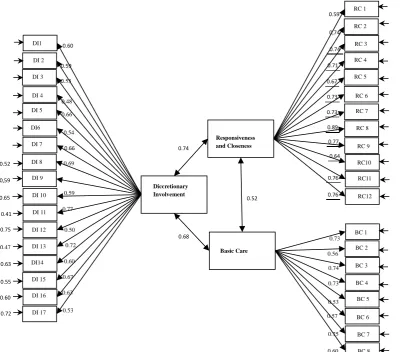
The results of the CFA showed that the 37-factor model consisting of a total of 37 items had acceptable fit indices and that the model was a good fit for the data (χ2=1152.32, df=626, p<.001; RMSEA=0.051, % 90 GA=0.046-0.56; AGFI=0.95; CFI=0.98, NNFI=0.98).
Figure 1. Factor loads and correlation coefficients between the factors in the Confirmatory Factor Analysis
3.2 Hierarchical Regression Analysis
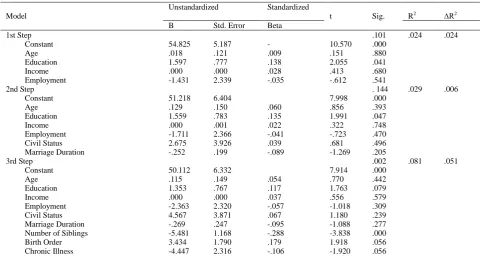
In the first step of the hierarchical regression analysis to explore how much the dependent variable Discretionary Involvement could be predicted using the information in the independent variables, demographic variables such as age, education, income, employment status were entered into the equation and the results were found to explain 2.4% of total variance (R=.024, R² = .024, F(5, 187)= 10,570 p< .05); it was observed that only the education variable was a significant predictor of the Discretionary Involvement variable (β= 0.138, p=0.041). In the second step, the variables of civil status and the duration of marriage were additionally entered into the regression model of the first step. The added contribution of this was 0.6%; this, together with the variables in the first step, raised explained variance related to basic care to 2.9% (R=.029, R² = .006, F(6, 404)= 7,998 p< .05) whereas the variables of civil status and duration of marriage that were entered into the regression model in the second step made no statistically significant contribution to the regression equation.
In the last step, the variables of number of siblings, birth order and chronic illness added to the regression model made a contribution of 5.1% to total variance, increasing explained variance related to basic care to 8.1% (R=.081, R² = .051, F(6, 332)= 7,914 p< .05). Only the number of siblings in the final step (β= -0.288, p=0.001) was found to significantly predict the variable Discretionary Involvement. In the final model, the variable of education had lost its significance in the equation. The results show that as the number of siblings increase, discretionary involvement points tend to fall. The results of the hierarchical regression analysis related to the dependent variable Discretionary Involvement are shown in Table 1.
0.57 0.53 0.73 0.74 0.56 0.73
0.64
0,65
0.69
0.59 0.77
0.50
0.60
0.55
0.59
0.48
0.66
0.54
0.66
0.72 0.60 0.67 0.63 0.53
0.59
0,74
0.74
0.71
0.67
Diccretionary Involvement
Responsiveness and Closeness
Basic Care
RC 1 RC 2 RC 3 RC 4 RC 5 RC 6
RC 8 RC 7
RC 9 RC10 RC11 RC12
BC 1 BC 2 BC 3 BC 4 BC 5 BC 6
BC 8 BC 7
0.73
0.73
0.89
0.77
0.64
0.76
0.76
DI1 DI 2 DI 3 DI 4
DI6 DI 7 DI 8 DI 9 DI 10 DI 11 DI 12 DI 13 DI14 DI 15
0.75 0.60
0.47
0.63
0.55
0.74
0.68
0.52
DI 5
DI 16 DI 17
0,59 0.52
0.41
0.75
0.60
Table 1. Results of Hierarchical Regression Analysis related to the Dependent Variable "Discretionary Involvement"
Model
Unstandardized Standardized
t Sig. R2 ∆R2
B Std. Error Beta
1st Step .101 .024 .024
Constant Age Education Income Employment 54.825 .018 1.597 .000 -1.431 5.187 .121 .777 .000 2.339 - .009 .138 .028 -.035 10.570 .151 2.055 .413 -.612 .000 .880 .041 .680 .541
2nd Step . 144 .029 .006
Constant Age Education Income Employment Civil Status Marriage Duration 51.218 .129 1.559 .000 -1.711 2.675 -.252 6.404 .150 .783 .001 2.366 3.926 .199 .060 .135 .022 -.041 .039 -.089 7.998 .856 1.991 .322 -.723 .681 -1.269 .000 .393 .047 .748 .470 .496 .205
3rd Step .002 .081 .051
Constant Age Education Income Employment Civil Status Marriage Duration Number of Siblings Birth Order Chronic Illness 50.112 .115 1.353 .000 -2.363 4.567 -.269 -5.481 3.434 -4.447 6.332 .149 .767 .000 2.320 3.871 .247 1.168 1.790 2.316 .054 .117 .037 -.057 .067 -.095 -.288 .179 -.106 7.914 .770 1.763 .556 -1.018 1.180 -1.088 -3.838 1.918 -1.920 .000 .442 .079 .579 .309 .239 .277 .000 .056 .056
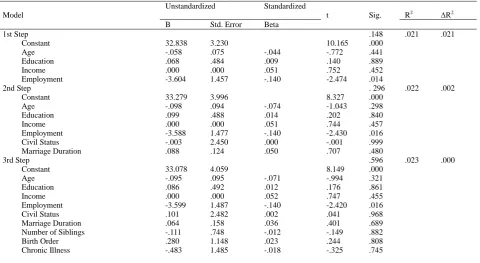
Table 2. Results of Hierarchical Regression Analysis related to the Dependent Variable "Basic Care"
Model
Unstandardized Standardized
t Sig. R2 ∆R2
B Std. Error Beta
1st Step .148 .021 .021
Constant Age Education Income Employment 32.838 -.058 .068 .000 -3.604 3.230 .075 .484 .000 1.457 -.044 .009 .051 -.140 10.165 -.772 .140 .752 -2.474 .000 .441 .889 .452 .014
2nd Step . 296 .022 .002
Constant Age Education Income Employment Civil Status Marriage Duration 33.279 -.098 .099 .000 -3.588 -.003 .088 3.996 .094 .488 .000 1.477 2.450 .124 -.074 .014 .051 -.140 .000 .050 8.327 -1.043 .202 .744 -2.430 -.001 .707 .000 .298 .840 .457 .016 .999 .480
3rd Step .596 .023 .000
Constant Age Education Income Employment Civil Status Marriage Duration Number of Siblings Birth Order Chronic Illness 33.078 -.095 .086 .000 -3.599 .101 .064 -.111 .280 -.483 4.059 .095 .492 .000 1.487 2.482 .158 .748 1.148 1.485 -.071 .012 .052 -.140 .002 .036 -.012 .023 -.018 8.149 -.994 .176 .747 -2.420 .041 .401 -.149 .244 -.325 .000 .321 .861 .455 .016 .968 .689 .882 .808 .745
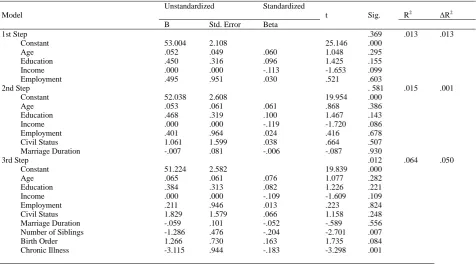
Table 3. Results of Hierarchical Regression Analysis related to the Dependent Variable "Responsiveness and Closeness"
Model
Unstandardized Standardized
t Sig. R2 ∆R2
B Std. Error Beta
1st Step .369 .013 .013
Constant Age Education Income Employment 53.004 .052 .450 .000 .495 2.108 .049 .316 .000 .951 .060 .096 -.113 .030 25.146 1.048 1.425 -1.653 .521 .000 .295 .155 .099 .603
2nd Step . 581 .015 .001
Constant Age Education Income Employment Civil Status Marriage Duration 52.038 .053 .468 .000 .401 1.061 -.007 2.608 .061 .319 .000 .964 1.599 .081 .061 .100 -.119 .024 .038 -.006 19.954 .868 1.467 -1.720 .416 .664 -.087 .000 .386 .143 .086 .678 .507 .930
3rd Step .012 .064 .050
Constant Age Education Income Employment Civil Status Marriage Duration Number of Siblings Birth Order Chronic Illness 51.224 .065 .384 .000 .211 1.829 -.059 -1.286 1.266 -3.115 2.582 .061 .313 .000 .946 1.579 .101 .476 .730 .944 .076 .082 -.109 .013 .066 -.052 -.204 .163 -.183 19.839 1.077 1.226 -1.609 .223 1.158 -.589 -2.701 1.735 -3.298 .000 .282 .221 .109 .824 .248 .556 .007 .084 .001 4. Discussion
Besides enjoying the support of a mother, a child's relations in future life are also significantly affected by the sense of worth instilled in the child by the father (Bowlby, 1982) and it is this concept of how having a caring, responsive father is just as important in child development as the presence of a caring and nurturing mother that makes this a matter that needs to be explored (Ainsworth et al., 1978; as cited in Easterbrooks and Goldberg, 1984).
To date researchers have explored the dimensions of father involvement in the context of selected activities, setting forth varied nomenclature in their studies (Pleck, 2010) and conducting more concentrated investigations into certain specific behavior (Cabrera et al., 2007). As explained by Palkovitz ( 2002) as well, because there is no conceptual framework on father involvement that can be converted into psychometrically valid and reliable measurements, the dimensions of father involvement have remained beyond the scope of standard measuring techniques.
In the present study, the predictive effect of independent variables on the dependent variables of discretionary involvement, basic care and responsiveness and closeness were examined with a total of three hierarchical regression analyses. In the hierarchical regression analysis, the independent variables were added into the regression model in one block in three steps. In the first step, age, education, income, employment status and similar demographic variables were added to the model. In the second step, marital variables such as civil status and the duration of marriage were added. In the last step, the variables of number of siblings, birth order and chronic illness were added to the model.
In the hierarchical regression analysis on the predictability of the dependent variable "Discretionary Involvement," it was seen that as the number of siblings increased, the fathers' discretionary involvement scores tended to decrease.
of adequacy and parental involvement with childcare will increase even more as the number of children in the family increases. This result may have stemmed from cultural differences in families and from demographic characteristics related to the variables in the study. Paulson et al. (2010) has asserted that the number of children in a family does not have a significant effect in this respect.
According to the results of the hierarchical regression analysis performed to determine the degree to which the information in independent variables can predict the dependent variable Basic Care in FIS, an instrument comprising activities that reflect direct contact, unemployed fathers are more likely to register higher scores in the basic care variable compared to fathers who work.
Poyraz (2007) has found that there is no significant difference in fathers' perceptions of their role as fathers when considered in terms of their professions but that the scores of the role of fatherhood among fathers who are employers and civil servants are higher than fathers in other occupations. The same research has made the point that working at a highly stressful and tiring job may have an adverse effect on fathers' perceptions of their fatherhood roles. Barling (1986) reports in a study that explores the relationship between a father's working conditions and children's behavior problems that in situations where fathers are not happy with the conditions of their jobs, their children will be more likely to be hyperactive and display problem behavior.
Mothers may be working in families where fathers are unemployed. Research has reported findings that show that father involvement is affected by the mother's working outside of the home as well as by the mother's working schedule (Coltrane, 1995; Radin and Harold-Goldsmith, 1989). Hoffman (1974) has reviewed studies on gender roles in families in which the woman works and has asserted that although fathers rarely take on childcare as a primary responsibility, they tend to be more actively involved in routine childcare when the spouse is a working mother.
In the study of Türkoğlu, Çeliköz and Uslu (2013) in which the researchers worked with fathers in the age group 30-40 years with college degrees, professional occupations, and a maximum of 3 children between the ages of 3-6, unemployed fathers were deliberately left out of the study sample. The study explored the perceptions of the time fathers were able to spend with their children of the ages 3-6 and it was found that fathers felt that they were not spending enough time with their children due to the physical and mental fatigue they experienced as a result of their busy working hours. The present study however may have revealed higher scores in the basic care variable either because fathers spent more time at home with their children or due to the fact that their spouses were working.
According to the results of the hierarchical regression analysis performed to discover the predictability of the dependent variable of responsiveness and closeness through the information in the independent variables, as chronic illness and the number of siblings in a family increased, fathers' responsiveness and closeness scores tended to diminish.
Chronic childhood illnesses may include orthopedic problems, congenital heart disease, epilepsy, chronic kidney failure, cancer, hemophilia, asthma and other similar conditions (Erdoğan and Karaman, 2008). In research by Bayramoğlu (2009), who set out to determine the emotional state of children and adolescents diagnosed with a chronic illness, the investigator found that fathers with multiple children were more likely to display higher levels of anxiety and burnout in relation to their child with a chronic illness compared to fathers of only children.
In their sense of devotion to their children, parents go through various emotional periods when the child's health is compromised or the child develops some kind of medical condition. These periods are fraught with various emotions that include anger, hopelessness, guilt, despair, isolation, anxiety, depression and other similar states of mind. The number of siblings a child has, the parents' attitude toward the child, whether or not the parents display partiality toward one child or another or the existence of an acute or chronic illness can lead to changes and inconsistencies in the attitudes of mothers and fathers (Gültekin and Baran, 2005).
Deniz and Aral (2003) studied behavioral problems in children with and without a chronic illness and concluded that there were no significant differences between children's scores depending on the number of their siblings. Research has shown that fathers have a closer emotional interest in a sick child and feel despair when they feel they are not contributing adequately enough to the child's care and are losing control over the child's illness (Gültekin and Baran, 2005). When compared with mothers, fathers have less opportunities to help their children directly. At the same time, because of their long working hours, they receive less support and information from the health team compared to mothers. It is evident that this situation leads to the result that fathers are less involved with the problems of their child who has been diagnosed with a chronic illness (Çavuşoğlu, 1992).
relationship with the father, the difference in the roles taken on within society and inside the family lead way to differences in the way fathers affect their children as compared to mothers.
5. Conclusion
Our study found that the number of children in a family had an effect on the discretionary involvement and responsiveness and closeness dimensions of father involvement. In other words, fathers with only one child were more likely than fathers with two or more children to participate in leisure time activities with their children, take part in games and engage in behavior that involved direct contact with the child, including hugging and kissing. Paquette, Bolte, Turcotte, Dubeau and Bouchard (2000) have found that the rate of father involvement diminishes as the number of children increases. Similarly, Mehall et al. (2009) have shown in their results that as the number of siblings increase in a family, fathers tend to show less of an interest in their babies. Şahin and Demiriz (2014) have concluded that fathers with only one child have a higher perception of their roles as father and participate more in household tasks compared to fathers with two or more children. These results point to the fact that the time fathers with two or more children are spending with their children is not adequate in terms of being involved in their children's lives as fathers.
6. Recommendations
In the light of these findings, more activities and settings could be staged at the pre-schools to encourage families and especially fathers to become more involved with their children. Since a positive perception of the role of fatherhood is strongly and positively associated with family involvement activities, educators may provide support in enabling fathers and other family members to develop a positive perception of fatherhood. In providing this support, to avoid the differences stemming from the variable of being a father of an only child or of more than one child, activities may be planned together with fathers to provide real-life examples that promote time management and effective leisure time management.
References
Allen, S., & Daly, K. (2002).The Effects of Father Involvement: A Summary of the Research Evidence. Newsletter of
the Father Involvement Initiative-Ontario Network, 1, 1-11. http://dx.doi.org/10.4324/9781410603500
Aral, N., Baran, G., Bulut, Ş., & Çimen, S. (2000). Çocuk Gelişimi I. Ya-Pa Yayın Paz. San.ve Tic. A.Ş. Turan Ofset. İstanbul.
Barling, J. (1986). Fathers' Work Experiences, the Father-Child Relationship and Children's Behaviour. Journal of
Occupational Behaviour, 7, 61-66. http://dx.doi.org/10.1002/job.4030070108
Baruch, G. K., & Barnett, R. C. (1986). Role quality, multiple role involvement, and psychological well-being in midlife women. Journal of Personality and Social Psychology,51, 578-585.
http://dx.doi.org/10.1037/0022-3514.51.3.578
Bayramoğlu, M. B. (2009). Mental Ve Fiziksel Bir Nedene Bağlı Kronik Hastalık Tanısı Alan Çocuk Ve Ergenlerin
Ebeveynlerinde Anksiyete, Depresyon Ve Tükenmişlik Düzeyi. T.C. Sağlık Bakanlığı Dr. Lütfi Kırdar Kartal Eğitim
Ve Araştırma Hastanesi Aile Hekimliği. Yayınlanmamış Yüksek Lisans Tezi, İstanbul.
Bowlby, J. (1982). Attachment and loss: Retrospect and prospect. American Journal of Orthopsychiatry, 52(4), 664–678. http://dx.doi.org /10.1111/j.1939-0025
Cabrera, N., Fitzgerald, H. E., Bradley, R. H., & Roggman, L. (2007). Modeling the dynamics of paternal influences on children over the life course. Applied Development Science, 11(4), 185-189.
http://dx.doi.org/10.1080/10888690701762027
Carter, S. (2003). Educating Our Children Together: A Sourcebook for Effective Family –School Comminity Partnerships. http://www.directionservice.org/cadre/ educatingourchildren_01.cfm (13.11.2015)
Çatıkkaş, K. T. (2008). Okul Öncesi Eğitime Babaların Katılım Düzeyleri İle İlgili Değişkenlerin İncelenmesi. Yeditepe Üniversitesi Sosyal Bilimler Enstitüsü Eğitim Yönetimi ve Denetimi Yüksek Lisans Programı, Yayınlanmamış Yüksek Lisans Tezi, İstanbul.
Çavuşoğlu, H. (1992). Kronik ve Ölümcül Hastalık Kavramları İle Hematolojik ve Onkolojik Sorunu Olan Çocuk ve
Hemşirelik Bakımı. Hürbilek Matbaacılık, Ankara, 15-38.
Coltrane, S. (1995). The future of fatherhood: Social, demographic and economic influence on men’s family involvements. In W. Marsiglio (Ed.), Fatherhood: contemporary theory, research and social policy. (255-275). Thousand Oaks, Ca: Sage. http://dx.doi.org/10.4135/9781483327242.n13
Coverman, S. (1985). Explaining husband’s participation in domestic labor. Sociological Quarterly, 26, 81-97. http://dx.doi.org/10.1111/j.1533-8525.1985.tb00217.x
marriage. Marriage and Family Review, 12, 105-131. http://dx.doi.org/10.1300/j002v12n03_07
Deniz, Ü., & Aral, N. (2003). Kronik hastalığı olan ve olmayan çocukların davranış problemlerinin yaş ve cinsiyete göre incelenmesi. Çağdaş Eğitim Dergisi, 28, 37- 44.
Easterbrooks, M. A., & Goldberg, W. A. (1985). Toddler development in the family: impact of father involvement and parenting characteristic. Child Development, 55, 740-752. http://dx.doi.org/10.1037/0012-1649.21.5.774
Erdoğan, A., & Karaman, M. G. (2008). Kronik ve ölümcül hastalığı olan çocuk ve ergenlerde ruhsal sorunların tanınması ve yönetilmesi. Anadolu Psikiyatri Dergisi. 9, 244-252.
Fagan, J., & Iglesias, A. (1999). Father involvement program effects on fathers, father figures and their Head Start children: A quasi-experimental study. Early Childhood Research Quarterly,14, 243-269.
http://dx.doi.org/10.1016/s0885-2006(99)00008-3
Green, S. (2001). Creating a Father Friendly Child Care Environment. Child Care Centers Connections, 10(1). http://fcs.tamu.edu/files/2015/01/fcc-10-01-father involvement.pdf (14.11.2015)
Green, S. (2003). Reaching Out to Fathers: An Examination of Staff Efforts That Lead to Greater Father Involvement in Early Childhood Programs. Early Childhood Research & Practice,5, 1-17
Grossman, F. K., Pollack, W., S., & Golding, E. (1988). Fathers and children; Predicting the quality and quantity of fathering. Developmental Psychology, 24(1), 82-91. http://dx.doi.org/10.1037/0012-1649.24.1.82
Gültekin, G., & Baran, G. (2005). Hastalık ve çocuk. Aile ve Toplum Eğitim Kültür ve Araştırma Dergisi., 8. 61-69. Güngörmüş, O. (1990). Baba çocuk ilişkisi, Ana-Baba Okulu (2. Basım), Remzi Kitabevi. İstanbul
Gürşimşek, I., Kefi, S., & Girgin, G. (2007). Okulöncesi Eğitime Babaların Katılım Düzeyi İle İlişkili De- ğişkenlerin İncelenmesi. Hacettepe Üniversitesi Eğitim Fakültesi Dergisi, 33, 181-191.
Halle, T., & Le Menestrel, S. (2000). How do social, economic and cultural factors influence fathers’ involvement with their children?. Child Trend Research Brief,15. http://dx.doi.org/10.1037/e479992006-001
Harris, K. M., & Morgan, S. P. (1991). Fathers, sons and daughters differential paternal involvement in parenting.
Journal of Marriage and the Family, 53, 531-544. http://dx.doi.org/10.2307/352730
Hohmann, M., & Weikart D. P. (2000). Küçük Çocukların Eğitimi. (Çev: Sibel Saltiel Kohen ve Ülfet Öğüt). Hisar Eğitim Vakfı Yayınları, 1, 433-445. http://dx.doi.org/10.1177/0192513x10388733
Ishii-Kuntz, M., Makino, K., Kato, K., & Tsuchiya, M. (2004). Japanese fathers of preschoolers and their involvement in child care. Journal of Marriage and Family,66, 779-791. http://dx.doi.org/10.1111/j.0022-2445.2004.00052.x Jöreskog, K., & Sörbom, D. (2006). Interactive LISREL 8: Structural equation modeling with the SIMPLIS command
language. Chicago, IL: Scientific Software International. http://dx.doi.org/10.1207/s15328007sem1304_3
Kotaman, H. (2008). Türk Ana Babaların Çocukların Eğitim Öğretimlerine Katılım Düzeyleri. Uludağ Üniversitesi Eğitim Fakültesi Dergisi, 21(1), 135-149.
Kuruçırak, Ş. (2010). 4-12 aylık bebeği olan babaların, babalık rolü algısı ile bebek bakımına katılımı arasındaki ilişki.
Yayınlanmamış Yüksek Lisans Tezi, Akdeniz Üniversitesi.
Lamb, M. E. (2000), Kültürler arası bakış açısı ile babanın çocuk gelişimindeki rolü ve önemi, Sempozyum Raporu,
Anne Çocuk Eğitim Vakfı Yayın, 12, 19-32.
Levine, J. A. (1993). Involving Fathers in Head Start: A Framework for Public Policy and Program Development.
Families in Society, 74, 4-19.
Levy-Shift, R., & Israelashvili, R. (1988). Antecedents of fathering. Some further exploration. Developmental
Psychology,24, 434-440. http://dx.doi.org/10.1037/0012-1649.24.3.434
Marsiglio, W. (1991). Paternal engagement activities with minor children. Journal of Marriage and the Family, 53, 973-986.
Marsiglio, W. (1993). Contemporary scholarship on fatherhood: Culture, identity, and conduct. Journal of Family Issues, 14, 484-509. http://dx.doi.org/10.1177/019251393014004002
McBride, B. A., & Lutz, M. A. (2004). Intervention: Changing The Nature and Extend of Father Involvement. The Role of the Father in Child Development (Edit.Michael E. Lamb).Fourth Edition. Published New York, Wiley. http://dx.doi.org/10.4324/9780203101414.ch7
McHale, S. M., & Huston, T. L. (1984). Men and Women as parents: sex role orientations, employment and parental roles with infants. Child Development, 55, 1349-1361. http://dx.doi.org/10.2307/1130005
Mehall, K. G., Spinrad, T. L., Eisenberg, N., & Gaertner, B. M. (2009). Examining the relations of infant temperament and couples’ marital satisfaction to mother and father involvement: a longitudinal study. Fathering, 7, 23-48. http://dx.doi.org/10.3149/fth.0701.23
Model, S. (1981). Housework by husbands; Determinants and implications. Journal of Family Issues, 2, 225-237. http://dx.doi.org/10.1177/0192513x8100200207
Palkovitz, R. (2002). Involved fathering and child development: Advancing our understanding of good fathering. C. Tamis-LaMonda, & Cabrerra, N. (Eds.). Handbook of Father Involvement içinde (119–140), Mahwah, NJ: Lawrence Erlbaum Associates. http://dx.doi.org/10.1177/1066480702250155
Paquette, D., Bolte, C., Turcotte, G., Dubeau, D., & Bouchard, C. (2000). A new typology of fathering: defining and associated variables. Infant & Child Development, 9, 213-230.
http://dx.doi.org/10.1002/1522-7219(200012)9:4<213::aid-icd233>3.0.co;2-0
Parke, R. D. (1981). Fathers. Cambridge, Mass. Harvard University Press
Parke, R. D., & O'Leary, S. (1976). Father-mother-infant interaction in the nevvborn period: Some findings, some
observations, and some unresolved issues. İn K.F. Riegel and J. Meacham (Eds.), The Developing Individual in a
Changing World, Vol. 2: Social and Environmental İssues. The Hague: Mouton.
Paulson, J. F., Dauber, S. E., & Leiferman, J. A. (2010). Parental Depression, Relationship Quality, and Nonresident Father Involvement with their Infants. Journal of Family Issues, 32, 528 549.
Pleck, J. H. (2010). Paternal involvement: revised conceptualization and theoretical linkages with child outcomes. M. E. Lamb, (Ed.), The Role Of The Father In Child Development, 5, 58-93, Hoboken, Wiley. http://dx.doi.org/10.1080/03004430903172335
Poyraz, M. (2007). Babaların Babalık Rolünü Algılamalarıyla Kendi Ebeveynlerinin Tutumları Arasındaki İlişkinin
İncelenmesi. Gazi Üniversitesi Eğitim Bilimleri Enstitüsü, Çocuk Gelişimi ve Eğitimi Anabilim Dalında Yüksek Lisans Tezi
Radin, N. (1981). Child rearing fathers in intact families. Merrill-Palmer Quarterly, 27, 489-514.
Radin, N., & Goldsmith, R. (1989). The involvement of selected unemployed and employed men with their children.
Child Development, 60, 454-459. http://dx.doi.org/10.2307/1130989
Riley, R. W., Peterson, T. K., Moreno, M. G., & Goode, W. W. (2000) Strengthening Participation of Fathers in
Children’s Learning and Development. Fathers Matther Involving Fathers in Children’s Learning.A Kit for
Educators and Other Professionals. USA, 442-580.
Russell, G. (1978). The father role and its relation to masculinity, femininity and androgyny. Child Development, 49, 1174-1181. http://dx.doi.org/10.2307/1128757
Şahin, F. T., & Özbey, S. (2009). Okul Öncesi Eğitim Programlarında Uygulanan Aile K atılım Çalışmalarında Baba Katılımının Yeri ve Önemi. Aile Toplum ve Eğitim Kültür Araştırma Dergisi, 30-39.
Sahin, H., & Demiriz, S. (2014). Beş Altı Yaşında Çocuğu Olan Babaların, Babalık Rolünü Algılamaları İle Aile Katılım Çalışmalarını Gerçekleştirmeleri Arasındaki İlişkinin İncelenmesi. Türkiye Sosyal Araştırmalar Dergisi., 1, 273-294
Seçer Z., Çeliköz, N., & Yaşa, S. (2007). Bazı Kişisel Özelliklerine Göre Okulöncesi Eğitim Kurumlarına Devam Eden Çocukların Babalarının Babalığa Yönelik Tutumları. Selçuk Üniversitesi Sosyal Bilimler Enstitüsü Dergisi, 18, 425-438
Sımsıkı, H., & Şendil, G. (2014). Baba Katılım Ölçeği’nin (BAKÖ) Geliştirilmesi. Electronic Journal of Social
Sciences,49, 104-123. http://dx.doi.org/10.17755/esosder.23977
Türkoğlu, B., Çeliköz, N., & Uslu, M. (2013). 3-6 Yaş Aralığında Çocuğu Olan Babaların Nitelikli Zaman Algılarına Dair Görüşleri. Eğitim ve Öğretim Araştırmaları Dergisi,2, 54-71.
Yazgan, Y, (2000) Değişik Açılardan Babanın Çocuk Gelişimindeki Rolü Ve Önemi, Babanın Çocuk Gelişimindeki Rolü
Sempozyum Raporu, İstanbul: Anne Çocuk Eğitim Vakfı, 12.