How to cite
Aliyev. A.G. (2020). Some Methodological Problems of Improving the Effectiveness of the Management of Innovative Enterprises. Management Dynamics in the Knowledge Economy. 8(2), pp. 175-191, DOI 10.2478/mdke-2020-0012
ISSN: 2392-8042 (online) www.managementdynamics.ro
https://content.sciendo.com/view/journals/mdke/mdke-overview.xml
Some Methodological Problems of Improving the
Effectiveness of the Management of Innovative
Enterprises
Alovsat G. ALIYEV
Institute of Information Technology of Azerbaijan National Academy of Sciences, 9A B. Vahabzade St., 1141 Baku, AZ; [email protected]
Abstract: Issues of management of activities and the development processes of modern innovative enterprises are viewed. The creation necessity of modern innovative enterprises has been indicated, their management features and indicators have been defined. Management models of modern innovative enterprises have been clarified. Management of modern innovative enterprises has been developed. The analysis of some scientific publications indexed on the management of the activity of innovation enterprises has been carried out. As a result of examining the organizational management structure models of different profile innovation structures, its exemplary organizational structure is proposed. Structures of a management system based on intellectualizing features of management have been offered. The architectural-technological structural model of a network of modern innovative enterprises with different profiles is developed. The main directions for the management of innovative enterprises of the future are defined and an appropriate conceptual model of management was proposed based on the recommendations of international organizations. The conceptual model of the intellectual management system of the complex activity of innovative enterprises has been proposed. Appropriate approaches and models have been proposed to improve product/service manufacturing in innovative enterprises. Taking into account the recommendations of international organizations, the infrastructure problems and institutional mechanisms of increasing the efficiency of perspective activity of innovative enterprises in Azerbaijan have been studied. Prospects for the application of the trends of the IV Industrial revolutions in improving the efficiency of management of the activities of similar enterprises are shown. The proposed approaches and models for improving the management processes of innovative enterprises can be applied in other relevant innovation structures.
Keywords: information and knowledge economy; 4.0 industrial revolution; high technologies park; modern innovative enterprises; innovative product/services; management indicators; management intellectualization.
Introduction
The economic development model of most developing countries in the modern world is innovative. The development of a modern economy is realized based on innovations. In this regard, many world countries design development strategies for their national economies. As a rule, new strategies for economic development are being implemented to ensure the sustainability of the economic policies of the world.
target vision for the post-2025 period. The targeted vision of the Strategic Road Map for the post-2025 period will provide wide opportunities, expansion of access to quality education, the basis of transition to efficiency, and innovation-based economy.
The competitive labor force being the main driven force of the economy, regulation of labor market, application of high technologies, including smart machines and systems are part of the transition of the economy from the efficiency-based model to the innovation-based model. The impact of innovative technologies on the development of new emerging economic fields, automated knowledge creation process, "internet control", remote control technologies, artificial intelligence and robotization, an adaptation of management to the requirements of advanced technologies (bio, nano, information, communication, industry, finance, etc.) will be implemented.
In the creation of innovation-oriented and knowledge-based economics, 1) the acquisition of high quality and competitive information technology products for international and local markets, 2) creation of clusters and high-technology parks stimulating the development of startups and innovation enterprises are the main goals. High-technology park, scientific, and technological innovation technoparks are the main leading force for the transition to a digital or innovative economy.
Modern innovative technologies facilitate prosperity as a guarantor of stable economic growth and to improve the welfare of society. In "Azerbaijan 2020: Vision for Future" (UNPD, 2012, p.34), as well as the National Strategy for the development of the Information Society (NOTEM, 2014) it has been talked about the development of new management models towards to strengthen reciprocal relations between the fields of science, education and production, the establishment of innovation centers, modern innovative enterprises, technological complexes, technoparks, and business incubators, and issues of their activity organization.
In accordance with the challenges of the Centre for the 4.0 industrial revolution (World Economic Forum, 2019) the Azerbaijani economy is being built based on an innovation-oriented, knowledge, technology-based economic system. The introduction of high-quality and competitive information technology products to international and local markets, the creation of clusters, and high-tech parks that stimulate the development of innovative enterprises, their effective management are the main goals of current economic policy.
One of the main trends in the information society, as in the IV industrial revolution, is the technology of artificial intelligence. For this reason, the creation of the Regional Center of the World Economic Forum (2019) in Baku has begun. The main goal here is to implement the tasks and capabilities of Industry 4.0 technologies, including artificial intelligence technologies in the country. The widespread use of these technologies will improve the technological infrastructure of Azerbaijan, its formation in accordance with the objectives of Industry 4.0, the creation of special data centers, supercomputer clusters, the provision of modern electronic services, and the entry into the next stage of the development of the information society and the country's global competitiveness.
Recommendations of international economic organizations on the organization of perspective activities of innovative enterprises were taken into account by synthesizing. The model of conceptual intellectual management of perspective activity of modern innovative enterprises in Azerbaijan and the interaction of its constituent elements are defined.
Technology Park in Azerbaijan National Academy of Sciences (ANAS), Eco-industrial park in Balakhany, agro and other high tech parks in regions have been established to form manufacturing of competitive, innovative products or service with high export potential (NOTEM, 2014).
Both internal factors such as progress, capital, and environmental sustainability, and some external factors influence activity planning and management of these innovative enterprises. Management of innovation enterprises is related to several problems. Planning of development in innovation enterprises, activity organization, the motivation of staff, organization of governmental control, etc. are included in those problems (Wasim, 2014). The necessity for determination of main management parameters in innovation enterprises activity, development of its management model, and intellectual control system have made the continuation of researches in this area indispensable. The requirements, priorities, and recommendations given to new innovative enterprises in the future development concept of the European Union Commission's enterprises (EFFRA, 2020, p.136) have made the effective management of the innovative enterprises, structures, and technoparks in the country a topical issue.
Therefore, the formation of existing potential and perspective directions of improving the activity efficiency of innovative enterprises in Azerbaijan is important for the modern era. This problem has made it important to comprehensively study the perspective directions of improving the activity and management efficiency of these structures. As this process is characterized by new and many different indicators and criteria, there is a need to study and apply their methodological problems separately.
The solution of methodological problems of increasing the efficiency of the management of innovative enterprises creates additional opportunities for a comprehensive study of the perspective directions of the relevant field and decision-making processes.
Literature review
It is known that there are many research projects in the field of management and improving the efficiency of innovative enterprises. Their analysis allowed us to consider the following problems of this article. In this paper (Kłos, Skrzypek, & Dabrowski, 2017) is proposed a model for a knowledge-management system for innovation-processes improvement and enterprise-strategy development. The system is aimed at small and medium-sized manufacturing or service companies. The model of the system was created on the base of the results of survey research made in 112 Polish small and medium-sized enterprises. Illustrative examples are given.
The issues related to the prospects of development of innovative enterprises of electronic industry in the contexts of the strategy of import substitution implementation, limitation of access to international markets, and the need to transition to a knowledge-intensive production are discussed in this article. The main features, limitations and possible ways to improve the development of innovative enterprises in the context of the relationship of science, government, and business are identified (Samonova & Semernik, 2018).
In the article by the usage of multivariate analysis was developed the model of assessment of management effectiveness of innovation and investment activity of enterprises based on determining maximum values of both innovation and investment and economic effects. According to the suggested procedure for the selection of strategic alternatives of innovation and investment development of enterprises, project packages of effective management of innovation and investment activity of enterprises were developed for each cluster (Zaburanna & Lutska, 2017).
number of approaches that can be used to address a particular type of innovation problem. A set of innovation concepts has been created to solve those challenges. Practical steps of the decision-making mechanism for selecting innovation concepts have been proposed. The decision-making mechanism is based on the analytic hierarchy process (AHP) and serves primarily for managers of medium and large enterprises (Peterkova & Franek, 2018).
Based on the European Innovation Scoreboard (European Commission, 2019) data a comparative assessment of innovation management has been done through three aspects: 1) resource capacity, 2) prospects of business entities innovation activity; 3) innovation activity effectiveness. Analyze for Ukraine has done in comparison with average European Commission data and also with Poland and Germany (Panas & Tkach, 2017).
This paper explores the necessity of innovation management and the present developmental situation and the existing problems of domestic enterprises and gives suggestions for those problems. Also, this paper uses the case of a diesel engine factory in Shandong to study enterprise management innovation (Zhou, 2017).
Aliyev and Shahverdiyeva (2017) development issues of conceptual bases of the establishment of an intellectual management system of innovative technoparks are viewed. Management mechanisms of technoparks have been clarified. The conceptual model of the management of technoparks has been developed. Conceptual structures of a management system based on intellectualizing features of management have been offered. Analyzes the material to make it easier to break through the basic assumptions and recommendations.
Research design and methodology
In accordance with international development tendencies, the development of relevant tools for the measurement of information and knowledge-based economic processes is reviewed as a research object. Recommendations of international economic organizations on the organization of perspective activities of innovative enterprises were taken into account by synthesizing. The model of conceptual intellectual management of perspective activity of modern innovative enterprises in Azerbaijan and the interaction of its constituent elements are defined.
Management processes and models of innovative enterprises with a similar profile have been studied. As a result of examining the organizational management structure models of different profile innovation structures, its exemplary organizational structure is proposed. The architectural-technological structural model of a network of modern innovative enterprises with different profiles has been proposed.
Systematic analysis, correlation and regression analysis, mathematical and econometric modeling methods, expert assessment method, measurement theory, a theory of fuzzy sets, algorithmizing and ICT tools were applied to increase the efficiency of performance and management of innovative enterprises.
Recommendations of some international organizations on the perspective activities of innovative enterprises
In modern conditions, both United Nations specialized agencies and several regional organizations provide recommendations and suggestions to enterprises and structures, their reconstruction and improvement. One of the most important such recommendations belongs to the European Commission. The priority areas of cooperation between the European Commission and many countries include directions such as economic diversification by reducing regional differences, promoting regional development to ensure more balanced and comprehensive development, developing an education system that meets the needs of the working force in the labor market, etc.
The Concept of Future Enterprise Development is aimed at determining the future development trends and formation trends of enterprises operating in the manufacturing sector (EFFRA, 2020, p.136). The essence of this concept, adopted by the European Commission, is to make several recommendations related to the structure and operation of the future enterprise.
Some aspects need to be considered to manage the role of people and the workplace in the innovative enterprise of the future (Aliyev & Shahverdiyeva, 2018a; EFFRA, 2020, p.136) 1)to accelerate the formation of intellectual and creative human potential, 2)to increase the effectiveness of the structure and dynamics of innovative human resources, to increase the level of qualified personnel training, 3)to intellectualize the level of human resource management, 4)to ensure the participation of specialists in conducting scientific and innovative research, 5)to develop the socio-cultural and social activity of human resources, etc.
The main opportunities of ICT should be used effectively to improve production systems at different levels: 1) Intellectual enterprises should be modified according to flexible production and customer requirements. 2)Attention is paid to increasing the efficiency of creating and managing a global network of production and logistics in virtual enterprises. 3)In digital enterprises, ICT is mostly used in product design and product life cycle management, knowledge acquisition and management, application of compatible models for products and processes, design work, life cycle management.
In accordance with the concept of development of the enterprise of the future perspective activity model of modern innovation enterprises can consist of the following components: 1)additive, adaptive technologies, and structures,
2)increasing the role of the human factor,
3)considering the development prospects of innovative products, services, 4)client-oriented, logistics, e-commerce, marketing,
5)flexible management structure, 6)application of intellectual systems
7)modern ICT, grid, cloud, fog, and other technologies.
Management of modern innovative enterprises
General principles of management of modern innovative enterprise activity are regulated based on the legislation about enterprises. After the establishment of innovation enterprises, certain measures are being implemented to ensure their management and development. Many key principles must be observed in building the organizational and management system of modern innovative enterprises (Adebisi & Bakare, 2019; Aliyev, 2019; Khanmirzaee, Jafari, & Akhavan, 2018).
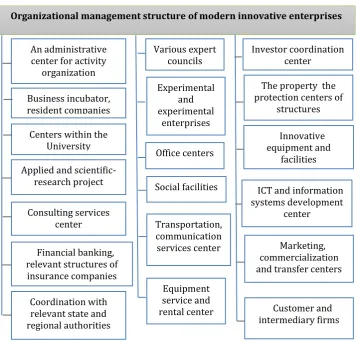
Figure 1. The organizational management structure of scientific-technological innovation enterprises
The competent authority for the establishment of innovative structure implements following functions: 1)to participate in the formation of governmental politics in the field of establishment and activity of technoparks, 2)to help a responsible company with the organization of activity in technoparks, 3)to formulate innovative and legal acts that regulate technopark activity, 4)to select management operator, 5)to regulate technopark activity, 6)to prepare an annual report about technopark activity and so on.
The functions of the modern innovative enterprise's management system can be summarized as follows: 1)formation of a system for supporting innovative activities, 2)creation of favorable conditions for the implementation of scientific and research and experimental-design works, 3)provision of consulting, engineering, technical, technological, information and other services for innovation enterprises, 4)market research, provision of marketing services to related institutions, 5)accompaniment of the innovation product to the discovery, selection, and application of it, 6)development of intellectual information system to support decision-making, etc.
For the management of modern innovative enterprises, a proper management system should be established. This system must be formed according to organizational and economic structure and as well as the purpose ad duties of innovation enterprises. According to the content, functions of the management system consist of functions such as accounting, analysis, planning, organization, forecasting, connection, and control.
Concrete tasks are being implemented in accordance with each stage of management. Following tasks are included in such tasks: 1)establishment of favorable condition for the
Organizational management structure of modern innovative enterprises
Investor coordination center
Innovative equipment and
facilities manufacturing The property the protection centers of
structures
ICT and information systems development
center Various expert
councils
Experimental and experimental
enterprises
Office centers
Social facilities
Transportation, communication
services center Marketing, commercialization and transfer centers Equipment
service and
rental center Customer and
intermediary firms Centers within the
University
Applied and scientific-research project
centers
Coordination with relevant state and regional authorities Consulting services
center Business incubator, resident companies An administrative center for activity
organization
Financial banking, relevant structures of
formation of supporting system of innovative activity, activity of residential companies, implementation of scientific-research and experimental-constructor works, 2)consulting, engineering, technical, technological, information and other services for innovation enterprises, 3)market research, marketing services for related enterprises, 4)revealing innovative product and accompanying of them, 5)development of intellectual information system for supporting decision-making, assistance to the development of innovation orders and investment projects on the preferential privileges for technoparks residents, assistance to attracting investment for the establishment of the development of innovation business and science-intensive manufacture, to achieve effective organization of scientific-educational-industrial relations, to create modern information structure, selection of factors that influence effectiveness of technopark activity, revealing internal potential and external environment that help to increase effectiveness of technopark, determination of application conditions of effectiveness strategy based on balanced indicators concept in technoparks and so on.
Management indicators of modern innovative enterprises activity
Based on the systematization of modern innovative enterprise activity experiments, its management indicators can be determined. Effective management of innovation enterprises is also evaluated based on that kind of indicators (Nechaev, Antipina, & Antipin, 2015; Zhou, 2017).
Following indicators are included: 1)tax and customs preferences in innovation enterprises, 2)scientific-innovative and educational activity, 3)scientific-technical, technological and resource potential, 4)governmental regulation mechanisms of development of innovative strategies, 5)financial and investment sources, 6)staff potential, 7)recognition level of technopark residents, high education and scientific research institutions, 8)infrastructure, technical, social and information provision of innovation enterprises, 9)direct interest of scientific research and education institutions, compatibility of specialization of innovation enterprises to the priorities of region policy, sustainable partnership with industrial companies, advanced practice in the field of commercialization of researches and technologies, balanced activity plan of innovation enterprises and so on. These indicators and relationships among them must be taken as an essential part of the development of an effective management structure.
Management indicators for the activity of modern innovative enterprises: 1)the tax and customs incentives, 2)scientific-innovative and educational activity, 3)development of residents, educational and scientific research enterprises, 4)on the commercialization of technologies, 5)financial and investment sources, 6)social and staff potential, 7)infrastructure and information provision, 8) state regulation mechanisms for the development of innovative strategies, 9)scientific-technical, technological and resource potential.
Management models and features of modern innovative enterprises
Management models and tools of modern innovative enterprises consist of a set of management decision-making procedures and rules, and they have an essential impact on the subjects’ activity managed in innovation enterprises (Alguliyev, Aliyev, & Shahverdiyeva, 2016;Kang, 2014; Lendel, Hittmár, & Latka, 2015; Mitan & Vătămănescu, 2019).
by the management company. Management company contributes to the development of residents’ business by gathering current and prospective functions of innovation enterprise managers and serves proper business-services to them. Management company as well as involves scientific and technological innovative enterprises to technoparks, place them, and serve to them. Following stages can be included in the management of technoparks: 1)analysis and monitoring of the current state of the managed system, 2)its development and forecasting, 3)ambitiousness, 4)planning, 5)distribution of resources and functions, 6)stimulation, 7)operative management and control, 8)analysis of changes (Wang, 2016).
It should be noted that, in any system, including innovative enterprises, there must be management mechanisms for efficient management. It should be considered that currently enough experience has been obtained which allows the implementation of management functions such as control, motivation, organization, planning in accordance with management stages in the development and application field of management theory.
In practice, the various governing bodies of innovative enterprises have been established. The management structure of innovative enterprises are like below: 1) management, a board of directors, 2) scientific and technical council, 3) financial and economic block, 4) intellectual property service, 5) innovative projects center, 6) production and innovation institutions and companies, 7) scientific and educational complex, 8) business incubator, 9) scientific-technological innovation enterprises technopark units, 10) service, 11) marketing and commercialization.
Conceptual model of a management network of modern innovative enterprises
Effective management of modern innovative enterprise activity creates a necessity for the development of its specific conceptual model beforehand. The establishment of such a model should be based on a modern scientific-technological and innovative approach.
This model, in the general case, is the harmonious combination of social-economical purposes of innovative enterprises, management system, requirements of innovation-investment projects, commercialization mechanisms of the results of scientific researches, organizational principles of participant elements, and production (Startseva & Bronnikova, 2015).
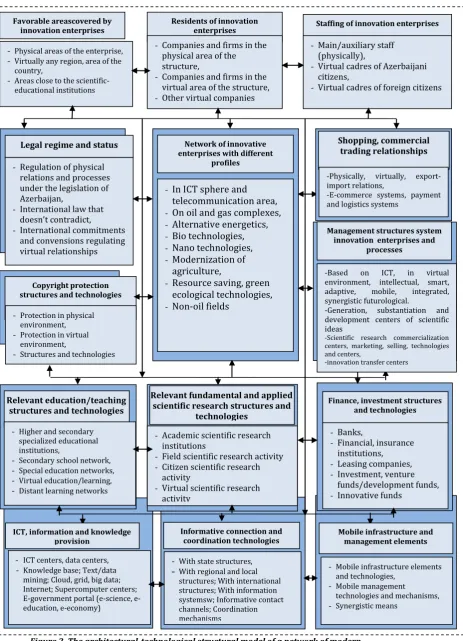
The presented picture provides information about a list of submodels, their content, and main components, which are necessary for the effective management of modern innovation enterprises. It is proposed to form a network of modern innovative enterprises, taking into account the economic strategic priorities of the region, organizational and management structure of modern innovative enterprises. In this case, reorganizing some of the substructures of common character with innovative enterprises it's possible to have even more effective network innovative infrastructure.
Figure 2. The architectural-technological structural model of a network of modern innovation enterprises with different profiles
- With state structures, - With regional and local
structures; With international structures; With information systemsw; Informative contact channels; Coordination mechanisms
- Mobile infrastructure elements and technologies,
- Mobile management
technologies and mechanisms, - Synergistic means
- ICT centers, data centers, - Knowledge base; Text/data
mining; Cloud, grid, big data; Internet; Supercomputer centers; E-government portal (science, e-education, e-economy)
Legal regime and status - Regulation of physical
relations and processes under the legislation of Azerbaijan,
- International law that doesn’t contradict,
- International commitments and convensions regulating virtual relationships
Staffing of innovation enterprises Residents of innovation
enterprises Favorable areascovered by
innovation enterprises
- Physical areas of the enterprise, - Virtually any region, area of the
country,
- Areas close to the scientific-educational institutions
- Main/auxiliary staff (physically),
- Virtual cadres of Azerbaijani citizens,
- Virtual cadres of foreign citizens - Companies and firms in the
physical area of the structure,
- Companies and firms in the virtual area of the structure, - Other virtual companies
Informative connection and coordination technologies Copyright protection
structures and technologies
- Protection in physical environment, - Protection in virtual
environment,
- Structures and technologies
- In ICT sphere and telecommunication area, - On oil and gas complexes, - Alternative energetics, - Bio technologies, - Nano technologies, - Modernization of
agriculture,
- Resource saving, green ecological technologies, - Non-oil fields
Network of innovative enterprises with different
profiles
Relevant education/teaching structures and technologies
- Higher and secondary specialized educational institutions,
- Secondary school network, - Special education networks, - Virtual education/learning, - Distant learning networks
Relevant fundamental and applied scientific research structures and
technologies - Academic scientific research
institutions
- Field scientific research activity - Citizen scientific research
activity
- Virtual scientific research activity
Finance, investment structures and technologies
- Banks,
- Financial, insurance institutions, - Leasing companies, - Investment, venture
funds/development funds, - Innovative funds
Mobile infrastructure and management elements ICT, information and knowledge
provision
Management structures system innovation enterprises and
processes
-Based on ICT, in virtual environment, intellectual, smart, adaptive, mobile, integrated, synergistic futurological.
-Generation, substantiation and development centers of scientific ideas
-Scientific research commercialization centers, marketing, selling, technologies and centers,
-innovation transfer centers Shopping, commercial
trading relationships -Physically, virtually, export-import relations,
Intellectualization features of management. Following areas are preferred in the development concept of modern innovative enterprises to increase the effectiveness of enterprises activity: 1)consideration of development prospects in produced goods and services, 2)application of intellectual systems in the determination of innovation and scientific research areas, modernization of enterprise, development, and management of the database, 3)development of mobile management structure of innovative enterprises, 4)increasing the role of the human factor in increasing the efficiency of the enterprise, 5)consideration of innovative services aimed at the needs of enterprise customers, 6)the using of advanced technologies, ICT for development of enterprise, the role of highly qualified specialists and scholars, using of technological opportunities such as modeling, stimulation, forecasting, etc.
Conceptual model of effective management of modern innovative enterprises includes the following components (Alguliyev et al., 2016; Ratten & Usmanij, 2020; Startseva & Bronnikova, 2015):
development submodel of organizational management mechanisms on high effectiveness of technoparks activity,
management block model on activation of innovation processes and improvement of innovation potential through the development of the science-intensive field,
selection, evaluation and realization model of investments and innovation-investment projects,
activity submodel on the integration of production-science-education-business relations,
organizational submodel of regional and international relations,
association submodel with governmental and financial institutions
organizational submodel of social-economic goals and relations
submodel of marketing and market research, commercial and sale relations,
submodel of management block on the organization of consulting activity and commercialization mechanisms of the results of scientific researches,
submodel on the technical and technological provision
submodel on the formation of information and institutional infrastructures
improvement submodel of the effectiveness of structure elements activity.
Prospective spheres of the application of intellectual systems in the economy are below: 1) production management, 2) internal planning and forecasting of production and enterprise, 3) marketing and sales management, 4) financial management, 5) the risk-management 6) banking, 7) commercial and others. Intellectual systems are classified according to different features.
Figure 3. The conceptual structure of intellectual management system of the modern innovative enterprises
In a classification of intellectual information systems, their application areas, autonomy level, dependency on the knowledge base or information systems, reciprocal interaction with objects, adaptivity, presentation model of knowledge should be considered (Aliyev & Shahverdiyeva, 2017; Huber, Kaufmann, & Steinmann, 2017; Kuznetsov, Gorlacheva, & Bityerakov, 2017). O u ter influ ences a nd en vir on men t f ac tor s
Management subject (managing subsystem)
(Managed subsystem) Management subject
Mission, priority, strategic aim and
position of enterprise, process, management
system
Collecting and systematic analyse of initial information,
indicators Ou ter in flue n ce an d envi ro n m ent fac to rs
Composition of development program, activity plan of
enterprise, process
Realization, algorhythm of activity, development plan, processing and application
of performance mechanisms of activity
procedures Data bases Informative, analitical systems, logical and intellectual support means Int er na l envi ron men t f ac tor s an d in fl u ence m ech an isms Knowle dge bases Stages, field, modules, principles, scientific-methodological bases of management High-level computer service, network technologies (cloud, grid, GPS,...), platforms, programs. Virtual, corporative, local architectural and technological structures and solutions Innovativization of management
and development processes
Checking results, adjustment of aims, plans and mechanisms. Creating
feedback Improving
intellectualiza- tion level
By taking the aforementioned qualifications and responsibilities, intellectualization contours of management of modern innovative enterprise activity can be given as a set of interconnected blocks (figure 3).
Directions for improving the efficiency of product/service production in innovative enterprises
One of the main sources of improving efficiency at the micro-level of the economy in innovative companies is the development of their production plans based on the achievements of mathematical methods and ICT. Therefore, econometric modeling approaches were used for this purpose.
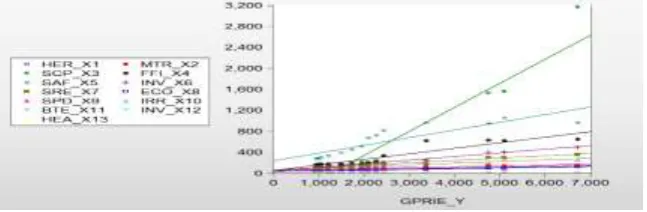
Based on this approach, initial indicators have been determined to establish an econometric model for the analysis of innovation and science-intensive products or service production in the activity of innovative enterprises. Y is a dependent variable and characterizes Gross Product Release in Innovative Enterprises (GPRIE-Y) and the volume of services (man). Xi independent variables characterize the following indicators in innovative enterprises: HER-X1 - heat and energy resources costs, man., applied to the product -service launch of the innovative enterprises, MTR-X2 - material and technical resource costs, man., SCP-X3 - costs for the purchase of semi-finished and complementary products, man., FFI-X4 - Fundamental funds and infrastructure elements, man., SAF-X5 - Salary (basic, creative, supplementary) fund, man., INV-X6 - Investment incentives (all sources), man., SRE-X7 - Scientific research and education costs, man., ECO-X8 - Environmental protection and ecological balance costs, man., SPD-X9 - Social protection and public development costs, man., IRR-X10 - Innovative research and perspective research costs, man., BTE-X11 - expediency degree of "Resource-production-sales" business environment, assessment of the expert group on the (0, 10) scale, INV-X12 - Innovative degree of cycle "Science-education-research innovation-production", assessment of the expert group on the (0, 10) scale, HEA-X13 - The ecological and health level of production and environment, assessment of the expert group on the (0, 10) scale.
Taking these into account, the econometric model of the innovative enterprises is proposed as follows in such a way that its relevant parameters are determined by computer software packages based on the least-squares method.
To study the activity of the innovative enterprises, analysis of potential socio-economic development indicators of the technopark has been carried out. Correlation-regression analysis methods have been used to evaluate the activity of innovative enterprises, to detect the interconnection of some indicators. As an investigated indicator, total innovative product or service production volume in the innovative enterprises has been accepted.
Based on the initial indicators of the activity of innovative enterprises, its econometric model was established. To identify important factors, the construction of a pair correlation matrix defining the activity of innovative enterprises has been implemented [30-32].
The final table of regression analysis, additional characteristics of assessment of the impact of factors, prediction of the indicators of the activity of innovative enterprises, by using of multi-factor regression analysis it is possible to predict the total innovation product volume (Aliyev & Shahverdiyeva, 2018b; Kleiner, 2016).
An input matrix has been established based on observed expert assessment of non-dependent variables included in the econometric model.
Estimation Equation: GPRIE_Y = C(1)*HER_X1 + C(2)*MTR_X2 + C(3)*SCP_X3 +
C(4)*FFI_X4 + C(5)*SAF_X5 + C(6)*INV_X6 + C(7)*SRE_X7 + C(8)*ECO_X8 + C(9)*SPD_X9 + C(10)*IRR_X10 + C(11)*BTE_X11 + C(12)*INV_X12 + C(13)*HEA_X13 + C(14).
Substituted Coefficients: GPRIE_Y = -4.099*HER_X1 + 3.115*MTR_X2 + 0.840*SCP_X3 - 0.363*FFI_X4 + 2.083*SAF_X5 + 1.229*INV_X6 - 2.008*SRE_X7 + 18.398*ECO_X8 - 2.114*SPD_X9 + 6.488*IRR_X10 - 1.935*BTE_X11 - 1.389*INV_X12 - 150.415*HEA_X13 - 343.834.
The graph of the distribution of observed values of the variables according to the input matrix is given in Figure 4 and 5 The regression ratios of the econometric model were calculated using the least-squares method based on the matrix values.
Fig. 4. Graph of distribution of observed values of variables in innovative enterprises
The graphs and calculations shown are carried out using the special software developed based on the synthesis of relevant modules of statistical software packages The final table of regression analysis, the additional characteristics of the assessment of factors impact, the prediction of the activity indicators of innovative enterprises, using the multifactor regression analysis, it is possible to predict the total innovative product or service volume.
Application perspectives of 4.0 industrial revolution in improving the efficiency of activity management of innovative enterprises
The following technological innovations will be more important in the application of the IV Industrial Revolution Platform in innovative enterprises. The development of blockchain technologies, the emergence of new network cryptocurrencies will lead to many socio-economic changes in international monetary relations. 3D printing will create new production, sales, marketing, and advertising technologies. As a result of the industrial revolution, there will be a serious need for new mechanisms of regulation in human-nature relations in the field of energy collecting, storage, and due to the emergence of new alternative energy sources.
The main Internet and information technologies based on the IV Industrial Revolution in various fields of application include implant technology, new visual interface, portable Internet (clothing Internet), Internet of Things, "smart" city, Big Data technologies, drone cars, artificial intelligence, robotics, cryptocurrency technologies, 3D printing in the production, education, medical sphere, and consumer goods field (Gulin & Uskov, 2017; Skobelev & Borovik, 2017; World Economic Forum, 2019).
Research shows that the innovations brought and to be brought by the IV Industrial Revolution create opportunities for emerging of new revolutions and transition to them.
Thus, how the structural elements of innovative technologies existing in the IV industrial revolution interact with each other, function, and further improve the relationship between these elements in the near future leads to the formation and emergence of a new V industrial revolution. Favorable conditions are being created for the sustainable development of new technologies. For this reason, ample opportunities are being created for the formation of the next V industrial revolution. It should be noted that the continuation of the features of the application of the V industrial revolution in the globalized world in further scientific and practical research is considered one of the most important and necessary issues for the modern period.
Conclusions
In the third millennium, the creation of an information community depends on the formation and development of an economy based on knowledge and innovation. Such an economy gives impetus to the development of science-intensive areas, as well as technological innovations and new technologies. The use of high technology will lead to the innovative economic development of the country.
intellectual society, as well as strengthen the ties between science and education. Such aspects require the creation of an effective and intellectual management system.
As a result of studying the models of the organizational structure of management of various innovative structures, its exemplary organizational structure was developed. An architectural and technological structural model of a network of modern innovative enterprises of various profiles has been developed. The main directions of managing innovative enterprises of the future are identified and the corresponding conceptual management model based on the recommendations of international organizations is proposed. A conceptual model of an intellectual system for managing the integrated activities of innovative enterprises has been developed. The model of intellectual management of the promising activities of modern innovative enterprises was proposed from such blocks as 1) additive, adaptive technologies, and structures, 2) increasing the role of the human factor, 3) considering the prospects for the development of innovative products and services, 4) customer-oriented, logistics, electronic commerce, marketing, 5) a flexible management structure, 6) the use of intelligent systems 7) modern ICT, network, cloud, fog, and other technologies.
Also, to improve the production of products/services at innovative enterprises, appropriate approaches and models have been developed. The obtained calculations based on them show that the constructed regression models can be used for practical purposes. The analysis showed that the factors included in the regression models are statistically significant and have a significant impact on the total volume of a product or service. Additional characteristics of the regression model make it possible to predict the performance of technology parks and calculate the total volume of innovative products and services.
It can be noted that the implementation of the proposal to create the concept of an intellectual management system for modern innovative enterprises will increase the efficiency and high-tech development of the non-oil sector on a high-tech basis.
References
Adebisi, S.A., & Bakare, N.A. (2019). Survival strategies and sustainability of small and medium enterprises in a volatile environment. Management Dynamics in the Knowledge Economy, 7(4), 553-569. DOI: 10.25019/MDKE/7.4.07.
Alguliyev, R.M., Aliyev, A.G., & Shahverdiyeva, R.O. (2016). Models and mechanisms for the management of ICT-technoparks. Science Journal of Business and Management, 4(6), 199-203. DOI: 10.11648/j.sjbm.20160406.14.
Aliyev, A.G. (2019). Development of models of manufacturing processes of innovative products at different levels of management. International Journal of Information Technology and Computer Science, 11(5), 23-29. DOI: 10.5815/ijitcs.2019.05.03. Aliyev, A.G., & Shahverdiyeva, R.O. (2017). Conceptual bases of intellectual management
system of innovative technoparks. International Journal of Education and Management Engineering, 2, 1-7. DOI:10.5815/ijeme.2017.02.01.
Aliyev, A.G., & Shahverdiyeva, R.O. (2018a). Application of mathematical methods and models in product–service manufacturing processes in scientific innovative technoparks. International Journal of Mathematical Sciences and Computing, 4(3), 1-12. DOI: 10.5815/ijmsc.2018.03.01.
Aliyev, A.G., & Shahverdiyeva, R.O. (2018b). Perspective directions of development of innovative structures based on modern technologies. International Journal of Engineering and Manufacturing, 8(4), 1-12. DOI: 10.5815/ijem.2018.04.01.
Deloitte Legal (2016). Strategic road maps for the national economy and main economic
sectors approved. Retrieved from
EFFRA (2020). Factories of the Future. Retrieved from https://www.effra.eu/sites/default/files/factories_of_the_future_2020_roadmap.pdf European Commission (2019). 2019 Innovation Scoreboards: The innovation
performance of the EU and its regions is increasing. Retrieved from https://ec.europa.eu/commission/presscorner/detail/en/IP_19_2991
Gulin, K.A., & Uskov, V.S. (2017). Trends of the Fourth Industrial Revolution. Economic and Social Changes: Facts, Trends, Forecast, 10(5), 216-221. DOI: 10.15838/esc.2017.5.53.15.
Huber, D., Kaufmann, H., & Steinmann, M. (2017). The organizational structure: the innovative enterprise. In Huber, D., Kaufmann, H., & Steinmann, M. (Eds.), Bridging the Innovation Gap (pp.53-91). Cham, Switzerland: Springer. DOI: 10.1007/978-3-319-55498-3_5.
Kang, B.J. (2014). Exploring governance models of science & research parks and related organizations. World Technopolis Review, 3(1), 39-54. DOI: 10.7165/wtr2014.3.1.39. Khanmirzaee, S., Jafari, M., & Akhavan, P. (2018). A study on the role of science and technology parks in development of knowledge-based economy. World Journal of Entrepreneurship Management and Sustainable Development, 14(1), 74-85. DOI: 10.1108/WJEMSD-05-2017-0021.
Kleiner, G.B. (2016). Economy. Modeling. Mathematics. Moscow, RU: CEMI RAN.
Kłos, S., Skrzypek, K., & Dabrowski, K. (2017). A knowledge-management system for the innovation-strategy development of SME enterprises. In Damas evic ius, R., & Mikas yte , V. (Eds.), Information and Software Technologies. ICIST 2017. Communications in Computer and Information Science (pp.15-24). Cham, Switzerland: Springer. DOI: 10.1007/978-3-319-67642-5_2.
Kuznetsov, A.I., Gorlacheva, E.N., & Bityerakov, M.A. (2017). Managing the innovative development of a high-tech science-intensive enterprise. Bulletin of the Moscow Region State University. Series: Economics, 2, 114-122.
Lendel, V., Hittma r, S ., & Latka, M. (2015). Application of management of innovation processes in enterprises: management approach, problems and recommendations. Procedia Economics and Finance, 34, 410-416. DOI: 10.1016/S2212-5671(15)01648-2.
Mitan, A., & Va ta ma nescu, E.M. (2019). Romanian medium-sized enterprises internationalization in the light of internal capabilities and external conditions. A Secondary data analysis. Management Dynamics in the Knowledge Economy, 7(4), 485-501. DOI: 10.25019/MDKE/7.4.03.
Nechaev, A., Antipina, O., & Antipin, D. (2015). Efficiency estimation of innovative activity the enterprises. Journal of Mathematics and Statistics, 10(4), 443–447. DOI: 10.3844/jmssp.2014.443.447.
NOTEM (2014). National strategy for the development of information society (2014- 2020) is approved. Retrieved from https://notemlaw.com/news/164-national-strategy-for-the-development-of-information-society-2014-2020-is-approved.html. Panas, Y., & Tkach, S. (2017). The features of innovation management at Ukrainian and
European enterprises. Baltic Journal of Economic Studies, 3(2), 101-106. DOI: 10.30525/2256-0742/2017-3-2-101-106.
Peterkova, J., & Franek J. (2018). Specifics of management of enterprise innovation activities in the Czech Republic - the decision-making mechanism. Management Systems in Production Engineering, 26(3), 137-142. DOI: 10.1515/mspe-2018-0022. Ratten, V., & Usmanij, P. (2020). Entrepreneurship and organizational change: managing innovation and creative capabilities. In Ratten, V. (Ed.), Entrepreneurship and Organizational Change (pp.1-6). Cham, Switzerland: Springer.
Skobelev, P.O., & Borovik, S.Y. (2017). On the way from industry 4.0 to industry 5.0: from digital manufacturing to digital society. International Scientific Journal Industry 4.0, 2(6), 307-311.
Startseva, T.E., & Bronnikova, T.S. (2015). Economics and management of innovative development of the enterprise. Methodological tools. Monograph. Moscow, RU: RUSAYNS.
UNPD (2012). Development Concept “Azerbaijan 2020: Vision for the Future”. Retrieved from
http://www.undp.org/content/dam/azerbaijan/docs/sustain_development/AZ_Vis ion2020_government_draft_en.pdf
Wang, Y. (2016). The management innovation research on small micro enterprise. In Proceedings of the 2016 2nd International Conference on Education Technology, Management and Humanities Science (pp.552-555). Paris, FR: Atlantis Press. DOI: 10.2991/etmhs-16.2016.123.
Wasim, M.U. (2014). Factors for Science Park Planning. World Technopolis Review, 3(2), 97-108. DOI: 10.7165/wtr2014.3.2.97.
World Economic Forum (2019). The Centre for the Fourth Industrial Revolution is a hub for global, multistakeholder cooperation to develop policy frameworks and advance collaborations that accelerate the benefits of science and technology. Retrieved from
https://www.weforum.org/centre-for-the-fourth-industrial-revolution/about#:~:text=The%20Centre%20for%20the%20Fourth,have%20both %20merits%20and%20risks.
Zaburanna, L., & Lutska, T. (2017). Assessment of management effectiveness of innovation and investment activity of enterprises. Marketing and Management of Innovations, 4, 162-175. DOI: 10.21272/mmi.2017.4-14.
Zhou, W. (2017). Analysis of the key issues of enterprise management innovation. In Proceedings of the 7th International Conference on Education, Management, Information and Mechanical Engineering (pp.1699-1705). Paris, FR: Atlantis Press. DOI: 10.2991/emim-17.2017.345.
Received: December 11, 2019 Accepted: June 3, 2020
© 2020 Faculty of Management (SNSPA), Author(s). This is an open-access article licensed under the Creative
Commons Attribution-NonCommercial-NoDerivs License