Does the Type of Material Information Matter to CEO
Turnover?
Ya-Fang Wang
Department of Accounting, Providence University
200, Sec. 7, Taiwan Boulevard, Shalu Dist., Taichung City 43301 Taiwan (R.O.C.)
Tel: 886-4-2632-8001 ext.13216 E-mail: [email protected]
Received: Feb. 20, 2016 Accepted: May 6, 2016 Published: June 1, 2016
doi:10.5296/ajfa.v8i1.9339 URL: http://dx.doi.org/10.5296/ajfa.v8i1.9339
Abstract
Using hand-collected data to obtain the nature of material information, I examine whether and how the likelihood of CEO turnover is associated with material information disclosures. I find the likelihood of CEO turnover increases following different types of material information announcements. Further, I partitioned the sample into the various stages of company life cycle in order to determine whether life cycle stage affects the relationship between the disclosure of material information and CEO turnover. The results show that the disclosure of material information by companies only in maturity and decline is associated with high CEO turnover.
1. Introduction
Issuing material information is a people-oriented corporate culture in which product safety and consumer rights are paramount. Hence, encouraging companies to issues material information is particularly important, because such companies of issuing material information are more likely to reject illegal act when they face the beneficial temptation. One key to sustainable operations is to bear in mind material information in the full weight of any corporate decision. Companies are more likely to disclose material information when they think such information is important to corporate decisions and are therefore more likely to win trust and respect from customers and stockholders. In this study, I focus on whether material information disclosures are associated with following economic consequences, because I argue that the nature of material information disclosures is of particular importance and may cause various influences on companies and market participants (Foster and Viswanathan 1993; Kim and Verrecchia 1991; Holthausen and Verrecchia 1988). Material information disclosures belong to voluntary disclosures in Taiwan, and Taiwan has specific sections designated to encourage companies to disclose material information in a timely and accurate manner.
Material information is defined as (1) financial or nonfinancial information having a material impact on a public company’s financial and business performance, or (2) financial or nonfinancial information having a material impact on the price of the securities or investment decision of market participants. According to the laws stated in the Taiwan Stock Exchange Corporation Procedures, material information can be classified into six categories to capture the nature of material information from different perspectives. According to the Taiwan Stock Exchange Corporation Procedures for Verification and Disclosure of Material Information of Companies with Listed Securities, I divided the disclosure of material information into six classifications: (1) material change in shareholder equity, (2) material change in business policy, (3) material disasters resulting in serious reduction or complete cessation of production, (4) material effects on shareholder equity or company operations resulting from a change in laws, regulations, or rules of the home country, (5) mass media reportage about the parent company sufficient to affect securities prices of a listed subsidiary in the ROC, and (6) occurrence of any other material event that shall be immediately reported pursuant to law or regulation of a foreign company’s home country.
interpret as signals of firms’ financial health. This raises the question of whether companies are likely to terminate their CEOs when they think the CEO shall be responsible for material information disclosures.
The remainder of this study is organized as follows: Section 2 presents a literature review. Section 3 describes the sample selection process and research design. Section 4 reports the empirical results. Conclusions are discussed in Section 5.
2. Literature Review
According to Furtado and Karen (1990), the research on executive turnover comprises three broad categories: (1) factors contributing to turnover, (2) immediate market reactions to executive turnover events, and (3) subsequent performance post management turnover. Many studies on executive turnover change the focus from poor performance to financial reporting quality. And, these empirical studies have proved the existence of the relationship between poor performance and the likelihood of managerial turnover (Coughlan and Schmidt 1985; Warner et al. 1988; Weisbach 1988; Denis et al. 1997; Engel et al. 2003; Bonnier and Bruner 1989; Furtado and Rozeff 1987; Kaplan and Minton 2006; Kim 2008; Karpoff et al. 2008). In this study, I focus on whether material information disclosures are associated with following executive turnover, because I argue that the nature of material information disclosures is of particular importance and may cause various influences on companies and market participants (Foster and Viswanathan 1993; Kim and Verrecchia 1991; Holthausen and Verrecchia 1988). Thus, my study represents initial attempt to reveal the intricacy between executive turnover and material information.
3. Research Design
3.1. Data Sources
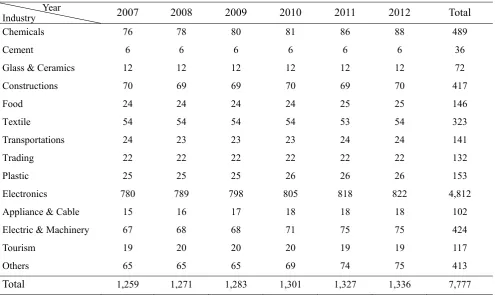
To test research questions, I collected publicly listed companies in Taiwan over the period from 2007 to 2012. My sample comprised 7,777 firm-year observations and this sample was identified through two sources. I began by hand collecting data related to types of MI disclosures from the Market Observation Post System. I then accessed company-level data related to CEO turnover and accounting from the Taiwan Economic Journal (TEJ) database. Table 1 provides the distribution of research samples across industries and years and shows that electronics industry has the highest percentages in research samples (61.87%), while cement industry has the lowest percentages in research samples (0.46%).
Table 1. Sample Distribution
Year
Industry 2007 2008 2009 2010 2011 2012 Total
Chemicals 76 78 80 81 86 88 489
Cement 6 6 6 6 6 6 36
Glass & Ceramics 12 12 12 12 12 12 72
Constructions 70 69 69 70 69 70 417
Food 24 24 24 24 25 25 146
Textile 54 54 54 54 53 54 323
Transportations 24 23 23 23 24 24 141
Trading 22 22 22 22 22 22 132
Plastic 25 25 25 26 26 26 153
Electronics 780 789 798 805 818 822 4,812 Appliance & Cable 15 16 17 18 18 18 102 Electric & Machinery 67 68 68 71 75 75 424
Tourism 19 20 20 20 19 19 117
Others 65 65 65 69 74 75 413
Total 1,259 1,271 1,283 1,301 1,327 1,336 7,777
3.2 Model Specification-Material Information vs. CEO Turnover
I constructed a research model to explore whether material information is associated with CEO turnover, and test which types of material information can better describe companies’ reactions to releases of material information. The research model (1) is as follows:
) 1 ( , 6
5 4
3 2
6 1
0 MI ROA LOSS LEV SIZE GCO YEAR it
CEO=α +α− +α +α +α +α +α +ϕ +ε
equals 1 if the company disclosed material change in business policy, else 0; MI-3 equals 1 if the company disclosed material disaster resulting in serious reduction or complete cessation of production, else 0; MI-4 equals 1 if the company disclosed material effect on shareholders' equity or company operations resulting from a change in laws, regulations, or rules of the home country, else 0; MI-5 equals 1 if the company disclosed mass media reportage about the parent company sufficient to affect securities prices of a listed subsidiary in the ROC, else 0; MI-6 equals 1 if the company disclosed occurrence of any other material event that shall be immediately reported pursuant to law or regulation of the foreign company's home country, else 0; ROA equals net income divided by total assets; LOSS equals 1 if operating income is less than zero, else 0; LEV equals long-term debt divided by total assets; SIZE equals the natural log of total assets; GCO equals 1 if the company receives a going concern opinion, else 0; and YEAR equals dummy variables controlling for years.
4. Results and Analysis
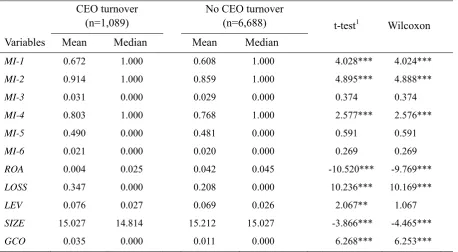
Table 2. Descriptive Statistics
CEO turnover (n=1,089)
No CEO turnover
(n=6,688) t-test1 Wilcoxon
Variables Mean Median Mean Median
MI-1 0.672 1.000 0.608 1.000 4.028*** 4.024***
MI-2 0.914 1.000 0.859 1.000 4.895*** 4.888***
MI-3 0.031 0.000 0.029 0.000 0.374 0.374
MI-4 0.803 1.000 0.768 1.000 2.577*** 2.576***
MI-5 0.490 0.000 0.481 0.000 0.591 0.591
MI-6 0.021 0.000 0.020 0.000 0.269 0.269
ROA 0.004 0.025 0.042 0.045 -10.520*** -9.769***
LOSS 0.347 0.000 0.208 0.000 10.236*** 10.169***
LEV 0.076 0.027 0.069 0.026 2.067** 1.067
SIZE 15.027 14.814 15.212 15.027 -3.866*** -4.465***
GCO 0.035 0.000 0.011 0.000 6.268*** 6.253*** 1 Asterisks *, **, *** indicate significance at the 0.10, 0.05, and 0.01 levels.
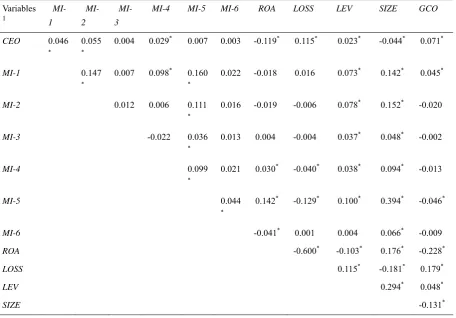
Table 3. Correlation Matrix
Variables 1
MI-1
MI-2
MI-3
MI-4 MI-5 MI-6 ROA LOSS LEV SIZE GCO
CEO 0.046
*
0.055
*
0.004 0.029* 0.007 0.003 -0.119* 0.115* 0.023* -0.044* 0.071*
MI-1 0.147
*
0.007 0.098* 0.160 *
0.022 -0.018 0.016 0.073* 0.142* 0.045*
MI-2 0.012 0.006 0.111
*
0.016 -0.019 -0.006 0.078* 0.152* -0.020
MI-3 -0.022 0.036
*
0.013 0.004 -0.004 0.037* 0.048* -0.002
MI-4 0.099
*
0.021 0.030* -0.040* 0.038* 0.094* -0.013
MI-5 0.044
*
0.142* -0.129* 0.100* 0.394* -0.046*
MI-6 -0.041* 0.001 0.004 0.066* -0.009
ROA -0.600* -0.103* 0.176* -0.228*
LOSS 0.115* -0.181* 0.179*
LEV 0.294* 0.048*
SIZE -0.131*
1 * Indicates significance at the 5 percent level.
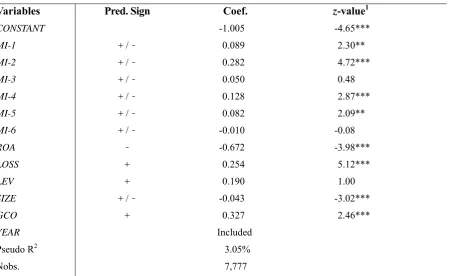
Table 4. Material Information and CEO Turnover
Variables Pred. Sign Coef. z-value1
CONSTANT -1.005 -4.65***
MI-1 +/- 0.089 2.30**
MI-2 +/- 0.282 4.72***
MI-3 +/- 0.050 0.48
MI-4 +/- 0.128 2.87***
MI-5 +/- 0.082 2.09**
MI-6 +/- -0.010 -0.08
ROA - -0.672 -3.98***
LOSS + 0.254 5.12***
LEV + 0.190 1.00
SIZE +/- -0.043 -3.02***
GCO + 0.327 2.46***
YEAR Included
Pseudo R2 3.05%
Nobs. 7,777
1 Asterisks *, **, *** indicate significance at the 0.10, 0.05, and 0.01 levels, respectively. One-tailed for
directional expectations, two-tailed for others.
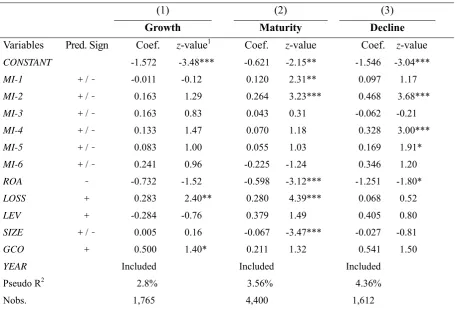
Table 5. Material Information and CEO Turnover: Consider Life Cycle
(1) (2) (3)
Growth Maturity Decline
Variables Pred. Sign Coef. z-value1 Coef. z-value Coef. z-value
CONSTANT -1.572 -3.48*** -0.621 -2.15** -1.546 -3.04***
MI-1 +/- -0.011 -0.12 0.120 2.31** 0.097 1.17
MI-2 +/- 0.163 1.29 0.264 3.23*** 0.468 3.68***
MI-3 +/- 0.163 0.83 0.043 0.31 -0.062 -0.21
MI-4 +/- 0.133 1.47 0.070 1.18 0.328 3.00***
MI-5 +/- 0.083 1.00 0.055 1.03 0.169 1.91*
MI-6 +/- 0.241 0.96 -0.225 -1.24 0.346 1.20
ROA - -0.732 -1.52 -0.598 -3.12*** -1.251 -1.80*
LOSS + 0.283 2.40** 0.280 4.39*** 0.068 0.52
LEV + -0.284 -0.76 0.379 1.49 0.405 0.80
SIZE +/- 0.005 0.16 -0.067 -3.47*** -0.027 -0.81
GCO + 0.500 1.40* 0.211 1.32 0.541 1.50
YEAR Included Included Included
Pseudo R2 2.8% 3.56% 4.36%
Nobs. 1,765 4,400 1,612
1 Asterisks *, **, *** indicate significance at the 0.10, 0.05, and 0.01 levels, respectively. One-tailed for
directional expectations, two-tailed for others.
5. Conclusions
This study provides empirical evidence to explore whether material information is associated with CEO turnover based on a sample of 7,777 observations from 2007 to 2012. Overall, evidence shows that companies are more likely to terminate their CEOs following material information announcements. I further consider the various stages of company life cycle in order to determine whether life cycle stage affects the relationship between the disclosure of material information and CEO turnover. Notably, I find that the disclosure of material information by companies only in maturity and decline is associated with high CEO turnover.
References
Al-Tuwaijri, S. A., T. E. Christensen, & K. E. Hughes II. (2004). The relations among environmental disclosure, environmental performance, and economic performance: A simultaneous equations approach. Accounting, Organizations and Society, 29(5-6), 447-471. http://dx.doi.org/10.1016/S0361-3682(03)00032-1
Anthony, J., & K. Ramesh. (1992). Association between accounting performance measures and stock prices: A test of the life cycle hypothesis. Journal of Accounting and Economics, 15(2-3), 203-227. http://dx.doi.org/10.1016/0165-4101(92)90018-W
Arthaud-Day, M.L., Certo, S.T., Dalton, C.M., & Dalton, D.R. (2006). A changing of the guard: executive and director turnover following corporate financial restatements. Academy of Management Journal, 49, 1119-1136. http://dx.doi.org/10.5465/AMJ.2006.23478165
Black, E. (1998). Life-cycle impacts on the incremental value-relevance of earnings and cash
flow measures. Journal of Financial Statement Analysis, 4(1), 40-56.
http://dx.doi.org/10.1016/0748-5751(86)90010-2
Bonnier, K.A., & Bruner, R.F. (1989). An analysis of stock price reaction to management change in distressed firms. Journal of Accounting and Economics, 11, 95-106. http://dx.doi.org/10.1016/0165-4101(89)90015-3
Burks, J.T. (2010). Disciplinary measures in response to restatements after Sarbanes-Oxley. Journal of Accounting and Public Policy, 29, 195-225. http://dx.doi.org/10.1016/j.jaccpubpol.2010.03.002
Bushee, J. B., & T. H. Goodman. (2007). Which institutional investors trade based on private information about earnings and returns? Journal of Accounting and Research,45(2), 289-321. http://dx.doi.org/10.1111/j.1475-679X.2007.00235.x
Canadian Institute of Chartered Accountants (CICA). (2010). Environmental, Social, and Governance (ESG) Issues in Institutional Investor Decision Making. CICA, Toronto.
Cohen, J., L. Holder-Webb, L. Nath, & D. Wood. (2011). Retail investors’ perceptions of the decision-usefulness of economic performance, governance, and corporate social responsibility disclosures. Behavioral Research in Accounting, 23(1), 109-129. http://dx.doi.org/10.2308/bria.2011.23.1.109
Collins, D., Masli, A., Reitenga, A.L., & Sanchez, J.M. (2009). Earnings restatements, the Sarbanes-Oxley Act and the disciplining of chief financial officers. Journal of Accounting, Auditing and Finance, 24, 1-34. http://dx.doi.org/10.2139/ssrn.1076800
Core, J. E. (2001). A review of the empirical disclosure literature: Discussion. Journal of
Accounting and Economics, 31(1-3), 441-456.
http://dx.doi.org/10.1016/S0165-4101(01)00036-2
http://dx.doi.org/10.1016/0165-4101(85)90027-8
Cruise, S. (2011). Investors demand improved sustainability reporting.
Davis, A. K., Piger, J. M., & Sedor, L. M. (2012). Beyond the numbers: Measuring the information content of earnings press release language. Contemporary Accounting Research, 29(3), 845-68. http://dx.doi.org/10.1111/j.1911-3846.2011.01130.x 1
Denis, D.J., Denis, D.K., & Sarin, A. (1997). Ownership structure and top executive turnover.
Journal of Financial Economics, 45, 193-221.
http://dx.doi.org/10.1016/S0304-405X(97)00016-0
Desai, H., Hogan, C., & Wilkins, M.S. (2006). The reputational penalty for aggressive accounting: earnings restatements and management turnover. The Accounting Review, 81, 83-112. http://dx.doi.org/10.2308/accr.2006.81.1.83
Dhaliwal, D. S., O. Z. Li, A. Tsang, & Y. G. Yang. (2011). Voluntary nonfinancial disclosure and the cost of equity capital: The initiation of corporate social responsibility reporting. The Accounting Review,86(1), 59-100. http://dx.doi.org/10.2308/accr.00000005
Diamond, D., & R. Verrecchia. (1991). Disclosure, liquidity, and the cost of capital. The Journal of Finance,46(4), 1325-1359. http://dx.doi.org/10.2307/2328861
Engel, E., Hayes, R.M., & Wang, X. (2003). CEO turnover and properties of accounting
information. Journal of Accounting and Economics, 36, 197-226.
http://dx.doi.org/10.1016/j.jacceco.2003.08.001
Foster, F. D., & S. Viswanathan. (1993). The effect of public information and competition on trading volume and price volatility. Review of Financial Studies, 6(1), 23-56. http://dx.doi.org/10.1093/rfs/6.1.23
Furtado, E.P., & Karen, V. (1990). Causes, consequences, and shareholder wealth effects of management turnover: A review of the empirical evidence. Financial Management, 19, 60-75. http://dx.doi.org/10.2307/3665635
Furtado, E.P., & Rozeff, M.S. (1987). The wealth effects of company initiated management
changes. Journal of Financial Economics, 18, 147-160.
http://dx.doi.org/10.1016/0304-405X(87)90065-1
Galbraith, J. R. (1982) growth. The Journal of Business Strategy, 3(1), 70-79. http://dx.doi.org/10.1108/eb038958
Gelb, D. S., & J. A. Strawser. (2001). Corporate social responsibility and financial disclosures: An alternative explanation for increased disclosure. Journal of Business Ethics, 33(1), 1-13. http://dx.doi.org/10.1007/s10551-008-9968-9
Healy, P., & K. Palepu. (2001). Information asymmetry, corporate disclosure, and the capital markets: A review of the empirical disclosure literature. Journal of Accounting and Economics, 31(1-3), 405-40. http://dx.doi.org/10.1016/S0165-4101(01)00018-0
Henry, E. (2008). Are investors influenced by how earnings press releases are written? Journal of Business Communication, 45(4), 363-407. http://dx.doi.org/10.1177/0021943608319388
Holthausen, R. W., & R. E. Verrecchia. (1988). The effect of sequential information releases on the variance of price changes in an intertemporal multi-asset market. Journal of Accounting Research,26(1), 82-106. http://dx.doi.org/10.2307/2491114
Iatridis, G., & P. Alexakis. (2012). Evidence of voluntary accounting disclosures in the Athens
Stock Market. Review of Accounting and Finance, 11(1), 73-92.
http://dx.doi.org/10.1108/14757701211201830
Kaplan, S., & Minton, B. (2006). How has CEO turnover changed? Increasingly performance sensitive boards and increasingly uneasy CEOs. Working Paper. National Bureau of Economic Research. http://dx.doi.org/10.2139/ssrn.891326
Karpoff, J.M., Lee, D.S., & Martin, G.S. (2008). The Consequences to managers for financial
misrepresentation. Journal of Financial Economics, 88, 193-217.
http://dx.doi.org/10.1016/j.jfineco.2007.06.003
Kim, A. (2008). Effectiveness of the Sarbanes Oxley Action corporate governance: Evidence from executive turnover. Working Paper. University of Minnesota.
Kim, O., & R. E. Verrecchia. (1991). Trading volume and price reactions to public
announcements. Journal of Accounting Research, 29, 302-321.
http://dx.doi.org/10.2307/2491051
Kravet, T., & Muslu, V. (2013). Textual risk disclosures and investors’ risk perceptions.
Review of Accounting Studies, 18(4), 1088-1122.
http://dx.doi.org/10.1007/s11142-013-9228-9
Lambert, R., C. Leuz, & R. Verrecchia. (2007). Accounting information, disclosure, and the
cost of capital. Journal of Accounting Research, 45(2), 385-420.
http://dx.doi.org/10.1111/j.1475-679X.2007.00238.x
Lev, B., C. Petrovits, & S. Radhakrishnan. (2010). Is doing good good for you? Yes, charitable contributions enhance revenue growth. Strategic Management Journal, 31(2), 182-200. http://dx.doi.org/10.1002/smj.810
Loughran, T., & Mcdonald, B. (2011). When is a liability not a liability? Textual analysis,
dictionaries, and 10-Ks. The Journal of Finance, 66(1), 35-65.
http://dx.doi.org/10.1111/j.1540-6261.2010.01625.x
Merkley, K. J. (2014). Narrative disclosure and earnings performance: Evidence from R&D disclosures. Accounting Review, 89(2), 725-57. http://dx.doi.org/10.2308/accr-50649
Orlitzky, M., F. L. Schmidt, & S. L. Rynes. (2003). Corporate social and financial performance: A meta-analysis. Organization Studies, 24(3), 403-441. http://dx.doi.org/10.1177/0170840603024003910
Price, S. M., J. S. Doran, D. R. Peterson, & B. A. Bliss. (2012). Earnings conference calls and stock returns: The incremental informativeness of textual tone. Journal of Banking & Finance,36(4), 992-1011. http://dx.doi.org/10.1016/j.jbankfin.2011.10.013
Rodríguez, P., D. S. Siegel, A. Hillman, & L. Eden. (2006). Three lenses on the multinational enterprise: Politics, corruption, and corporate social responsibility, Journal of International Business Studies,37, 733-746. http://dx.doi.org/10.1057/palgrave.jibs.8400229
Warner, J., Watts, R.L., & Wruck, K.H. (1988). Stock prices and top management changes.
Journal of Financial Economics, 20, 461-492.
http://dx.doi.org/10.1016/0304-405X(88)90054-2