●
●
www.acrd.net.au/anjsbes
JSBES
54
HRM Sustainability: The Scale Development-An Explore Study
Lenis Cheung, Alex Mak, Loretta Leung and Amy Mak
The Open University of Hong Kong, Hong Kong
Abstract
The paper aims to develop a set of measures for sustainable human resource management
(HRM) based on the review of literature and interview with managerial and frontline staff. It is
argued that the current measures proposed by researches only focus on evaluating the outcomes
of sustainable HRM (i.e. organizational, social and individual outcomes) but would be more
meaningful and effective to have measures which capture the contribution of HR practices to the
sustainable HRM outcomes. Therefore, better HR practices could be in place to assure that
outcomes of sustainable HRM would benefit organizations, people and the related environment.
1. Introduction
Given the growing interest of the concept on sustainability, the discussion on such
concept has been emphasized on the use of strategies to benefit the company, society and the
environment; however, there is no holistic approach on how to apply the concept of
sustainability at the human resource management level, especially when the companies are
facing the increasing competition for highly skilled employees under the changes of economic
and demographic structure of the society. Attracting and retaining employees as well as making
them available for future needs become vital for the success of company. In other word,
sustainability in HRM should include the consideration of three aspects. i.e. organization
performance, the employees‘ social well-being, and the employability of employees. However, a
close examination of the literature reveals a lack of measurement scale and empirically based
theory to explain and measure HRM sustainability of organization. Therefore, the purposes of
this paper are to (1) explore this new HRM concept in the eyes of business practitioners and (2)
construct a scale to measure the sustainability of organization in three different aspects including
55
employees. The study will draw on the literature in sustainability HRM and supplement it with
the findings from field interviews with staff in diverse functions, hierarchical levels, and
organizations to develop an integrating framework of sustainability in HRM.
2. Literature review
2.1 Drives for sustainability in HRM
Sustainability, in a business sense, addresses the long term existence and the sustainable
competitiveness of organizations and it is a much talk about business issue amongst management
at the corporate level (see Porter and Kramer, 2006). In order to sustain competitiveness of
organizations, the management of human resources and its related practices and strategies have
long been seen as the drive for organizational success.
Nevertheless, many organisations have focused on sustaining their financial profit as
their paramount objective. As a result, many work arrangements and HR practices, such as job
intensification, flexible work arrangement, employee involvement and employee empowerment,
have been introduced to achieve efficiency and cost-effectiveness in operations. The downside
of these arrangements and practices, however, is that they impose pressure on workers and create
negative externalities for other stakeholders, such as employees‘ families and communities.
Caring for employees, thus seen by the public, is an ethical obligation that organisations must
bear. Such care for employees requires organisations to provide not only a working climate that
built on trust, respect and dedication but also to promote the well-being of employees as well as
that of their families (Mariappanadar, 2012b). This, thus, drives the need for sustainability in
HRM.
Another emerging issue that drives for sustainability in HRM is today‘s
knowledge-based economy. As the result, the challenge encountered by HRM is the increasing competition
for highly skilled employees (App et al., 2012 and Lis, 2012). As the consequence of this
competition, the concern of HR managers is not just on retaining their valued human resources
but also on how to ensure the availability of these resources in the future. HRM would have to
ensure that those highly skilled employees are attached to the organization and that their skills
can be maintained valid over time in order to realize organizational goals (Ehnert, 2006) and to
assure sustainable competitive advantage of the organizations (Wilkinson et al., 2001).
56
Another drive for highly skilled employees is due to demographic change. This is not
just a phenomenon in Europe but also a phenomenon encountered by many Asian countries,
such as Japan and Taiwan. The aging population together with low birth rate in countries within
these regions would lead the availability of required skills to sustain competitive advantage of a
firm to fall (Lis 2012). This has result in attracting and retaining highly skilled employees to be
the paramount issue in HRM. The idea of sustainability, thus, seems to offer HRM a new way of
addressing these challenges (i.e. on attracting and retaining employees as well as making them
available for future needs).
Given the contextual changes discussed, organizations would have to adopt not only
sustainability strategies in order to create sustainable values for sustaining competitive
advantage at the corporate level (Porter and Kramer, 2006) but they also have to support the
sustainability of HRM. In order words, one must take on a more dynamic view to the
management of HR.
2.2 HRM in a sustainable sense
The soft perspective of HRM acknowledges the importance of human resources to
business operations, seeing employees as valued resources. It emphasizes that HR managers
should promote a work environment that facilitates employee development, satisfaction and
commitment, including training, employee involvement, and participation, so that employees are
motivated to work at the highest level of efficiency (Guest, 1987).
The resource-based view further recognizes the importance of employees, as valuable
or even scarce resources to create competitive advantage for organizations (Barney, 1991).
Under the resource-based view, competitive advantage could be achieved by human resources
that create values to the organization and are not easily imitated by the competitors (Barney,
1991). To assure values are being created and that employees‘ rare characteristics are being
unlashed over time, employers should allow their employees to learn and develop so that their
experiences and knowledge would further lead to sustainable creation of values and sustain
competitiveness (Docherty et al., 2002). Thus, to sustain an organization‘s competitive
advantage, employees have to be highly skilled and motivated (Wright and McMahan. 1992). In
addition to learning and development, sustaining competitive advantage could also be achieved
57
HRM systems and the related practices, thus, are crucial to the creation of unique
human capital for firms. Kazlauskaitė and Bučiūnieniė (2008) suggested that different HR views require different HRM roles and different sets of HR activities to sustain an organisation‘s
competitive advantage, and that combining human resources and the ways they are being
managed can add additional values to organisations and hence their sustainable competitive
advantage. This implies that different HRM systems sustain organisations‘ competitive advantages in different ways. Colbert and Kurucz (2007) suggested that the formulation of HR
planning and HR strategies must be supported by sustainability, and that different HR functions,
such as talent management, should play a role in facilitating sustainability. In addition, human
resources are also important to organisations‘ sustainable competitive advantages. HR
capabilities can be used to attract and retain employees, or their capabilities can be further
enhanced by means of learning and development (see Khandekar and Sharma, 2005).
Although the soft perspective of and resource-based view on HRM emphasise the
importance of human resources and their use to achieve greater competitiveness respectively,
they do not consider the negative impact on the social and human outcomes which may bring. In
other words, these views do not address on how HR managers could secure a lasting supply of
human resources that creates value which are scarce to the organization. Moreover, should
organizations need to release their human resources would not impose negative impacts on the
affected employees and the labour market environment. In other words, HRM outcomes could
be both positive and negative.
It was not until the last decade that sustainability became a concern in the field of HRM
(i.e. Zaugg et al., 2001). Despite the fact that research on sustainability in HRM is at its early
stage. Sustainability in the human resource management addresses the impact of people
management policies and practices beyond the company outcomes, such as productivity and
profitability. It also looks into the impact on people (i.e. human and social outcomes) at the same
time. Sustainable HRM practice is defined as ―the management of human resources to meet the
optimal needs of the company and community of the present without compromising the ability
to meet the needs of the future‖ (Mariappanadar, 2003, p. 910). In other words, organisations not
only have to attend to shareholders‘ interests (i.e. maximise economic returns from operation)
but they also have to consider the well-being of the stakeholders (i.e. reduce the harm to
58
manage the harm imposed by HR practices. This harm covers three aspects: psychological,
social and health (Mariappanadar, 2012a, 2013). In addition to reducing harm imposed on
employees, employee growth is equally important for HRM. Although it takes time for
organisations to see the full effect of learning and development, both are crucial to sustainability
as they create a win-win situation for employers and employees.
2.3 Recent development of sustainability in HRM
To date, according to Kramar (2014), the literature on sustainable HRM can fall into
three streams. These are 1) capability reproduction, 2) promoting social and environmental
health and 3) connections.
Writers focusing on capability reproduction emphasis that HRM must ensure that not
only highly skilled employees are attracted to the organisation but their skills can be maintained
as valid over time so as to realise organisational goals (Ehnert, 2009a). To assure sustainable
competitive advantage of the organisations, it is suggested that human resources need to be
regenerated, at least, in time for its consumption (Wilkinson et al., 2001).For incident, employee
learning and development not only creates talent within the organisations but also leads to
strategic success. This success is based on employees‘ continuous improvement in work
performance as well as knowledge regeneration for future use. Likewise, employees can enhance
their employability, that is, employment with their existing employer or another employer. (see
Ehnert, 2009b).
Other writers focus on promoting social and environmental health, the focus which
addresses the social and health tensions put on employees by management. Pfeffer (2010)
proposed a new dimension to sustainability — the human factor. His study concerned the social
sustainability of employees with a specific focus on human health and mortality. These indicate
how a company‘s decisions about employee welfare can affect the social well-being of
employees. Others have focused on the social aspects of HR practices. Mariappanadar (2003,
2012) explored the social impact of downsizing, and Chan (2013) explored other more socially
responsible alternatives to staff reduction. Kozica and Kaiser, (2012) investigated not only the
negative but also the positive effects of flexible labour practices.
Under the stream of connections, attention is given to HRM and organizational
59
not until the beginning of this decade that scholars focused on the environmental impacts of
HRM in addition to its impacts on company profits and society (Cohen et al., 2010; Mandip,
2012). Emerging under the name ―green HRM‖, scholars are now seeking ways to integrate
environmental management into the management of human resources. According to Daily and
Huang (2001), environmental management refers to the balance between industrial growth and
the protection of the natural environment so that future generations may thrive. Vij et al. (2013)
provided a handful of green practices that can be integrated with HR administrations, and
suggested how the role of HR managers can be changed to promote green practices at all levels.
Mandip (2012) further verified the importance of environment friendly HR practices and
suggested ways to improve environmental performance in all HR activities. He also highlighted
the importance of trade unions and employee involvement in helping employers to adopt green
HRM policies. Most importantly, he emphasised the need to preserve knowledge capital to
ensure that the knowledge that drives business success is passed on to the next generations and
successors of the business.
Sustainability in HRM is an emerging management issue as well as a hot research topic.
Nevertheless, the research efforts that have been put into sustainability in HRM are somewhat
disintegrated, with research looking into different aspects of sustainability separately — mainly
from company, social, and environmental perspectives. A holistic approach to sustainability in
HRM is still missing from research to date.
To truly realise sustainability in HRM, one must consider all the three aspects of
sustainability. In other words, one would have to consider the organisational performance, the
employees‘ well-being and the connections to the environment. To-date, one most referred
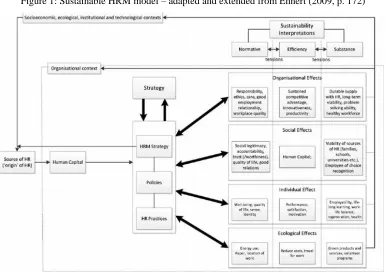
model on stainable HRM is the one proposed by Ehnert (2009, p172, cited in Kramer, 2014).
This proposed model indicated that the outcomes of stainable HRM are achieved by
organizational, social and individual outcomes. Nevertheless, it does not consider how each of
these outcomes may affect each other. For instance, the model does not consider how
organization outcomes may affect social outcomes. Although an extended version of this model
was proposed by Kramar (2014), see Figure 1, revealing that the outcomes of sustainable HRM
can be measured; it is merely making independent evaluations on organizational, social and
60
outcomes. In order to understand how far organizations are adapting to the concept of sustainability in the management of human resource and what HR practices need to be enhanced to strengthen sustainability in HRM, there is a need to call for a scale development so that the extent of HRM practices in supporting sustainability can be measured.
Figure 1: Sustainable HRM model – adapted and extended from Ehnert (2009, p. 172)
Source: Adapted from Krama (2014).
Thus, the measurement scale that is proposed in this paper is not putting the focus on
evaluating the outcomes of sustainable HRM. Instead, the measure is set to evaluate the
effectiveness of HR practices in achieving outcomes of sustainable HRM which would require a
different set of measures. The new measures should help to capture the extent of current HRM
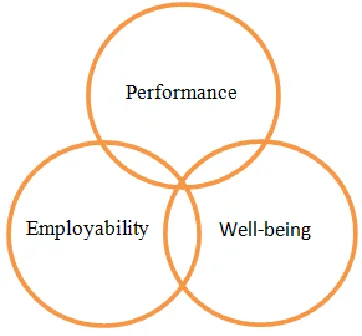
practices has on sustainable HRM outcomes in organisations. Figure 2 presented three key
elements which HR practices should consider in their making in order to achieve sustainable
HRM outcomes. These elements are performance, well-being and employability. Each of these
elements is intersecting with one and other, indicating that HR practices should consider the
interest between, for example, company‘s financial (organizational) gain and the well-being of
61
three aspects could also address the three areas of sustainable HRM which emerged from the
recent literature on sustainable HRM: capability reproduction, promoting social and
environmental health, and connections.
Figure 2: Three key elements for sustainable HR practices
Performance here refers to organization performance, including financial performance
and productivity. Well-being of employees covers the physical, social and psychological
well-beings, whereas employability concerns the job security of one‘s job, and the ability to find new
jobs when the current job no longer acquires one‘s service. The latter element can also imply the
impact on the labour market, the environment.
3. Research plan and methodology
The development of the proposed scale measures come from two sources - i) review of
literature and 2) interviews with managerial and frontline staff. By reviewing the literature on
performance management, employability, job security, well-being and sustainable HRM, it was
found that some of the previous literature already contains measures that fit the purpose of this
study. Further, some measures were formulated after modification was made from the original
source.
To develop further measures on this new area of study, an exploratory research was
conducted by the use of the semi-structured in-depth interviews. Twenty-nine (29) employees in
62
sampling approach, as they were responsible for strategic planning, daily operation and
implementation. The sample of Chinese employees comprises respondents from small,
medium-sized, and large companies with ages ranging from the early 20s to the late 40s. Altogether,
twenty-nine Chinese employees were interviewed (see Table 1). The interviews lasted between
30 minutes and two hours, and they were recorded and then transcribed. The sample thus
reflecting a diverse set of organizations, departments and positions and is well suited for
obtaining a rich set of ideas and insights. It is hope that the field interviews will provide a
notably clearer idea of the scale domain under three aspects (the employees‘ social well-being;
the employability of employees and the organization performance) and allow to define HRM
sustainability more precisely, and thus facilitate theory development, scale measurement and
theory testing in the future research.
Table 1: Interviewee profiles
Items Number of interviewees
Gender
Male 18
Female 11
City Beijing 20
Guangzhou 9
Age
21 to 30 7
31 to 40 17
41 to 50 5
Position
Manager 11
Executive 14
Junior staff 4
4. Findings
Some of the scale development effort was derived from the interview conducted. Some
of the responses collected for use are highlighted under the themes below.
Job development opportunities
Providing development opportunities for employees is regarded as important, which
63
We all want to find a good job…salary is not the only consideration. …(I) also look for
opportunities to help me grow to my full potential.
Another employee said:
It’s everyone’s wish to take up more challenging jobs (refers to promotion)… to wish to
develop oneself through these challenges.
The interviews showed that management is expected to take an active role in employees‘ job
development. A manager said:
It's important that managers need to get involved in their subordinates'
development plan... they were like my sons and daughters and I have the
responsibilities to take care of them.
Offering opportunities to the subordinates for development could be seen as a way to
promote their welfare. This includes managers spending time on their subordinates, helping them
derive development plans.
A harmonious working environment
The interviews showed that creating a harmonious working environment was regarded
as an important task of human resource management. Many interviewees expressed that
maintaining harmony in the workplace was important. To do so, they claimed that they need to
be very diplomatic and adopt a non-confrontational attitude in handling disagreement. Different
ways were employed to avoid direct confrontation with colleagues or the management in public.
They were careful not to embarrass others in public and avoided damaging their face, so as not
to jeopardize the harmonious relationship. An employee said:
That's not OK to point out employees’ mistakes in front of their colleagues; Chinese will see this as an open ‘accusation’! It will embarrass them … So, they (managers) should
talk to them (their subordinates) one-to-one in private. Giving them (subordinates) face
can help build up their relationship.
Amongst managers, it is believed that achieving a constant harmony should be a goal of
business. As harmony is perceived as important, since it is the responsibility of the management
64
As a team leader, I think it’s my responsibility to create a harmonious atmosphere for the
members, allowing them to work in a friendly environment. So far, I’m quite satisfied
with it (the working environment).
Both managers and employees considered harmony as necessary in the workplace since
it affected the work atmosphere, which in turn influenced their work efficiency. Many
interviewees claimed that if the workplace was not harmonious, their performance would be
affected. An employee stated:
After having several conflicts with her (her colleague), all of a sudden, I felt
loss… felt so sad. I just couldn’t concentrate on my work.
Good interpersonal relationship helps foster a harmonious workplace. Indeed, Chinese
society is relation-based, in which the focus is not fixed on an individual, but on the relation
between individuals who interact with each other (King and Bond, 1985). While the
interviewees acknowledged the importance of good interpersonal relationship in creating a
harmonious workplace, they were concerned about the possible negative effects of
overemphasizing this relationship. Indeed, the challenge of the management is to cultivate good
interpersonal relationships within the organisation and avoid the possible negative impacts of
such relationship may bring.
Employees’ social well-being
It was evident that workers expected the management of their organisations to not only
show concern for their work lives, but also care about other aspects such as their personal
feelings and families. One of the interviewees talked about her appreciation of her manager for
showing his care and concern to her father.
When my father was hospitalized, he (her manager) sent flowers to the hospital extending his regards… When one receives a small kindness from others, one should exert oneself
to the utmost to pay the debt of gratitude. I had a very good relationship with him… In
fact, I was willing to do more for him, work harder for him, just to show my gratitude.
In fact, many interviewees said that they respected those supervisors who had shown care and
affection. Many saw that having a company that showed care and concern to its employees was,
65
When your company shows care and concern, you feel satisfied and secured. I don’t
know many other cultures, but I believe the feeling of security is very important to
Chinese.
A manager agreed and said that having human resource practices that show care to
employees would have a positive impact on employees‘ morale:
It won’t require too much money. [The company] just needs to, say, throw a small birthday party to the employees… a birthday cake, or even a card will do. Just show
some concern. The employees would appreciate that.
Another manager also said:
If an employee got sick or has family crisis, we would ask more and find out what the
person needs and what help could be offered. (We) will go all the way to help.
In the reciprocal supervisor and supervisee relationship, the subordinate respects the
authority of the supervisor, in return, the supervisor shows consistent concern for the well-being
of the subordinate. Therefore, for Confucians, the management has an obligation to take care of
employees‘ well-being.
Some interviewees said that the management would gain respect and loyalty from
employees by showing them care and concern, and not just by relying on the authority. Some
interviewees described the management that showed care and concern to employees as showing
humanity, and believed that working under such management would enhance their morale.
Based on the qualitative data collected, new measures can be developed according to
the issue covered.
5. Conclusions and limitation
The scale developed for this study is still in its early stage. Further review of literature
and interviews are needed, in particular with employees. Still more works need to be done (i.e.
pilot study and data collection) to assure the scales developed are both reliable and valid to serve
the purpose that it set to perform – measuring the extent of HR practices on sustainable HRM
66 References
App, S., Merk, J. and Buttgen, M. (2012), ―Employee branding: Sustainable HRM as a
competitive advantage in the market for high-quality employees‖, Management
Review, Vol. 23 No. 3, pp. 261–278.
Barney, J. (1991), ―Form resources and sustained competitive advantage‖, Journal of
Management, Vol. 17 No. 1, pp. 90–120.
Chan, A. (2013)
,
―Workforce reduction practices in Hong Kong: Are they efficient and
socially responsible?‖, Journal of Management and Sustainability, Vol. 3 No. 3,
pp. 37–45.
Colbert, B.A. and Kurucz, E.C. (2007), ―The conceptions of triple bottom line business
sustainability and the role of HRM‖, Human Resource Planning, Vol. 30 No. 1, pp. 21–
29.
Daily, B.F. and Huang, S. (2001), ―Achieving sustainability through attention to human resource factors in environmental management‖, International Journal of Operation &
Production Management, Vol. 21 No. 12, pp. 1539–1552.
Docherty, P., Forslin, J. and Shani, A.B. (Rami) (Eds.) (2002), Creating sustainable work
system: Emerging perspectives and practice, Routledge, London.
Ehnert, I. (2006). ‗Sustainability Issues in Human in Human Resource Management: Linkages, theoretical approaches, and outlines for an emerging field‘. Paper prepared for 21st
EIASM SHRM Workshop, Aston, Birmingham, March 28th-29th, 2006.
Ehnert, I. (2009a), ―Sustainability issues in human resource management: Linkage, theoretical
approaches and outlines for an emerging field‖, Paper prepared for 21 EIASM SHRM
Workshop, Aston, Birmingham, 28–29 March, 2006.
Ehnert, I. (2009b), Sustainable Human Resource Management: A Conceptual and Exploratory
Analysis from A Paradox Perspective. Physica-Verlag, Heidelberg.
Guest, D (1987), ―Human resource management and industrial relations‖, Journal of
Management Studies, Vol. 24 No. 5, pp. 503–521.
Kazlauskaitė, R. and Bučiūnieniė, I. (2008), ―The role of human resources and their management in the establishment of sustainable competitive advantage‖, Engineering Economics,
Vol. 5 No. 60, pp. 78–84.
67
competitive advantage: An empirical analysis from Indian global organizations‖,
Education and Training, Vol. 47 No. 8/9, pp. 628–638.
King, A.Y.C. and Bond, M.H. (1985), ―The Confucian paradigm of man: A sociological view‖,
in Tseng, W. and Wu, D.Y.H. (Eds.), Chinese Culture and Mental Health, Academic
Press, Orlando, FL, pp. 29–45.
Kozica, A. and Kaiser, S. (2012), ―A sustainability perspective on flexible HRM: How to cope
with paradoxes of contingent work‖, Management Revue, Vol. 23 No. 3, pp. 239–261.
Kramar, R (2014), ―Beyond strategic human resource management: is sustainable human
resource management the next approach?‖, The International Journal of Human
Resource Management ,Volume 25, Issue 8, pages 1069-1089.
Lis, B. (2012), ―The relevance of corporate social responsibility for a sustainable human
resource management: An analysis of organizational attractiveness as a determinant in
employees‘ selection of a (potential) employer‖, Management Revue, Vol. 23 No. 3,
pp. 279–295.
Mandip, G. (2012), ―Green HRM: Management commitment to environmental sustainability‖,
Research Journal of Recent Sciences, Vol. 1, pp. 244–252.
Mariappanadar, S. (2003), ―Sustainable human resource strategy: The sustainable and unsustainable dilemmas of retrenchment‖, International Journal of Social Economics,
Vol. 30 No. 8, pp. 906–923.
Mariappanadar, S. (2012a), ―The harm indictors of negative externality of efficiency focused
organizational practices‖, International Journal of Social Economics, Vol. 39 No. 3, pp.
209–220.
Mariappanadar, S. (2012b), ―Harm of efficiency oriented HRM practices on stakeholders: An ethical issue for sustainability‖, Society and Business Review, Vol. 7 No. 2, pp. 168–
184.
Mariappanadar, S. (2013), ―Stakeholder harm index: A method to capture the costs of harm of
HRM practices on stakeholders‖, Proceedings of the International Network of Business
and Management Journals Conference, Lisbon, Portugal, 17–19 June.
Pfeffer, J. (2010), ―Building sustainable organizations: The human factor‖, Academy of
Management Perspectives, Vol. 2, pp. 34–45.
68
advantage and corporate social responsibility‖, Harvard Business Review, Vol. 84
No.12, pp. 79–92.
Vij, P., Suri, S. and Singh, S. (2013), ―Green HRM – delivering high performance HR systems‖,
International Journal of Marketing and Human Resource Management, Vol. 4 No. 2,
pp. 19–25.
Wilkinson, A., Hill, M. and Gollan, P. (2001), ―The sustainability debate‖, International Journal of Operation & Production Management, Vol. 21 No. 12, pp. 1492–1502.
Wright. P.M. and McMahan, G.C. (1992), ―Theoretical perspectives for strategic human resource management‖, Journal of Management, Vol. 18 No. 2, pp 295–320.
Zaugg, R.J., Blum, A. and Thom, N. (2001), ―Sustainability in human resource management‖,
Working paper no. 51, Institute for Organisation and Human Resource Management,