Society and Technology
Take a moment to think about some of the things you’ve done today. Did you begin by brushing your teeth and combing your hair? Perhaps you made toast for breakfast, or cut some fruit while you listened to the radio. Maybe you checked your email. How did you get to school? By bicycle? By bus? Think about all the tools, machines, and appliances you used. All of them—the toothbrush, comb, toaster, knife, radio, bicycle, bus, and computer—are examples of technology.
Technologyis everything that we use to carry out tasks. It can be as big as a spaceship, or as small as a watch. It can be as complicated as a television, or as simple as a pencil. Some of the best technology is the simplest, like the wheel. But technology is more than the tools we use. It is also the way that we use tools.
Technology has a huge impact on society. Take the automobile. The
invention of this machine let Canadians travel farther and faster than ever before. It also changed us. We now organize our cities and neighbourhoods around the car. Many of us work in the automotive industry. We use gasoline more than any other fuel, so we create a lot of air pollution by driving cars. Every technology affects society in both good ways and bad ways.
Key
CONCEPT
How did industrialization, urbanization, and technological change
affect the identities of Canadians both positively and negatively?
Chapter
INQUIRY
Think
AHEAD
▲
1. a) For every old technology shown above left, identify the new technology shown above right that replaced it.
b) Discuss the positive and negative effects of each one.
2. Sometimes graphics can help us think of more ideas.
a) As a class, choose one of the examples of new technology shown above. b) Think about its positive and negative
effects. Organize your ideas in a doughnut chart like this. c) Did the new technology benefit
Canadians? Did it benefit you? Explain.
Technology and Canadians
In this chapter, you will learn about technologies that we started using about a century ago. These include the light bulb, the telephone, the automobile, the airplane, new farm equipment, radios, and machine guns. Together, they turned our world upside down. You will see how these inventions created a new Canada.
Would you like to master effective Internet searching? The Skill Check feature in this chapter shows you how to Do a Keyword Search. This skill is important to your studies because it will enable you
to find good information fast. The project at the end of the chapter
will ask you to research a great Canadian of your choosing.
Honing
Your Skills
T
he library has a wealth of information about the many changes that took place in the twentieth century. So does the Internet. How do you sift through all the masses of material to find a few useful sites? A good keyword search on an effective search engine can do the trick. Choose your keywords carefully. That way, you’ll have several useful sites to look through instead of thousands of useless ones.S
KILL
C
HECK
:
Do a Keyword Search
Generating Your Keywords
1. Decide what subject or topic you are researching (for example, Canadian inventions).
2. Brainstorm keywords. These can be single words or phrases (for example,
technology, Canadian inventors, industry, inventions, famous, discoveries).
3. Weed out unimportant, general, or very similar words (such as inventions
and famous).
4. Put your words in order of
importance (for example, Canadian inventors, technology, discoveries, industry).
5. Check your spellings.
Do Your Keyword Search
Do your search. Just list the words with no commas. Put phrases within quotation marks (for example, “Canadian inventors” technology discoveries industry).
1. If the number of hits you get is large, be more specific or reduce the number of keywords.
2. If you don’t get any hits, change or add keywords.
• A thesaurus can help you find synonyms for your keywords. Synonyms are words that mean the same thing. Synonyms for invention
include creationand discovery. • Think of words related to the subject
that are not synonyms, such as tool,
mechanical, medicine, and weapon. Keyword searches get better results when you use multiple words or phrases related to the subject. First you’ll see hits with all the keywords in order. Then you’ll see hits with all the keywords but not in order. Finally, you’ll
see hits with some of the keywords.
Generate some keywords you could use to research these topics: industrialization,
urbanization, and technological
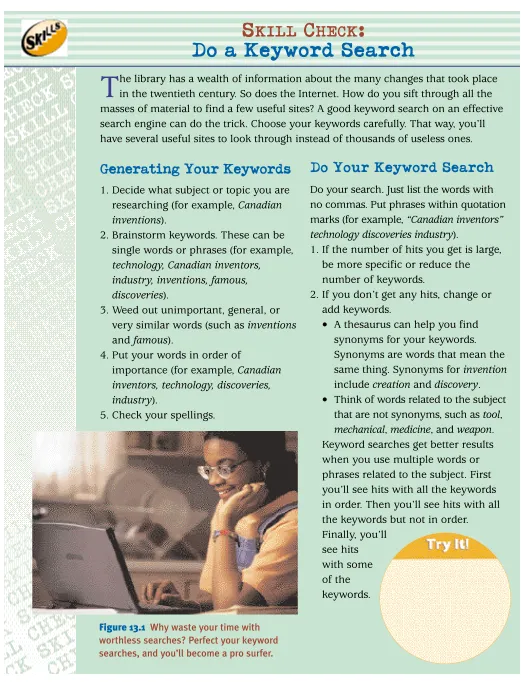
change. Figure 13.1 Why waste your time with
B
efore the twentieth century, most Canadians had jobs related to fishing, logging, or farming. We harvested the natural resources and sold them around theworld. Then a great change took place after Confederation. It was the start of industrialization. This is an economic system based on large industries. It was a big change—so big that we called it a revolution. This section tells how the Industrial Revolutionchanged the Canadian identity.
A Global Revolution
When you hear the word revolution, you probably think of politics. When a
government is overthrown and replaced with another, we call it a revolution. But the word
revolutioncan describe any major change in the world. For example, when people started using
computers instead of typewriters, we called it a computer
revolution.
The Industrial Revolution began when people started using mechanical power. The steam engine gave people a way to harness energy. It burned coal. This heated water and turned it to steam. The energy in pressurized steam could pull a train, twirl a merry-go-round, or run a power loom.
The Industrial Revolution did not begin in Canada. It began in Great Britain in the mid-1700s. From there it spread to other countries. Three factors made the revolution possible in Canada: new technologies, business investors, and a large workforce.
The Rise of the Factory]
Before industrialization, most goods were made by hand. A dressmaker sewed a dress by hand. A logger laboured with saw and axe. Most goods were made by skilled craftspeople using hand tools. These were called cottage industriesbecause the workplace was a home or small shop.
The introduction of machines changed where people worked. Steam engines, water power, and electric motors could power big, new machines. But a single worker could
How did the rise of industrialization
help develop Canada’s economy?
Focus
The Rise of Industry
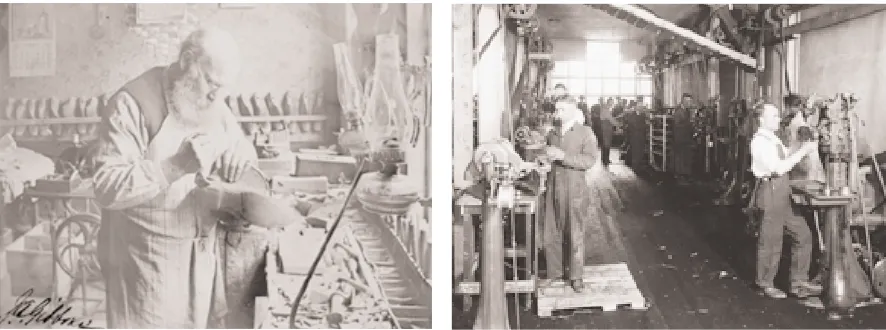
Figure 13.2 Two photos showing the changes brought by industrialization. On the left, a shoemaker works in his Ontario workshop. On the right, workers make shoes in an Alberta factory. Make two lists of words and phrases to compare the workdays of the shoemaker and the factory workers.
Look on the Voices and VisionsCD-ROM to see how “modern” manufacturing techniques were applied to the dairy industry in Alberta.
Figure 13.3 Young girls collecting waste coal beside the train tracks in Toronto in 1900. Some children took the coal to heat their homes. Others sold it to earn money. What would be the pros and cons of children collecting coal on train tracks? Think about health and safety concerns as well as earning potential.
not afford one. Machines were expensive. Instead, business investors bought the machinery and hired people to run it. A new type of workplace emerged: the factory. Here, many workers worked together to run the new machines. They could produce many more goods than they could have produced on their own.
Working in the Factory]
Factories changed the waypeople worked, too. In a cottage industry, a shoemaker might make three pairs of shoes in a day. In a shoe factory, a worker did just one step. For example, he or she might cut out shoe
soles for 200 shoes. Other workers would do the other steps. This was called the division of labour. Work became repetitious. As a result, workers lost many of their skills.
To become even more efficient, factories introduced the assembly line. An incomplete product was placed on a conveyor belt. As the product moved down the line, each worker did one task on it. By the end of the line, the product was
complete.
Early factories were organized with machines in mind, not people. They were hot, airless, dusty, and dangerous. The managers who ran the factories were very strict. Workers—some of whom were
children—spent ten to twelve hours a day on the job, six days a week. No wonder factories were compared to jails. Workers who got sick or injured lost their pay or their jobs. There was no employment or health insurance.
What jobs are Canadian 14-year-olds allowed to do today? Make a list, and then discuss why young people are allowed to work at some jobs but not others.
CASE
STUDY
Child Labour in Canada
Is it acceptable for children to work? Children in Canada’s new industrial society were expected to work. They helped buy food and pay bills because their parents’ wages were so low. Many children worked on farms.
In the 1880s, Théophile Charron worked in a cigar factory. He was 14 years old. In 1888, he answered questions about his job.
Q. When you call yourself a cigar-maker, you mean that you have served your apprenticeship, do you not?
A. Yes, sir.
Q. How long? A. Three years.
Q. You began working at 11 years? A. Yes, sir.
Q. What wages did you get during your apprenticeship?
A. One dollar a week for the first year, $1.50 for the second year, and $2 for the third year. When I worked extra, I got more.
Q. Did you have any fines to pay during your apprenticeship? A. Yes, sir.
Q. Many?
A. A good number.
Q. How many hours did you work a day?
A. Sometimes 10 hours, other times eight hours. It was just as they wanted it. Q. Do you remember why you paid these fines?
A. Sometimes for talking too much; mostly for that. Q. You were never licked [struck; hit]?
A. Yes; not licked so as any harm was done me, but sometimes they would come along, and if we happened to be cutting tobacco wrong, they would give us a crack across the head with a fist.
Q. Was it usual to beat children like that? A. Often.
Source: Royal Commission on the Relations of Capital and Labor in Canada
(Ottawa: Queen’s Printer and Controller of Stationery, 1889).
As the years passed, the government made laws to ban child labour. In 1891, one in four Canadian boys between the ages of 10 and 14 worked full-time. By 1911, that number had dropped to one in twenty. In the same year, two out of every hundred Canadian girls had a job. When you read and view primary sources like
this interview, remember that they show the perspectives and values of society at the time.
Think It
Through
▲
An Expanding Economy
The growth of industry made the Canadian economy grow by leaps and bounds. Three new railways sped up the transport of goods. In turn, the building of railways created a need for steel and iron. New factories made many types of products. Alberta, for example, began to see
meatpacking plants, dairies, lumber mills, grain mills, wool factories, glass factories, sugar factories, cigar factories, and brick factories, among others.
Preventing Aboriginal Participation
Many First Nations and Métis people were prevented from taking part in the economy. Often the government was involved inlimiting their activities. For example, the West Coast First Nations had fished for salmon on the coast and rivers for as long as they could remember. During the 1870s, newcomers began fishing, too. They built industrial canneries to process the fish. Competition for fish grew, so the government said that First Nations could only catch fish to eat. For many years, they could not sell their catch.
1. Railways were crucial in Canada’s early industrial society. Building and running railways created a lot of economic activity. Draw a tree diagram with a railway engine as the trunk. On the branches, show how
the railway encouraged spinoff businesses. Alternatively, write about the spinoff businesses.
2. Create a similar tree diagram or paragraph showing the impact of the computer.
Global Connections
At the age of 12, Canadian Craig Kielburger learned about a Pakistani boy who was murdered for speaking out about child labour. In response, he started Free the Children. Find out more about this organization of young people by doing a keyword search. How does it help children? As an active citizen, what could you do to help this organization?
Global Connections
Figure 13.4 Data for measuring the Canadian economy. An efficient economy gets the most out of the resources it has. By how much did the workforce grow from 1900 to 1910? What happened to the value of goods produced during that time? Would you say the economy became more efficient, less efficient, or stayed about the same? Explain.
Number of people in the workforce 170 000 443 000 500 000
Dollar value of manufactured goods* $170 000 000 $556 000 000 $1 152 000 000
Dollar value of goods exported* $34 000 000 $100 000 000 $136 000 000
1867 1900 1910
T
he new technologies of the early twentieth century changed people’s lives. The 1910s and 1920s brought newways to travel and communicate. In this section you will learn about a few key technologies.
The Horseless
Carriage
Canadians began driving cars in the years before the First World War.
Electricity or steam powered the earliest cars. Within a few years, gasoline engines became the norm. They were more reliable and easier to use.
Not everyone was happy about the new technology. Farmers didn’t like cars because they frightened the horses. So the government made a law. When a car met up with a horse and carriage on the road, the car had to stop while the horse passed by. The assembly line made the price of cars low. In 1924, a Model T Ford cost only $395. (At that time, the minimum weekly wage was about $14.) By 1929, 1.2 million motor vehicles were on Canadian roads.
More automobiles created the need for better roads. Before the First World War, most roads were dirt tracks. In 1912, a journalist named Thomas Wilby set out to drive across the country from Halifax to Vancouver. At times he had to hitch a ride on a ferry or the railway. He made it, but it took him 48 days and many flat tires. It was 1942 before it was possible to drive on a continuous road all across the country.
In what ways did new technology contribute to the development
of Canada?
Focus
Technology and Identity
Figure 13.5 A Canadian car factory, about 1930. Other factories made car parts and tires. What other businesses spin off from the auto industry?
V
OICES
V
OICES
“
The Telescopenewspaper voiced people’s fear of the car in this editorial. What is the writer worried about? Compare this to modern Canadians’ gripes about traffic.
Gradually the nuisance is becoming more general. Every town in Ontario has its automobile and some have more than one. It will not be long before the
automobiles will drive the farmers off the roads altogether, unless something is done to restrain them. The farmers built these highways in the first place and are straining themselves to keep them in repair.
What they ought to do is pledge every candidate for Parliament to vote in favour of a law banning automobiles from using the public high-ways altogether, or at least under conditions that will not interfere with traffic.
Up, Up, and Away [
A second revolution in transportation arrived with the airplane. The first aircraft flew in Kittyhawk, North Carolina, in 1903. Canada wasn’t far behind. J.A.D. McCurdy designed the Silver Dartin Baddeck, Nova Scotia. He flew it for almost a kilometre on its first flight, in 1909.
During the First World War, airplanes were used as weapons of war. Afterward, hundreds of Canadian pilots returned home. They were eager to fly for a living, but there were no passenger aircraft. The technology wasn’t reliable yet. Former war pilots such as Wop May got jobs flying bush planes to remote locations to transport people, spot forest fires, haul the mail, take photographs from the air, do rescue work, and conduct surveys for new mineral resources. The first passenger planes began flying in the 1920s.
The Age of Radio []
Canadians want to keep in touch with each other. It helps us know what is going on in our communities. We like to hear about other parts of the country. It strengthens our feeling of being Canadian.
We use the mass mediato find out about each other. Newspapers have been around for a long time. The first issue of the
Edmonton Bulletin, for example, came out in 1880. Radio came later. In 1920, a station in Montréal aired the first radio broadcast in Canada. By 1930, there were 60 stations across the country. Virtually every household had a radio. Even later came televisions and television stations. Global TV, for example, began in Calgary as CHCT-TV in 1954.
Figure 13.6 Fred McCall, one of the pilots who put on flying exhibitions after the First World War. He is shown here at the Calgary Exhibition in 1919, standing in front of his Curtiss Jenny aircraft wearing a scarf and goggles. Once, McCall crashed onto a merry-go-round! Why do you suppose the public considered pilots to be dashing heroes in the 1920s?
Figure 13.7 A boy tuning in to his favourite program in 1935. Before television, radio was the most important form of mass media. It was the way most people stayed in touch with the world. How do you get information about your
community? about the world?
Open Chapter 13 on your Voices and VisionsCD-ROM to see a few of the airplanes produced
in Canada.
Media and Identity
Why are the mass media so important to identity? Let’s think about some examples. Radio signals cross borders. The early programs that Canadians listened to came from the United States. Canadians worried. Would there be room for Canadian ideas and stories? In 1936, the government founded the Canadian Broadcasting
Corporation and its French-language counterpart, together known as CBC/Radio-Canada. The goal was to bring a Canadian voice all across the nation. By the next year, new transmitters allowed English radio to reach 76 per cent of listeners.
This was not the case for Francophone radio. Canada’s first publicly funded French radio station, Canada
Broadcasting French (CBF), went on the air in Montréal in 1936. But it was not broadcast all across the
nation. Francophones in Alberta were not permitted to have a French radio station, even if they funded it themselves. The
Association canadienne-française de l’Alberta (ACFA) kept trying, though. Volunteers raised $140 000. Finally, they got a permit to start the privately owned CHFA in 1949. What do you think the Francophone community missed during those early radio-free years?
Currently, CBC/Radio-Canada has stations all across the nation broadcasting in both French and English.
Identity
Identity
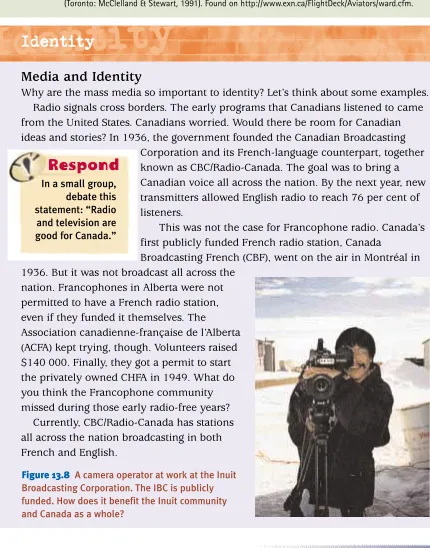
Figure 13.8 A camera operator at work at the Inuit Broadcasting Corporation. The IBC is publicly funded. How does it benefit the Inuit community and Canada as a whole?
In a small group, debate this statement: “Radio and television are good for Canada.”
Respond
V
OICES
V
OICES
“
Max Ward, bush pilot and founder of Wardair (Canada’s largest charter airline, operating from 1953 to 1989), comments about the legendary bush pilots:
If you were born and brought up in Edmonton during the 1920s and 1930s, the most exciting people around were the bush pilots, who were always in the news with stories of their exploits. My whole idea of adventure, of living, was tied up in the notion of joining their ranks some day in a magnificent flying machine.
Source: Max Ward, The Max Ward Story: A Bush Pilot in the Bureaucratic Jungle
R
apid growth seldom occurs without growing pains. The expanding economy brought prosperity. It also brought social problems. As cities grew, parts of them became overcrowded, dirty, and unhealthy.Some people grew wealthier. Others were trapped in low-paying jobs. Competition for wealth led to the most destructive wars the world had ever seen. This section looks at Canada’s growing pains.
The First World War
(1914–1918)]
At the end of the century, the winds of war were blowing. Germany had built up the biggest army in the world. In response,
Great Britain, France, and Russia had built up big armies, too. National pride spurred on nations to use their arms.
In June 1914, an assassination was used as an excuse to set in motion a train of events that led to the First World War. The war was fought mainly in Europe but had an impact all over the world. Canada went to war as part of the British Empire.
Factories can make inexpensive clothes, but they can also make guns. All through the war, Canada’s factories made deadly technology. They made guns, tanks, aircraft, battleships, submarines, and poisonous gases. Technology gave armies the ability to kill many people quickly. Technology did not cause the war, but it made the fighting far more deadly.
What strains did industrialization place on Canadian society?
Focus
An Industrial Society
How do you keep your cultural identity in a multimedia age? Embrace it, says Buffy Sainte-Marie. “The reality of the situation is that we [the First Nations] are not all dead and stuffed in some museum with the dinosaurs: we are Here in this digital age.” A Cree, Sainte-Marie was born on the Piapot Reserve in Saskatchewan. She has had a long and successful career as a musician. Now she is an educator and multimedia artist. She uses new technology to link communities. Check out her online presence by developing a keyword search.
1. Research one of the following Alberta inventions: the hay bale booster, fairy phonograph, rubber curling hack,
Jaycopter, and bear-proof bin. How did the new technology affect people’s lives?
2. a) Draw up a list of your own mass media habits. How much Canadian content do you absorb in a day?
b) Should mass media in Canada have Canadian content? Write a letter to the
editor or a poem in which you communicate your opinion.
3. Identify the dates of important
technological advances in Canada, such as the first airplane flight or the introduction of the motorized tractor. Build on what you find in this section by searching the Internet. Then make a timeline of your findings.
Think It
Through
Germany surrendered. It didn’t feel like a victory. Nine million soldiers had been killed. Canada had 60 661 dead. Many thousands more were injured and maimed.
More than 4000 of Canada’s volunteer soldiers in the First World War were Aboriginal. Many were heroes, such as Private David Kisek, a soldier from the Shoal Lake Band in Ontario. Private Kisek leaped into the open to take on four enemy machine guns. Why do we honour this act of bravery?
Vimy Ridge and the Canadian Identity
Is fighting for one’s country the supreme act of citizenship?
For Canadians, the most important battle of the war took place at Vimy Ridge in France. Both French and British soldiers had failed to capture this height of land from the enemy. Capturing it, however, was crucial. So in April 1917, the Canadians stepped up to the plate.
Canadian soldiers fought and died on the ridge over five long days. They finally drove the Germans back. The cost was heavy: 3598 Canadians were killed and another 7000 were wounded. The whole world saw the remarkable accomplishment. This was not the feat of a mere colony.
Canada’s efforts during the war helped Canadians feel proud. They also won us the respect of nations around the world.
Remembering
Every November 11, Canadians mark Remembrance Day. We honour those who have died defending our country, including the heroes at Vimy Ridge.
There are many ways of remembering. Some people visit the Canadian Battlefields Memorial in Vimy, France. Other Canadians visit Ottawa for the National Remembrance Day Ceremony. Some communities create their own way of remembering. For example, in Edmonton in 2004, the community honoured Aboriginal veterans with a Tribute Jamboree. The White Buffalo Dance Society drummed, danced, and sang a traditional honour song for the veterans.
Identity
Identity
How can an event such as a battle affect a nation’s identity? Does remembering the past help you feel more Canadian?
Respond
Figure 13.9 A recruitment poster for the Canadian Armed Forces. The war began in a spirit of
Life in the Industrial
City ]
The end of the war in 1918 brought more change to Canadian society. The factories no longer needed to produce war goods, so they began to make consumer goods again. More factories were built in urban areas. Returning soldiers came to live in cities. So did farm workers, who were being replaced with farm machinery. Mohawk ironworkers came to build the new office buildings.
The cities got bigger and bigger. During the 1920s, more Canadians began to live in cities than in the country. The complex Canadian identity slowly changed.
Growth of the Suburbs ]
Originally, cities were a jumble of shops, factories, and houses for rich and poor alike. People lived close to where they worked and where they shopped. For the most part, they walked everywhere.
During the Industrial Revolution, the city changed. It reorganized itself into neighbourhoods. The key to this change was the street railway. Streetcars ran on tracks down the middle of the street. They were powered by electricity. They were the first technology for moving large numbers of people quickly through a city at low cost.
The street railway allowed people to live far from where they worked. People
moved to the suburbs, residential neighbourhoods at the city’s edge.
Workers Organize []
Early factories were not nice places to work. There were few rules to protect workers from management. Employers could hire or fire them whenever they wanted. Wages could be reduced. The workers had no say.
Workers began to form unions. Unions speak for the workers who belong to them. They tried to improve the conditions under which people worked. They argued for fair wages, shorter workdays, and safe working conditions.
Figure 13.10 Population of four Canadian cities, 1891–2004. Which city grew the most during each period? Make a graph showing how much each city grew in each period. Why would this help you “see” it better?
Montréal 219 616 490 000 618 506 3 606 700
Toronto 181 215 380 000 521 000 5 203 600
Vancouver 13 700 120 000 163 220 2 160 000
Winnipeg 25 639 136 000 179 087 702 400
City 1891 1911 1921 2004
Think It
Through
▲
Strike in Winnipeg [
In a strike, unionized workers refuse to work until their employer agrees to give them what they want. It is an active citizen’s way to fight for workers’ rights.
After the First World War, Canada saw many strikes. The biggest strike of all took place in Winnipeg in 1919. Workers from many unions all went on strike at the same time to support one another. This was a general strike. There was no telephone; the mail stopped coming; streetcars stopped running. Even the police voted to support the strikers. The city was paralyzed.
The workers went on strike for higher wages and union recognition. Employers refused to negotiate. They wanted the
They argued that the strikers were troublemakers. The mayor called in the Royal North West Mounted Police (RNWMP). Before long, two strikers were dead and thirty were injured.
After the strike failed, people elected politicians to speak for them. Farmers helped form the National Progressive Party in 1921. The Progressives opposed tariffs. They opposed the influence of business people on government. In 1921, the
Progressives became the official opposition in Ottawa. Other farmers’ parties won victories in Alberta, Ontario, and Manitoba.
People empowered themselves in other ways. For example, farmers formed wheat pools in the 1920s. They used these to buy and sell wheat on world markets.
Sharing the Wealth [
Not everyone benefited from
industrialization. First Nations peoples still suffer from problems that started in these times. For example, miners did not realize that chemical waste damages the land for generations, including First Nations lands. Gradually, though, the lives of most working people did improve. Working conditions became safer and healthier. People got help when they were sick or lost their jobs. Farmers gained some control over their livelihoods. Ordinary people began to share in the benefits of change.
Figure 13.12 Chaos in the streets of Winnipeg in June 1919. The RNWMP are on horseback. Government officials met with Winnipeg business leaders but not with strike leaders. Was this fair?
1. Scan the section.
a) Identify problems that Canadians faced because of industrialization.
b) Which was the worst? Why?
c) Did some groups of people suffer from these problems more than others? Explain your thoughts.
2. Here are some words that describe a liveable city: safe, clean, healthy, and
beautiful. Think of other words to add to the
T
he industrial era saw many women entering the workforce. As they took on a wider role outside the home, womenbegan to demand the same rights as men. This section looks at the changing role of women in industrial society.
Women and the
Workplace
New labour-saving technologies gave women more free time. Many wanted to work. Some worked as maids or nannies. Others found work in the new factories. New inventions such as the telephone and
typewriter created other jobs for women. Offices, department stores, banks, laundries, and restaurants employed thousands of women. Even so, few of these jobs paid well.
During the First World War, many men left their jobs to fight overseas. This gave women a chance to show that they could do these jobs, too. After the war, though,
women had to go back to domestic life.
Women Speaking Out []
Women started to speak up more about the issues of the day. Some of them wrote articles, published books, or spoke at gatherings. Canada has benefited by the added voice of women on all issues.
Tekahionwake (Pauline Johnson) was one of the most popular speakers in Canada in the years leading to the First World War. She was a Haudenosaunee [hah-duh-nuh-SAH-nee] woman from the Six Nations Reserve in Ontario. Because of her charisma, Tekahionwake got people’s attention.
Women Get the Vote []
As women moved into the workplace, more and more of them wanted to have all the rights of citizenship. Before the First World War, women in Canada could not vote in elections. They could not run for election, either. Politics was considered “man’s work.”
Women began to organize. They
wanted suffrage—the right to vote. They put pressure on the government. They collected
Canadian Women Step Up
What were the social and economic effects of the changing role of women in Canadian society?
Focus
V
OICES
V
OICES
“
Tekahionwake (Pauline Johnson) wrote poems, stories, and articles. Here she criticizes novel writers for using stereotypes of First Nations women. A stereotype
is an overgeneralized portrayal of people from one group. Stereotypes can reflect people’s prejudices.
[The First Nations heroine] is always desperately in love with the young white hero …. She is so much wrapped up in him that she is treacherous to her own people, tells falsehoods to her father and the other chiefs of her tribe, and otherwise makes herself detestable and dishonourable. Of course, this white hero never marries her!
Source: Pauline Johnson, “A Strong Race Opinion: On the Indian Girl in Modern Fiction,” Toronto, 22 May 1892. Available online at
http://www.humanities.mcmaster.ca/~pjohnson/writings.html.
”
Why is the use of stereotypes in
petitions, held rallies, and lobbied the government. But the elected politicians were all men, and they would not budge.
Finally, during the First World War, Canadian women won the vote at two levels of government. Provincially, the three Prairie provinces were first. Here, women won the right to take part in provincial elections in 1916. In 1918, women across Canada won the right to vote in federal elections.
One battle was won. Women could now vote for a person to represent them in government. Did women automatically get the right to run for Parliament? No, that was another battle. In July 1920, the Dominion Elections Act was changed to allow women
Women who believe in woman suffrage seem to think that we men want to deprive them of their liberties; but we wish to do no such thing. All men … place women on a very high pedestal … and we want her to remain there, where she can command our respect and esteem …. Why should she besmear herself with the rottenness of politics?
—A letter to the editor Source: Toronto Globe, 1912.
Let it be known that it is the opinion of the Roblin government that woman suffrage is illogical and absurd as far as Manitoba is concerned. Placing women on a political equality with men would … break up the home; … it will throw the children into the arms of servant girls …. The majority of women are emotional and very often guided by misdirected enthusiasms, and if they had the franchise they would be a menace rather than an aid.
—Manitoba premier Rodmond Roblin Source: The Grain Growers’ Guide, 4 February 1914.
We are not here to ask for a reform, or a gift, or a favour, but for a right—not for mercy, but for justice.
—Nellie McClung, activist for women’s suffrage Source: The Grain Growers’ Guide, 4 February 1914.
Women’s place is in the home, I hear, but do you think it is part of a mother’s mission to sit quietly by and see her sons and daughters growing up under conditions which she knows are bad but, through lack of power, is unable to remedy?
—A.V. Thomas, suffrage activist Source: Cited in R. Craig Brown and Ramsay Cook,
Canada 1896–1921: A Nation Transformed
(Toronto: McClelland & Stewart, 1974), p. 299.
“
”
V
OICES
V
OICES
“
”
Perspectives on Women and the Vote
“
”
“
”
Create a point-of-view organizer. In the first column, summarize the arguments expressed in this feature. In the second column, explain why you agree or disagree with each argument.
Respond
to sit in the House of Commons. Even so, many people still believed that government was a man’s job, so they wouldn’t vote for women. Beliefs are much harder to change than laws. However, one by one, women began to be elected. The first female member of Parliament, Agnes Macphail of Ontario, was elected in 1921.
The “Persons” Case [
Are you a person? Is the girl sitting next to you a person? Believe it or not, the
government of Canada did not always regard women and girls as persons.
Emily Murphy was the magistrate of a newly created Women’s Court in Edmonton. In 1919, she thought it was time that a woman was named to the Canadian Senate. When she asked the prime minister,
however, she was told that it was
impossible. Under the law, only “qualified persons” could be senators, and women were not “persons.”
Murphy would not accept this answer. She and four other Alberta women brought the question to the Supreme Court of Canada. The other women were Nellie McClung, Louise McKinney, Irene Parlby, and Henrietta Muir Edwards. They became known as the “Famous Five.”
The court ruled against the women. Then they took the case to the highest court, in England. In 1929, this court ruled that Canadian women were indeed persons. Four months later, Prime Minister Mackenzie King made Cairine Wilson the first female senator.
In 2005, 33 women were serving in the 105-member Canadian Senate.
Nellie McClung once said, “Never retreat, never explain, never apologize. Get the thing done and let them howl.” What do you think she meant? Think of a situation where a strategy like this is justified.
Figure 13.15 Statue of the Famous Five, 1999, in Calgary. The artist is Barbara Paterson of Edmonton. Think of a possible reason why the federal government built a replica in 2000 to stand on Parliament Hill.
Alberta women formed organizations such as the United Farmers Women of Alberta (UFWA) to fight for women’s property rights as well as voting rights.
CASE
STUDY
Other Groups Gaining a Voice
Did all citizens now have equal democratic rights? No. Many Canadians still could not vote. Before the Second World War, no Chinese, South Asian, or Japanese Canadians could vote. After the war, attitudes changed. Here are the dates when various groups of Canadians won the right to vote.
• 1947: Canadians of Chinese and South Asian background • 1948: Japanese Canadians
• 1950: The Inuit • 1960: First Nations
• 1970: Citizens 18 to 20 years of age
Before 1960, the government did not let First Nations vote unless they gave up their treaty Indian status. That explains why most of them refused to vote until the policy was changed.
Comment on this statement: “Voting in a democracy is a responsibility as well as a right.” Should the voting age be lowered again?
Respond
Figure 13.16 Won Alexander Cumyow, the first person of Chinese descent born in Canada. He was born in British Columbia in 1861. This Canadian citizen worked as an interpreter in the law courts. However, he was not eligible to vote until he was 86 years old, in 1947. In this photo, Won casts his first vote in a federal election. What would it have felt like to work for a government that wouldn’t allow you to vote?
1. a) Today, what jobs are done largely by women? by men? by both? Brainstorm some ideas in order to come up with three lists. Sort your findings in a Venn diagram (see page 21).
b) Discuss this situation in class. Ask these questions:
• Why are certain jobs held mostly by one gender?
• Is it possible for both men and women to do any of these jobs? If not, what prevents them?
• Is there discrimination in the workplace today?
• What is your bias on this topic?
2. All adult citizens in Canada now hold the vote, and all are considered persons. Are women and men therefore equal? Debate this question in a small group.
3. After reading this section, have your ideas about women’s rights changed? If so, how have they changed? Write a journal entry or poem to answer this question.
Think It
Through
T
he 1920s had brought a decade of good times for many people. Then, in 1930, Canada, along with much of the restof the world, plunged into the Great Depression. In this section, you will learn how the Depression and the world war that followed threw Canada into turmoil.
The Depression ]
In the 1930s, the economy slowed almost to a halt. Factories closed. Wages fell. Workers lost their jobs. Others lost their life savings. The resulting financial crisis affected nearly the whole world. Nothing
like it had been seen before. Men, young and old, drifted to the cities looking for work. Many families were left with no income at all.
The Depression hit the West particularly hard because of a terrible drought. In the farm districts, incomes fell. Some people lost their farms. Others left their farms to search for work. During the 1930s, more people left the Prairie
provinces than arrived.
Aboriginals Coping in Hard Times
First Nations people continued to make a living as they had in previous decades. Most were already poor. Many didn’t have jobs to lose. The Depression made an already difficult situation worse, but they continued to cope. They kept on hunting, trapping, selling their handiwork to tourists, growing produce, and keeping livestock. Marlene Brant of Tyendinaga, Ontario, tells how her family coped.Bad Times, Good Times
What were the impacts of the Great Depression and the Second World War on Canadian society?
Focus
The most influential person in my life, of
course, was my mother, who was a real
Mohawk Matriarch. A very strong and
intelligent person who brought up ten
children in the midst of the depression and
was a real partner and co-worker with my
father. She always had a little business
going on, on the side. She believed really
strongly in education …. My father was a
quieter person …. He did farming for our
own food supply, so we were never hungry.
Source: Quoted in Bernadette Wabie, “Aboriginal Women and Community Development: Consistency Across Time” (Master’s Thesis, Trent University, 1999), p. 55.
Figure 13.17 A prairie-wide dust storm pictured at Fort Macleod, Alberta, in the 1930s. For years, little rain fell. Crops withered in the fields. The soil turned to a fine dust and blew in great clouds across the prairie. Did any of your relatives live through those years? Why are times of great trial sometimes very memorable?
I am so worried on account of the children as we never have any vegetables except potatoes and almost no fruit and the baby hasn’t any shoes.
—Letter to Prime Minister R.B. Bennett from a farmer in Benton, Alberta, 1935 Source: From Michiel Horn, ed., The Dirty Thirties: Canadians in the Great Depression(Toronto: Copp, Clark Publishing, 1972), p. 236.
We tried to sell our ranch, and it was a good one, but nobody would buy it. Who would in those days when cows were selling for about six dollars each?… So we just loaded up the wagon and drove away from it.
—Anonymous Source: Barry Broadfoot, Ten Lost Years: 1929-1939
(Toronto: Doubleday Canada Ltd., 1973), p. 51.
If you could see what I saw. People hungry and dying down on the beach. Three stakes and a sack, that was home for them ….
And then the trouble in [Vancouver] started. People had iron bars, they broke windows at Woodward’s and everyone went in and helped themselves. You see, they had no jobs and no food….
And the garbage cans: on Hastings Street, Granville Street, people ate from them. I saw a mother with a baby pull out some chicken bones, set them on the garbage lid and right away three, four kids were standing around eating chicken bones.
—Shinichi Hara Source: Quoted in Daphne Marlatt and Carole Itter, eds.,
Opening Doors: Vancouver’s East End(Victoria: Aural History Program, Province of British Columbia, 1979), p. 123.
“
”
V
OICES
V
OICES
“
”
Voices of the Depression
“
”
Imagine you are a teenager living in the 1930s. Your family has left the farm in search of work. Be an active citizen: write a letter to the prime minister. What would you say?
Respond
Figure 13.18 Men at a Montréal soup kitchen in 1931. Unemployed men and women could find a free meal at a soup kitchen. These were run by churches and other charities. What similar acts of citizenship go on in your community?
Making Change
On to Ottawa!
By 1933, about one quarter of the workforce was jobless. The government created work camps for unmarried, unemployed men. Here the men did hard labour. They cleared roads and cut firewood for 20 cents a day.
The camps seemed like prisons to the men who lived in them. They wanted real work at a decent wage. In 1935, they went on strike in Vancouver. The men climbed on freight trains heading east. They were going “on to Ottawa” to meet the prime minister face to face.
As the trains crossed the country, more trekkers jumped on. When they reached Regina, police received orders to stop the men. Prime Minister Bennett refused their demands. In Regina, police and protestors clashed in a bloody riot. A police officer died, and many protestors were injured or arrested.
Politics during the Depression
The old political parties did not seem to be helping people, so several new parties appeared. In Alberta, “Bible Bill” Aberhartcaptured the ears of the people. Every Sunday, he spoke to Canadians on his religious radio program. People liked his new ideas. He started a political party called Social Credit. Among other things, the party wanted to give $25 a month to every citizen. It would do this by printing its own
“prosperity certificates.” Aberhart believed this would get the economy moving again. Albertans elected the Social Credit Party in 1935. The federal government stopped the certificate program because provinces do not have the right to print money.
Nonetheless, Social Credit stayed in power for more than 35 years.
Another new party was the
Cooperative Commonwealth Federation (CCF). Its roots were grassroots prairie farmers’ organizations. The CCF argued that the government should have programs such as employment insurance, workers’ compensation, and public ownership of key industries. Then it could prevent downturns such as the Depression. The CCF eventually became the New
Democratic Party.
Social Services in Canada
The poverty and suffering of the Depression made Canadians think. Couldn’t government do more to protect citizens from hard times? • The old-age pensionbegan in 1927. It
gave elderly people an income.
• Employment insurancecame after the Depression. It was short-term financial help for people who lost their jobs. • Family allowancecame next. A small
sum was paid monthly to every family with children.
• Public health carewas the idea of Tommy Douglas, the CCF premier of Saskatchewan. His government started paying for hospital care in 1947. This led to a Canadian health care system.
The Return of War []
The Depression did not really end until 1939 when, once again, the world went to war. The army gave a job to anyone who wanted one. The sudden demand for arms and supplies got the wheels of Canadian industry turning again.
The war started when Nazi Germany invaded its neighbours. The Axis countries were Germany, Italy, and Japan. The Allies were Britain, the countries in its empire, France, and China. In 1941, the Soviet Union and then the United States joined the Allies after being attacked by Germany and Japan respectively. For the first time, Canada entered a war as an independent nation.
The fighting lasted six years. Canadian troops saw action in western Europe, Italy, and Asia. As in the First World War, new technology was put to use with horrible results. Aircraft dropped bombs on enemy cities. They killed many civilians. Luckily, Canada was not bombed. Warships
bombarded each other with heavy artillery. Submarines used torpedoes. By the war’s end, the United States had the atomic bomb. This piece of technology was the most destructive weapon of all.
During the war, more than a million Canadians served their country. Of these, 42 042 gave their lives. Another 54 414 were wounded.
Figure 13.21 A “prosperity certificate” printed by the Alberta Social Credit party in the 1930s. To maintain the value of this “money,” people had to put a one-cent stamp on it every week. How might this make the certificates unpopular?
Today, private citizens, companies, and governments all pitch in when disaster strikes. Drought hit the prairies in 2001 and 2002. By the second year, Western farmers were desperate. They had no feed for their cattle and horses. So farmers in Ontario started the Hay West campaign. Individuals across Eastern Canada donated 30 000 tonnes of hay to 1000 Alberta farm families. What does this tell you about Canadian citizenship?
Figure 13.22 Workers at the VMD Shipyard in Victoria, BC. Women produced weapons and ammunition in war factories. They operated farms and ran businesses. Others served as nurses, radio
operators, and ambulance drivers. By 1945, more than 43 000 women were in the armed forces (though not in armed combat roles). How can a time of war be both exciting and boring?
Think It
Through
▲
Postwar Prosperity []
After the war, prosperity continued. The West’s oil and coal continued to be in demand around the world. Factories went back to producing consumer goods.
Canadians had the money to spend on cars, housing, and other goods.
After the soldiers came home, many Canadian men and women got married and started families. A huge number of children were born in the years following the war. This group came to be known as the baby boomers. In the early 1950s, the first baby boomers reached school age. Governments had to scramble to build more classrooms. Between 1945 and 1961, enrolment in Canadian schools almost doubled.
1. Think about changes in technology that have occurred since the First World War. One example is the invention of television. There are many others. Make a list of five changes that have affected the complex Canadian identity. Rank them by importance. For each one, list the positive and negative effects on society or the environment.
2. Our society tends to label each generation as it comes along. There are the baby boomers and the GenXers. What would you call your generation? Think about your biggest problems and greatest assets.
3. How did industrialization, urbanization, and technological change affect the identities of Canadians both positively and negatively? Write an opinion piece or create a collage to answer this question.
V
OICES
V
OICES
“
Mervin Wolfe, from Brandon, Manitoba, was 19 when he joined the Canadian Army. Here he tells about his experience in the D-Day invasion to free Europe from Nazi (German) occupation. Make a list of the technologies he mentions.
There were snipers firing at us from this big, old house right at the edge of the beach. There must have been half a dozen guys dead on the beach when I went in. As I ran up the beach, I was loaded up pretty heavily with my packsack, wireless set, a Sten gun, six rounds of ammunition and six hand grenades. One of the British commandos was running faster than me, probably because I was weighed down. He crossed in front of me and the moment he did he got hit.
Source: Quoted in Luke Fisher, D’Arcy Jenish, and Barbara Wickens, “Tale of War,”
Maclean’s, 6 June 1994, vol. 107, no. 23, pp. 44–45.
”
Chapter 13
PROJECT
Great Canadian Citizens
C
anada has a wealth of great Canadian citizens. We have inventors and athletes, explorers and humanitarians, medical doctors and politicians. Canadians from all walks of life have made an impact on Canada. We have made an impact on the world, too. This textbook has introduced you to many outstanding Canadians.This chapter project challenges you to find a “Great Canadian Citizen.” You will make a poster, bulletin-board display, or computer presentation about this person. It will show how he or she has changed Canada and the world.
Plan Your Search
Work with a partner. Together, plan a search to choose your great Canadian citizen.
• First, limit your search. Choose a specific period of time in Canada’s history. Or choose a particular area of excellence. For example, you might want to focus on war heroes. First Nations leaders or Canadian inventors of space technology would be good choices, too. • Working with your partner, create a list of
keywords and phrases. Use Skill Check: Do a Keyword Search on page 288 to help you.
Search for Possible
Candidates[]
Conduct your search. Make a list of Canadians you and your partner think make great citizens. Then choose.
Find Out about Your Great
Canadian Citizen []
Plan and conduct a search to find out about your great Canadian citizen. Find out who, where, when, what, why, and how he or she changed Canada or the world.
Make Your Poster, Display,
or Report []
After you have completed your research, design a poster, bulletin-board display, or a computer presentation with your partner. It should present your information in an eye-catching manner. Include both text and graphics.
Share []
In small groups, exchange information about your great Canadians. Discuss their
accomplishments. How did their impact on Canada and the world compare and differ?
Thinking about It []
• What could you add to your poster, display, or report that would show the connection to the world?
• Has your vision of Canada’s identity changed as a result of this project? How?
• What personal qualities made the person you researched a great citizen? Could you become a great citizen, too?
During the First and Second World Wars, many Canadian women did their part on the “home front” by working in the
war factories. To see images of a few of them, open Chapter 13 on your
Voices and Visions